
Marketing Ideas for Valentine’s Day: A Complete UK Guide
Table of Contents
Valentine’s Day is one of the most commercially active periods in the UK calendar, and the brands that benefit most are not always the ones with the biggest budgets. They are the ones that plan early, understand what their audience actually wants, and deliver campaigns that feel personal rather than formulaic.
This guide on marketing ideas covers the full picture: a phased execution timeline, social and video tactics, email sequences that get opened, B2B approaches that most businesses ignore, and practical advice on measuring what actually worked. Whether you run a restaurant, a retail shop, or a professional services firm, there is a strategy here that fits.
The sections below move from planning through to execution, covering the channel-by-channel tactics and the metrics you need to make the most of the season.
The Valentine’s Day Marketing Context for UK Businesses
Before diving into specific tactics, it helps to understand what is shaping how UK consumers behave around Valentine’s Day. Spending patterns have shifted, the definition of the occasion has broadened, and digital channels now dominate how people discover and purchase gifts. Getting these fundamentals right makes every tactic that follows more effective.
Who Is Actually Celebrating?
Valentine’s Day is no longer a two-person occasion. A growing proportion of UK shoppers spend on gifts for friends, family members, and even pets. The “Galentine’s Day” trend, observed on 13 February, has moved from a niche social media concept into a genuine commercial opportunity, particularly in food, drink, beauty, and experience sectors.
Self-gifting is also rising. Research consistently shows that a significant share of UK Valentine’s Day purchases are made by people buying something for themselves, treating the day as a personal occasion rather than a romantic obligation. Brands that limit their messaging to couples will miss a large portion of this audience.
When Spending Actually Happens
UK Valentine’s spending clusters into two distinct windows. The first runs from late January through to around 7th February, when planned purchases dominate: jewellery, bookings, experience gifts, and clothing. The second window covers the final 48 to 72 hours before the 14th, when last-minute purchases spike sharply, particularly digital gift cards, same-day flower delivery, and restaurant walk-ins.
Brands that plan for both windows rather than treating the run-up as one continuous push will capture a wider share of purchases. Your early campaign builds consideration; your late push converts the undecided.
Cost-of-Living Pressures and What They Mean for Campaigns
UK consumers have been more selective about discretionary spending following the cost-of-living pressures of recent years. Valentine’s Day has not been immune. Businesses that acknowledge this and position their offering as value-driven or genuinely meaningful rather than expensive for its own sake tend to see stronger engagement than those leading with premium price points.
This does not mean discounting everything. It means framing campaigns around quality, thoughtfulness, and experience rather than price tags. A well-crafted email or social post that says “make it memorable without overspending” will often outperform a generic “treat your Valentine” message. Understanding your digital strategy at the campaign level helps position the right message for the right audience segment.
The Inclusive Messaging Opportunity
Brands that centre their Valentine’s campaigns entirely on romantic partnerships risk excluding a large portion of their audience. Messaging that speaks to friendship, self-care, family, and community broadens appeal without diluting the seasonal relevance. The most commercially successful Valentine’s campaigns of recent years have tended to be the most inclusive ones, anchored in the idea that love takes many forms.
The 6-Week Valentine’s Day Execution Timeline
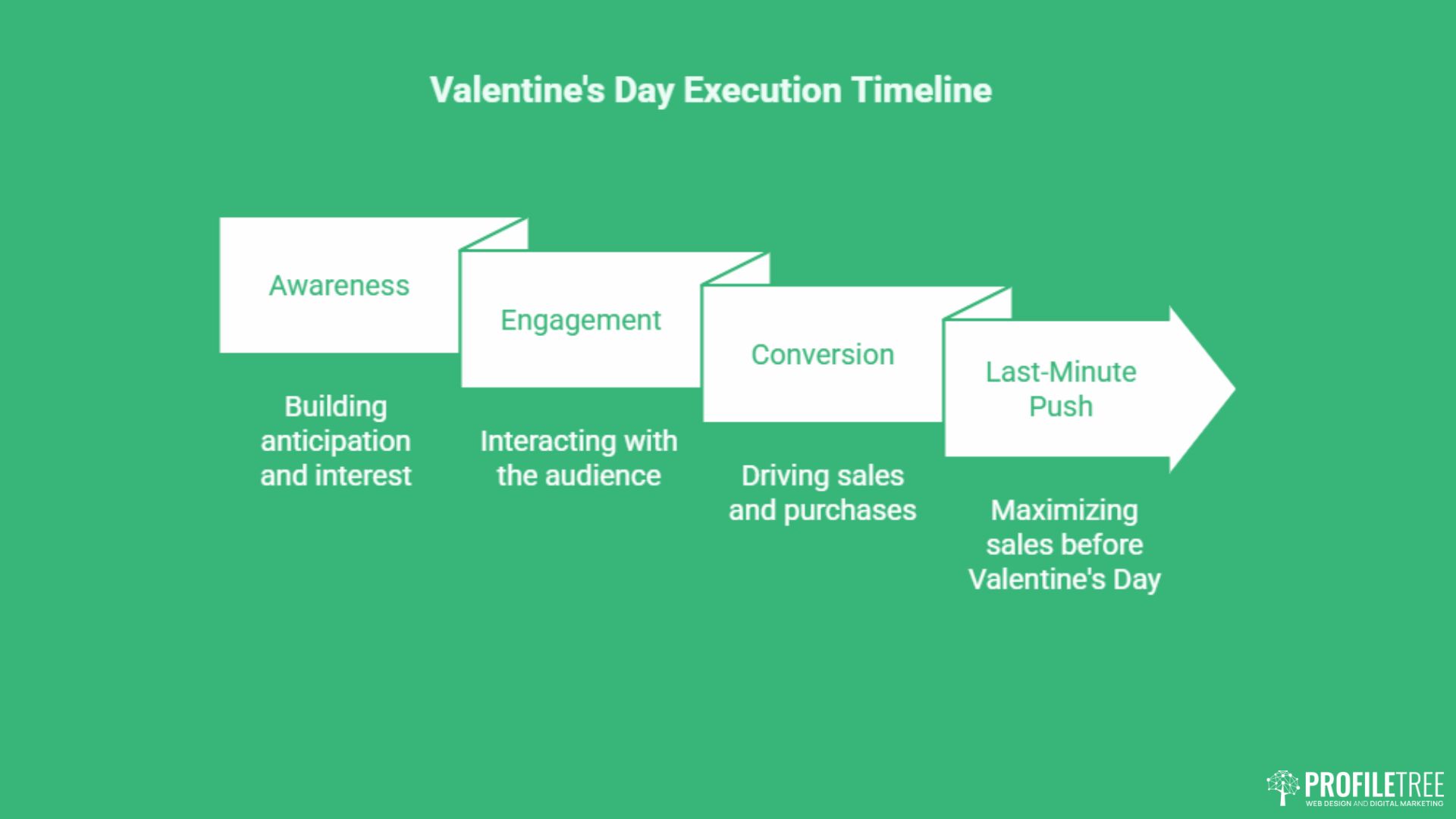
One of the most consistent gaps in Valentine’s marketing is timing. Most businesses either start too late, missing the early consideration phase, or push too hard too early, burning out their audience before the purchasing window opens. A phased approach solves both problems by aligning your activity with how audiences actually move through the buying process.
Phase 1: Awareness (First Two Weeks of January)
This phase is about planting the seed. Valentine’s Day is still several weeks away, so hard-sell messaging will fall flat. Instead, focus on content that builds relevance: gift guides, “what to book early” posts, behind-the-scenes preparation content, and seasonal email list building.
For businesses in hospitality, this is the time to open booking pages and promote early reservations with a small incentive, such as a complimentary glass of wine or a priority table selection. For retailers, it is the time to surface high-consideration products, particularly jewellery and experiences, which people research well in advance. Pair this with your content marketing calendar so awareness content feeds into your wider search strategy.
Phase 2: Engagement (Late January)
By the final week of January, Valentine’s messaging can become more direct without feeling premature. This is the right window for social media contests, UGC (user-generated content) challenges, and email nurture sequences to warm audiences built in Phase 1.
Run a social contest asking followers to share a photo or story related to your product or service using a branded hashtag. Keep entry simple: tag a friend, share a post, or submit a photo. The goal is engagement and reach, not immediate conversion. Contests that require too many steps typically underperform in this phase.
Phase 3: Conversion (1st to 10th February)
This is the primary purchasing window. Audiences are now actively researching and buying. Your messaging should shift from inspiration to action: specific offers, clear calls to action, urgency signals such as “limited availability” or “order by [date] for guaranteed Valentine’s delivery.”
Email should intensify during this window, with personalised sequences based on what subscribers have browsed or purchased previously. Paid social and search activity should peak here. Retargeting audiences who visited product pages but did not convert during Phase 2 is particularly effective in this window. A well-structured digital marketing plan keeps these channels working together rather than in isolation.
Phase 4: Last-Minute Push (11th to 14th February)
The final push should be unapologetically last-minute in tone. Audiences in this phase know they have left things late; messaging that acknowledges this with warmth and a practical solution (same-day delivery, instant digital gift cards, click-and-collect) converts well.
Physical businesses should flag extended opening hours, walk-in availability, and any same-day offerings prominently across all channels. Royal Mail and major courier services typically publish their final guaranteed delivery dates for Valentine’s Day in late January; building those dates into your messaging adds genuine utility that competitors often miss.
Social Media and Video Tactics That Actually Work
Social media is where Valentine’s campaigns gain reach, but the platforms and formats that work best have changed considerably. Short-form video now dominates organic reach on Instagram, TikTok, and YouTube Shorts, while static posts have to work much harder to achieve meaningful distribution. The tactics below are built around what is actually performing in the current platform environment.
TikTok and Instagram Reels: The Short-Form Opportunity
Short-form video is the most efficient organic reach mechanism available to most businesses right now. For Valentine’s Day, the content types that perform consistently well include product demonstrations in a gift context, “what we got up to” behind-the-scenes content, and trend participation, such as “Get Ready With Me” formats where a product or service is naturally woven into the narrative.
The GRWM format is particularly well-suited to beauty, fashion, food, and hospitality brands. A restaurant filming a short “behind the scenes of setting our Valentine’s tables” video, or a clothing brand showing a complete Valentine’s outfit build, captures the organic discovery behaviour that drives TikTok and Reels traffic. For context on TikTok marketing mistakes, the guide covers the common errors that reduce reach before they compound.
User-Generated Content and Hashtag Campaigns
UGC campaigns work well for Valentine’s Day because the occasion naturally prompts people to share. A well-designed UGC campaign gives your audience a reason to create content featuring your brand, then reshares that content to extend reach without additional spend.
Keep the entry mechanic simple. Asking followers to share a photo of a past Valentine’s experience, a gift idea, or a “who would you take?” post with a branded hashtag gives you genuine social proof while reaching the tagged person’s network. The key is to offer something worth participating in: a prize, recognition, or simply a compelling enough prompt that people want to be part of it. Pairing UGC with Instagram Live formats can amplify the reach of your best entries in real time.
Video Marketing: Showcasing the Experience
For hospitality, food, and experience businesses, video is the single most persuasive format for Valentine’s Day because it allows people to picture themselves in the scenario. A well-produced 60-second video of a Valentine’s dinner setting, a couple’s spa experience, or a behind-the-bar cocktail preparation will outperform any static image in converting browsers to bookers.
Video does not have to mean expensive production. Authentic, well-lit phone footage shot in your actual venue or workspace often outperforms polished promotional content on social platforms. What matters is that the video communicates the atmosphere or product clearly and gives the viewer a genuine reason to choose you.
The following video from ProfileTree’s team explores how video marketing works as a commercial tool for businesses looking to build this kind of seasonal content:
Influencer Partnerships for Seasonal Reach
Influencer marketing for Valentine’s Day works best when the partnership feels authentic to the creator’s existing content. A food blogger posting about a restaurant they genuinely enjoy, or a lifestyle creator reviewing a gift they actually received, carries more conversion weight than a scripted promotional post.
For UK businesses, micro-influencers with engaged local audiences often deliver better commercial results than national accounts with high follower counts and lower engagement rates. A Northern Ireland restaurant, for example, is better served by a partnership with a Belfast-based food and lifestyle account than a UK-wide influencer whose audience is spread across the country. For ideas on this approach, the Northern Ireland food influencers resource is a useful starting point.
Email Marketing Sequences for Valentine’s Day
Email remains one of the highest-converting channels for seasonal campaigns, provided the list is segmented properly, and the content goes beyond a standard promotional blast. The brands that see the best results from Valentine’s email marketing are the ones that treat their subscriber list as a collection of individuals with different purchase histories, rather than a single audience to broadcast to.
Subject Lines That Get Opened
Valentine’s Day is one of the most competitive periods for email open rates. Inboxes fill with predictable “treat your Valentine” subject lines, most of which get ignored. Subject lines that stand out typically do one of three things: they acknowledge the reader directly, they introduce an unexpected angle, or they use light humour without being cringey.
Lines that have demonstrated strong open rates in similar campaigns include those addressing the self-gifting angle (“You deserve this more than they do”), the last-minute buyer (“Still need a plan? We’ve got you”), and the Galentine’s audience (“For the friend who always shows up”). What consistently underperforms is generic urgency without personalisation: “Don’t miss our Valentine’s sale” on its own rarely moves the needle. For a broader view of what the data shows about email performance, email statistics by industry provide useful benchmarks.
The Self-Love and Treat-Yourself Angle
As noted in the context section above, self-gifting is a genuine and growing behaviour around Valentine’s Day. An email sequence built around this angle positions your product or service as a personal reward rather than a gift for someone else, which removes the dependency on the recipient having a romantic partner.
This works particularly well for beauty, wellness, fashion, food, and subscription products. The messaging leans into self-appreciation: “You’ve earned this”, “A little something for the most important person in your life”, or similar framings that feel warm rather than saccharine. Pair this with a personalised product recommendation based on past purchase behaviour for the strongest results.
Segmenting by Relationship with the Brand
A Valentine’s email sequence performs significantly better when it distinguishes between three core audience groups. Active customers who have purchased recently should receive loyalty-focused messaging with an early-access offer or exclusive product. Lapsed customers, those who purchased in the past but not recently, respond well to re-engagement framing (“It’s been a while; here’s something worth coming back for”). Cold subscribers who have not engaged in several months are best served with a single high-value piece of content or offer, rather than a full sequence.
Treating all three groups identically wastes the potential of your list and risks increased unsubscribe rates from people who feel they are receiving irrelevant messages. Segmentation does not have to be complex; even a simple split between recent buyers and everyone else will improve performance measurably. If you are building this from scratch, the email marketing resources on the ProfileTree site are a practical starting point.
Timing Your Sequence
A three-email sequence works well for most businesses. Send the first email in late January to build awareness and capture early consideration. Send the second in the first week of February with a specific offer or product focus and a clear call to action. Send the third in the 48 to 72 hours before Valentine’s Day, focused entirely on urgency and last-minute conversion: last-order dates, digital alternatives, or in-store availability.
Avoid sending more than three Valentine’s emails unless your list engagement metrics justify it. Over-mailing during a high-competition period damages deliverability and trains your audience to ignore your messages during future campaigns.
B2B and Service-Based Valentine’s Day Marketing
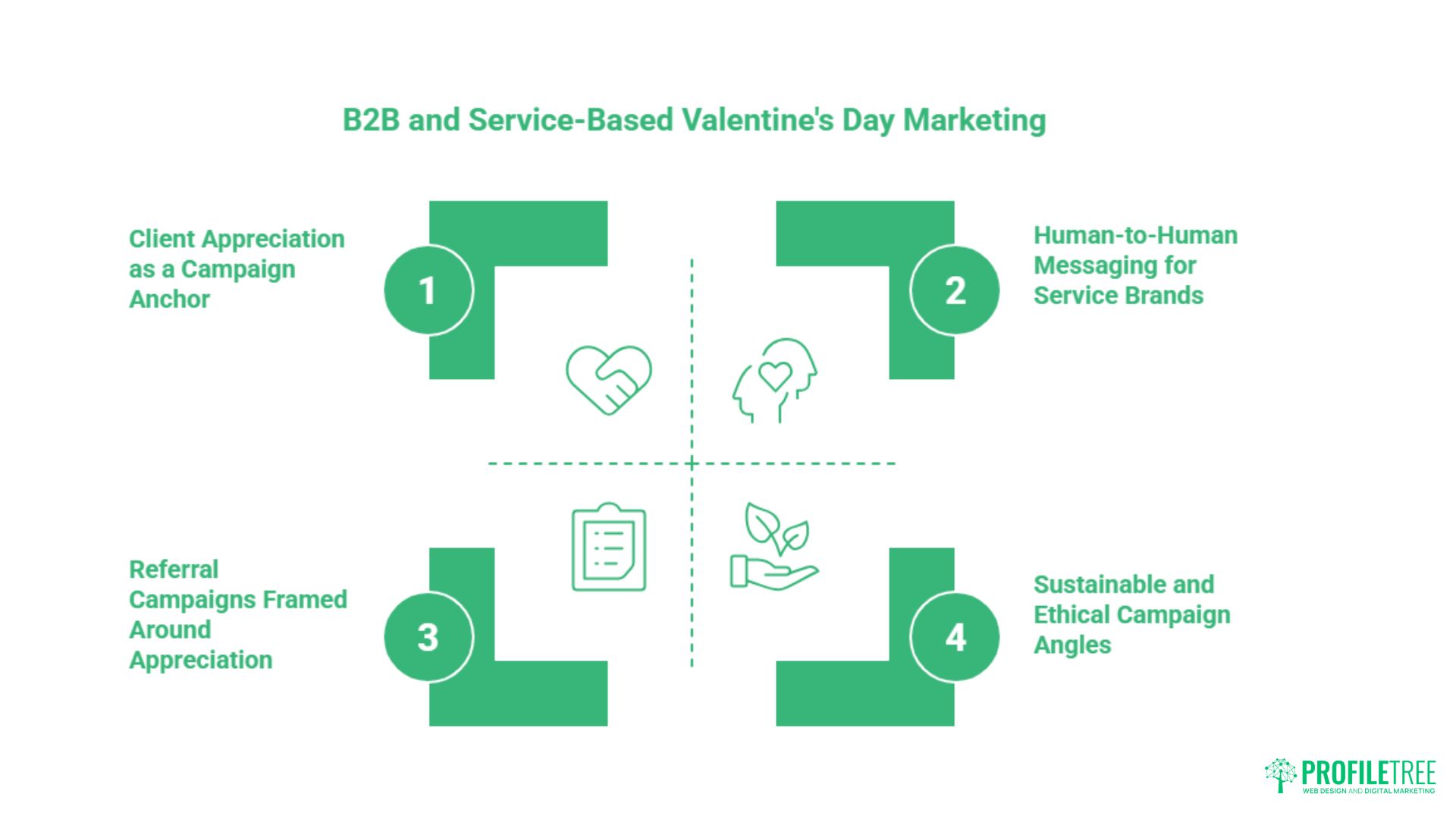
Most Valentine’s Day marketing guides are written with B2C retail in mind, which means the B2B sector is largely ignored despite the genuine opportunity it represents. Professional services firms, SaaS businesses, agencies, and consultancies can all find meaningful ways to use Valentine’s Day as a moment to strengthen client relationships and build brand personality without it feeling forced.
Client Appreciation as a Campaign Anchor
Valentine’s Day gives B2B businesses a socially accepted reason to reach out to clients with something that is not a sales pitch. A well-crafted “thank you for working with us” message, delivered through a personalised email, a small physical gesture, or a social post celebrating client work, builds genuine goodwill that transactional communications rarely achieve.
The framing matters. “We value our clients” is forgettable. “Here’s what we loved about working with you this year, and what we’re excited about for the year ahead” is memorable and positions the relationship as a genuine partnership. Ciaran Connolly, founder of ProfileTree, notes that in digital services, the strongest client relationships are built through consistent communication between projects, not just at project milestones. A Valentine’s touchpoint, handled well, contributes to that consistency.
Referral Campaigns Framed Around Appreciation
Valentine’s Day is an underused occasion for referral marketing in the B2B context. A referral campaign framed as “share the love” or “introduce someone who could benefit” sits naturally alongside the seasonal tone without feeling like a hard sell. The incentive can be modest: a content resource, a complimentary session, or simply an acknowledgement. What matters is the timing and framing.
For professional services businesses, a short email to existing clients in the first week of February, acknowledging the relationship and mentioning that referrals are always appreciated, is a low-cost tactic that consistently delivers results. Pairing this with a well-structured social media strategy that amplifies client success stories extends the reach of that appreciation beyond email.
Human-to-Human Messaging for Service Brands
B2B brands that maintain a strictly corporate tone year-round often see strong engagement when they briefly let their personality show. A LinkedIn post from a founder or senior team member about what they love about their work, their clients, or their industry, published around Valentine’s Day, tends to attract disproportionate engagement because it contrasts with the usual content stream.
This does not mean abandoning professionalism. It means finding one or two moments in the year to communicate as a person rather than as a brand, and Valentine’s Day provides a culturally understood permission structure for exactly that. For service businesses looking to build this kind of brand voice consistently, the brand voice consistency guide covers the practical mechanics of maintaining it across channels.
Sustainable and Ethical Campaign Angles
Eco-conscious gifting is a growing consideration for UK consumers and is particularly relevant for Valentine’s Day, which has historically been associated with single-use packaging, air-freighted flowers, and disposable card products. Brands that address this directly, whether by highlighting their own sustainable packaging, promoting experiences over physical gifts, or supporting a relevant cause for the occasion, tap into a real and growing audience preference.
This angle works for both B2C and B2B contexts. A business that sends a donation to a relevant charity in a client’s name rather than a physical gift makes a memorable impression precisely because it is different. For businesses wanting to explore this within a broader digital marketing approach, it is worth considering how sustainability messaging fits into year-round positioning rather than appearing only at seasonal moments.
Northern Ireland and Ireland-based businesses can also draw on the region’s character as a creative and community-focused place. For a sense of how that geography feeds into brand storytelling, this guide to Northern Ireland’s cities shows how local identity can be a genuine differentiator in any campaign.
Measuring the Success of Your Valentine’s Campaign
Seasonal campaigns are often assessed superficially: a rough sense of whether sales were up or down compared to last year. A more structured approach to measurement allows you to understand which tactics drove results, which did not, and what to do differently next time. Valentine’s Day is a recurring opportunity, so every iteration should be better than the last.
The Key Metrics to Track by Channel
For email, the primary metrics are open rate, click-through rate, and conversion rate (purchases or bookings attributed to the email sequence). Track these by segment rather than for the campaign as a whole; knowing that your lapsed-customer re-engagement email had a 6% conversion rate while your active-customer sequence had a 14% rate tells you far more than an aggregate figure.
For social media, look beyond likes and comments to reach, saves, and link clicks. Saves on Instagram are a particularly strong signal for content that is genuinely useful, such as gift guides or timing advice. For paid campaigns, cost per acquisition is the headline metric, but tracking which creative formats and audience segments drove the lowest cost per conversion gives you the insight to reinvest more effectively next year.
Attribution in a Multi-Channel Campaign
Valentine’s Day campaigns typically touch a customer across multiple channels before a purchase: a social ad creates awareness, an email drives consideration, and a retargeting ad delivers the final conversion push. Last-click attribution, which credits the final touchpoint entirely, understates the value of awareness and mid-funnel activity.
For most small and medium businesses, a simple approach works: track the channel where the final conversion happened, but also note the volume of sessions driven by each channel during the campaign window. A channel that drove significant traffic but few direct conversions may still have played a meaningful role in the purchase journey. Building this habit across campaigns, not just Valentine’s Day, improves your overall understanding of how your channels interact. A professional digital strategy built around these signals will serve you well beyond the seasonal peaks.
Post-Campaign Review: What to Log for Next Year
A post-campaign review does not have to be complex. Recording four things is enough to make next year’s campaign meaningfully better: what your best-performing creative or subject line was, which audience segment responded most strongly, when your conversion peak occurred, and what you would do earlier or later in the timeline. These notes take 30 minutes to compile, but compound in value every year they are applied.
Teams using digital training programmes to build internal capability get the most from this kind of structured review, because the learning feeds directly into ongoing practice rather than sitting in a report that no one reads again.
Conclusion
A well-executed Valentine’s Day campaign requires more than a themed post and a promotional email. It requires an understanding of when your audience is ready to act, which channels carry the most weight for your specific business, and how to measure what worked. Start with the timeline, choose the two or three tactics that fit your resources, and build from there. To discuss how ProfileTree can support your seasonal marketing strategy, get in touch with our team.
FAQs
How early should I start Valentine’s Day marketing?
The most effective approach uses a four-phase structure. Begin with awareness content in the first two weeks of January, move to engagement activities in the final week of January, shift to direct-conversion messaging from 1st to 10th February, and run a last-minute push in the final 72 hours before the 14th. Starting the hard sell in mid-to-late January is too late to capture early consideration, particularly for high-value purchases like jewellery, experiences, and restaurant bookings that people research well in advance.
Is Valentine’s Day marketing relevant for B2B businesses?
Yes, though the approach differs from B2C. B2B businesses benefit most from using Valentine’s Day as a client appreciation moment rather than a sales push. A personalised “thank you for working with us” message, a referral campaign framed around relationship value, or a social post that shows brand personality can all build goodwill and strengthen client relationships. The key is framing the communication around the relationship rather than the product or service.
What are the best Valentine’s Day subject lines for email marketing?
Subject lines that stand out acknowledge the reader directly or take an unexpected angle. Strong examples include self-gifting framings (“You deserve this more than they do”), last-minute buyer acknowledgements (“Still need a plan? We’ve got you”), and friend-focused lines for the Galentine’s audience (“For the friend who always shows up”). Generic urgency without personalisation, such as “Don’t miss our Valentine’s sale,” consistently underperforms.
What is Galentine’s Day, and should I include it in my campaign?
Galentine’s Day is observed on 13 February and celebrates female friendship, originating from a TV reference but now a genuine commercial occasion in the UK. It is particularly relevant for beauty, food, drink, spa, and lifestyle brands whose audiences skew female. Including Galentine’s in your campaign broadens your reach beyond romantic couples and addresses the “I don’t have a Valentine” segment in an inclusive and positive way.
How can small businesses compete with big brands on Valentine’s Day?
Small businesses have genuine advantages at Valentine’s Day: local relevance, personal service, and the ability to offer genuinely bespoke experiences that large retailers cannot match. Leaning into local identity (a Belfast restaurant promoting an exclusive set menu, a Northern Ireland maker offering personalised products) differentiates your offering from generic national campaigns.