
Organic Social Media Growth Hacks for UK Businesses
Table of Contents
Social media growth has become harder, not easier. Algorithmic reach has contracted across every major platform, feeds are filling with AI-generated content, and audiences are quicker than ever to scroll past anything that feels generic. The businesses seeing real follower growth in 2026 are not spending more on paid ads; they are being smarter about organic strategy.
This guide covers 17 practical organic social media growth hacks that work for UK and Irish SMEs. Each one is platform-specific, audience-first, and designed to build a following that actually engages with your brand. From Instagram’s evolving features to LinkedIn’s B2B authority model, there is a tactic here for every business type.
Whether you are starting from scratch or trying to revive a stagnant account, the strategies below provide a clear, structured path to sustainable growth without a paid advertising budget.
Why Organic Social Media Growth Has Changed in 2026
The social media landscape of 2026 is meaningfully different from even two years ago. Understanding what has shifted is essential before applying any tactic, because strategies that worked in 2023 can actively hurt you now.
The Shift from Viral Reach to Community Depth
Platform algorithms have moved decisively away from rewarding broad viral content and towards surfacing posts that generate meaningful interaction within defined communities. Instagram’s 2025 ranking updates explicitly prioritised “sends” (direct message shares) over likes, treating a DM share as evidence that content genuinely resonated with someone. TikTok’s For You Page has similarly evolved to factor in repeat viewers and profile visits rather than pure watch time.
For UK SMEs, this is actually good news. You do not need a national audience to win on social media. A Belfast-based accountancy firm with 800 engaged local followers will consistently outperform a brand with 15,000 passive ones when it comes to generating enquiries, referrals, and search signals.
AI Content Saturation and the Authenticity Advantage
The volume of AI-generated social content has increased sharply since 2024. Audiences are not necessarily able to identify AI writing by reading it, but they are responding to the feeling that something is generic, and they are scrolling past it faster. Research from the Reuters Institute (2024) found that trust in social content from brands has declined year-on-year, with audiences placing higher value on posts that demonstrate genuine knowledge, behind-the-scenes access, or real opinion.
This creates a clear opening for smaller UK businesses. The human context you can provide, your team, your local knowledge, and your real client stories, is exactly what the platforms’ algorithms are now rewarding and what AI-scaled content cannot replicate.
Social SEO as a Discovery Channel
TikTok overtook Google as a search destination for users aged 18 to 34 for certain query types as far back as 2022, and that trend has only strengthened. Instagram’s search functionality now processes keyword queries in captions and alt text, not just hashtags. LinkedIn’s algorithm increasingly surfaces posts to users based on topic relevance rather than connection proximity alone.
This means that optimising your social content for search, not just reach, has become a legitimate growth channel. Understanding how search intent works is no longer just an SEO consideration; it applies directly to organic social strategy, too.
The GDPR Context for UK and Irish Businesses
UK businesses operating under UK GDPR and Irish businesses under EU GDPR face specific constraints when moving social followers to owned channels like email lists. Any mechanism that collects personal data from followers, a competition entry form, a gated resource, or a DM auto-responder that captures email addresses requires a lawful basis under data protection law. This is a professional distinction that most US-produced guides ignore entirely. Build your community on-platform first; migrate data to owned channels only with proper consent flows in place.
Platform-Specific Organic Growth Hacks
Generic advice about “posting consistently” and “engaging with your audience” is not enough. Each platform rewards different behaviour, and the most effective growth hacks are tailored to how each algorithm actually works in 2026.
Instagram: Notes, Close Friends, and Broadcast Channels
Instagram Reels remain the highest-reach content format on the platform, but the space is saturated. The underutilised growth tools are the newer features that most brands have not yet adopted at scale.
Instagram Notes (short 60-character status updates visible in the DM tab) generate disproportionate visibility because they appear directly in the messaging inbox rather than the feed. Using them for questions, polls, or time-sensitive prompts creates conversation that the algorithm registers as meaningful engagement. Broadcast Channels, introduced in 2023 and now widely available, allow brands to build a direct-subscribe audience outside the feed entirely, closer to a newsletter than a social post.
For product-based businesses, Instagram’s native shopping tags integrated into Reels and carousels continue to convert well for UK audiences. The key is ensuring your profile bio includes keyword-rich text, not just a tagline. Terms like “Belfast wedding florist” or “Manchester personal trainer” improve discoverability in Instagram search. ProfileTree’s breakdown of Instagram Reels for brands for a deeper dive into format strategy.
TikTok: The SEO-First Approach to the For You Page
TikTok’s search behaviour has fundamentally changed how the For You Page distributes content. Posts that contain spoken keywords (picked up via TikTok’s auto-captions) and typed keywords in captions are indexed by TikTok’s internal search engine, meaning your video can surface to someone who searches a term days or weeks after you post it.
The practical hack here is to treat your TikTok captions like short-form SEO copy. Open with a keyword-rich sentence (“Here’s how Belfast SMEs are using video to generate leads in 2026”), speak that keyword aloud in your first five seconds, and include two or three relevant hashtags that function as topic tags rather than trend-chasing. ProfileTree’s analysis of TikTok usage in the UK for platform-specific benchmarks that inform this approach.
For businesses uncertain whether TikTok fits their brand, the answer for most UK SMEs is yes, provided the content shows genuine knowledge or personality. A construction company explaining planning permission in plain English, a solicitor debunking legal myths, or a restaurant owner doing a weekly supplier visit will consistently outperform polished brand content on this platform. Avoid the common pitfalls covered in our guide to TikTok marketing mistakes.
LinkedIn: Authority Building for UK B2B Professionals
LinkedIn organic reach for company pages has declined, but personal profile reach remains strong. The most effective B2B organic growth strategy on LinkedIn in 2026 involves employee advocacy, getting team members to post from their personal profiles on topics connected to the business, rather than relying on the company page alone.
Text-only LinkedIn posts continue to reach more people than link posts, because the algorithm deprioritises content that takes users off the platform. The format that works best is a short personal insight (four to eight sentences), a clear professional observation or data point, and one question that invites responses. Industry-specific positioning matters: a LinkedIn post from a Northern Ireland-based agency commenting on a recent UK Government digital strategy will reach a far more relevant audience than a generic “five tips for better marketing” post. ProfileTree’s overview of LinkedIn for UK businesses covers this in more detail.
For B2B businesses, combining personal profile posting with a company page that acts as a credibility anchor (showcasing case studies, client testimonials, and service details) creates a dual presence that builds both reach and trust.
X (Twitter) and Threads: Text-Based Conversational Growth
X has fragmented as a platform, but for businesses in media, tech, professional services, and public affairs, it retains a specific audience that is difficult to reach elsewhere. The growth hack on X is thread-based content: a series of connected posts on a single topic that allows depth without character-count constraints.
Threads (Meta’s equivalent) have seen accelerating user growth in the UK and offer higher organic reach at this stage of the platform’s maturity; earlier-stage platforms consistently reward early adopters with better distribution. Build your engagement habits using the approach outlined in our guide to building engagement on X.
The Human-First Framework: Standing Out Against AI Content
The single biggest opportunity in organic social media growth right now is the gap between AI-generated content and genuinely human content. Most brands have not yet worked out how to close it, and the ones that do are seeing outsized growth as a result.
Why Authenticity Is the Actual Growth Hack
The Reuters Institute Digital News Report 2024 found that audiences are increasingly using social media for entertainment and personal connection rather than news consumption, and they are actively avoiding content that feels corporate or automated. This is not a soft cultural observation; it has measurable platform consequences. Posts that generate saves and DM shares (the highest-weight engagement signals on Instagram and TikTok) are almost always posts that feel personal, specific, or surprising.
For a UK SME, “authentic content” does not mean poorly produced content. It means content where the human behind it is visible: their opinion, their expertise, their local knowledge, or their candid account of something that went wrong and how it was resolved. A well-lit, clearly recorded video of a business owner explaining why they made a decision will outperform a polished brand video in organic reach on almost every platform in 2026.
Showing the Work, Not Just the Outcome
Behind-the-scenes content consistently generates stronger organic engagement than finished-product posts. The reason is practical: platform algorithms register how long someone watches a video or reads a carousel, and process content that creates curiosity, which tends to hold attention longer than content that simply presents a result.
For a web design agency, this might mean posting the wireframe stage of a project before the finished site. For a food business, it might be the sourcing trip rather than the plated dish. For a professional service, it might be explaining the reasoning behind a recommendation rather than just stating the outcome. This approach also positions your team as knowledgeable, which directly supports the content marketing strategy that underpins long-term brand authority.
User-Generated Content as a Trust Signal
User-generated content (UGC), posts from customers featuring your product or service, functions as social proof that no brand-produced content can replicate. The growth mechanic here is deliberate: make it easy and desirable for customers to create content about you. This means creating physical or digital moments worth photographing, asking for reviews in a way that connects naturally to the experience, and resharing customer content promptly and visibly.
For Northern Irish and Irish businesses specifically, tagging local landmarks, communities, or cultural references in UGC reshares builds local relevance signals that boost discoverability within regional audiences. Resources like Connolly Cove’s guide to Northern Ireland’s top cities illustrate how strong local content builds audience connection; the same principle applies directly to social media posts rooted in place and community.
Ciaran Connolly, founder of Belfast digital agency ProfileTree, notes that the businesses building the strongest social media followings in 2026 are not the ones with the biggest budgets; they are the ones willing to show their process, share their perspective, and speak directly to a specific audience rather than trying to appeal to everyone.
The UK and Ireland Context: Timing, Culture, and Local SEO
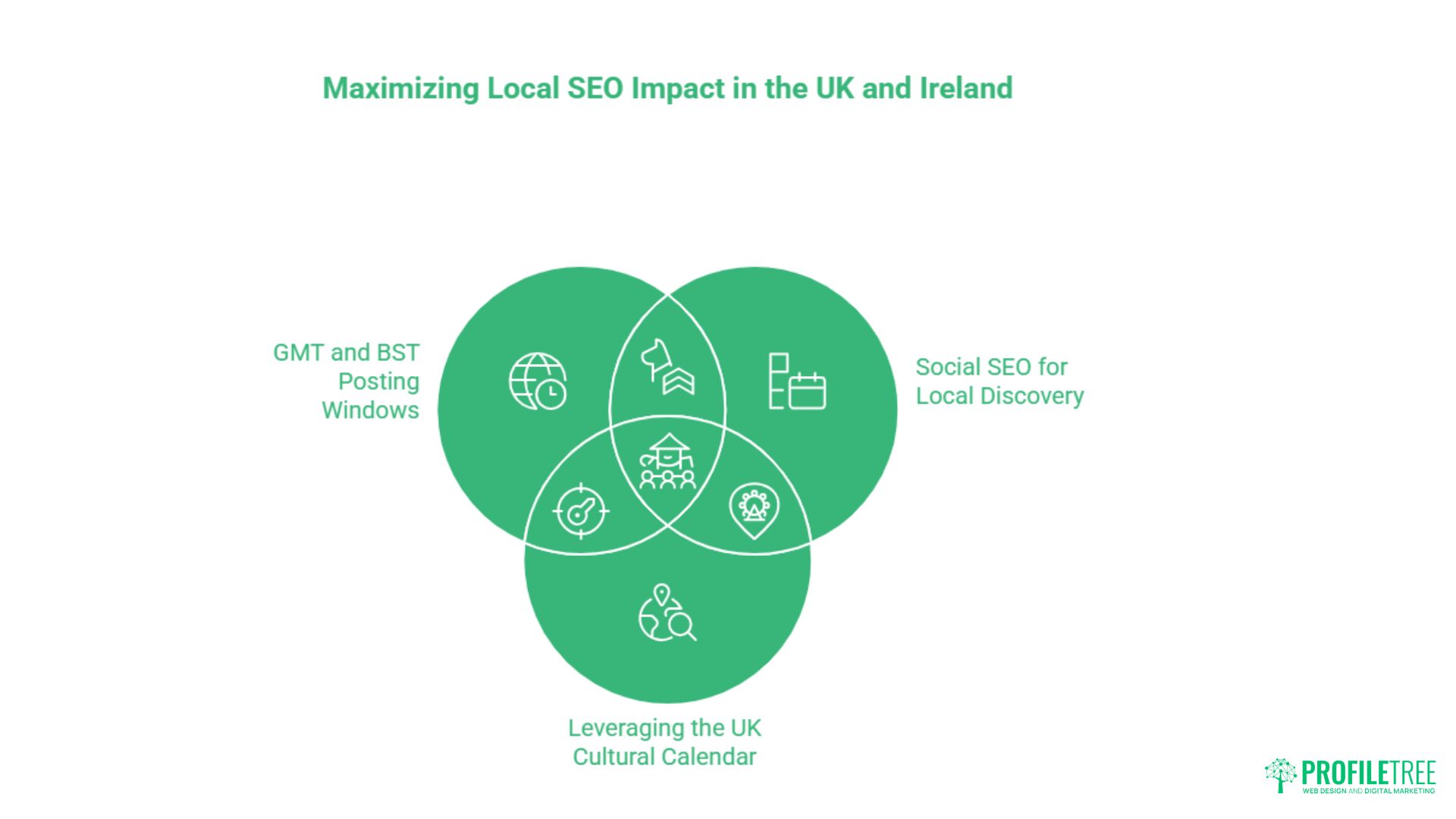
The majority of organic social media guides are written for a US audience and use EST posting times, US cultural references, and US platform usage data. For UK and Irish businesses, this leads to posting at the wrong times and missing the cultural moments that actually resonate with local audiences.
GMT and BST Posting Windows
UK social media peak usage clusters around three windows: 7–9 am (commute and pre-work), 121 pmm (lunch), and 10 pmpm (evening). For B2C businesses, Sunday evenings 9 pm9pm GMT/BST) consistently show high engagement rates across Instagram and TikTok for UK audiences, because users are in a browsing rather than a doing mindset. For B2B content on LinkedIn, Tuesday to Thursday between 8 am and 10 am captures decision-makers before their day fills up.
These windows shift by an hour during British Summer Time (late March to late October), and it is worth updating your scheduling tools accordingly at each clock change. Most scheduling platforms default to UTC rather than BST, which causes posts to go out an hour late during summer months, a small but correctable mistake that affects your reach.
Leveraging the UK Cultural Calendar
UK-specific cultural events represent consistently underutilised organic growth opportunities. The Six Nations, Bank Holidays (which differ between England, Scotland, and Northern Ireland), the January sales cycle, and events like the Chelsea Flower Show or the Edinburgh Festival generate significant social media activity with high geographic specificity, meaning content that references them reaches a locally relevant audience without paid targeting.
The approach is not about jumping on every trending topic, but about identifying the three or four annual events most relevant to your specific audience and creating content that connects them to your service or product in a way that adds genuine value. A Northern Ireland-based business has access to unique local events and contexts, such as the Titanic Belfast anniversary, the Derry Halloween festival, or the Galway Races, for Irish-market businesses, that create differentiation from generic UK content. Understanding how social media supports destination marketing illustrates how localised content builds distinct audience segments.
Social SEO for Local Discovery
Adding location-specific keywords to social media bios, captions, and alt text improves discoverability in platform search for people in your area. Instagram, TikTok, and LinkedIn all index this text. A Belfast-based accountancy firm that includes “Belfast accountants” and “Northern Ireland tax advice” in its LinkedIn company description and post captions will surface more reliably to local searchers than a firm with a generic profile.
This is the social equivalent of local SEO, and it requires the same discipline: consistent naming, accurate location tagging, and keyword use that reflects how your actual customers search. Our social media marketing services include local optimisation as a core component for this reason. The technical SEO principles that underpin discoverability apply directly here, and businesses with a joined-up approach to digital strategy typically see faster results.
Technical Optimisation, Measurement, and Long-Term Growth
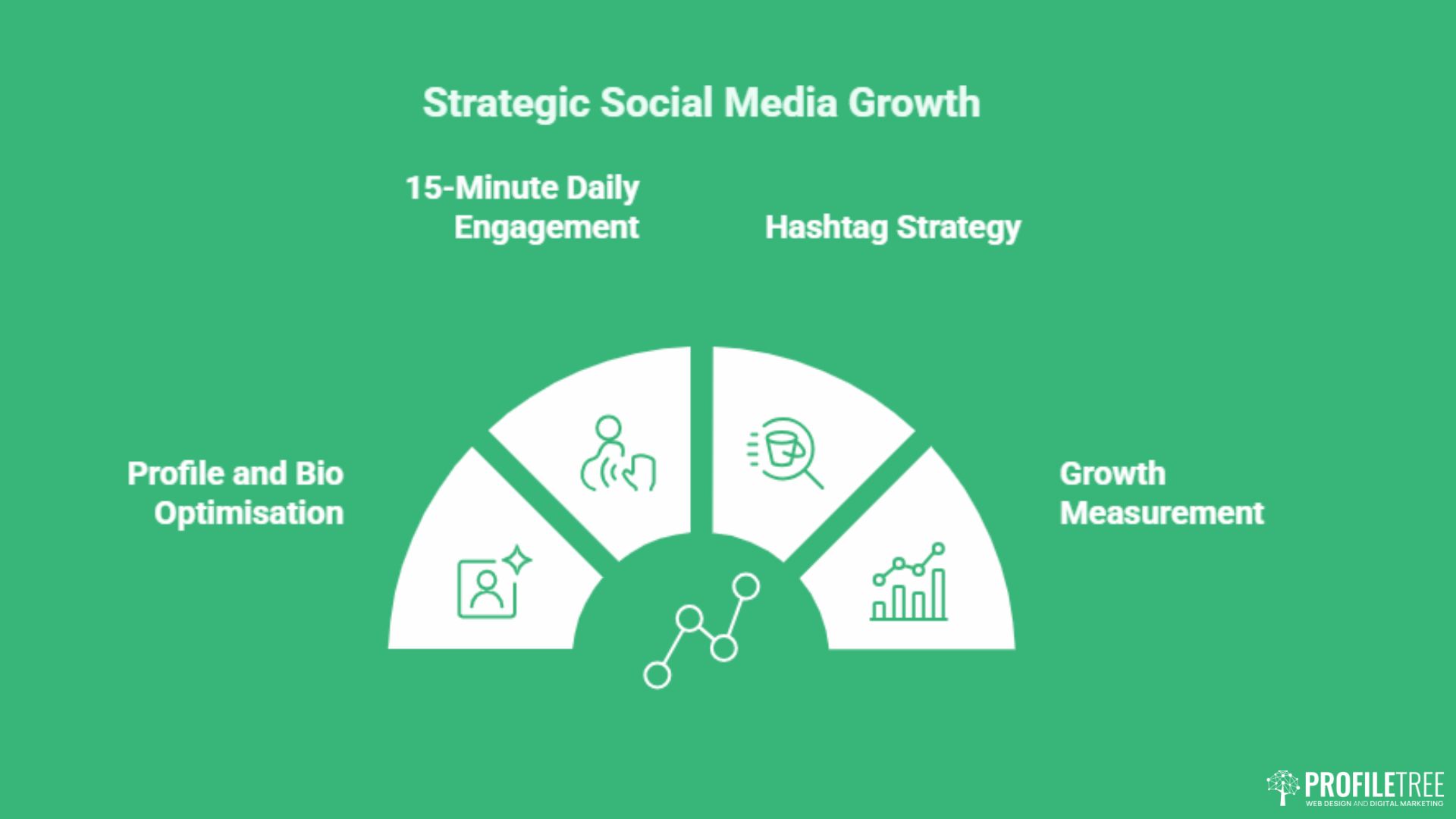
An organic growth strategy without measurement is guesswork. The platforms provide enough native analytics data to inform meaningful decisions, but only if you know what to track and how to act on what you find.
Profile and Bio Optimisation
Your social media profile is the most-crawled element of your social presence, both by platform search engines and by external crawlers. On Instagram, the name field (not the username) is indexed for search. Put your most important keyword there, not just your brand name. On LinkedIn, the company tagline and “About” section are indexed; fill both with specific, keyword-relevant copy rather than a brand statement. On TikTok, your bio text and any links are indexed.
Profile photos and cover images should be consistent across platforms and recognisable at small sizes. For personal brand accounts, a clear headshot outperforms a logo every time, as it signals a human behind the content, which is an increasingly important trust factor. If your broader digital presence needs coherence, the foundations are covered in our guide to brand voice consistency.
The 15-Minute Daily Engagement Habit
Posting content and logging off is one of the most common organic growth mistakes. Platform algorithms reward accounts that engage actively on the platform, not just those that publish. A structured 15-minute daily engagement routine, responding to every comment within 24 hours, leaving substantive replies on five to ten posts in your niche, and responding to stories from accounts you follow, signals to the algorithm that your account is actively participating in the community it is trying to reach.
For small business owners who manage their own social media, this is the single most time-efficient growth activity available. A genuine, specific reply to a relevant post in your industry will reach more of the right people than a scheduled post sent to your existing audience. The principles behind community-driven social media apply directly here.
Hashtags as Topic Tags, Not Trend Vehicles
Hashtag strategy has shifted. On Instagram, three to five highly specific hashtags now outperform twenty broad ones; the algorithm uses them to categorise content by topic rather than to distribute it to hashtag followers. On TikTok, hashtags function as search keywords. On LinkedIn, two to three industry-specific hashtags remain useful for topic distribution but have limited direct reach and impact.
The practical approach is to build a small, stable library of hashtags specific to your industry and location, and use them consistently rather than chasing trending tags. A Belfast-based interior designer should be using tags like #BelfastInteriors and #NorthernIrelandHomes consistently, building topical authority in those specific search categories over time. Pair this with an understanding of free social media analytics tools to track which hashtag clusters are actually driving profile visits.
Measuring Growth That Actually Matters
Follower count is a vanity metric. The numbers that actually indicate whether your organic strategy is working are: profile visits (are people curious enough to click through after seeing your post?), saves and shares (are people finding your content valuable enough to revisit or pass on?), and website clicks or link taps (is your social presence generating commercial intent?). Most platform analytics dashboards now surface these figures without requiring third-party tools.
Set a monthly review cadence. Compare the same metrics month-on-month rather than week-on-week, as weekly fluctuations are too noisy to inform strategy. If profile visits are rising but website clicks are flat, the issue is likely in your bio or your calls to action. If shares are high but follower growth is slow, you are reaching the right people but not giving them a compelling reason to follow. Both are diagnosable problems with specific solutions; neither requires more content, just smarter content.
If you need support building a measurement framework that connects social performance to commercial outcomes, our digital marketing services team works with UK and Irish SMEs on exactly this.
Conclusion
Organic social media growth in 2026 rewards specificity, consistency, and genuine human presence, not volume or polish. UK businesses have a structural advantage in local knowledge, authentic voice, and the ability to serve niche audiences that global SaaS brands cannot reach. Apply the platform-specific tactics in this guide, build your engagement habits, and measure what actually matters. For tailored support with your social media strategy, speak to the ProfileTree team.
FAQs
How can I grow my social media followers organically now?
Focus on three fundamentals: consistent posting in formats the platform currently rewards (short-form video on Instagram and TikTok, text posts on LinkedIn), daily engagement with your niche community, and Social SEO, using keyword-rich copy in bios, captions, and alt text so your content surfaces in platform search. Follower growth follows from visibility, and visibility in 2026 comes from topic-specific relevance rather than broad reach.
Is organic social media growth still possible?
Yes, but the definition of “growth” has shifted. Organic reach for individual posts has declined on most platforms, but organic discoverability through search and community engagement has increased. Businesses with niche, well-defined audiences consistently achieve better organic results than those targeting broad demographics, because the algorithms are explicitly optimised to serve specific communities.
What is the fastest way to get 1,000 followers for free?
The most reliable free route to 1,000 genuine followers is the engagement-first approach: spend 15 minutes per day leaving substantive comments on posts in your niche, create one piece of genuinely useful content per week, and optimise your profile for keyword search. Avoid “follow-for-follow” schemes and engagement pods; both inflate follower counts with non-relevant accounts, which suppresses your algorithmic reach and makes every subsequent post perform worse.
Do hashtags still work for organic reach?
Hashtags still work, but they function differently now. On Instagram and TikTok, they are primarily topic-classification signals rather than distribution mechanisms; they tell the algorithm what your content is about, which determines who it surfaces to. Use three to five highly specific, niche hashtags rather than twenty broad ones. On LinkedIn, two to three industry tags remain useful for topic reach. On X, hashtags in trending topics can still generate short-term visibility bursts.
How often should I post for organic growth on UK social media?
Quality and consistency outrank frequency. For most UK SMEs managing their own accounts, three to four posts per week on one or two primary platforms will outperform daily posting across five platforms. Posting at the right time for UK audiences matters: 7–9 am and 7–10 pm GMT/BST for B2C content, Tuesday to Thursday mornings for B2B LinkedIn content. Use a simple content calendar to plan at least two weeks, which prevents the reactive posting that tends to be lower quality.