
Mobile Marketing: Strategy, Channels and UK Compliance
Mobile marketing is the practice of reaching consumers through their smartphones and tablets, using channels that range from SMS and push notifications to in-app advertising and location-based promotions. It is not a subset of digital marketing; it is where most digital engagement now actually happens. In the UK, Ofcom data consistently shows that adults spend more time on their mobile devices than on any other screen, and that share is still growing.
For SMEs across Northern Ireland and the rest of the UK, mobile is no longer a secondary consideration. It is the primary channel through which customers find, research, and purchase. This guide covers the core channels, the compliance landscape that UK marketers must navigate, and how to build a mobile strategy that works within the constraints of modern privacy regulation.
Table of Contents
What is Mobile Marketing?
Mobile marketing is any marketing activity that reaches people on a mobile device. That includes channels you own (your website, your app, your SMS list), channels you pay for (mobile display ads, in-app advertising, social media ads served on mobile), and channels that operate in real time based on a user’s location or behaviour.
The distinction from broader digital marketing matters because mobile introduces constraints that desktop does not: smaller screens, touch-based navigation, interrupted attention patterns, and stricter privacy controls at the operating system level. Marketers who treat mobile as a scaled-down version of desktop typically see lower engagement and higher bounce rates. The channel requires its own thinking.
Mobile marketing differs from mobile advertising in scope. Advertising is the paid placement element. Marketing encompasses the full set of activities, including organic content, SMS campaigns, push notifications, and customer experience design.
Mobile Marketing vs Digital Marketing: Understanding the Nuance
Digital marketing covers all online channels: search, email, social, display, video, and mobile. Mobile marketing is a discipline within that, but one that increasingly overlaps with almost everything else. More than 60% of Google searches now originate from mobile devices, which means your SEO, paid search, and content strategy are already mobile strategies, whether you have planned them that way or not.
The practical difference shows up in execution. A digital marketing strategy that ignores mobile-specific UX, loading speed, and thumb-friendly design will underperform even if the targeting and messaging are well-constructed. Mobile marketing thinking asks: how does this experience feel on a 6-inch screen, on a 4G connection, in a moment of interrupted attention?
The Strategic Importance of Mobile in the UK Market
UK smartphone penetration sits above 90% of the adult population, and mobile accounts for the majority of time spent online across all age groups. Ofcom’s annual Communications Market Report documents this consistently, and the trend has continued to shift toward mobile-first behaviour year on year.
For SMEs, this has a direct commercial implication. A potential customer searching for a local service, reading a review, or clicking a social media ad is overwhelmingly likely to be doing so on their phone. If your website loads slowly on mobile, your checkout process requires pinch-and-zoom, or your email templates break on small screens, you are losing customers at the point of highest intent.
Why Mobile-First Matters for SME Growth
The mobile-first approach is not about building a separate mobile experience. It means designing everything, from your website structure to your email layouts to your advertising creative, with the mobile experience as the primary consideration. Protecting user data and building trust with mobile users is now intertwined with this design thinking, because UK consumers are increasingly aware of how their data is used.
“The businesses we see gaining ground in mobile aren’t necessarily spending more,” says Ciaran Connolly, founder of ProfileTree. “They’re being more deliberate about the moment they’re trying to reach people in. Mobile demands precision in both targeting and timing.”
Core Types of Mobile Marketing
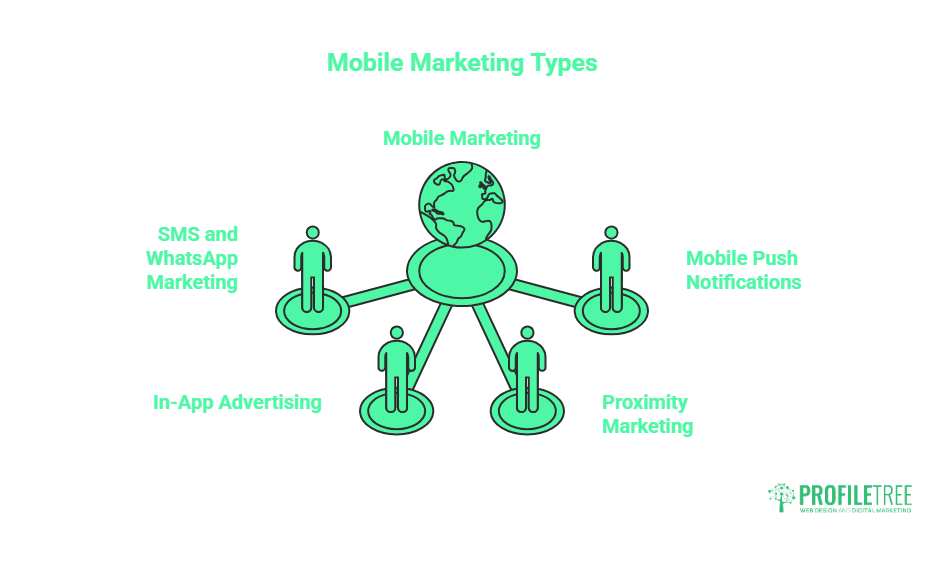
Mobile marketing spans several distinct channels, each with different reach, cost structures, and regulatory requirements. Understanding which channels fit your audience and your compliance obligations is the starting point for any practical strategy.
SMS and WhatsApp Marketing
SMS remains one of the highest-engagement channels available. Open rates for SMS marketing campaigns consistently run significantly higher than email, and delivery is near-instant. For time-sensitive promotions, appointment reminders, and transactional messages, it remains difficult to beat.
WhatsApp Business is growing in relevance for UK SMEs. The platform’s penetration in the UK is substantially higher than in the US market, which is why many American mobile marketing guides underweight it.
The WhatsApp Business API allows businesses to send templated messages to opted-in customers, handle customer service conversations, and send product updates. WhatsApp Business features have expanded considerably, making it a viable channel for businesses that have traditionally relied on email alone.
Both SMS and WhatsApp require explicit consent under UK regulation. The rules are covered in detail in the compliance section below.
In-App Advertising and Mobile Web
In-app advertising places your message inside third-party applications. Formats include banner ads, interstitials, rewarded video, and native placements within social media feeds. Targeting is based on device identifiers, behavioural data, and contextual signals, though the availability of that data has changed significantly since Apple introduced App Tracking Transparency (ATT) in 2021.
Mobile web advertising operates through the same programmatic and social channels as desktop, but creatives must be built for vertical scrolling and thumb interaction. Considering how to use email alongside mobile web touchpoints is worth factoring into your attribution planning, since users frequently move between channels before converting.
Proximity Marketing: QR Codes, NFC, and Geofencing
Proximity marketing delivers messages based on a user’s physical location. QR codes experienced a significant resurgence during the pandemic and have since stabilised as a genuine consumer behaviour rather than a novelty. They work well for bridging physical and digital touchpoints: a poster, a product label, or a business card can link directly to a specific landing page or offer.
Geofencing creates a virtual boundary around a physical location and triggers a push notification or ad when a user enters that area. It is used by retailers, venues, and local service businesses to reach customers who are physically proximate. Local festival and events marketing demonstrates how proximity-based approaches can be adapted for community contexts, and the same principles apply to high-street retail in Belfast and beyond.
NFC (Near Field Communication) is used in contactless payment and, increasingly, in smart packaging and physical-to-digital experiences.
Mobile Push Notifications
Push notifications are messages sent from an app or browser to a user’s device. They appear on the lock screen or notification tray and do not require the user to be actively using the app. When used well, they drive re-engagement and time-sensitive conversions. When overused, they generate uninstalls.
An effective push notification strategy requires segmentation. A blanket broadcast to your entire subscriber list will underperform compared to a triggered notification sent to users who have taken a specific action or who match a defined behavioural profile. AI in e-commerce conversion is increasingly relevant here, as machine learning tools now automate send-time optimisation and personalisation at the individual level.
Navigating UK Privacy and Compliance: GDPR and PECR
This is where most mobile marketing guides, particularly those produced for US audiences, fall short. UK marketers are not operating under the same regulatory environment as their American counterparts, and the penalties for getting it wrong are material.
What PECR Means for SMS and Push Marketing
The Privacy and Electronic Communications Regulations (PECR) govern direct electronic marketing in the UK. They sit alongside UK GDPR and, for SMS and email marketing, they are often the more immediately relevant piece of legislation.
Under PECR, you cannot send a direct marketing text message to an individual unless they have given specific, informed consent to receive marketing from your organisation. The “soft opt-in” exception applies only to existing customers, and only for similar products or services to those they have previously purchased. It does not apply to prospecting lists, purchased data, or new contacts.
The Information Commissioner’s Office (ICO) enforces PECR and has issued fines for SMS marketing sent without proper consent. The GDPR training essentials that apply to your wider data practices apply here too, but PECR adds an additional consent layer specific to electronic direct marketing.
Location Data and the Consent Requirement
Collecting and processing location data for geofencing or proximity marketing requires a lawful basis under UK GDPR. Consent is the most appropriate basis for location tracking in a marketing context, and it must be granular: a user who consents to receive notifications has not necessarily consented to have their precise location tracked over time.
Building GDPR-compliant web forms is a starting point, but your mobile opt-in flows need the same level of care. The consent record must be stored, and the user must be able to withdraw it as easily as they gave it.
The Privacy Shift: Marketing After Apple’s ATT and Google’s Privacy Sandbox
Apple’s App Tracking Transparency framework, introduced in 2021, requires iOS apps to ask users for permission before tracking them across other apps and websites. The majority of users opt out. This broke the attribution models that mobile advertisers had relied on for a decade, and the industry is still adjusting.
What the Post-IDFA World Means in Practice
The IDFA (Identifier for Advertisers) was the device-level identifier that enabled cross-app tracking on iOS. With most users declining tracking, advertisers now receive aggregated and modelled data rather than deterministic user-level attribution. This means you know approximately what is working, not precisely which users converted.
Google’s Privacy Sandbox is moving in the same direction for Android, replacing individual tracking with cohort-based signals. The practical result is that last-click attribution models are becoming unreliable, and marketers who have not invested in AI content and analytics capabilities will find it harder to optimise campaigns with confidence.
Zero-Party Data as the Strategic Response
Zero-party data is information a customer actively and intentionally shares with a brand: survey responses, preference centre choices, quiz results, and declared interests. It requires no inference, no tracking, and no third-party relationship. It is, by definition, consented data.
Building a zero-party data strategy means creating genuine reasons for customers to tell you what they want. This could be a preference centre in your SMS opt-in flow, a quiz on your website, or a post-purchase survey. The data you collect this way is both more accurate and more durable than anything derived from device tracking.
Building a Mobile Marketing Strategy: A Five-Step Framework
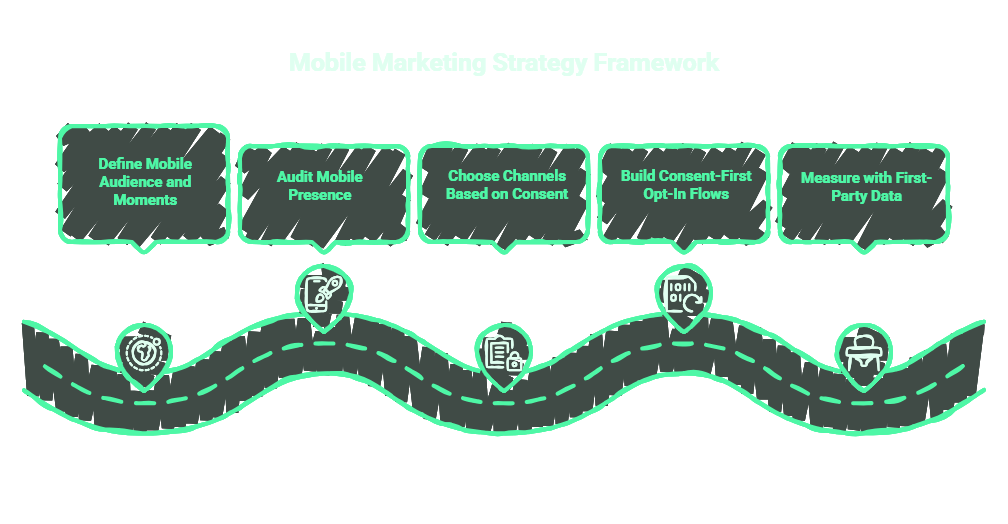
A mobile strategy is not a channel plan. It is a structured approach to reaching the right person, on the right device, at the right moment, with the right level of consent in place to do so legally. The five steps below apply whether you are building from scratch or auditing an existing mobile presence. Work through them in order; skipping the audience and audit stages typically results in channel investment that cannot be properly measured or optimised.
Step 1: Define Your Mobile Audience and Moments
Before selecting channels, identify who you are trying to reach and in what context. A local service business in Belfast reaching customers who are searching on the go has different channel priorities than an e-commerce brand trying to re-engage lapsed purchasers. Language and localisation strategy considerations apply if you are operating across markets with different regulatory environments or cultural norms around messaging.
Step 2: Audit Your Mobile Presence
Review your website’s mobile performance in Google Search Console. Check your Core Web Vitals scores for mobile. Test your checkout or contact flow on a real device. Map every touchpoint a customer hits on their phone, from the first search result to the confirmation page, and identify where friction exists.
Step 3: Choose Channels Based on Consent You Can Obtain
Your channel selection should be driven by the consent you can realistically build. If you have an existing customer base and a transactional relationship, SMS is viable. If you are starting from scratch, mobile web advertising with a clear lead-generation goal is a lower-friction entry point. iOS or Android for business decisions affect where you invest in app-based experiences, since the two platforms have different user demographics and different privacy frameworks.
Step 4: Build Consent-First Opt-In Flows
Your opt-in process should be clear, specific, and easy to complete on a mobile screen. State exactly what the subscriber will receive, how often, and how they can opt out. Store the consent record with a timestamp and the specific wording shown at the point of consent. This is not just good practice; it is a legal requirement under PECR.
Step 5: Measure with First-Party Data
Given the changes to cross-app tracking, your measurement approach should rely primarily on data you own. This includes on-site behaviour tracked through your own analytics implementation, conversion tracking through your CRM, and customer surveys. Social media analytics tools can supplement this for channel-level performance, but should not be treated as the primary source of truth for attribution.
Mobile Marketing KPIs Worth Tracking
The metrics you prioritise should reflect your channel mix and objectives. Across the main mobile channels, the following benchmarks provide a working reference:
| Channel | Typical Open/View Rate | Average CTR | UK Regulatory Hurdle |
|---|---|---|---|
| SMS | 90–98% | 6–8% | PECR consent required |
| Push Notifications | 5–10% | 1–3% | App permission required |
| WhatsApp Business | 70–80% | 15–25% | WhatsApp opt-in + PECR |
| Mobile Display Ads | N/A | 0.3–0.7% | UK GDPR applies to targeting data |
| In-App Video | N/A | 1–2% (completed views) | ATT consent on iOS |
These figures are industry estimates and vary considerably by sector, audience, and creative quality. Use them as directional benchmarks rather than guaranteed outcomes.
Tracking business partnership and performance data through your mobile campaigns is particularly important when working with third-party platforms, as their reported metrics may not align with your own first-party conversion data.
The Future of Mobile: AI, AR, and Contextual Targeting
AI is changing mobile marketing in two ways: it is automating optimisation decisions that previously required manual analysis, and it is enabling creative personalisation at a scale that was not previously practical. Send-time optimisation, dynamic content insertion, and predictive churn models are now accessible to SMEs through platforms that have built these capabilities into standard packages.
Augmented Reality in mobile advertising remains largely the preserve of larger brands and platforms, but the infrastructure is maturing. Apple’s ARKit and Google’s ARCore provide the technical foundation; what most SMEs lack is the creative investment. App Clips, Apple’s lightweight app experiences that load without a full download, reduce friction in scenarios where you want a user to complete a specific action without committing to installing your full application.
Canva’s AI tools represent the kind of accessible AI-assisted creative capability that is already relevant for mobile ad production, particularly for social formats that require rapid iteration across multiple sizes and placements.
Conclusion
Mobile marketing rewards businesses that plan carefully, build consent properly, and measure honestly. The channel mix available to UK SMEs has never been more varied, but the regulatory environment has also never been more demanding. Getting both right, choosing channels your audience actually uses and collecting the data to prove what works, is what separates campaigns that drive genuine growth from those that generate noise.
If you are ready to build a mobile strategy that is compliant, measurable, and tied to real commercial outcomes, get in touch with the ProfileTree team.
FAQs
What is the difference between mobile marketing and mobile advertising?
Mobile advertising is the paid placement element: display ads, in-app ads, and social media ads served on mobile devices. Mobile marketing is the broader discipline that includes advertising alongside owned channels and earned touchpoints. Advertising is one tool within the wider marketing set.
Is SMS marketing legal in the UK without consent?
No. Under PECR, you must have specific consent from the individual before sending them a direct marketing text message. The soft opt-in exception applies only to existing customers being marketed similar products or services, and it does not cover prospecting or purchased lists.
How does mobile marketing benefit small businesses?
The primary advantage for small businesses is the directness of the channel. SMS open rates run far higher than email, and local-intent mobile searches have strong commercial intent. A small business with a well-maintained SMS list, a mobile-optimised website, and a consistent Google Business Profile is well-positioned to compete with larger competitors for local customers, without requiring a significant advertising budget.
What is a good CTR for mobile display ads?
Industry benchmarks put average mobile display CTRs between 0.3% and 0.7%, though this varies significantly by format, sector, and targeting quality. Rich media and video formats typically outperform standard banner placements.
How do I track mobile conversions without cookies?
Server-side tracking sends conversion data from your server to ad platforms rather than relying on browser-based cookies or device identifiers. This approach is less affected by browser privacy changes and iOS tracking restrictions. Alongside server-side tracking, building a first-party data strategy through your CRM gives you a durable record of customer behaviour that does not depend on third-party tracking infrastructure.