
Website Analytics Strategy: What Tracking Data Reveals
Table of Contents
To run a business website effectively, you need to understand what tracking tools and analytics reveal about your commercial performance. The data these tools provide informs every significant decision about your digital presence, from content strategy to advertising spend allocation.
Without proper analytics implementation, you’re operating blind. You won’t know which marketing channels deliver actual customers, which pages lose potential enquiries, or where visitors abandon purchase journeys. For businesses across Belfast, Northern Ireland, and the UK, this represents thousands of pounds in wasted marketing investment.
What Analytics Tools Actually Measure (And What That Means for Your Business)
Analytics platforms collect three categories of data that directly impact commercial decisions: audience demographics, traffic sources, and on-site behaviour. Each category answers different strategic questions.
Demographics: Understanding Who Your Customers Actually Are
If you’ve conducted market research, you have assumptions about your ideal customers. Analytics tools test those assumptions against reality.
Demographic tracking captures age ranges, gender distribution, geographic location, language preferences, education levels, income brackets, and stated interests. For Belfast-based professional services firms, this data often reveals that core converting audiences differ significantly from assumed target markets.
Geographic data frequently exposes unexpected market opportunities. Businesses often find substantial traffic from the Republic of Ireland while their service information, pricing, and logistics pages only address UK customers. This mismatch costs real enquiries.
The business application: Demographic data identifies content-market mismatch before it drains your budget. When ProfileTree implements web design projects in Belfast, analytics configuration is built into the development process specifically to capture demographic data from launch day.
Traffic Sources: Where Your Visitors Actually Come From
Modern business websites receive traffic from six primary channels. Understanding traffic source value lets you allocate marketing budgets to channels that actually deliver customers, not just visitors.
Organic search represents users finding your site through search engines. This traffic typically has the highest conversion intent because users are actively searching for solutions you provide.
Paid search includes Google Ads, Bing Ads, and other PPC platforms. Tracking paid campaign performance separately from organic is essential for ROI calculation. Businesses frequently discover that paid campaigns targeting broad industry terms generate high-cost clicks that convert poorly compared to organic search traffic. When the cost per lead from paid search exceeds £100 while organic delivers similar leads at £10-15, that distinction demands budget reallocation toward SEO services rather than continued ad spend on underperforming keywords.
Social media traffic from platforms like LinkedIn, Facebook, and Instagram requires separate analysis because user intent differs from search traffic. Legal and professional services firms often find LinkedIn content drives significantly higher conversion rates (typically 5-10% to consultation bookings) compared to Facebook traffic (usually under 1%). This distinction should shape your entire social media marketing strategy.
Email marketing performance tracking answers whether your newsletter campaigns actually drive business results or just vanity metrics. Proper email source tracking distinguishes between traffic from promotional campaigns, transactional emails, and regular newsletters.
Direct traffic represents users typing your URL directly or using bookmarks. Direct traffic frequently includes miscategorised sources from apps, secure messaging platforms, or tracking blockers.
Referral traffic arrives via links from other websites, industry directories, or blog mentions. For businesses investing in content marketing or PR activities, referral tracking proves whether those efforts generate actual enquiries.
Common Analytics Mistakes That Cost SMEs Thousands
The most expensive analytics errors aren’t technical. There are strategic misunderstandings about what data means and how to act on it.
Mistake 1: Confusing Traffic Volume with Business Performance
Many businesses celebrate rising traffic numbers while enquiries remain flat. Hospitality and tourism businesses particularly fall into this trap, tracking traffic growth from blog content about free local attractions while that traffic generates zero booking intent.
Traffic volume looks impressive in monthly reports. Without conversion tracking, it reveals nothing about commercial value.
What to track instead: Conversion rate by traffic source, enquiry-to-customer rate, and revenue per visitor segment. These metrics reveal commercial performance, not just audience size. For businesses using social media platforms, understanding how social media marketing increases sales requires tracking these conversion metrics rather than vanity metrics like follower counts or post reach.
Mistake 2: Treating All Conversions Equally
Not all conversions have equal business value. Professional services firms often track “contact form submissions” as their primary goal, while finding strong conversion rates but disappointing revenue.
Deeper analysis frequently reveals that a large percentage of form submissions are recruitment enquiries, supplier pitches, or information requests rather than potential client contacts. The forms convert well because they’re easy to complete. They don’t convert to paying clients.
Mistake 3: Ignoring Mobile-Desktop Performance Gaps
Retailers with catalogue-style websites frequently notice poor overall conversion rates without realising that desktop and mobile performance can differ dramatically. Platform-level analysis often reveals desktop users converting at 3-5% while mobile users convert under 1%. The issue typically isn’t traffic quality but technical problems like non-functional image galleries, complicated checkout processes, or forms that don’t work properly on smaller screens.
Businesses often consider expensive advertising to boost “low conversion rates” when the actual problem is a fixable UX issue visible only through device-segmented analytics.
Mistake 4: Not Tracking the Full Customer Journey
Many businesses only track the final conversion action, missing the investigation phase entirely. Manufacturing businesses selling technical products typically see customer journeys spanning 8-12 website visits over 4-6 weeks before purchase.
Analytics setups that only measure immediate conversions make marketing appear far less effective than reality. Proper journey tracking reveals which content assets move prospects through consideration phases, completely changing content investment priorities.
As Ciaran Connolly, Founder of ProfileTree, explains: “The businesses that get analytics right are those that understand the difference between tracking everything and tracking what matters. When we work with clients through our digital strategy service, the first question isn’t ‘what platform should we use?’ It’s ‘what decisions will this data inform?’ That question determines the entire implementation approach.”
Platform Considerations for Professional Tracking Implementation
Website platforms handle analytics implementation differently. The platform you choose directly affects what data you can capture.
WordPress: Flexible Control with Technical Overhead
WordPress offers complete control over analytics implementation. You can install any tracking tool, configure custom event tracking, and integrate multiple platforms simultaneously.
The flexibility creates complexity. A properly configured WordPress analytics setup for a service business typically includes Google Analytics 4 for traffic analysis, Google Tag Manager for event coordination, form submission tracking, phone call tracking integration, and CRM data synchronisation.
For businesses without technical staff, this configuration becomes a maintenance burden. Tools conflict, updates break tracking, and data quality deteriorates over time without regular audits.
When WordPress works: If you have internal technical capability or work with an agency that provides WordPress development services, the platform’s flexibility delivers superior tracking capability. ProfileTree clients running WordPress sites benefit from properly architected analytics that grow with their business needs rather than constraining them. For businesses considering WordPress, understanding the complete WordPress website setup process helps evaluate whether the platform’s analytics flexibility justifies its complexity.
Shopify: E-commerce Optimised, Limited Customisation
Shopify’s built-in analytics focus on e-commerce metrics: product performance, cart abandonment, and customer lifetime value. The platform makes basic tracking straightforward.
Customisation beyond standard metrics requires apps or custom code. If your business model includes lead generation alongside e-commerce or complex customer journeys, Shopify’s constraints become problematic.
Platform-Agnostic Approach: Business Requirements First
The platform selection question is backwards for most businesses. The correct sequence: identify which business decisions require data support, determine what tracking configuration delivers that data, then select a platform capable of implementing that configuration.
Professional training providers often choose website builders for initial ease of use, then discover six months later they need to track which course pages lead to telephone enquiries, which email sequences generate the highest show-up rates for online events, and which blog topics attract qualified prospects versus casual browsers.
If the platform can’t track phone calls, distinguish between email campaign sources, or support custom event tracking, the “easy” platform choice creates expensive website rebuild requirements.
When DIY Analytics Falls Short: The Business Growth Threshold
Most businesses start with basic analytics. Google Analytics provides free traffic data. Platform dashboards show conversion numbers. This works adequately until it doesn’t.
The Threshold Signals
Several situations indicate your tracking needs have outgrown DIY capability:
Multiple marketing channels with unclear ROI: When you’re spending across Google Ads, social media, email marketing, and offline advertising, attributing results to specific channels requires sophisticated tracking architecture.
Complex conversion paths: Service businesses rarely convert on the first visit. Proper tracking must capture which content prospects consume and how many visits occur before an enquiry.
Team decision-making based on data: When multiple people need to access and act on analytics data, proper dashboards and reporting become essential.
Significant advertising spend: Once monthly ad spend exceeds £1,000-£1,500, the cost of improperly optimised campaigns from inadequate tracking data exceeds the cost of proper analytics implementation several times over.
Technology distributors spending £4,000-5,000 monthly on Google Ads while using only basic conversion tracking typically know campaigns generate clicks and some conversions. They don’t know which product categories convert, which ad copy attracts qualified buyers versus researchers, or what search terms generate actual sales versus enquiries that never progress.
Proper conversion tracking implementation (typically £2,000-2,500) frequently reveals that 50-60% of ad spend targets searches that never convert to sales. Reallocating budget based on actual performance data can increase revenue per advertising pound by 100-150%.
Decision Framework: Choosing Your Analytics Approach
Select your tracking strategy based on business complexity, technical capability, budget, and growth trajectory.
For Businesses Under £100K Annual Revenue: Basic platform analytics combined with Google Analytics 4 typically suffices. Focus on fundamental metrics: traffic sources, top landing pages, and basic conversion tracking.
For Businesses £100K-£500K Annual Revenue: Professional analytics configuration provides multi-channel attribution tracking, proper event configuration, dashboard design that answers specific business questions, and CRM integration. ProfileTree’s digital training service helps marketing managers interpret analytics data without continuous external support.
For Businesses Above £500K Annual Revenue: Analytics becomes a competitive advantage requiring continuous tracking refinement, A/B testing infrastructure, customer journey analysis, and integration between all customer touchpoint systems.
If you can’t explain which marketing channel delivers your most profitable customers, what percentage of visitors view pricing before leaving, or prove ROI for each major marketing investment, your analytics setup isn’t serving business decision-making adequately.
The Performance Impact of Tracking Tools
Adding tracking tools to websites affects loading speed and user experience. Each tool typically adds 20-150KB of JavaScript. Multiple tools loading simultaneously can delay page rendering by 1-3 seconds.
Professional implementation uses script loading prioritisation, tag management systems like Google Tag Manager, and conditional loading to minimise performance impact. Proper configuration reduces total tracking load time by 40-60%.
Video Marketing and Analytics Integration
When ProfileTree produces video content for business clients, viewing behaviour analytics inform every production decision.
Manufacturers investing in product demonstration videos often find that basic analytics show videos are viewed, but detailed tracking reveals viewer drop-off patterns. When viewers consistently abandon videos at the 90-second mark regardless of content, this indicates a structural format problem rather than content quality issues.
This type of analysis prompts format restructuring: moving key product benefits and specifications to the first 60 seconds, with detailed technical information positioned later for engaged viewers who need that depth. Such changes typically increase average view duration from around 1 minute to over 2 minutes, with corresponding increases in enquiries from pages featuring videos compared to text-only product pages.
Compliance Considerations for UK Business Websites
Website tracking tools in the UK operate under GDPR and PECR regulations. Before collecting analytics data, UK websites must clearly explain what data the site collects and why, obtain explicit consent for non-essential tracking, allow users to reject tracking without losing site access, and honour consent preferences across the entire site.
Professional setups integrate tracking with consent management. Analytics scripts only execute after consent is granted. If a visitor rejects analytics cookies, the site functions normally but doesn’t track their behaviour.
E-commerce businesses can face ICO (Information Commissioner’s Office) inquiries following customer complaints about tracking without consent. When analytics are technically installed correctly but fire before consent banners display, businesses face investigation, required procedure changes, and compliance audit costs that proper initial implementation prevents.
Making Analytics Data Actually Useful
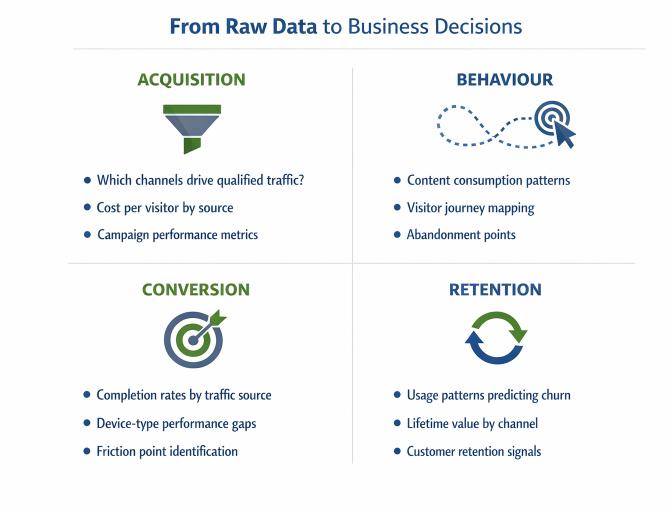
Raw analytics data is meaningless without context. Effective analytics answers four categories of questions:
Acquisition questions: Which channels drive qualified traffic? What’s the cost per visitor from each source? Understanding statistics in business decision-making helps interpret this acquisition data correctly.
Behaviour questions: What content do prospects consume before making purchase decisions? Where do visitors abandon intended actions?
Conversion questions: What percentage of traffic completes desired actions? How does conversion rate vary by traffic source or device type?
Retention questions: For subscription businesses, what usage patterns predict customer retention versus churn? Which acquisition channels deliver the highest lifetime value?
Getting Started: The Practical Implementation Path
For Belfast businesses and SMEs across Northern Ireland, ready to improve their analytics capability:
Phase 1: Audit Current State – Document what tracking you currently have, what data it collects, and what questions it cannot answer. Identify the three most important business decisions analytics should inform.
Phase 2: Essential Tracking Setup – Implement core analytics properly: Google Analytics 4 with proper goal configuration, basic event tracking for enquiry forms, and traffic source categorisation. Ensure compliance with UK privacy regulations.
Phase 3: Attribution Framework – Connect analytics to business outcomes. Implement phone call tracking if telephone enquiries matter. Integrate CRM data to track which website interactions lead to sales.
Phase 4: Continuous Improvement – Schedule quarterly reviews of what data you’re collecting and whether it still answers your most important business questions.
Frequently Asked Questions
What’s the difference between Google Analytics and Google Analytics 4?
Google Analytics 4 replaced Universal Analytics in July 2023. GA4 uses event-based tracking instead of session-based tracking, provides better mobile app integration, and includes improved privacy controls for GDPR compliance. All new website tracking should use GA4, as Universal Analytics no longer collects data.
How long does it take to see meaningful data from website analytics?
Basic traffic patterns become visible within 7-14 days. Statistically significant conversion data typically requires 30-90 days, depending on traffic volume. Sites with under 1,000 monthly visitors need 3-6 months before patterns emerge reliably.
Can I track phone calls generated by my website?
Yes, through call tracking software that assigns unique phone numbers to different marketing sources. When a visitor finds your site through Google Ads, they see one number; organic search shows a different number. The system tracks which source generated each call and can record conversations for quality analysis.
Do I need to tell visitors I’m tracking their website behaviour?
Yes, under UK GDPR and PECR regulations. Your privacy policy must explain what data you collect, why you collect it, and how you use it. For non-essential cookies, including most analytics tools, you need explicit consent before tracking begins.
What’s the most important metric to track for service businesses?
Enquiry-to-customer conversion rate matters more than any traffic metric. Track how many enquiries become paying customers, average revenue per customer acquired through the website, and cost per acquired customer by marketing channel. These metrics reveal commercial performance rather than just traffic volume.
How do I know if my tracking is working correctly?
Test it by submitting an enquiry form on your own website and verify it appears in analytics as a conversion. Make a test purchase if you run an e-commerce. Check that different pages show view counts that increase when you visit them.
Should I track user behaviour on every page or just key pages?
Focus on detailed behaviour tracking like heatmaps on pages where conversion happens: service pages, product pages, pricing pages, and checkout flows. Blog content and informational pages need basic metrics like views and time on page, but rarely justify detailed behaviour analysis.
Can analytics tell me why visitors leave without converting?
Analytics identifies where visitors leave and what actions they didn’t complete, but can’t directly tell you why. If 60% of visitors exit your pricing page after 8 seconds, that pattern suggests a problem. The specific issue requires session recording tools or user testing to identify.
Do I need different tracking for mobile and desktop users?
Modern analytics platforms automatically segment mobile and desktop traffic. You don’t need separate installations, but you should analyse the segments separately because behaviour differs significantly. Many businesses discover their desktop site performs well while their mobile experience loses most potential customers.
How much does professional analytics implementation cost?
One-time setup for a small business website costs £800-£1,500, including Google Analytics 4 configuration, goal setup, event tracking, and basic dashboard creation. Complex implementations for e-commerce sites range from £2,000 to £5,000, depending on integration requirements. Ongoing analytics management typically costs £300-£800 monthly if needed.
Your Next Steps
Proper website analytics transforms business decision-making from guesswork to data-supported strategy. The investment in professional tracking implementation delivers returns through every marketing pound spent more effectively and every UX improvement made based on real user behaviour.
If your current analytics setup can’t answer where your most profitable customers come from, what content influences their decisions, or which marketing channels waste budget, it’s time to upgrade your approach.
ProfileTree works with businesses across Belfast, Northern Ireland, and the UK to implement analytics configurations that serve commercial decision-making rather than just generating reports. Our team combines technical implementation capability with business strategy understanding to ensure tracking tools deliver insights that matter.
Ready to understand what your website traffic data actually reveals about your business performance?Contact our team to discuss your analytics requirements and explore how proper tracking implementation supports profitable growth.
All cost figures in this article are drawn from real-world UK installations and are accurate at the time of writing, but are intended as estimates rather than formal quotations.