
Instagram Guides Discontinued: What Replaced It for SMEs
Table of Contents
Instagram Guides no longer exists. Meta removed the feature on 15 December 2023, leaving business owners and social media managers searching for where their curated content had gone and what to use instead.
This article explains what Instagram Guides were, why Meta discontinued them, where your old content is now, and how to replace the editorial value of Guides with content formats Instagram actually supports. If you manage Instagram for a business in Northern Ireland, Ireland, or the UK, the practical toolkit below gives you a workable content strategy for the platform as it stands.
What Were Instagram Guides?
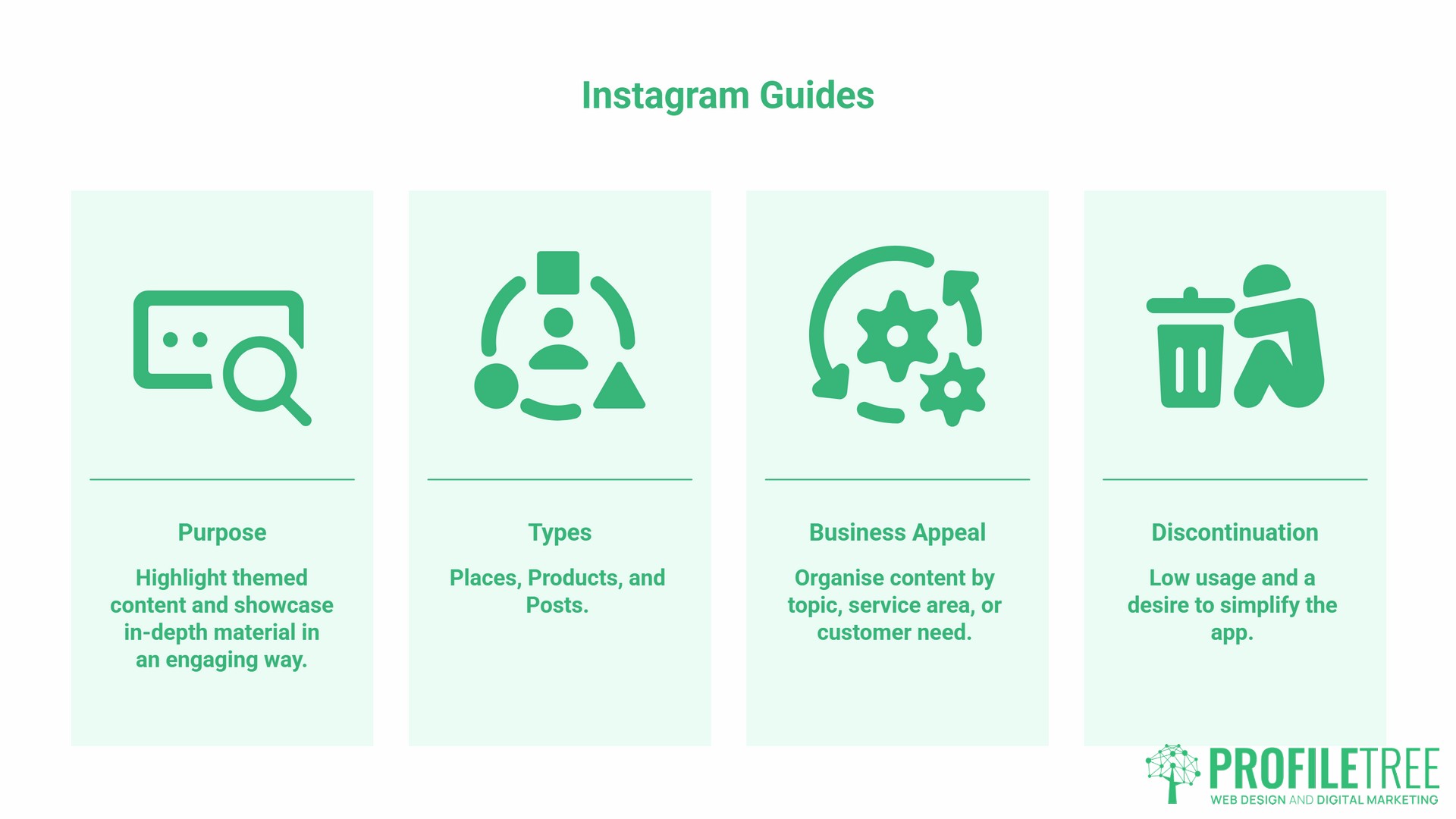
Instagram first launched Guides in 2020 to highlight themed content and showcase more in-depth material in a more engaging, interactive way. Guides provided an alternative display format, enabling creators and brands to share explainers and image collections accompanied by short text descriptions. Guides could also be shared via Stories, which provided another way to drive engagement.
There were three types: Places (recommended locations), Products (curated product showcases), and Posts (thematic collections of your own or saved content).
For businesses, the appeal was obvious. Guides acted as a lightweight editorial layer on top of your grid, letting you organise content by topic, service area, or customer need without rebuilding your posting strategy. A Belfast retailer could build a gift guide without publishing new posts. A Northern Ireland tourism operator could group location recommendations into a discoverable format that sat permanently on their profile.
The feature never reached the engagement levels Meta needed to justify maintaining it. As an Instagram spokesperson told The Verge when the discontinuation was announced: “Usage is low and we are always looking at ways to simplify the app.” In November 2023, Meta confirmed it would remove the feature, and Instagram Guides were retired as of December 15th, with all existing Guides on profiles converted to Collections.
Where Did Instagram Guides Go?
Your existing Guide content was not deleted. Instagram Guides were converted into private Saved Collections, and Guide data could be downloaded via Meta for 90 days following the discontinuation. That download window has since closed, but the Collections themselves remain accessible.
To find your converted content:
- Open Instagram and go to your profile
- Tap the hamburger menu (three lines) in the top right corner
- Select “Saved”
- Your converted Guides appear here as individual Collections, labelled with their original Guide titles
Collections mimic the popularised Pinterest. Similarly, Collections offers a way for you to save specific posts or Reels to a “board,” and you can have multiple boards that keep your saved content organised. But unless you create a collaborative board with specific people of your choosing, you will be the only one who can access your Collections.
This matters practically. Followers cannot browse your old Guides from your profile. If you had Guides that served as public-facing resources, product catalogues, FAQ compilations, and local recommendations, those are no longer visible to your audience. You will need to recreate that function using current Instagram features.
Comparison: Instagram Guides vs. current equivalents
| Original Guide Feature | Closest Current Replacement | Visibility |
|---|---|---|
| Places Guide (local recommendations) | Story Highlights or Instagram Map Search | Public |
| Product Guide (curated product list) | Instagram Shopping tab or Carousels | Public |
| Post Guide (themed editorial content) | Story Highlights | Public |
| Private content curation | Saved Collections | Private only |
| Shareable thematic content | Carousels or Reels | Public |
The Instagram Content Toolkit for SMEs
The discontinuation of Instagram Guides does not change the underlying need: businesses still need ways to organise, present, and make content discoverable. The formats below collectively cover what Guides once did, in many cases more effectively, because they reach more of your audience through Instagram’s algorithm.
Story Highlights: The Editorial Replacement
Story Highlights are the closest functional replacement for Instagram Guides as a public-facing, profile-based content organiser. They sit directly below your bio, they are permanently visible, and you control exactly which Stories they contain.
Where a Guide once grouped posts by topic, a well-organised Highlights section does the same job through Stories. A Northern Ireland accountancy firm might build Highlights covering “Tax Tips,” “New Clients,” “Team,” and “Case Studies.” A Belfast café might use them for “Menu,” “Events,” and “Behind the Scenes.” The sections sit at the top of the profile, as the old Guides tab did.
The key difference from Guides is that Highlights draw from Stories rather than grid posts. If you want a particular message to appear in a Highlight, you need to post it as a Story first. Businesses that rarely use Stories will need to adjust their posting habits to get full value from this format.
For the editorial, magazine-style presentation that Guides once allowed, the practical approach is to design your Story Highlights covers to match your brand identity. A consistent set of branded cover icons turns a functional feature into a professional profile element, and it is one of the first things a new profile visitor notices when they land on your account. Designing these well is a realistic task for any business working with a content marketing team or a designer, even on a one-off basis.
Instagram Collections: Private Curation
Saved Collections replaced Guides structurally, but they are private. Only you can see them. This makes them useful for internal purposes: gathering competitor research, saving inspiration, and bookmarking posts to repurpose. They cannot replace Guides as a public content discovery tool.
One partial exception is Collaborative Collections, which allow you to invite other accounts to contribute saved posts to a shared collection. For B2B businesses, this creates a low-friction way to curate resources with clients or partners. A digital agency could build a shared Collection with a client containing posts, examples, and references relevant to an active campaign, without needing to exchange links separately.
Reels: The Reach Driver
Reels achieve an average reach rate twice that of other formats, surpassing Carousels and Images. Instagram’s internal data shows that Reels are reshared 4.5 billion times per day through direct messages, and audio and shareability are the two signals the algorithm prioritises most.
Instagram famously went all-in on Reels when the format launched, and the investment has paid off for brands willing to commit to video. The algorithm prioritises entertaining, funny, and inspiring content, and direct message sends are among the most heavily weighted signals for Reels distribution.
For SMEs that have not yet incorporated short-form video into their content mix, this is the area where professional support makes the most practical difference. Producing a Reel that looks polished and holds attention for 30 to 60 seconds requires either in-house capability or an external production resource. ProfileTree’s video production service works with businesses across Northern Ireland and the UK to produce short-form content suited to Reels and other social formats, without requiring an in-house production setup.
One practical note for UK businesses: shorter Reels perform better, with Instagram promoting those under 90 seconds. If you are producing Reels for the first time, starting with content in the 30 to 60 second range is a sensible approach before committing to longer formats.
Carousels: The Engagement and Save Generator
If Instagram Guides served an educational and product-showcase function, Carousels are the format that most directly replaces that use case in the current feed. Carousels generate more engagement because users spend more time viewing multiple slides, are more likely to save the content, and often generate more comments discussing different slides within the post. In 2024, Instagram expanded carousel capacity to 20 slides per post.
Carousels are twice as likely to be saved as Reels, and naturally produce longer viewing times than regular posts, both factors that Instagram’s algorithm increasingly favours when deciding to boost a post’s reach.
Saves are a particularly important metric for businesses. When a user saves a post, it signals genuine intent: they found the content useful enough to revisit. A carousel covering “5 questions to ask before hiring a web designer” or “How to set up Instagram Shopping for a UK retailer” delivers structured, saveable information that performs well over time in the algorithm.
The best-performing carousels are designed for two actions: saving and sharing. Templates, checklists, decision trees, and pricing breakdowns earn savings because they are reference material. Content framed as “send this to the person who handles X” earns shares. Both signals are treated as high-value engagement by the current algorithm.
For SMEs managing their own Instagram, carousels are one of the most accessible high-performance formats because they can be produced with text and graphics rather than requiring video capability. A well-designed 8 to 10-slide carousel covering a topic relevant to your customers can outperform a single-image post by a significant margin in saves and reach. ProfileTree’s content marketing service works with businesses to plan and produce exactly this kind of structured, purposeful social content.
Instagram Notes and Close Friends: The Community Layer
Notes (brief text updates that appear in your followers’ direct message inboxes) and Close Friends lists (a private broadcast channel for a selected group) are Instagram’s community-level communication tools. Neither directly replaces Guides, but both fill different gaps in an SME’s Instagram toolkit.
For retail or hospitality businesses in Northern Ireland, the Close Friends feature functions well as a VIP customer channel. You can share early access to offers, behind-the-scenes content, or new stock arrivals with a curated list of your most engaged customers, without the content appearing in your main feed or Stories to everyone. The list is private, so recipients know they are seeing something exclusive.
Notes are best suited to quick updates and conversation starters rather than structured content. They work for businesses with an active, engaged following, but are less effective as a primary content channel for accounts still building their audience.
Strategic Pivot: How UK SMEs Should Adapt
The practical response to the loss of Instagram Guides is to stop trying to replicate the format and instead map your content objectives to the features Instagram’s algorithm actively supports.
Start by asking what you were using the guides for. If the answer is “to showcase our products,” the combination of Instagram Shopping tags and Carousels achieves that more effectively, because both appear in Search and Explore. If the answer is “to organise FAQs or educational content,” Story Highlights backed by a consistent posting schedule is the right replacement. If the answer is “to build local recommendations,” your Google Business Profile is a more durable investment for that purpose because it sits in local search results rather than a social profile, and unlike an Instagram feature, it is not subject to Meta’s product decisions.
“The death of Guides is actually a prompt to declutter your strategy,” says Ciaran Connolly, founder of ProfileTree. “Businesses that relied on the feature for discoverability were probably already missing the point of what Instagram does well. Reels and Stories reach new audiences. Guides never did.”
The broader point is that Instagram’s content landscape changes faster than most SMEs can keep up with. A feature that existed in 2020 was gone by 2023. Building your entire content curation strategy around a single platform feature creates fragility. The businesses that hold up best through these changes are those with a clear content strategy that maps objectives to formats, measures what is working, and can adapt when formats change without losing their core audience.
For businesses that have been managing their Instagram without a clear content strategy, this transition is a practical moment to put one in place. Knowing which format to use for which objective, how often to post, and how to measure results is the difference between a profile that generates enquiries and one that sits largely unnoticed. ProfileTree’s digital marketing strategy service works with SMEs across Northern Ireland, Ireland, and the UK to build social media content plans that are tied to business objectives rather than individual platform features.
For teams managing social media in-house, ProfileTree’s digital training programmes cover the current Instagram toolkit, including how to structure content calendars, use Reels effectively, and measure performance through Instagram Insights.
Measuring Instagram Performance Without Guides
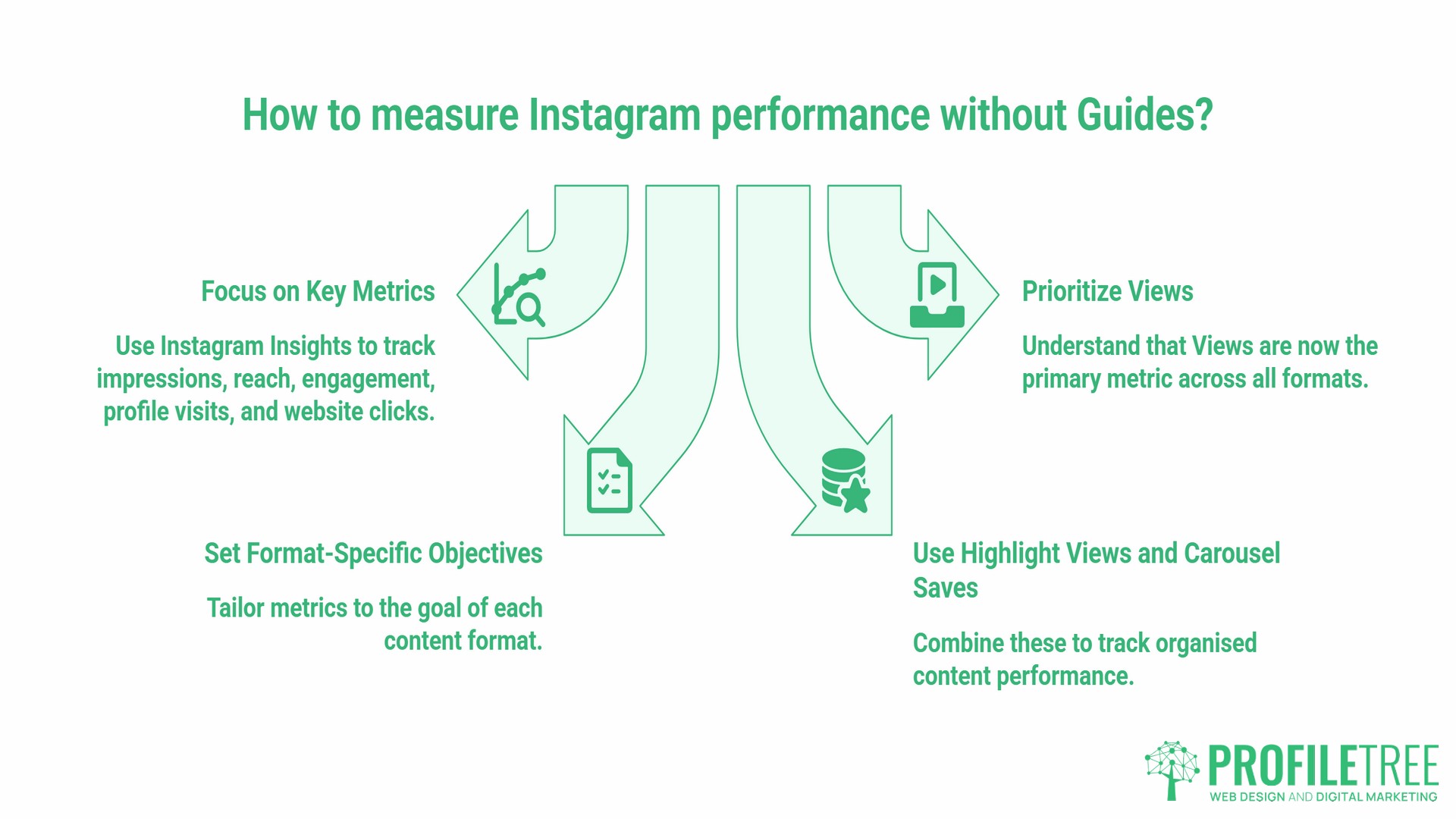
The metrics that matter for Instagram have not changed fundamentally since Guides was discontinued. What has changed is where you focus your attention and which format you assign to which objective.
Instagram Insights still tracks:
- Impressions: the total number of times your content was displayed
- Reach: the number of unique accounts that saw a post
- Engagement: likes, comments, saves, and shares combined
- Profile visits: the number of accounts that visited your profile from a specific post
- Website clicks: clicks on the link in your bio, tracked per post or Story
In 2026, Instagram officially transitioned to “Views” as the primary metric across all formats, Reels, Stories, photos, and Carousels, unifying how performance is calculated across the platform. This means the headline number you see in Insights is now Views rather than Impressions for most content types, and it is worth understanding what sits behind that number before drawing conclusions.
The practical approach is to set clear objectives for each content format before you post. A Reel designed to reach new audiences should be measured on reach and profile visits. A Carousel designed to educate existing followers should be measured on saves and shares. A Story promoting a limited offer should be measured on swipe-ups and direct messages. Measuring all formats against the same metric gives a misleading picture of what is performing and what needs changing.
For accounts that had Guide-specific performance data, the closest equivalent now is tracking Highlight views for permanent profile content and Carousel saves for educational material. Neither is a direct replacement, but combining the two gives a reasonable picture of how your organised content is performing over time.
FAQ
What happened to Instagram Guides in 2023?
Meta discontinued Instagram Guides as of 15 December 2023, with all existing Guides on profiles converted to Collections. Users can no longer create new Guides, and the Guides tab no longer appears on profiles.
Where are my old Instagram Guides now?
Your old Guides were converted into private Saved Collections. Go to your profile, tap the menu, select “Saved,” and you will find your converted content there. The content is private and no longer visible to your followers on your profile.
Can I still create a Guide on Instagram?
No. The Guide creation option was fully removed in December 2023. There is no workaround or third-party method to recreate the format within Instagram.
What is the difference between Instagram Collections and Guides?
Guides were public-facing, editable editorial posts that sat as a tab on your profile and were visible to any visitor. Collections are a private saved content system, visible only to the account holder, unless you create a collaborative board with specific other accounts.
How do I share a saved Collection with my followers?
You cannot share a Collection directly to your feed or profile in the way Guides were shared. The closest approach is to use content saved in a Collection as source material, then publish it as a Carousel, Story, or Reel. You can also share individual posts from within a Collection to your Stories.
What is the best replacement for Places Guides on Instagram?
For local recommendations, Google Business Profile and Instagram Map Search (which surfaces posts tagged at specific locations) are both more effective replacements. Story Highlights organised by location can also serve a similar function for businesses with strong local followings.
Did Instagram delete my Guide data?
No. Guide data could be downloaded via Meta for 90 days following the discontinuation, and the content itself was preserved as private Collections in your Saved folder. The posts included in your Guides still exist on your profile.