
Digital Marketing for Manufacturers: A Practical UK Guide
Table of Contents
Digital marketing for manufacturers has moved from optional to operational. British industrial firms that once relied on trade shows, printed directories, and referrals now compete with suppliers from across Europe, Asia and North America, all visible to the same procurement teams online.
The buyers who commission your work research suppliers, compare specifications and draw up shortlists long before they pick up the phone. A manufacturer that is absent from that research phase is simply not in the running.
This guide sets out how marketing for manufacturers works for UK businesses: the SEO and content that reaches technical buyers, the video, social and paid channels that build trust, the regional and Net Zero angles competitors miss, and the email, lead generation and measurement that tie activity back to revenue.
Why Digital Marketing for Manufacturers Works Differently
Manufacturing businesses face marketing conditions that look nothing like retail or professional services. The buying cycle runs long, the products are technically involved, and the decision spans procurement, engineering and finance at once. A digital marketing strategy for manufacturers has to start from those realities rather than borrow tactics built for quick consumer sales.
The Modern Industrial Buyer
The way industrial buyers choose suppliers has changed completely. Before any supplier conversation begins, a procurement manager or design engineer has usually run several specific searches, visited three to five websites, watched at least one video and downloaded a technical data sheet.
Research by 6sense finds that B2B buyers are around 70 per cent of the way through their buying journey before they contact a seller, and Gartner reports they spend only about 17 per cent of their time meeting suppliers at all. The shortlist is often set before a phone rings.
A site that reads like a digital brochure, with no technical depth and no clear route to an enquiry, gets dismissed early. This is where professional web design earns its keep: a slow or confusing site loses the shortlist before the product is judged.
The practical lesson is that the website carries most of the early selling. By the time an engineer emails, they have often decided you are worth a conversation, so the pages that answer their technical questions do more work than any sales script.
Long Sales Cycles and Multiple Decision Makers
Consumer marketing can turn an advert into a sale within minutes. Manufacturing sales cycles regularly run to six, twelve or eighteen months, with procurement, engineering and finance all weighing in. Online marketing for manufacturers has to nurture a buyer across that whole span, not chase a single click.
Content needs to carry the prospect from first awareness of a problem through active supplier evaluation to enquiry. One visit is rarely enough, so the plan has to keep the brand visible for the full evaluation period, which is where a considered digital strategy support pays off. A prospect who forgets you between months two and nine is effectively a lost lead, no matter how strong the first impression was.
The Post-Brexit Reshoring Opportunity
Supply-chain reshoring has opened real demand for UK manufacturers who can be found online. Firms that once sourced from EU suppliers are now actively searching for domestic alternatives, and clear certifications, accreditations and lead times can capture that demand directly.
The same visibility reaches export markets in North America and Asia-Pacific that sales trips cannot affordably cover. For more on how trading conditions reshaped demand generation, ProfileTree’s guide to the post-Brexit shift sets out the wider picture.
SEO and Content That Wins Technical Buyers
Search visibility decides whether a manufacturing business appears when buyers look for the products, capabilities or certifications they need. Manufacturing SEO rewards a different approach from a general services firm: technical precision and genuine authority, not repeated keywords.
Keyword Research for Technical Specifications
Manufacturing SEO starts with how buyers actually search. A procurement manager does not type “good engineering company”; they type “ISO 9001 precision CNC machining Belfast” or “stainless steel fabrication UK 48-hour turnaround”. Digital marketing for manufacturing companies needs keyword research that mirrors that specification-led language.
Long-tail queries of five words or more carry lower volume but far higher intent, and they cover the sub-sectors that generic pages ignore. Building product manufacturers, brick and construction suppliers, and contract manufacturers each search in their own terms, so SEO for manufacturers looking to increase RFQs should map those variants deliberately.
Google Search Console data showing which queries already earn impressions is the quickest starting point for any campaign. ProfileTree’s SEO services are built on that principle rather than on chasing broad, low-intent phrases.
Content Depth That Earns Rankings
Buyers in this sector want substance: case studies with measurable outcomes, specification guides, material comparisons, capability statements and process explainers. Thin pages with no technical detail will not rank for competitive manufacturing queries, and they give an engineer no reason to stay.
A single well-researched guide on one capability often outperforms a dozen shallow blog posts. A steady content marketing programme built around your core capabilities is the most durable way to grow that depth over time.
On-Page SEO and Site Performance
Strong content still needs sound on-page work across the site: clear title tags, descriptions that earn clicks, heading structures that match how buyers think, and internal links that move visitors from reading towards enquiring. Original photography of real equipment carries more weight with Google’s image systems than stock imagery.
Speed and stability matter just as much. Poor performance quietly undermines good content, so reliable hosting and management keep a site fast for buyers who have three rival tabs open beside yours.
Building Authority Through Digital PR
Backlinks from relevant, credible sites remain one of the strongest ranking signals. Digital PR for manufacturers means citations from industry publications, trade bodies such as Make UK, technical forums and verified supplier directories, earned through genuine expertise rather than bought in bulk.
Guest articles in the trade press and considered technical commentary build a site’s authority over months. Where a site’s structure or code is holding rankings back, a review of the underlying website development is often the more useful fix before any link work begins.
Video, Social Media and Paid Channels

Beyond search, a full approach to marketing for manufacturers draws on video, social and paid media. Each reaches a different audience at a different stage, and the firms with the steadiest pipeline tend to run several of them together rather than betting on one.
Video for Manufacturing Businesses
Video is the most underused asset in the sector and one of the highest value. A factory tour answers questions a data sheet cannot. A product demonstration removes doubt before an enquiry lands. A client testimonial reassures buyers who shortlist on instinct as much as on numbers.
YouTube is a search engine in its own right, and manufacturing buyers use it for process demonstrations, material comparisons and equipment reviews. A channel of well-titled technical content feeds enquiries straight into the pipeline, which is why a planned video marketing approach tends to beat text-only alternatives.
LinkedIn for Industrial Networking
LinkedIn is the main social platform for B2B manufacturers. It is where procurement managers, operations directors and engineers follow sector news and size up potential suppliers. A steady presence, sharing completed projects, capability announcements and team expertise, keeps a firm in front of the people who commission work.
The value lies in being part of the right professional conversations, not in chasing follower counts. ProfileTree’s guide to LinkedIn for business covers how to use the platform’s targeting and content options in practical detail.
Pay-Per-Click for High-Intent RFQs
Paid search and LinkedIn advertising let a manufacturer reach buyers who are actively searching or who match a defined professional profile. For this sector, PPC works best when it is tightly targeted: by specific query, job title, company size or industry.
Google Ads built around technical, specification-led queries can produce RFQs at a predictable cost, while LinkedIn adds targeting by job function that search alone cannot. Paid search suits buyers already looking for a capability; paid social suits reaching a defined role before they start searching.
Both perform only when the landing pages behind them are detailed and easy to enquire from, an area covered by ProfileTree’s digital marketing services. A managed social media marketing programme keeps the organic side consistent alongside paid activity, so the two reinforce each other rather than competing for the same budget.
The UK Advantage: Regional Reach, Net Zero and Recruitment
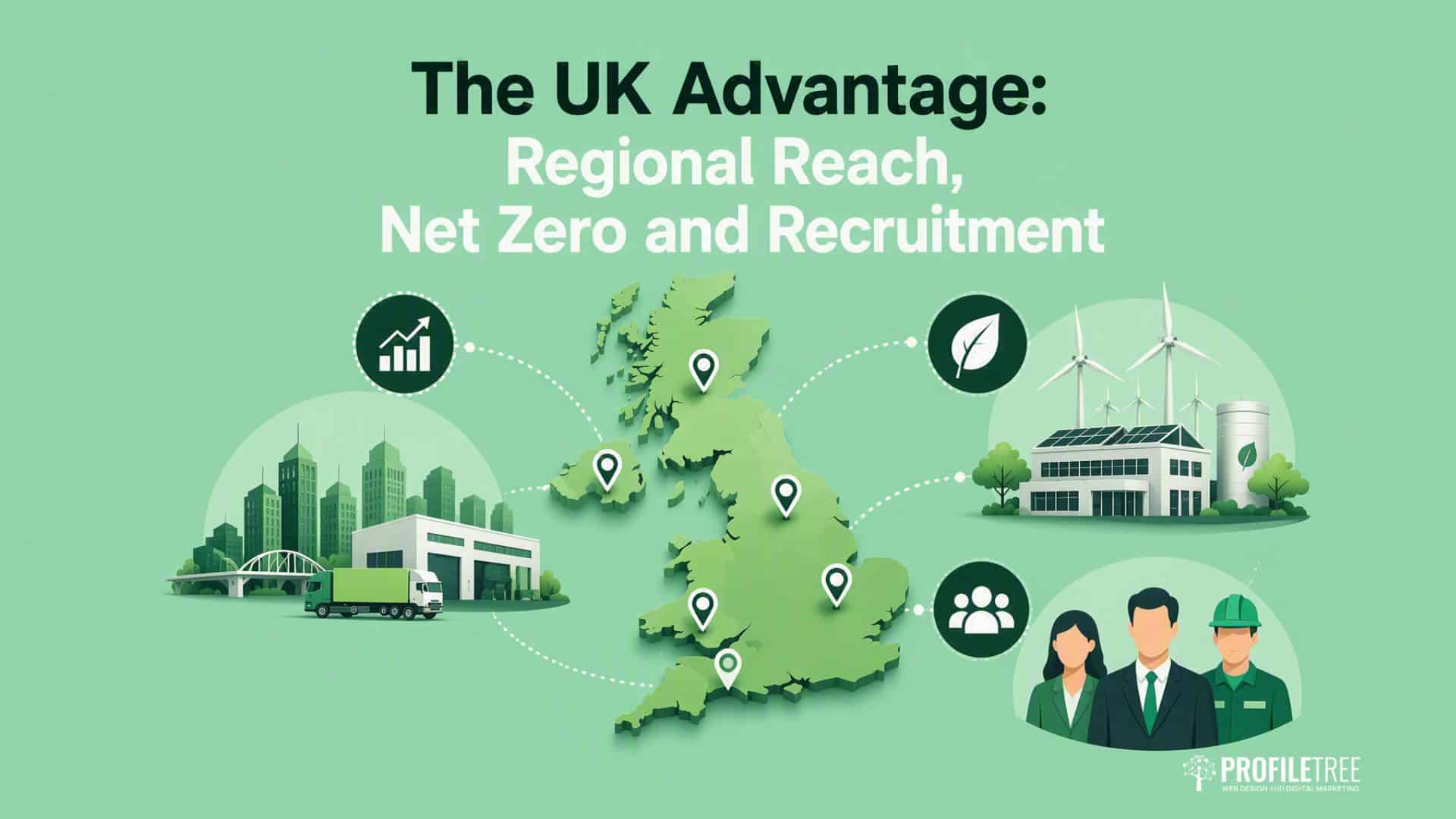
Most top-ranking guides on this topic are written for a US audience, citing trade shows in Las Vegas and American statistics. That leaves a clear gap for UK manufacturers around regional reach, sustainability credentials and the fight for skilled staff.
Local SEO Across UK Industrial Hubs
Manufacturers with a defined service geography can capture high-intent queries from buyers searching for regional suppliers, from the Midlands and the North East to Northern Ireland. Local search is one of the most underused tools in the sector, and it rewards clear location signals across a site.
Northern Ireland shows the point well: a dense base of engineering and construction-product firms sits close to the ports and cities across Northern Ireland that anchor the region’s supply chains. ProfileTree’s view on Northern Ireland marketing shows how regional intent translates into enquiries, and refining local search results often lifts visibility fastest.
Marketing Your Net Zero and ESG Credentials
Sustainability has become a procurement requirement rather than a nicety. Many Tier 1 supply-chain tenders now expect a credible Net Zero position, yet few competitors give the topic any space online. A manufacturer that documents its ESG progress clearly answers a question buyers are already asking.
Carbon reduction, transparent sourcing and recycled-content data all belong on the site and in the sales conversation. Presented as evidence rather than slogans, these details often decide a tender where two suppliers are otherwise level on price and lead time. ProfileTree’s work on sustainable marketing strategies looks at how to present those credentials honestly, without the vague claims that buyers have learned to discount.
Using Digital to Win the Recruitment Race
Manufacturers are short of skilled engineers, and a strong online presence serves more than customers alone. The same channels that win contracts also win talent, showing the next generation of engineers what the work and the culture actually look like. A candidate researching an employer behaves much like a buyer researching a supplier, forming a view long before any formal contact.
Short factory videos, employee stories and project highlights carry more weight with candidates than a static careers page. One considered post from a managing director often does more than a month of generic company updates, and it doubles as social proof for buyers watching the same feed.
Email, Lead Generation and Measuring ROI
Email remains one of the most cost-effective channels in the sector, reaching the inbox directly rather than depending on an algorithm. Paired with clear lead capture and honest measurement, it turns steady visibility into a pipeline that finance can see.
Building a Segmented Email Programme
An effective programme starts with segmentation. Procurement managers, design engineers and maintenance teams each need different materials, and one generic newsletter to all three loses the very people it should reach.
Automated sequences triggered by behaviour do the nurturing a sales team cannot manage by hand: a prospect who downloads a capability statement receives a relevant case study next. ProfileTree’s email marketing resource covers how to build those sequences from scratch.
“The right email can turn a cold lead into an engaged prospect. For manufacturing clients, we have seen automated sequences double the rate at which website enquiries convert to qualified sales conversations.”
Ciaran Connolly, founder of ProfileTree
Lead Magnets and AI-Assisted Capture
Gated content, where a buyer swaps contact details for a genuinely useful resource, is a dependable lead source. Technical guides, material-selection tools and compliance checklists all justify the exchange, provided the resource delivers real value rather than generic advice.
Pairing that content with an on-site assistant sharpens capture further by qualifying visitors in real time. ProfileTree’s AI chatbots route each enquiry to the right resource based on what the visitor actually needs.
The Metrics and ROI Framework That Matter
Measuring return is harder when a buyer visits a site a dozen times across eight months, but difficulty is not a reason to skip it. The metrics that count sit closest to an enquiry: organic traffic to service pages, enquiry submissions, email engagement and qualified RFQs per month.
| Metric | Why it matters for manufacturers |
|---|---|
| Organic traffic to service pages | Shows SEO is working and the right buyers are arriving |
| RFQ and enquiry submissions | The closest direct measure of revenue impact |
| Email sequence engagement | Signals active prospect interest between visits |
| Video watch time | Tracks trust-building consumption before enquiry |
| Cost per qualified lead | Total spend divided by genuine commercial enquiries |
A simple framework helps non-marketers judge the return. Take the average value of a new contract, multiply by the enquiry-to-sale conversion rate, and set that against the monthly investment. If a firm spends £2,000 a month on SEO and content, converts 10 per cent of enquiries, and each client is worth £40,000 a year, a single new client each quarter covers the annual budget several times over.
A common benchmark is 2 to 5 per cent of turnover on marketing, split between paid and organic. ProfileTree’s guidance on marketing ROI sets out how to attribute leads across a long cycle, and digital training builds the in-house skill to sustain it. Firms using AI marketing tools can surface patterns in prospect behaviour that would take months to spot by hand.
All prices and figures in this guide are indicative UK examples and correct at the time of writing; use them as a benchmark rather than fixed quotations.
Conclusion
Start with the fundamentals: a website that states your capabilities plainly, technical content that answers buyer questions, and a steady presence where suppliers get researched. Layer in email, video and paid activity as evidence of return grows. Results compound across quarters, not weeks. Manufacturers ready to map the highest-priority channels before committing budget can book a digital strategy consultation with ProfileTree’s Belfast team.
FAQs
How much do UK manufacturers spend on digital marketing?
A common benchmark for B2B firms is 2 to 5 per cent of turnover, usually split between paid campaigns and organic work such as SEO and content. Niche sub-contractors often sit at the lower end and scale up as attribution proves the return.
How long does SEO take to produce results in manufacturing?
Lower-competition technical queries can show movement within three to six months, while competitive sub-sectors often take twelve months or more. Long sales cycles mean the commercial payback usually lags the ranking gains.
How do you reach procurement managers and engineers online?
LinkedIn advertising targets by job title, company size and sector, while SEO captures buyers at the point of active search. Technical content then attracts engineers, comparing specifications, covering the full buying committee.
Is video worth the investment for a manufacturing business?
Yes. Factory tours, capability demonstrations and testimonials build trust faster than text alone, and video keeps buyers on the page longer. A single well-made film can generate enquiries for years.
What is the best way to generate RFQs online?
Combine high-intent, specification-led search terms with low-friction enquiry paths on detailed landing pages. Removing steps between interest and contact is usually what lifts RFQ volume most.