
How the Facebook Algorithm Works: A UK Marketer’s Guide
Table of Contents
Facebook organic reach for business pages sits below 2% on average in 2026, yet the algorithm of Facebook is not random, and it is not unfair. It is a system with specific rules, and businesses that understand those rules get meaningfully better results than those that do not.
This guide explains how Meta’s ranking system works in 2026, which signals carry the most weight, and what SME owners and marketing managers in the UK and Northern Ireland can do to get more out of the platform without scaling ad spend every time they want to reach. It also covers the UK-specific regulatory context that most guides ignore entirely.
How the Facebook Algorithm Works in 2026
Meta does not use a single algorithm. What most marketers call “the Facebook algorithm” is a multi-stage ranking system that processes every piece of content on the platform before deciding whether to show it to any given user. Since the rollout of Meta’s Andromeda AI engine, that process has shifted from a social graph model, which is what your followers see, to an interest graph model: what any user might find valuable, whether or not they follow you.
The practical result of this shift is significant. In 2026, up to 50% of a user’s Facebook Feed is content from accounts they do not follow. This “unconnected” distribution means that a well-performing post from a Belfast restaurant can reach people across Northern Ireland who have never interacted with that page before. It also means that low-quality content from pages a user does follow gets suppressed more aggressively than before.
The four-step ranking process
Meta describes its ranking process in four stages. Understanding these stages is the clearest way to see why some posts reach thousands of people and others reach none.
Inventory. Every time a user opens Facebook, the system assembles a pool of candidate content: posts from friends, pages followed, groups joined, and content flagged as potentially interesting based on historical behaviour. This pool can contain tens of thousands of pieces of content.
Signals. The system then scores each piece of content against hundreds of ranking signals. These include who posted it, what format it is, how users have previously responded to similar content, how recently it was posted, and dozens of behavioural indicators from the viewing user’s history.
Predictions. Using the signal data, the system generates a probability score for each piece of content: how likely is this specific user to engage with this specific post in a meaningful way? “Meaningful” has changed substantially. Passive likes carry far less weight than they once did. Shares via Messenger, saves, and comments that trigger replies carry considerably more.
Relevance score. The final ranking combines prediction scores with a “value of time” (VOT) calculation. Meta increasingly measures whether a user willingly spent time on a piece of content, not just whether they clicked it. A video watched to 80% completion by someone who then scrolled back to rewatch a section scores higher than a video that generated 200 passive likes and was scrolled past in two seconds.
Andromeda and the shift to AI recommendations
The Andromeda AI engine, which Meta began rolling out at scale in 2024, fundamentally changed how the discovery feed works. Earlier versions of the algorithm relied heavily on explicit social signals: you liked a post, so you see more from that page. Andromeda infers interest from far more subtle behavioural patterns, including what you hover on without clicking, how long you pause on certain content categories, and how your engagement patterns shift at different times of day.
For UK SMEs, this creates both risks and opportunities. The risk: content that relies on a loyal following for reach has less protection than before, because even loyal followers only see your content if Andromeda predicts they will engage meaningfully with it. The opportunity: genuinely good content from smaller pages can now reach new audiences without requiring follower counts that once made organic reach unachievable.
The Ranking Signals That Actually Move Reach
Not all engagement is equal. Understanding the relative weight of different signals is the most practical thing a business owner or marketing manager can take away from this guide, because it changes the content decisions you make before you ever hit publish.
High-weight signals
Shares via Messenger carry the most weight of any individual action in 2026. When someone privately forwards your post to another person, Meta reads that as a strong signal of genuine value: the sender found it worth actively putting it in front of a specific person. A post that generates 10 Messenger shares will typically outperform one that generates 100 passive likes in terms of ongoing distribution.
Saves are the second-highest-weight signal. When a user saves a post to return to later, Meta interprets that as a VOT indicator: the content was worth more than a scroll-past. For SMEs that produce genuinely useful content, how-to guides, local event information, and practical tips for their industry, encouraging saves is a more sustainable way to expand reach than chasing likes.
Comments that generate replies sit third. A comment thread shows ongoing interest. Meta’s AI sentiment analysis now attempts to distinguish between “meaningful” conversation and “toxic” engagement: the same post can be promoted or suppressed depending on whether the comment section generates constructive replies or conflict. This is worth knowing if you are managing a page in a contentious category such as local politics, property, or planning.
Medium-weight signals
Native video completion rates are a significant medium-weight signal, particularly for Reels. A video watched past the 60% mark outperforms one abandoned at 10%, regardless of how many people started watching it. This is why a short, punchy Reel that most viewers finish often reaches more people than a longer video with more total views. For short-form video content, completion rate is the metric to watch, not view count.
Post shares to personal timelines (public shares, not Messenger) carry meaningful weight but less than direct-message shares. Public shares still contribute to reach, particularly for content targeting new audiences through the unconnected feed.
Low-weight signals
Reactions (likes, loves, and similar) remain part of the ranking model but carry significantly less weight than in the pre-Andromeda era. Click-throughs to external links were deprioritised several years ago as part of Meta’s broader effort to keep users on the platform, and that remains the case. A post that drives traffic to your website performs worse algorithmically than one that keeps users engaged within Facebook.
This creates a genuine tension for businesses whose goal is website traffic. The practical response is a two-step approach: use Facebook to build awareness and engagement with native content, then use targeted advertising or retargeting to drive traffic conversion. The Facebook Ads framework is specifically designed for this transition from organic to paid reach when organic hits its ceiling.
Content format and the Reels versus Feed distinction
Reels and the main Feed use different ranking logic. Reels draw from a separate inventory pool that skews heavily toward the unconnected discovery feed, giving them greater potential to reach non-followers. Static images and text posts are distributed almost exclusively to connected audiences.
The implication for UK SMEs is that a mixed-format content approach is more resilient than relying on any single format. A business that relies solely on static image posts caps its potential reach before the algorithm even scores the content. The social media content strategy principles that work across platforms apply directly here: format diversity protects reach.
Video content produced specifically for Facebook (rather than cross-posted from YouTube or TikTok) performs better in most cases. Facebook’s algorithm gives native uploads a ranking advantage over external video links, and the VOT signals from native video are more granular because Meta can measure viewer behaviour directly. For businesses without in-house production capability, video marketing services can make the format difference actionable without requiring a camera operator on staff.
UK Regulation and What It Means for Your Content
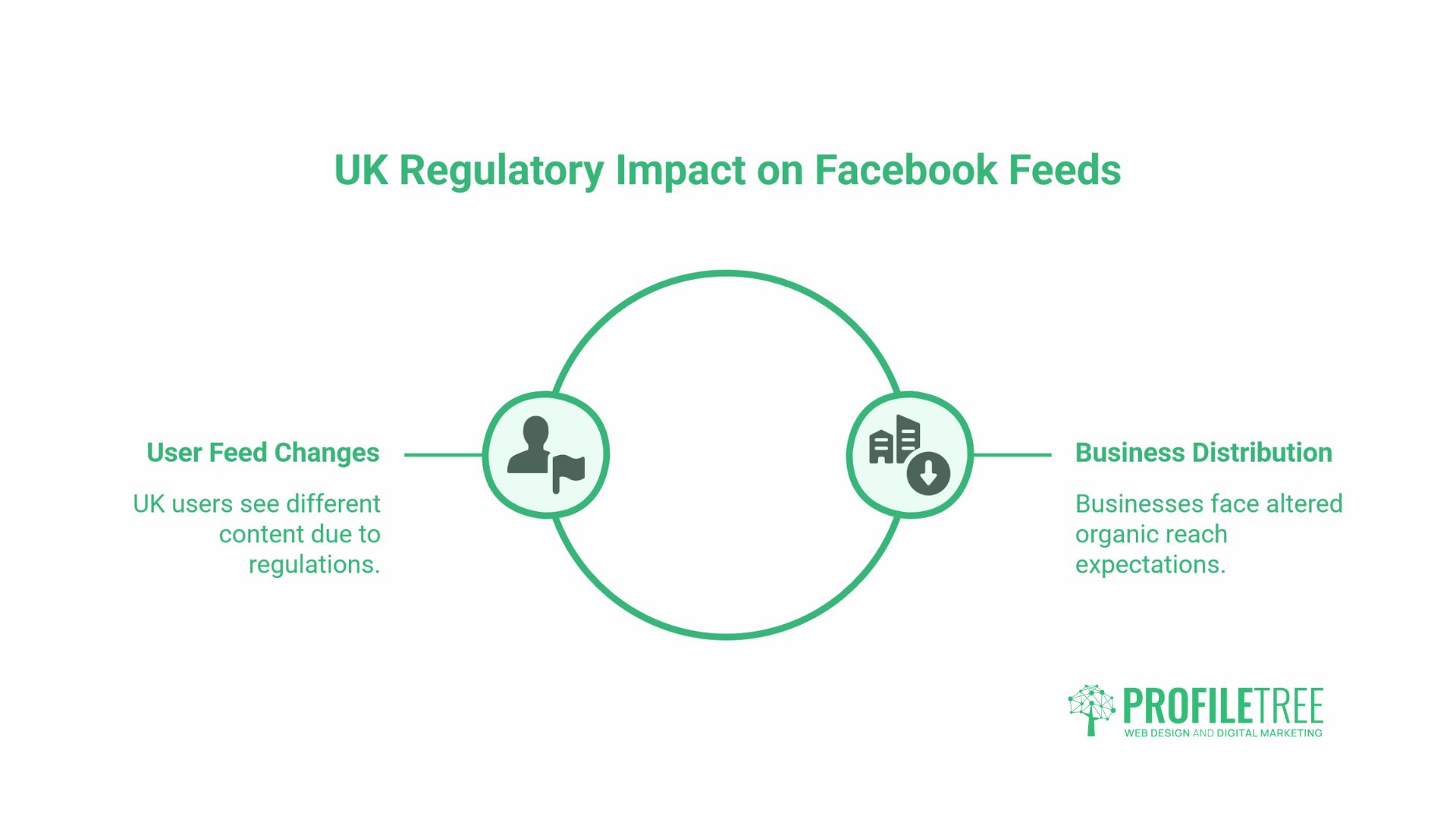
Most Facebook algorithm guides are written for a US audience and ignore the regulatory context that shapes Meta’s operations in the UK and Ireland. Two pieces of legislation have materially changed what UK users see in their feeds and what businesses can expect from organic distribution.
The UK Online Safety Act
The Online Safety Act, with its main provisions taking effect in 2024, requires platforms like Meta to implement systems to protect users from harmful content. In practice, this has had two algorithmic consequences for UK business pages. First, content in regulated categories, such as financial promotions, health claims, and content involving children, is subject to additional friction in distribution pending safety checks. Second, Meta has implemented a version of the chronological feed for UK users under pressure from the Act’s transparency requirements, allowing users to bypass the AI-ranked feed entirely. For businesses with highly engaged followers, encouraging that subset to switch to chronological viewing can recover some of the reach lost to algorithmic filtering.
The Digital Markets Act and its UK equivalent
The Digital Markets Act in the EU (and the UK’s Digital Markets, Competition and Consumers Act) places obligations on Meta to allow users to manage how their Instagram and Facebook data is linked. Some users are now operating in a “data siloed” state where Meta cannot draw on their full cross-platform behavioural profile to make predictions. For those users, Andromeda is working with less data, which can mean less accurate personalisation and, for businesses, a slightly higher likelihood of appearing in their feeds if the content format and timing signals align.
The practical takeaway for Belfast and Northern Ireland businesses is that the UK regulatory context creates both restrictions and openings. Content that relies on aggressive data profiling for ad targeting has become harder to execute precisely. Content that earns organic traction through genuine quality is less affected, as the quality signals the algorithm uses are mostly on-platform and within regulatory boundaries. Understanding this context is part of what a professionally managed social media marketing approach offers: a strategy that accounts for the regulatory environment, not just the platform’s technical mechanics.
“What we see across clients in Northern Ireland is that the businesses getting consistent Facebook reach in 2026 are the ones who stopped thinking about volume and started thinking about what their specific audience finds genuinely worth sharing. The algorithm is, in a strange way, a quality filter. The problem is that most businesses still haven’t adjusted their content to match that standard.”
Generative AI content and Meta’s labelling policy
Meta began applying “Made with AI” labels to certain images and content types in 2024, and the scope of that labelling expanded through 2025. Content flagged as AI-generated is processed differently in the ranking system. The evidence from practitioners is mixed: AI-labelled images do not appear to be systematically penalised as some predicted, but they do not generate the same VOT signals as original photography or native video because users tend to scroll past them more quickly. For SMEs using AI image generation tools to produce social content, this is worth monitoring on a page-by-page basis using Facebook Insights.
Seven Strategies to Increase Organic Reach in 2026
The following strategies are drawn from how the algorithm actually works, not from generalised advice.
1. Prioritise share-worthy content over likeable content
The highest-weight signal is Messenger shares. Before publishing any post, ask whether it is the type of content someone would actively send to a specific person. Useful, surprising, locally relevant, or genuinely funny content earns shares. Content that is merely pleasant earns likes. The two are not equivalent in algorithmic value: a post with five Messenger shares and 20 likes will typically outperform one with 150 likes and no shares in terms of ongoing reach.
2. Optimise video for completion, not views
For any video content, the goal is to maximise the percentage of viewers who watch past 60% of the runtime. Front-loading the most interesting or useful information improves completion rates because the first three to five seconds determine whether most viewers continue. Avoid the common structure of building slowly to a point: state the point first, then support it. This applies to Reels, native video posts, and live video recordings.
3. Post natively across formats
Upload video directly to Facebook rather than sharing YouTube links. Use Facebook Reels for content designed to reach new audiences. Use standard feed posts with native images to deepen engagement with existing followers. Each format pulls from a different inventory pool and sends different signals, so using all of them expands the total addressable audience rather than splitting the same audience across formats.
4. Build content around your comment section
Meta’s AI sentiment analysis evaluates the quality of conversation a post generates, not just the quantity of comments. Posts that ask a specific, answerable question relevant to the audience’s actual situation tend to generate higher-quality comment threads than vague engagement prompts. A Northern Ireland builder asking “What’s the single thing that would make you more confident hiring a tradesperson you haven’t used before?” will generate more algorithmically useful conversation than “Tell us what you think below.”
5. Use Facebook Groups as a distribution layer
Facebook Groups operate under their own ranking logic and tend to have higher organic reach than business pages, because the social signals within a group are stronger than those generated by page content. For businesses that can justify a community-focused group, the group can act as a distribution amplifier for content that also lives on the main page. The Facebook Groups guide covers the setup and management considerations in detail.
6. Time posts around active hours, not generic best-practice windows
The VOT calculation is partly time-sensitive: content posted when the target audience is actively browsing generates faster initial engagement signals, which feed the algorithm’s early distribution decisions. Facebook Insights provides page-specific active hours data. Using that data rather than industry averages to schedule posts is consistently more effective. For most UK SME pages, active hours skew toward early evening on weekdays and mid-morning at weekends, but this varies significantly by industry and audience demographic.
7. Coordinate organic content with paid amplification strategically
Organic reach for business pages has structural limits regardless of content quality. When a post performs above average organically in its first four hours (measured by early share and save rates), paid amplification via Facebook Ads compounds that early signal rather than fighting against low initial engagement. Boosting a post that has already demonstrated organic traction costs less per result than boosting a post with no organic history, because the early engagement data gives Meta’s ad system a better prediction model to work from. For SMEs with limited budgets, this selective amplification approach is more efficient than routine spending on every post.
Understanding these mechanics in depth is one component of ProfileTree’s digital marketing work with UK clients: connecting the technical logic of how the platform scores content to the practical decisions a business makes every time it posts.
How to Reset Your Facebook Algorithm
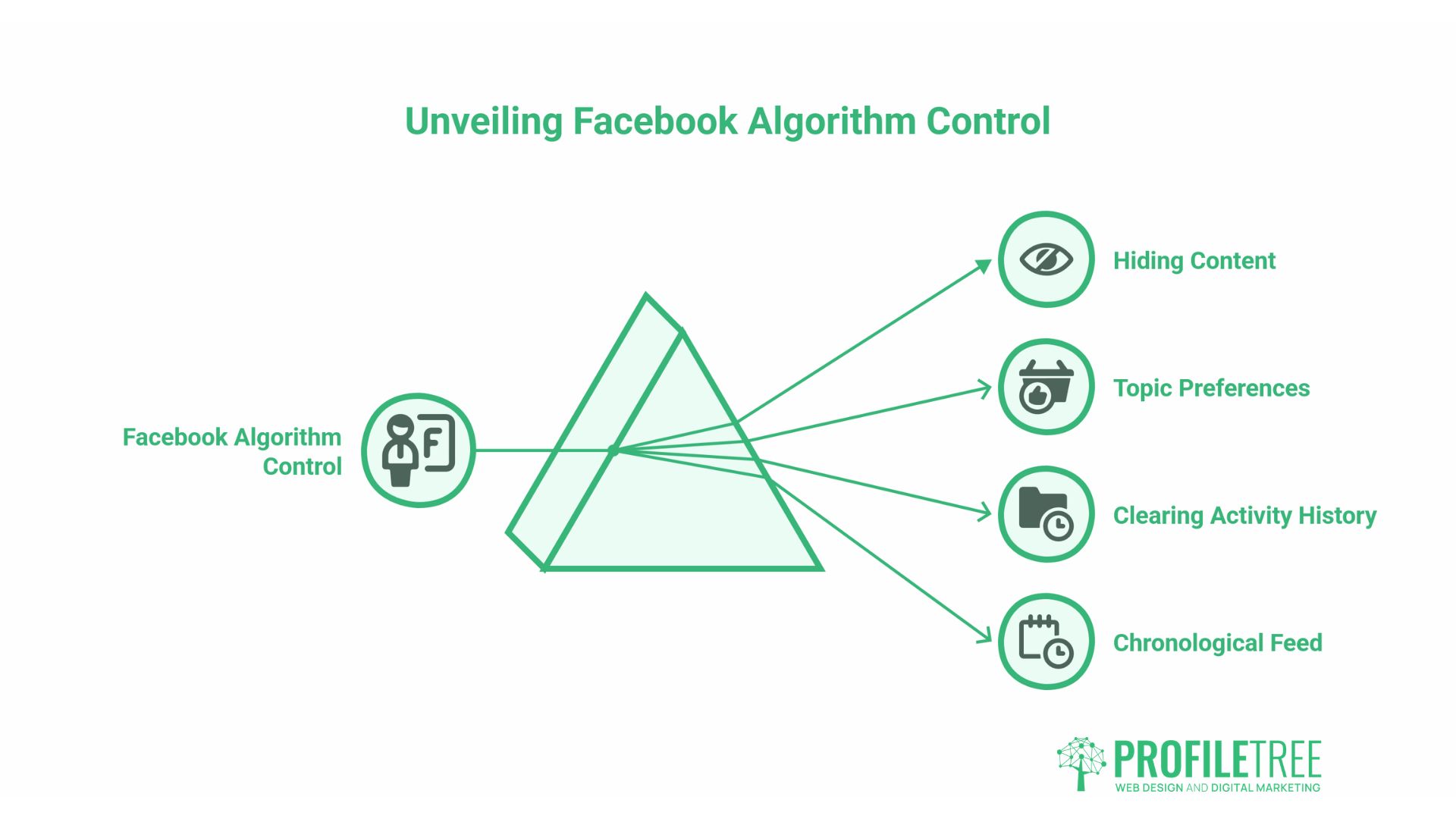
Users can reset or retrain their Facebook algorithm through their account settings. On the mobile app, this sits under Settings and Privacy, then Feed, where you can access “Manage your Feed.” Options include hiding content from specific sources, marking topics as “See less” or “See more,” and clearing the activity history that informs your interest profile. The chronological feed option, available to UK users under the Online Safety Act, can be accessed from the Feed menu and bypasses AI ranking entirely.
For businesses, the equivalent consideration is audience re-engagement. If a page’s engagement has dropped significantly over months, the algorithm has essentially learned that most followers do not find the content worth engaging with. Recovering from this requires sustained improvement in content quality and format over time; there is no technical shortcut that resets the page’s historical signal data, unlike a user’s personal feed preferences.
For teams managing this process, the case for professional social media support often becomes clearest at exactly this point: when organic reach has declined to a level where the effort required to recover it exceeds what can realistically be managed in-house. ProfileTree’s digital training programmes also offer an intermediate path, building the internal capability of business owners and marketing staff to manage these platforms more effectively without fully outsourcing.
Conclusion: the Algorithm of Facebook
Facebook’s algorithm rewards content that people find worth sharing, not content that merely earns a passive like. For UK and Northern Ireland SMEs, understanding the mechanics behind that distinction, combined with the regulatory context that shapes Meta’s operations in this market, is what separates businesses that achieve consistent reach from those watching their numbers decline.
The ProfileTree guide to Facebook marketing covers the broader strategic picture, and social media marketing support is available for teams that want a structured approach rather than trial-and-error.
FAQs
How often does the Facebook algorithm change?
Meta updates its ranking models continuously. Minor signal-weighting shifts occur without announcement; major structural changes are less frequent but more significant. Following Meta’s Newsroom and Meta for Business blog gives the most reliable advance notice.
Why is my Facebook organic reach below 2%?
It reflects Meta’s shift from social graph to interest graph ranking. Your posts only reach followers when Andromeda predicts meaningful engagement. Improving content quality, format variety, and early engagement rates in the first hour after posting are the most direct levers.
Does the Facebook algorithm prefer Reels over static posts?
Reels have a broader potential reach because they draw from the unconnected discovery feed. That advantage disappears if completion rates are low. Use Reels to reach new audiences and static posts to deepen engagement with existing followers.
What is a shadowban on Facebook in 2026?
Meta calls it “limited distribution.” It applies to content that triggers policy violations or to pages with accumulated low-quality signals. Check Facebook’s Page Quality section in Page Settings to see whether any restrictions are active on your page.