
The Importance of a Website for Your Business: A Complete Guide
Table of Contents
The importance of a website for any business becomes clear the moment a potential customer searches for what you offer. That search happens on Google, at any hour, with no prior awareness of your brand. If your business does not appear in those results, that customer moves on to someone who does. A website is the asset that makes you findable, and for SMEs across Northern Ireland, Ireland, and the UK, being findable in local search is often the difference between a steady pipeline of enquiries and a reliance on word of mouth alone.
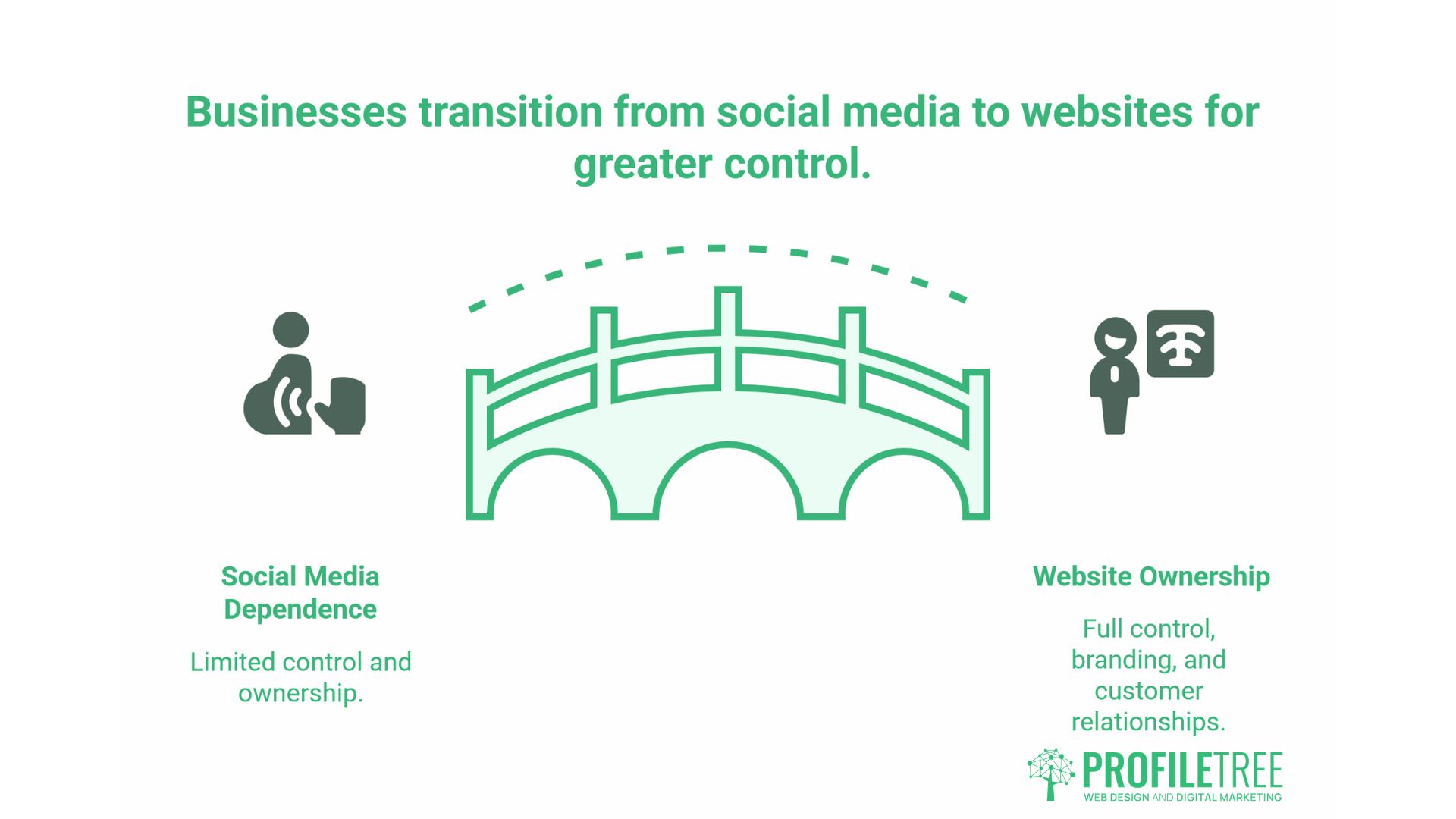
What separates a website from every other online presence is ownership. A social media profile is a platform property. A business directory listing exists on someone else’s terms. A website built on your own domain is yours to control, build on, and keep. It collects data about your visitors, supports every other marketing channel you run, and builds authority with search engines over time. Understanding the importance of a website means understanding that it is not just a digital brochure; it is the infrastructure on which your entire online presence depends.
Digital Sovereignty: Owning vs Renting Your Online Presence
Consider a business that built its entire customer base through Facebook over five years. Page reach, group members, event bookings, all of it lived on a platform the business did not own. When Facebook reduced organic reach for business pages, many of those businesses lost their primary customer channel with no warning and no alternative.
This is the risk of building on rented land. Social media platforms are tools for reaching audiences. They are not substitutes for a digital asset you control. A website gives a business its own address, data, and rules. Nobody can change the algorithm on your site, restrict your reach, or suspend your account because you violated a policy you did not write.
The same principle applies to business directories, review platforms, and third-party marketplaces. All of them carry the same fundamental risk: the platform’s commercial interests will always take priority over yours. A website operating under your own domain is the only genuinely owned digital property in that list.
“The businesses we see struggle most online are the ones that outsourced their digital presence entirely to platforms they don’t control,” says Ciaran Connolly, founder of ProfileTree, a Belfast-based web design and digital marketing agency. “A website isn’t just a brochure; it’s the infrastructure your entire digital strategy should be built on.”
Why a Website Is Important for Your Business: 12 Practical Reasons
The case for a website is often stated in vague terms: credibility, visibility, and growth. Those outcomes are real, but the mechanisms behind them are worth understanding in detail. The following reasons matter most for SMEs across the UK and Ireland.
1. It Establishes Credibility Before the First Conversation
When a prospective customer searches for a service and finds a business with no website, the immediate assumption is that the business is either very small, inactive, or not worth the risk. Research by Verisign consistently finds that the majority of consumers are more likely to contact a business with a professional website than one without. That perception shapes buying decisions before a single word has been exchanged.
The credibility a website provides is not purely aesthetic. A business email address on your own domain (yourname@yourbusiness.co.uk) signals permanence in a way that a Gmail address does not. An SSL certificate signals that the site is secure. These details are invisible to the business owner but immediately visible to a potential customer assessing whether to make contact.
2. It Is Open 24 Hours a Day
A website does not close. A potential customer researching at 11 pm, comparing options on a Sunday morning, or checking details during a lunch break can find and evaluate a business at any point without any action required from the owner. For service businesses in particular, where a customer might need a solicitor, a plumber, or a consultant at short notice, being findable at any hour is a direct commercial advantage.
3. It Makes Your Business Findable in Local Search
The importance of a website for local businesses is especially clear when you look at how search actually works. When someone searches “accountant Derry” or “web design Belfast,” the results are built around a combination of Google Business Profile data and the website behind it. A business without a website can still have a Google Business Profile, but that profile has limited depth and no supporting content for Google to assess topical relevance. The website and the Google Business Profile work together. One without the other leaves significant search visibility on the table.
ProfileTree’s work on local SEO consistently shows that businesses with well-structured websites rank more reliably in “near me” searches than those relying solely on directories or social profiles.
4. It Gives You Data About Your Customers
A website connected to Google Analytics 4 shows which services attract the most interest, where visitors are coming from geographically, which pages cause people to leave, and what questions they ask before making a decision. None of that data is available when an online presence lives entirely on a third-party platform. Social media gives you likes and follower counts. A website gives you the insight to make decisions about content, pricing, and conversion.
For businesses that want to move beyond basic traffic reporting, ProfileTree’s guide to Google Analytics for content marketing explains how to turn that data into practical editorial and commercial decisions.
5. It Supports Every Other Marketing Channel
Social media advertising drives traffic to a destination. Email campaigns link to a landing page. Search ads point to a URL. Without a website, every one of those channels is either unavailable or significantly less effective. The website is the central asset that makes digital marketing coherent. When all channels point to the same well-built domain, the cumulative effect is greater than the sum of any single channel working independently.
6. It Allows You to Showcase Your Work and Build Trust Over Time
Case studies, testimonials, portfolio examples, and team profiles all contribute to the trust a potential customer develops before making contact. These elements can exist on social media, but they are scattered, temporary, and subject to the platform’s formatting constraints. On a website, they are presented in the context you choose, at the pace you set, and in a format that remains consistently accessible.
7. It Is More Cost-Effective Than Traditional Advertising Over Time
A well-built website that ranks organically for relevant search terms generates enquiries without ongoing spend. A half-page ad in a local newspaper runs once and delivers nothing after the payment period ends. The upfront cost of a professional website is higher, but the asset continues to work for years. For SMEs with limited marketing budgets, organic search traffic from a well-optimised site is often the most cost-efficient channel available and unlike paid advertising, it continues even after the budget runs out.
8. It Helps You Compete with Larger Businesses
A well-designed, properly optimised website levels the playing field in ways that physical presence cannot. A sole trader with a strong website and a clear content strategy can outrank a national chain for local search terms because Google is assessing relevance and quality, not company size. The importance of website design and technical performance is particularly visible here: a fast, well-structured site earns rankings that a slow or poorly built one cannot, regardless of how large the business behind it is.
9. It Enables Online Lead Generation and Direct Sales
For service businesses, a website with clear calls to action, an enquiry form, and well-structured service pages converts browsers into leads at any hour. For businesses selling products, a website provides a direct sales channel without the commission fees and branding constraints of a marketplace. The website is the only environment where the entire customer journey from awareness through to enquiry or purchase can be controlled end-to-end.
10. It Protects Against Platform Changes
Social platforms change their algorithms, adjust advertising policies, and occasionally shut down entirely. A business that built its online presence on a single platform has no fallback when those changes occur. Organic search traffic, email subscribers, and direct visits are channels the business controls. They cannot be switched off by a third-party commercial decision.
11. It Supports Content Marketing and Long-Term Authority
A website with a regularly updated blog or resource section builds topical authority over time. Google’s ranking systems assess whether a site covers a subject thoroughly and consistently, not just whether individual pages contain certain phrases. Businesses that publish genuinely useful content about their sector attract search traffic, earn links from other sites, and become a default reference point for their audience. This is how content marketing works, and it requires a website as the foundation.
For further context on what the data shows about website performance and business growth, ProfileTree’s business website statistics guide is worth reviewing.
12. It Gives Your Brand a Professional Visual Identity Online
Typography, colour, photography, and spacing, these elements communicate quality before a visitor reads a word. On social media, branding is constrained by the platform’s templates. On a professionally built website, every visual decision is intentional and consistent. Research shows that users form judgements about a site’s credibility within milliseconds of landing on it. A site that looks dated or unprofessional signals the same about the business behind it, regardless of how strong the actual service is.
The UK and Ireland Perspective
Most articles about why websites matter are written with a US audience in mind. For businesses trading in the UK and Ireland, several specific factors shape the case for a properly built site.
Domain Choice and Local Trust
A .co.uk domain signals to UK consumers that the business is UK-based. For service businesses where local credibility matters, solicitors, accountants, tradespeople, consultants, the domain extension is a genuine trust signal, even if a small one. Irish businesses face the same consideration: a .ie domain communicates that the business operates in Ireland and understands the local market. A .com suits businesses targeting multiple markets, but for a Belfast or Dublin SME serving local clients, the country-code domain carries real weight with local audiences.
GDPR and Data Privacy as a Competitive Differentiator
UK and Irish businesses are subject to GDPR and the UK Data Protection Act 2018. A website that handles this correctly with a clear cookie consent mechanism, an accessible privacy policy, and appropriate data handling for contact forms demonstrates compliance and builds trust with customers who are increasingly aware of how their data is used. Businesses that handle this poorly face regulatory risk and, more practically, lose the confidence of privacy-conscious customers. A professionally built website addresses these requirements by design.
Google Business Profile and Local Maps Visibility
For high-street businesses, hospitality, and local services, Google’s local pack (the map and three-result display for location-based searches) is often the first result a potential customer sees. A Google Business Profile is necessary to appear there, but the profile is significantly strengthened by a website that provides detailed, consistent information about services, location, and hours. The two work together: the profile captures the local search, and the website provides the depth that converts the click into an enquiry.
Accessibility Requirements
UK public sector websites are legally required to meet WCAG 2.1 AA accessibility standards. The legal requirement does not yet extend to all private businesses, but accessibility is increasingly treated as a baseline expectation by users and search engines alike. A website that works for users with visual impairments, motor difficulties, or cognitive differences reaches a wider audience and avoids the reputational risk of exclusion. ProfileTree’s work on accessibility in website design covers the practical implications for businesses in regulated sectors.
Website vs Social Media: A Practical Comparison
The most common objection to investing in a website is that a social media presence already does the job. For some very early-stage businesses, a social profile is a reasonable starting point. But the two are not interchangeable.
| Factor | Your Own Website | Social Media Profile |
|---|---|---|
| Ownership | You own the domain, data and content | Platform owns the account and can suspend it |
| Search visibility | Can rank for thousands of search terms over time | Limited — social profiles rarely rank for service queries |
| Customisation | Full control over design, layout and functionality | Constrained by platform templates |
| Data access | Full analytics: traffic sources, behaviour, conversions | Engagement metrics only — no conversion data |
| Algorithm risk | None — organic traffic is not platform-dependent | High — reach can be reduced without notice |
| Content longevity | Pages remain findable for years | Posts are buried within hours |
| Credibility signals | SSL, professional domain email, structured content | Follower count, which is easily gamed |
| GDPR compliance | Can be built in from the start | Dependent on the platform’s own compliance |
Social media and a website serve different functions. Social media reaches and engages audiences. A website converts that engagement into enquiries, builds long-term authority, and provides the infrastructure that the business owns. Treating them as alternatives rather than complementary channels typically results in underperformance on both.
How to Choose the Right Approach
The decision is not whether to have a website, but what kind and how to approach the build. For most SMEs, the question comes down to three practical considerations.
The first is purpose. A website designed primarily to capture local service enquiries needs different features and content from one designed to sell products nationally. Clarifying the primary commercial goal shapes every decision from structure to content to SEO strategy.
The second is build quality. A website built quickly on a generic template with no attention to page speed, mobile performance, or technical SEO will rank poorly and convert poorly, regardless of how much content is added later. The upfront investment in a properly built site pays back through performance over time. ProfileTree’s UK business website guide covers what to look for when commissioning a build.
The third is an ongoing strategy. A website is not a one-time task. Search rankings require consistent content, technical maintenance, and ongoing link acquisition. Businesses that treat the website as a completed project rather than a live marketing channel tend to see declining performance within 12 to 18 months.
Conclusion
The importance of a website for business is not a matter of debate; it is a matter of infrastructure. Every other digital channel a business uses, from social media to email to paid search, performs better when it points to a website the business owns and controls. For SMEs across Northern Ireland, Ireland, and the UK, a professionally built, well-optimised site remains the most reliable way to generate consistent enquiries, build long-term authority, and compete on equal terms with businesses far larger. If your current site is not delivering, or you are yet to build one, ProfileTree’s web design team works with businesses at every stage to create websites that rank, convert, and grow.
FAQs
Do I need a website if I already have a strong Facebook page?
A Facebook page reaches people already on the platform. A website reaches people searching on Google. Facebook can reduce your reach at any time; your website’s organic traffic cannot be switched off by a platform decision. The two serve different purposes and work best together.
How much does a professional website cost in the UK?
A professionally built small business website typically costs between £2,000 and £8,000, depending on scope and complexity. E-commerce sites usually start at £5,000 and upwards. Prices vary by supplier and specification. Always request a detailed brief and written quote before committing.
Does having a website help with local SEO?
Yes. Google uses your website content to understand what your business does and where it operates. A properly optimised site reinforces your Google Business Profile and significantly improves your chances of appearing in local search results.
Is a .co.uk or .ie domain better than .com for a UK or Irish business?
For businesses primarily serving UK or Irish customers, a country-code domain carries a stronger local trust signal and tends to perform better in regional search results. A .com suits businesses targeting international audiences.