
Agile Marketing: The Definitive Guide for UK Teams
Table of Contents
Most marketing plans are out of date before the campaign even launches. Budgets get cut mid-quarter, a competitor moves first, and the audience a team mapped six months ago has already shifted its attention elsewhere. Agile marketing is the direct response to that problem: short working cycles, a shared backlog, and decisions made on evidence rather than the loudest opinion in the room.
This guide covers what agile marketing actually means, the frameworks teams use to run it, why UK and Northern Ireland businesses hit specific friction points that most agile guides ignore, and how to implement it with a small team and a normal-sized budget. It also covers the practical failure modes: sign-off bottlenecks, senior stakeholders overriding data, and agencies still working to quarterly retainers while the internal team tries to run two-week sprints.
What Is Agile Marketing?
Agile marketing is a way of planning and running marketing work in short, iterative cycles rather than long, fixed campaigns. A team agrees on a focused set of tasks for a defined period (usually one to four weeks), delivers something measurable at the end of it, reviews what worked, and adjusts before the next cycle starts.
“Agile marketing is not a software tool or a meeting format. It is a decision about how your team makes decisions: incrementally, with evidence, rather than in big upfront bets.” Ciaran Connolly, founder of ProfileTree
The approach borrows its logic from software development, where teams found that rigid multi-month plans could not keep pace with changing requirements. Marketing runs into the same problem on a shorter timeline: a campaign signed off in January rarely still fits the market by March.
Agile marketing is not the same thing as Scrum. Agile is the underlying philosophy: work in short cycles, test and learn, respond to change. Scrum is one specific framework for putting that philosophy into practice, using fixed-length sprints and defined roles. A team can be agile without running Scrum; they cannot run Scrum without being agile.
The Agile Marketing Manifesto
A group of marketing practitioners met at SprintZero in 2012 and set out seven values that separate agile from traditional marketing practice:
- Validated learning over opinions and conventions
- Customer-focused collaboration over silos and hierarchy
- Adaptive and iterative campaigns over big-bang campaigns
- Ongoing customer discovery over static prediction
- Flexible planning over rigid planning
- Responding to change over following a fixed plan
- Many small experiments over a few large bets
The manifesto’s stewards later condensed and updated this list to five values, folding some of the original seven into one another and adding an explicit focus on business outcomes over activity. Most working teams still refer to the original seven when explaining the concept, since they map more directly onto day-to-day marketing decisions. Either version does the same job: it tells the team to test with real data ahead of deferring to seniority, and to treat the plan as a direction, not a contract.
Traditional (Waterfall) Marketing vs Agile Marketing
Most UK marketing teams still operate under Waterfall principles, whether or not they use that term. A three-month brand campaign planned in January, approved in March, launched in April, and reviewed in July is a Waterfall campaign. The feedback arrives only after the budget has already been spent.
| Dimension | Waterfall Marketing | Agile Marketing |
| Planning cadence | Annual or quarterly, locked upfront | Continuous, reviewed every one to four weeks |
| Feedback loops | Post-campaign, often 90-plus days after the decision was made | Mid-sprint, feeding the next cycle in real time |
| Risk profile | High: large budgets committed before validation | Lower: small bets tested before scaling |
| Resource allocation | Fixed by channel or department | Flexible, follows data and opportunity |
| Departmental structure | Siloed by function (SEO, social, brand, paid) | Cross-functional squads built around outcomes |
| Success metric | Campaign delivery against the original brief | A measurable business outcome per sprint |
The difference is not really about speed; it is about when decisions get made and on what basis. Waterfall marketing asks a team to be right at the start. Agile marketing accepts that the team will be wrong at the start and builds in the mechanism to correct course before it becomes expensive.
Why UK and Northern Ireland Marketing Teams Struggle With Agile
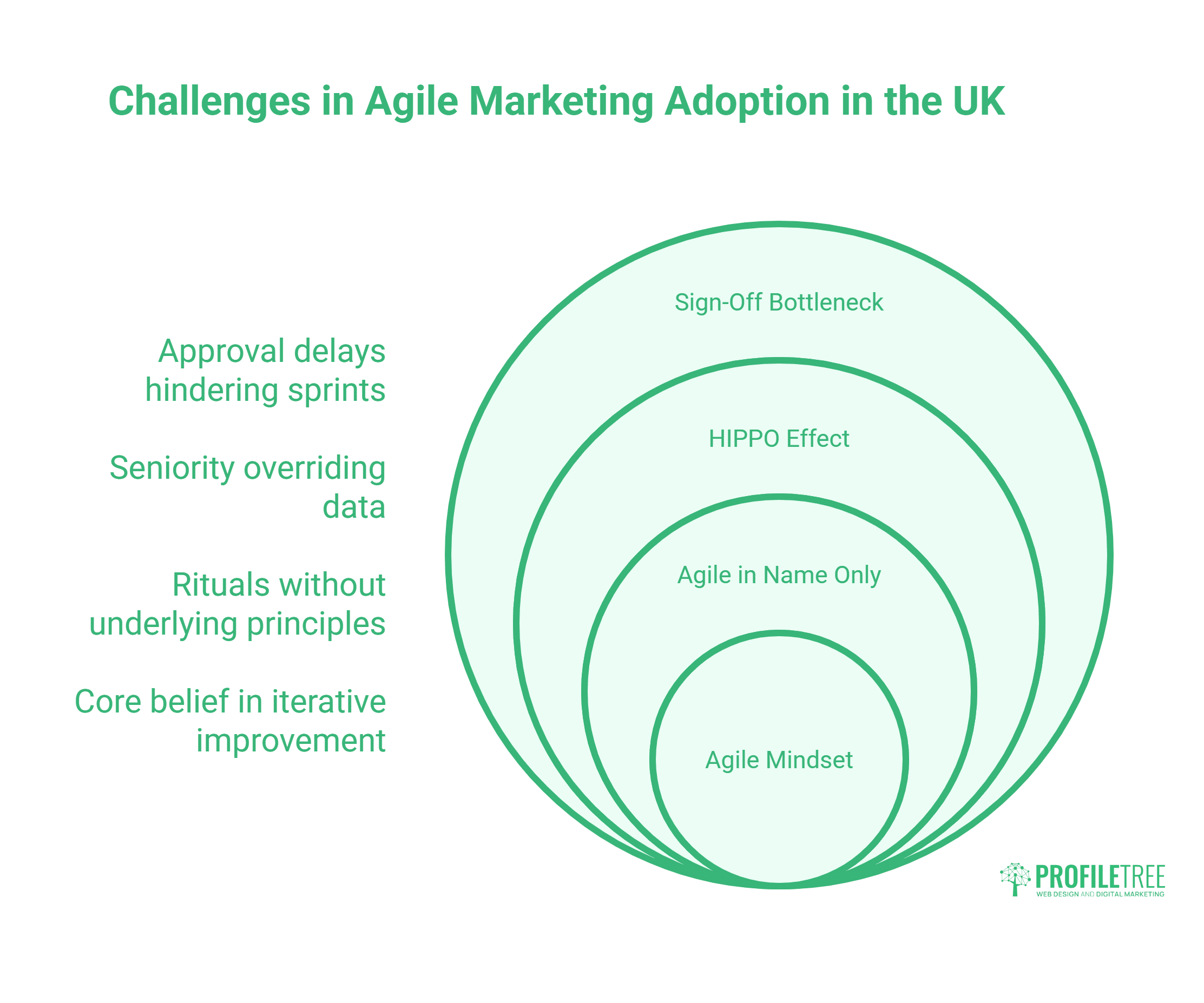
Most agile marketing guides are written for US technology companies or global brands with large, independent marketing functions. The structural reality in most UK and Northern Ireland businesses looks different, and it changes how agile actually needs to be introduced.
The Sign-Off Bottleneck
Many UK organisations, particularly those with a traditional management structure, need several layers of approval before any marketing output goes live. A two-week sprint loses most of its value if the finished piece then sits in a review queue for three weeks. Running agile without addressing sign-off culture produces the worst of both: short sprints with long approval tails.
The practical fix is to bring the approving stakeholder, whether that’s a senior director, a legal team, or a client, into sprint planning rather than only the final review. When decision-makers understand what a sprint is attempting and why, approval tends to move faster because there is less to explain after the work is already done.
The HIPPO Effect
The HIPPO (Highest Paid Person’s Opinion) is one of the most commonly cited reasons agile fails in marketing teams. When the most senior person in the room overrides data with a preference, the feedback loop that agile depends on breaks down.
Agile does not require flattening a company’s hierarchy; it does require that sprint priorities be set based on customer data, campaign performance, and search demand rather than on seniority alone. That is a cultural change. In many UK businesses, it needs explicit backing from leadership before it becomes normal practice, not a one-off experiment. The section below on ad-hoc demands sets out a formal way to manage this without turning every senior request into a personal confrontation.
The “Agile in Name Only” Problem
Plenty of UK teams run standups, use a Trello board, and call their work items “sprints” without any of the underlying agile mindset. The rituals become overhead rather than tools for learning, and teams end up carrying the process cost of agile with none of the speed benefit.
If a team is going through the motions without changing how it makes decisions or responds to feedback, it is worth stepping back and asking whether the structure is serving the work or just replacing it.
Core Agile Marketing Frameworks: Scrum, Kanban and Scrumban
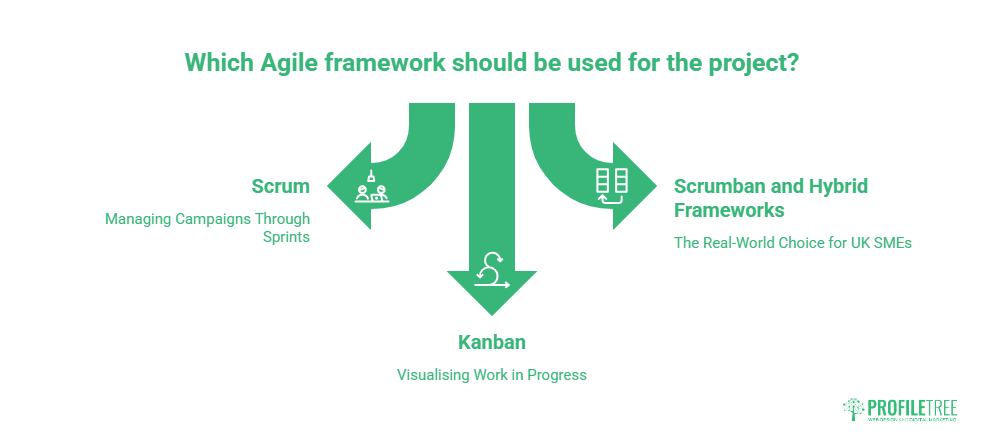
Three frameworks sit under the agile marketing umbrella, and the right choice depends on team size, the type of work involved, and how much structure clients or senior stakeholders expect.
Scrum: Managing Campaigns Through Sprints
Scrum organises work into fixed-length sprints, typically one to four weeks, with defined roles, a planning session at the start, and a retrospective at the end. At the start of each sprint, the team pulls tasks from a prioritised backlog and commits to finishing them within that window. A sprint review then assesses what was delivered, and a separate retrospective looks at how the team can work better next time.
Scrum works well for structured, repeatable cycles: campaign development, content batches, and product launch sequences, where deliverables can be planned and reviewed within short windows. The framework needs a Marketing Owner (sometimes called a Product Owner), who sets priorities and manages the backlog, and a Scrum Master, who facilitates the process and protects the sprint from scope creep. Managing the team day to day is not part of the role.
Kanban: Visualising Continuous Flow
Where Scrum uses time-boxed sprints, Kanban focuses on continuous flow. Work items move through columns on a board, typically “To Do,” “In Progress,” “In Review,” and “Done,” with a limit set on how many tasks can occupy each stage at once. These work-in-progress (WIP) limits are what make Kanban useful: they prevent a team from starting ten things and finishing none, which is the default failure mode for a busy marketing function with no structure in place.
Kanban suits always-on activity: social media management, SEO content, email schedules, and community management all benefit from a system that does not force artificial sprint boundaries onto continuous work. The two metrics that matter here are lead time (how long a task takes from entering the backlog to completion) and throughput (how many tasks the team finishes per week), both of which feed directly into reporting cadences.
Scrumban and Hybrid Models
Most marketing teams cannot operate in a purely agile state. Finance sets annual budgets. Clients sign off on plans at the start of a quarter. Regulatory requirements under ICO and CMA guidance often demand fixed review periods before creative goes live. Scrumban, a blend of Scrum’s sprint structure and Kanban’s visual flow, offers a middle path: teams work within quarterly or monthly planning horizons but manage daily execution through a visual board with WIP limits, while ongoing tasks continue alongside larger projects that run in cycles.
| Framework | Best suited for | WIP limits | Primary metric | Meeting cadence |
| Scrum | Structured content and campaign cycles | Per sprint | Velocity (tasks or story points per sprint) | Daily standup, sprint planning, retrospective |
| Kanban | Continuous, unpredictable workloads | Per column | Lead time and throughput | Optional, run as needed |
| Scrumban | Mixed planned and reactive teams | Hybrid | Both, tracked separately | Sprint ceremonies plus a standing triage slot |
For UK SMEs starting out, this hybrid model is often the right entry point. It respects the business’ existing rhythms while introducing the iterative discipline that makes agile effective in the first place.
Dual-Track Sprints: Managing Creative and Analytical Work Together
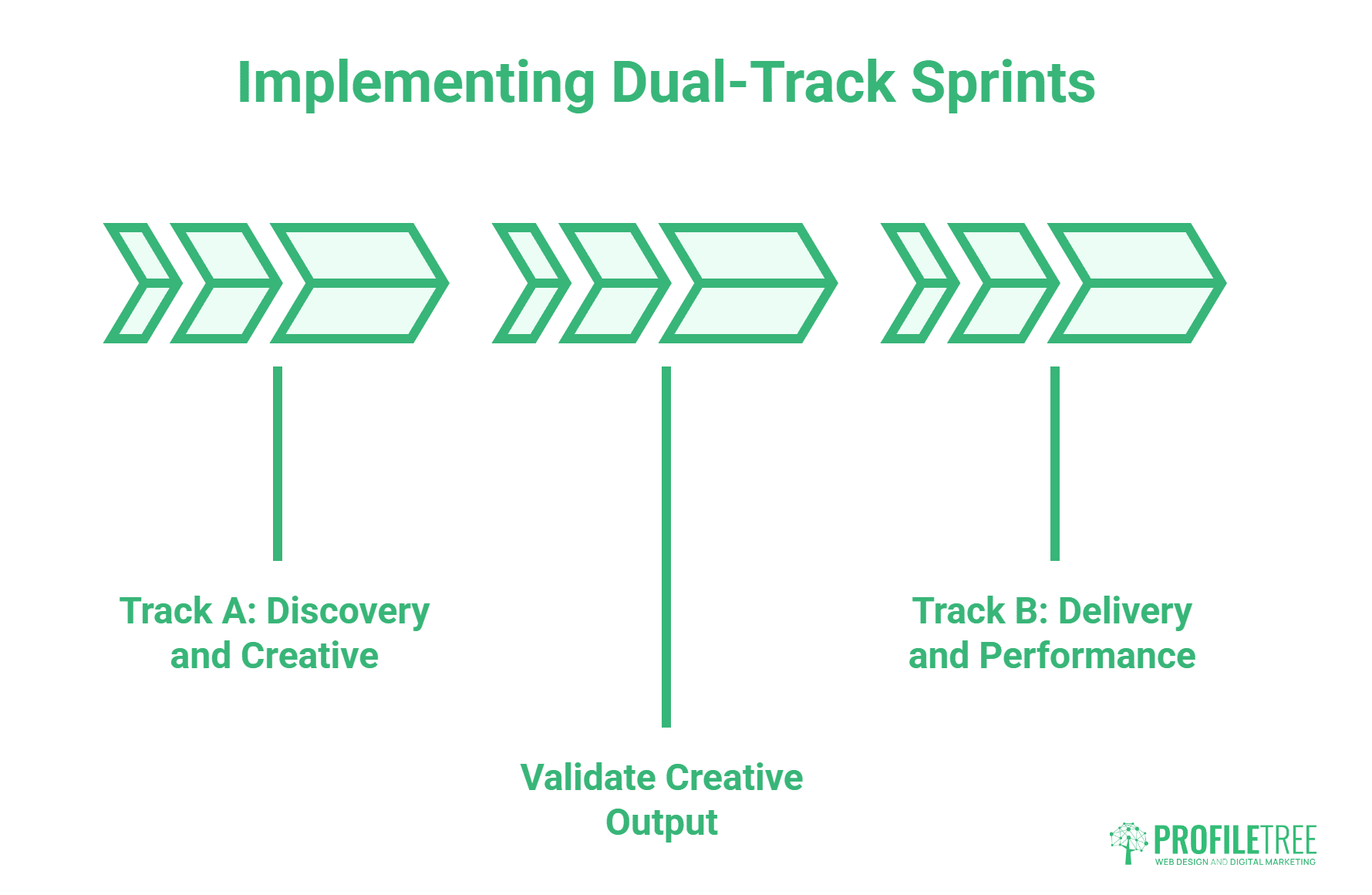
One structural problem with applying Scrum directly to marketing is that creative work and analytical work run on different time cycles. A two-week sprint suits writing and publishing five SEO articles, running A/B tests on ad copy, and reporting on paid search performance. It does not suit developing a new brand identity, producing a video series, or building a campaign concept from nothing. Creative work needs incubation, iterative refinement of ideas, and longer feedback cycles from stakeholders with subjective opinions.
Dual-track sprints solve this by running two parallel workstreams.
Track A: Discovery and Creative
This track carries work that cannot be delivered inside a standard sprint: brand strategy, video production briefs, new campaign concepts, and website redesign projects. It runs on longer, overlapping phases, typically four to eight weeks, with defined review gates rather than sprint end dates. Output from Track A feeds into Track B once it has been validated.
Track B: Delivery and Performance
This track handles execution work on a standard two-week cycle: SEO content, paid media optimisation, email campaigns, social posts, and conversion testing. Track B draws on assets developed in Track A, so the two tracks must be deliberately sequenced; run in isolation, they undercut each other.
A practical example: a professional services firm launching a new service line would use Track A to develop positioning, messaging, and visual identity over six weeks, while Track B simultaneously runs blog content, social posts, and search campaigns using placeholder copy and existing brand assets. When Track A delivers the new creative, Track B absorbs it at the next sprint boundary without disruption. Video production timelines rarely fit neatly inside two-week sprints, but the distribution and promotion plan built around that video usually can.
Managing Ad-Hoc Demands: The HiPPO Triage Protocol
A senior leader arrives mid-sprint with an urgent request: a competitor has launched something, an event has appeared on the calendar, or the managing director saw something on LinkedIn. The team drops current work to respond, the sprint collapses, and velocity data stops meaning anything. The team then gradually loses confidence in the whole system.
The fix is not to refuse senior requests. It is to give every request a formal triage path so urgency and importance get assessed the same way each time, rather than reactively. A designated triage gatekeeper, usually the Scrum Master or Marketing Director, assesses every unplanned request against three questions:
- Is this genuinely time-critical? If the deadline sits beyond the current sprint’s end date, the request goes into the backlog for the next planning session. Most “urgent” requests are not actually time-critical.
- Does it meet the threshold for sprint insertion? Define a threshold in advance, for example, a revenue impact above a set figure or a public-facing deadline within 48 hours. Only requests that clear the threshold qualify for mid-sprint insertion.
- What leaves the sprint to make room? The “one in, one out” rule is non-negotiable. If a new item enters the sprint, an equivalent amount of committed work returns to the backlog. This keeps velocity data reliable and stops the team from being permanently over-committed.
The gatekeeper role matters because it takes the social pressure out of the decision. The team is not refusing the managing director; an agreed process is managing the request, and that process was signed off by the managing director at the start of the programme.
Essential Agile Marketing Ceremonies
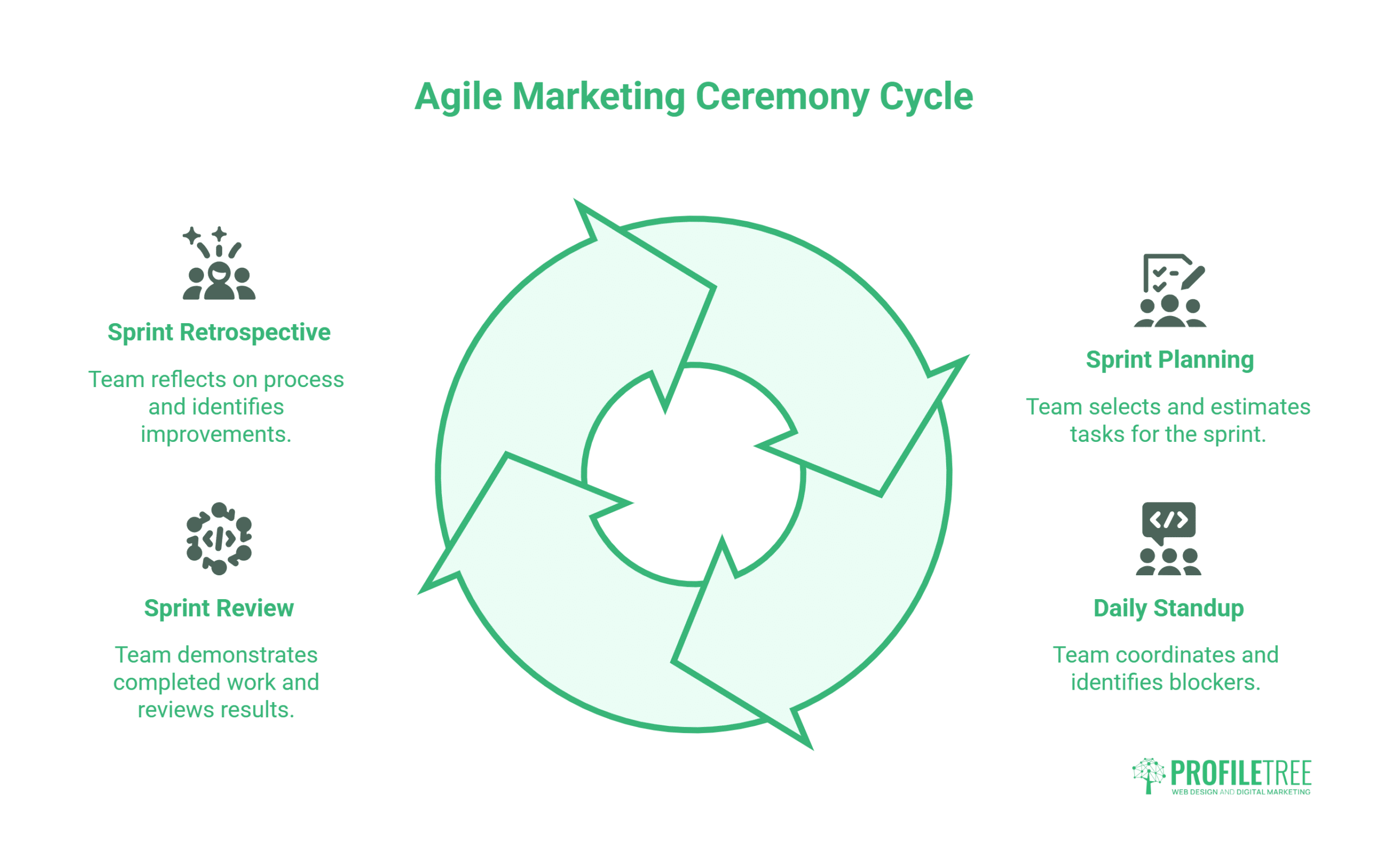
Four recurring meetings underpin any sprint-based marketing programme. These are not optional additions to an already full calendar; they replace the ad hoc check-ins, progress chases, and reactive status meetings that consume most marketing teams’ time.
Sprint Planning
Held at the start of each sprint, typically 60 to 90 minutes for a two-week cycle. The team selects items from the prioritised backlog, estimates effort, and commits to a sprint goal. The Scrum Master facilitates; the Marketing Director or Product Owner sets priorities. The goal itself matters more than the task list: “publish four blog posts” is a task list, while “move three service pages into the top 20 positions for their target terms” is a goal that gives the sprint review something worth discussing.
Daily Standup
Fifteen minutes, same time each day. Each person answers three questions: what did I complete yesterday, what am I working on today, and is anything blocking me? This is a coordination mechanism between peers, not a status report to a manager.
Sprint Review
Held at the end of each sprint. Completed work is demonstrated, not just reported, to stakeholders. Data from the sprint (campaign results, content performance, conversion rates) feeds directly into the next sprint’s priorities.
Sprint Retrospective
A separate meeting from the review, focused on process rather than output. A well-run retrospective takes 30 to 45 minutes and asks what went well, what did not, and what the team will change next time. This is the mechanism through which the team’s way of working improves, which is distinct from improving the work itself, and it should produce one or two concrete adjustments.
A sprint commitment only holds if the team can protect it. In most UK marketing environments, the biggest threat to that is an unplanned, urgent request landing mid-sprint, which is exactly what the triage protocol above is designed to manage.
What Agile Marketing Looks Like for a Team of Two to Five People
Most agile marketing guidance assumes a team of 10 or 20 people, with a dedicated Scrum Master and separate specialists for each channel. That is not the reality for most UK and Irish SMEs, where marketing is often one or two people, sometimes combined with another role entirely.
Picture a small team: one marketing lead and a part-time content writer, supporting a business with no separate digital function. There is no need for a certified Scrum Master here. One person deputises the role for an hour a week, running a short planning session and a five-minute check-in in place of a formal daily standup. The backlog might hold a mix of blog posts, a couple of landing pages, some organic social content for LinkedIn and Instagram, and a monthly email. A two-week sprint with three or four committed items is realistic. A two-week sprint with ten items is not, regardless of how motivated the team is.
The framework does not need to be pure Scrum or pure Kanban at this scale. Most small teams end up running a simplified Kanban board with a soft two-week review point attached, giving some of Scrum’s rhythm without the ceremony overhead that a two-person team cannot sustain. The point is not to follow a textbook version of agile; it is to build a working cadence of planning, doing, and reviewing that fits the team’s actual size.
Roles in an Agile Marketing Team
Three roles appear in most sprint-based marketing teams, adapted from their software development equivalents.
The Scrum Master facilitates the ceremonies, protects the sprint from scope creep, and removes blockers. In a marketing context, this is typically the most operationally experienced person on the team, seniority aside. The Scrum Master does not manage the team; the role serves the process.
The Product Owner is usually the Marketing Director or Head of Content. This person owns the backlog, sets priorities, and decides what goes into each sprint. They are the bridge between business objectives and the team’s daily work.
The cross-functional team brings together skills that are traditionally kept separate: SEO, copywriting, design, analytics, and social media. The team is self-organising within the sprint, meaning individuals pick up work from the board on their own initiative, without waiting to be assigned tasks by a manager.
The UK and Irish Agency-Client Agile Integration Playbook
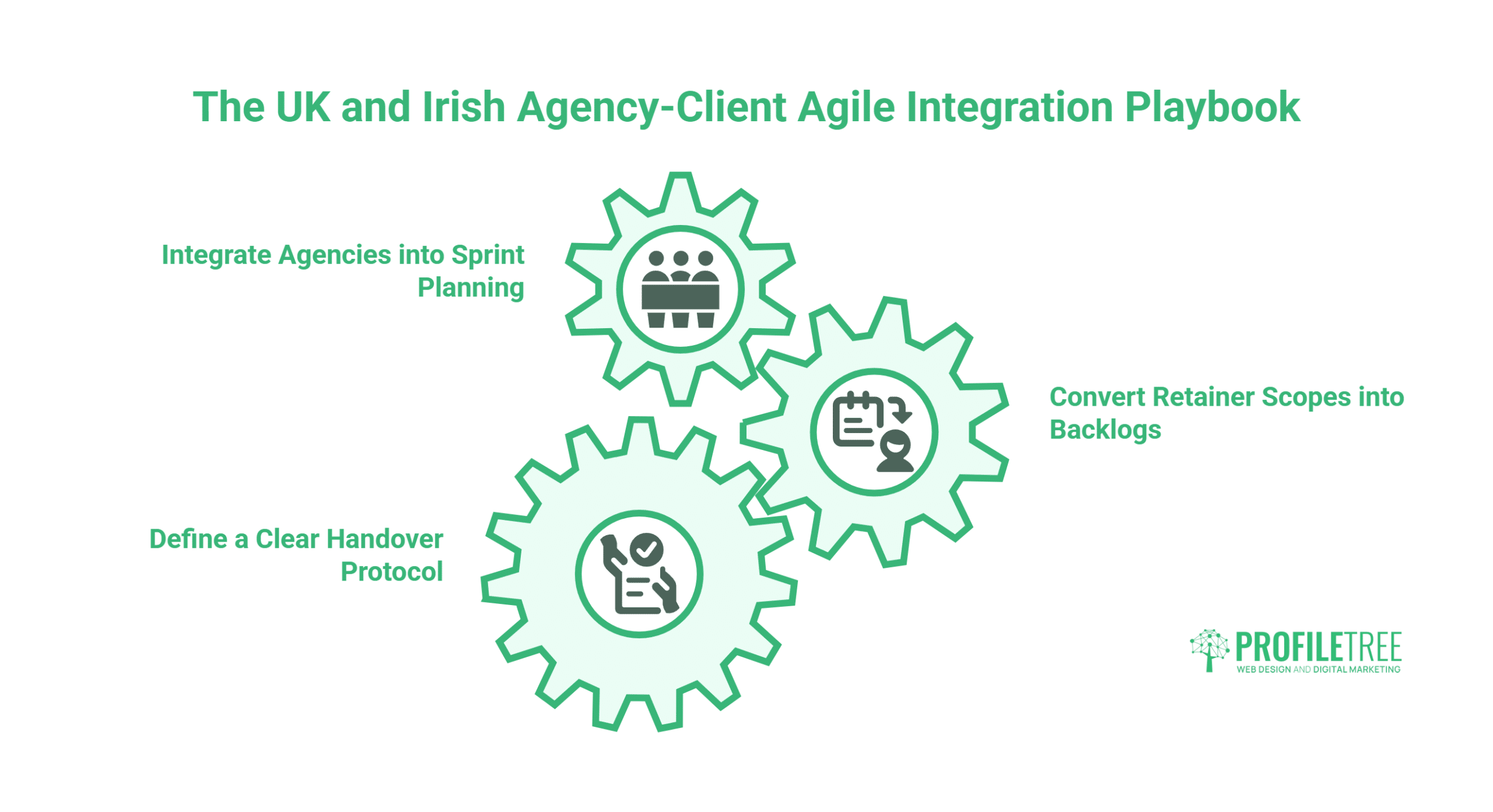
Most agile marketing guidance assumes that all marketing work happens within a co-located, in-house, cross-functional team. In the UK and Ireland, the reality is usually different. Many marketing directors manage a lean internal team alongside a cluster of external agencies on fixed-scope annual retainers: one for SEO, one for paid media, one for content, one for design. Those agencies typically operate on Waterfall timelines with monthly reporting.
Running internal sprints while agency partners work to quarterly deliverable schedules creates real friction. Three adjustments resolve most of it.
Integrate Agencies into Sprint Planning
Agency representatives should attend sprint planning sessions, not just monthly review calls, so the agency’s work is planned in line with the internal team’s cycle and deliverables tied to sprint boundaries rather than calendar months. Most agencies will accommodate this once the benefit of project clarity is explained.
Convert Retainer Scopes into Sprint-ready Backlogs
Annual retainer agreements define outputs: a fixed number of articles, a monthly ad budget, and a set of design assets. These outputs can be reorganised into a prioritised backlog at the start of the year and allocated to sprints during planning. This does not require renegotiating the contract; it changes the sequencing logic from “what was agreed in January” to “what delivers the most value this sprint.”
Define a Clear Handover Protocol
Agency assets entering the sprint (a batch of articles, a set of ad creatives, a new landing page) need a defined acceptance criterion so the internal team knows when work is genuinely done versus when it needs revision. Acceptance criteria are a standard Scrum tool and apply just as well to agency deliverables.
Teams that bring in external digital strategy support alongside an in-house marketing function typically move through this integration within two or three sprint cycles once the backlog structure is in place.
Implementing Agile Marketing: A 30-Day Migration Plan
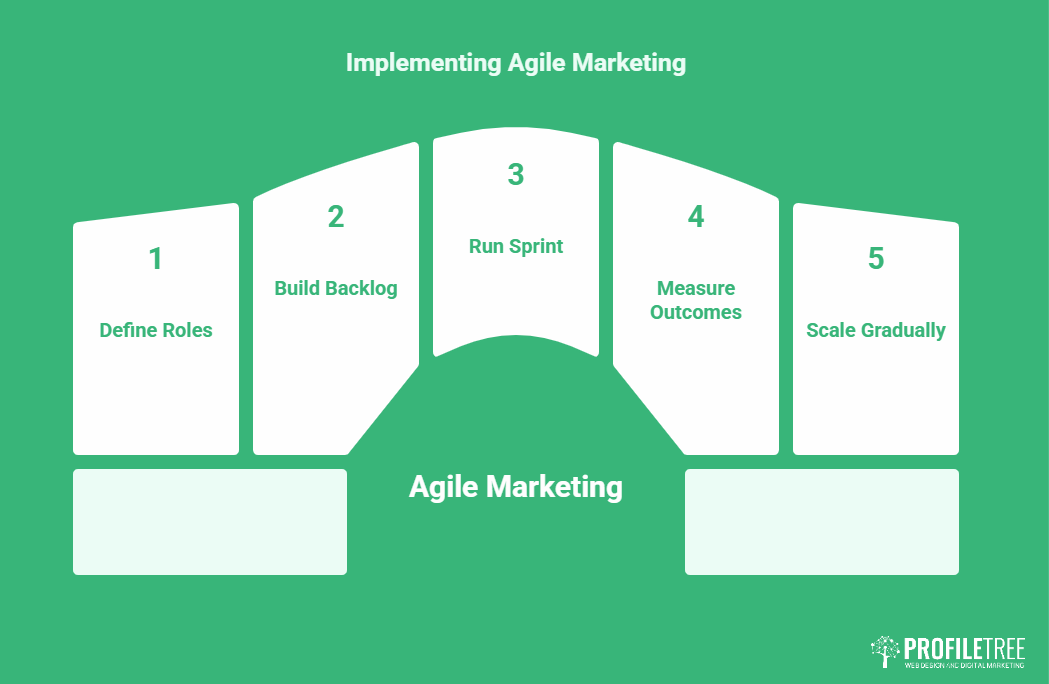
The first 30 days of an agile transition should focus on process infrastructure, not on changing how the work itself gets done. Teams that try to run a perfect version of Scrum from day one usually abandon it within six weeks.
Week 1: Audit and Roles
List everything the team is currently working on, assign rough effort estimates, and identify which tasks are genuinely urgent versus habitual. Decide who will act as Scrum Master and Product Owner, and make clear that these are facilitation roles, not a new management layer.
Week 2: Build the Backlog and Set the Cadence
Move all existing and planned work into a single prioritised backlog using a visible tool: Trello, Jira, Asana, or a physical board. Set the sprint length (two weeks is the default starting point for most marketing teams), and book all four ceremonies into recurring calendar slots before the first sprint starts.
Week 3: Plan and Protect the First Sprint
Select backlog items conservatively at the first planning session; it is better to complete 80% of the sprint goal cleanly than to overcommit and miss most of it. Once the sprint is committed, protect it. Separate the sprint’s core work from a small fast-response lane for genuine urgencies, so an unplanned request does not automatically turn the whole cycle into a reactive scramble.
Week 3 to 4: Run the Sprint and Apply Triage
Hold daily standups. The Scrum Master applies the triage protocol above to any mid-sprint requests, so none of them bypasses the process unchecked.
Week 4: Review, Reflect, and Hold the Line
Demonstrate completed work to stakeholders at the sprint review, then run a genuine retrospective and document two or three process changes for next time. From here, do not adjust the process constantly; give the framework at least three full sprint cycles before drawing conclusions about what is or is not working.
Common Reasons Agile Marketing Fails
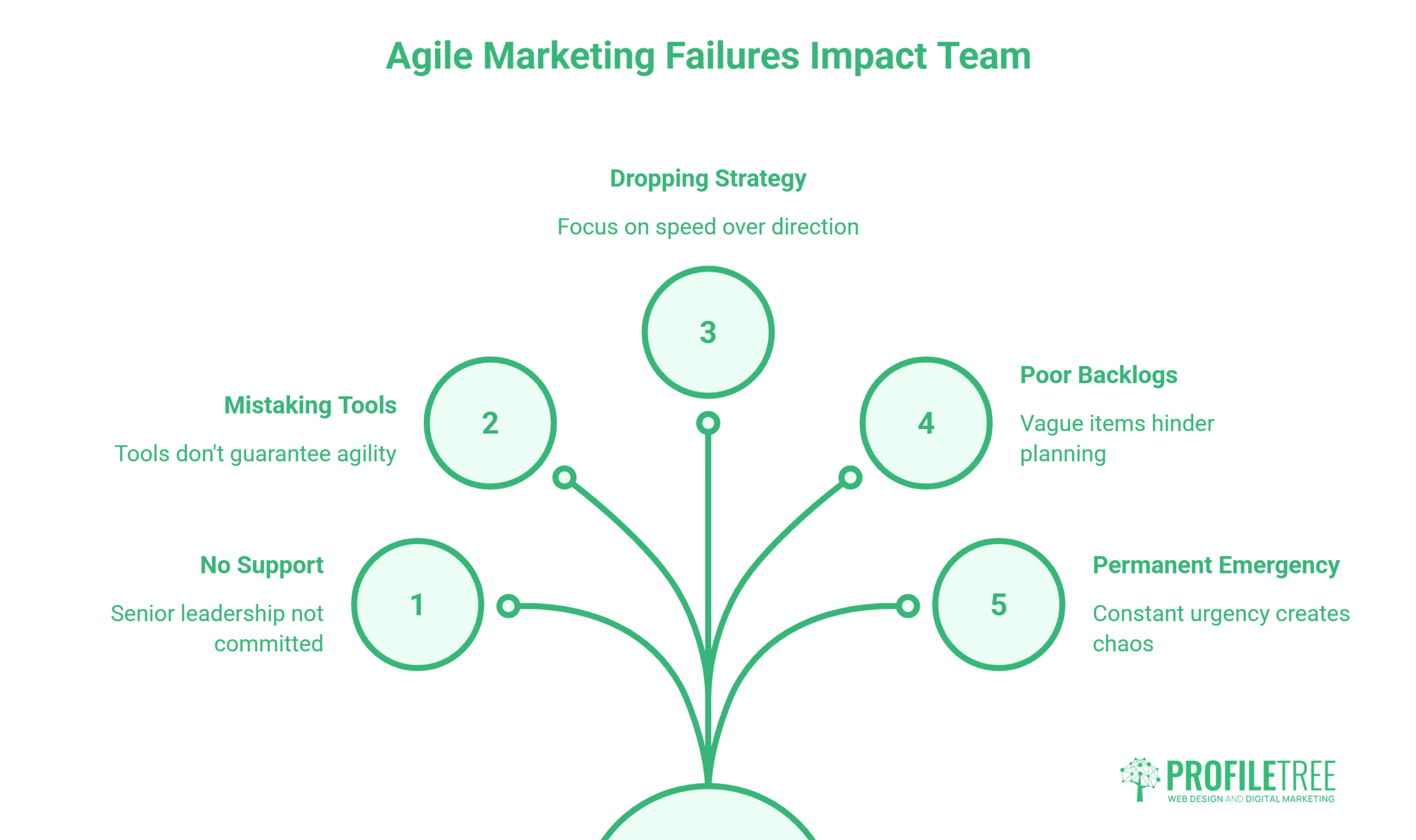
Most agile transitions fail for a handful of predictable reasons, and the framework chosen rarely has anything to do with it.
No Executive Support
If senior leadership is not committed to changing how decisions get made, the team runs sprints, but approvals still follow the old process. Agile cannot be bolted on from the bottom up in a hierarchical organisation without explicit backing from above.
Mistaking Tools for Change
Installing Jira or Trello does not make a team agile. The tools support the process, but the process depends on behaviour: prioritising the backlog honestly, protecting sprint commitments, and acting on what the retrospective actually finds.
Dropping Strategy for Speed
Agile is an execution method, not a substitute for marketing strategy. A team focused entirely on sprint velocity without a clear direction produces plenty of output that does not add up to much.
Poorly Written Backlogs
Vague items (“improve the website,” “do more social media”) cannot be prioritised, estimated, or reviewed properly. The quality of sprint planning comes directly from the quality of the backlog feeding it.
Treating Agile as a Permanent Emergency
Some teams adopt agile during a crisis and never adjust the pace once the emergency passes. A sprint culture where everything is always urgent is not agile; it is a different kind of chaos running on a shorter clock.
Measuring Agile Marketing Performance
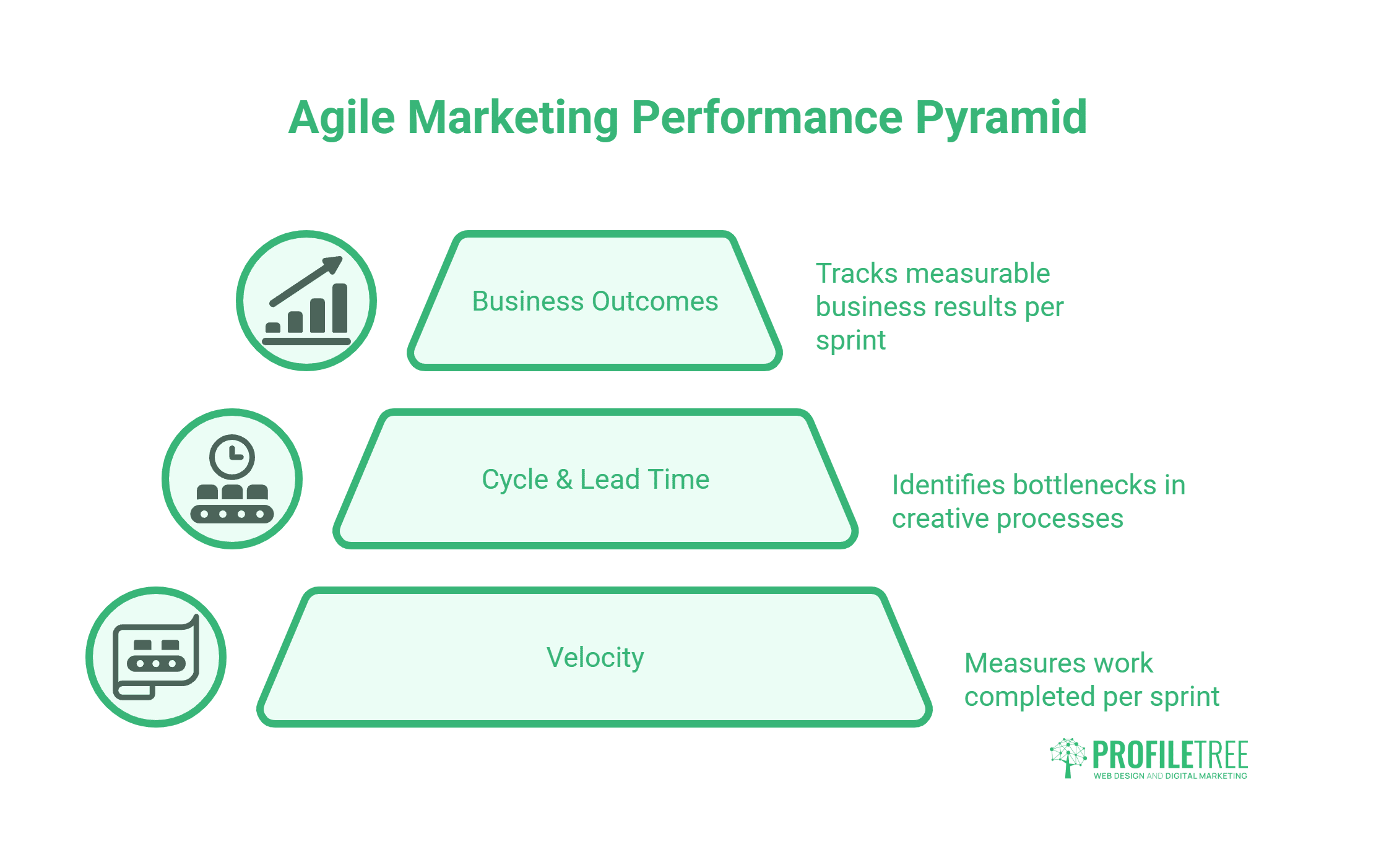
Measurement in agile marketing works at two levels: sprint-level metrics that assess immediate output and velocity, and strategic metrics that track direction and business impact. Confusing one for the other is a common source of frustration for teams new to the approach.
Velocity
Velocity measures how much work a team completes per sprint, in tasks or story points. It works best as a planning tool, not a performance metric: a team with consistent velocity can forecast output reliably, while velocity that swings sharply between sprints usually indicates scope creep or poor estimation.
Cycle Time and Lead Time
Cycle time measures how long a task takes from the point work starts to the point it is finished; however, lead time measures from the moment the task enters the backlog. Both are more useful than raw output volume for spotting bottlenecks in creative and approval processes.
Business Outcome Metrics
Each sprint should tie to at least one measurable business result: organic traffic growth, conversion rate improvement, cost-per-acquisition reduction, pipeline growth, or qualified lead volume. Agile ceremonies only earn their place if sprint goals connect to commercial targets; ticking off activity alone does not count. For SEO programmes specifically, this usually means tracking changes in ranking position and organic click data at the end of each cycle, feeding directly into the next sprint’s content priorities.
These sprint-level and strategic metrics should be reviewed at different points: sprint-level KPIs at the sprint review itself, and strategic KPIs at a quarterly check-in, where the Product Owner uses the pattern across several sprints to adjust the backlog’s focus for the next quarter.
Agile Marketing Tools for UK Teams
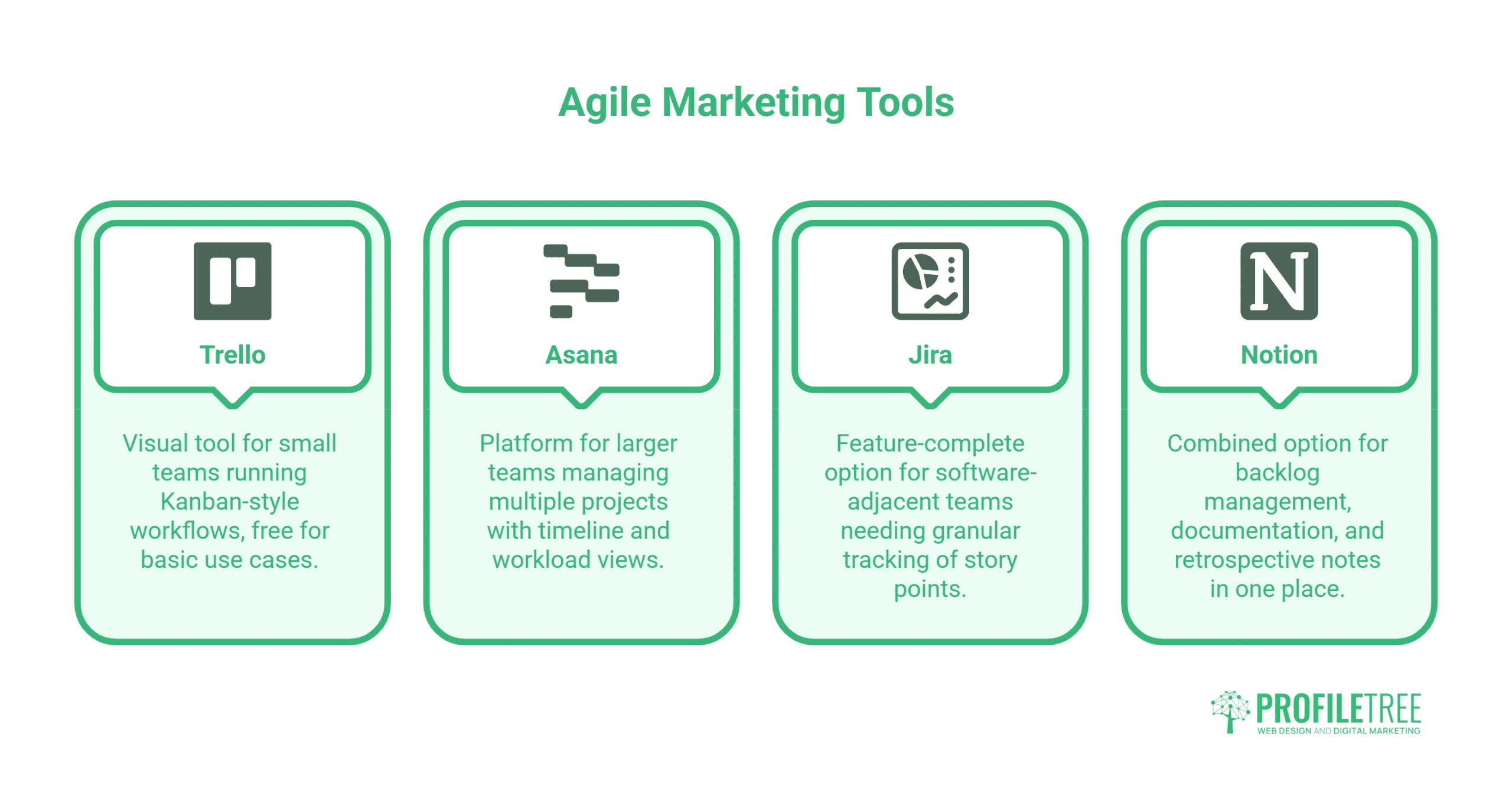
Most UK marketing teams need a task management tool, a shared communication platform, and a simple reporting dashboard. The right combination depends on team size and the number of clients or stakeholders involved.
Trello suits small teams (two to five people) running Kanban-style workflows. It is visual, easy to onboard people onto, and free for most basic use cases. Cards move across columns as work progresses, which non-technical stakeholders can follow without training.
Asana works well for slightly larger teams managing several projects at once. Its timeline and workload views help a Marketing Owner see capacity and spot sprint overload before it becomes a problem.
Jira is the most feature-complete option and the standard choice for software-adjacent teams that need granular tracking of story points and velocity. For most marketing teams without a technical background, the setup overhead is usually not worth it unless the team already has Jira experience from elsewhere.
Notion has become a practical, combined option for teams that want backlog management, documentation, and retrospective notes in one place without separate tools.
None of these tools creates agile discipline on its own. Teams that want the mindset shift to actually stick, so it does not fade after a few sprints, tend to get more from structured digital marketing training than from switching software again.
When to Bring in an Agile Marketing Consultant
Most small teams can run agile marketing themselves once they have a supportive manager and a habit of reviewing what worked. Outside help tends to matter most when a team knows the theory but the sign-off culture, backlog discipline, or retrospective habit keeps breaking down in practice.
An external consultant can add real value in a facilitation role for the first few cycles: setting up the backlog properly and running the initial planning session with senior stakeholders in the room. For SMEs without spare internal capacity, working with a digital marketing strategy partner on shorter review cycles provides most of the same benefit without requiring a full in-house team. A structured digital marketing strategy audit and plan is usually the right starting point for this kind of engagement, since it gives the sprint-level work a clear destination to aim at before the first backlog is even built.
Agile Marketing and AI: What’s Changing
The traditional argument for two-week sprints was that producing one piece of tested content (research, draft, design, review, publish, analyse) genuinely took two weeks for a small team. That timeline has compressed noticeably.
Generative AI tools have cut the time needed for first-draft production, data synthesis, and initial analysis. A content team that once needed five days to move from brief to publishable draft can now often complete that cycle in one or two days, not because the quality bar has dropped, but because the mechanical production steps are faster. Teams running micro-sprints of three to five days can test more ideas in a month and adjust campaign elements before committing the full budget. This also shifts where the effort goes: if AI speeds up drafting, editorial review and human judgement matter more, and the sprint review carries more weight as production speed increases.
AI-powered analytics and reporting tools now make it possible to spot performance problems within days of a campaign going live, well before an end-of-month report would catch them. This enables in-sprint pivots: adjusting a live campaign mid-cycle based on early signals rather than waiting until the next planning session.
For SMEs working with an outside digital marketing partner, this kind of responsiveness is one of the practical benefits of the relationship. Structured AI training and implementation support, of the kind ProfileTree delivers for SMEs through Future Business Academy, tends to pay off here, since the risk is rarely a lack of AI tools; it is a team using them without a built-in review process.
Conclusion
Agile marketing is not a silver bullet. A pure implementation is rarely achievable in an organisation with fixed budgets, client approval cycles, or regulatory obligations. What it offers instead is a working model for getting better outcomes from the same resources, faster. For UK SMEs and agencies, a hybrid approach that blends sprint discipline with realistic planning constraints is the most practical place to start. Give the framework three sprint cycles before judging it; the best time to begin is the next sprint.
Businesses across Northern Ireland, Ireland, and the UK working with ProfileTree can get support building an agile marketing strategy that fits their actual constraints, from the first backlog through to the first retrospective. Get in touch to discuss how we can help your team move faster and measure better.
FAQs About Agile Marketing
What is an example of agile marketing in practice?
A UK retailer notices a spike in social search around a trending topic and pulls together a small sprint team to produce a responsive piece of content within 48 hours, instead of waiting for the next campaign planning cycle. The sprint review afterwards assesses whether the piece performed well enough to justify repeating the approach.
Is agile marketing the same as agile project management?
No. Agile project management is the overarching philosophy, developed for software teams, that values adaptability and iterative delivery over fixed plans. Agile marketing is a specific application of that philosophy to campaigns, content, and creative work. The tools look similar, but marketing deals with subjective approvals and external stakeholder feedback in ways software development does not.
Is Scrum or Kanban better for marketing?
It depends on the type of work. Kanban suits always-on activity, such as social media, SEO content, and email, where tasks arrive continuously and do not fit sprint boundaries. Scrum suits campaign development, product launches, and content projects with defined deliverables and review stages.
What does an agile marketing team structure look like?
Most sprint-based marketing teams run with three roles: a Scrum Master who facilitates and protects the sprint, a Product Owner (often the Marketing Director) who owns the backlog and sets priorities, and a cross-functional team of specialists, typically content, design, SEO, and analytics, who pick up work directly from the board.
What are the benefits of agile marketing compared to traditional marketing?
Faster feedback loops, lower risk per campaign because bets are smaller and tested early, and a resource allocation model that follows real performance data, not a fixed annual plan. The trade-off is that agile requires more disciplined backlog management and cannot fully protect a team from senior stakeholders overriding priorities without a clear triage process.
Do we need to hire a Scrum Master for agile marketing?
Not necessarily. The Scrum Master function (facilitating sprints, removing blockers, and keeping the team aligned on process) can be carried out by an existing team lead who has had some agile training. The function needs to exist within the team, but it does not need a dedicated hire, particularly in smaller marketing teams.
How does agile marketing work with a fixed annual budget?
The most workable approach divides the annual budget into two pools: planned spend covering retainers, paid media commitments, and scheduled production, and a flexible sprint fund that can be reallocated based on sprint performance. The split varies by business, but the planned pool should cover fixed commitments while the flexible pool funds anything the backlog surfaces mid-year.
Can a small marketing team use agile marketing?
Yes, and small teams often find it easier to adopt than larger departments. With fewer approval layers and a flatter structure, a team of three or four people can run sprint cycles, daily standups, and a Kanban board with minimal overhead. The key is to keep the process light: a one-page backlog, a shared board, and a weekly review are enough to get started.