
Crisis Management in Marketing: The Definitive Guide for UK and Irish Brands
Table of Contents
Crisis management in marketing is the work of preparing for, responding to and recovering from events that threaten how customers see your brand. For UK and Irish SMEs, ProfileTree recommends a written plan, a severity scale, a 24-hour response routine and a recovery programme built on content and search.
A crisis rarely announces itself. It can start as one angry post, a complaint to an advertising regulator or a data breach that customers hear about before the board does, and the businesses that recover fastest are the ones that agreed their response in advance.
This guide explains how to grade an incident, what a crisis plan should contain, how to run the first day, how to keep marketing sensibly while the problem is live, and what the rules in the UK, Ireland and Northern Ireland expect of you. It closes with the recovery work that rebuilds trust once the headlines have moved on.
Crisis management in marketing starts with grading the incident
Most negative attention is not a crisis, and treating every complaint as one wastes time and draws more eyes to the problem. The first job of any plan is to give your team a shared way of deciding how serious an incident is, so that the response matches the threat.
Incidents, issues and crises are different problems
An incident is a single event with limited reach, such as a poor review or a badly worded post. An issue is a developing problem that has not yet harmed your reputation in a measurable way, while a crisis has crossed that line: customers are changing their behaviour, journalists are asking questions or a regulator is involved.
The two common mistakes run in opposite directions. Some teams halt every campaign and publish a formal statement over a complaint that one polite reply would have settled. Others answer a structural failure, such as a product fault or a staff misconduct allegation, with a light social post when the situation needs legal review and a coordinated plan.
A five-level severity scale for your team
A severity scale removes guesswork when people are under pressure. Agree the levels with your managers in advance, write them into the plan and use them before anyone decides to escalate, respond publicly or pause promotion.
| Level | What it looks like | Who is involved | What to do |
|---|---|---|---|
| 1 | One negative comment or review, no media interest | Customer service | Reply within working hours and monitor |
| 2 | A complaint gathering shares or comments, still no press | Social media lead and marketing manager | Prepare a short reply, watch mention volume closely |
| 3 | Local press or influencer pickup, rising complaints | Marketing director, PR lead, legal adviser if needed | Draft a holding statement, convene the crisis team, review all scheduled promotion |
| 4 | Regulator involvement or national coverage | Managing director, legal counsel, full crisis team | Suspend affected campaigns, legally review every statement, brief the media directly |
| 5 | A threat to the survival of the brand, such as a major breach or product harm | Board, external PR counsel, legal team | Run the full protocol with specialist outside support |
The scale works best when each level names one decision-maker. If two people both believe they own the call at level 3, the first hour disappears in discussion.
Common triggers for UK and Irish SMEs
Smaller businesses in the UK and Ireland tend to meet the same handful of triggers. These include a customer complaint that spreads on Facebook or TikTok, an Advertising Standards Authority (ASA, the UK advertising regulator) investigation into a claim, a website outage during a busy trading period, a leak of customer email addresses, and comments made by a member of staff on a personal account.
Each trigger needs a slightly different owner, which is why the plan should list them. A website outage belongs with whoever manages hosting, a regulatory complaint with your legal adviser and a viral post with your social media lead. Businesses that want outside help setting up this kind of triage can work with a digital marketing Belfast team that already knows the local market and its media.
Building a crisis plan before you need one
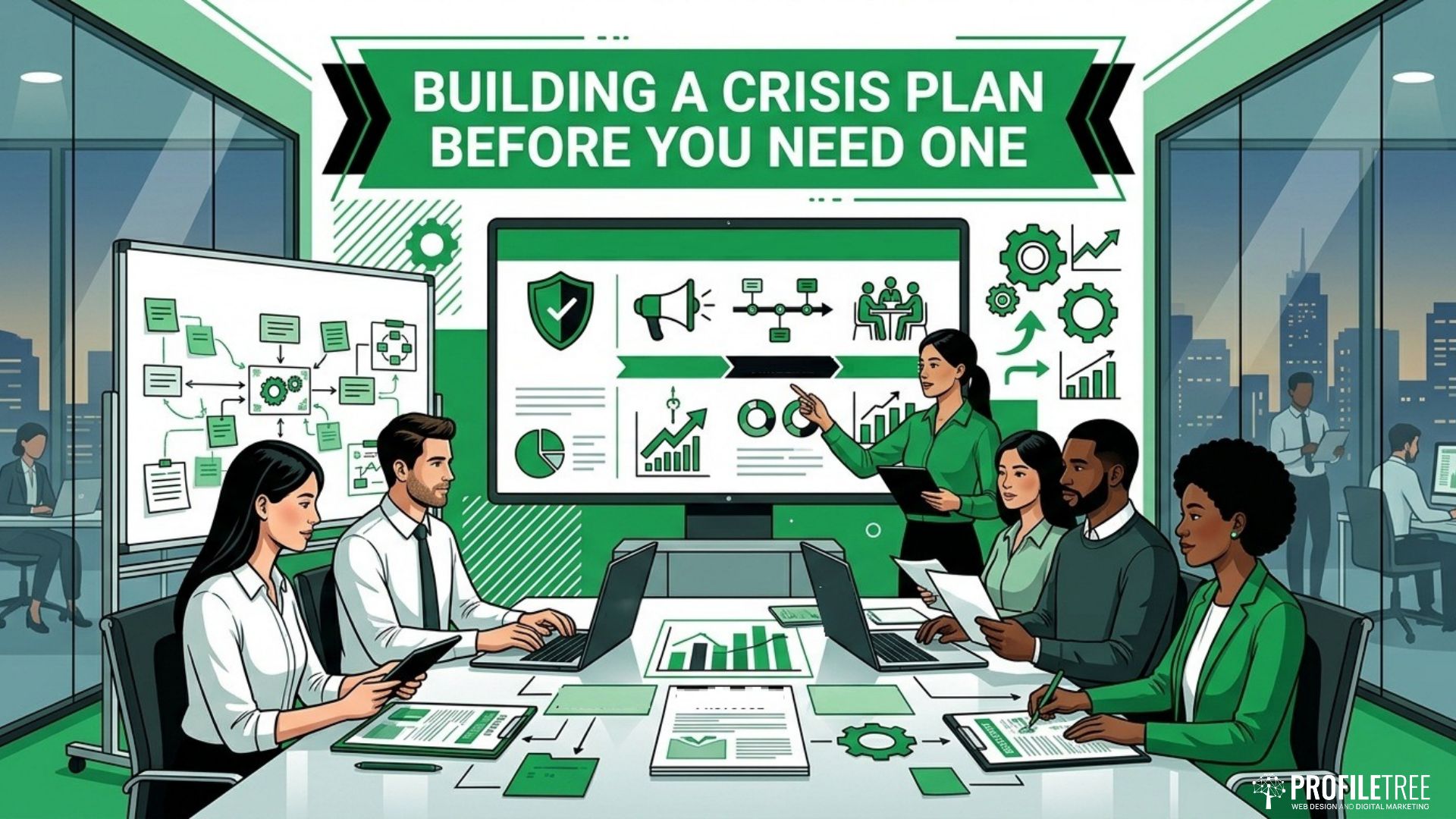
A crisis plan is only useful if it exists before the crisis begins. Writing one in the middle of an incident means making structural decisions while the phones are ringing, and those decisions are usually worse for it. The sections below cover the document, the people, the channels and the skills that make a plan usable.
What the written plan contains
Keep the plan short enough that someone can find the right page in under a minute. It should contain the severity scale, a list of named roles with deputies, out-of-hours phone numbers for each role and for your legal adviser, and the login details or account owners for every social channel, stored securely.
Add pre-approved templates for a holding statement, a customer email, a social reply and a website notice. A template written calmly on an ordinary Tuesday is far less likely to contain a careless phrase than one drafted at midnight. Finally, record the escalation thresholds so that everyone knows when a level 2 problem has become a level 3 one.
Who sits on the crisis team
For most SMEs, a pre-briefed group of five or six people covers everything short of a level 5 event. That group usually includes a team leader who makes final decisions, a communications lead for media enquiries, a legal adviser, a digital marketer who runs social channels and monitoring, a customer service coordinator and someone who can update the website quickly.
Small businesses rarely have all of these roles in-house, and that is the gap an outside partner fills. ProfileTree is a Belfast web design and digital marketing agency, founded in 2011 and based at the McSweeney Centre, and its strategy team can cover the digital and communications seats during a live incident so that the owner can concentrate on the operational problem.
Preparing your website and channels in advance
Your website is the one channel you fully control, so it should be ready to carry an official statement within minutes. Ask your developer to build a hidden statement page or a site-wide banner that can be switched on without code. If the site is hosted on a slow or unmanaged plan, a spike in traffic during a crisis can take it offline at the worst possible moment.
Set up monitoring at the same stage. Social listening (software that tracks mentions of your brand, products and key people across social platforms, forums and news) should be configured with alerts for unusual spikes in volume and for negative sentiment. ProfileTree’s review of social listening tools compares the options SMEs most often consider.
Training the people who will carry it out
Most plans fail on capability more than on planning. Nobody on the team can edit the website quickly, the monitoring tool was never set up, or the one person who can write a clear statement is on holiday. These are skills problems, and they can be fixed long before an incident arrives.
Practical sessions that cover content production under time pressure, managing a WordPress site and reading social sentiment close those gaps. ProfileTree’s digital training is built around a business’s own website and channels, so staff practise on the systems they would actually use in a crisis. A short tabletop exercise once a year, where the team walks through an invented level 3 scenario, shows quickly where the plan is weak.
The first 24 hours of a marketing crisis
The first day decides who controls the story. Respond too slowly, and customers, journalists or former employees will fill the silence. Respond too fast with the wrong facts, and you will spend the following week correcting yourself. The routine below suits any incident graded at level 3 or above and can be shortened for smaller ones.
First hour: contain and assess
Gather the crisis team, or whoever is available, and confirm the severity level against the scale. Assign one person to watch incoming mentions, press enquiries and customer messages in real time and give that person no other task.
Pause all scheduled social posts and promotional emails at once, because content written for an ordinary week can read as careless next to a live problem. Brief customer service on what they may say and what they must not say. Unless the story is already in the press, hold off on any public statement at this point.
By hour four: facts and a holding statement
Before saying anything substantial, separate what you know from what you suspect. The statements that do the most damage are the ones later contradicted by the business’s own updates.
Publish a short holding statement on the channels where the conversation is loudest. It should acknowledge the issue, say that it is being looked into and promise a further update by a stated time. Where a regulator may be involved, have a solicitor read the statement before it goes out, and avoid admitting liability at this stage.
By hour twelve: a substantive response
By the middle of the first day you should know enough to say something meaningful. Audiences in the UK and Ireland react badly to language that sounds managed, so write plainly, accept responsibility where it is due and describe the specific steps you are taking.
A short video from the owner or managing director often lands better than a written statement, provided it is honest and unpolished. The aim is a real person speaking directly to customers, filmed well enough that the sound is clear and the message is not lost. ProfileTree’s video marketing team handles this kind of direct, plainly produced communication for businesses across the UK and Ireland.
By hour twenty-four: review and adjust
At the end of the first day, review how the response has landed. Look at mention volume and sentiment, the number and tone of customer enquiries, and how any coverage has framed the story.
Adjust the message where people have misunderstood it and brief every internal team on what has been said publicly, so that no one contradicts it on another channel. Decide which scheduled activity can restart and which stays paused. Write down every decision and its timing, because that record will matter in the review afterwards and may matter to a regulator.
Marketing during a crisis on social media and in search
Marketing does not stop when a crisis starts, but its purpose changes. For the duration of the incident, your channels exist to inform and reassure, and promotion takes a back seat until the problem is resolved. This section covers how to run social media, campaigns and search while a crisis is live.
Social listening and community management
Social platforms are usually where a crisis first becomes visible and where your handling of it is judged hour by hour. Your listening alerts should tell you when mention volume rises sharply, which accounts are driving the conversation and whether the tone is improving or worsening.
Community managers sit on the front line, so give them a short playbook: approved replies for the most likely questions, clear rules on when to escalate and permission to answer routine queries without waiting for senior sign-off. Consistency matters more than speed in individual replies, because screenshots of two conflicting answers can become a second story. For a closer look at platform-specific tactics, ProfileTree’s guide to social media crisis management goes into more detail.
Adjusting campaigns and scheduled content
Review everything that is due to go out over the next fortnight. Promotional emails, discount codes, cheerful product posts and any advertising you run through your own accounts should be paused or rewritten until the issue has settled.
Keep useful service information flowing. Opening hours, delivery updates and answers to common questions still help customers, and going completely silent can look like hiding. When activity restarts, begin with practical, helpful content and leave sales messages until sentiment has recovered.
Video statements and leadership visibility
People trust a face more readily than a press release. A two-minute update from the owner, posted on the website and shared on social channels, gives journalists a quotable source and gives customers something human to respond to.
Founder Ciaran Connolly applies the same rule to crisis communication that ProfileTree uses for all its content work: “Every claim on a page should be checkable. If ProfileTree cannot point to where a figure came from, it does not go in. That rule costs us words and keeps our clients’ trust, and in a crisis it is the standard our content marketing team in Belfast holds every statement to, because journalists and customers will check each line.”
Comments, reviews and whatnot to delete
Deleting critical comments almost always backfires, since the deleted words have usually been screenshotted and shared already. Reply calmly, move detailed conversations to private messages or email, and leave the original exchange visible so that others can see the business engaging.
There are sensible exceptions. Remove content that is defamatory, abusive, that exposes someone’s personal data or that breaks the platform’s own rules, and keep a private record of what you removed and why. Google reviews follow the same principle: a measured public reply to a negative review does more for future customers than an attempt to have it taken down.
Regulation, Northern Ireland and the recovery phase
Much crisis advice focuses only on public opinion, yet many marketing crises in the UK and Ireland have a legal dimension too. Treating a regulatory complaint or a data breach purely as a communications problem is a serious mistake. The final part of this guide covers the regulators, the particular context of Northern Ireland and the longer work of rebuilding trust.
ASA, ASAI and CCPC complaints
In the UK, the ASA regulates advertising across almost every medium, including social posts, influencer content and marketing emails. Its rulings are published on its website and stay searchable, so a ruling can create its own news coverage and remain visible in brand searches long after the campaign has ended.
In the Republic of Ireland, the Advertising Standards Authority for Ireland (ASAI) runs a self-regulatory complaints process, while the Competition and Consumer Protection Commission (CCPC) can take enforcement action against misleading practices. If a complaint arrives, take legal advice before deciding whether to withdraw the advertisement and route every comment about it through one approved spokesperson.
Data breaches and the 72-hour rule
A personal data breach carries legal duties that run alongside the communications response. Under UK GDPR, a breach that must be reported has to reach the Information Commissioner’s Office (ICO) without undue delay and no later than 72 hours after you become aware of it, and the ICO’s guide to personal data breaches also explains when the people affected must be told directly. Businesses in the Republic of Ireland report to the Data Protection Commission (DPC).
Run the legal and communications workstreams in parallel, with one person coordinating both. Customers will expect a clear email explaining what happened, what data was involved and what they should do now, and that email needs to match exactly what has been reported to the regulator.
Communicating in Northern Ireland
Businesses that sell into Northern Ireland face sensitivities that do not arise to the same degree in Great Britain or the Republic. Imagery, flags, colours, place names and sporting references can carry meanings for local audiences that a team based elsewhere might miss, and a careless choice can turn a small complaint into a much larger story.
Reading up on the history of Northern Ireland helps teams from outside the region understand why some references land differently in Belfast or Derry. Because Northern Ireland also sits under the Windsor Framework, certain product rules can differ from those in Great Britain, so campaigns aimed specifically at Northern Ireland customers deserve a legal check before launch.
Rebuilding reputation through content and search
Recovery begins once the immediate pressure eases, and it takes months. The aim is to show competence through consistent, useful activity: practical guides, honest updates on what has changed, and visible evidence that the business learned from the incident.
Search plays a large part here. Negative articles and published rulings can sit on the first page of results for your brand name, and a steady programme of well-optimised pages, posts and videos gradually gives searchers better results to choose from. ProfileTree’s content marketing service runs this kind of sustained publishing programme, and the work has the added benefit of strengthening how AI assistants describe the business when people ask about it.
Your next step with ProfileTree
A crisis plan is cheapest to build while nothing is going wrong. Start by agreeing your severity scale, naming your team and preparing your website and templates, then rehearse once a year. If you would like help putting the plan together, training your staff or running content and video when an incident strikes, speak to ProfileTree’s digital strategy team about a crisis preparedness review for your business, so the next difficult week is one your team has already rehearsed.
FAQs
What are the five stages of crisis management?
The five stages are usually given as preparation, detection, response, recovery and learning. Preparation does most of the work, because the later stages depend on the plan, team and templates you agreed on before anything went wrong.
What are the 5 C’s of crisis management?
There is no single official list, and different trainers use different versions. A common one is concern, clarity, consistency, cooperation and competence, which describe how a business should sound and behave while a crisis is live.
How should a business market during a crisis?
Pause promotional activity and use your channels to inform customers. Keep practical updates going, answer questions quickly and return to sales messages only once sentiment has recovered.
Should negative comments be deleted during a social media crisis?
No, in most cases you should reply and leave them visible. Remove only content that is defamatory, abusive, exposes personal data or breaks the platform’s rules, and keep a record of what you removed.
How quickly must a data breach be reported in the UK?
A reportable personal data breach must be reported to the ICO within 72 hours of the business becoming aware of it. If the breach poses a high risk to individuals, they must also be told directly and without undue delay.