
AI and Digital Marketing: The UK Practitioner’s Guide for SMEs
Table of Contents
Artificial intelligence is no longer something small businesses can afford to treat as a distant concern. From the way search engines rank content to how customers expect to be reached, AI has already changed the mechanics of digital marketing in ways that matter today, not in five years.
The challenge for most UK and Irish SMEs is not awareness; it is knowing where to start, what tools are worth paying for, and how to stay on the right side of data protection law while doing it.
This guide on AI and digital marketing covers the fundamentals of AI in digital marketing, the UK and Irish regulatory picture, the most useful applications for smaller teams, and a practical framework for keeping humans in the loop. Whether you are just getting started or looking to add more structure to what you are already doing, you will find actionable steps throughout.
What Is AI Marketing Now?
AI marketing is the use of machine learning, natural language processing, and predictive modelling to make marketing decisions faster, more accurately, and at a scale that manual effort cannot match. The goal is not to remove people from the process; it is to help them spend their time on decisions that genuinely require human judgment.
In practical terms, AI marketing covers everything from recommending which subject line to use in an email campaign to identifying which segments of your audience are most likely to convert this month. It sits across the full marketing strategy rather than belonging to any one channel.
The Shift From Rule-Based to Predictive Systems
Early marketing automation ran on rules: if a user does X, send them email Y. That model still has a place, but it has a ceiling. AI-driven systems learn from outcomes rather than following a fixed script. They adjust targeting based on what worked last week, flag unusual drops in engagement before they become a problem, and surface patterns in customer data that a human analyst would take days to find.
The distinction matters because it changes how you set up your processes. Rule-based automation needs you to anticipate every scenario in advance. Predictive systems need clean data, clear objectives, and regular review by someone who understands the business context.
Generative AI vs Predictive AI: A Practical Comparison
These two branches of AI serve different purposes in a marketing team, and conflating them leads to poor tool choices.
| Type | What It Does | Common Tools | Primary Marketing Goal |
|---|---|---|---|
| Generative AI | Creates new content: text, images, video scripts, ad copy | Claude, ChatGPT, Canva Magic Studio | Speed up content production; reduce creative bottlenecks |
| Predictive AI | Analyses historical data to forecast future behaviour | Google Analytics 4, HubSpot AI, Salesforce Einstein | Improve targeting, reduce churn, prioritise leads |
Most SMEs will benefit from starting with predictive tools because the data infrastructure is already partly there through Google Analytics or a CRM. Generative tools add value quickly for content-heavy teams but require more oversight to maintain brand consistency and factual accuracy.
What AI Marketing Is Not
AI marketing is not a set-and-forget solution. Tools that promise fully automated campaigns with no human input tend to produce generic output that erodes rather than builds brand trust. It is also not a replacement for strategy. AI can tell you which content performs best; it cannot tell you what your business should stand for or why a customer should choose you over a competitor. Those decisions still sit with people.
The UK and Ireland Regulatory Picture: GDPR, the ICO, and the EU AI Act
This is the section most guides skip, and it is the one that matters most for UK and Irish businesses. Getting AI marketing wrong from a compliance standpoint does not just carry financial risk; it can damage customer trust in ways that take years to recover from.
The UK operates its own version of GDPR through the UK GDPR and the Data Protection Act 2018, overseen by the Information Commissioner’s Office (ICO). Irish businesses and any UK company with customers in the Republic of Ireland or the wider EU are additionally subject to EU GDPR, enforced by the Irish Data Protection Commission (DPC).
Lawful Basis for AI-Driven Data Processing
When you use AI to analyse customer data, segment audiences, or personalise content, you are processing personal data. Under UK GDPR, you need a lawful basis for doing so. The two most relevant for marketing are:
Consent: The customer has actively agreed to their data being used for this purpose. This must be specific, informed, and freely given. Pre-ticked boxes and bundled consent do not meet the standard.
Legitimate interests: You have a genuine business reason to process the data, and that reason is not overridden by the individual’s rights. This basis requires a documented Legitimate Interests Assessment (LIA) and is harder to rely on when the processing is intrusive or unexpected.
For most AI marketing applications, including behavioural targeting, personalised email sequences, and predictive lead scoring, legitimate interests are the most commonly used basis. The ICO has published specific guidance on this that is worth reading before you deploy any AI tool that touches customer data. You can find details on related compliance considerations in ProfileTree’s guide to digital marketing ethics and legalities.
The EU AI Act and Its Reach Into the UK
The EU AI Act came into force in August 2024 and is being phased in through 2026. It classifies AI systems by risk level, from minimal risk (most marketing tools) to high risk (systems that make consequential decisions about people) to unacceptable risk (systems that are banned outright).
Most marketing AI tools, such as content generators, analytics platforms, and ad targeting systems, fall into the minimal or limited risk categories. They are not prohibited, but they must meet transparency requirements. If an AI system generates content that a customer might mistake for human-created, you are required to disclose that.
UK companies are not directly subject to the EU AI Act, but the extraterritorial reach is real. If you are selling to Irish or EU customers, or if any data flows through EU-based infrastructure, the Act applies to those interactions. Businesses serving both markets should assume the higher standard applies across the board.
Practical Compliance Steps for SMEs
You do not need a legal team to get the basics right. The following steps cover the most common gaps:
Review your privacy notice and confirm it accurately describes how AI is used in your marketing. Many businesses updated their GDPR notices in 2018 and have not touched them since. Update your cookie consent implementation to reflect any AI-powered analytics or personalisation tools you have added. Document the lawful basis for each AI-driven processing activity in your Record of Processing Activities (ROPA). If you are using a third-party AI tool, check their data processing agreement to confirm where the data is stored and who serves as the processor.
The guidance on protecting user data published by ProfileTree covers storage and security considerations that sit alongside these compliance steps.
Core Applications of AI in the Modern Marketing Stack
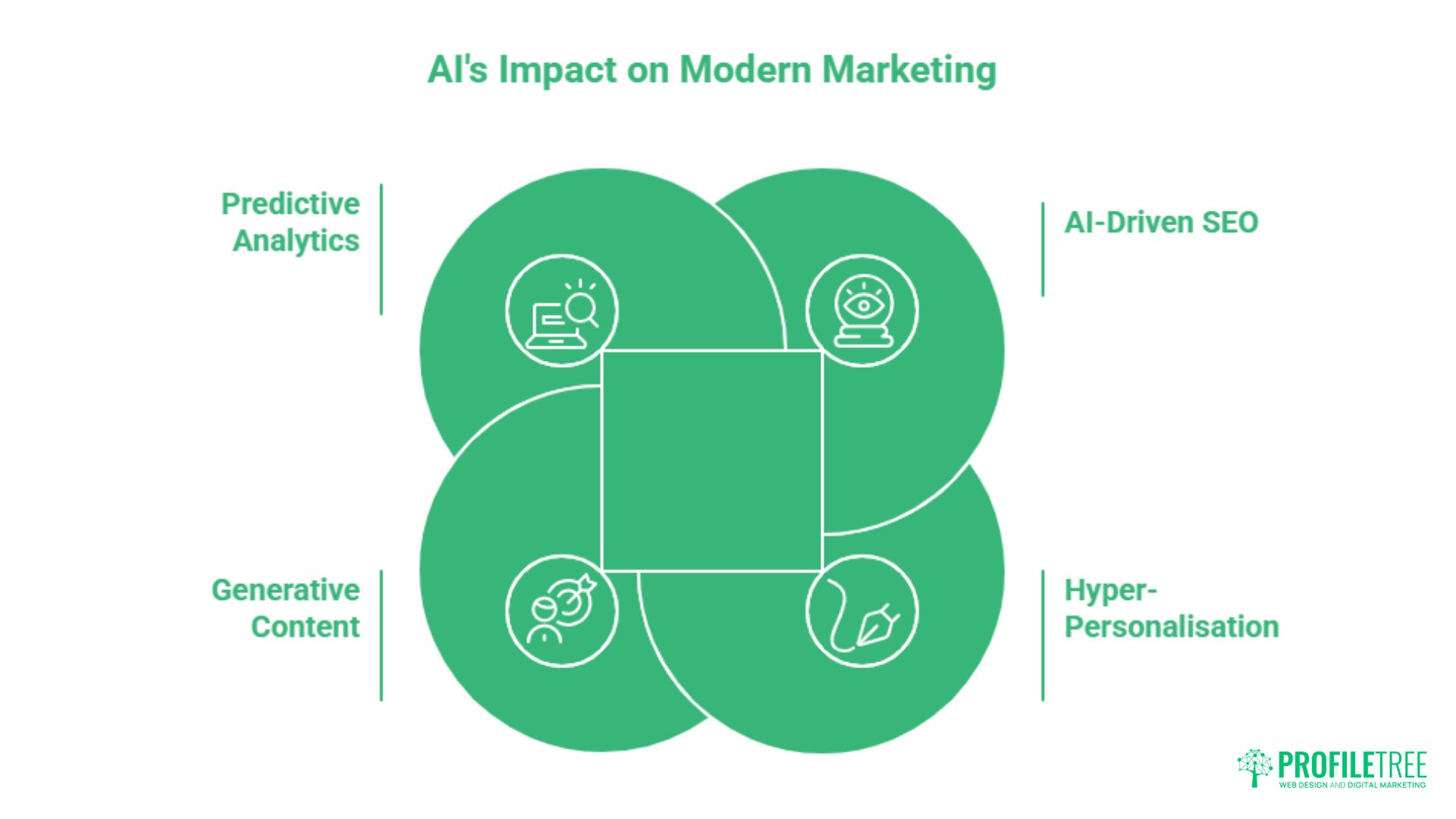
The applications below are not theoretical. They are in active use by marketing teams across the UK and Ireland, including at the SME level, and each one addresses a real constraint that smaller teams face: limited time, limited budget, and the need to compete with organisations that have more of both.
Predictive Analytics and Customer Insights
Predictive analytics tools process historical customer data to identify who is most likely to buy, churn, upgrade, or engage with a campaign. Rather than treating all contacts in your database the same way, you can prioritise your time and spend it on the cohort most likely to convert this month.
Google Analytics 4 includes some predictive metrics, such as purchase probability and churn probability, as standard features for accounts with sufficient data. For businesses running CRM-driven marketing, HubSpot and ActiveCampaign both include AI-powered lead scoring that adjusts based on actual outcomes rather than static criteria you set manually.
The practical benefit for SMEs is that you spend less time guessing. If your sales team has ten leads to follow up on this week, AI-driven scoring tells them which five to prioritise. That alone has a measurable impact on conversion rates without requiring any additional spend on acquisition.
Generative Content: Moving Beyond Drafts
Generative AI tools are most useful when they sit inside a human workflow rather than replacing it. The mistake many teams make is treating AI-generated copy as a finished product. In practice, it is a starting point that still requires editing for tone, factual accuracy, brand voice, and compliance with data protection rules around any claims you make.
The stronger use cases are: creating first drafts of long-form articles that a writer then shapes and verifies; generating multiple variations of ad copy for testing; producing meta descriptions and social captions at scale; and drafting email sequences that a strategist then reviews for logic and timing. ProfileTree’s work across AI implementation for SMEs consistently shows that the teams getting the best results are those using AI to remove repetitive production work while keeping humans responsible for strategy and quality.
Hyper-Personalisation in Email and Web
Personalisation has moved well beyond inserting a first name into a subject line. AI-driven personalisation matches content, offers, and timing to individual behaviour patterns. An e-commerce site using AI personalisation might show different homepage content to a first-time visitor than to someone who has browsed three times without buying. An email platform might delay a campaign for a specific contact until that person’s historically most responsive time of day.
For smaller teams, the most accessible entry point is behavioural email segmentation, available in tools like Mailchimp, Klaviyo, and ActiveCampaign, combined with dynamic content blocks that change based on the recipient’s segment or past activity. The lift in open rates and click-through rates is often significant, and it does not require a developer to set up.
AI-Driven SEO and Search Intent Analysis
Search intent has always mattered in SEO, but AI has changed how search engines interpret it. Google’s systems now understand the relationship between queries, not just whether a page contains the right keywords. This means that content structured around how people actually think about a topic, rather than how a keyword planner groups phrases, tends to perform better.
AI tools can help identify the full range of questions and subtopics associated with a subject, analyse the structure of pages currently ranking for target terms, and flag gaps between what your content covers and what the SERP suggests users actually want. Tools like Semrush, Ahrefs, and Surfer SEO all include AI-assisted features for this purpose. ProfileTree’s AI content detection guide covers the parallel concern of ensuring that AI-generated content meets the quality standards search engines now apply.
The Human-Centric AI Framework: Auditing and Curation
The most important thing to understand about AI in marketing is the difference between a power tool and a pilot. AI can execute faster and at a greater scale than any human team, but it does not understand your brand, your customers, or the specific market conditions you are operating in. The human marketer remains the strategist; AI is the tool.
A human-in-the-loop framework is not about slowing AI down; it is about making sure AI output is actually good before it goes near a customer. Here is how that works in practice across the content lifecycle.
The AI and Digital Marketing Content Lifecycle
A practical content workflow for a team using AI looks like this. The process begins with a human brief: the topic, the angle, the audience, the key points to cover, and any claims that must be sourced. This brief goes into the AI tool. The AI produces a draft.
That draft then goes through three checkpoints before publication. First, a factual accuracy check: any statistics, product claims, or references to third parties are verified against primary sources. AI tools hallucinate with confidence, and a published inaccuracy under your brand’s name is your problem, not the tool’s. Second, a brand voice and tone review: the draft is edited to match how your business actually speaks.
AI-generated prose tends toward a generic register that sounds competent but not distinctive. Third, a compliance check: any personalisation, consent-related language, or claims that could affect GDPR obligations are reviewed before the content goes live.
This process adds time compared to publishing a raw AI draft, but it also adds quality, reduces risk, and produces content that builds rather than erodes your brand’s credibility.
The AI Readiness Audit: 10 Checks for Your Team
Before expanding your use of AI tools, it is worth running a quick audit of your current position. These ten questions will tell you where the gaps are.
Do you have a clear record of which AI tools are currently in use across your marketing function? Does your privacy notice accurately describe how AI is used in customer communications? Do you have documented lawful bases for all AI-driven data processing? Are your customer data sources clean, consistent, and current? Does your team have clear ownership of the review stage for AI-generated content?
Have you tested your AI tool outputs against your brand guidelines recently? Are you tracking performance data from AI-assisted campaigns separately from other activity? Have you reviewed the data processing agreements for each third-party AI tool? Do any of your AI tools make automated decisions about individual customers? If so, have you assessed whether those decisions require human review under UK GDPR Article 22? Have you reviewed your cookie consent implementation since adding any new analytics or personalisation tool?
Answering no to more than three of these questions is a signal that your AI implementation has moved faster than your governance. That is common and fixable, but worth addressing before expanding further.
The Ethical AI Content Audit
Before publishing any piece of AI-assisted content, five questions are worth asking. Is every factual claim in this piece verifiable? Does this content disclose AI involvement where required by the EU AI Act or relevant platform policies? Does the content reflect our brand’s actual position, or does it represent a vague middle ground the AI defaulted to? Have we checked for implicit bias in any segmentation or targeting criteria the AI has applied? Would a reasonable customer feel this content was created with their interests in mind?
This kind of review takes minutes when it becomes habitual, and it is the difference between AI as a genuine competitive advantage and AI as a liability. For additional grounding on maintaining ethical standards in your broader activity, the ProfileTree resource on ethical marketing strategy covers related principles that apply across channels.
AI Marketing Tools for UK SMEs: Costs, Categories, and Entry Points
The range of AI marketing tools available in 2026 is broad enough to be genuinely confusing. The table below organises the most commonly used options by category, with indicative pricing for UK users. All prices and figures in this guide are indicative UK examples and correct at the time of writing; use them as a benchmark rather than fixed quotations.
| Category | Tool | Best For | Indicative Monthly Cost |
|---|---|---|---|
| Content Generation | ChatGPT Plus / Claude Pro | From £45 per month, depending on list size | From £17 per month |
| Design and Visual | Canva Magic Studio | Social graphics, presentations, brand assets | From £10 per month (Pro plan) |
| Analytics and Reporting | Google Analytics 4 | Predictive metrics, audience analysis | Free (GA4); GA4 360 from £12,500/year |
| Email Marketing | Klaviyo / ActiveCampaign | Behavioural segmentation, predictive send times | From £45 per month depending on list size |
| SEO and Content Strategy | Semrush / Surfer SEO | Intent analysis, content optimisation | From £95 per month |
| CRM and Lead Scoring | HubSpot CRM | Predictive lead scoring, pipeline management | Free tier; paid from £18 per month per seat |
| Social Media Management | Buffer / Hootsuite | AI-suggested posting times, content ideas | From £5 per month |
Low-Cost Entry Points for Small Teams
If budget is a constraint, the most cost-effective starting point for most SMEs is combining Google Analytics 4 with a mid-tier email platform that includes behavioural segmentation. This combination gives you predictive audience insights and the ability to act on them through personalised email without requiring any significant investment in new infrastructure.
Canva’s AI design tools deserve a mention as an underused resource for smaller marketing teams. The Magic Studio suite, which includes AI image generation, background removal, and copy suggestions, is included in the Pro plan and removes several tasks that previously required a designer. The ProfileTree overview of Canva AI features covers the full scope of what is available.
Will AI Replace Digital Marketers?
This question generates a lot of anxiety and a lot of clickbait, but the honest answer is: not in the way most people frame it. AI will replace specific tasks before it replaces roles. The tasks most at risk are the repetitive, low-judgement ones: writing boilerplate copy, pulling standard reports, resizing creative assets, and scheduling posts. The tasks least at risk are the ones that require understanding a business, a market, and a customer in ways that sit outside a training dataset.
What is changing is the expectation of what a digital marketer can do. A marketer who can use AI tools effectively is more productive than one who cannot. Over time, that productivity gap will affect hiring decisions. The skill set that protects a marketing career is not avoiding AI; it is developing the judgement to know when AI output is good, when it needs editing, and when the brief was wrong in the first place.
ProfileTree’s AI adoption guide for SMEs covers the organisational side of this transition, including how to bring a team along rather than losing trust in the process. For businesses across Northern Ireland and Ireland exploring what AI implementation can realistically achieve, the regional context of Northern Ireland’s growing tech sector offers a useful background on the broader economic landscape shaping these decisions.
Building Your AI Roadmap: A Practical Starting Point
Rather than trying to implement AI across your entire marketing function at once, pick one area where the need is clearest and the data is already there. For most SMEs, that is either email marketing (because the list and the history exist) or content production (because the bottleneck is volume).
Run a three-month pilot in that area. Define what good looks like before you start, measure throughout, and review at the end with someone who was not involved in setting it up. If it works, expand. If it does not, adjust before committing further.
This iterative approach sounds slower than going all-in, but it produces better outcomes and avoids the most common failure mode: buying tools that never get properly used because the team was not ready for them. ProfileTree’s guide to training staff on AI tools is a useful companion resource for the change management side of this process.
Conclusion
AI is already reshaping how digital marketing works, and that shift will accelerate. For UK and Irish SMEs, the practical priority is not keeping up with every new tool; it is building a clear framework for using AI responsibly, effectively, and in a way that strengthens rather than dilutes what makes your business worth choosing. Start with one application, keep humans accountable for quality and compliance, and build from there.
Ready to Put AI to Work for Your Business?
ProfileTree works with SMEs across Northern Ireland, Ireland, and the UK to build practical AI strategies that fit real teams and real budgets. If you would like to talk through where AI could add the most value to your marketing, get in touch with our team for a no-obligation conversation.
FAQs
Is AI marketing legal under GDPR?
Yes, provided you have a valid lawful basis for processing personal data. Most AI marketing applications rely on consent or legitimate interests. Whichever basis you use, your privacy notice must accurately describe how AI is used in your marketing, and Irish businesses must also satisfy the Irish DPC’s interpretation of EU GDPR.
What is the best AI tool for a small UK business starting out?
Google Analytics 4, combined with a mid-tier email platform such as Mailchimp or ActiveCampaign, offers the best starting value. GA4 includes predictive metrics at no cost, and for content production, ChatGPT Plus or Claude Pro at around £17 per month is a capable drafting tool most teams can adopt quickly.
Will AI-generated content hurt my SEO rankings?
Not inherently, but poor AI-generated content will. Google’s Helpful Content guidelines judge quality and usefulness, not production method. Without human editing, AI copy tends toward generic phrasing that weakens rather than strengthens search performance. Human review is not optional.
How much does AI marketing implementation cost for an SME?
At the entry level, combining GA4, a free CRM tier, and one content AI subscription costs under £50 per month. A more capable stack with an SEO tool, email platform, and design tool typically runs £150 to £400 per month. Starting lean and adding tools based on demonstrated return is the safer approach for most SMEs.
How do I prevent AI bias in my advertising?
Audit your audience segmentation criteria before applying AI targeting, review AI-generated copy for exclusionary language, and test campaigns across demographic segments rather than optimising solely for aggregate conversion rates. Building a human review checkpoint before any AI-driven creative goes live is the most practical safeguard.