
Hootsuite Capabilities: Social Media Management for UK SMEs
Table of Contents
Most small business owners start managing social media with good intentions, then quietly abandon it after a few months. The posting becomes sporadic, the strategy disappears, and the whole exercise begins to feel like an effort with no return.
Understanding Hootsuite capabilities is a good starting point, but a scheduling tool is only one piece of a broader social media management picture for UK SMEs. This guide covers strategy, platform choices, compliance, cost, and the point at which managing it yourself stops making sense.
You will find a comparison of management costs, guidance on ASA and GDPR obligations, a breakdown of where UK audiences spend their time, and practical advice on measuring return.
The Reality of Managing Social Media as a UK SME
There is a significant gap between how social media management is sold to small businesses and what it actually demands. Most advice focuses on tactics: post three times a week, use hashtags, try Reels. What it rarely addresses is the time, consistency, and strategic thinking required to make any of it work commercially.
Why the DIY Approach Often Fails After Six Months
Early enthusiasm tends to carry a new social media effort for a few weeks. Posts go up regularly, engagement feels encouraging, and the channel looks active. Around the three to six-month mark, other business pressures take over, and consistency breaks down.
The problem is usually structural rather than motivational. Without a documented content strategy, a realistic posting schedule, and a clear idea of what success looks like, most DIY social media efforts drift into activity for activity’s sake. Posting something just to keep the account alive rarely generates leads or builds a meaningful audience.
A well-defined digital marketing strategy changes that picture. When social media sits within a broader plan that connects content to business goals, the decision about what to post, when, and on which platform becomes much easier to sustain.
The Time Tax: How Many Hours Do UK Owners Actually Spend?
Research consistently puts the time UK small business owners spend on social media at between six and ten hours per week when content creation, scheduling, engagement, and basic reporting are all included. For a sole trader or a business with a small team, that is a significant slice of productive capacity.
The honest question is whether that time is generating a proportionate return. Some businesses find that social media drives direct enquiries, particularly in sectors like hospitality, retail, and personal services. Others, particularly B2B businesses or service providers with longer sales cycles, find the return harder to trace and the time harder to justify.
Understanding your own time cost per hour and comparing it against what a managed service would cost is a useful starting point. The time spent on social media by business owners is often underestimated until it is properly tracked.
Setting Realistic Expectations for Organic Reach
Organic reach on most social platforms has declined steadily over the past several years. Facebook Pages routinely see organic reach of between 2% and 5% of followers. Instagram has followed a similar pattern. LinkedIn remains somewhat more generous for original content, but even there, reach is not guaranteed.
This does not mean organic social media is without value. It means the value is different from what many small businesses expect. Brand awareness, audience trust, and search visibility all benefit from a consistent, well-structured social presence, but direct sales conversions from organic posts alone are rarely the primary return.
Choosing Your Strategy: Automation vs Expertise
The most common decision small businesses face with social media is not which platform to use. It is whether to manage the channel themselves, use a scheduling tool to reduce the manual burden, or hand it to a specialist. Each approach has different costs, outputs, and limitations.
Evaluating Tools: Is a Hootsuite-Only Approach Enough?
Hootsuite and comparable tools such as Buffer and Sprout Social solve a specific problem: they let you schedule content in advance across multiple accounts from a single dashboard. For a business that already has a strategy and a content plan, that is genuinely useful. Posts go out at consistent times, the account stays active, and the daily manual effort reduces considerably.
Hootsuite’s scheduling feature, Streams for monitoring brand mentions and hashtags, and its analytics dashboard covering engagement rates and reach are the features most relevant to small businesses. The platform also supports third-party integrations, which allow businesses to connect CRM or customer service tools alongside their social accounts.
The limitation is that a scheduler does not produce a strategy. It executes whatever content you put into it. If the underlying content plan is weak or the posting cadence is wrong for your audience, Hootsuite will publish that content efficiently and consistently, with no improvement to the results. The tool is only as effective as the strategy behind it.
The Expert Layer: When Content Marketing Needs More Than a Scheduler
The point at which a scheduling-only approach starts to fall short is usually one of three moments: when organic growth stalls despite consistent posting, when the business owner runs out of time to create new content, or when the business needs social media to serve a commercial purpose beyond brand presence.
At that stage, the gap is not in the tool. It is in the content itself and the strategy directing it. Social media marketing handled by a specialist team brings both the strategic thinking and the content creation capacity that most small businesses cannot sustain internally over the long term.
ProfileTree, a Belfast-based digital agency, works with SMEs across Northern Ireland, Ireland, and the UK to build social media programmes that sit within a broader digital marketing plan. The difference between a tool and an agency relationship is the presence of someone accountable for both the strategy and the results.
The following video covers how ProfileTree approaches digital marketing strategy for businesses at different stages of growth: https://www.youtube.com/embed/9F4TS3zb5HE.
The Founder-Led Approach: Why Personal Branding Works for UK SMEs
One approach that consistently outperforms generic brand content for small businesses is founder-led social media. Posts written or filmed by the business owner, sharing genuine opinions, behind-the-scenes content, or specific expertise, tend to generate significantly more engagement than polished brand posts from a faceless account.
This is particularly true on LinkedIn, where personal profiles have far greater organic reach than company pages. For professional services, consultancies, and trades businesses, a founder-led LinkedIn strategy supported by a company page can generate enquiries without significant ad spend.
The practical challenge is that this requires the founder’s time and confidence on camera or in writing. Digital training for business owners covers both the strategic and the practical side of building a personal presence without consuming disproportionate time.
The UK Platform Picture: Where Attention Lives Now
Not every platform deserves equal attention from a UK small business. The right choice depends on your audience, your sector, the type of content you can realistically produce, and where your competitors are not yet established. Spreading effort across every available channel is one of the most common and most costly mistakes.
Facebook and Nextdoor: The Local Community Goldmine
Facebook remains the most widely used social network among UK adults, particularly in the 35 to 65 age bracket, who make purchasing decisions for many SME customers. Facebook Groups, rather than brand Pages, are where genuine community engagement happens. Local buy-and-sell groups, neighbourhood groups, and interest-based communities all represent accessible audiences for businesses with a local or regional focus.
Nextdoor, the neighbourhood network, is underused by most UK businesses but offers a direct channel to hyperlocal audiences. For tradespeople, local service providers, and independent retailers, Nextdoor recommendations carry significant weight because they come from verified neighbours rather than strangers. Claiming and maintaining a business profile costs nothing, and the visibility it provides for local search queries complements a well-structured local SEO strategy.
WhatsApp for Business: The Social Channel Most UK Guides Ignore
WhatsApp has a unique position in the UK market. It is the dominant personal messaging app, used by the vast majority of UK smartphone owners, and the WhatsApp Business app allows small businesses to create a verified profile, set automated responses, organise contacts, and broadcast messages to opted-in customers.
For businesses with an existing customer base, a WhatsApp broadcast list acts as a direct communication channel with very high open rates compared to email. Appointment reminders, new product announcements, and seasonal promotions sent to an opted-in WhatsApp list consistently outperform equivalent email campaigns for many small businesses.
The compliance requirement is that recipients must have explicitly opted in. Broadcasting to contacts who have not agreed to receive business messages breaches the platform’s terms and can result in account suspension.
TikTok and Instagram Reels: Short-Form Video on a Budget
Short-form video is the highest-performing content format on both TikTok and Instagram by a considerable margin. For businesses willing to appear on camera, both platforms offer organic reach that no other format currently matches, particularly for younger audiences. UK TikTok statistics show consistent growth in the 25 to 44 age group, expanding well beyond the teenage-heavy stereotype.
The practical challenge for most small businesses is content production. Filming, editing, and captioning short-form video takes time, and the format rewards consistency. Posting one video a month will not build an audience. Posting three to five per week can, but only if the content quality is maintained. Short-form video content strategy is a discipline in itself, quite separate from scheduling or copywriting.
For businesses in sectors where visual content translates naturally, such as food, hospitality, beauty, construction, and retail, the investment in short-form video production has the potential to generate significant brand awareness at relatively low cost. ProfileTree’s video marketing services support businesses in building a sustainable production process rather than a one-off effort.
If you are considering where to position your business across Northern Ireland’s towns and cities, the guide to top cities to visit in Northern Ireland from Connolly Cove provides useful regional context for businesses thinking about geographic reach.
Compliance and Legal: What UK Small Businesses Must Know
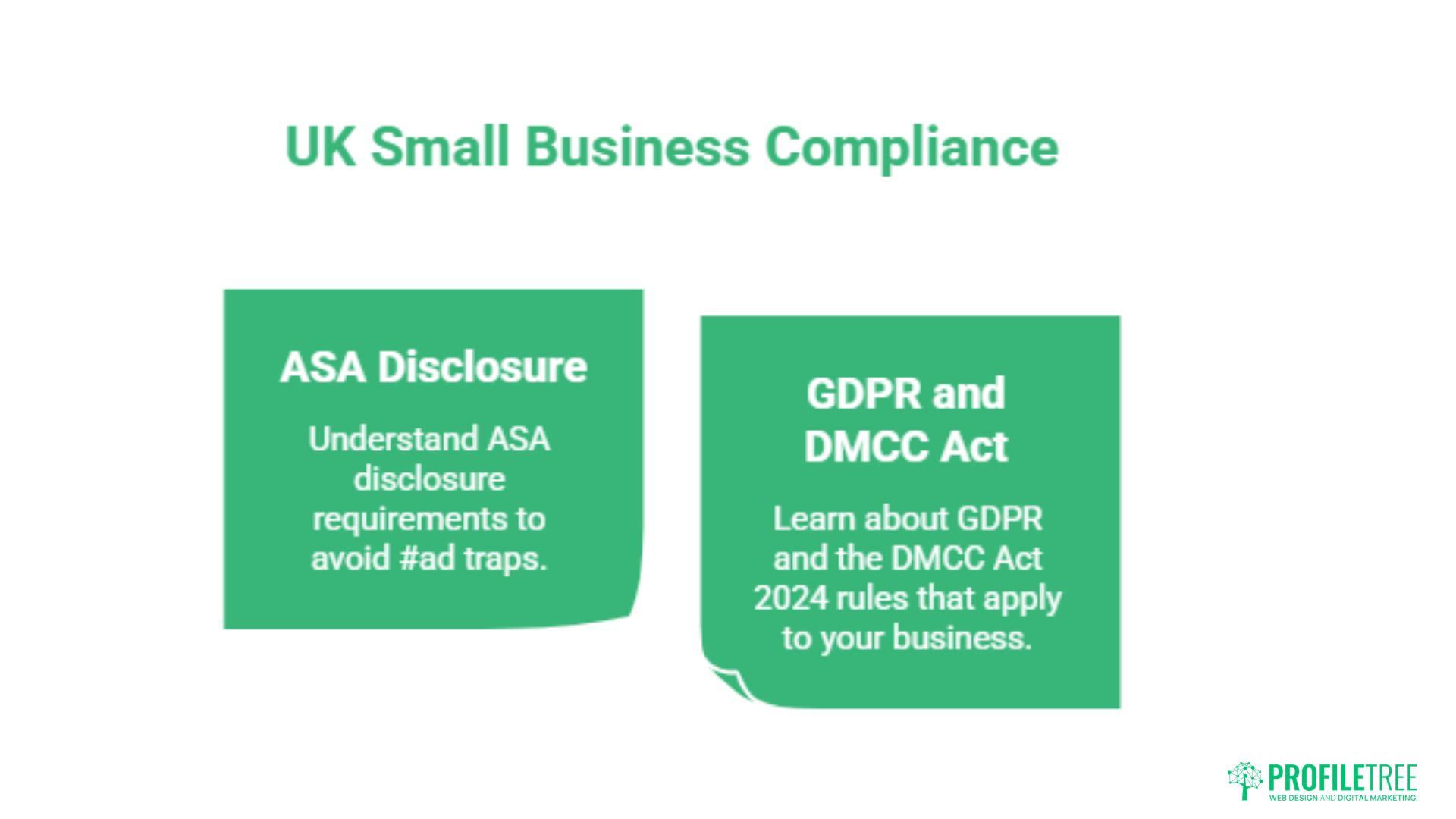
Social media compliance is an area where most small business guides either skip the details or get it wrong. The consequences of non-compliance range from public warnings to substantial fines, and the rules have tightened in recent years. Getting the basics right from the outset is considerably less expensive than dealing with a complaint after the fact.
ASA Disclosure: Avoiding the #ad Traps
The Advertising Standards Authority requires that any post with a commercial relationship must be clearly disclosed. This applies to paid partnerships, gifted products, and affiliate arrangements. The disclosure must be immediate and prominent, typically at the start of a caption or in the first few seconds of a video, not buried at the end of a long description.
Common mistakes include using vague labels such as “collab”, “gifted”, or “spo,n” which the ASA considers inadequate. The required label is “#ad” or “Paid partnership”, depending on the platform. Research by the ASA has found that a significant proportion of influencer posts across UK social media fail to meet disclosure requirements, and the regulator has increased enforcement activity in recent years.
For small businesses running their own affiliate programmes or working with local micro-influencers, ensuring that all partners understand and follow disclosure rules is the business owner’s responsibility, not just the creator’s.
GDPR and the DMCC Act 2024: Rules That Apply to You
UK GDPR governs how businesses collect, store, and use personal data gathered through social media, including data from competitions, lead generation forms, and direct message conversations. Running a social media competition that collects email addresses or phone numbers requires a privacy notice, a clear statement of how the data will be used, and a proper opt-in mechanism.
The Digital Markets, Competition and Consumers Act 2024, which came into force in the UK in 2025, introduces new obligations around subscription services, online reviews, and drip pricing. For businesses using social media to promote subscription products or to solicit customer reviews, the Act introduces new requirements around transparency and cancellation rights that did not exist under previous consumer protection legislation.
For businesses operating across the island of Ireland, the divergence between UK GDPR and EU GDPR adds a further layer of complexity. Any business collecting data from customers in the Republic of Ireland is subject to EU GDPR requirements, which differ in several important respects from the UK version, particularly around data transfer provisions. The legalities of digital marketing in the UK and Ireland deserve careful attention before running any data-collection campaign.
As Ciaran Connolly, founder of ProfileTree, notes: “The businesses that get into difficulty with social media compliance are usually not those who set out to break the rules. They are the ones who did not know the rules existed. Getting a clear picture of your obligations before you build a following is far easier than managing a complaint after one.”
The Cost of Social Media Management in the UK
One of the most searched questions about social media management is also one of the least clearly answered in most guides. What does it actually cost? The honest answer is that it depends significantly on scope, but the ranges below reflect what UK businesses are currently paying across different service levels.
Pricing Tiers: Freelancer vs Agency vs In-House
The table below covers the three main options a small business faces when moving beyond DIY management. All figures are indicative UK benchmarks.
| Service Tier | Monthly Cost Range | What Is Typically Included | Best For |
|---|---|---|---|
| Freelancer (part-time) | £300 to £700 | Post scheduling, basic copywriting, one or two platforms | Strategy, content creation, scheduling, and monthly reporting |
| Mid-tier agency | £800 to £1,500 | Strategy, content creation, scheduling, monthly reporting | SMEs ready to treat social media as a lead generation channel |
| Full-service agency | £1,500 to £2,500+ | Multi-platform management, video content, paid social, analytics | Businesses with growth targets requiring measurable ROI |
| In-house (part-time hire) | £1,200 to £1,800 salary equivalent | Full ownership of content, daily management, broader marketing support | Businesses at a scale where social media warrants a dedicated resource |
All prices and figures in this guide are indicative UK examples and correct at the time of writing; use them as a benchmark rather than fixed quotations.
Hidden Costs: Ad Spend, Content Creation, and the Restart Penalty
Agency or freelancer fees rarely cover everything. Paid social advertising, where a business boosts posts or runs targeted campaigns, requires a separate ad budget on top of management fees. For most UK SMEs, a realistic minimum ad budget for Facebook and Instagram is £200 to £400 per month to generate meaningful reach and test what works.
Content creation, particularly photography and video production, is often not included in entry-level management packages. A business without a library of good visual assets will quickly find that a social media manager can only do so much with stock imagery. Investing in a social media marketing approach that includes original content creation produces better results than any scheduling tool alone.
The restart penalty is a less-discussed cost. When a business lets an account go dormant for several months and then attempts to revive it, platform algorithms treat it as a low-engagement account and suppress its reach further. Restarting from a dormant account takes considerably longer to build momentum than maintaining consistent activity from the outset. Continuity has real commercial value.
What a DIY Tool Actually Costs
Hootsuite’s paid plans for small businesses start at around £35 to £50 per month for basic scheduling and analytics. Buffer and Sprout Social offer comparable entry-level pricing. These costs are modest, but they do not account for the owner’s time spent creating content and managing the accounts themselves.
A business owner spending eight hours per week on social media at an effective hourly rate of £40 is investing around £1,400 per month in time alone. Against that, a mid-tier agency at £1,000 per month often represents better value, freeing the owner for revenue-generating activity while producing more consistent output.
How to Measure Social Media ROI Beyond the Like Button
Vanity metrics are the most common trap in social media reporting. Follower counts, likes, and impressions are easy to track and satisfying to see grow, but none of them directly indicate whether social media is contributing to business revenue. Measuring the right things from the start makes it considerably easier to justify continued investment and adjust tactics when something is not working.
The Metrics That Actually Matter for SMEs
For most small businesses, the metrics worth tracking fall into three categories. Traffic metrics measure how many people are moving from social platforms to your website. Lead metrics measure how many of those visitors take a meaningful action: filling in a contact form, requesting a quote, or signing up for a mailing list. Revenue metrics connect social media activity to actual sales, which requires a functioning attribution model but is achievable with a basic analytics setup.
Google Analytics 4, set up with proper UTM parameters on any links shared through social media, gives a clear picture of which platforms are sending traffic and which of that traffic is converting. This takes about an hour to configure properly and provides far more useful data than native social media analytics alone.
Tracking the 31%: Knowing Your Data
Studies on digital marketing attribution consistently find that a minority of businesses, often around 30%, can confidently attribute revenue to specific marketing channels. For the majority, the relationship between social media activity and commercial outcomes remains unclear.
Closing that gap is not a technical challenge so much as a process one. Businesses that define what a conversion looks like before they start posting, set up the tracking to measure it, and review results monthly are the ones that can make informed decisions about where to invest time and budget. The ROI of digital marketing campaigns is measurable with the right foundations in place.
When Analytics Point to a Platform Change
Consistent measurement sometimes reveals that a platform a business has invested heavily in is generating traffic but no conversions, while another platform with less activity is producing better-qualified leads. This is useful information, but only if the data exists to surface it.
For businesses that have been active on social media for six months or more without a clear picture of what is working, a proper analytics audit is a sensible starting point. ProfileTree’s social media analytics tools guide covers what is available at different budget levels and what each tool actually measures.
Conclusion
Effective social media management for a UK small business is less about being on every platform and more about doing a smaller number of things consistently and strategically. Choosing the right platforms for your audience, understanding your legal obligations, knowing what success looks like, and deciding honestly whether to manage it internally or externally are the four decisions that determine whether the investment generates returns. The tools available to help are good. The strategy behind them matters more.
Ready to get more from social media? ProfileTree works with SMEs across Northern Ireland, Ireland, and the UK to build social media strategies that connect to real business goals. Get in touch with our team to discuss what a managed approach could look like for your business.
FAQs
How much should I pay for social media management in the UK?
Freelance support starts from around £300 per month for basic scheduling. Mid-tier agency management covering strategy, content, and reporting typically runs £800 to £1,500. Full-service packages including paid social and video sit at £1,500 to £2,500 or above. All figures are indicative UK benchmarks; use them as a starting point rather than fixed quotations.
Is social media management worth it for a small business?
For consumer-facing businesses, a well-managed presence generates real enquiries. For B2B businesses with longer sales cycles, the return is more often brand credibility than direct conversions. Either way, a clear measurement framework established from the outset is what separates useful investment from wasted spend.
Which social media platform is best for UK local businesses?
Facebook Groups and Nextdoor are strongest for local visibility and community reach. LinkedIn suits B2B and professional services. Instagram and TikTok deliver the best organic reach for visual content, but require consistent production to build an audience.
Do I need to use #ad on every sponsored post?
Yes, whenever a commercial relationship exists. The ASA requires clear disclosure before the viewer engages with the content. “#ad” at the start of a caption meets the requirement. Labels such as “gifted” or “collab” do not, and enforcement action can follow. The obligation applies to the business running the campaign, not just the creator.
How do I find a social media manager in Northern Ireland?
A local agency with knowledge of the Northern Irish market will generally outperform a remote generalist, particularly for community platforms and cross-border compliance. ProfileTree is based in Belfast and works with businesses across Northern Ireland, Ireland, and the UK.