
Content Marketing for Bloggers and Vloggers: The UK Growth Guide
Table of Contents
Writing regularly and running a content marketing operation are two very different things. Most bloggers and vloggers produce content with genuine skill, yet struggle to grow because they treat publishing as the finish line rather than the starting point.
This guide is built for UK creators who want to close that gap. It covers the strategic foundations that separate high-growth blogs from stagnant ones, the AI-assisted workflows that keep output quality high without burning out, and the legal compliance requirements that US-centric guides consistently ignore.
You will find practical frameworks on audience research, content planning, distribution, and measuring real business value, plus guidance on how digital training services can accelerate the process.
Blogging vs. Content Marketing: Understanding the Strategic Shift
The distinction matters more than most creators realise. Blogging is the medium; content marketing is the strategy built around it. A blogger writes because they have something to say. A content marketer writes because a specific audience needs an answer at a specific moment in their decision journey. Both can produce excellent writing, but only one produces consistent, compounding growth.
The table below summarises the core differences:
| Dimension | Blogging | Content Marketing |
|---|---|---|
| Primary driver | Creative expression | Audience intent and business goals |
| Structure | Chronological, reactive | Planned, funnel-aware |
| Success metric | Page views, comments | Conversions, revenue per visit |
| Content type | Posts and videos | Posts, videos, newsletters, social assets, guides |
| Publishing rhythm | When inspiration strikes | Consistent calendar aligned to search demand |
Defining Your Goals Before You Write
Every piece of content you publish should serve one of three purposes: attract new readers through search, convert existing readers into subscribers or customers, or retain and deepen loyalty among your current audience. Without that clarity, you are producing content for content’s sake.
Start by writing down three measurable goals for the next 90 days. These might be reaching 500 newsletter subscribers, ranking on page one for a target keyword, or generating £X from affiliate partnerships. Those goals then filter every topic decision you make.
Audience Personas Beyond Basic Demographics
Most audience research stops at age, location, and interests. That level of detail is rarely specific enough to produce content that truly connects. You need to understand the questions your audience types into Google at 11 pm, the objections they have before spending money, and the language they use when describing their problems.
For UK-based creators, this means reading British forums, Facebook Groups, and Reddit threads rather than defaulting to US data. The concerns of a small business owner in Belfast differ from those in Boston, and your content should reflect that. Exploring resources like the top cities to visit in Northern Ireland is a good reminder that UK audiences have rich local contexts worth tapping.
The Content Audit: Knowing What You Already Have
Before adding more content to your library, audit what already exists. Export your Google Search Console data and identify which posts earn impressions without clicks (a gap between visibility and relevance), which rank between positions 11 and 20 (close to page one with targeted updating), and which have no search presence at all.
Posts with existing impressions are your fastest wins. A structural update, a stronger introduction, and a more focused meta description can move a position-15 article onto page one in a matter of weeks. Understanding what a blogger is contextually can also help frame how your content fits into Google’s evolving content quality signals.
The Four Pillars of a UK Blogger’s Content Strategy
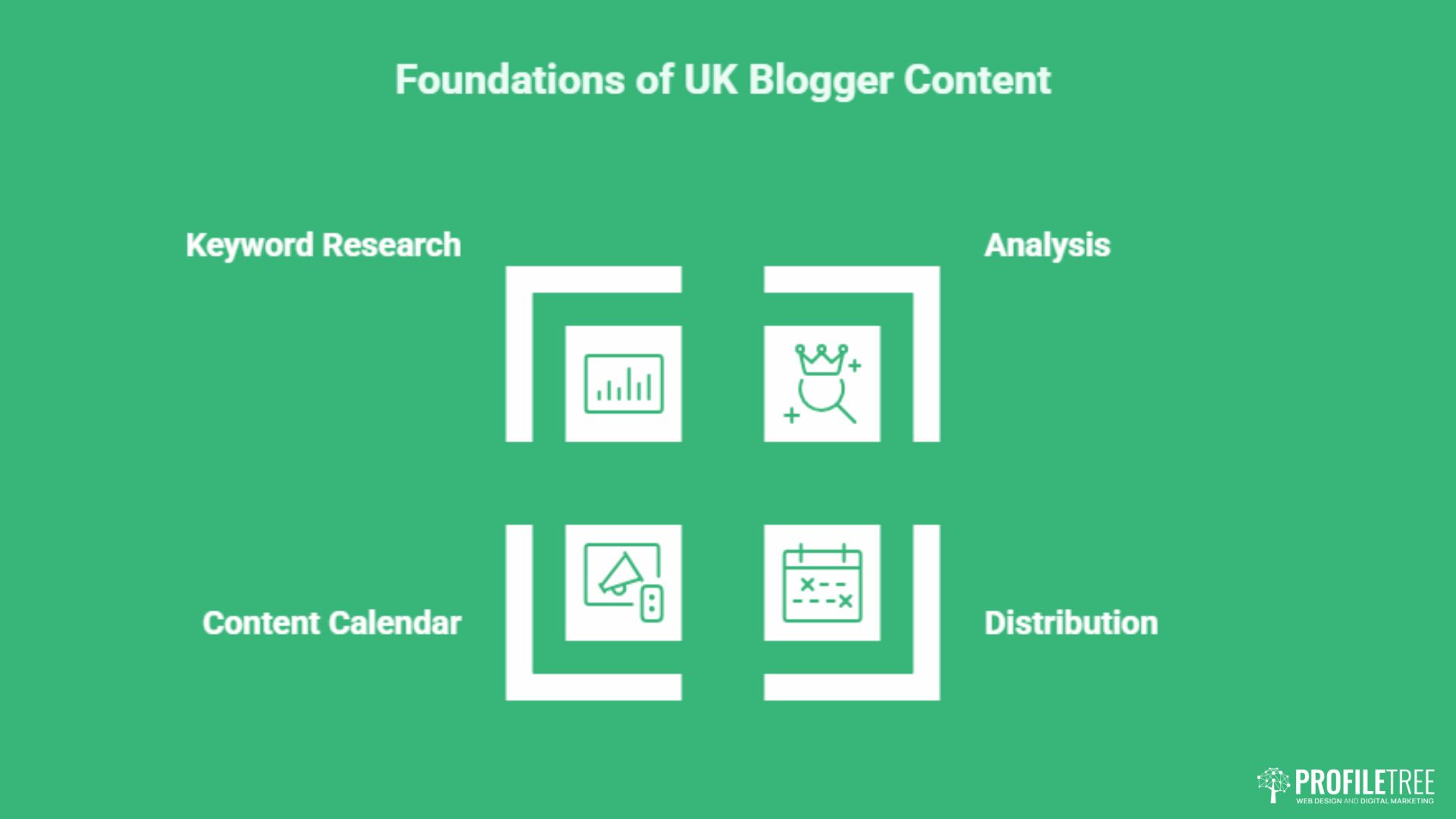
Every effective content marketing operation rests on the same four pillars: strategy, creation, distribution, and analysis. Most UK bloggers are strong on creation and weak on the other three. Getting all four working together is what separates blogs that plateau from those that compound over time.
Keyword Research for the UK Market
UK search behaviour differs meaningfully from US search behaviour in vocabulary, spelling, and local intent. Tools like Semrush, Ahrefs, and Google Search Console are all valuable, but they need to be filtered for the UK locale before you draw conclusions. A keyword with 10,000 monthly searches in the US may have only 400 in the UK, which changes the prioritisation entirely.
Focus on three keyword tiers. Head terms (short, competitive, high volume) tell you what the broad topic looks like. Middle-tier terms (two to three words, moderate competition) are often your best entry points. Long-tail phrases (four or more words, low competition, high intent) tend to convert better because the searcher knows exactly what they want. A strong meta keyword strategy helps you organise these tiers effectively across your site.
Prioritise long-tail terms when building authority from scratch. A post ranking first for “freelance content marketing for UK B2B bloggers” will earn fewer visits than a post about “content marketing,” but the audience quality will be far higher.
The Content Calendar: Consistency Over Frequency
Publishing three posts a week and then disappearing for a month sends negative signals to both Google and your audience. A consistent calendar of one or two quality pieces per week outperforms sporadic volume in almost every niche.
Build your calendar around three axes: search-driven content (targeting specific keywords), timely content (responding to trends or industry news), and evergreen content (foundational guides that remain useful for years). Balance these so roughly 60% of your output targets search intent, 20% captures timely interest, and 20% deepens your evergreen authority.
A content calendar also makes it easier to spot gaps. If you have published 12 posts in the “how to start” phase but nothing in the “advanced tactics” phase, your audience has no obvious next step after your entry-level content. The digital content marketing trends guide outlines how topic clusters can fill those structural gaps.
Distribution: Getting Content Beyond Your Own Site
Publishing a post and waiting for Google to send traffic is a slow strategy. Effective distribution means actively placing your content in front of audiences where they already spend time. That includes email newsletters, social media repurposing, community participation, and zero-click content on platforms like LinkedIn and Threads.
Zero-click content deserves particular attention for UK bloggers. Rather than sharing a link and hoping for clicks, publish the core insight natively on the platform. A LinkedIn post that delivers genuine value builds your brand with people who may never visit your blog until they need exactly what you offer. At that point, the familiarity you have built does the selling for you.
Analysis: Moving Beyond Page Views
Page views tell you how many people arrived. They tell you almost nothing about whether your content marketing is working as a business asset. The metric that matters most is Revenue Per Visit (RPV): total earnings divided by total sessions across a defined period.
Calculate RPV by adding your affiliate commissions, display ad revenue, and product or service sales for the month, then dividing by your total monthly sessions. Even a rough RPV figure clarifies which content types and which audience sources are actually driving business value. If your SEO traffic has an RPV of £0.04 and your email traffic has an RPV of £0.38, that gap tells you exactly where to invest your next 90 days. Reviewing your customer feedback strategy is another way to sharpen this analysis.
The AI-Human Hybrid Workflow for UK Bloggers
AI tools have made content production faster. They have also made it harder to stand out, because every blogger now has access to the same baseline capability. The competitive advantage no longer comes from using AI; it comes from knowing precisely where to use it and where to replace it with genuine human judgment.
Where AI Genuinely Helps
Research and outlining are the two areas where AI tools provide the clearest return. Ask a well-configured AI assistant to summarise the top-ranking articles on a topic, identify the questions they fail to answer, and propose a structure that addresses those gaps. That process, which used to take two hours, now takes ten minutes.
AI is also effective for generating first drafts of repeatable content types: product descriptions, FAQ answers, meta descriptions, and email subject line variants. These are formats where structure matters more than voice, so the efficiency gain is high and the quality risk is low.
Where Human Judgment Must Take Over
The introduction of every post, the opinion sections, the specific examples drawn from real experience, and the editorial decisions about what not to include: these must be written by you. AI tools are trained on averages. They produce content that sounds reasonable because it reflects consensus. Your competitive advantage comes from the things that deviate from that consensus.
This is especially important for UK bloggers building E-E-A-T (Experience, Expertise, Authoritativeness, Trustworthiness). Google’s systems are increasingly good at identifying content that lacks first-hand experience. A post about affiliate marketing that has never actually tested the products it recommends will be outranked by one that has. Understanding content creation ethics is closely tied to maintaining that authenticity under AI pressure.
Preserving Your Blogger Voice
Your voice is the differentiator that AI cannot replicate. It is built from your specific opinions, your storytelling patterns, your sense of humour, and your professional perspective. The blogs that build loyal audiences are those where the reader feels they know the person behind the content.
To preserve that voice while using AI tools, write the introduction and conclusion yourself before touching any AI output. Edit AI-generated body sections aggressively, replacing generic phrasing with specific language from your own experience. Read every section aloud. If it sounds like something a corporate brochure would say, rewrite it. Strong content creation tools can support production without replacing the voice that makes your blog worth reading.
UK Legal and Compliance: What Every Blogger Must Know
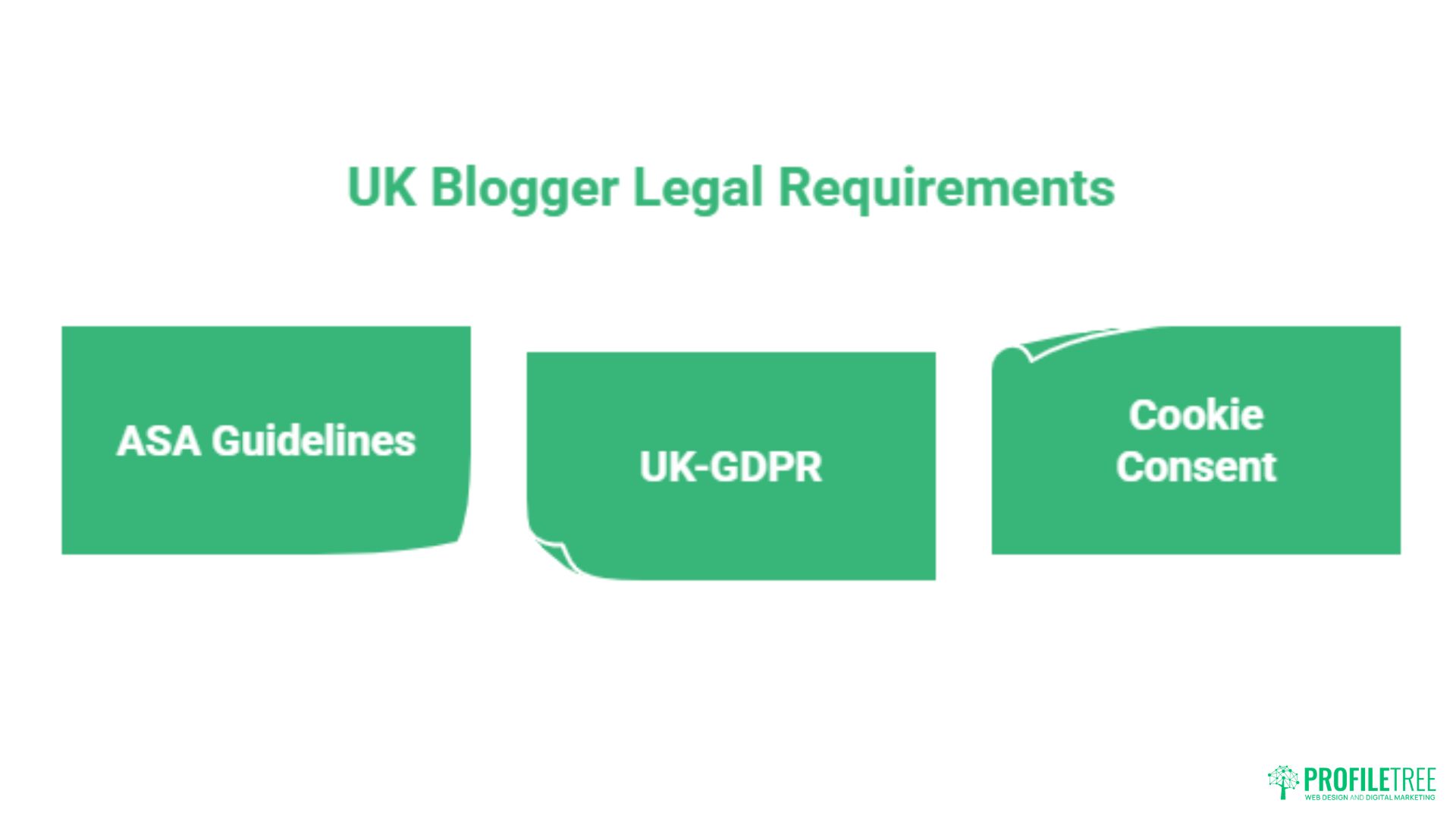
This section is almost entirely absent from US-based content marketing guides, which creates a real risk for UK creators who follow that advice without adaptation. The Advertising Standards Authority (ASA) and UK-GDPR impose specific obligations on bloggers that are not optional.
ASA Guidelines for Disclosed Content
Any content that earns you money or has been provided free of charge must be clearly labelled. The ASA requires that labels appear prominently at the beginning of a post or video, before the reader or viewer engages with the content. Using small text at the bottom of a 2,000-word post does not meet the standard.
The accepted labels are straightforward. Use “#Ad” or “[Ad]” for paid partnerships and sponsored content. Use “#Gifted” or “[Gifted]” for products received free of charge without a payment. Use “#Affiliate” or “[Affiliate]” when links earn you commission. The label must be visible without scrolling or clicking on mobile devices. The CAP Code, which the ASA enforces, applies to content published anywhere online, including social media posts and YouTube descriptions.
“Transparency in content marketing is not just a compliance requirement; it’s what builds long-term trust with your audience,” notes Ciaran Connolly, founder of ProfileTree. “UK readers are increasingly aware of undisclosed sponsorship, and the reputational cost of being caught is far greater than the inconvenience of labelling properly.” The broader context of transparent content marketing shows why this matters commercially as well as legally.
UK-GDPR and Mailing List Growth
If you collect email addresses from UK residents, you are subject to UK-GDPR, which diverged from EU GDPR after Brexit. The core principles remain the same: you need a lawful basis for processing personal data, and consent is the most common basis for newsletter sign-ups.
Consent must be freely given, specific, informed, and unambiguous. Pre-ticked boxes are not valid. Consent obtained through a vague “sign up for updates” form without specifying what those updates contain is not valid either. You must also make it as easy to withdraw consent as to give it, meaning every email must contain a functioning unsubscribe link.
For UK bloggers using lead magnets (free downloads, checklists, templates) to grow their lists, the offer and the consent must be separated. You cannot make the download conditional on consenting to marketing emails; the two must be offered as distinct opt-ins. Email statistics by industry confirm that opt-in lists built on genuine consent consistently outperform purchased or coerced lists on every metric. See our email statistics by industry for benchmark data across sectors.
Cookie Consent and Privacy Policy Requirements
If your blog uses cookies, including those placed by Google Analytics, advertising networks, or social sharing buttons, you need a cookie consent mechanism that meets the UK Information Commissioner’s Office (ICO) standard. That means offering a genuine choice before cookies are set, not an accept-only banner.
Your privacy policy must clearly state what data you collect, why you collect it, how long you keep it, and who you share it with. If you use affiliate links, this should be disclosed in your privacy policy as well as in line with individual links. A blog without these basics is operating outside the law, and regulatory risk aside, it also undermines the trust you are trying to build with your audience.
Distribution, Monetisation, and Measuring What Matters
Building great content and leaving it to rank organically is not a strategy for 2026. The blogs growing fastest are those that treat every published piece as a content asset to be repurposed, distributed, and measured across multiple channels. This section covers the mechanics of making that work in practice.
Email Marketing as a Distribution Engine
Your email list is the one distribution channel you own. Social platforms change their algorithms, advertising costs fluctuate, and search rankings shift. Your list remains yours regardless of what happens to any third-party platform.
Effective email newsletters for bloggers serve three purposes: they deliver value that keeps subscribers engaged, they drive traffic to new and updated posts, and they create revenue opportunities through affiliate links, product promotions, and sponsored slots. Keep the writing tight, lead with the most useful insight, and resist the temptation to make every email a promotional piece. A practical guide on how to use email effectively covers list segmentation and engagement tactics worth applying.
Social Media and the Zero-Click Approach
Social platforms actively suppress posts that drive traffic off-platform. Links in posts typically receive a fraction of the reach that native content receives. The zero-click strategy works with that reality rather than against it.
Instead of posting a link to your latest article, publish the core insight as a native post. On LinkedIn, this might be a carousel breaking down your five key frameworks. On Threads, it might be a short thread of the most surprising findings from your research. The audience consumes the value without leaving the platform, your reach expands, and the followers who want more know where to find you. Graphic design plays a significant role in making social assets compelling; our graphic design in content guide explains how visual standards affect engagement.
Affiliate Marketing and Monetisation Realities
Affiliate marketing works best when the product or service you are recommending is genuinely part of your workflow or has been tested directly. UK affiliate networks worth considering include Awin, which represents a broad range of British retailers and financial services brands, and Impact, which covers many SaaS tools popular with content creators.
Authentic recommendations outperform generic roundups significantly. A post that says “I used this tool for six months and here is what I found” will consistently earn more clicks and conversions than a “10 best tools for bloggers” listicle where the author has tested nothing. The reputational risk of recommending poor products also falls sharply when your recommendations are grounded in real use. Understanding ethical content creation principles helps maintain that integrity at scale.
Calculating Revenue Per Visit
Revenue Per Visit is calculated by dividing total monthly earnings from your blog (ad revenue, affiliate commissions, digital product sales, sponsored content fees) by total monthly sessions. If you earned £800 in a month with 25,000 sessions, your RPV is £0.032.
| Revenue Source | Monthly Amount |
|---|---|
| Display advertising | £200 |
| Affiliate commissions | £350 |
| Digital products / courses | £175 |
| Sponsored posts | £75 |
| Total | £800 |
All prices and figures in this guide are indicative UK examples and correct at the time of writing; use them as a benchmark rather than fixed quotations.
Once you have a baseline RPV, segment it by traffic source. Email subscribers will typically show an RPV three to ten times higher than organic search traffic because they have an established relationship with you. That gap tells you exactly where to focus growth efforts. The blog vs. vlog comparison is worth reading if you are deciding which format to prioritise for monetisation.
Conclusion
Turning a blog or vlog into a sustainable content marketing operation requires more than consistent publishing. It demands clear goals, a structured keyword strategy, a disciplined workflow that integrates AI without losing your voice, and full compliance with UK legal requirements that most guides ignore. Start with an honest audit of what you have, identify the one pillar you are weakest on, and build from there. The compounding effect of consistent, strategic content marketing is real.
Ready to professionalise your content operation? Explore our digital training services to find out how ProfileTree supports UK creators and businesses with practical, results-focused digital marketing skills.
FAQs
How is content marketing different from just writing a blog?
Blogging is the medium; content marketing is the strategy built around it. A blog post is a content marketing asset when it serves a defined goal, targets a specific audience at a specific stage of their journey, and is measured against clear outcomes such as traffic, conversions, or revenue. Without that strategic layer, a blog is simply a publishing habit.
What are the four pillars of content marketing for bloggers?
The four pillars are strategy (defining goals and audience), creation (producing content that addresses specific intent), distribution (placing that content in front of the right people across multiple channels), and analysis (measuring performance against business outcomes, not just page views). Most bloggers are strong on creation and underinvest in the other three.
Do I need to use AI for content marketing?
AI tools are not mandatory, but ignoring them entirely puts you at a disadvantage. The practical approach is to use AI for research, outlining, and structural tasks, while retaining human authorship for introductions, opinion sections, and anything requiring first-hand experience. The blogs that are growing fastest now are using an AI-human hybrid model rather than choosing one over the other.
How do I label affiliate links for UK audiences?
The ASA requires clear, prominent disclosure at the start of any content that contains affiliate links or paid partnerships. Use “#Affiliate” or “[Affiliate]” before the content begins, not buried in a footer. On social media, “#Ad” is required for any post where you have received payment or a free product in exchange for coverage. Disclosure must be visible on mobile without scrolling.
How long does it take to see results from content marketing?
Expect a three-to-six-month window before content marketing produces measurable organic growth. Individual posts can rank faster with strong targeting and internal linking, but the compounding effect of a full content strategy typically takes six months to a year to become clearly visible in analytics. Email and social distribution can accelerate early results while search authority builds.