
Cross-Selling Strategies That Actually Grow Revenue
Table of Contents
Most SMEs leave money on the table after every sale. A customer buys from you, completes the transaction, and leaves, while a complementary product or service that would genuinely help them sits unseen on another page of your website.
Cross-selling is the practice of presenting relevant additional products or services to a customer who has already shown buying intent. Done well, it increases average order value, improves customer satisfaction, and strengthens long-term loyalty. Done poorly, it feels pushy and drives customers away. The difference almost always comes down to how your digital channels are designed, how your content is structured, and how you use customer data.
This guide covers the cross-selling strategies that work for small and medium-sized businesses operating in the UK and Ireland, with a practical focus on how to implement them through your website, email, and wider digital marketing.
What Is Cross-Selling and Why Does It Matter for SMEs?
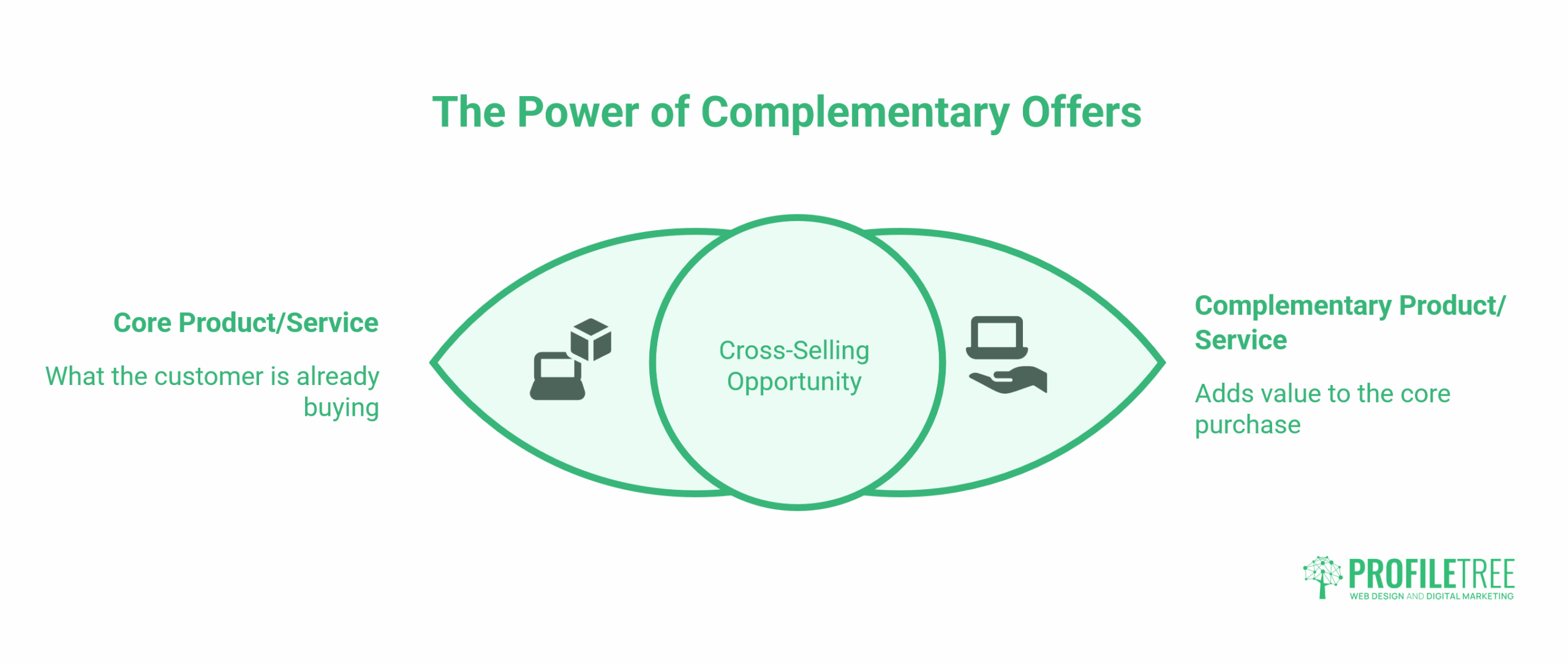
Cross-selling means recommending a product or service that complements what a customer is already buying. If someone purchases a laptop through your online store, suggesting a carry case or software subscription is cross-selling. If a client books your accountancy firm for tax returns and your team mentions your bookkeeping service, that is cross-selling in a professional services context.
It is worth being clear about the distinction between cross-selling and upselling, because the two are regularly confused. Upselling encourages customers to buy a more expensive version of the same product (a higher-spec laptop, for instance). Cross-selling introduces a different product or service category that adds value alongside the original purchase. Both have a place in a well-designed digital strategy, but they require different timing, placement, and messaging.
For SMEs, the commercial case is straightforward: acquiring a new customer costs significantly more than selling again to an existing one. Cross-selling helps you extract more value from customers who have already decided to trust you, without the full acquisition cost.
Cross-Selling vs. Upselling at a Glance
| Cross-Selling | Upselling | |
|---|---|---|
| What it does | Adds a complementary product/service | Upgrades the existing purchase |
| Timing | During or after the purchase | During the purchase |
| Example (retail) | Phone + case + screen protector | Phone with larger storage |
| Example (B2B services) | Web design + SEO retainer | Standard hosting + managed hosting |
| Risk if mishandled | Feels irrelevant or opportunistic | Feels pushy or bait-and-switch |
Why Most SME Cross-Selling Fails (And What to Fix First)
Before discussing tactics, it is worth addressing the most common reason cross-selling underperforms for UK and Irish SMEs: their websites do not support it.
Cross-selling is a digital and structural problem as much as a sales one. If your product pages have no related product recommendations, your checkout has no complementary offer, your post-purchase emails are generic, and your site is not optimised for mobile, no amount of sales training will move the needle.
The Website Architecture Problem
Many small business websites are built around individual products or services as standalone pages, with no internal structure that connects related offerings. A customer visiting a specific service page has no visible pathway to a complementary service. This is a web design and information architecture issue that needs to be resolved at the structural level, not patched with a pop-up.
A well-designed ecommerce or services website creates natural journeys between related pages. Related products appear on product pages. Service packages are grouped logically. Navigation reflects how customers think about their needs, not how the business is internally organised. For businesses running WooCommerce or a bespoke CMS, this kind of ecommerce website development decision shapes cross-selling outcomes long before any marketing campaign begins.
The Content Problem
Cross-selling depends on customers’ understanding why a related product matters to them. If your product descriptions are thin, your category pages lack context, and your emails are templated, customers have no reason to explore further. Content marketing for ecommerce and service businesses is not just about attracting new visitors through search; it shapes whether existing customers see the full value of what you offer.
The Data Problem
Personalised cross-selling requires data: purchase history, browsing behaviour, and customer segments. Many SMEs collect this data passively through their ecommerce platform or CRM but never put it to work. Customer segmentation is the bridge between raw transaction data and recommendations that feel relevant rather than random.
Seven Cross-Selling Strategies for UK and Irish SMEs
The following seven strategies cover website structure, email, data, and post-purchase outreach. Each is practical for businesses operating without a large marketing team, and each connects to a specific point in the customer journey where cross-selling has the best chance of landing well.
1. Related Product Recommendations on Product Pages
The most direct cross-selling opportunity on any ecommerce site is the product page itself. A customer who has found a specific product and is reading about it is at a high point of buying intent. A well-placed recommendation for a complementary item, presented with a brief explanation of why the two work together, can add real value to their decision.
The keyword is relevance. A customer buying a professional camera lens does not need to see your entire accessories range; they need to see the lens hood, filter, and lens bag that professional photographers consistently pair with it. The recommendation should feel like advice from a knowledgeable shopkeeper, not an automated cross-sell engine firing at random.
This placement also creates an SEO benefit. Internal links between genuinely related products improve site structure and distribute authority across your catalogue, which supports search engine optimisation for deeper pages that might otherwise lack incoming links.
Pro tip: Avoid labelling the section “You might also like.” Customers respond better to functional framing, such as “Frequently bought together” or “What professionals also use with this.”
2. Checkout and Basket Cross-Sells
The checkout page is the highest-intent moment in the customer journey. The decision to buy has already been made. A well-timed, low-friction offer at this stage can increase average order value without requiring the customer to retrace their steps.
Effective checkout cross-sells share three characteristics: they are priced relatively low compared to the main purchase, they are immediately relevant, and they require minimal decision-making. A £5 add-on at checkout does not need a product page’s worth of explanation. A brief description and a single click to add it to the basket are sufficient.
For service businesses, the equivalent is the post-proposal cross-sell: a brief mention in the engagement documentation of a related service that typically follows the initial engagement. Website projects often naturally lead to SEO retainers, for example, because the site needs traffic after launch.
“By streamlining the path to purchase on our product pages, we increase the likelihood of both initial and additional sales,” notes Ciaran Connolly, founder of ProfileTree.
3. Post-Purchase Email Sequences
Email is one of the most effective channels for cross-selling, precisely because it reaches customers after the initial transaction when their guard is lower, and their satisfaction with the purchase is (ideally) high. The timing and content of post-purchase emails matter enormously.
A bare-minimum post-purchase sequence for an ecommerce SME should include: a confirmation email immediately after purchase, a delivery or onboarding email that provides practical value, and a follow-up after the customer has had time to use the product that introduces a natural next step or complementary item.
The third email is where the cross-sell sits. It should be framed around the customer’s experience with their purchase, not around your sales targets. “Now that you’ve had your camera for a few weeks, here’s what our professional customers reach for next” is a very different proposition from “Check out our accessories range.”
Email compliance matters here, too. Under UK GDPR and PECR (the Privacy and Electronic Communications Regulations), you must have a lawful basis for sending marketing emails. For existing customers, the “soft opt-in” rule generally allows you to email about similar products and services, provided you gave them the opportunity to opt out when they purchased and on every subsequent email. This is not a technicality; it is a genuine constraint that affects how you build your email sequences and manage consent.
4. Personalised Recommendations Using Customer Data
Customers who feel that recommendations are relevant to them are far more likely to act on them than those who receive generic “popular products” suggestions. Personalisation at scale requires data, and most ecommerce platforms, including WooCommerce, Shopify, and Wix, collect more usable data than the average SME uses.
Customer segmentation is the practical starting point. Dividing your customer base by purchase category, order value, purchase frequency, and browsing behaviour gives you the building blocks for relevant cross-sell targeting. A customer who has bought professional tools twice in six months is a different audience to a first-time buyer of consumer-grade products, even if they purchased from the same product category.
Increasingly, AI-powered recommendation tools built into ecommerce platforms are making product-level personalisation accessible to smaller businesses. The AI conversion impact is now measurable and documented across platform studies. The practical implication for SMEs is that spending time configuring the recommendation logic in your existing platform, rather than leaving it on default settings, can produce meaningful improvements without additional software investment.
5. Product Bundling
Bundling complementary products into a single offer, often at a price more attractive than buying each item individually. It is one of the most reliable cross-selling tactics because it reduces decision fatigue: the customer does not need to evaluate each product separately and decide whether they want it; they evaluate the bundle as a complete solution.
Bundles work particularly well for products with a natural usage relationship: a camera and its accessories, a skincare routine’s core products, a software subscription with an onboarding training package. The framing should always be about customer completeness, not about shifting excess stock.
There are two bundle types worth distinguishing. Pure bundles exist only as a set; the component parts are not available separately. Mixed bundles offer the option of buying individually or as a package. For most SMEs, mixed bundles are the more practical starting point because they preserve flexibility and allow customers who only want one item to purchase without frustration.
For service businesses, bundling typically takes the form of tiered packages or retainer structures that combine complementary services at a fixed monthly fee. A digital agency offering web design, SEO, and content marketing as a bundled retainer is applying exactly the same principle as an ecommerce retailer offering a camera kit.
6. Social Proof in Cross-Sell Placements
“Frequently bought together” works partly because it is true, and partly because it signals social proof. Customers are more willing to add a complementary product when they can see that other buyers in a similar position made the same choice.
Review snippets placed alongside cross-sell recommendations amplify this effect. A brief verified review of the accessory product displayed at the point of recommendation reduces the need for the customer to follow a separate link to research it; in a checkout or product page context, it is a meaningful friction reduction.
For service businesses, testimonials that reference the full scope of work and specifically mention how a client moved from one service to an adjacent one serve the same function. They normalise the cross-sell by showing that it represents a common and successful client journey.
7. Lifecycle Cross-Selling: Timing Matters
The most effective cross-sell timing aligns with genuine need rather than with your revenue calendar. A customer who has just completed a website build is not ready to hear about a full SEO strategy on day one; they need time to launch, gather initial traffic data, and identify what they do not yet know. Six to eight weeks after launch is often the natural time when questions arise that an SEO service can directly answer.
Mapping your cross-sell outreach to the customer’s actual usage journey, rather than arbitrary follow-up schedules, requires some content strategy planning, but the payoff is a cross-sell that arrives when the customer’s need is real rather than hypothetical.
For ecommerce, lifecycle logic typically means working with your platform’s purchase data: understanding when customers tend to reorder consumables, when they progress to a higher-specification product, and when they go quiet. Each of these moments is a cross-sell opportunity if your outreach is framed correctly.
Cross-Selling and UK/Irish Data Regulations
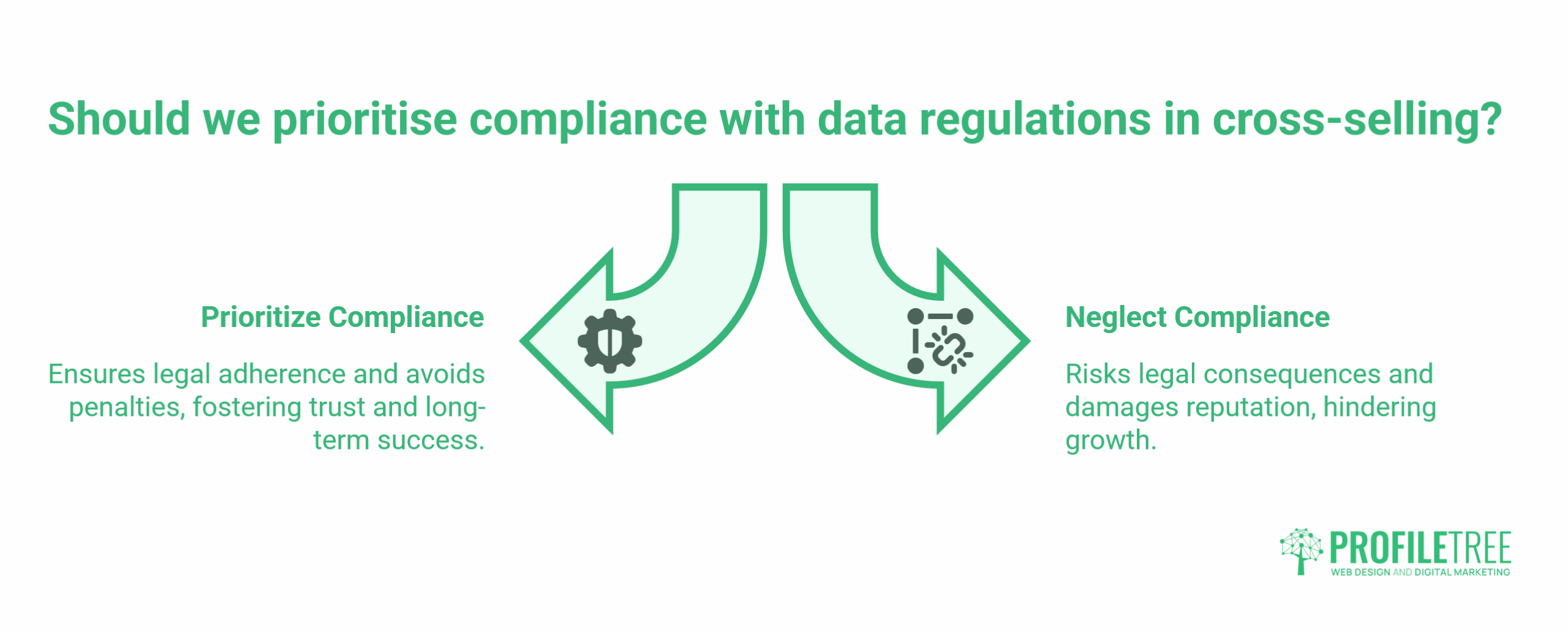
This is the section most guides skip, and for UK and Irish businesses, it is not optional.
UK GDPR and PECR. Under PECR, you cannot send electronic marketing communications to customers without either explicit consent or a valid soft opt-in. The soft opt-in applies when the customer provided their contact details during a sale, the marketing relates to similar products or services, and they were given the chance to opt out when they provided their details and in every subsequent message. The keyword is “similar”: cross-selling a product from a different category than the one originally purchased may not qualify.
Data minimisation. UK GDPR requires that you collect and use data only in proportion to the purpose. Building detailed behavioural profiles to drive cross-selling recommendations is legitimate, but it requires a clear privacy notice and an accessible way for customers to opt out of profiling.
Navigating these requirements is more straightforward than it sounds, but it does require that your email platform, CRM, and website consent management are set up correctly from the start. e-commerce data privacy has direct implications for how cross-sell email sequences are structured and what consent language appears at checkout.
The practical takeaway: build your consent and data practices before your cross-sell campaigns, not after. A cross-sell sequence that bypasses PECR requirements is not just a compliance risk; it actively undermines customer trust, the foundation that makes cross-selling effective in the first place.
How to Measure Cross-Selling Performance
Cross-selling generates real commercial value only if you measure it and improve it over time. The metrics below give a structured view of what is working.
Average Order Value (AOV). The most direct measure of cross-selling effectiveness. Track AOV over time and correlate changes with specific cross-sell interventions (new bundle launch, updated product page recommendations, new email sequence). A rising AOV in a period where you have actively worked on cross-sell placements is a strong signal.
Attach Rate. The proportion of transactions that include a cross-sold item alongside the primary purchase. An attach rate of 15% on a specific product page cross-sell, for example, indicates that roughly 1 in 7 customers take the recommendation. This metric allows you to compare performance across different cross-sell placements without being distorted by overall volume changes.
Cross-Sell Penetration Rate. The percentage of your total customer base that has purchased from more than one product or service category. This is the broadest view of whether your cross-selling strategy is working at a relationship level rather than just a transactional one. If your penetration rate is low relative to your catalogue range, it suggests a structural or awareness problem rather than a messaging one.
Customer Lifetime Value (CLV). Cross-selling should increase CLV by deepening the customer-business relationship. If customers who have bought across multiple categories show measurably higher lifetime value than single-category buyers, you have demonstrated the long-term ROI of the strategy.
A practical improvement cycle: audit your current AOV and attach rate for key products, implement one cross-sell change (updated product page placement, new email, bundle offer), measure the impact over 30 to 60 days, then iterate. Small, measured changes over time produce more reliable insight than wholesale platform overhauls.
Cross-Selling in Practice: Sector Scenarios
Retail and ecommerce. A UK-based homeware retailer running WooCommerce has strong sales on individual kitchen items but low basket sizes. Restructuring product pages to display “complete the kitchen” bundle recommendations, adding a checkout cross-sell for related items under £15, and building a post-purchase email sequence at 14 days post-delivery are three actions that address different points in the customer journey without requiring platform changes.
B2B professional services. An accountancy firm in Northern Ireland provides tax return services to small businesses. A structured post-engagement follow-up sent after the tax return is filed that introduces bookkeeping and payroll services, framed around the client’s likely upcoming needs rather than the firm’s service range, is a cross-selling application in a professional context. The timing, trust, and relevance conditions are identical to ecommerce.
Digital services. A web design agency that completes a site build has a natural cross-sell opportunity into SEO, content marketing, and digital training. The challenge is timing: introducing these before the site is live feels premature, and waiting too long means the client has moved on. A structured three-month check-in, tied to specific observable milestones (site traffic data, search visibility), creates a context in which the cross-sell lands as a response to a real business need.
Conclusion
Cross-selling works when it is built into the structure of your digital channels rather than bolted on as an afterthought. The starting points are practical: review your product pages for related recommendation logic, map a post-purchase email sequence to your customer journey, and define which product or service pairings offer genuine value to your customers. ProfileTree works with SMEs across Northern Ireland, Ireland, and the UK to design websites and digital strategies that support commercial growth at every stage of the customer relationship. If your current site is not designed to support cross-selling, get in touch to discuss what a structural improvement would look like for your business.
FAQs
What is the best cross-selling strategy for small businesses?
Product page recommendations and a post-purchase email sequence are the highest-return starting points. Both work within existing platforms and require no additional software. Add bundling once you have transaction data showing which products customers already buy together.
What is the difference between cross-selling and upselling?
Cross-selling recommends a different, complementary product or service alongside the original purchase. Upselling encourages customers to buy a more expensive version of the same product. Upselling typically happens during the decision; cross-selling can happen before, during, or after the transaction.
What is a reasonable cross-sell conversion rate for ecommerce?
It varies by placement and sector. Checkout add-ons typically convert at 3–10%. Post-purchase emails tend to outperform standard promotional sends because the audience is warm. Your own before-and-after baseline is more useful than any industry average.
How do I know which products to cross-sell together?
Start with your transaction data. Products customers regularly buy together or in quick succession are the strongest natural pairings. Supplement this with product knowledge and customer feedback. Avoid pairing products based solely on margin; customer relevance always takes priority.