
SEO for Legal Professionals: A Practical Guide for UK and Irish Law Firms
Table of Contents
Most people who need a solicitor do not ring the firm they half-remember from a hoarding. They search. “Solicitor near me”, “family law Belfast”, “commercial lease advice Northern Ireland”: the practices sitting on page one for those queries are the ones taking the instruction.
That makes SEO for legal professionals a client pipeline rather than a marketing line item. It also makes it unusually constrained. Regulatory obligations, professional reputation and the buying behaviour of high-value clients all shape what good legal SEO looks like, and none of those pressures apply to a shop selling trainers.
This guide covers five things: why law firm SEO behaves differently from other sectors, how to research keywords that produce fee income, what on-page work satisfies both Google and the regulators, how local visibility is won, and how to measure whether any of it is working.
“Law firms often underestimate how specific their SEO needs to be,” says Ciaran Connolly, founder of ProfileTree. “The firms gaining ground aren’t chasing broad terms. They’re building authority around the exact practice areas and locations where they actually win work, and doing it through content that answers what potential clients are searching for.”
Why SEO for Legal Professionals Works Differently From Other Sectors
SEO for solicitors starts from a different position than SEO for a retailer or a tradesperson. Three forces set that position: professional regulation, an unusually crowded results page, and a buyer who is nervous, time-pressed and making a decision they cannot easily reverse. Each one changes what a firm should build and in what order.
The Regulators Who Shape What a Law Firm Can Publish
The Solicitors Regulation Authority in England and Wales, the Law Society of Northern Ireland, and the Law Society of Ireland each set standards on how firms describe and price what they do. The SRA’s Transparency Rules require regulated firms in defined practice areas to publish cost information in a prescribed format on their websites.
Those obligations are not an obstacle to legal SEO. They map neatly onto what Google already rewards: specific, verifiable, service-level detail on a page. A firm that treats compliance and content as two separate jobs ends up doing both badly, because the ethics of digital marketing for law firms and Google’s ranking criteria pull in the same direction rather than opposite ones.
Competing Against National Directories and Aggregators
Personal injury and conveyancing sit among the most contested query sets in the UK, which is why SEO for law firms rarely succeeds as a long-term chase. National firms and lead-generation directories hold most of the top positions, backed by domain authority that a regional practice will not match by writing a few blog posts.
The realistic route runs through specificity. “Contested probate solicitor Belfast” has a fraction of the volume of “probate solicitor”, and a far higher chance of ranking and converting. Chasing head terms with a thin site is one of the SEO risks that quietly drain a marketing budget without ever producing a ranking.
Why Trust Signals Carry Extra Weight in Legal Search
A star rating matters more when someone is choosing who handles their divorce than when they are buying a kettle. Review volume, author credentials, named fee earners and transparent pricing feed both ranking and the conversion rate of the people who do land on the site.
The flip side is that promotional language carries real risk here. Claims a firm cannot substantiate carry legal implications for misleading advertising that reach the Advertising Standards Authority as well as the regulator.
Shifting the Goal From Traffic to Fee-Earning Instructions
Sessions are a poor proxy for success in legal marketing. A firm ranking well for “how long does probate take” may collect thousands of visits from people who will never instruct anyone, while a page targeting “contested probate solicitor” brings twelve visits a month and two matters.
Sorting one from the other is a question of search psychology and user intent rather than volume. Volume tells you how many people asked. Intent tells you whether any of them will pay.
Keyword Research for Solicitors, Barristers and Legal Services
Keyword research for the legal sector is an exercise in commercial judgement rather than spreadsheet size. Most law firm SEO plans fail here, not later. A term with 5,000 monthly impressions can produce nothing. A term with 50 can carry a practice area. Sorting one from the other takes four steps.
Educational Searches Against Instruction-Intent Searches
Educational queries attract researchers. Instruction-intent queries attract buyers. Both belong in a plan, but they do different jobs and should sit on different page types.
| Educational Keywords | Instruction-Intent Keywords |
|---|---|
| What is a settlement agreement | Settlement agreement solicitor Belfast |
| How long does probate take | Contested probate solicitor Northern Ireland |
| What is a commercial lease | Commercial lease review Belfast |
| Divorce process UK | Divorce solicitor Belfast free consultation |
Google Search Console will show which educational terms already bring impressions to a firm’s site. Those terms then point towards the instruction-intent pages worth building, along with the secondary keywords that give each of those pages its context.
Practice Area Terms That Bring Fee Income
Long-tail phrases of four or more words convert better and face weaker competition from aggregators. “Personal injury solicitor Derry” is winnable for a regional practice in a way “personal injury solicitor UK” is not, and the person typing it has already narrowed their geography.
The same logic applies across specialisms. SEO for conveyancing solicitors, SEO for employment lawyers and SEO for barristers are separate problems with separate query sets, which is why ProfileTree builds SEO services for law firms around a practice-area audit rather than a single keyword list.
Dual-Jurisdiction Targeting Across Northern Ireland and Ireland
SEO for solicitors in Ireland and SEO for solicitors in Northern Ireland are two search programmes, not one. Someone searching in Dublin sits under a different regulator, a different court system and different conveyancing conventions from someone searching in Belfast. Treating both as “Ireland” produces pages that rank properly in neither market.
Writing credible location copy means knowing how the city of Belfast is actually divided into quarters and professional districts, rather than naming the city and hoping. On the technical side, multi-regional search targeting has to be built into the site structure rather than bolted on as duplicate pages.
Screening Out Queries That Waste Fee-Earner Time
Not every ranking is worth having. A private-client firm that ranks for legal aid queries will field calls it cannot convert, and the partners will conclude that SEO does not work. The fix is positioning: pages that state clearly who the service is for and what it costs filter enquiries before they reach a fee earner.
That filtering only works if the firm is measuring the right things in the first place. Traffic totals and legacy scores like Alexa Rank flatter a monthly report without telling a partner anything about fee income.
On-Page SEO, E-E-A-T and Regulatory Compliance
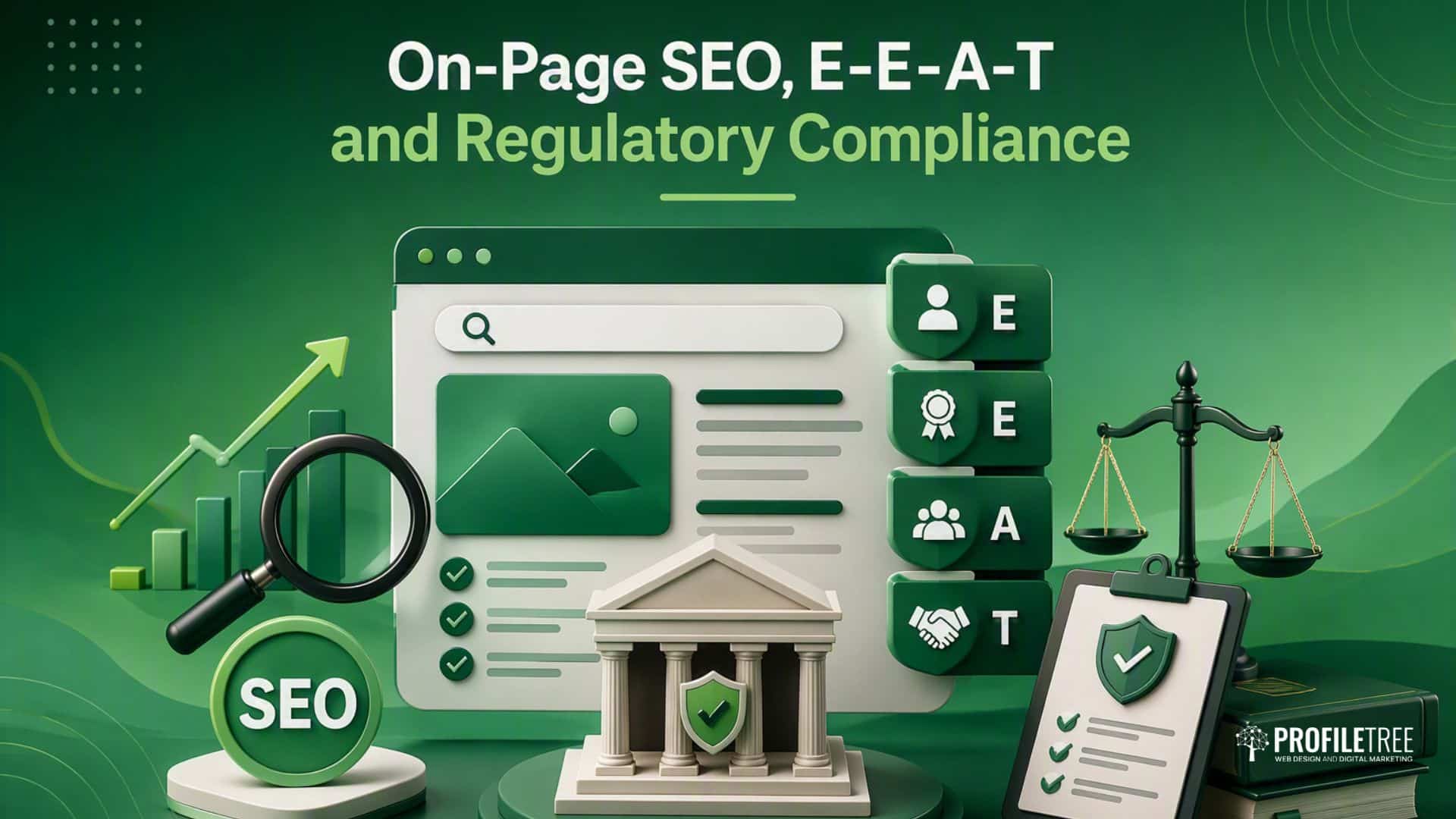
Legal content sits in Google’s Your Money or Your Life category, which means it faces a higher quality threshold than most sectors. Four on-page areas decide whether law firm SEO clears that bar: authorship, pricing, metadata and the technical build underneath.
Author Credentials on Every Piece of Legal Content
Every substantive page should carry a named author with verifiable credentials. Solicitors, barristers and legal executives need to appear by name, specialism and qualification, not as “the team”. Google reads LinkedIn profiles and professional directory listings as part of its assessment of who wrote a page.
This is among the fastest improvements available to a legal website and among the most commonly skipped. That higher standard comes from Google’s YMYL classification, which suppresses thin, unattributed content in regulated sectors rather than simply ranking it a little lower.
Price Transparency as a Ranking Asset
Firms bound by the Transparency Rules already have to publish cost information. Building those pages properly turns a compliance task into a ranking asset, because queries like “how much does conveyancing cost in Belfast” and “how much does SEO cost for a solicitor” reward pages that answer directly rather than deflecting to a contact form.
Overclaiming does the opposite. “Leading law firm” and “best solicitors in Northern Ireland” breach professional marketing standards and read as unsubstantiated promotion to Google’s quality systems. Specific descriptors work better on both counts: years in practice, case volumes, and named specialisms. The ethics and legalities of digital marketing and Google’s quality systems reward the same restraint.
Title Tags and Meta Descriptions for Practice Area Pages
A practice area page competes for the click before it competes for the ranking. Titles should carry the service and the location within the first forty characters, because that is what survives truncation on mobile. Meta descriptions should state what the page contains and what the reader will find out.
Legal websites are also prone to legacy metadata left behind by old plugins and old agencies, and meta keywords in particular are worth auditing and stripping before anything new is written.
Technical Foundations for a Law Firm Website
Technical SEO for law firms follows familiar rules: pages loading in under three seconds on mobile, a clean heading hierarchy, crawlable navigation and structured data that matches what is visible on the page. A single page trying to rank for both “solicitor Belfast” and “solicitor Dublin” will lose to two dedicated pages every time.
Accessibility belongs in the same conversation. Semantic markup, descriptive link text and logical heading order serve disabled users and search crawlers with the same code, which makes accessibility compliance in legal website design a ranking input as much as a legal obligation.
Local Visibility and Authority for Law Firms

Local search is where most practices see movement fastest. Legal instructions are geographically bound: clients want someone they can meet, near the court or the property in question. Four assets decide whether a firm appears in that local result, and none of them require a large budget.
Google Business Profile for a Legal Practice
A fully completed and actively maintained profile is the single highest-return local asset a firm holds. Practice areas, opening hours, photographs, service listings and a description written in the language clients actually use all belong in it, updated with posts covering firm news or practical client guidance.
The map results sitting above the organic listings are where a large share of “solicitor near me” traffic ends up, so how Google Maps assembles and ranks business listings matters more for those queries than any on-page change.
Legal Directories, Citations and NAP Consistency
NAP stands for Name, Address and Phone Number. Any variation in how those appear across the Law Society register, Chambers and Partners, the Legal 500 and general business directories weakens local rankings, because the discrepancy creates doubt about which record is correct.
Directory listings serve two purposes at once: they confirm the firm’s details, and they carry authoritative links. For most practices, accurate entries on the main legal directories and the wider set of free business listing sites across the UK and Ireland matter more than any general link-building campaign.
Location Pages for Firms With More Than One Office
Every office needs its own page, and every page needs content that could not have been written for anywhere else: the local court, matters handled in that area, the solicitors based there, references to the local property or business market. Swapping a town name on a template produces near-duplicate pages that Google declines to rank at all.
Getting that architecture right at the build stage is considerably cheaper than retrofitting it, so location page structure belongs in the web development brief rather than in a content project eighteen months later.
Reviews and the Discipline of Responding to Them
Reviews are a direct local ranking factor and, for professional services, often the deciding factor between two firms with similar credentials. A firm needs a repeatable process for asking satisfied clients at the right moment, and a measured, professional response to every review, including the difficult ones.
That process usually sits with support staff rather than partners, which makes it a natural candidate for digital marketing training so that no firm ends up paying an agency to press “reply” on a Google review.
AI Search and Measuring Return From Legal SEO
The results page a potential client sees in 2026 is not the one they saw three years ago. AI-generated answers now sit above the links for a large share of legal queries, and a firm that is not cited in them loses visibility that it never sees in a rankings report. Measurement has to keep pace.
Earning Citations in AI-Generated Answers
AI systems favour content structured for extraction: a direct answer in the first forty to sixty words of a section, clear headings that match real questions, tables, and factual statements that can be lifted without distortion. Pages covering several sub-questions of one topic are cited more often than pages covering one topic narrowly.
Conversational and spoken queries follow similar patterns, and the voice search statistics for UK businesses are worth checking before any FAQ section gets rewritten.
Connecting Rankings to Instructions
Impressions and average position describe visibility. Neither describes income, and SEO for legal professionals is judged on income. A firm should track which queries lead to a form submission or a call, then attribute matters back to organic search through a conversion goal in analytics.
Positions between 10 and 30 are the optimisation opportunity: content depth, credential signals and internal linking can move those pages onto page one. Anything below 50 is not yet competitive. When a page that was working stops working, diagnosing the organic traffic drop properly comes before rewriting a word of it.
Catching Technical Problems Before They Cost Rankings
Search Console is the free early-warning system most firms have but rarely open. Indexing failures, mobile usability faults and structured data errors all suppress visibility quietly, and a practice area page that has silently dropped out of the index will not announce itself.
A monthly check takes twenty minutes and prevents months of lost visibility, because the most common Search Console errors on professional services sites are almost all quick fixes once someone spots them.
Building Search Visibility That Lasts
SEO for solicitors’ compounds. A practice area page built well this year keeps attracting instructions for years, and a maintained review profile becomes one of a firm’s most valuable assets. Most practice areas across Northern Ireland, Ireland and the UK are still dominated by national directories rather than the local firms doing the work, and that gap is winnable. Talk to ProfileTree about where your firm currently ranks and what it would take to change that.
FAQs
How much does SEO cost for a UK law firm?
Agency retainers for legal SEO commonly run from around £1,000 to £5,000 a month, depending on practice areas targeted, geographic spread and how competitive the terms are. Personal injury and conveyancing cost more than niche commercial work.
How long before a law firm sees results?
Expect measurable movement in impressions and average position within three to six months. Page one for competitive practice area terms usually takes six to twelve. Google Business Profile work can show results in four to eight weeks.
Is SEO compliant with SRA and Law Society rules?
Yes, provided claims are accurate, substantiated and not misleading, and required cost information is published as the rules specify. Superlatives like “best” or “leading” are where firms get into difficulty.
Can a small firm do its own legal SEO?
Partly. Google Business Profile upkeep, review requests and practice area blogging are realistic in-house tasks. Technical audits, site architecture and authority building generally need specialist input.
How does AI search affect a law firm’s visibility?
AI answers cite sources they can extract cleanly. Firms with named authors, clear question-led headings, direct answers and factual detail get cited. Generic, unattributed content does not.