
Organisational Emergency Management: A UK Business Guide
Table of Contents
Most UK businesses have insurance. Far fewer have a plan for what happens when the emergency arrives before the insurer picks up the phone.
Organisational emergency management (OEM) is the structured process by which a business prepares for, responds to, and recovers from disruptions, whether a fire, a flood, a cyber-attack, or an extended server outage. For SMEs across Northern Ireland, Ireland, and the UK, it is not a theoretical exercise. Storm Éowyn in early 2025 left tens of thousands of businesses without power for days; the 2021 flooding in London and Belfast forced dozens of small businesses to close, with no recovery plan in place.
This guide covers the five phases of organisational emergency management, the UK legal framework you need to understand, and how modern businesses with hybrid teams and digital operations need to think about resilience differently from organisations that existed entirely on one site.
What Is Organisational Emergency Management?
Organisational emergency management is the structured approach a business takes to prevent, prepare for, respond to, and recover from emergencies. It applies to any incident that threatens people, operations, assets, or reputation, ranging from physical events such as a building fire to digital incidents such as a ransomware attack or a complete loss of internet connectivity.
It is worth separating OEM from two related but distinct concepts.
Emergency Management vs Business Continuity vs Crisis Management
These three terms are often used interchangeably, which causes problems when businesses try to plan.
| Emergency Management | Business Continuity | Crisis Management | |
|---|---|---|---|
| Focus | Immediate safety and response | Keeping operations running | Protecting reputation and leadership |
| Time frame | Hours to days | Days to weeks | Concurrent with the event |
| Primary goal | Protect people and assets | Maintain essential functions | Manage stakeholder confidence |
| Who leads | Incident Commander / Safety Officer | Operations / IT | CEO / Communications |
A business that only has one of the three is exposed. Effective business continuity planning using AI tools increasingly draws all three disciplines into a single integrated framework.
The UK Legal and Regulatory Landscape
Most UK business owners know they have health and safety obligations. Fewer could say with confidence which legislation specifically covers emergency preparedness. Here is what applies to private businesses.
The Civil Contingencies Act 2004
The Civil Contingencies Act 2004 is the primary piece of UK legislation governing emergency preparedness. It divides responders into two categories. Category 1 responders, which include local authorities, emergency services, and NHS trusts, have a statutory duty to prepare for and respond to emergencies. Category 2 responders, such as utility providers and transport operators, have a duty to cooperate and share information.
Private businesses do not fall under a formal Category 1 or 2 duty. However, the Health and Safety at Work Act 1974 and the Management of Health and Safety at Work Regulations 1999 impose a legal duty of care on all employers to assess risks and implement appropriate controls. Failing to do so can expose a business to civil liability, insurance disputes, and regulatory scrutiny.
For SMEs, the practical implication is clear: even without a formal statutory duty, you are legally required to have assessed the risks to your employees and to have procedures in place for when those risks materialise.
ISO 22301 and ISO 22320: Which Standards Apply?
| Standard | What it covers | Who it applies to |
|---|---|---|
| ISO 22301 | Business continuity management systems | Any organisation wanting a certified BCM framework |
| ISO 22320 | Emergency management and incident response | Organisations coordinating multi-agency or complex responses |
For most UK SMEs, ISO 22301 is the more relevant starting point. It provides a certifiable framework for building a business continuity management system and is increasingly required by larger clients and public sector procurement processes. ISO 22320 is more commonly used by local authorities, emergency services, and large infrastructure operators.
Ciaran Connolly, founder of ProfileTree, notes that when working with SME clients on digital strategy: “The businesses that handle disruption best are the ones that have treated their digital systems as business-critical infrastructure, not just as tools. When a server goes down, or a website becomes unavailable, having a plan for that is the same discipline as having a fire evacuation procedure.”
The Five Phases of Organisational Emergency Management
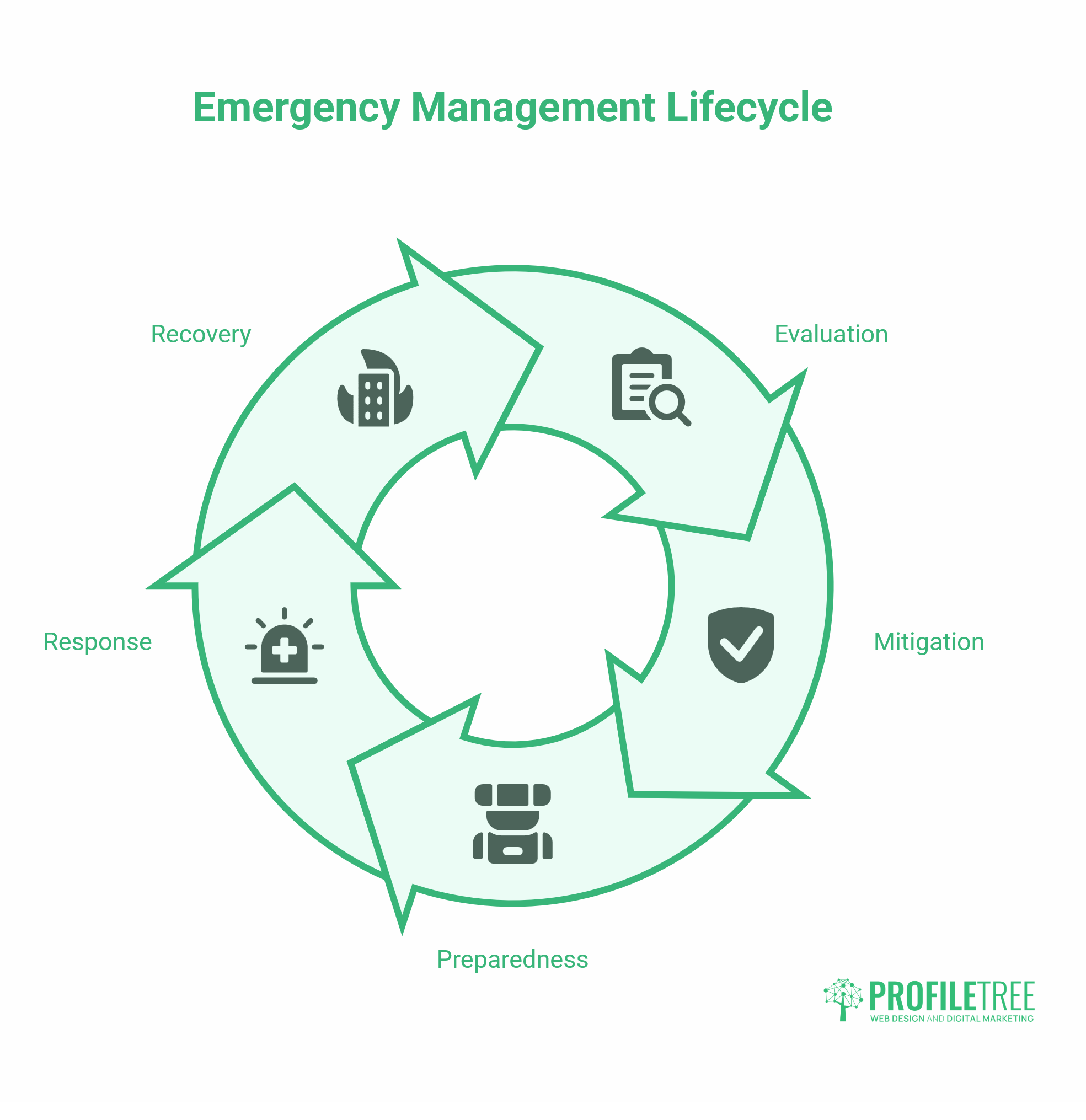
The emergency management lifecycle is most commonly described in five phases. These are not strictly sequential. Evaluation feeds back into mitigation, and preparedness work continues even during a response. Think of them as a continuous loop rather than a linear process.
Phase 1: Mitigation
Mitigation is the work you do before an emergency to reduce the likelihood or severity of disruption. It begins with a risk assessment: systematically identifying the hazards relevant to your business based on your location, sector, size, and operations.
For a Northern Ireland-based professional services firm, relevant hazards might include extended power outages, flooding (Northern Ireland has seen increased flood risk in recent years), cyber incidents targeting client data, and key-person dependency, where the absence of a single individual could cripple operations.
For a manufacturing business in the Midlands, the risk profile looks different: supply chain disruption, machinery failure, and chemical or fire incidents may sit higher on the register.
The output of mitigation work is a risk register: a documented assessment of each identified hazard, its likelihood, its potential impact, and the controls already in place. Understanding your organisation’s risk profile is also directly relevant to business risk management strategy, which covers how systematic risk thinking applies across commercial operations.
Phase 2: Preparedness
Preparedness translates your risk register into actionable plans. This is where most SMEs underinvest. Writing a plan is not preparation; testing it is.
Preparedness activities typically include: developing an emergency response plan with clearly assigned roles; establishing communication protocols and backup channels; identifying evacuation routes, muster points, and assembly procedures; and securing access to the resources you would need in an emergency.
For businesses with remote or hybrid teams, which now represent the majority of UK office-based SMEs, preparedness must account for the reality that your staff may not be in one place when an incident occurs. “Distributed muster points” is not just a logistical issue; it requires a communication infrastructure that works independently of the systems that may themselves be disrupted.
ProfileTree’s digital training programmes can form part of a business’s preparedness activity, ensuring that staff across dispersed locations are confident using the digital tools and communication systems that an emergency response depends on.
Phase 3: Response
The response phase begins when an incident occurs. The quality of your response in the first 60 minutes is disproportionately significant. Organisations that have pre-assigned roles, tested communication chains, and accessible documentation consistently outperform those that begin making decisions from scratch.
A basic response framework for the first hour of a major incident:
- Confirm the nature and scope of the incident
- Activate the designated Incident Commander
- Account for all personnel (physical and remote)
- Initiate the communication cascade to internal stakeholders
- Assess whether external emergency services are required
- Issue an initial holding statement to external stakeholders if needed
- Begin documenting decisions and actions
For digital incidents, such as a ransomware attack or data breach, response also involves isolating affected systems, notifying the ICO if personal data is at risk (within 72 hours under GDPR), and engaging any cyber incident response support you have in place.
Businesses that have invested in AI-powered monitoring tools are increasingly better positioned to detect and respond to digital incidents faster. ProfileTree’s AI implementation work with SMEs covers how tools such as automated anomaly detection and AI-assisted reporting can significantly reduce response times.
Phase 4: Recovery
Recovery is the process of returning your organisation to normal operations, or to a redefined version of normal if the incident has caused lasting change. It begins while the response is still ongoing and can extend for weeks or months after the immediate incident is resolved.
Recovery activities typically include: assessing damage to physical and digital assets; restoring systems and data from backups; supporting staff affected by the incident; managing ongoing communications with customers, suppliers, and other stakeholders; and, where relevant, pursuing insurance claims.
Business continuity statistics consistently show that organisations without a tested recovery plan take significantly longer to restore operations and suffer higher financial losses. A business whose website, customer data, and operational systems are all hosted with appropriate redundancy and backup protocols is in a materially better position when recovery begins. This is one reason why reliable web hosting and website management are business continuity considerations, not just technical ones.
Phase 5: Evaluation
Evaluation is the discipline that separates organisations that improve from those that repeat the same failures. After every incident, whether a full-scale emergency or a minor disruption quickly contained, the business should conduct a structured debrief.
The evaluation should address: what the plan said should happen; what actually happened; where there were gaps between the two; what decisions were made under pressure that the plan did not anticipate; and what changes need to be made to the plan before the next incident.
This continuous improvement cycle is directly analogous to what good digital analytics practice looks like: measure what happened, understand why, and adjust. Organisations that apply this discipline to their emergency management tend to apply it to their operations more broadly.
Emergency Management in a Hybrid and Digital World
An emergency plan built around one physical office no longer reflects how most UK businesses actually operate. If a significant portion of your team works remotely, your response procedures need to account for that reality from the outset.
Managing Remote Staff During a Regional Crisis
The pandemic permanently changed what “workplace” means for most UK office-based businesses. As of 2025, the majority of professional services firms operate with at least some hybrid working arrangements. This creates a direct challenge for emergency management planning.
A fire evacuation procedure designed for one building does not account for the 14 staff who are working from home that day. A power outage affecting your office may not affect your remote staff at all, but a regional telecommunications failure could disable everyone simultaneously.
Effective hybrid emergency planning requires: a communication system that works independently of office infrastructure (a WhatsApp group is not a substitute for a documented protocol, but it is better than nothing); a method of accounting for all staff that does not depend on anyone being physically present; and clarity about which critical functions can continue remotely and which cannot.
Cyber-Emergencies: When Your Digital Infrastructure Fails
A cyber incident is now one of the most likely disruptions a UK SME will face. The UK’s National Cyber Security Centre (NCSC) consistently reports that SMEs are disproportionately targeted because they often have valuable data but weaker defences than larger organisations.
A cyber-emergency has specific characteristics that physical emergencies do not. The incident may not be visible until significant damage has occurred. The affected systems may include the very tools you would normally use to communicate and coordinate your response. And the regulatory obligations, particularly those related to GDPR and ICO notifications, run in parallel with the operational response.
Knowing how to protect your website from cyber-attacks is a foundational element of digital emergency preparedness, not a separate technical concern. Businesses should also ensure that their website and customer-facing communications can be updated quickly during an incident. A static website that cannot post a holding notice, update contact information, or redirect visitors is a liability in a crisis.
The Human Element: Psychological Safety and Duty of Care
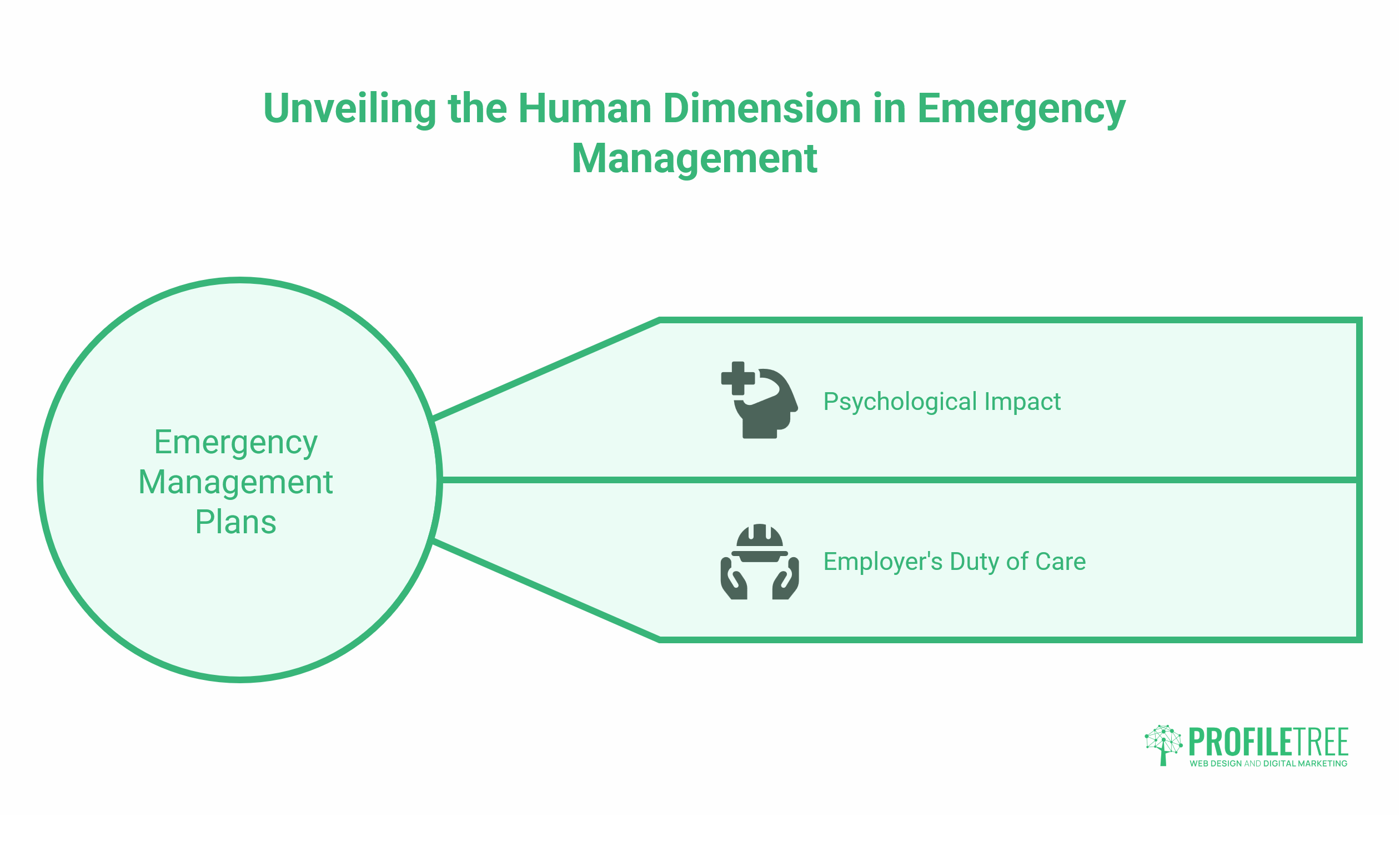
Emergency management plans that treat staff as resources to be deployed rather than people to be supported consistently underperform in real incidents. The psychological impact of emergencies on employees, whether physical incidents or prolonged digital crises, is a recognised risk that falls within an employer’s duty of care.
UK employers have an obligation under the Health and Safety at Work Act to ensure the well-being of their employees, and this extends beyond physical safety to mental health in increasingly explicit ways following the Health and Safety Executive’s updated guidance on work-related stress.
Practical measures include: designating a welfare role within the emergency management team with explicit responsibility for checking in with staff; having access to an Employee Assistance Programme; and ensuring that post-incident debriefs create space for staff to raise concerns about how they were supported during the event, not only how the operational response performed.
Mental Health First Aid training, now widely available through certified providers across the UK, is a meaningful addition to any organisation’s preparedness activities.
Building an Effective Emergency Management Team
A plan without named people behind it is not a plan. Before an incident occurs, your business needs designated roles, documented responsibilities, and identified deputies for when the primary person is unavailable or directly affected by the event.
Key Roles and Responsibilities
No single person can manage an emergency effectively on their own. An Emergency Management Team (EMT) should be small enough to make decisions quickly and broad enough to cover the essential functions.
| Role | Primary Responsibility |
|---|---|
| Incident Commander | Overall decision-making authority during the incident |
| Safety Officer | Monitoring conditions and ensuring the safety of personnel |
| Communications Lead | Managing all internal and external communications |
| Operations Lead | Coordinating the practical response on the ground or remotely |
| Welfare Officer | Monitoring staff wellbeing and providing support |
| IT/Digital Lead | Managing digital systems, data protection, and cyber response |
For SMEs, one person may hold more than one of these roles. The important thing is that the roles are documented, that the people assigned to them know what is expected, and that deputies are identified in case the primary person is unavailable or directly affected by the incident.
The Communications Lead role deserves particular attention. During an incident, your customers, suppliers, and broader stakeholders will form an opinion of your organisation based on how you communicate. A slow, unclear, or contradictory communications response can cause more lasting damage than the incident itself. This is where a well-maintained website, active social media presence, and a pre-prepared holding statement template become operational assets. ProfileTree’s content marketing and digital marketing strategy regularly covers communications planning as part of a broader business strategy.
Practical Steps for SMEs Starting From Zero
If your business does not yet have a formal emergency management plan, starting can feel overwhelming. These steps are a practical sequence for organisations building from nothing.
First, complete a simple risk assessment. List the five most likely disruptions to your specific business and rate each on likelihood and potential impact. This does not require specialist software; a spreadsheet will suffice.
Second, assign emergency roles. Even if you have three staff, someone needs to be the designated decision-maker and someone needs to be responsible for communications.
Third, document your contact cascade. Who calls whom, in what order, using which channel, if your office is inaccessible or your email system is down?
Fourth, check your digital infrastructure. Can your website be updated remotely? Do you have backups of your critical data that are stored separately from your primary systems? Does your IT provider have an emergency response procedure?
Fifth, test it. Run a tabletop exercise once a year at a minimum. Sit a small group of staff around a table, introduce a hypothetical scenario, and walk through what the plan says you would do. Gaps will become immediately obvious.
Conclusion
Organisational emergency management is, at its core, a discipline of clarity: knowing what could go wrong, knowing what you would do if it did, and having tested that knowledge before you need it. For UK SMEs operating with lean teams and increasing digital dependency, the stakes are real. A business that loses access to its systems, data, or primary communication channels without a recovery plan in place is not just facing an operational problem. It faces a reputational one.
The five phases, the UK regulatory context, and the specific challenges of hybrid and digital operations all point in the same direction: preparedness is not a cost; it is a capability. If you want to assess how well your current digital infrastructure supports your business continuity planning, speak to the ProfileTree team.
FAQs
What are the five phases of organisational emergency management?
Mitigation, preparedness, response, recovery, and evaluation. They form a continuous loop rather than a linear sequence, with evaluation feeding directly back into mitigation and preparedness work.
Is organisational emergency management a legal requirement in the UK?
Not directly under the Civil Contingencies Act 2004, which applies to Category 1 responders such as local authorities. However, the Health and Safety at Work Act 1974 requires all employers to assess risks and put in place adequate controls, effectively mandating basic emergency procedures.
What is the difference between emergency management and business continuity?
Emergency management covers the immediate response: protecting people and containing the incident. Business continuity focuses on keeping essential operations running during and after a disruption. Both are necessary and work best when integrated into a single framework.
What is a tabletop exercise, and how often should we run one?
A tabletop exercise is a facilitated discussion where a small group works through a simulated emergency scenario on paper, without physically enacting it. Run one at least annually. Full-scale drills are recommended every two to three years, depending on your risk profile.