
Understanding the Marketing Funnel: A UK SME Guide
Table of Contents
A marketing funnel is the path a potential customer follows from first hearing about your business to becoming a paying client, and, ideally, telling others about you afterwards. Most UK small business owners are already running some version of one without realising it. A social post leads someone to a website. The website captures an email. The email brings them back to book a call.
Understanding the marketing funnel properly, rather than running its stages by accident, is what separates businesses that generate a steady flow of qualified enquiries from those that generate a lot of activity and very little revenue. This guide covers the five stages that matter for UK service businesses, how to build your first funnel from nothing, why the old “cone” model no longer tells the whole story, and what GDPR and PECR mean for how you capture leads.
What Is a Marketing Funnel?
A marketing funnel maps the stages a prospect moves through before buying, from first becoming aware of a business to making a purchase and, ideally, recommending it to others. The word “funnel” reflects a simple fact: more people enter at the top than exit at the bottom. Someone who follows your business on Instagram might never book a call. Someone who reads three blog posts and downloads a guide is far more likely to.
Most funnel guides describe a straight line from top to bottom. Awareness, then interest, then decision. That model is useful for teaching the concept, but it rarely matches how people actually behave.
The Traditional Funnel vs a Non-Linear Customer Journey
A prospect might see a Facebook ad, forget about it for six weeks, ask a colleague for a recommendation, search Google for reviews, read an AI-generated summary of your services, and only then fill in a contact form. That is not a straight line. It is closer to a loop, with the prospect moving back and forth between research and consideration multiple times before they convert.
This matters for how you build a marketing funnel in 2026. Rather than assuming every visitor progresses neatly from one stage to the next, treat each stage as a touchpoint that needs to hold its own, because a prospect might land on your consideration content before they have ever seen your awareness content.
Why Most Marketing Funnels Fail for UK Small Businesses
The standard marketing funnel advice online was written for US SaaS companies with dedicated marketing teams and five-figure monthly ad budgets. Drop that model into a Belfast accountancy firm or a Dublin-based trades business and it falls apart within weeks.
The disconnect is not just about budget. It is about complexity. Most templates ask small business owners to manage seven or eight channels at once before they have confirmed which one produces a single lead. The result is a scattered effort that feels busy but generates nothing measurable. There are three patterns that recur when working with SMEs across Northern Ireland and the wider UK market.
Trying to replicate enterprise tactics on a micro budget. A local solicitor running a £200 monthly ad budget cannot operate the same funnel as a national insurance brand spending £50,000. When the tactics do not match the resource, the funnel produces expensive lessons rather than revenue. Start with a minimum viable funnel: one awareness channel, one capture mechanism, one follow-up sequence. Build outward once you have proof that the core works. A digital marketing strategy review is often the fastest way to confirm which single channel deserves that initial focus.
Skipping the middle of the funnel entirely. Many small businesses invest in awareness (social posts, maybe some paid ads) and then jump straight to a sales call or a “buy now” landing page. The consideration stage, where a prospect weighs their options and decides whether to trust you, gets nothing. This is where content marketing, case studies, explainer videos and email sequences do their work. Leaving it empty means asking cold contacts to make warm decisions.
Measuring the wrong things. Follower counts, page views, and impressions feel like progress. For most SMEs, they are vanity metrics. The number that matters is qualified enquiries, and that requires tracking the journey from first touch to conversation, not just counting eyeballs at the top.
Ciaran Connolly, founder of ProfileTree, puts it this way: “The businesses that get the most out of a marketing funnel are rarely the ones with the biggest budget. They are the ones who know exactly which stage is losing them prospects, and fix that stage before adding another channel.”
The 5-Stage Lean Funnel Framework
Rather than mapping every possible customer touchpoint, this framework focuses on the five stages that matter for service-based businesses in the UK market. Each stage has a clear job, and each one feeds the next. The goal is not to be present everywhere at once. It is to move someone from “I’ve heard of this business” to “I trust this business enough to spend money with them.”
Stage 1: Awareness, Getting Found in Local Search
For most UK small businesses, organic local search is the most cost-effective channel for building awareness. When someone in Derry searches for “accountant near me,” or a buyer in Birmingham looks for “commercial solicitor Belfast,” the businesses that appear in the local pack and organic results get the enquiry. Those that do not, do not.
Google Business Profile optimisation, consistent NAP (name, address, phone) data across directories, and a well-structured website with clear location signals are the foundations of local awareness. This is not a once-and-done task; treating local SEO as an ongoing asset rather than a setup job is what separates businesses with a steady enquiry pipeline from those relying on referrals alone. A locally focused SEO approach for Northern Ireland businesses also tends to surface quick wins that generic national campaigns miss.
Paid social and Google Ads can support awareness, but for a business with a limited monthly budget, organic search compounds over time in ways paid spend does not.
Stage 2: Interest, Building Trust With Expert Content
Once someone has found you, the next question they ask is: do I trust these people? That question is answered by what they find when they look more closely. A thin website with no evidence of expertise, no recent content, and no clear indication of who you serve will lose the consideration before it starts.
Content marketing builds that trust systematically. Blog posts that answer the real questions your potential clients are searching for, video content that shows your team and process, and case studies that demonstrate outcomes all contribute to a prospect’s confidence that you know what you are doing.
Video is particularly effective at this stage. A short walkthrough of how you work, a client testimonial, or an explainer covering a common question all carry more weight than written copy alone. A structured approach to video production helps businesses create this kind of content without requiring broadcast-level budgets. Audio content works the same way; a business podcast built around genuine expertise can carry a prospect through the interest stage just as effectively as a video series.
Stage 3: Consideration, the Mid-Funnel Value Exchange
At consideration, your prospect is actively comparing options. They may be looking at two or three providers. Your job is to give them a reason to stay in conversation with you rather than signing up to a competitor’s email list or booking a call elsewhere.
This is where lead magnets, webinars and targeted email sequences earn their place. A free guide, a checklist, a short audit, or an invitation to a live Q&A session all give the prospect something of value in exchange for permission to follow up. The exchange has to be genuine; a worthless PDF downloaded just to capture an email will not convert anyone.
For UK businesses, content marketing at this stage needs to reflect the specific context your audience operates in. A construction firm in Northern Ireland, weighing up a new digital presence, needs content that reflects UK planning frameworks, local tender processes, and the operating environment they actually recognise, not a generic template written for a US audience. It is worth checking your own consideration-stage content against common content marketing mistakes before assuming the problem sits elsewhere in the funnel.
Stage 4: Conversion, Turning Enquiries Into Revenue
For most service businesses, conversion is not an online transaction. It is a booked call, a completed contact form, or a request for a proposal. The conversion stage is where your website design, landing page copy, and call-to-action structure either close the gap or create friction.
A contact form buried at the bottom of a homepage, a page that loads slowly on mobile, or a pricing page with no clear next step will cost you conversions that your earlier funnel stages already earned. Web design decisions at this stage are commercial choices, not aesthetic ones; every extra second of load time or extra form field is a chance for a warm prospect to close the tab.
The call-to-action language also matters. “Book a Discovery Call” tends to outperform “Contact Us” because it tells the prospect what happens next and frames the commitment as low risk.
Stage 5: Advocacy, the Post-Purchase Retention Loop
A satisfied customer who tells three colleagues is worth more than a Google ad that reaches three hundred strangers. For SMEs with limited acquisition budgets, the advocacy stage is not a nice-to-have. It is a multiplier on everything that came before.
Review management on Google and Trustpilot, structured referral requests, and post-project follow-up emails all feed the advocacy stage. Businesses that systematically ask for reviews and referrals outperform those relying on good work to speak for itself, because most satisfied customers simply forget to leave a review unless they are asked. Online communities and private groups play a growing role here, too; community engagement statistics show how much advocacy now happens outside the review platforms that businesses actually monitor.
Why the Linear Funnel No Longer Tells the Full Story
The five stages above still matter, but treating them as a straight line from top to bottom misses how people research purchases now. A growing share of research is conducted within AI-generated answers rather than on the pages themselves. Someone might ask ChatGPT or a Google AI Overview to compare local web design agencies and never click through to any of the results before deciding who to contact.
This is sometimes called the “messy middle,” and for UK SMEs it has two practical implications. First, your content needs to be citable on its own terms; each section should answer a specific question clearly enough that an AI system can lift it out and use it, because that is increasingly how prospects encounter your expertise before they ever visit your site. Second, social proof now travels through channels you do not control, including WhatsApp groups, LinkedIn comments, and private Slack communities, sometimes called “dark social.” A referral that happens in a closed group will never show up in your analytics, but it still moves a prospect through your funnel.
The practical response is not to abandon the funnel model. It is to stop assuming a prospect enters at awareness and exits at conversion in a tidy sequence. Build each stage so it can stand alone, because a prospect might land on your pricing page first and your explainer content second.
The AI-Powered Funnel: How UK SMEs Save Time at Every Stage
This is the section most funnel guides skip because most were written before AI tools became genuinely useful for small-business marketing. A one-person marketing operation can now produce content, manage email sequences, and analyse performance at a scale that previously required a team.
Content creation at the top of the funnel. AI writing tools can draft blog post outlines, generate social media posts from an existing article, and produce email subject line variations in minutes. The output needs editing and local context before it is publication-ready, but the time saving is real. A business that previously published one blog post a month can realistically produce four, which compounds awareness-stage visibility over time. Design tools with built-in AI features handle image generation and simple video content at no extra cost beyond the standard subscription, removing a production bottleneck for businesses without an in-house designer.
Lead nurturing in the middle of the funnel. Email automation tools with built-in AI can segment contacts based on behaviour, send follow-up sequences triggered by specific actions, and score leads based on engagement. Set up once, these sequences run without manual intervention, meaning a prospect who downloads a guide at 11 pm on a Sunday receives a relevant follow-up at 9am Monday.
Performance analysis at the bottom of the funnel. AI-powered features within Search Console and Analytics now surface anomalies and opportunities that previously required an analyst to identify. A business owner who spends twenty minutes a week reviewing performance data will spot what is working faster than one relying on quarterly reports alone. AI training and implementation support, including the practical sessions run through ProfileTree’s sister brand, Future Business Academy, covers exactly this: integrating these tools into a working marketing workflow rather than treating them as standalone experiments.
GDPR and PECR Compliance in UK Funnel Building
This section is conspicuously absent from most marketing funnel guides, most of which were written for the US market, where data protection regulations operate differently. In the UK, building a funnel without understanding your obligations under GDPR and the Privacy and Electronic Communications Regulations (PECR) creates real risk. The following points are the minimum any UK small business should have in place before capturing leads.
Consent at the point of capture. Any form that collects an email address must include a clear, specific statement of how that data will be used. Pre-ticked opt-in boxes are not compliant. Consent must be freely given, specific, informed and unambiguous, and this applies to contact forms, lead magnet downloads and competition entries alike.
Double opt-in for email sequences. Double opt-in, where a subscriber confirms their email address by clicking a link in a confirmation email, is not a legal requirement under GDPR, but it is strong evidence of genuine consent if your practices are ever challenged. It also produces a cleaner, more engaged list, which improves deliverability and conversion rates.
Data storage and processing. Under GDPR, you must be able to tell a contact what data you hold about them, why you hold it, how long you retain it, and who has access to it. If you use a US-based email tool, check its data processing agreement to confirm compliance with the UK’s data adequacy under the post-Brexit framework.
Cookie consent on landing pages. Any landing page with analytics tracking requires a compliant cookie consent mechanism. A banner that only offers “Accept All” without a genuine reject option does not meet UK ICO requirements. The ICO’s guidance on direct marketing and electronic communications sets out the current rules in detail and is worth bookmarking before you build your first capture form.
How to Build a Marketing Funnel: A Step-by-Step Framework
If you are creating a marketing funnel from nothing rather than fixing an existing one, the order you build in matters more than the tools you choose.
Start with one audience persona, not three. Define who your best client actually is, in specific terms: the size of business, the problem they come to you with, and what they have usually tried before finding you. A funnel built for “everyone” converts no one particularly well.
Map content to stages, not to a content calendar. For each of the five stages above, identify one piece of content that does that job. One awareness piece (a local SEO landing page or a short video), one interest piece (a blog post answering a specific question), one consideration piece (a case study or a short guide), and one conversion asset (a clear, low-friction contact page). Resist the urge to build all five at once; get one working end to end before expanding.
Choose a tech stack you can actually run. For most UK SMEs starting out, a free-tier email tool, a CMS-based website, and native analytics are sufficient. Layer in paid automation only once you have proof that the sequence you are automating actually converts.
Test the handoff points, not just the content. The gap between stages is where most funnels leak. Check what happens between someone reading your blog post and finding your contact form; check what happens between someone submitting an enquiry and receiving a reply. A slow or confusing handoff undoes good work at every earlier stage.
How Much Does a Marketing Funnel Cost in the UK?
This is the question most marketing guides avoid, usually because the honest answer is inconvenient for platforms trying to sell their own tools. A functional funnel does not require significant spend, but it does require clarity about where the cost sits.
| Tier | Monthly Budget | What It Covers |
|---|---|---|
| Bootstrapped | £0 to £200 | Google Business Profile, a free-tier email tool, organic social, DIY blog content |
| Growth Phase | £200 to £800 | Paid search or social (one channel), email automation, a CMS-based website with landing pages, content support |
| Scale Phase | £800 to £2,500+ | Multi-channel paid media, an SEO retainer, video content, full email automation, conversion-focused web design |
The bootstrapped tier is genuinely viable for a local service business in its first year of digital marketing. The constraint is time rather than money; organic content and local SEO need consistent effort over six to twelve months before they compound into meaningful traffic.
The growth phase is where most businesses moving beyond a DIY setup start. A modest paid search budget on one focused campaign, combined with an email sequence and a well-structured website, tends to produce measurable returns within three to six months. A content marketing retainer fits comfortably within this range without requiring a long-term commitment before a channel has been validated.
The scale phase applies once a business has confirmed which channels produce qualified leads and wants to accelerate. This is where a free website audit or a full strategy review becomes valuable: ensuring increased spend goes towards the stages and channels with proven returns, rather than being spread thinly across everything.
Measuring Funnel Success: KPIs That Matter
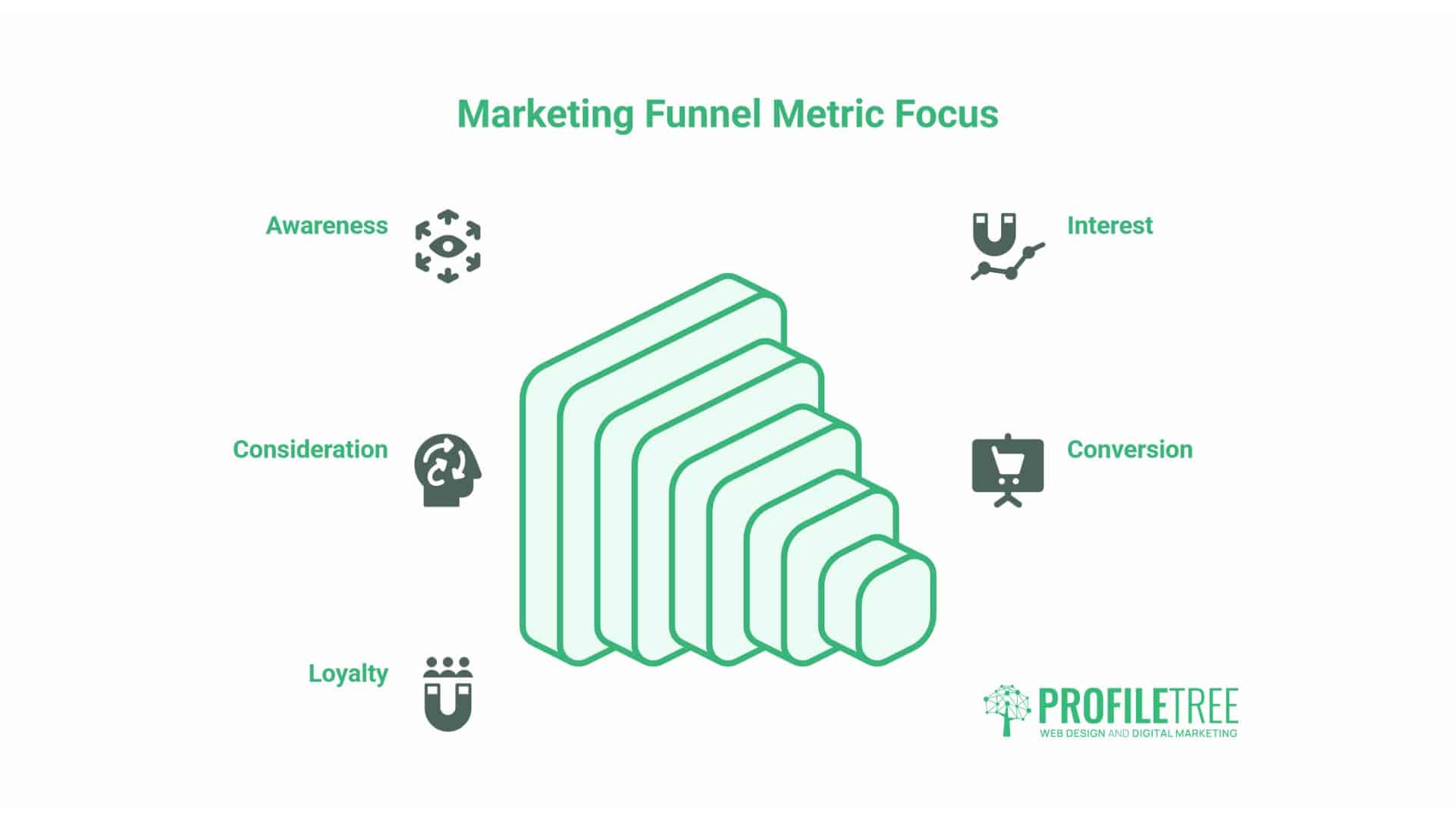
Every stage needs one metric that tells you whether it is working, not five metrics that make a dashboard look busy.
Awareness: organic impressions and branded search volume, tracked through Google Search Console rather than social reach alone.
Interest: time on page and return visits, which indicate whether your content is actually being read rather than just landed on.
Consideration: lead magnet conversion rate and email open rates, which show whether the value exchange at this stage is genuine.
Conversion: enquiry-to-call rate and cost per qualified lead, not just raw form submissions, since not every submission is a real prospect.
Advocacy: review volume and referral-sourced enquiries, tracked by asking new clients directly how they found you.
Common Funnel Pitfalls and How to Fix Them
The most common pitfall is treating the funnel as a one-time build rather than a system that needs regular attention. A funnel set up in January and never revisited will quietly stop converting as competitors update their own content and as search behaviour shifts.
A second common pitfall is measuring the funnel by channel rather than by stage. A business might track “how is our Instagram doing” without ever asking “how many Instagram followers actually reach the consideration stage.” Reorganise your reporting around the five stages, not the platforms.
A third pitfall, particularly common among UK SMEs, is under-investing in the handoff between marketing and the actual conversation with a prospect. A brilliant funnel that delivers a warm enquiry to an unanswered phone line or a three-day-old email reply has still failed. The social media management side of a funnel is often blamed for poor conversion when the real issue sits at the response stage.
Conclusion
A marketing funnel does not need to be complex to work. For most UK SMEs, a minimum viable funnel with three stages, one awareness channel, one trust-building mechanism, and one clear conversion path will outperform a sprawling multi-channel strategy without a measurement framework. Start with what you can sustain, measure what matters at each stage rather than at the top alone, and build from evidence rather than assumption.
Ready to build a funnel that actually converts? A digital marketing strategy review is the practical next step if you want a second opinion on where your current funnel is losing prospects.
FAQs
What is a marketing funnel?
A marketing funnel maps the stages a potential customer moves through before buying, from first becoming aware of a business to making a purchase and, ideally, recommending it to others. More people enter at the top than exit at the bottom, which is where the name comes from.
What is the difference between a sales funnel and a marketing funnel?
A marketing funnel covers the full customer journey, from awareness through to post-purchase advocacy. A sales funnel focuses on the final stages: moving a qualified lead from consideration to a closed sale. Marketing builds the lead; sales closes it.
How do I create a marketing funnel for a small business?
Start with one audience persona, one piece of content per stage, and a tech stack you can run without help. Confirm the minimum viable version works end-to-end before adding channels, automation, or paid spend.
Is a marketing funnel still relevant when customer journeys are non-linear?
Yes, but the stages now need to work independently rather than in a strict sequence. A prospect might encounter your consideration content before your awareness content, particularly when they research through AI-generated answers, so each stage should be able to stand on its own.