
Mastering YouTube SEO: Drive Rankings, Traffic & ROI in 2026
Table of Contents
The digital video space has become one of the most competitive marketing channels for UK businesses. With over 90% of the adult UK population using YouTube, standing out requires more than just uploading content and hoping for views.
YouTube SEO represents a systematic approach to making your video content discoverable, engaging, and profitable. For businesses in Northern Ireland, Ireland, and across the UK, understanding how YouTube’s algorithm works in 2026, and how it integrates with Google’s search results, can mean the difference between invisible content and a channel that generates consistent leads and sales.
This guide provides the technical knowledge and practical strategies needed to optimise your YouTube presence. Whether you’re a business owner evaluating video marketing, a marketing manager building a content strategy, or a decision-maker considering professional support, you’ll find actionable insights that address the current state of YouTube SEO.
Understanding YouTube SEO in 2026
YouTube operates as both a video platform and the world’s second-largest search engine. For UK businesses, this dual nature creates opportunities that extend beyond simple view counts.
The platform’s algorithm has shifted from prioritising clickbait and viral content to rewarding what YouTube calls “contextual authenticity”, content that genuinely satisfies the specific intent of the person searching. This change particularly benefits businesses that can demonstrate expertise and provide genuine value to their target audience.
Why YouTube SEO Matters for UK Businesses
Search visibility on YouTube translates directly to business outcomes. When your videos appear in search results and recommendations, you’re not just gaining views, you’re positioning your business as an authority in your field.
For companies offering specialised services, YouTube provides a way to demonstrate expertise that text-based content cannot match. A web design agency can showcase before-and-after transformations. An AI training provider can demonstrate practical implementations. A video production company can display its creative capabilities while simultaneously teaching best practices.
The platform’s integration with Google means optimised YouTube content can appear in traditional search results, expanding your reach beyond YouTube itself. This cross-platform visibility is particularly valuable for local businesses targeting specific regions in the UK.
The Current UK YouTube Environment
The UK market presents unique characteristics that affect YouTube strategy. British audiences respond to content that acknowledges regional nuances, uses appropriate terminology, and demonstrates understanding of the UK business environment.
Regulatory compliance adds another layer. The Advertising Standards Authority (ASA) and Committee of Advertising Practice (CAP) enforce strict rules around advertising content, influencer partnerships, and product promotions. For businesses in regulated sectors, particularly those in the food, beverage, and financial services industries, these requirements aren’t optional considerations but legal necessities.
YouTube Shorts have gained significant traction among UK users aged 25-45, surpassing other short-form platforms in this demographic. However, the most effective strategies treat Shorts as a discovery mechanism rather than a standalone product. Short-form content introduces your brand and expertise, whilst longer videos provide the depth needed to convert interest into action.
How YouTube’s 2026 Algorithm Works
YouTube’s recommendation system prioritises content based on several factors: watch time, engagement rate, click-through rate from thumbnails, session time (how long people stay on YouTube after watching your video), and historical performance of your channel.
The algorithm also considers “satisfaction signals”, likes, shares, comments, and whether viewers watch similar content afterwards. For businesses, this means creating content that not only attracts initial clicks but keeps people engaged throughout the video and encourages them to explore more of your content.
Keyword relevance remains important, but YouTube now interprets search intent more sophisticatedly. The platform understands synonyms, related concepts, and the context around search queries. This means optimisation requires understanding what your audience actually wants to learn or solve, not just which exact phrases they type.
“Video content isn’t about going viral anymore,” says Ciaran Connolly, Director of ProfileTree. “For businesses, it’s about consistently showing up in the searches that matter to your customers, demonstrating expertise, and building trust before they ever contact you.”
Developing Your YouTube Keyword Research Strategy
Effective keyword research forms the foundation of YouTube SEO. Without understanding what your target audience searches for, you’re creating content in the dark.
The research process begins before you film anything. Start by identifying the core problems your business solves and the questions potential customers ask during their buying journey. These real-world queries form the basis of searchable content.
Finding High-Value Keywords for Your Business
Begin with YouTube’s search bar itself. Type in terms related to your business and note the autocomplete suggestions. These represent actual searches from real users. Pay particular attention to question-based queries (“how to”, “why does”, “what is”) as these indicate informational intent, people actively seeking to learn.
Google’s autocomplete provides additional insights. The suggestions here often differ from those on YouTube because people use Google and YouTube with different intents. Google searches tend to be broader, whilst YouTube searches are often more specific and action-oriented.
Tools like Ubersuggest, TubeBuddy, and VidIQ can reveal search volume data and competition levels. However, don’t dismiss low-volume keywords if they’re highly specific to your service. A term searched 100 times monthly by exactly your target customer is more valuable than a term searched 10,000 times by an irrelevant audience.
For local businesses, include location-specific terms to target customers in your area. “Web design Northern Ireland” or “AI training Belfast” might have lower search volumes than generic terms, but attract exactly the audience you can serve.
Understanding Search Intent Types
Search intent falls into several categories, each requiring different content approaches:
Informational intent: People want to learn something. “What is YouTube SEO” or “how to optimise videos” fall here. Content should educate thoroughly without requiring a purchase decision.
Navigational intent: People search for specific brands or channels. “ProfileTree digital marketing” represents navigational intent. Optimise your channel name and branding for these searches.
Transactional intent: People are ready to take action. “Best YouTube marketing agency UK” or “hire video production Belfast” indicate buying intent. Content should demonstrate capability and include clear contact paths.
Comparison intent: People are evaluating options. “YouTube Shorts versus TikTok” or “in-house video versus agency” fit here. Content should provide a balanced analysis whilst positioning your approach.
Match your content type to the search intent. Tutorials suit informational searches. Case studies work for transactional intent. Comparison videos address evaluation-stage queries.
Creating Your Keyword Map
Organise keywords into clusters based on topics and intent. A web design agency might have clusters around “WordPress development”, “website speed optimisation”, “e-commerce platforms”, and “website security”.
Within each cluster, identify primary keywords (higher volume, more competitive) and supporting keywords (more specific, less competitive). Your content strategy should include both primary keywords for pillar content and supporting keywords for more focused videos.
Document the search volume, competition level, and intended content type for each keyword. This mapping prevents you from creating duplicate content and ensures comprehensive coverage of all topics.
Consider seasonal variations. “Video marketing Q4 planning” peaks in autumn. “Website refresh strategies” might spike in January as businesses plan annual updates. Time your content to align with these patterns.
Analysing Competitor Content
Review what currently ranks for your target keywords. Watch the top five videos completely. Note their length, structure, thumbnail style, and how they address the topic.
Identify gaps in their coverage. What questions don’t they answer? What recent developments have they missed? What perspective unique to your business could you provide?
Look at engagement metrics (visible likes, comments) relative to view counts. High engagement relative to views suggests the content truly satisfied viewers. Low engagement, despite high views, might indicate clickbait titles that fail to deliver on their promises.
Don’t simply copy what works for competitors. Use their content as a benchmark, then exceed it with greater depth, better production quality, or unique insights from your business experience.
Video Optimisation Best Practices
Once you’ve identified your keywords and created your video, optimisation determines whether YouTube surfaces your content to potential customers.
Optimisation isn’t about manipulating the algorithm; it’s about clearly communicating what your video covers so YouTube can match it to relevant searches and recommendations.
Crafting High-Performance Titles
Your title serves two audiences: YouTube’s algorithm and human viewers. Both need to immediately understand what the video covers.
- Place your primary keyword near the beginning of the title. “YouTube SEO Guide for UK Businesses 2026” clearly signals the topic. “How We Help Clients: Part 3” doesn’t.
- Keep titles under 60 characters so they display fully in search results and mobile views. Longer titles get truncated, potentially cutting off crucial information.
- Use numbers when relevant. “7 YouTube SEO Mistakes Costing You Customers” or “3-Step Video Optimisation Process” set clear expectations about content structure.
- Include your location for local services. “Video Production Belfast: Behind the Scenes” helps local businesses find you.
- Avoid clickbait tactics. “You Won’t Believe This YouTube Secret!” may generate initial clicks, but it ultimately creates dissatisfaction when the content fails to deliver, ultimately damaging long-term channel performance.
- Create curiosity without deception. “The YouTube Ranking Factor Nobody Discusses” promises valuable information, while “Everything You Know About YouTube Is Wrong” makes exaggerated claims.
- Test title variations on older content. If a video from six months ago has plateaued in views, try updating the title with current keywords or a clearer value proposition.
Writing Descriptions That Drive Discovery
YouTube allows 5,000 characters in video descriptions. Use this space strategically.
The first 150 characters appear in search results before the “Show More” break. This space should include your primary keyword, a compelling summary of what viewers will learn, and ideally a call-to-action or link.
The full description should thoroughly describe the video content, naturally include relevant keywords, and provide additional resources or links.
Structure descriptions with clear sections:
- Opening summary (150 characters): Primary keyword, value proposition, main call-to-action.
- Detailed overview (300-500 words): Expand on what the video covers, using secondary keywords naturally. Break into short paragraphs for readability.
- Timestamps: Create chapter markers for videos longer than 8 minutes. “0:00 Introduction”, “2:15 Keyword Research Process”, “7:30 Optimisation Checklist”. Timestamps improve user experience and can appear as individual chapters in search results.
- Links and resources: Website link, relevant blog posts, tools mentioned in the video, and social media profiles.
- About your business: Brief description of your services and expertise.
- Hashtags: Add 3-5 relevant hashtags at the end. These help YouTube categorise your content. “#YouTubeSEO #VideoMarketing #DigitalMarketingUK”
Avoid keyword stuffing. “YouTube SEO, YouTube optimisation, YouTube ranking, YouTube algorithm, YouTube tips, YouTube marketing” reads as spam. Instead: “This YouTube SEO guide covers the optimisation strategies we use at ProfileTree to help UK businesses improve their video rankings and attract more qualified leads.”
Creating Compelling Thumbnails
Thumbnails represent your primary opportunity to attract clicks in a crowded feed. YouTube automatically generates three thumbnail options from your video, but custom thumbnails dramatically outperform these default options.
Effective thumbnails use bright, contrasting colours that stand out in feeds. Test your thumbnail at small sizes; if text or details disappear, simplify.
Include faces where possible. Human faces, especially those that make eye contact or display clear emotions, tend to attract attention. If you’re camera-shy, consider branded graphics with strong visual hierarchy.
Add text overlays that reinforce the title. Keep text to 3-5 words maximum. “YouTube SEO Guide” or “5 Ranking Factors” work. “Everything You Need to Know About YouTube Search Engine Optimisation in 2026” doesn’t.
Maintain consistent branding across thumbnails. Use the same fonts, colour schemes, and layout styles so your content is immediately recognisable. This builds brand recall and encourages viewers to watch multiple videos.
Test thumbnail options before publishing. Show draft thumbnails to colleagues or customers and ask which they’d click. A/B test different approaches across videos and track which styles generate better click-through rates.
Avoid misleading thumbnails. Red arrows, exaggerated facial expressions, or images unrelated to content might generate initial clicks but create dissatisfaction that damages channel performance and violates YouTube’s spam policies.
Optimising Tags and Keywords
YouTube allows you to add tags to help categorise content. Whilst tags are less influential than titles and descriptions, they still play a role in search and recommendations.
Start with your primary keyword as the first tag. Follow with variations, related terms, and broader category tags.
For a video titled “WordPress Website Speed Optimisation Tips”, tags might include:
- WordPress speed optimisation
- WordPress performance
- Website loading time
- WordPress hosting
- Core Web Vitals
- Website speed
- WordPress tutorial
- Web development
Include both specific and broad tags. Specific tags help you appear in niche searches. Broad tags help YouTube understand your video’s general category.
Add tags related to your business location for local visibility: “Belfast web design”, “Northern Ireland digital agency”, “UK video production”.
Don’t waste tag space on irrelevant keywords. “Viral video secrets” won’t help a technical WordPress tutorial and might confuse the algorithm about your content’s purpose.
Use all available tag space (around 400-500 characters total), but prioritise quality over quantity. Twenty highly relevant tags outperform fifty loosely related ones.
Playlist Strategy for Channel Growth
Playlists group related videos, encouraging viewers to watch multiple pieces of content in sequence. This increases total watch time, a critical ranking signal.
Create playlists around keyword themes. A digital marketing agency might have playlists for “SEO Tutorials”, “Video Marketing Strategies”, “AI in Marketing”, and “Website Design Best Practices”.
Name playlists using target keywords. “Complete YouTube SEO Guide” ranks in search itself and clearly communicates content value.
Order videos strategically within playlists. Place foundational content first, followed by increasingly advanced topics. This creates a logical learning path.
Add videos to multiple playlists where relevant. A video about “Using AI for Video Editing” could appear in both “AI in Marketing” and “Video Production Tips”.
Update playlists regularly as you publish new content. Playlists with recent additions appear more valuable to YouTube’s algorithm.
Use playlist descriptions to provide context and include relevant keywords. Treat these descriptions like mini-landing pages that encourage viewers to watch the entire series.
Cards and End Screens for Engagement
Cards are small pop-up notifications that appear during videos, whilst end screens display in the final 5-20 seconds. Both drive viewers to additional content.
Add cards at strategic moments. If you mention a related video or resource, insert a card at that timestamp so interested viewers can click immediately.
Link to content that naturally extends the viewer’s journey. A video about YouTube keyword research might link to videos about optimisation, analytics, or content planning.
Use end screens consistently. Include links to 2-3 related videos, your channel subscription button, and potentially a website link (once you’re eligible through the YouTube Partner Programme).
Create verbal calls-to-action that direct attention to cards and end screens. “I’ve linked our full website optimisation guide in the card appearing now”, or “Subscribe for weekly digital marketing tutorials—the button’s appearing on screen”, improve click-through rates.
Test different combinations. Track which cards and end screens generate engagement and refine your approach based on performance data.
Closed Captions and Transcripts
Closed captions serve two audiences: viewers who need or prefer text, and YouTube’s algorithm, attempting to understand your content.
YouTube automatically generates captions, but they’re rarely 100% accurate. Technical terms, brand names, and accents can confuse the auto-generation, creating captions that misrepresent your content.
Edit auto-generated captions or upload your own. Professional transcription services produce accurate results quickly. Alternatively, many video editing tools now include transcription features.
Accurate captions improve accessibility, making your content available to deaf and hard-of-hearing viewers and those watching without sound (common on mobile devices).
Captions also provide searchable text that helps YouTube understand the topic and context of your content. Keywords spoken in your video become searchable elements when accurately transcribed.
Consider adding captions in multiple languages if you serve international audiences. This expands your potential viewership significantly.
YouTube SEO Mistakes That Damage Channel Performance
Whilst optimising for YouTube SEO, certain mistakes can actively harm your channel’s growth. Understanding these pitfalls helps you avoid wasting time and resources on ineffective strategies.
Many businesses approach YouTube with tactics that worked in earlier years but now conflict with current algorithm preferences and viewer expectations.
Keyword-Stuffed Titles and Descriptions
Cramming multiple keywords into titles creates awkward, unnatural phrasing that repels human viewers. The title “YouTube SEO Video Marketing Digital Strategy Online Business Growth Tips Tutorial Guide” may contain numerous keywords, but it signals spam to both viewers and YouTube’s algorithm.
YouTube’s natural language processing understands synonyms and related concepts. You don’t need to include every possible variation of a keyword. A naturally written title, such as “YouTube SEO Strategy for UK Businesses,” captures multiple related search terms without appearing manipulative.
Keyword-stuffed descriptions suffer the same problems. Blocks of keywords separated by commas appear spammy and offer no value to viewers reading the description.
Focus on creating titles and descriptions that humans want to read. If your title sounds awkward when spoken aloud, rewrite it. If your description consists primarily of keyword lists rather than helpful information, you’re optimising for an outdated understanding of how YouTube works.
Thin, Generic Descriptions
Minimal descriptions represent missed opportunities. A description like “In this video, I talk about YouTube SEO” provides almost no information to viewers or the algorithm.
Thin descriptions prevent YouTube from fully understanding the depth and relevance of your content. The algorithm uses description text to match videos to search queries and recommendations. Without sufficient context, your content won’t appear in as many relevant situations.
Viewers who read descriptions before watching are evaluating whether the video is worth their time. Generic descriptions fail to convince them, resulting in lower click-through rates from search results.
Invest time crafting comprehensive descriptions. Aim for 200-400 words of genuine, helpful information that expands on the video topic, provides context, and includes natural keyword usage.
Misleading Thumbnails and Titles
Clickbait tactics may create short-term click gains but ultimately cause long-term channel damage. If your thumbnail shows something that doesn’t appear in the video, or your title promises information you don’t deliver, viewers feel deceived.
YouTube tracks “satisfaction signals”, whether viewers watch most of the video, like it, and watch more of your content afterwards. Misleading titles and thumbnails generate initial clicks, but poor satisfaction signals as viewers quickly leave disappointed.
This damages your channel in two ways: lower rankings, as YouTube identifies your content as unsatisfying, and reduced trust that prevents viewers from clicking on future videos, even when they’re relevant.
Maintain accuracy in all promotional elements. Your thumbnail and title should clearly represent the actual video content. If you promise “7 YouTube SEO Strategies”, deliver all seven with actionable detail.
Ignoring Watch Time and Retention
View counts matter less than watch time, the total minutes people spend watching your content. A 10-minute video watched completely by 1,000 people provides more value to your channel than a 2-minute video watched by 5,000 people.
Many businesses create unnecessarily long videos, assuming longer content means more watch time. However, if viewers leave after 3 minutes of a 20-minute video, you’ve achieved poor retention that signals low-quality content.
Analyse your retention graphs in YouTube Analytics. Identify where viewers commonly drop off. If 40% leave in the first 30 seconds, your intro is too slow. If retention drops during a specific section, the content may not be engaging or relevant.
Create content that matches viewer intent and attention span. Tutorials can run 15-20 minutes if they provide genuine value throughout. Quick tips work better as 3-5 minute videos. Match video length to the topic’s natural scope.
Hook viewers immediately. The first 10 seconds should clearly establish what the video covers and why viewers should keep watching. Save lengthy intros, channel promotions, and tangential information for later in the video.
Neglecting UK Compliance Requirements
For businesses operating in the UK market, compliance with ASA and CAP regulations isn’t optional. Violations can result in public reprimands that damage a brand’s reputation and potentially lead to legal consequences.
All promotional content must be clearly labelled. If you’ve received payment, free products, or any incentive for featuring a brand, you must disclose this. Use YouTube’s “Paid Promotion” toggle and include clear verbal disclosures in the video.
Influencer partnerships require particular attention. If you’re collaborating with YouTubers to promote your services, those videos must include clear advertising disclosures.
For food and beverage businesses, High Fat, Sugar, Salt (HFSS) product restrictions apply to content targeting UK audiences. These regulations affect what you can promote and how you can present it on digital platforms.
Financial services content must comply with the requirements of the Financial Conduct Authority (FCA). Claims about returns, risks, and product features must meet specific standards.
When in doubt, consult with legal professionals familiar with UK digital advertising regulations. Compliance might seem limiting, but it protects your business and builds trust with audiences who value transparent marketing.
Inconsistent Posting Schedule
YouTube’s algorithm favours channels that publish consistently. Uploading five videos one week, then nothing for two months, then three videos in one day creates unpredictable patterns that don’t encourage subscriber loyalty or algorithm confidence.
Determine a realistic publishing schedule based on your production capacity. One quality video weekly outperforms random bursts of activity. Even one video monthly, published consistently, builds momentum better than sporadic uploads.
Consistency helps your audience know when to expect new content. Subscribers who see a new video every Tuesday develop viewing habits that boost your early engagement, critical for signalling to YouTube that your content is valuable.
Quality always outweighs quantity. Don’t sacrifice production standards to maintain an unsustainable schedule. It’s better to publish excellent content fortnightly than to publish weekly with rushed, low-quality videos.
Measuring and Improving YouTube Performance
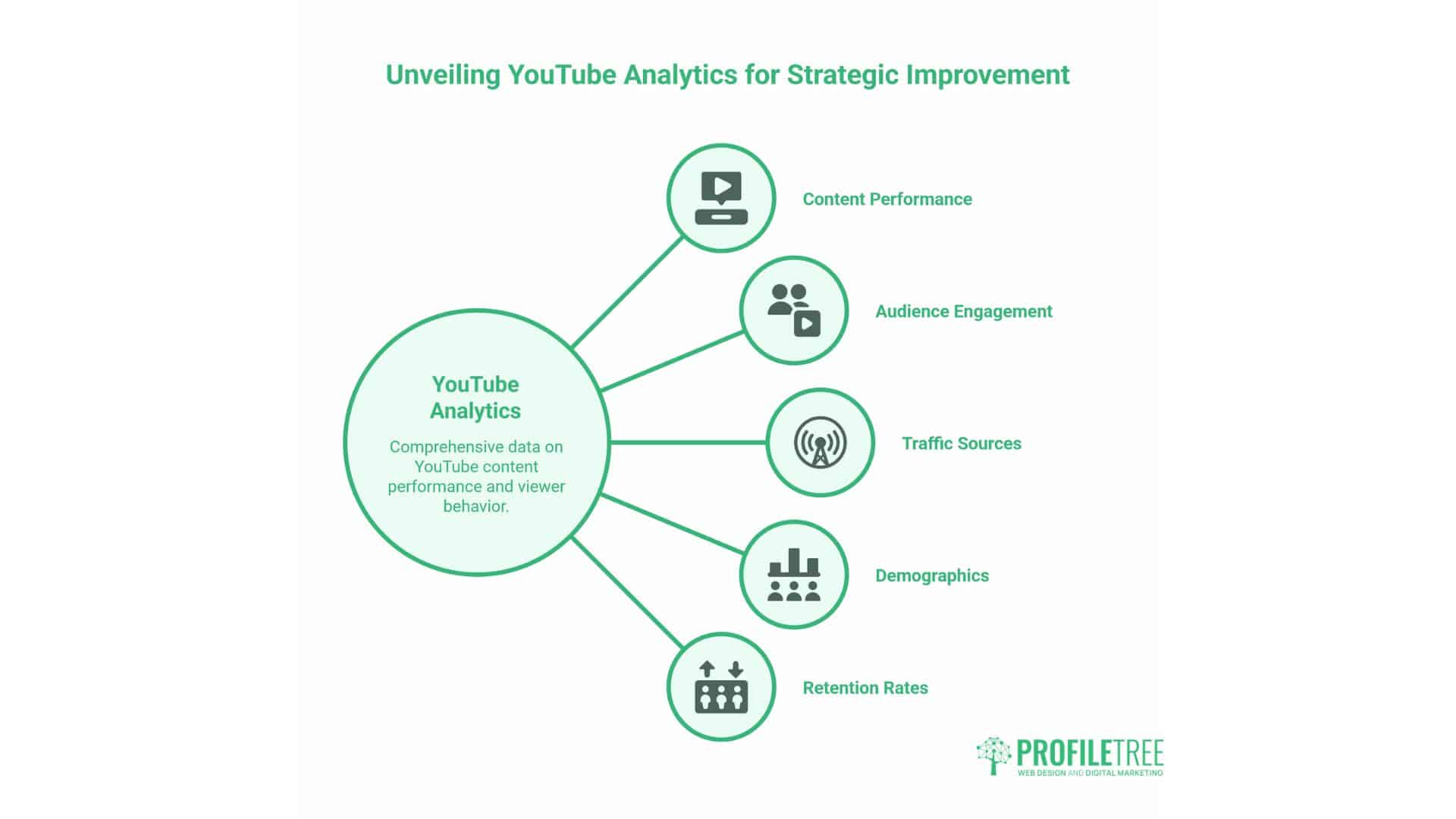
YouTube provides extensive analytics that reveal how your content performs and where to focus improvement efforts. Understanding these metrics helps you refine your strategy based on actual performance rather than assumptions.
For businesses, analytics should answer specific questions: Which content attracts potential customers? What topics generate the most engagement? Where do viewers drop off? Which videos drive website visits or enquiries?
Key Performance Indicators for Business Channels
Different metrics matter depending on your goals. A business using YouTube for brand awareness focuses on different indicators than one using it for lead generation.
Impressions: How often your thumbnail appears in search results, recommendations, and feeds. Growing impressions indicate YouTube is showing your content to more people.
Click-through rate (CTR): The percentage of impressions that generate clicks. The average CTR varies by niche, but 4-6% is a reasonable range for most business content. Higher CTR suggests compelling titles and thumbnails. A lower CTR indicates that your promotional elements don’t effectively communicate value.
Average view duration: How long viewers watch before leaving. This metric matters more than view counts. A high view duration indicates to YouTube that your content satisfies viewers.
Audience retention: The percentage of your video viewers who watch. YouTube Analytics shows retention graphs that reveal exactly where viewers lose interest. Use these to identify and improve weak sections.
Engagement rate: Likes, comments, and shares relative to views. Higher engagement signals valuable content and boosts rankings. A video with 1,000 views and 50 comments demonstrates stronger engagement than one with 10,000 views and 30 comments.
Traffic sources: Where views originate; YouTube search, suggested videos, external websites, or direct links. Understanding traffic sources helps you double down on what’s working.
Subscriber conversion: The percentage of viewers who subscribe after watching. Track which videos are most effective in converting viewers into subscribers.
For business-focused channels, also track:
Website clicks: Traffic from video descriptions and end screens to your website. This directly measures how well videos drive business enquiries.
Conversion tracking: If you use unique URLs or tracking parameters in video descriptions, you can measure leads and sales generated from specific videos.
Using YouTube Analytics Effectively
YouTube Studio provides comprehensive analytics. Familiarise yourself with key sections:
Overview tab: High-level metrics showing recent performance trends. Check this weekly to spot unusual changes; sudden view increases might indicate a video gaining traction, while sudden drops might signal technical issues.
Reach tab: Impression and CTR data. Use this to evaluate the effectiveness of thumbnails and titles. If impressions are growing but CTR is falling, test new thumbnail approaches.
Engagement tab: Watch time and retention data. Study retention graphs for every video. Identify patterns; do viewers consistently leave during your intro? At the same point in multiple videos?
Audience tab: Demographics, location, and viewing times. Understand who watches your content and when they’re most active. Schedule uploads to align with peak viewing times.
Research tab: Shows search terms viewers used to find your videos and related topics your audience watches. This data informs future content ideas and reveals opportunities you may be missing.
Create custom reports that focus on the metrics that matter most for your business goals. If lead generation is your priority, create reports that track website clicks and identify top-performing videos for driving traffic.
A/B Testing and Continuous Improvement
YouTube allows you to test different thumbnails on existing videos. Use this feature to experiment with thumbnail styles and identify what resonates with your audience.
Test one variable at a time. If you change both thumbnail and title simultaneously, you won’t know which change affected performance.
Allow tests to run for at least one week to gather meaningful data. Initial results can be misleading, as YouTube’s algorithm is testing new thumbnails.
Document your findings. Create a simple spreadsheet to track what you tested, the results, and the key learnings. Over time, patterns emerge that inform your thumbnail and title strategy.
Beyond thumbnails, experiment with:
Video length: Experiment with different durations for similar topics and track the corresponding retention rates.
Content structure: Test different approaches to introductions, section order, and calls-to-action placement.
Publishing days and times: Experiment with upload schedules to identify when your audience is most active.
Content topics: Use search trends and audience research to test new topics whilst maintaining your core content themes.
When to Consider Professional Support
Building an effective YouTube presence requires a significant amount of time and expertise. For businesses where time is better spent on core activities, professional support can accelerate results.
Consider professional help when:
Production quality matters: If your industry expects polished content and you lack video production skills, agencies like ProfileTree can handle filming, editing, and optimisation whilst you focus on subject matter expertise.
Strategy is unclear: Determining what content to create, how to optimise it, and how to measure success requires specialised knowledge. Expert guidance prevents costly mistakes and wasted effort.
Results have plateaued: If your channel has stopped growing despite consistent effort, professionals can audit your approach, identify problems, and implement solutions.
Scale is needed: Producing consistent, high-quality content on a weekly or multiple times weekly basis stretches most small business teams. Professional support makes sustainable scaling possible.
ROI needs to be proven: Agencies experienced in business-focused YouTube marketing can implement proper tracking, attribute results to specific videos, and demonstrate return on investment.
When evaluating potential partners, ask about their experience with business channels (not just entertainment content), their understanding of your industry, their approach to measurement and reporting, and provide examples of channels they have successfully grown in your market.
FAQs
What is YouTube SEO?
YouTube SEO is the practice of optimising your videos and channel to appear in YouTube’s search results and recommendations. This involves strategic keyword use in titles, descriptions, and tags, creating compelling thumbnails, and encouraging engagement to make your content discoverable by people searching for topics related to your business.
How long does it take to see YouTube SEO results?
Results vary based on competition, content quality, and consistency. Some videos rank within days for low-competition keywords, whilst competitive topics might require weeks or months. Channel-level growth typically becomes noticeable after 20-30 quality videos are published consistently over several months.
Do I need expensive equipment to succeed on YouTube?
No. Modern smartphones shoot excellent video quality. Viewers prioritise valuable content over production polish. However, clear audio is essential; invest in a decent microphone before upgrading your cameras. Production improvements make sense as your channel grows, but they’re not barriers to starting.
How often should I upload videos?
Consistency matters more than frequency. Weekly uploads work well if you can maintain quality. Fortnightly or monthly schedules work if sustainable. Choose a schedule that you can maintain long-term and stick to, rather than uploading irregularly.
Building Your YouTube Strategy for Sustainable Growth
YouTube represents one of the most powerful channels available to UK businesses in 2026. The platform’s integration with Google search, its broad demographic reach, and its ability to demonstrate expertise in ways that text cannot match create significant opportunities for businesses that approach it strategically.
Success requires understanding your audience’s search behaviour, creating content that genuinely addresses their needs, optimising every element for discoverability, and continuously refining your approach based on performance data.
The businesses that win on YouTube treat it as a long-term investment in brand authority and customer acquisition. They commit to consistent content creation, study their analytics, and recognise that early videos inform later successes even when they don’t immediately generate views.
ProfileTree works with businesses across Northern Ireland, Ireland, and the UK to develop video strategies that generate measurable business results: qualified traffic, engaged audiences, and converted customers. Our approach combines technical SEO expertise, video production skills, and a deep understanding of UK market requirements, including compliance with ASA regulations.
If you’re ready to move beyond random uploads to a systematic YouTube strategy that drives business growth, get in touch. We’ll audit your current presence, identify opportunities specific to your industry and location, and create a roadmap for building a YouTube channel that works as hard as your other marketing investments.