
Social Media Optimisation: The Complete Guide for UK Businesses
Table of Contents
Posting on social media and optimising it are two different disciplines. Most UK businesses do the first. Far fewer do the second, and that gap is exactly why some accounts convert followers into enquiries while others just accumulate likes.
Social media optimisation means treating every profile, post and campaign as something that can be measured and improved, rather than a box to tick each morning. It covers profile setup, content strategy, posting mechanics, paid amplification and the analytics that tell you whether any of it worked. This guide covers all five, with a specific focus on what actually applies to businesses operating in the UK and Ireland rather than the generic, US-centric advice that dominates most search results on this topic.
“The most common social media problem we see from SMEs in Northern Ireland isn’t a lack of content. It’s a lack of strategy. They’re active on platforms that don’t suit their audience, posting at the wrong times, with no clear connection between their social activity and their business goals. The fix is rarely dramatic. It’s usually a few structural changes applied consistently.” Ciaran Connolly, Founder, ProfileTree
What Is Social Media Optimisation, and How Does It Differ From SEO?
Social media optimisation, sometimes shortened to SMO, is the practice of improving your presence across social platforms to drive measurable outcomes: relevant followers, higher engagement, more website clicks, and more enquiries. It sits alongside search engine optimisation rather than replacing it, and the two disciplines operate on different mechanics.
| Feature | SEO | Social Media Optimisation |
|---|---|---|
| Primary goal | Rank in search engines | Improve reach, engagement and conversions on social platforms |
| Speed of results | Slow, often months | Faster feedback, results visible within days |
| Ranking signals | Backlinks, content relevance, technical health | Engagement rate, watch time, shareability, posting consistency |
| Audience discovery | Search intent | Algorithmic recommendation and network sharing |
The overlap matters more than the difference. A strong social media optimisation strategy drives traffic that search engines interpret as a signal of authority, and content built for search often performs well when adapted for social distribution. ProfileTree’s digital marketing services treat both as part of a single, connected plan rather than as separate workstreams.
Why Social Media Optimisation Matters for UK SMEs
There are over 57 million active social media users in the UK, and the opportunity for small and medium businesses is real. So is the noise. Businesses that treat social media as a broadcast channel for promotional content typically see low engagement and no measurable return on the time spent.
Businesses that get consistent value from social platform optimisation treat the channel as a trust-building tool rather than an advertising billboard. They publish content that answers questions their customers are already asking, respond to comments and messages within hours rather than days, and build a presence consistent enough that they become the obvious choice when someone is ready to buy.
The difference between those two approaches is optimisation itself: deliberate decisions about what to post, where, when and to whom, based on data rather than guesswork.
The Five Pillars of a High-Performing Social Presence
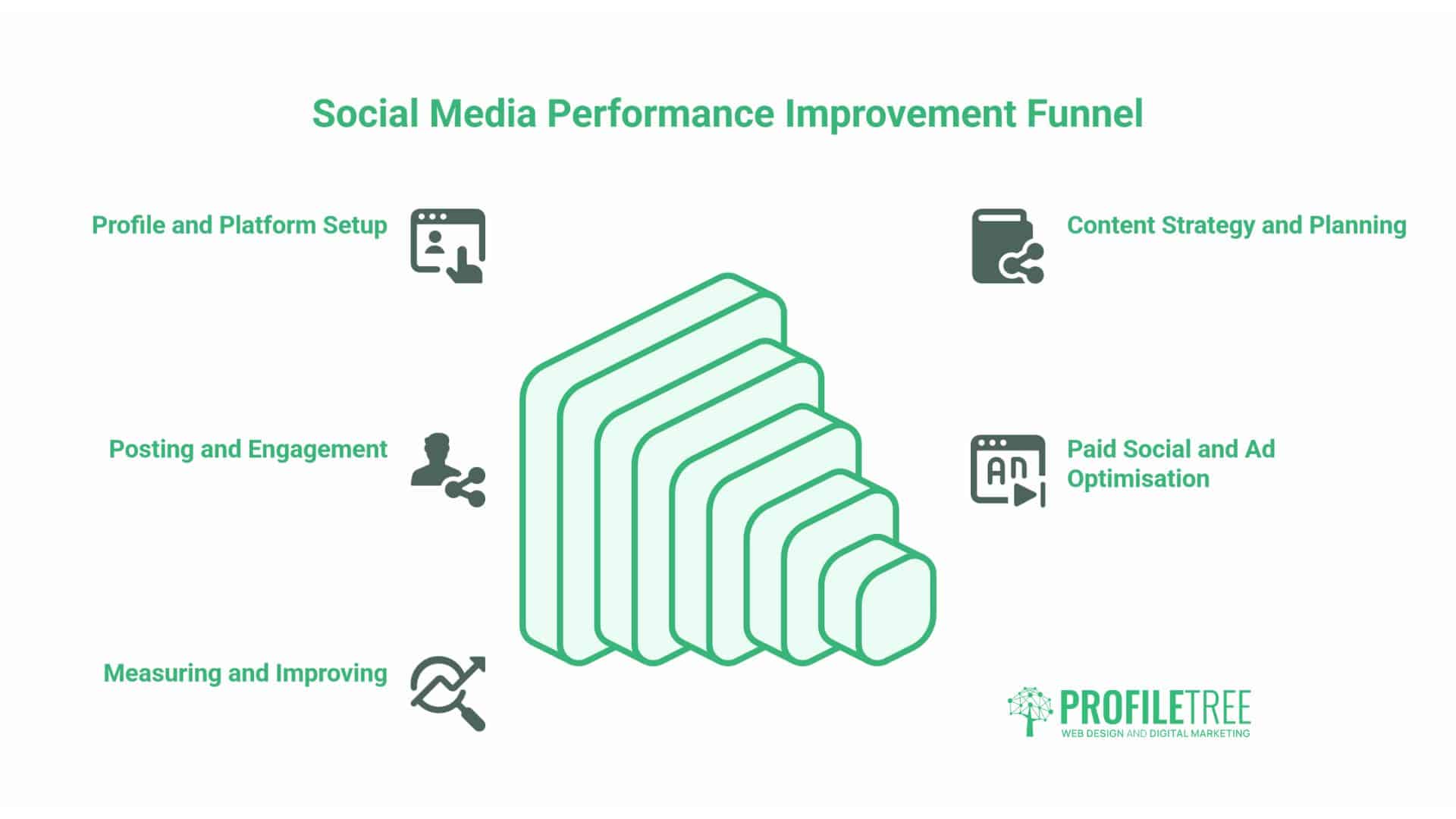
Improving social media performance rests on five connected areas. Skipping any one of them weakens the others, so treat this as a sequence rather than a menu to pick from.
Pillar One: Profile and Platform Setup
Before you plan a single post, get the foundations of platform optimisation right. What you put on your profiles and which platforms you choose to be active on determine whether everything downstream is worth the effort.
Choose your platforms deliberately. The most common mistake in social profile optimisation is trying to maintain a quality presence across five platforms with a small team. That effort rarely pays off compared to doing well on two or three platforms. Choose based on where your audience genuinely spends time:
- LinkedIn suits B2B businesses, professional services and anything targeting decision-makers across Northern Ireland and the wider UK
- Facebook remains the most widely used platform across UK age groups and works well for local businesses running community engagement and targeted paid ads
- Instagram suits product businesses, hospitality, creative services and any brand with strong visual content, particularly for audiences under 45
- TikTok is growing fastest for reaching under-35 audiences through how-to content, behind-the-scenes footage and personality-driven brands
- X works best for businesses in media, technology or any sector where real-time commentary carries weight
Optimise the profile itself. Your social media profile page optimisation should clearly state who you are, what you do, and where you’re based, with a link to either your website or a specific landing page relevant to your current goal. Keep branding consistent: the same logo, colour palette and business name across every platform. A business that looks different on Facebook than on LinkedIn is harder to trust.
Write your bio for the customer, not for yourself. “Award-winning creative studio” tells a customer nothing useful. “We design websites and brand identities for Northern Ireland businesses” tells them exactly what they need to know. ProfileTree’s web design services follow the same principle: clarity beats self-praise on every channel.
Keep usernames consistent. Use the same handle across every platform where possible. If your preferred username is taken on one platform, use the closest available variant and note it in your bio. Consistent naming of compounds over time as more people associate them with what you offer.
Pillar Two: Content Strategy and Planning
Posting without a plan produces inconsistent results. A clear content strategy, covering what you publish, why and for whom, is what separates social media that builds a business from social media that fills a calendar.
Define what success looks like before you plan content. Common goals for UK SMEs include driving website traffic, generating enquiries, building awareness among a defined audience, and retaining existing customers through regular touchpoints. Each goal needs a different content type. Traffic goals need calls to action and links. Awareness goals need shareable, genuinely useful content. Retention goals need behind-the-scenes updates and personal communication.
Build a content calendar. Planning content in advance is the single most effective habit for maintaining consistency. A simple monthly calendar, covering what to post, which platform and which date, prevents the common pattern of posting in bursts followed by long silences. A workable content mix for most B2B SMEs runs roughly 50% educational content, 30% brand and culture content, and 20% commercial content. Audiences disengage when the balance tips too far toward promotion.
ProfileTree’s content marketing services build social content planning alongside blog and long-form strategy, so social posts and organic search content work from the same brief rather than two disconnected plans.
Research the audience you actually have. Platform analytics show who is engaging with your content, which is often different from who you assumed your audience was. Check demographics monthly: age range, location, active hours and which formats get the most engagement. For UK SMEs, location data matters specifically. If most followers sit outside your service area, either the content is attracting the wrong people or the paid targeting needs adjusting.
Diversify formats deliberately. Text posts, images, short videos, carousels, polls and live video perform differently across platforms and audience segments. Short-form vertical video, covering Instagram Reels, TikTok and YouTube Shorts, is currently the highest-reach format for building new audiences. That said, the best format is the one your team can produce consistently to a decent standard. A well-crafted text post published weekly outperforms a poorly produced video published once.
Pillar Three: Posting and Engagement
How and when content goes live matters as much as what it says. The mechanics of posting, covering timing, frequency and interaction, directly affect how far a post travels.
Post when your audience is active, in UK time. Social platforms surface content to more people when it gets early engagement, and posting when your audience is online increases that early engagement. General patterns for UK business audiences: LinkedIn peaks Tuesday to Thursday between 8 and 10 am GMT and again around lunchtime. Instagram performs best in the early evening for consumer brands. Facebook engagement spreads across the day but peaks around lunchtime and early evening. A specific UK pattern worth watching is the “commuter window,” roughly 7:30 to 8:30 am, when mobile scrolling spikes on the way to work. These are starting points; your own analytics will confirm what applies to your specific audience.
Bank holidays and UK-specific cultural moments also shift engagement patterns in ways that US-focused advice rarely accounts for. Posting volume typically drops around bank holiday weekends, so plan content in advance rather than assuming a normal week.
Consistency beats frequency. Posting three times a week reliably for months beats posting daily for a fortnight and then going quiet. As a starting point, LinkedIn and Facebook, three to four times weekly. Instagram, four to five times weekly, including Stories. X, daily or more if the platform is central to strategy. TikTok rewards higher frequency, and daily posting is achievable with short, informal content. Reduce frequency before reducing quality; one strong post per week outperforms five mediocre ones.
Engage rather than broadcast. Responding to comments, answering direct messages and engaging with other accounts in your sector builds the relationships that turn followers into customers. Aim to reply within a few hours on working days. Slow or absent responses signal that a business isn’t paying attention, and potential customers notice. When a post features a client, supplier or partner, tag them; tagged accounts often reshare content, extending reach to their audience at no cost.
Monitor what’s being said. Social listening, using tools like Mention or Brandwatch, or the native notification systems on each platform, provides genuine insights into how a business and its competitors are perceived. Negative feedback, handled well and promptly, builds more trust than no negative feedback at all. Respond professionally, acknowledge the issue and move the conversation to a private channel. Never delete legitimate negative comments.
Pillar Four: Paid Social and Ad Optimisation
Organic reach on most platforms has declined significantly over recent years. For SMEs that need to grow an audience or drive traffic on a shorter timeline, social media ad optimisation fills that gap.
Know when paid social makes sense. Paid social works best with a clear goal, a specific target audience, and a landing page or offer that matches the ad. Boosting random posts without a conversion goal rarely produces a measurable return. Running targeted campaigns toward a specific action, such as booking a consultation or downloading a guide, produces data that can actually be acted on.
Facebook and Instagram ads offer the most granular targeting for most UK SMEs, spanning location, age, interests, job title and lookalike audiences based on existing customers. LinkedIn ads cost more but work well for B2B campaigns targeting decision-makers by industry or seniority.
Budget in a way that produces usable data. A focused test campaign of £150 to £300 per month is usually enough to gather meaningful data on cost per click and conversion rate without significant financial risk. Run a campaign for two weeks, measure it against a specific goal, and scale spend on what works while stopping what doesn’t. The most common mistake in paid social optimisation is running too many small campaigns simultaneously rather than concentrating the budget on one or two well-defined campaigns; spread too thin, the data becomes meaningless.
Review and adjust weekly. Every platform provides detailed analytics on paid campaigns, including reach, click-through rate, cost per click and, with conversion tracking set up correctly, cost per conversion. A/B testing ad creative, changing one variable at a time, such as the image, headline or call to action, is the fastest way to find what actually performs before committing more budget to it.
Pillar Five: Measuring and Improving Social Media Performance
Tracking the right metrics tells a business whether social media activity is contributing to actual goals rather than just generating activity. Most platform analytics dashboards show more data than anyone needs, so focus on what matters.
The metrics worth checking regularly:
- Reach and impressions. Reach measures unique viewers; impressions count total views including repeat views.
- Engagement rate. Likes, comments, shares and saves as a percentage of reach. A low-reach post with high engagement is often more valuable than a high-reach post with no interaction.
- Link clicks. How much traffic social posts drive to the website, tracked in Google Analytics by filtering for social traffic sources.
- Follower growth rate. Slow growth on a well-maintained account suggests the content isn’t reaching new people, not that the account is failing outright.
- Conversions from social. With goal tracking set up, enquiries, sales or sign-ups can be attributed to specific social channels.
Review these figures monthly and compare month-on-month rather than reacting to individual posts. Trends matter more than one-off spikes, and a single viral post rarely indicates genuine improvement in social reach optimisation unless it repeats.
Regional Optimisation: What Works for UK and Irish Audiences
Most social media optimisation advice online is written for a US audience, and it shows. Posting time recommendations are given in EST. Case studies reference brands with no presence in the UK market. Cultural references are missed entirely.
A few adjustments matter specifically for UK and Irish businesses:
Timing runs on GMT and BST, not EST. Scheduling tools default to the account owner’s local time zone, but it’s worth double-checking this setting after any daylight saving time change, since a missed adjustment can shift posts by an hour at exactly the point in the year when engagement patterns are also shifting.
Tone tends toward understatement. UK and Irish audiences generally respond better to dry humour, self-deprecation and understated confidence than to the high-energy, superlative-heavy tone common in American social content. Brands that lean into a distinctly British or Irish voice, rather than a generic international one, tend to build stronger engagement with local audiences.
Bank holidays and local events shift the calendar. Content planned around UK bank holidays, St Patrick’s Day for Irish audiences, or regional events specific to Northern Ireland performs better than generic seasonal content lifted from a US calendar.
Compliance sits alongside strategy. Paid social campaigns targeting UK consumers need to comply with ASA advertising standards, particularly regarding claims made in ad copy. This is a genuine gap in most SMO advice, which tends to focus purely on performance and fails to cover the regulatory context.
Using AI to Optimise Social Content Without Losing Your Voice
AI tools are changing how businesses manage social media, from scheduling and content planning through to sentiment analysis and performance forecasting. The practical opportunity is speed: generating several variations of a caption, hook or headline in the time it previously took to write one, then testing which version performs before committing further budget or effort to a direction.
A simple workflow looks like this: start with one core idea, use an AI tool to generate three to five variations of the hook or opening line, publish the strongest candidates as separate tests where the platform allows it, then feed the results back into the next batch of content. Over time, this produces a clearer picture of what language and framing actually resonate with a specific audience, rather than relying on instinct alone.
The risk worth flagging honestly: AI-generated captions and comments can read as generic if published without editing, and audiences increasingly notice. The tools work best as a first draft and testing accelerator, not as a replacement for a human final read-through. ProfileTree’s AI transformation services help SMEs identify where AI genuinely reduces the time cost of social media management without losing the authentic voice that makes social content work in the first place.
Platform-Specific Optimisation Tactics
General principles apply everywhere, but each platform rewards slightly different behaviour.
LinkedIn rewards thought leadership and native content over links pushed off-platform. Posts that share a specific opinion or a lesson from real project work consistently outperform generic industry news shares. Optimise your company page the same way you’d optimise a service page, with clear positioning in the “About” section and consistent posting from both the company page and individual team members.
Instagram and TikTok function increasingly as search engines in their own right, particularly for younger users. Keyword-rich captions, clear on-screen text and descriptive alt-text all help content surface in in-app search, not just the algorithmic feed. This is a genuinely under-covered area in most SMO guides.
Facebook still carries weight for local business discovery, particularly through Groups and local community pages. Facebook and Google Business Profile signals reinforce each other for businesses with a physical location or defined service area.
X rewards speed and real-time relevance more than any other platform. Businesses without the resources to monitor and respond quickly are generally better placed to put more effort elsewhere.
Connecting Social Media to the Wider Digital Strategy
Social media works best as one part of a connected presence, not a standalone channel. Posts linking to well-optimised blog content drive qualified traffic. Email marketing reinforces messages started on social channels. A strong Google Business Profile reinforces the credibility signals that a social presence alone builds.
For SMEs serious about growth, an integrated approach, where social, SEO, content and paid channels work toward the same goals, consistently outperforms any single channel run in isolation. ProfileTree’s digital marketing strategy service builds this kind of connected plan across a four-stage process: audit, plan, deliver, monitor and refine. The web design and development services make sure the website itself is ready to convert the traffic that social activity sends toward it, and the SEO services make sure that traffic finds you in the first place through organic search as well as social discovery.
Businesses in specific sectors benefit from more targeted planning. A local SEO strategy for trades businesses works differently from social optimisation for a professional services firm, and a video production plan feeds directly into the short-form content that performs best on Instagram and TikTok. Businesses building out a training programme for their own team can also draw on ProfileTree’s digital marketing training to develop this capability in-house rather than outsourcing every aspect.
Your 30-Day Social Media Optimisation Checklist
- Audit current profiles across every active platform for consistent branding, bio clarity and working links
- Define one primary goal for social activity over the next quarter
- Build a content calendar covering the next four weeks, mapped to the 50/30/20 content mix
- Check platform analytics for actual audience active hours rather than relying on general benchmarks
- Set a response-time target for comments and messages, and assign ownership
- Choose one AI tool to test for caption variation and hook testing
- Run one small paid social test, £150 to £300, against a single defined conversion goal
- Review reach, engagement rate and link clicks after 30 days and adjust the plan accordingly
Social Media Optimisation for Businesses in the UK: Final Thoughts
Improving social media performance is less about the volume of content published and more about the clarity of the strategy behind each post. Choose platforms where the audience actually is. Build a content calendar that balances useful content with commercial intent. Post at the right UK-specific times, respond to the audience, and measure what actually matters to the business rather than every number the platform surfaces.
Businesses that get consistent commercial value from social media treat it as a long-term channel requiring regular attention, not a one-off campaign or a task handed to whoever has spare time that week.
FAQs
What is the fastest way to optimise my social media?
Start with the bio and link-in-bio setup on your two or three main platforms. Clear, keyword-relevant bios and a working, current link often produce a faster improvement than any content change, because they fix the point where interested visitors are currently dropping off.
How does social media optimisation differ for B2B and B2C companies?
B2B optimisation typically centres on LinkedIn and authority-building content: opinions, case studies and industry commentary aimed at decision-makers. B2C optimisation shifts weight toward Instagram, TikTok and visually driven, lifestyle-oriented content aimed at a broader consumer audience.
Can I use the same content across every platform?
Not effectively. Each platform rewards native formatting: LinkedIn favours text-first posts, Instagram and TikTok favour vertical video, and X favours short, immediate commentary. Reformatting core ideas for each platform performs better than posting identical content everywhere.
Does social media help with SEO?
Indirectly. Social activity doesn’t directly influence Google rankings, but it drives website traffic, builds brand awareness that increases branded search volume, and can generate backlinks when content gets shared externally. A consistent social presence also strengthens the entity signals that AI-powered search systems use to understand and cite a business.