
7 Content Marketing Mistakes Costing SMEs Leads and Traffic
Table of Contents
Content marketing is one of the most searched topics in digital marketing — and one of the most misunderstood. Businesses invest time, budget, and genuine effort into blogs, guides, and social content, then wonder why none of it is generating leads.
The problem is rarely effort. It’s usually a small number of content marketing mistakes that repeat across businesses of every size and sector, quietly undermining campaigns that should be working.
At ProfileTree, we’ve audited content strategies for SMEs across Belfast, Northern Ireland, and the wider UK for over fourteen years. The same errors appear again and again. This guide covers seven of the most costly content marketing mistakes, what they’re actually doing to your traffic and leads, and what to do differently.
Mistake 1: Publishing Without a Documented Strategy
Most businesses treat content as something that happens between other tasks. Someone writes a blog post when they have time. A social update goes out when someone remembers. There’s no documented strategy, no defined audience, no connection between what’s published and what the business actually needs to achieve.
The result is a body of content that looks active on the surface and does almost nothing commercially. Traffic might accumulate on posts that attract readers who will never become customers. High-value service pages get little attention. The content calendar, if one exists at all, is driven by convenience rather than commercial intent.
“The businesses we work with that see the strongest results from content are always those with a clear plan behind it,” says Ciaran Connolly, founder of ProfileTree. “It doesn’t need to be complicated, but you need to know who you’re writing for, what they’re searching for, and what you want them to do next.”
A documented content strategy defines your target audience, maps content to stages of the buying journey, sets measurable objectives, and connects your editorial output to your commercial goals. Without it, you’re producing content for its own sake.
Before commissioning or writing anything new, define your primary audience, identify three to five commercial goals your content should support, and map your existing content against those goals. Most audits reveal that the majority of published content serves none of them. If that sounds familiar, our [content marketing services] can help you build a plan that connects output to outcomes.
Mistake 2: Writing for Search Engines Instead of People
There was a time when stuffing a page with keywords was enough to rank. That approach has been penalised out of existence, but a subtler version persists: content written primarily to satisfy a keyword brief rather than to genuinely help the reader.
You can usually spot it. The article is technically thorough but reads like a checklist. Every section covers a topic that appeared in an SEO brief. The language is generic, the examples are hypothetical, and the only reason to read past the introduction is that you’re already committed to the piece.
Google’s Helpful Content system is now permanently integrated into its core ranking algorithm. It evaluates whether content was produced primarily for people or primarily for search engines. Pages in the latter category lose ranking equity over time, dragging down the entire site.
This matters especially for SMEs in Northern Ireland and Ireland, where competition for niche local search terms can be won or lost by a handful of well-written, genuinely useful pages. Generic content that ranks briefly then drops is worse than no content at all, because it occupies a URL and dilutes your site’s overall quality signals.
Before writing anything, ask what specific question a real customer is trying to answer. Write the clearest, most practical answer to that question. Add real context: your own experience, a specific example from your industry, a concrete recommendation. Then optimise for search — not the other way around.
Mistake 3: Ignoring UK and Local Search Intent
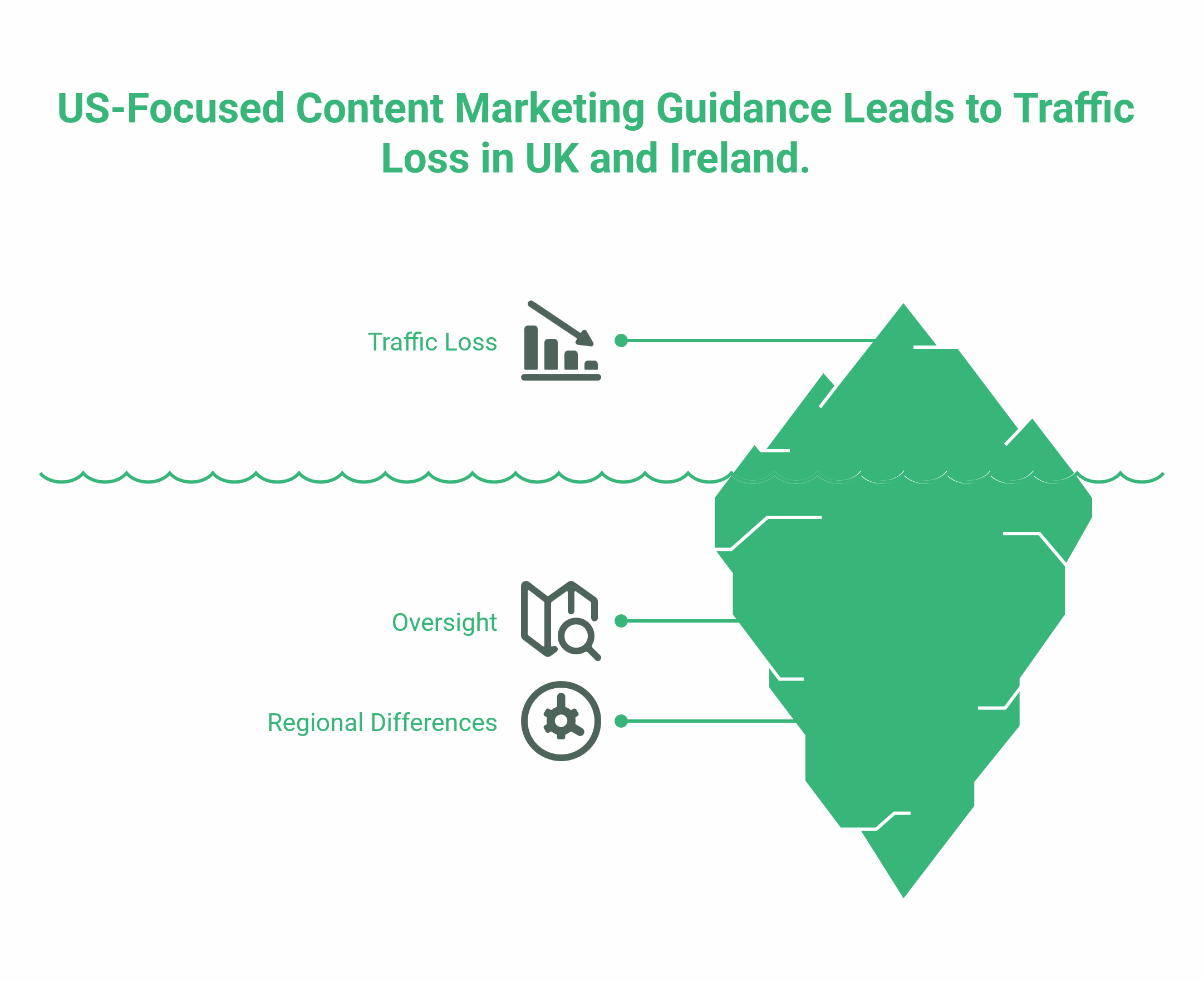
This is the mistake that US-centric content marketing advice consistently overlooks, and it costs UK and Irish businesses real traffic.
Search intent in Northern Ireland and Ireland has regional characteristics that generic content ignores. Buyers here use different terminology, reference different regulations, and make decisions in distinct commercial contexts. An article about content marketing, written for a US or even a London audience, may rank for broad terms but will fail to connect with local buyers looking for help relevant to their situation.
Spelling is the obvious example — “optimise” not “optimise”, “colour” not “colour” — but it goes deeper than that. Local credibility signals matter. Mentioning the Go Succeed programme, Invest NI, or the broader range of council-funded digital support schemes in the right context tells a Northern Irish reader immediately that you understand their environment. A blanket reference to “UK government funding” tells them nothing.
ProfileTree works with businesses across Belfast, Northern Ireland, and the Republic. The difference between content that converts locally and content that doesn’t is rarely technical. It’s usually about whether the writer understood the reader’s actual context: the buying environment, the business culture, and the specific pressures of running a small business in this market.
Review your highest-traffic pages. Check whether the language, examples, and commercial context reflect your actual target market. For businesses in Northern Ireland, UK English and genuine local context aren’t optional extras — they’re the difference between content that feels written for you and content that clearly wasn’t.
Mistake 4: Producing Top-of-Funnel Content with No Conversion Path
Traffic without conversion is a vanity metric.
Many businesses invest heavily in blog content that attracts readers at the very top of the buying funnel: people researching general topics, exploring options, or not yet ready to buy. That’s not inherently wrong. Top-of-funnel content builds authority and captures early-stage demand. But without a clear path from that content to a commercial outcome, the investment produces engagement data with no revenue attached.
The problem usually looks like this: a well-written blog post on a relevant topic attracts a few hundred readers per month. Those readers arrive, read, and leave. There’s no relevant internal link to a service page. No contextual call to action. No offer that matches where the reader is in their decision process. The blog exists as an island, disconnected from the business’s actual products.
Audit your top-traffic content pieces. For each one, identify the logical next step for a reader who found the article useful. Add a relevant internal link to a service page, a related guide, or a case study. Where appropriate, add a soft, contextually relevant call to action that meets the reader where they are rather than immediately asking for a sale.
If you’re unsure whether your content is working commercially, a [content audit] is a practical first step. It shows you which pages are generating leads and which are generating traffic that goes nowhere.
Mistake 5: Relying on Unedited AI Content
AI writing tools have a place in content production. They’re useful for research, outlines, and first drafts on well-defined topics. But unedited AI content published at scale is now actively harmful to search rankings and to brand credibility.
Google’s February 2026 core update specifically targeted thin or lightly edited AI content. Sites that had scaled output using AI without sufficient editorial oversight saw significant ranking declines. The mechanism is straightforward: AI-generated text tends to follow predictable patterns — uniform sentence length, formulaic transitions, generic phrasing — that are now identifiable both by algorithms and by readers who spend any time with written content professionally.
The damage goes beyond search. If a prospect reads a piece of content that feels hollow — technically accurate but with no real experience or perspective behind it — they’re unlikely to trust you with their marketing budget. Content is a credibility signal. Hollow content undermines it.
Use AI to assist, not to replace, editorial judgement. Draft with it, then rewrite with genuine expertise. Add your own experience, specific examples, and professional perspective. Vary sentence length deliberately. Cut formulaic transitions. If a paragraph reads like it could have been written by anyone about anything, rewrite it until it reads like it was written by you, about this, for this specific reader.
The businesses that do this well — that use AI for speed and human expertise for quality — consistently outperform those that automate the entire process.
Mistake 6: Tracking Vanity Metrics Instead of Pipeline
Page views feel good. Social shares feel good. A post going “viral” feels very good. None of these are business outcomes.
Vanity metrics are easy to measure and difficult to connect to commercial results. They tell you that people are reading your content, not that your content is generating leads, enquiries, or sales. A business can accumulate impressive traffic numbers for years while the content marketing function contributes nothing to revenue.
The metrics that matter are those connected to the buyer journey: how many visitors from content became leads; how many leads converted; which content pieces appear in the journeys of customers who actually purchased; which pages drive the most qualified traffic, not just the most traffic overall.
For most SMEs, the practical version of this is straightforward. Track conversions from content. Set up goal tracking in Google Analytics 4. Look at which blog posts generate contact form completions or enquiries, not just which ones get the most visits. Review content performance monthly against commercial outcomes.
Identify three commercial metrics you want content to influence — enquiries, leads, visits to a specific service page — and set up tracking for them. Review content performance against those metrics quarterly. Reallocate effort toward content that drives measurable outcomes and away from content that produces traffic without purpose.
Mistake 7: Treating Content as a One-Off Rather Than an Asset
A single blog post published once and never updated isn’t really an asset. It’s a snapshot that becomes less accurate, less competitive, and less visible over time. But many businesses publish a piece, move on, and never return to it.
Content published eighteen months ago almost certainly references outdated statistics. It may miss angles that have become important. It might rank for terms it wasn’t originally written for — and with a small amount of work, could rank significantly better for them. Or it might have dropped out of the rankings entirely because a competitor produced something more thorough.
AI-powered search platforms now place a heavy weight on content freshness. Pages cited in AI Overviews and AI-generated answers are, on average, materially fresher than those in standard organic results. This doesn’t mean changing a publication date — it means genuinely updating content with new information, expanded sections, and current examples.
Build a content refresh cycle into your strategy. Quarterly, identify your top-ten pages by impressions and review them for accuracy, completeness, and search performance. Update statistics, add new sections where relevant, and strengthen internal linking. Treat your best content as an investment to protect, not a task to complete and forget.
Our [SEO services] include content performance reviews as standard, precisely because the gap between a page that ranks and a page that used to rank is usually a matter of consistent attention rather than a major rewrite.
Is Your Content Marketing Working? Find Out Before You Invest More
Before adding more content to a strategy that isn’t delivering, it’s worth pausing to assess what you already have. Most businesses are closer to a functioning content strategy than they realise — they’re just missing one or two of the elements that make it work commercially.
A straightforward way to start is to pull your top 10 pages by impressions from Google Search Console and ask three questions about each one: Is this page ranking for terms my customers actually search for? Is it connected to a service or outcome I want to drive? And does it have a clear next step for the reader?
If the answer to any of those is no, you have a content performance problem rather than a content volume problem. Publishing more won’t fix it. Fixing the existing pages will.
ProfileTree has worked with SMEs across Northern Ireland, Ireland, and the UK since 2011, helping businesses identify exactly where their content is losing leads and putting the right structure in place to recover them. If you’d like an independent view of what your content is and isn’t doing, [get in touch with our team] for a content audit.
How ProfileTree Fixes Failing Content Strategies
When a business brings content to us that isn’t performing, we follow a consistent process.
Step 1: Content audit. We review existing content against search performance data, identify what’s ranking, what’s declined, and what has never performed. This gives us a clear picture of where the problems actually are.
Step 2: Audience and keyword mapping. We map the client’s target audience against actual search behaviour in their market. For Northern Ireland businesses, this means understanding local intent, regional terminology, and the specific buying context of SMEs in this market.
Step 3: Strategy and structure. We build a content plan connected to commercial goals. Every piece has a defined purpose, a target audience, a search objective, and a clear path toward a commercial outcome. We identify which existing content should be updated, which should be consolidated, and what new content is needed.
Step 4: Production with editorial standards. Content is written to our internal editorial standards: UK English throughout, genuine expertise, real examples, and no fabricated data. Every claim is sourced. Every piece goes through editorial review before publication.
Step 5: Performance review. We track content against commercial, not vanity, metrics and adjust the strategy based on the data.
ProfileTree was founded in Belfast in 2011. We’ve delivered over 1,000 web and digital projects for businesses across Northern Ireland, Ireland, and the UK. Our content team works across SEO, web design, video production, and [digital marketing training] — which means content strategy is connected to the broader digital picture rather than treated in isolation.
Conclusion
Content marketing that works isn’t complicated, but it does require discipline. A clear strategy, content mapped to commercial outcomes, genuine editorial quality, and consistent attention to performance — these are the differences between content that generates leads and content that fills a website. If any of the mistakes in this guide sound familiar, the place to start is a straightforward audit of what you have and what it’s actually doing for your business.
FAQs
What are the most common content marketing mistakes for small businesses?
The most common mistakes are producing content without a strategy, failing to connect it to commercial outcomes, and treating publishing as the finish line. A smaller number of well-researched pieces published consistently outperforms a high volume of thin content.
Why do most content marketing strategies fail to generate ROI?
Usually, because there’s no clear connection between what’s published and what the business wants to achieve. Without conversion paths and content mapped to the buyer journey, a strategy can generate traffic data while contributing nothing to revenue.
How long does it take to see results from a content marketing strategy?
For most SMEs in Northern Ireland and Ireland, meaningful improvements in rankings and traffic typically appear within three to six months of consistent, well-structured content work. Conversion improvements can appear sooner if content is properly connected to commercial outcomes from the start.
How do I know if my current content is working?
Check three things: whether your target pages rank for terms your customers actually search; whether content visits convert into enquiries; and whether your content appears in the journeys of customers who actually purchase. If you can’t answer all three, your tracking isn’t measuring what matters.