
Agile for Marketing: The Practical UK Guide for SMEs and Marketing Teams
Most marketing teams hear “agile” and picture a tech company in California doing daily standups in a glass-walled office. That image is part of why agile fails so often in UK businesses — it gets imported as theatre rather than adopted as a working method.
This guide explains what agile for marketing actually is, why it suits the pace of modern digital marketing, and how businesses across Northern Ireland, Ireland, and the wider UK can implement it without abandoning the strategic planning that serious marketing still requires. We cover the core frameworks, the cultural pitfalls that trip up UK teams specifically, and how AI tools are compressing the traditional sprint cycle in 2026.
Table of Contents
What Is Agile for Marketing?
Agile marketing is an approach to planning and executing marketing work in short, iterative cycles rather than long, fixed campaigns. Teams agree on a focused set of tasks for a defined period — typically one to four weeks — deliver something measurable at the end, review what worked, and adjust before the next cycle begins.
The approach originated in software development, where teams found that rigid multi-month project plans couldn’t keep pace with changing requirements. Marketing faces the same problem: a campaign planned in January rarely reflects what the market looks like in March.
“Agile marketing is not a software tool or a meeting format. It is a decision about how your team makes decisions — incrementally, with evidence, rather than in big upfront bets.” — Ciaran Connolly, founder of ProfileTree
The core shift is from campaigns as discrete events to marketing as an ongoing, measurable process. Instead of a six-month plan handed down from senior management, agile teams work from a prioritised backlog of tasks, pick the highest-value items each sprint, and surface results quickly enough to learn from them.
The Agile Marketing Manifesto: Seven Core Values
The Agile Marketing Manifesto, developed by a group of marketing practitioners and updated for the current landscape, identifies seven values that distinguish agile from traditional marketing practice:
Validated learning over opinions and conventions. Teams test ideas with real data rather than relying on gut instinct or historical precedent.
Customer-focused collaboration over silos and hierarchy. Marketing, sales, customer service, and other functions work toward the same customer outcome rather than separate departmental goals.
Adaptive and iterative campaigns over big-bang campaigns. Smaller, faster cycles replace single large launches. This reduces the risk of wasting budget on untested assumptions.
The process of customer discovery over static prediction. Customer insight is treated as an ongoing activity, not a one-off research exercise at the start of the year.
Flexible planning over rigid planning. Plans serve as a direction, not a fixed contract. Teams update priorities as conditions change.
Responding to change by following a fixed plan. The ability to pivot quickly is treated as a competitive advantage, not a failure of planning.
Many small experiments over a few large bets. Running more tests at a smaller scale produces faster learning and reduces the cost of failure.
Agile vs. Traditional Waterfall Marketing
| Factor | Traditional (Waterfall) | Agile Marketing |
|---|---|---|
| Planning cycle | 6–12 months fixed | Rolling 1–4 week sprints |
| Feedback loop | End of campaign | End of each sprint |
| Risk | High — large budget committed upfront | Lower — small batches tested first |
| Flexibility | Low — change is disruptive | Low change is disruptive |
| Speed to market | Slow | Fast |
| Best suited to | Predictable, stable environments | Fast-moving digital channels |
Waterfall still works well for certain marketing activities — a product launch with a fixed date, a large event, or a regulated campaign where every element needs sign-off before publication. Agile does not replace strategic planning; it changes how tactical execution is organised within that strategy.
Why UK Marketing Teams Struggle with Agile
The majority of agile marketing guides are written for US technology companies or enterprise brands with large, autonomous marketing functions. The cultural and structural reality in most businesses in the UK and Northern Ireland is different in ways that matter.
The Sign-Off Bottleneck
Many UK organisations, particularly those with traditional hierarchies, require multiple layers of approval before any marketing output goes live. A two-week sprint loses most of its value if the deliverable sits in a review queue for three weeks. Implementing agile without addressing sign-off culture produces the worst of both worlds: short sprints with long approval tails.
The practical fix is to involve the approving stakeholder — whether that’s a senior director, a legal team, or a client — in sprint planning, not just the review. When decision-makers understand what the sprint is attempting and why, approval becomes faster and more targeted.
The HIPPO Effect
The HIPPO — Highest Paid Person’s Opinion — is one of the most commonly cited reasons agile fails in marketing. When the most senior person in the room overrides data with preference, the validation loop that agile depends on breaks down entirely.
Agile does not require organisations to eliminate hierarchy. It does require that decisions about sprint priorities are driven by evidence — customer data, campaign performance, search demand — rather than seniority alone. That is a cultural shift, and in many UK businesses it requires explicit support from leadership before it becomes normal practice.
The “Agile in Name Only” Problem
Many UK teams run standups, use Trello boards, and call their work items “sprints” without any of the underlying agile mindset. The rituals become bureaucratic overhead rather than tools for learning. Teams end up with the process costs of agile and none of the speed benefits.
If your team is going through agile motions without changing how it makes decisions or incorporates feedback, it is worth stepping back and asking whether the structure is serving the work or substituting for it. ProfileTree’s digital marketing training for teams covers this directly — the mindset shift tends to matter more than the tooling.
The Two Main Agile Frameworks: Scrum and Kanban
Most agile marketing teams use one of two frameworks, or a hybrid of both.
Scrum for Marketing Teams
Scrum structures work into fixed-length sprints, typically one to four weeks. At the start of each sprint, the team selects tasks from a prioritised backlog and commits to completing them within the sprint window. At the end, they review completed work, gather feedback, and hold a retrospective to discuss what to improve.
Key Roles in a Marketing Scrum Setup
The marketing owner defines the backlog and sets priorities. This is typically a Head of Marketing, Brand Manager, or senior account lead — whoever holds accountability for the outcomes the team is working toward.
The Scrum lead (equivalent to a Scrum Master) removes obstacles, facilitates meetings, and keeps the team focused on the sprint goal. This is a coordination role, not a management one.
The team consists of the people doing the work — content writers, designers, analysts, paid media managers, and any other specialists relevant to the sprint goals.
The daily standup: a 15-minute team check-in covering what was completed yesterday, what will be completed today, and what is blocking progress. The standup surfaces problems early rather than letting them compound across the sprint.
Kanban for Smaller Teams and Agencies
Kanban suits teams where work arrives continuously and unpredictably, which describes most content marketing and social media functions. Rather than fixed sprints, Kanban uses a visible board of tasks moving through defined stages (typically: to do, in progress, in review, done) with a limit on how many tasks can be in any one stage at once.
The work-in-progress limit is the key mechanism. It prevents teams from starting ten things and finishing none, which is the default failure mode for busy marketing teams without structure.
For small agencies working with multiple clients, Kanban often works better than Scrum because it accommodates client-driven priorities shifting week to week without the overhead of formal sprint planning. ProfileTree’s guide to project management apps covers Trello, Asana, and similar tools that support both frameworks.
Which Framework Suits Your Team?
Use Scrum if your team works on defined campaigns or content programmes with clear deliverables, you can protect sprint commitments from interruption, and stakeholders can participate in planning and review on a regular cadence.
Use Kanban if your team handles a continuous stream of requests across multiple projects, priorities shift frequently based on client or business demands, and the team is small (two to five people) with overlapping responsibilities.
Use a hybrid (sometimes called Scrumban) if some of your work is campaign-based and some is ongoing, which is the reality for most in-house marketing teams.
The 2026 Factor: How AI Is Changing the Agile Sprint

The traditional argument for two-week sprints was that producing a piece of tested content — research, draft, design, review, publish, analyse — genuinely took two weeks for a small team. In 2026, that timeline has compressed significantly.
AI-Accelerated Micro-Sprints
Generative AI tools have reduced the time required for first-draft production, data synthesis, and initial analysis to a fraction of what it was two years ago. A content team that previously needed five days to move from brief to publishable draft can now complete that cycle in one or two days — not because the quality bar has dropped, but because the mechanical production steps are faster.
This changes what agile marketing looks like in practice. Teams running micro-sprints of three to five days can test more hypotheses in a month, surface data faster, and iterate campaign elements before entire budgets are committed.
The shift requires a recalibration of quality control. If AI accelerates the drafting stage, editorial review and human judgment become more important, not less. The sprint review and retrospective — the stages where teams ask whether the output actually achieved the goal — carry more weight when production speed increases.
Data-Driven Pivots Within the Sprint
AI-powered analytics and reporting tools now make it possible to identify performance problems within days of launching a campaign rather than waiting for end-of-month reports. This enables what some practitioners call “in-sprint pivots” — adjusting a live campaign mid-sprint based on early performance signals rather than waiting for the next sprint cycle.
For SMEs working with ProfileTree’s digital marketing services, this kind of real-time responsiveness is one of the practical benefits of an agile working relationship — campaigns can be adjusted based on what is actually happening rather than what was predicted to happen.
How to Implement Agile Marketing in Five Steps
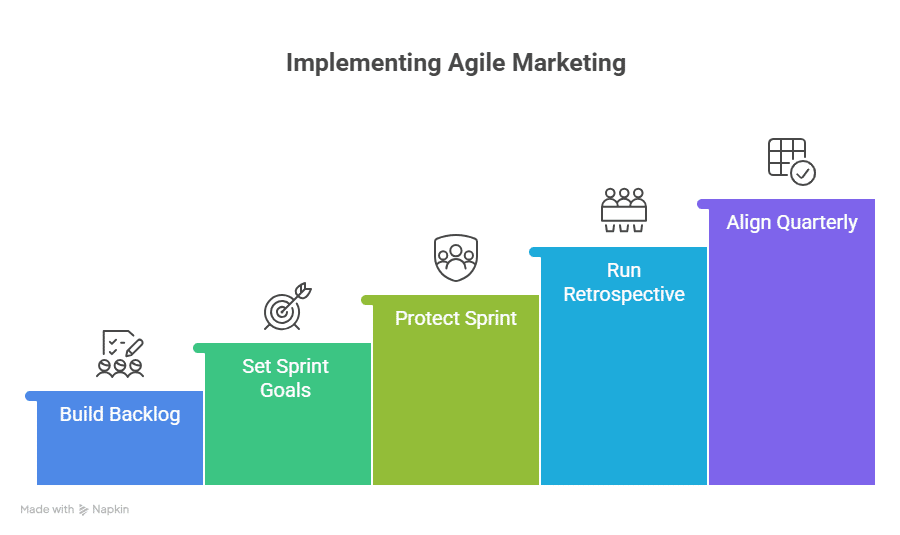
Step 1: Build the Backlog
The backlog is a single, prioritised list of all the marketing work the team could do. It includes campaign ideas, content pieces, landing pages, social posts, email sequences, experiments, and any other marketing output being considered.
The marketing owner maintains the backlog. Items are written as clear outcomes — what is being created, for whom, and what result is expected — rather than vague tasks. Before the first sprint, the backlog needs enough high-priority items to run three to four sprints without revisiting it.
Step 2: Set Sprint Goals, Not Just Task Lists
Each sprint should have a clear goal that connects to a business outcome. “Publish four blog posts” is a task list. “Increase organic traffic to the services section by driving three new entries to the top 20 positions” is a goal. The distinction matters because it gives the team a shared measure of success and makes the sprint review meaningful.
Step 3: Protect the Sprint
The sprint commitment only works if the team can actually complete what it has committed to. In most UK marketing environments, the biggest threat to this is unplanned urgent requests arriving mid-sprint. The standard approach is to distinguish between sprint work (protected) and a fast-response lane (a small capacity reserve for genuine urgencies). Without this separation, every sprint becomes a reactive scramble.
Step 4: Run a Genuine Retrospective
The sprint retrospective is the most valuable and most frequently skipped part of the process. It asks three questions: what went well, what did not go well, and what we will change in the next sprint. The answers should produce one or two concrete adjustments to how the team works — not a long list of aspirations.
ProfileTree’s project management training covers facilitation techniques for retrospectives that produce actionable outcomes rather than venting sessions.
Step 5: Align with Strategy Quarterly
Agile’s focus on short cycles can produce short-term thinking if there is no counterbalancing strategic review. Most experienced agile marketing teams run a quarterly “big room” session — a longer planning meeting where the roadmap is reviewed, themes are updated, and sprint goals for the next quarter are aligned with business priorities.
This is not a contradiction of agile principles. It is how you ensure that fast iteration is happening in the right direction.
Common Reasons Agile Marketing Fails
No executive support. If senior leadership is not committed to changing how decisions are made, the team will run sprints, but approvals will still follow the old process. Agile cannot be implemented from the bottom up in a hierarchically managed organisation without explicit sponsorship from above.
Mistaking tools for transformation. Installing Jira or Trello does not make a team agile. The tools support the process, but the process depends on behaviour — prioritising backlogs honestly, protecting sprint commitments, and acting on retrospective findings.
Abandoning strategy for speed. Agile is an execution method, not a substitute for marketing strategy. Teams that focus entirely on sprint velocity without a clear strategic direction produce a lot of output that does not compound into meaningful results.
Poorly written backlogs. Vague backlog items (“improve the website”, “do more social media”) cannot be meaningfully prioritised, estimated, or reviewed. The quality of sprint planning is directly determined by the quality of backlog items.
Treating agile as a permanent emergency. Some teams implement agile during a crisis and then never adjust the cadence after the emergency passes. A sprint culture where everything is always urgent is not agile — it is a different kind of chaos with shorter planning cycles.
Agile Marketing Tools for UK Teams
Most UK marketing teams need a task management tool, a shared communication platform, and a simple reporting dashboard. The right combination depends on team size and client structure.
Trello suits small teams (two to five people) running Kanban-style workflows. It is visual, easy to onboard, and free for most basic use cases. Cards move across columns as work progresses — intuitive enough that non-technical stakeholders can follow progress without training.
Asana works well for slightly larger teams managing multiple projects simultaneously. Its timeline and workload views help marketing owners see capacity and spot sprint overload before it becomes a problem.
Jira is the most feature-complete option and the standard for software-adjacent teams that need granular tracking of story points and velocity. For most marketing teams without a technical background, the configuration overhead is not worth it unless the team already has Jira expertise.
Notion has become a practical, combined option for teams that want backlog management, documentation, and retrospective notes in one place without separate tooling. ProfileTree’s digital marketing tools guide covers the current options in more detail.
Conclusion
Agile marketing works when teams treat it as a way of making better decisions faster, not as a set of rituals to perform. For UK SMEs, the practical version delivers real speed and adaptability without the overhead that makes enterprise agile feel bureaucratic. If your marketing currently operates in long fixed cycles with little mid-course adjustment, even a modest move toward iterative planning will produce faster learning.
If your team is looking to adopt a more agile approach to digital marketing or needs external support for campaign execution, content strategy, or training, talk to the ProfileTree team about what a phased engagement looks like in practice.
FAQs
What are the four core values of agile marketing?
The four most cited values from the Agile Marketing Manifesto are: validated learning over opinions, customer-focused collaboration over silos, adaptive campaigns over big-bang launches, and responding to change over following a fixed plan. These are priorities, not absolutes — agile teams still plan, they just plan in shorter cycles with more frequent review.
Is agile marketing the same as Scrum?
No. Scrum is a specific framework that sits within the broader agile approach. Agile describes a philosophy and a set of values. Scrum is one way of organising work according to those values — using defined sprint lengths, backlogs, daily standups, and retrospectives. Kanban and Scrum are alternative frameworks under the same agile umbrella. Most marketing teams end up with a hybrid that borrows elements from more than one framework.
How do you handle sign-off requirements in an agile marketing team?
This is the most common practical challenge for UK teams. The solution is to involve approvers in sprint planning — not just in the final review. When stakeholders understand what the sprint is attempting to achieve and what success looks like, approval decisions become faster and more focused.
Does agile marketing work for small UK agencies?
Yes, and Kanban usually suits agencies better than Scrum. Small agencies with multiple clients rarely have the schedule predictability that Scrum sprints require. A Kanban board with clear work-in-progress limits, weekly prioritisation, and a short retrospective gives most of the agile benefits without the rigidity of fixed sprint cycles.
Why do marketing teams fail at agile?
The most common reasons are lack of leadership buy-in, treating the rituals (standups, sprints, boards) as the goal rather than the means, and failing to change how decisions are made. A team that runs daily standups but still waits three weeks for a director to approve a social media post is not operating agilely — it has added process overhead without gaining speed.