
Local SEO for Accountants: Become the Go-To Practice in Your Area
Table of Contents
When a business owner needs an accountant, they typically want someone local. Someone they can meet face-to-face. Someone who understands local business conditions and can attend their premises if needed. This is why local SEO matters for accounting practices: regardless of how much work happens remotely, clients still search locally.
Accounting practices face a specific challenge: differentiating in a crowded market where services appear similar to searchers. Local SEO for accountants helps you stand out to potential clients in your area, building visibility for your practice when businesses and individuals search for accounting help.
This guide covers local SEO specifically for accountants: optimising your Google Business Profile, structuring your website for local visibility, building the reviews that influence client decisions, and creating content that positions your practice as the local authority.
Why Local Search Matters for Accounting Practices
Accountants benefit from local SEO for several reasons.
Clients prefer local relationships. Even when work is digital, clients value proximity. A local accountant can attend business premises, meet for coffee, and understand regional business conditions. Searches reflect this preference; “accountant near me” and “accountant [town]” consistently show high volume.
Trust requires visibility. Handing over financial information requires significant trust. Appearing prominently in local search, with reviews, credentials, and professional presentation, builds that trust before the first conversation.
Competition is geographic. Your real competitors are other practices serving your area, not accountants nationwide. Local SEO is achievable because you’re competing in a defined market.
Different client types search differently. Sole traders search differently from limited companies. Personal tax clients search differently from businesses needing an audit. Local SEO for accountants lets you target specific client types in your area.
Referrals often start with a search. Even when someone receives a referral, they typically search the recommended practice to verify credibility. Appearing professionally in that search confirms the referral.
Google Business Profile for Accountants
Your Google Business Profile determines local pack visibility, the box of businesses appearing in Google Maps results for local searches.
Category Selection for Accounting Practices
Categories determine which searches trigger your listing.
Primary category: “Accountant” captures broad relevant searches.
Secondary categories to consider:
- Tax Consultant
- Bookkeeping Service
- Chartered Accountant (if applicable)
- Certified Public Accountant
- Financial Consultant
- Payroll Service
- Business Management Consultant
Select categories matching services you actively provide. Missing categories means missing relevant searches.
Service Listings
Detail every service your practice offers. Google matches these with specific searches.
Business accounting:
- Annual accounts preparation
- Management accounts
- Bookkeeping services
- VAT returns
- Payroll services
- Company secretarial
Tax services:
- Corporation tax
- Personal tax returns
- Self-assessment
- Tax planning
- Capital gains tax
- Inheritance tax planning
- R&D tax credits
Business advisory:
- Business startup advice
- Business planning
- Cash flow forecasting
- Financial projections
- Exit planning
- Business valuations
Specialist services:
- Audit services (if applicable)
- Contractor accounting
- Landlord accounting
- Charity accounting
- Construction Industry Scheme (CIS)
Someone searching “R&D tax credits [location]” finds practices listing that specific service.
Practice Information
Complete every profile field thoroughly:
- Business description: Use the full 750 characters. Describe your practice, specialisms, client types you serve, and what distinguishes you. Include location naturally; “serving businesses across Belfast and Northern Ireland” rather than keyword stuffing.
- Opening hours: Reflect actual availability. If you offer evening appointments or Saturday availability for employed clients needing personal tax help, show this.
- Attributes: Complete all relevant options: appointment required, accessibility features, payment methods accepted.
- Services with pricing: Where appropriate, include pricing or price ranges. “Personal tax return from £150” helps searchers understand if you’re in their budget.
Photos for Accounting Practices
Accountants need photos that build professional trust:
- Office exterior and interior: Shows you have a professional premises (even if home-based, consider meeting room photos from the co-working space you use).
- Team photos: Professional headshots of partners and staff. People hire people; faces build connections.
- Credentials: Qualification certificates, professional body memberships (ICAEW, ACCA, AAT logos).
- Team at work: Natural photos of staff in office settings, meeting with clients (with permission), working at screens.
- Community involvement: Sponsorship photos, business networking events, charity work.
Avoid stock photos; they look generic and erode trust. Authentic images of your actual team and premises perform better.
Website Optimisation for Accounting Practices
Your website converts search visibility into client enquiries.
Service Page Structure
Create dedicated pages for each major service area rather than one generic services page.
Business accounting page targeting “business accountant [location] and “small business accountant [location].” Explain what’s included, how you work with clients, and who you typically help.
Personal tax page targeting “personal tax accountant [location]” and “self-assessment accountant [location].” Cover what’s involved, deadline reminders, and typical fees.
Bookkeeping page targeting “bookkeeping services [location].” Explain the software you support (Xero, QuickBooks, Sage), how the service works, and pricing models.
Tax planning page targeting “tax planning [location]” and “tax advisor [location].” Cover business and personal tax planning, when clients should seek help, and potential savings areas.
Specialist pages for niches you serve: contractor accountants, landlord accountants, startup accountants. These attract clients seeking specific expertise.
Each page needs sufficient depth to be genuinely useful, local relevance, and clear calls to action.
ProfileTree’s website design services help accounting practices build websites that rank and convert.
Location Strategy
Multi-location practices need pages for each office. Single-location practices serving multiple areas should consider location content carefully.
For multiple offices: Each office needs its own Google Business Profile and dedicated website page with unique content about that location.
For a single office serving a region: Create pages for major nearby towns only where you have a genuine presence: clients in that area, specific knowledge of local business conditions. Avoid thin pages for dozens of locations you barely serve.
Content That Demonstrates Expertise
Accounting practices benefit enormously from content marketing. Potential clients search for information before searching for accountants.
Deadline and compliance content:
- Self-assessment deadline guides
- Corporation tax filing deadlines
- Making Tax Digital requirements
- VAT threshold changes
Cost and decision content:
- How much does an accountant cost?
- When should I hire an accountant?
- Sole trader vs limited company comparison
- DIY accounting vs hiring help
Sector-specific content:
- Tax guide for landlords
- Accounting for Amazon sellers
- Contractor IR35 explained
- Startup accounting essentials
Local business content:
- Business grants in [your region]
- Starting a business in [your area]
- Local business networking groups
ProfileTree’s content marketing services help accounting practices create content that attracts clients.
Technical Requirements
Accounting practice websites need:
- Security:HTTPS is essential. Clients share sensitive financial information; security certificates are non-negotiable.
- Fast loading: Particularly on mobile where initial research often happens.
- Clear contact options: Phone, email, contact form, and online booking if you offer it.
- Accessibility: Many clients are older business owners. Readable fonts, clear navigation, and accessible design matter.
- Schema markup: LocalBusiness schema with accurate practice information, service schema for each service, and review schema for displaying ratings.
Your website development should prioritise security and accessibility alongside SEO performance.
Building Reviews for Accounting Practices
Reviews significantly influence accounting practice selection. Financial matters involve trust; potential clients look carefully at what existing clients say.
Why Reviews Matter for Accountants
Trust is the primary purchase driver. Clients hand over sensitive financial information. Strong reviews from real clients provide crucial reassurance.
Expertise is hard to evaluate otherwise. Potential clients can’t easily judge accounting competence before engaging. Reviews proxy for quality.
Specific review content reinforces services. Reviews mentioning “tax planning,” “business accounts,” or “self-assessment” help you rank for those terms.
Review recency signals active practice. A practice with recent reviews appears current. Old reviews only suggest past performance.
Generating Reviews From Clients
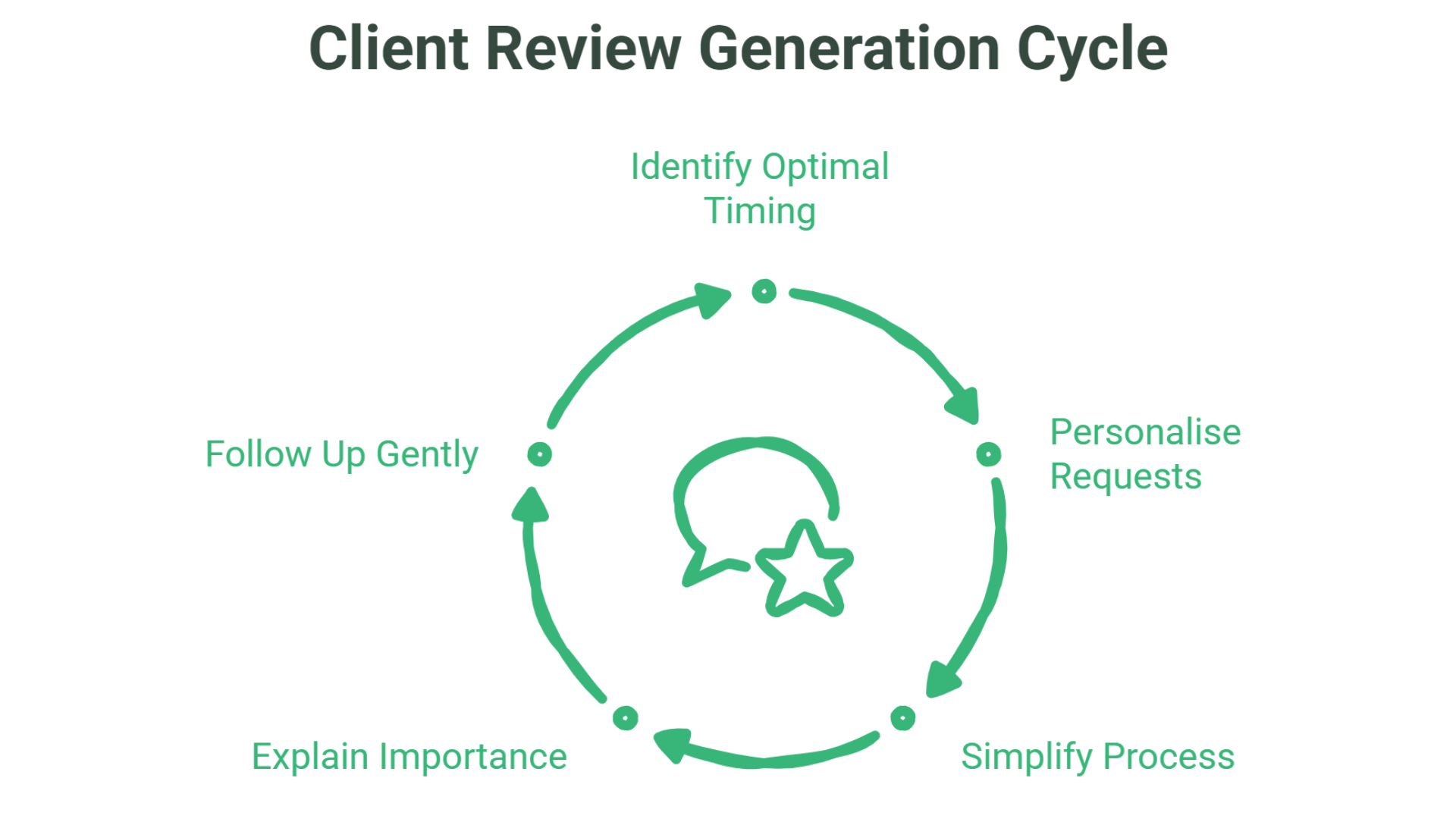
- Time requests appropriately. The best moments: after completing annual accounts, after a successful tax refund, after resolving a complex issue. When clients feel value, they’re willing to help.
- Make requests personal. Email requests from the partner who handles the client relationship outperform generic firm-wide messages.
- Simplify the process. Send a direct link to your Google review page. Every click required reduces completion rates.
- Explain why it matters. “Reviews help other business owners find us” is more compelling than simply asking for a favour.
- Follow up once. A gentle reminder a week later captures clients who intended to leave a review but forgot. Don’t pester beyond that.
Professional Considerations
Accounting professional bodies generally permit review solicitation provided:
- You don’t offer incentives for reviews
- You don’t pressure clients
- You don’t selectively request only positive reviews
- Reviews are genuinely from clients
Check your professional body’s guidance to ensure compliance.
Responding to Reviews
Respond to everything. Thank positive reviewers specifically. Address negative reviews professionally without breaching client confidentiality.
Keep responses appropriate. Don’t discuss specific client matters in public responses. A negative review claiming you “messed up their accounts” should be addressed with “Please contact us directly to discuss your concerns” rather than detailed defence.
Show personality appropriately. Responses can be warm and human while remaining professional. Avoid stiff, corporate language.
Citations for Accounting Practices
Citations build local authority through consistent business information across the web.
Key Directories for Accountants
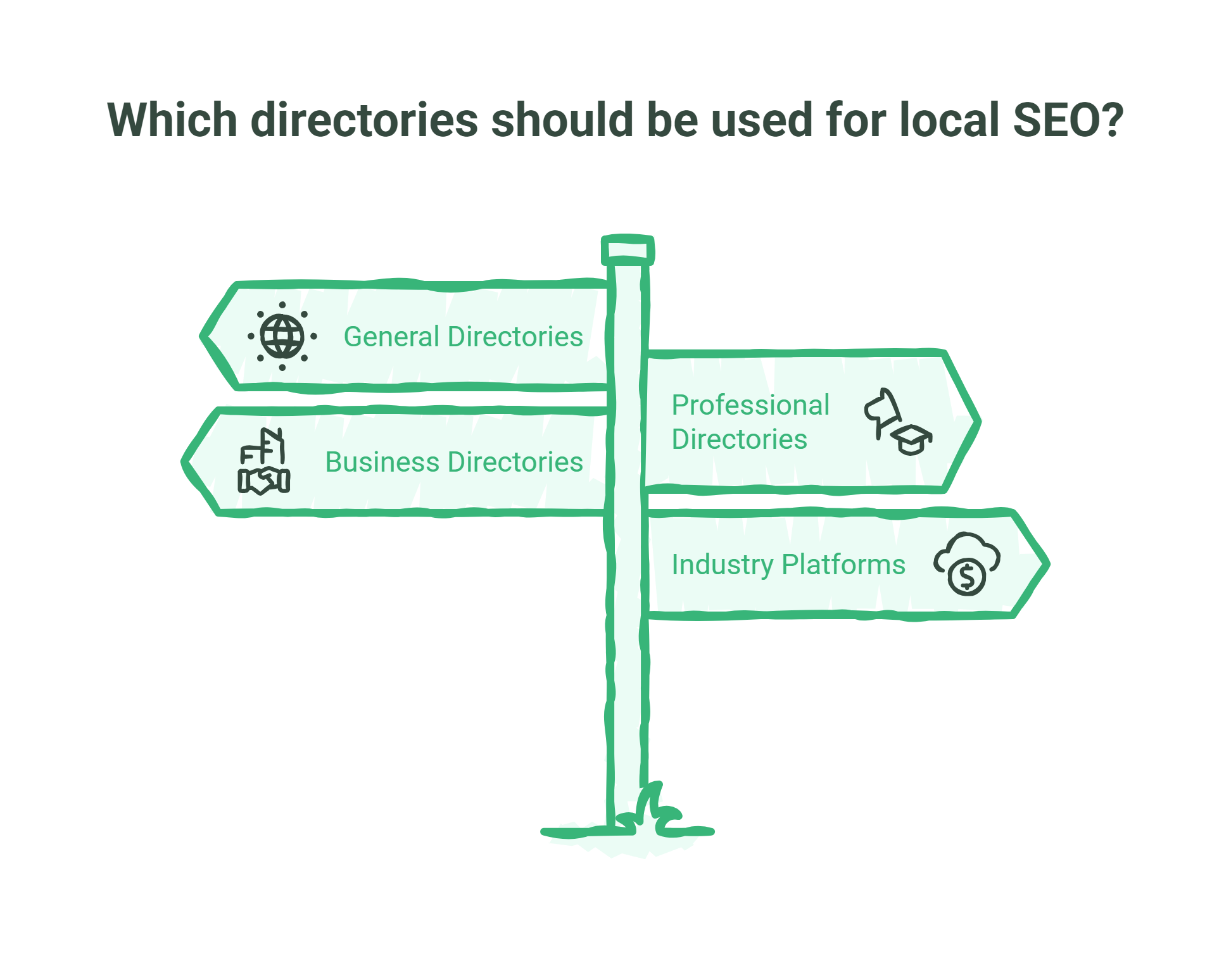
General directories:
- Google Business Profile
- Bing Places
- Apple Maps
- Yelp
- Thomson Local
- Yell
Professional directories:
- ICAEW Find a Chartered Accountant
- ACCA Find an Accountant
- AAT Licensed Accountant directory
- CIMA directory (if applicable)
Business directories:
- Local chamber of commerce
- Federation of Small Businesses member directory
- Local business associations
- Co-working space directories (if you use hot-desking)
Industry platforms:
- Accounting software partner directories (Xero Advisor Directory, QuickBooks ProAdvisor)
- Unbiased (financial advisor directory)
Citation Consistency
Ensure identical Name, Address, and Phone number everywhere:
- Practice trading name vs. registered company name
- Address format consistency
- Phone number format with or without area code
Audit existing citations and correct any inconsistencies. Old directories with previous addresses or phone numbers create confusion.
Competing in Your Local Market
Accounting is competitive; most areas have multiple practices serving similar clients. Differentiation through local SEO for accountants requires strategic thinking.
Finding Your Positioning
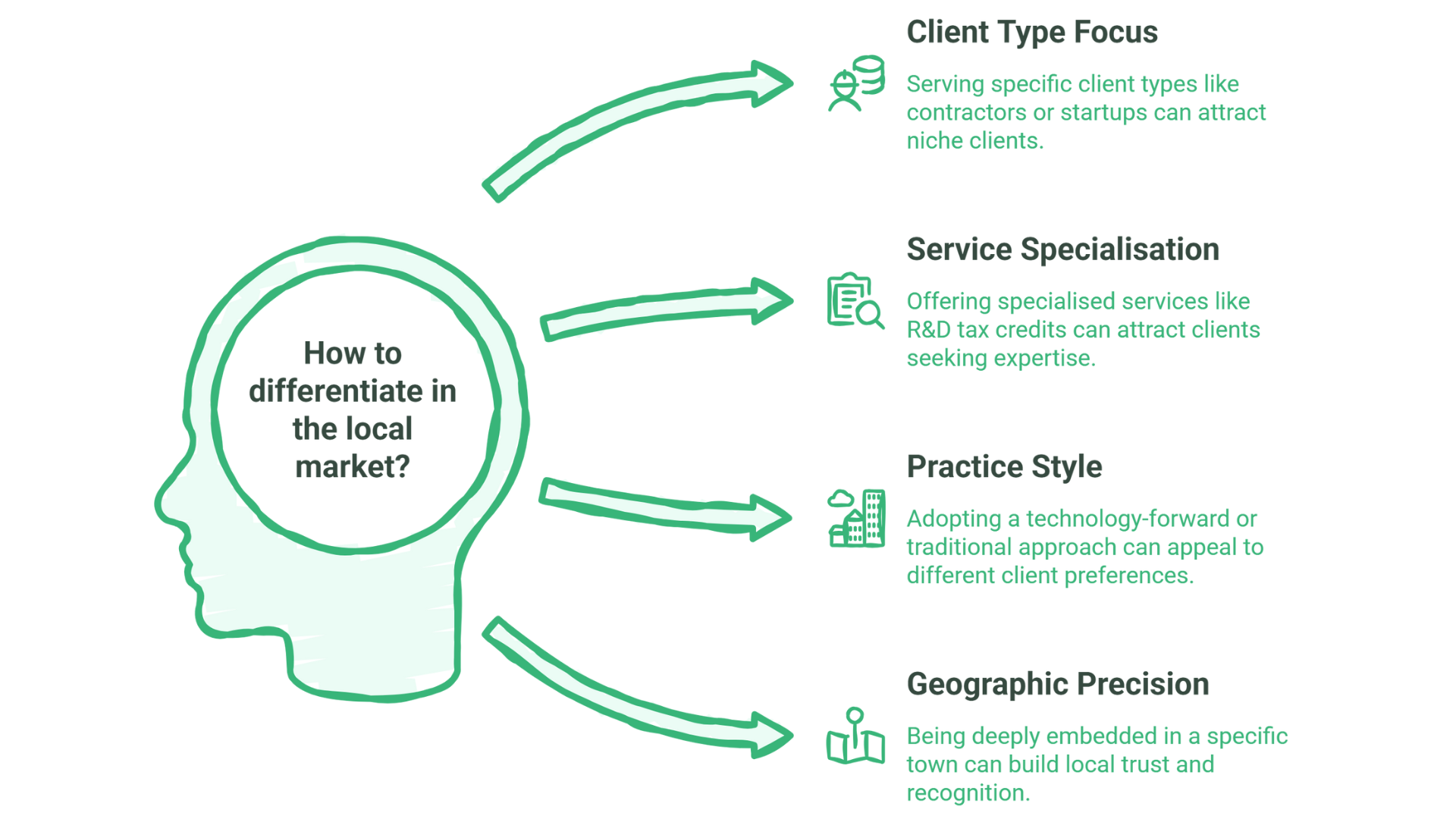
Client type focus: Serving contractors, landlords, startups, or specific industries creates natural differentiation. Someone searching “contractor accountant Belfast” sees practices mentioning contractors specifically, not generalists.
Service specialisation: R&D tax credits, audit services, management accounting, virtual FD services: specialist capabilities attract clients seeking specific expertise.
Practice style: Technology-forward cloud accounting practice versus traditional hands-on service. Price-competitive fixed fees versus premium advisory positioning. Different clients want different approaches.
Geographic precision: A practice genuinely embedded in a specific town—sponsoring local events, involved in the business community, known locally—has advantages over competitors covering broad regions generically.
Content Differentiation
Create content competitors don’t have:
Local knowledge: Business rates in your area, local council grants, regional business statistics. National content is everywhere; local content is scarcer.
Genuine opinions: Take positions on tax planning approaches, accounting software preferences, business structure decisions. Wishy-washy “it depends” content doesn’t differentiate.
Real examples: Anonymised case studies showing how you helped specific situations. “Client A saved £X through R&D tax credits” demonstrates capability.
Personal expertise: Partners sharing professional perspectives through blogs, videos, or guides establishes individual authority, not just practice authority.
ProfileTree’s digital strategy services help accounting practices develop differentiated positioning.
Measuring Success
Track metrics that matter for accounting practice growth:
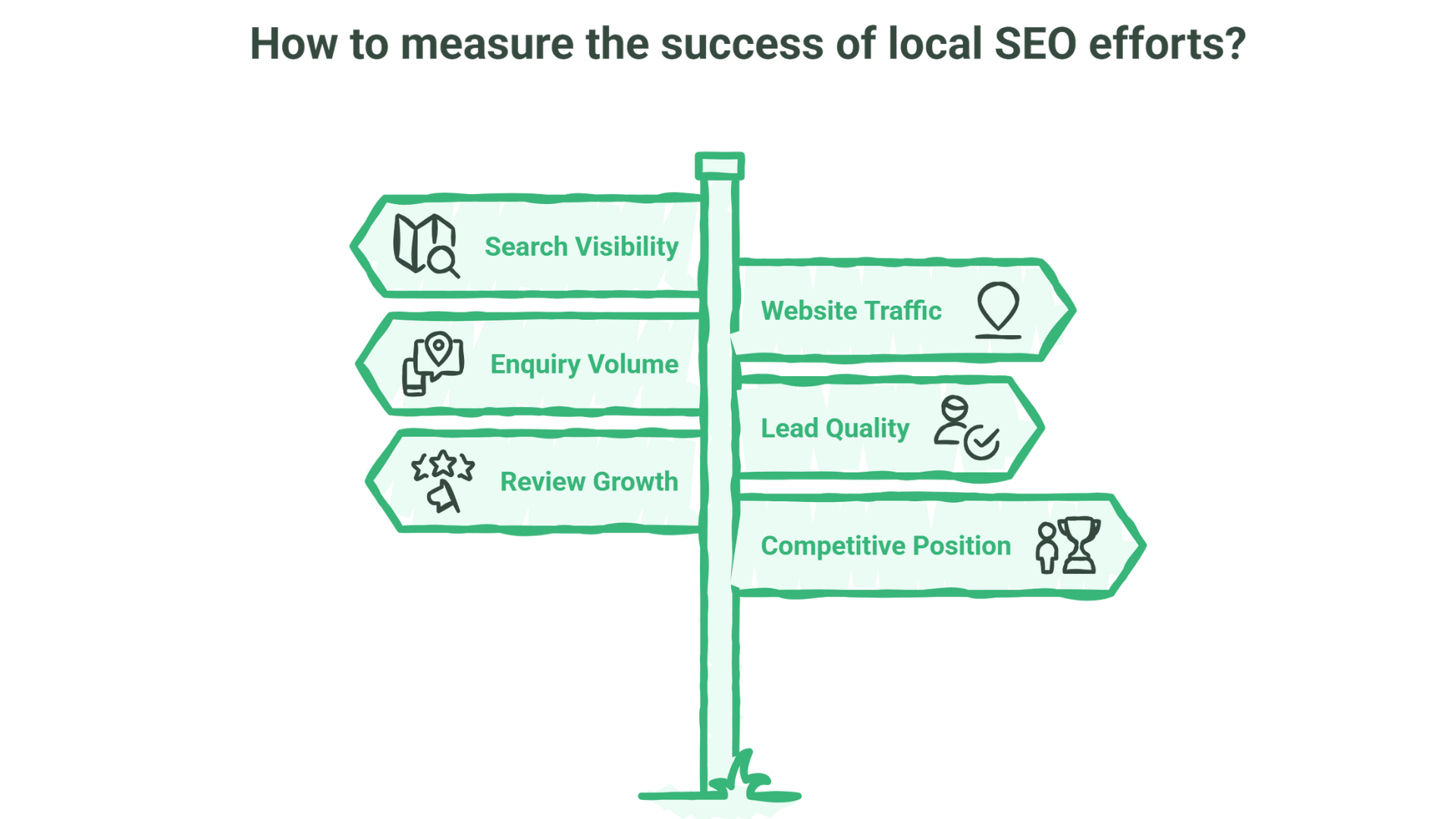
- Search visibility: Rankings for priority terms: “accountant [location],” “business accountant [location],” specific services plus location.
- Website traffic from local search: Segment analytics to show traffic specifically from local queries.
- Enquiry volume and source: Track where leads originate. Phone calls, contact forms, and emails should be attributed to channels.
- Lead quality: Are local SEO leads becoming clients? What client types? What services?
- Review growth: Monthly review count, average rating, and sentiment trends.
- Competitive position: How do you compare with competitors on key metrics: review count, profile completeness, ranking positions?
Accounting practices often underestimate how much business comes from local search,” notes Ciaran Connolly, ProfileTree founder. “Even practices with strong referral networks find that potential clients search to verify recommendations. Appearing professionally in that search, with strong reviews, clear services, and credible presentation, confirms the referral and wins the client.”
FAQs About Local SEO for Accountants
How long does local SEO take for accountants?
Google Business Profile optimisations typically show results within 2-4 weeks. Website improvements and citation building take 2-4 months to impact rankings meaningfully. Competitive markets and valuable keywords may take 6-12 months to achieve strong positions. January-April (tax season) is particularly competitive; starting SEO efforts mid-year allows ranking improvement before peak season.
Should I target businesses or individuals?
Most accounting practices serve businesses for ongoing accounting work and individuals for personal tax. Your SEO strategy should address both but may prioritise based on your practice goals. Business client keywords (business accountant, bookkeeping services) tend to be more valuable per client; individual keywords (personal tax, self-assessment) have higher volume but lower lifetime value.
Is being a chartered accountant an SEO advantage?
Not directly. Google doesn’t rank chartered accountants higher automatically. But qualification indirectly helps: you appear in professional body directories (citations), can use “chartered accountant” in categories and content (keyword targeting), and credentials build trust (improving click-through and conversion rates). Being chartered supports SEO even though it’s not a ranking factor itself.
How do I compete with large accounting firms?
Large firms often have weaker local SEO than you’d expect. They target a broad national presence rather than specific local markets. You can outrank them locally by: maintaining a more complete, active Google Business Profile; generating more local reviews; creating location-specific content; and being genuinely embedded in local business communities. Searchers often prefer local practices over national firms anyway.
Should I include pricing on my website?
Including pricing attracts price-aware clients and pre-qualifies enquiries, but may deter clients with complex needs, assuming they don’t fit your standard pricing. Consider showing “from” prices or typical ranges rather than fixed quotes. “Personal tax returns from £150” gives guidance without implying that complex returns cost the same. Test both approaches and measure enquiry quality.
How important are reviews for accountants compared to other factors?
Extremely important. Accounting involves trusting someone with sensitive financial information. Reviews provide social proof that other clients trust you. In competitive searches, practices with substantially more and better reviews typically outrank and out-convert competitors. Aim for 30+ reviews with 4.5+ rating as a competitive baseline; 100+ reviews provides a significant advantage.
Can I do local SEO myself, or should I hire help?
Basic optimisation (completing your Google Business Profile, asking clients for reviews, ensuring website accuracy), you can handle internally. Advanced work (technical website optimisation, comprehensive citation building, ongoing content creation, competitive strategy) typically requires either dedicated marketing staff or external help. Many practices handle basics internally while outsourcing strategic SEO work. ProfileTree’s SEO services support accounting practices at whatever level fits their needs.