
AI Prompts for E-commerce vs B2B Marketing Strategies
Table of Contents
The artificial intelligence revolution has fundamentally changed how marketing teams approach content creation, customer engagement, and conversion optimisation. However, many businesses make the critical error of using identical AI prompting strategies across different industry verticals. This approach fails because e-commerce customers and B2B decision-makers operate with entirely different motivations, timescales, and purchasing behaviours.
Recent performance data reveals that businesses using industry-specific AI prompting strategies see conversion rates improve by 40-60% compared to generic approaches. For Northern Ireland businesses competing in both local and international markets, this differentiation becomes even more crucial as they navigate diverse customer bases and market expectations.
This comprehensive guide examines how Belfast-based agencies and UK businesses can craft AI prompts that speak directly to their target market’s psychology, whether selling products to consumers or solutions to enterprises.
Understanding the Fundamental Differences Between E-commerce vs B2B Marketing Audiences
E-commerce customers typically make emotional, fast-paced decisions driven by personal desires, immediate needs, and lifestyle aspirations. Their purchasing process often involves quick research, price comparison, and impulse buying. Conversely, B2B buyers engage in methodical evaluation processes, considering long-term business impact, return on investment, and stakeholder approval.
These psychological differences directly influence how AI prompts should be structured. E-commerce prompts must capture attention quickly and trigger immediate action, whilst B2B prompts need to demonstrate expertise, build trust, and address multiple decision-maker concerns.
The language patterns also differ significantly. E-commerce responds to sensory descriptions, lifestyle imagery, and urgency indicators. B2B audiences prefer data-driven insights, industry terminology, and solution-focused messaging. Understanding these distinctions enables marketers to guide AI tools toward generating content that resonates with the intended audience.
Consider the difference in purchase complexity: e-commerce transactions often involve single individuals making relatively quick decisions, whilst B2B purchases typically require consensus from multiple stakeholders over extended periods. This reality must be reflected in your AI prompting strategy.
E-commerce AI Prompting Strategies That Drive Sales
E-commerce AI prompts should prioritise emotional connection and immediate value proposition. The most effective approaches focus on lifestyle enhancement, problem resolution, and social proof integration. Your prompts need to guide AI toward creating content that addresses the customer’s personal world and immediate gratification desires.
Product Description Prompts for E-commerce
“Write a product description for [product name] targeting [demographic] who want to [desired outcome]. Focus on how this product fits into their daily routine and makes their life easier. Include sensory details about texture, appearance, and user experience. End with a specific call-to-action that creates urgency without being pushy.”
This structure works because it combines personal relevance with tangible benefits. The sensory details help customers visualise ownership, whilst the routine integration shows practical value. The urgency element drives immediate action without creating resistance.
Email Marketing Prompts for E-commerce
“Create an email subject line and opening paragraph for [product category] customers who haven’t purchased in 30 days. Reference their previous interests and suggest new items that complement their past purchases. Include a personalised discount that expires in 48 hours. Make the tone friendly but enthusiastic, like recommendations from a knowledgeable friend.”
This approach leverages purchase history and creates personalised relevance whilst maintaining the relationship-focused tone that e-commerce customers prefer. The time-sensitive offer adds appropriate urgency without appearing desperate.
Social Media Content Prompts for E-commerce
“Generate Instagram post content for [product] that shows real-life usage scenarios. Include questions that encourage comments and sharing. Focus on the emotional benefits rather than technical specifications. Write in a conversational tone that reflects our brand personality of being [brand characteristics]. Include relevant hashtags that connect to lifestyle themes.”
Social media content for e-commerce thrives on community building and lifestyle association. This prompt structure creates engaging content that builds brand affinity whilst showcasing product benefits naturally.
B2B AI Prompting Strategies That Build Authority and Generate Leads
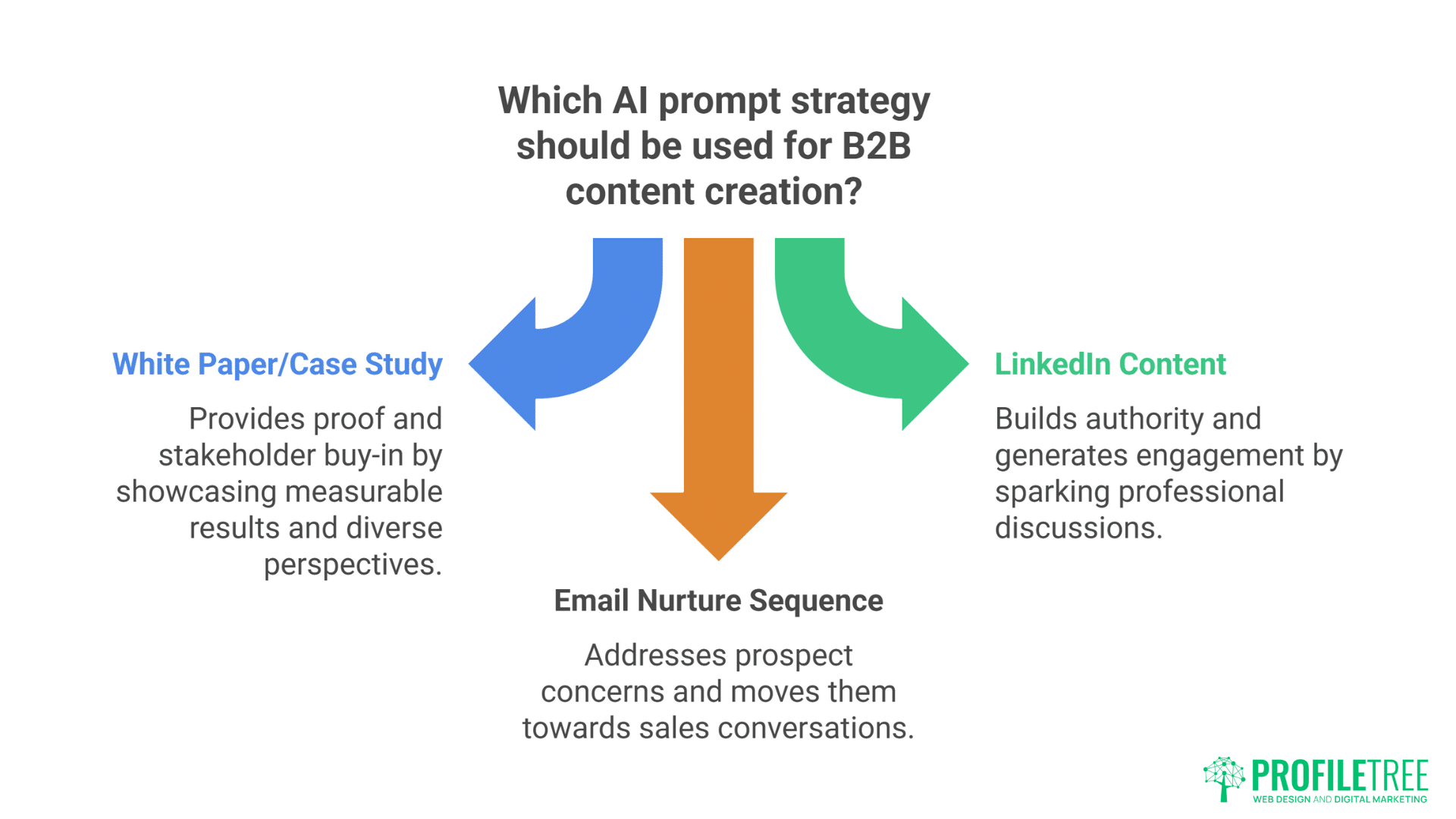
B2B AI prompts must demonstrate expertise whilst addressing the complex decision-making process inherent in business purchases. These prompts should guide AI toward creating content that builds trust, provides value, and addresses multiple stakeholder concerns simultaneously.
White Paper and Case Study Prompts for B2B
“Write a case study introduction for how [your service] helped a [industry] company achieve [specific outcome]. Begin with the business challenge, including quantifiable problems like [metric] reduction or [process] inefficiency. Structure the narrative to show the decision-making process, implementation timeline, and measurable results. Include quotes from different stakeholders (IT director, finance manager, operations head) to demonstrate cross-departmental impact.”
This structure addresses the B2B buyer’s need for proof and stakeholder buy-in. By including multiple perspectives, the content acknowledges the complex approval process typical in business purchases.
LinkedIn Content Prompts for B2B
“Create a LinkedIn post that positions us as thought leaders in [industry challenge]. Start with a controversial but true statement about current industry practices. Follow with three insights that demonstrate our expertise in solving this problem. End with a question that encourages C-level executives to share their experiences. Use professional language but maintain an approachable tone that invites discussion.”
B2B LinkedIn content succeeds when it sparks professional discussion whilst demonstrating expertise. This prompt creates content that builds authority and generates meaningful engagement from decision-makers.
Email Nurture Sequence Prompts for B2B
“Write email 3 of a 7-part nurture sequence for [target role] at [company size] companies considering [solution category]. This prospect has downloaded our [lead magnet] and visited our pricing page. Address their likely concern about [common objection] by providing a detailed explanation of [solution benefit]. Include a case study reference and offer to schedule a consultation to discuss their specific situation.”
B2B nurture sequences must acknowledge where prospects are in their research process and address evolving concerns. This prompt creates progressive value delivery whilst moving prospects toward sales conversations.
Industry-Specific Language Patterns and Tone Adjustments
The language patterns between e-commerce and B2B audiences differ substantially in vocabulary choice, sentence structure, and emotional register. E-commerce content benefits from vivid descriptors, personal pronouns, and action-oriented language. B2B content requires industry terminology, data integration, and solution-focused messaging.
E-commerce Language Patterns
E-commerce AI prompts should specify casual, enthusiastic language that mirrors how customers speak about products in personal conversations. Words like “love,” “amazing,” “perfect for,” and “must-have” resonate because they reflect genuine customer excitement. The tone should feel like a recommendation from a trusted friend who understands your needs.
Successful e-commerce prompts also incorporate sensory language that helps customers imagine product ownership. Descriptions of texture, appearance, sound, and functionality create mental ownership before purchase. This psychological technique significantly improves conversion rates across product categories.
B2B Language Patterns
B2B audiences respond to precise, professional language that demonstrates industry knowledge. Terms like “optimise,” “strategic advantage,” “competitive positioning,” and “operational efficiency” signal expertise and serious business focus. The tone should reflect competent professionalism without being overly formal or intimidating.
B2B prompts should also incorporate quantifiable language patterns. References to percentages, timeframes, cost savings, and performance improvements provide the concrete information business buyers need for justification and approval processes.
Conversion-Focused Prompt Engineering Techniques
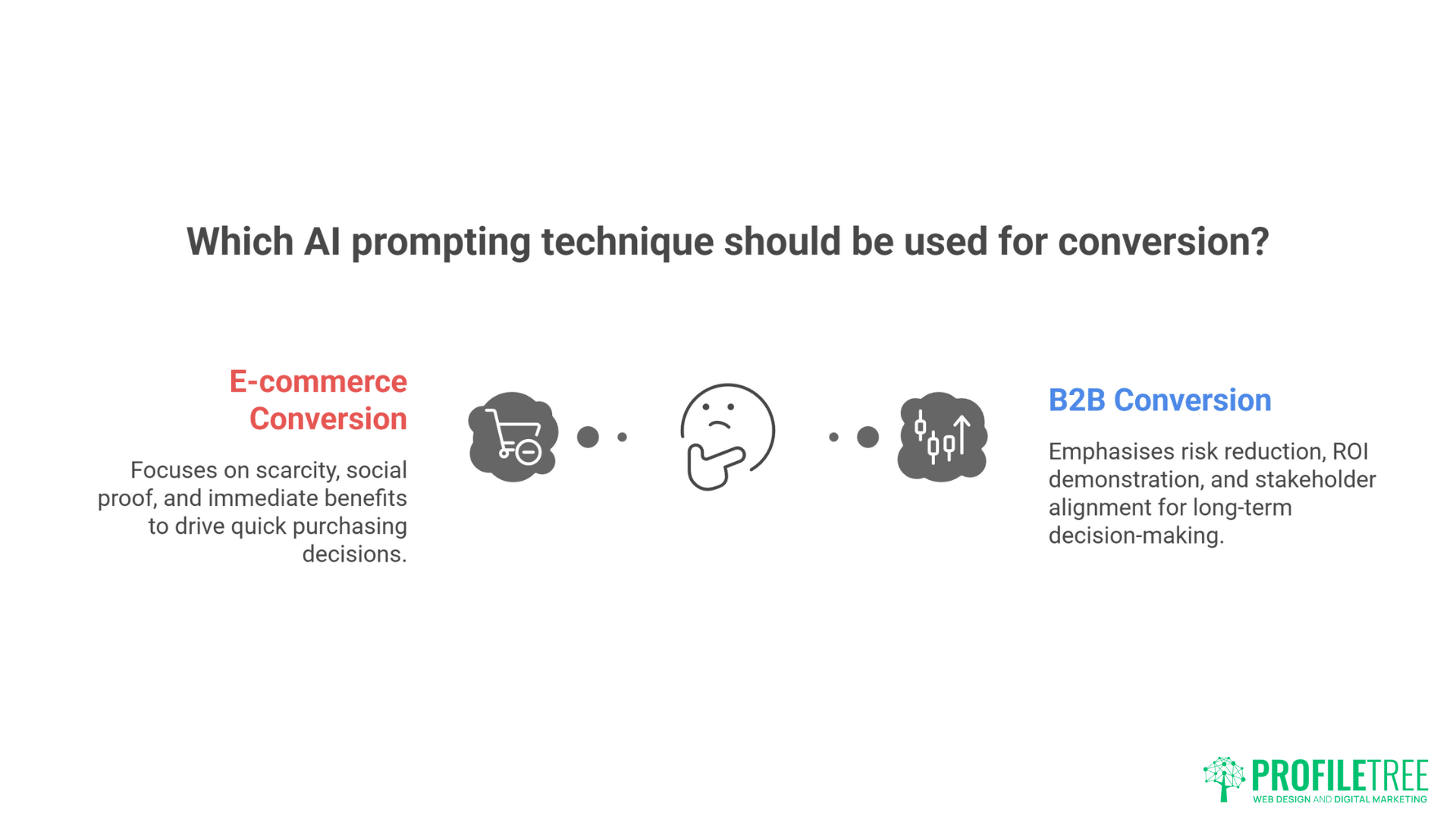
Effective AI prompting requires understanding how different audiences process information and make decisions. Conversion-focused techniques vary significantly between e-commerce and B2B applications, reflecting their different purchasing psychologies and decision-making timescales.
E-commerce Conversion Techniques
E-commerce prompts should incorporate scarcity, social proof, and immediate benefit messaging. The most effective approach combines multiple psychological triggers within natural, non-manipulative content. For example: “This bestselling [product] helps [target audience] achieve [desired outcome] in just [timeframe]. With only [quantity] remaining and [number] five-star reviews, it’s become the go-to choice for customers who want [specific benefit].”
This structure integrates scarcity (limited quantity), social proof (bestselling status and reviews), and immediate benefit (specific timeframe) whilst maintaining authentic product positioning.
B2B Conversion Techniques
B2B prompts should focus on risk reduction, ROI demonstration, and stakeholder alignment. The most effective approach addresses multiple decision-maker concerns whilst building confidence in the solution. For example: “Companies implementing [solution] typically see [specific metric improvement] within [timeframe], leading to [business outcome]. Our implementation process includes [risk mitigation elements] and ongoing support to ensure [success measurement]. Schedule a consultation to discuss how these results apply to your specific situation.”
This approach demonstrates proven results, acknowledges implementation concerns, and provides a clear next step without applying inappropriate pressure.
Seasonal and Campaign-Specific Prompt Variations
Both e-commerce and B2B marketing benefit from seasonal awareness and campaign alignment, but the approach differs significantly. E-commerce campaigns often focus on holidays, lifestyle events, and personal milestones, whilst B2B campaigns align with business cycles, industry events, and fiscal planning periods.
E-commerce Seasonal Prompting
“Create product recommendations for [target demographic] preparing for [seasonal event/lifestyle change]. Focus on how our [product category] enhances their [seasonal activity/goal]. Include gift-giving angles for recipients who [characteristic] and emphasise limited-time offers that end before [specific date]. Make the tone celebratory and helpful, positioning us as partners in making their [season/event] special.”
This seasonal approach connects products to emotional moments whilst creating appropriate urgency around natural deadlines.
B2B Seasonal Prompting
“Develop content targeting [target role] who are planning [business initiative] for [upcoming quarter/fiscal year]. Address how [solution category] supports [business objective] whilst considering [seasonal business constraint]. Include references to [industry event/deadline] and position our solution as essential preparation for [upcoming business challenge/opportunity].”
B2B seasonal content aligns with business planning cycles and industry-specific timing considerations rather than personal celebrations.
Regional Considerations for Northern Ireland and UK Businesses
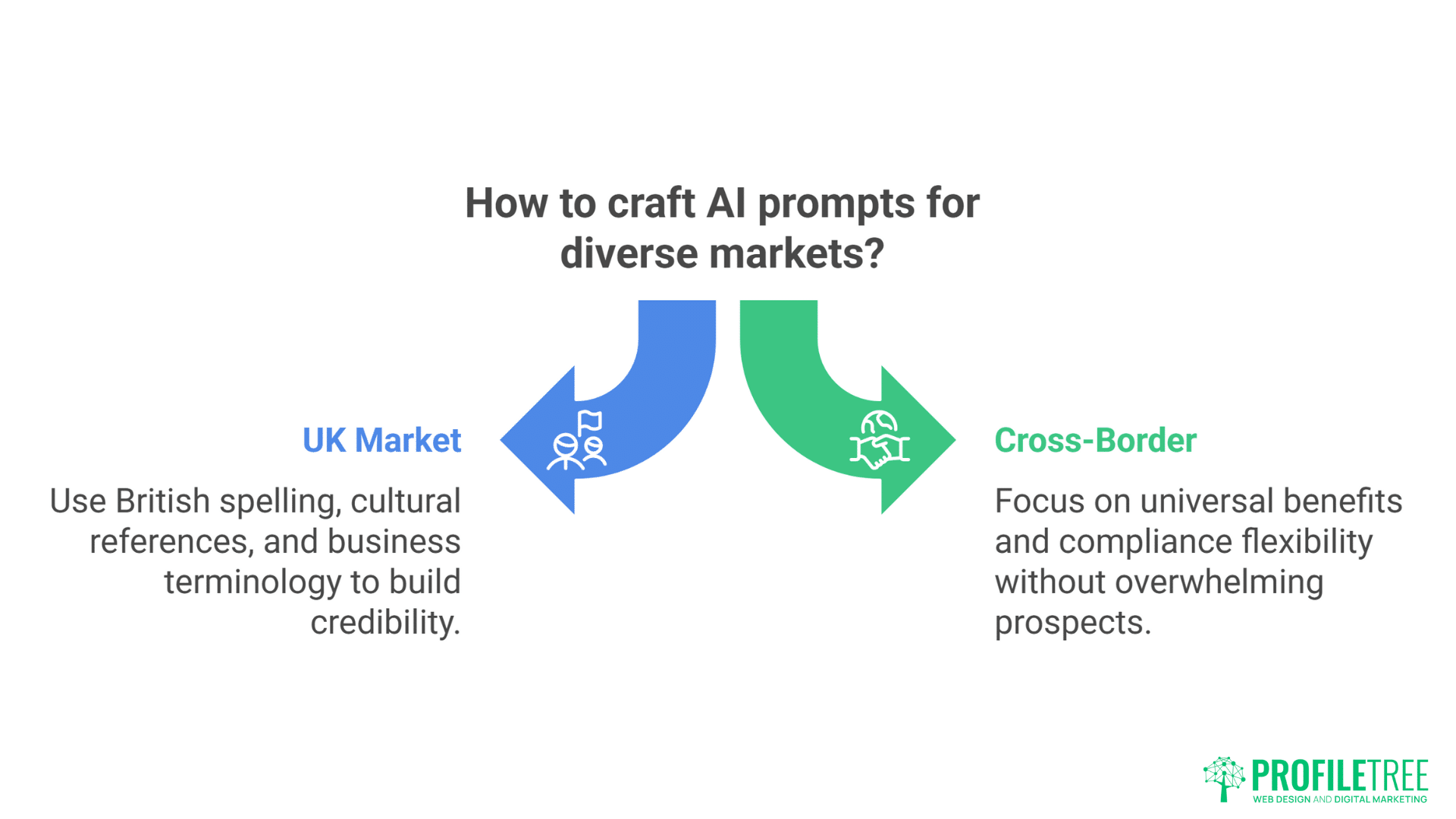
Belfast-based agencies serving diverse markets must consider regional language preferences, cultural references, and business practices when crafting AI prompts. Northern Ireland businesses often serve customers across Ireland, the UK, and international markets, requiring adaptable prompting strategies.
UK Market Considerations
UK-focused prompts should incorporate appropriate spelling (colour, optimise, realise), cultural references, and business terminology familiar to British audiences. References to HMRC compliance, VAT considerations, and UK-specific business practices demonstrate local expertise and build credibility.
For e-commerce targeting UK consumers, prompts should reference familiar retail experiences, delivery expectations, and customer service standards. British consumers often appreciate understatement over hyperbole, requiring more measured promotional language.
Cross-Border Considerations
Northern Ireland businesses serving both UK and Irish markets need prompts that work across jurisdictions. This requires avoiding overly specific regulatory references whilst maintaining local relevance. Focus on universal business benefits whilst acknowledging regional variations in business practices.
B2B prompts for cross-border audiences should emphasise compliance flexibility and regional expertise without overwhelming prospects with jurisdictional complexity.
Technical Implementation and AI Tool Selection
Different AI platforms excel at different content types and industry applications. Understanding which tools work best for e-commerce versus B2B content creation improves both efficiency and output quality.
E-commerce AI Tool Selection
E-commerce content creation benefits from AI tools that excel at creative, engaging copy with strong emotional appeal. Tools like ChatGPT and Claude work well for product descriptions, email marketing, and social media content when guided by detailed prompts that specify tone, audience, and desired emotional response.
Visual AI tools become particularly important for e-commerce, as product imagery and lifestyle photography significantly impact conversion rates. Prompts for image generation should specify lifestyle contexts, demographic representation, and emotional atmosphere alongside product features.
B2B AI Tool Selection
B2B content often requires more analytical and data-driven approaches. AI tools that excel at research synthesis, technical explanation, and logical argumentation work best. The same tools (ChatGPT, Claude) can be effective for B2B when prompted to emphasise analytical thinking, industry expertise, and solution-focused messaging.
B2B content also benefits from AI tools that can process industry reports, competitive analysis, and technical documentation to create informed content that demonstrates genuine expertise.
Measuring Success and Iterating Your Prompt Strategy
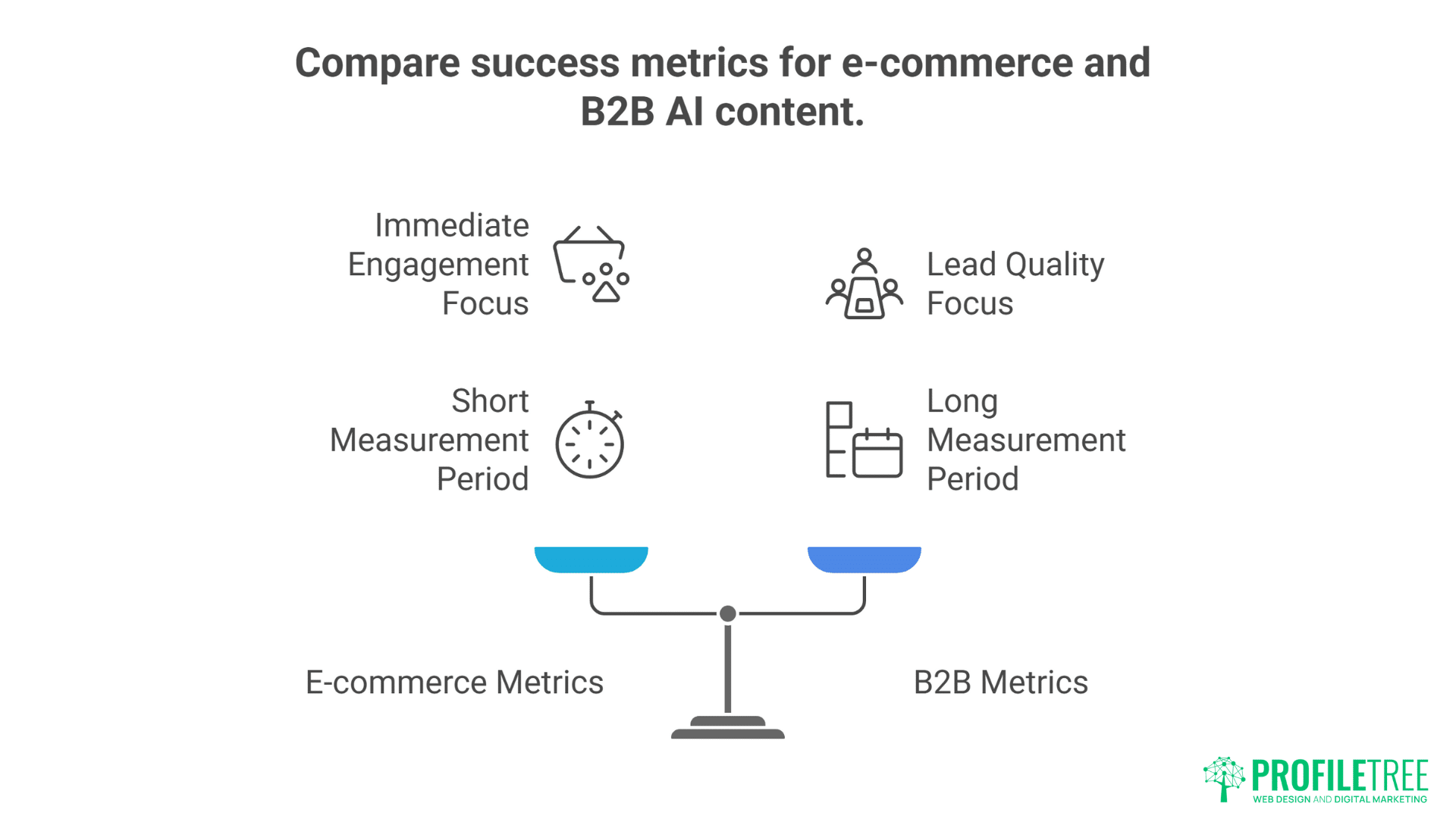
Success metrics differ significantly between e-commerce and B2B AI-generated content, requiring different measurement approaches and optimisation strategies.
E-commerce Success Metrics
E-commerce AI content success measures include click-through rates, conversion rates, average order value, and customer lifetime value. Content that generates immediate engagement and drives sales typically indicates effective prompting strategies.
A/B testing different prompt approaches helps identify which emotional triggers, language patterns, and call-to-action styles resonate best with your audience. Track performance across different product categories and customer segments to refine prompting strategies.
B2B Success Metrics
B2B AI content success focuses on lead quality, engagement depth, and sales cycle acceleration. Metrics include white paper downloads, consultation requests, proposal conversions, and deal closure rates. Content that generates qualified leads and meaningful sales conversations indicates effective B2B prompting.
B2B content often shows delayed impact, requiring longer measurement periods and multi-touch attribution analysis to understand true effectiveness.
Advanced Prompt Engineering for Complex Scenarios
Sophisticated marketing scenarios require advanced prompting techniques that go beyond basic content generation. These include multi-stakeholder messaging, complex product positioning, and integrated campaign development.
Multi-Stakeholder B2B Prompting
“Create messaging that addresses [primary decision maker] while acknowledging concerns from [secondary stakeholders]. The primary stakeholder cares about [main concern] whilst the [secondary role] focuses on [different concern]. Structure the content to show how [solution] addresses both perspectives whilst highlighting [shared benefit]. Include specific language that each stakeholder can use to justify the decision to their teams.”
This approach acknowledges B2B purchase complexity whilst creating content that supports the entire decision-making process.
Complex E-commerce Positioning
“Position [product] for customers choosing between [competitor A] and [competitor B]. Acknowledge the legitimate benefits of each alternative whilst highlighting our unique advantage of [differentiator]. Address price sensitivity by emphasising [value proposition] whilst avoiding direct price comparisons. Create urgency through [scarcity element] without appearing manipulative.”
This sophisticated approach creates differentiated positioning whilst respecting customer intelligence and competitive realities.
ProfileTree’s Approach to AI-Powered Marketing Strategy
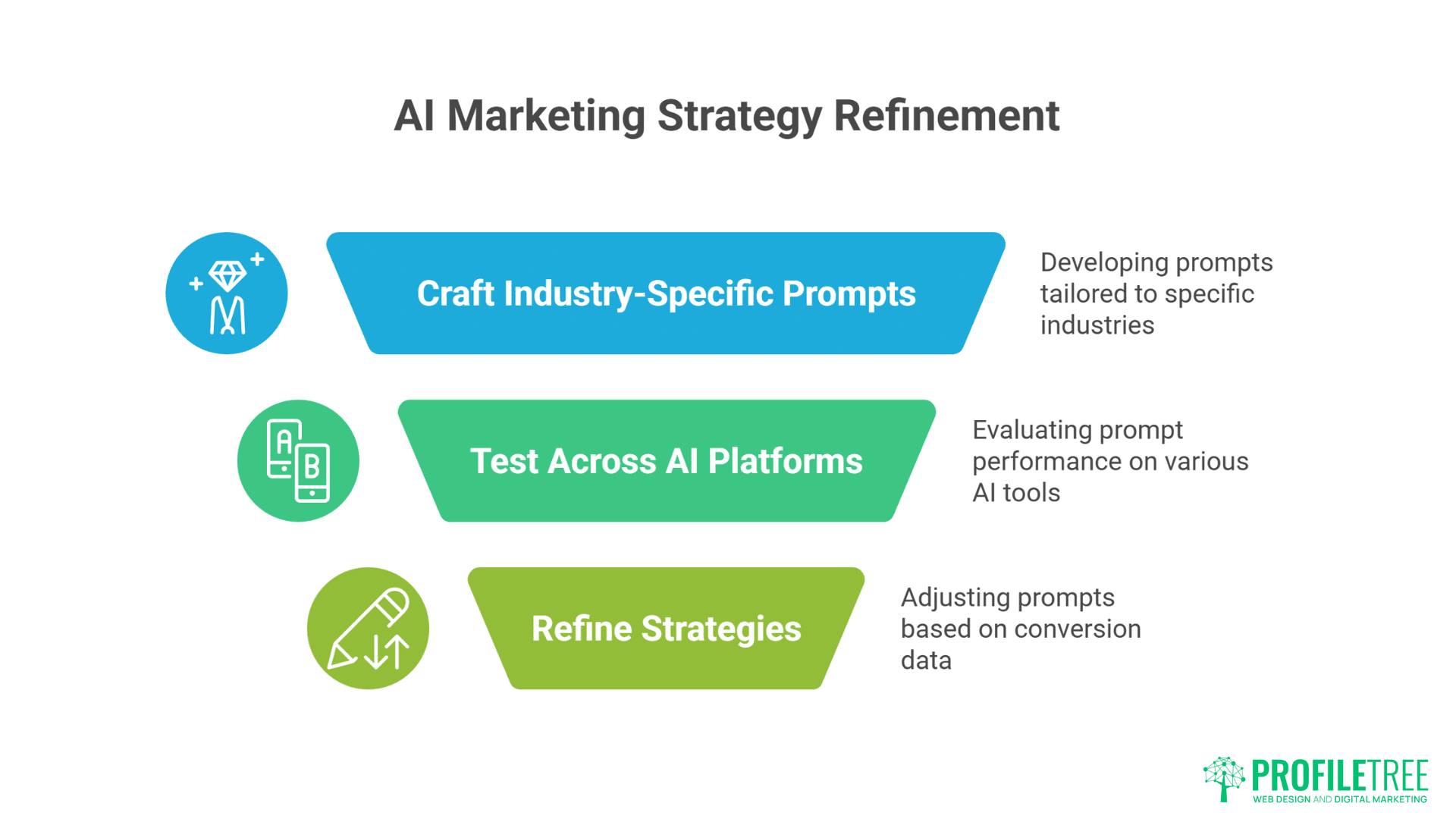
At ProfileTree, we’ve observed that businesses achieving the best results from AI marketing tools combine industry-specific prompting strategies with deep audience understanding. Our Belfast-based team works with both e-commerce retailers and B2B service providers across Northern Ireland, Ireland, and the UK, developing AI prompting frameworks that reflect each client’s unique market position.
The key insight we’ve discovered is that effective AI prompting requires the same strategic thinking as traditional marketing—understanding your audience, clarifying your value proposition, and communicating benefits in language that resonates. AI amplifies good marketing strategy; it doesn’t replace it.
As Ciaran Connolly, our Head of Digital Experience, explains: “AI tools are incredibly powerful, but they’re only as effective as the prompts that guide them. Businesses that take time to understand their audience psychology and craft industry-specific prompts consistently outperform those using generic approaches.”
Our approach involves developing prompt libraries tailored to specific client industries, testing performance across different AI platforms, and continuously refining strategies based on conversion data. This systematic approach ensures consistent, high-quality output that drives real business results.
Integration with Broader Digital Marketing Strategy
AI-generated content works best when integrated with comprehensive digital marketing strategies that include SEO optimisation, social media engagement, and conversion funnel analysis. Neither e-commerce nor B2B marketing succeeds through content alone—it requires strategic distribution and audience development.
E-commerce Integration
E-commerce AI content should support product discovery, customer education, and conversion optimisation. Integration with email marketing automation, social media scheduling, and customer service platforms creates cohesive customer experiences that drive both immediate sales and long-term loyalty.
Search engine optimisation remains crucial for e-commerce success. AI-generated product descriptions and blog content should incorporate relevant keywords whilst maintaining natural, customer-focused language that Google rewards.
B2B Integration
B2B AI content supports lead generation, nurture campaigns, and sales enablement processes. Integration with CRM systems, marketing automation platforms, and sales team workflows ensures consistent messaging across the entire customer journey.
B2B content marketing requires longer-term thinking and relationship building. AI-generated white papers, case studies, and thought leadership articles should position your organisation as a trusted advisor rather than just a service provider.
Future-Proofing Your AI Marketing Strategy
The artificial intelligence landscape continues evolving rapidly, with new tools, capabilities, and best practices emerging regularly. Building adaptable prompting strategies ensures continued effectiveness as AI technology advances.
Staying Current with AI Developments
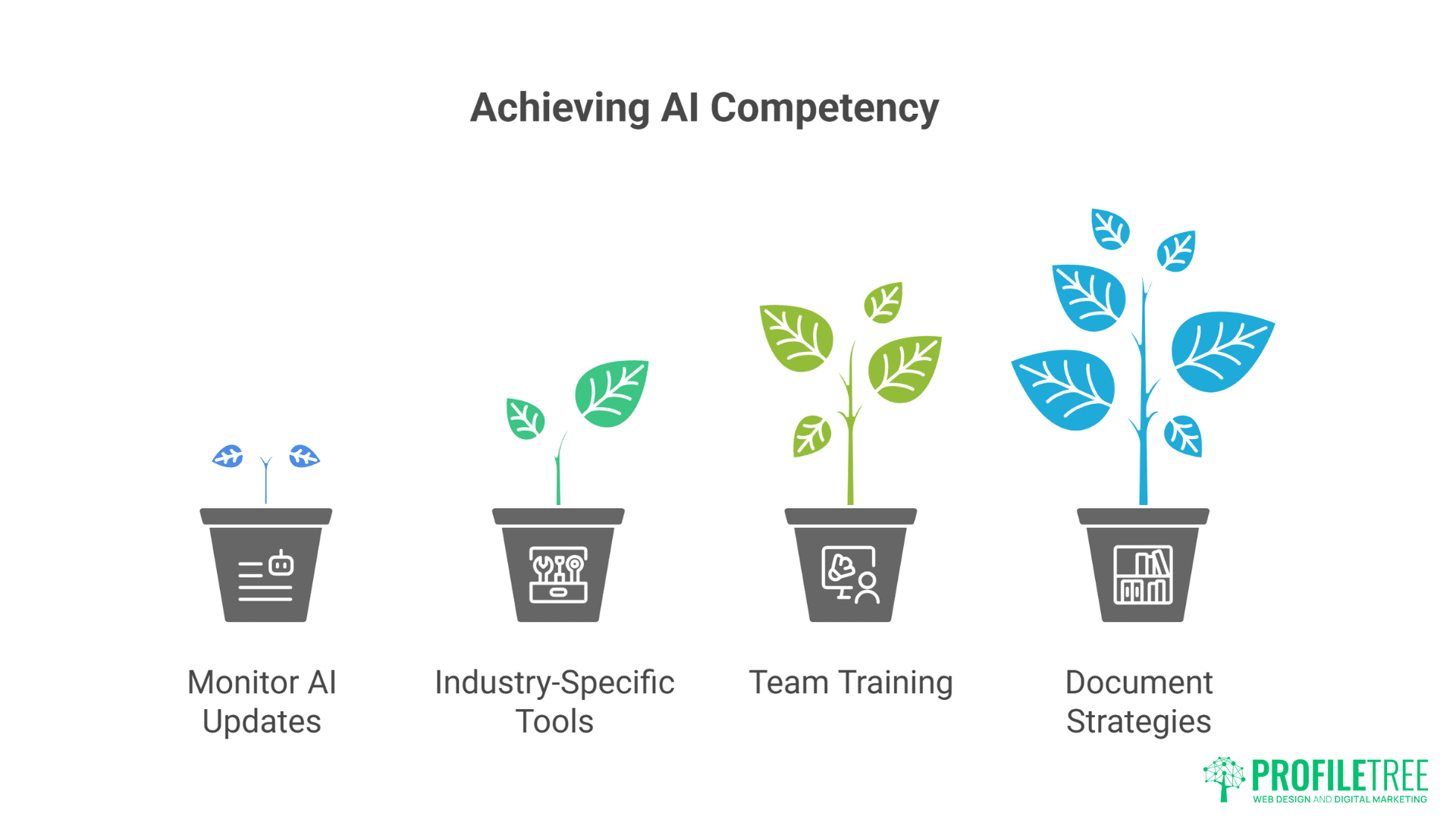
Monitor AI tool updates and new platform launches to understand evolving capabilities. Many AI platforms regularly improve their language models, context understanding, and output quality, requiring prompt strategy adjustments to maximise effectiveness.
Industry-specific AI tools are emerging rapidly, particularly for e-commerce applications like product photography, customer service automation, and personalisation engines. Stay informed about tools specifically designed for your industry vertical.
Building Organisational AI Competency
Successful AI implementation requires team training and systematic approach development. Invest in training programmes that help team members understand prompt engineering principles, industry-specific applications, and performance measurement techniques.
Create documentation and processes that capture effective prompting strategies, successful content examples, and performance insights. This organisational knowledge base becomes increasingly valuable as AI capabilities expand.
FAQs
What’s the most important difference between e-commerce and B2B AI prompts?
E-commerce prompts should focus on emotional triggers and immediate benefits that drive quick purchase decisions, whilst B2B prompts need to address rational evaluation processes and multiple stakeholder concerns. E-commerce content speaks to personal desires, whilst B2B content demonstrates business value and risk mitigation.
How do I know if my AI prompts are working effectively?
Track conversion metrics specific to your business model. E-commerce should monitor click-through rates, conversion rates, and average order value. B2B should focus on lead quality, engagement depth, and sales cycle length. A/B test different prompt approaches to identify what resonates with your audience.
Should I use different AI tools for e-commerce versus B2B content?
The same AI tools can work for both applications, but your prompting strategy should differ significantly. E-commerce prompts should emphasise creativity, emotional appeal, and urgency. B2B prompts should focus on analytical thinking, expertise demonstration, and solution-oriented messaging.
How often should I update my AI prompting strategy?
Review and refine your prompts monthly based on performance data. Major strategy updates should happen quarterly, incorporating new AI capabilities, market changes, and customer feedback. Seasonal adjustments are particularly important for e-commerce businesses.
What common mistakes should I avoid when using AI for marketing?
Avoid using identical prompts across different industries or customer segments. Don’t rely solely on generic AI output without industry-specific customisation. Never ignore the need for human oversight and brand consistency. Most importantly, don’t expect AI to replace strategic thinking—it amplifies good strategy but can’t create it.
Conclusion
The distinction between e-commerce and B2B AI prompting strategies reflects the fundamental differences in how these audiences think, research, and make purchase decisions. E-commerce customers respond to emotional connection, immediate benefits, and lifestyle integration, whilst B2B buyers require logical justification, risk mitigation, and stakeholder alignment.
Successful AI marketing implementation requires understanding these psychological differences and crafting prompts that guide artificial intelligence toward creating industry-appropriate content. This means developing different language patterns, conversion techniques, and measurement approaches for each market segment.
For Northern Ireland businesses serving diverse markets, mastering both approaches becomes crucial for competitive success. The companies that thrive in the AI-powered marketing landscape will be those that combine technological capability with deep audience understanding and strategic thinking.
The future belongs to businesses that use AI as a strategic tool rather than a content generation shortcut. By developing sophisticated, industry-specific prompting strategies, you position your organisation to create consistently effective marketing content that drives real business results across both e-commerce and B2B markets.
Whether you’re selling products to consumers or solutions to enterprises, the key is understanding your audience’s decision-making psychology and crafting AI prompts that produce content speaking directly to their specific needs, concerns, and motivations.