
How SMEs Can Invest in AI Training & Implementation: Complete Guide
Table of Contents
Small and medium enterprises implementing AI training and strategic adoption initiatives in 2026 position themselves to capture sustainable competitive advantages that will distinguish market leaders throughout the next decade. Government funding mechanisms covering up to 70% of implementation costs, combined with R&D tax credits reducing financial burden by 33% and documented ROI averaging 380% within twelve-month periods, create compelling investment cases where strategic execution matters more than timing hesitation.
The SME AI adoption environment has undergone a fundamental transformation, with comprehensive training and implementation programs now accessible for under £10,000 compared to £100,000+ enterprise requirements from just three years prior. Cloud-based AI services eliminate infrastructure investment barriers, while no-code platforms remove technical expertise requirements, supported by government initiatives specifically designed for smaller business participation.
How SMEs Can Invest in AI Training encompasses systematic approaches that maximise available resources while minimising implementation risks. Despite these favourable conditions, 67% of UK and Irish SMEs have not initiated AI exploration, creating substantial opportunity gaps for proactive organisations willing to invest strategically in workforce development and operational enhancement.
This comprehensive How SMEs Can Invest in AI Training framework provides actionable roadmaps covering budget calculation methodologies, grant application processes, training provider evaluation criteria, and ROI measurement systems. The scalable approach accommodates diverse organisational requirements, from five-person Belfast consultancies through 50-employee Manchester manufacturing operations.
Strategic AI investment requires understanding available funding mechanisms, realistic timeline expectations, and performance measurement frameworks that demonstrate tangible business value rather than technological implementation for its own sake.
Step 1: Assess Your SME’s AI Readiness and Investment Capacity
SME AI readiness assessment requires a comprehensive evaluation of current technological infrastructure, employee digital literacy levels, data quality standards, and existing workflow documentation that determines implementation feasibility and identifies potential barriers before investment commitments. Investment capacity analysis should examine available cash flow, grant eligibility criteria, projected ROI timelines, and internal resource allocation capabilities while establishing realistic budget parameters for training costs, system integration expenses, and ongoing operational adjustments necessary for successful AI adoption.
Digital Infrastructure Evaluation
Before investing in AI training, evaluate your existing digital foundation. Modern businesses typically have 60-70% of the required infrastructure. Cloud-based accounting software, CRM systems, and collaborative tools provide data sources and integration points for AI implementation.
Document your current technology stack comprehensively. List all software applications, data sources, and digital processes. Note integration capabilities and API availability. Identify data quality and accessibility. This inventory reveals both opportunities and gaps that training must address.
Assessment frameworks designed for SMEs take 2-3 hours to complete but save weeks of misdirected effort. Score your organisation across five dimensions: data readiness, technical infrastructure, process maturity, cultural openness, and resource availability. Scores indicate whether to pursue basic automation, advanced analytics, or transformative AI applications.
Belfast businesses using structured assessments identify 40% more AI opportunities than those proceeding without evaluation. Dublin SMEs completing readiness assessments reduce implementation time by 35% through better preparation. These improvements justify the minimal time investment required for the proper assessment.
Financial Capacity Analysis
Calculate available AI investment budget using the 3-5-10 rule: allocate 3% of annual revenue for initial training, 5% for pilot implementations, and up to 10% for full deployment if pilots prove successful. For a business with £500,000 annual revenue, this means £15,000 for training, £25,000 for pilots, and £50,000 for scaling—spread across 12-18 months.
Include hidden costs often overlooked in AI budgeting. Staff time for training participation costs £200-400 per employee daily. Integration work requires a 20-30% increase in software costs. Maintenance and updates need 15-20% of the initial investment annually. Change management support adds 10-15% to project costs.
Available funding dramatically reduces actual cash requirements. Government grants cover 40-70% of training costs, R&D tax credits return 33% of qualifying expenses, and productivity improvement schemes provide additional support. Factor these reductions into budget calculations to understand true investment needs.
Cash flow timing matters as much as total investment. Spread costs across quarters to maintain operational stability. Front-load training investments to build capability before major implementations. Reserve 20% contingency for unexpected opportunities or challenges. This phased approach reduces financial pressure while maintaining momentum.
Skills Gap Identification
Map current employee capabilities against AI implementation requirements. Technical skills matter less than expected—only 20% of AI success depends on technical knowledge. Business acumen, change management ability, and strategic thinking contribute 80%.
Create skills matrices for key roles. Identify who needs strategic AI awareness versus hands-on tool training. Determine which employees should become AI champions, leading the implementation. Recognise where external expertise supplements internal capabilities. This mapping ensures training investments target actual needs.
Common SME skills gaps include data analysis capabilities, process optimisation thinking, and change management expertise. Address these through targeted training rather than hiring new staff. Existing employees understand your business context, a valuable advantage when implementing AI solutions.
Consider succession planning in skills development. Train multiple employees in critical AI capabilities to avoid single points of failure. Create mentoring relationships between early adopters and followers. Document learned expertise for organisational knowledge retention. These practices ensure sustainable AI capabilities beyond initial implementation.
Step 2: Calculate Your AI Training and Implementation Budget
AI training and implementation budget calculation involves breaking down costs across three primary categories: initial training expenses typically ranging £2,000 to £8,000, depending on team size and complexity, technology integration costs averaging £1,500 to £5,000 for software subscriptions and setup, and ongoing operational expense,s including maintenance and additional training, that add 15-25% annually to initial investment. Accurate budgeting requires factoring in potential productivity disruption during implementation periods, contingency funds for unexpected technical challenges, and resource allocation for internal change management support that ensures successful adoption while maintaining business continuity throughout the transition process.
Direct Training Costs Breakdown
Professional AI training for SMEs ranges from £500 to £ 2,500 per person for comprehensive programmes. Executive awareness workshops cost £500-1,000 per participant. Hands-on implementation training runs £1,500-2,500 per person. Specialist technical training reaches £2,000-3,500 for advanced topics.
Group training delivers better value than individual enrollment. Five-person cohorts typically receive 20-30% discounts, and ten-person groups save 30-40%. In-house delivery for 15+ participants costs 50% less than public courses. These economies make comprehensive training affordable for smaller organisations.
Online training options further reduce costs. Self-paced courses cost £200-500 per person, virtual instructor-led training runs £400-800, and hybrid programmes combining online and in-person elements cost £600-1,200. Quality varies significantly, so evaluate carefully before committing.
Certification programmes command premium prices but deliver superior returns. Certified AI practitioners earn 25% more than non-certified peers, and businesses with certified staff win 35% more AI-related contracts. Certification costs of £1,500-3,000 per person typically return value within six months through improved capabilities and credibility.
Software and Technology Investments
AI software costs vary dramatically based on approach. Enterprise platforms cost £50,000+ annually—unnecessary for most SMEs. Mid-market solutions run £5,000-20,000 yearly. Small business tools cost £100-1,000 monthly. Many powerful AI capabilities come free or at low cost for smaller users.
Subscription models dominate AI software pricing. Budget £200-500 monthly for basic automation tools. Add £300-800 for analytics platforms. Include £400-1,000 for specialised industry applications. Total software costs typically run £1,000-2,500 monthly for comprehensive SME implementations.
Integration expenses often exceed software costs. Budget £2,000-5,000 for connecting AI tools to existing systems. Add £1,000-3,000 for data preparation and cleaning. Include £500-1,500 for workflow redesign. These one-time costs enable ongoing AI value delivery.
Hidden technology costs catch unprepared SMEs. Increased cloud storage adds £50-200 monthly. Enhanced security measures cost £100-300 monthly. Backup and recovery upgrades run £150-400 monthly. Premium support agreements add £200-500 monthly. Include these in comprehensive budgets.
Implementation and Support Costs
Consultant support during implementation typically costs £800-1,500 daily. Most SME projects require 10-20 consulting days spread across 3-6 months. This £8,000-30,000 investment accelerates implementation and reduces failure risk. However, quality training reduces consultant dependence by 50-70%.
Internal implementation costs often exceed external expenses. Allocate 20% of key employee time for 3-6 months during implementation. A £40,000 salary represents £4,000-8,000 in opportunity cost. Multiple employees are involved; multiply this figure. Factor these costs into ROI calculations.
Change management support prevents implementation failure. Budget £2,000-5,000 for communication programmes. Add £1,000-3,000 for adoption incentives. Include £500-1,500 for resistance management. These investments ensure AI delivers intended benefits rather than becoming expensive shelfware.
Post-implementation support maintains momentum. Annual maintenance runs 15-20% of initial investment. Continuous training costs £500-1,000 per person yearly. System optimisation requires £2,000-5,000 annually. These ongoing investments protect and expand initial AI returns.
Building Your Investment Timeline
Structure AI investments across four quarters for optimal cash flow management:
Quarter 1: Foundation (£5,000-10,000)
- Leadership awareness training
- Readiness assessment
- Initial tool selection
- Pilot project identification
Quarter 2: Capability Building (£8,000-15,000)
- Comprehensive staff training
- Software procurement
- Integration planning
- First implementation
Quarter 3: Expansion (£10,000-20,000)
- Additional implementations
- Advanced training
- System integration
- Process optimisation
Quarter 4: Optimisation (£5,000-10,000)
- Performance evaluation
- Scaling decisions
- Continuous improvement
- Next year planning
This phased approach spreads £28,000-55,000 total investment across 12 months, making AI affordable for most SMEs while maintaining business stability.
Step 3: Navigate Government Grants and Funding Opportunities
Government grant navigation requires systematic research across multiple funding streams, including Innovate UK Smart Grants covering up to 70% of AI project costs, regional development funds offering £5,000-£25,000 for SME technology adoption, and sector-specific programs targeting manufacturing, creative industries, or green technology initiatives. Successful grant applications demand detailed project planning, clear ROI projections, and alignment with specific funding criteria that emphasise job creation, productivity improvements, and innovation outcomes rather than generic technology adoption without measurable business benefits or economic impact demonstration.
UK Innovation Grants for AI Adoption
Innovate UK offers multiple funding streams specifically supporting SME AI adoption. The Smart Grant programme provides up to £2 million for game-changing innovations, though most SMEs receive £100,000-500,000. Application success rates average 15-20%, but well-prepared proposals achieve 40-50% success.
The Innovation Voucher scheme offers £5,000 for knowledge transfer from universities or research organisations. It is perfect for initial AI feasibility studies or expert consultation. Applications take 2-3 hours to complete, and decisions are made within 6-8 weeks. Success rates exceed 60% for qualifying businesses.
Regional growth funds provide additional support. The Northern Powerhouse Investment Fund offers loans and equity investments for technology adoption. The Midlands Engine Investment Fund supports digital transformation projects. The London Co-Investment Fund backs innovative technology implementations—research local opportunities matching your geography.
Sector-specific grants target particular industries. Manufacturing businesses access Made Smarter funding for digital technology adoption. Retail companies qualify for High Street Revival grants, including AI implementations. Agricultural businesses obtain Farming Investment Fund support for precision agriculture AI. Identify sector programmes through trade associations.
Irish Enterprise Support Programmes
Enterprise Ireland’s Digitalisation Grant provides up to €9,000 (£7,500) for digital technology adoption, including AI training and implementation. The grant covers 50% of eligible costs and has a straightforward application process. Over 2,000 SMEs have benefited, with 85% reporting positive ROI within 12 months.
The Agile Innovation Fund offers up to €300,000 (£250,000) for innovative projects, including AI implementations. Designed for rapid deployment, decisions are made within 4-6 weeks. The fund particularly supports projects demonstrating clear commercial potential and competitive advantage.
Local Enterprise Office Trading Online Vouchers include AI tool subscriptions and training. Vouchers worth up to €2,500 (£2,100) cover 50% of eligible costs. Simple application processes and high approval rates make these ideal for initial AI investments.
InterTradeIreland programmes support cross-border AI initiatives. Fusion grants place graduate researchers in SMEs for AI projects. Synergy supports collaborative AI research between businesses and institutions. These programmes provide expertise alongside funding, accelerating AI adoption.
R&D Tax Credits for AI Development
R&D tax credits return up to 33% of AI development costs for qualifying activities. Training staff in new AI technologies, developing custom AI solutions, and integrating AI into existing processes qualify. Many SMEs miss these valuable credits due to a lack of awareness.
Calculate potential credits using HMRC’s enhanced SME scheme. For every £100,000 spent on qualifying AI activities, you receive £33,000 in tax credits. Loss-making companies claim cash payments worth 14.5% of surrenderable losses. This transforms AI investment economics dramatically.
Documentation requirements seem daunting, but follow simple principles. Record project objectives linked to innovation and track time spent on qualifying activities. Maintain evidence of technical uncertainties overcome. Professional advisors charge 15-20% of recovered credits—worthwhile for maximising claims.
SMES overlook everyday qualifying AI activities, including customising off-the-shelf AI for specific needs, developing prompts and workflows for AI tools, creating training datasets for machine learning, integrating AI with legacy systems, and testing AI performance in business contexts.
Application Strategies for Maximum Success
Successful grant applications share common characteristics worth understanding: clear problem statements demonstrating genuine business need; specific, measurable outcomes with realistic timelines; strong evidence of management capability and commitment; detailed budgets showing value for money; and innovation elements differentiating from standard implementations.
Professional grant writers achieve 60-70% success rates versus 10-15% for self-written applications. They charge £2,000-5,000 per application or 5-10% of the grant value. For grants above £50,000, professional support typically returns 5-10 times its cost through improved success rates.
Time applications strategically for maximum success. Avoid end-of-financial-year rushes when competition intensifies. Submit early in funding rounds when budgets remain available. Allow 3-6 months from application to funding receipt in project planning. Build relationships with funding bodies before applying.
Common application mistakes that guarantee rejection: requesting amounts misaligned with project scope, claiming activities already completed, lacking innovation elements, providing insufficient detail on implementation plans, and failing to demonstrate clear commercial benefits.
Step 4: Select the Right AI Training Provider
Selecting the right AI training provider requires evaluating organisations based on proven SME experience, industry-specific expertise, and measurable outcomes rather than impressive marketing materials or generic corporate credentials that don’t translate to small business contexts. Key evaluation criteria include assessment of their curriculum relevance to your sector, availability of post-training support and mentorship, transparent pricing structures without hidden costs, and documented success stories from similar-sized businesses that demonstrate productivity improvements and ROI achievement rather than vague testimonials about satisfaction or engagement levels.
Evaluating Training Provider Expertise
SME-focused AI training differs fundamentally from enterprise programmes or academic courses. Evaluate providers based on SME-specific criteria: practical implementation focus, realistic resource assumptions, and proven SME outcomes. Providers lacking dedicated SME programmes rarely deliver appropriate value.
Industry specialisation matters more than general AI expertise. Manufacturing SMEs benefit from providers’ understanding of production environments. Service businesses need trainers familiar with customer experience applications. Retail companies require commerce-specific knowledge. Verify relevant sector experience through case studies and references.
Delivery capability assessment goes beyond marketing claims. How many SMEs have they trained? What percentage achieved successful implementations? Can they provide references from similar businesses? Do they offer ongoing support post-training? Answers reveal genuine capability versus promotional rhetoric.
Geographic considerations affect training effectiveness. Local providers understand regional business contexts, grant opportunities, and support networks. They facilitate peer connections and ongoing collaboration. However, specialist expertise may justify remote providers for specific needs. Balance local presence with subject expertise.
Training Methodology and Format Options
Practical SME training combines multiple delivery methods to address different learning needs. Pure online courses lack interaction and accountability, and classroom training lacks implementation support. Optimal programmes blend formats throughout the learning journey.
Cohort-based training delivers superior results for SMEs. Learning alongside peers facing similar challenges creates support networks lasting beyond formal training. Shared experiences accelerate problem-solving. Group dynamics maintain momentum when individual motivation flags.
Practical application during training distinguishes effective programmes. Using your own business data and processes ensures relevance. Implementing actual solutions during training proves that concepts work. Immediate value delivery justifies time away from operations. Look for programmes guaranteeing implementation during training.
Support structures determine long-term success. Post-training mentoring helps navigate implementation challenges. Alumni communities provide ongoing peer support. Regular check-ins maintain accountability. Resource libraries offer continued learning. Evaluate support offerings when selecting providers.
Cost-Value Analysis Framework
Training costs mean nothing without a value context. Calculate value using multiple metrics: time saved through efficiency gains, revenue increased through new capabilities, costs reduced through automation, and competitive advantages gained. Quality training returns 5-10 times the investment within 12 months.
Compare total programme costs, not just headline prices. Include travel and accommodation for in-person elements. Factor in employee time at hourly rates. Add technology or software requirements. Consider ongoing support costs. Total cost reveals actual investment requirements.
Payment structures affect cash flow and risk. Pay-per-module spreads costs but increases total expense. Upfront payment secures discounts but concentrates risk. Success-based pricing aligns provider incentives but may limit support. Evaluate options against your financial situation.
Hidden value often exceeds visible benefits. Network connections made during training generate future opportunities. Increased employee confidence improves retention. Enhanced reputation attracts better talent. Innovation culture develops beyond AI implementation. Consider these intangibles when evaluating investments.
The ProfileTree Difference
At ProfileTree, we’ve designed our AI training specifically for SME success. Our programmes recognise that smaller businesses can’t spare staff for weeks of training or afford enterprise-level investments. We deliver practical, immediately applicable knowledge that transforms operations without disrupting them.
Our unique approach combines intensive workshops with ongoing implementation support. Participants work on real business challenges from day one, implementing solutions during training rather than hoping to apply concepts later. This practical focus ensures every business leaves with working AI implementations, not just theoretical knowledge.
We intimately understand the SME landscape across Ireland and the UK. Our Belfast base gives us deep insight into regional challenges and opportunities. We help participants navigate local grant programmes, connect with peer businesses, and access support networks. This local knowledge, combined with international best practices, delivers unmatched value.
Ciaran Connolly, ProfileTree founder, notes: “Most AI training fails SMEs because it’s designed for companies with dedicated IT departments and unlimited budgets. We’ve built our programmes from the ground up for smaller businesses. Every exercise uses real SME scenarios. Every tool recommendation considers SME budgets. Every implementation approach respects SME resource constraints. This focus on practical reality rather than theoretical possibility is why our participants achieve 85% successful implementation rates compared to industry averages of 30%.”
Our integrated expertise across AI, digital marketing, web development, and business strategy means AI training connects to broader business growth. We show how AI amplifies existing marketing efforts, enhances website performance, and accelerates business development. This holistic approach multiplies AI investment returns.
Step 5: Create Your Implementation Roadmap
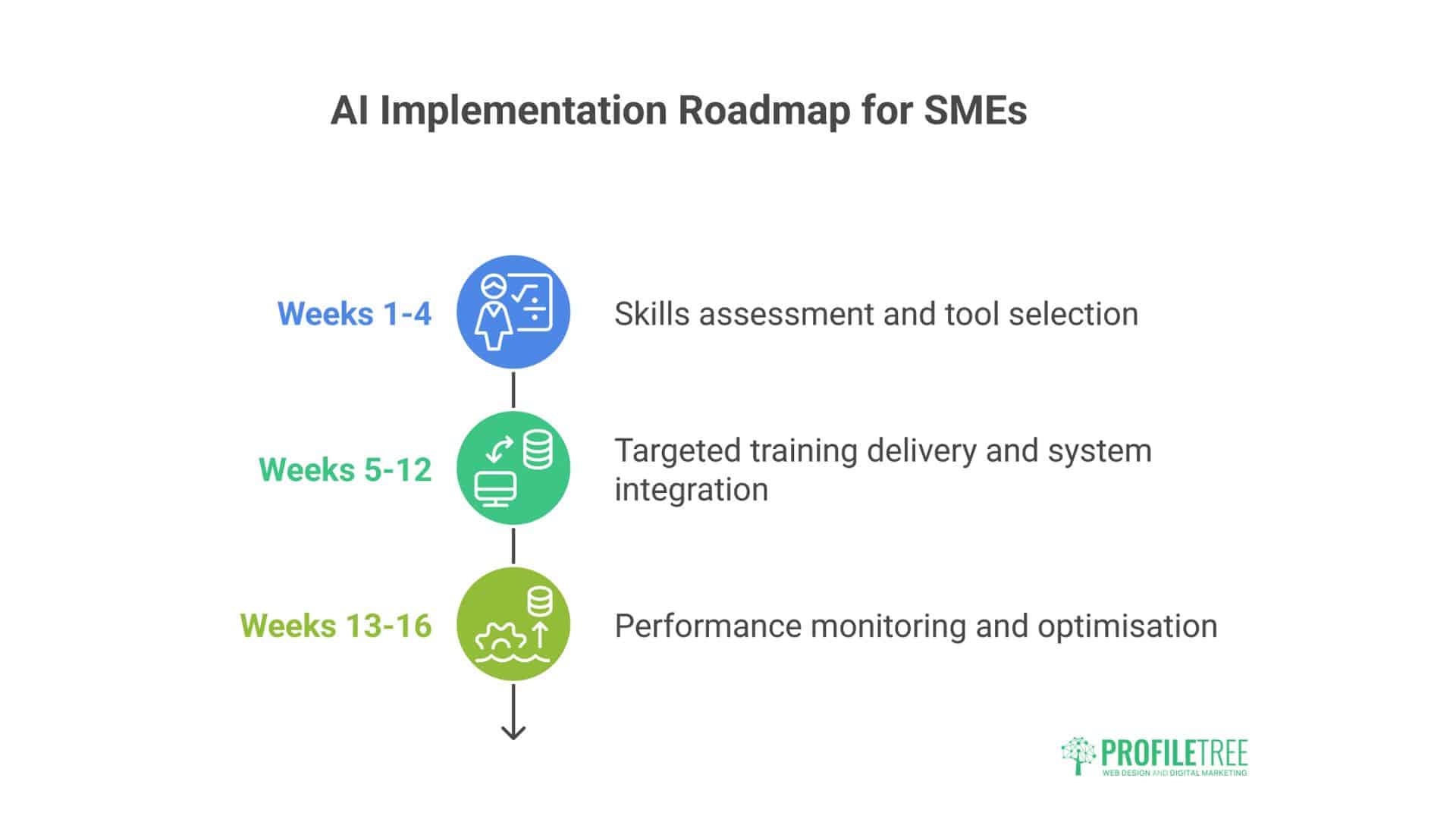
Implementation roadmap creation requires establishing clear phases with specific milestones, realistic timelines, and measurable outcomes that progress systematically from pilot testing through full organizational deployment while maintaining business operations continuity. Effective roadmaps typically span 12-16 weeks beginning with skills assessment and tool selection, progressing through targeted training delivery and gradual system integration, then advancing to performance monitoring and optimization phases that ensure sustained adoption and measurable business value rather than abandoning initiatives after initial enthusiasm wanes.
Phase 1: Quick Wins (Weeks 1-4)
Start with high-impact, low-complexity implementations that demonstrate AI value immediately. Email categorisation and response automation save 2-3 hours daily. Meeting transcription and summarisation recover 5-7 hours weekly. Basic chatbots handle 40-60% of routine enquiries. These quick wins build confidence and momentum.
Select initial applications based on clear criteria: minimal integration requirements, immediate time savings, low failure risk, and measurable impact. Avoid complex projects requiring significant change management or technical integration. Success breeds success—early wins generate enthusiasm for broader adoption.
Document everything during quick win implementations. Record time invested versus saved. Track cost reductions achieved. Measure quality improvements delivered. Capture employee feedback and suggestions. This documentation supports business cases for expanded implementation.
Common quick win opportunities by sector:
- Retail: Product description generation, review response automation
- Professional Services: Document analysis, report generation
- Manufacturing: Quality inspection reports, maintenance scheduling
- Healthcare: Appointment reminders, patient FAQ responses
- Construction: Safety report generation, project documentation
Phase 2: Process Transformation (Weeks 5-12)
Move beyond point solutions to transform entire business processes. Customer onboarding automation reduces processing time by 70%. Integrated forecasting and ordering prevent stockouts while lowering inventory costs. End-to-end invoice processing eliminates manual data entry.
Process selection requires strategic thinking. Map current workflows, identifying inefficiencies and bottlenecks. Calculate potential improvements from AI implementation—Prioritise based on business impact and implementation feasibility. Focus on processes affecting customer experience or operational efficiency.
Change management becomes critical during process transformation. Involve affected employees from the planning stages. Communicate benefits clearly and repeatedly. Provide comprehensive training and support. Celebrate successes publicly. Address resistance promptly and empathetically.
Integration challenges emerge during process transformation. Legacy systems may resist connection, data formats might require conversion, and workflows need redesign for automation. Budget 30-40% more time than initial estimates for integration work. Patience during this phase pays dividends through sustainable implementations.
Phase 3: Competitive Differentiation (Weeks 13-24)
Develop unique AI applications that distinguish your business from competitors. Custom recommendation engines that understand local preferences. Predictive maintenance systems prevent issues that competitors still experience. Personalisation capabilities that delight customers. These differentiators justify premium pricing and increase market share.
Innovation requires moving beyond vendor-provided solutions. Combine multiple AI tools in unique ways. Develop proprietary datasets that improve predictions. Create custom workflows addressing specific market needs. Train models on your unique business knowledge. This customisation creates competitive moats.
Measure differentiation impact through multiple metrics—track win rates against competitors before and after AI implementation. Monitor pricing power and margin improvements. Assess customer satisfaction and retention gains. Document market share changes. These metrics justify continued AI investment.
Protect competitive advantages through appropriate means. Consider trade secret protection for proprietary implementations. Document innovations for potential patent applications. Maintain confidentiality about specific AI applications. Build switching costs through customer-specific customisations. These protections extend competitive advantages.
Phase 4: Scaling and Optimisation (Months 7-12)
Scale successful implementations across all applicable areas. Automation working in one department extends to others. Prediction models proven in one product line expand to the full catalogue. Customer service AI handling email adapts to chat and phone. This scaling multiplies initial investment returns.
Optimisation improves existing implementations based on accumulated data and experience. Refine AI model parameters for better predictions. Adjust automation workflows for efficiency gains. Enhance integration points for smoother operation. Update training data for accuracy improvements. Continuous optimisation maintains competitive advantages.
Build internal capabilities for sustainable growth. Develop a centre of excellence managing AI initiatives. Create documentation enabling knowledge transfer. Establish governance frameworks ensuring responsible AI use. Build vendor relationships supporting long-term development. These foundations enable continued AI advancement.
Prepare for next-generation opportunities. Monitor emerging AI capabilities relevant to your business. Experiment with advanced applications in controlled environments. Build partnerships with technology providers and research institutions. Allocate resources for continued innovation. Forward thinking ensures sustained competitive advantages.
Step 6: Measure ROI and Scale Success
Measuring AI ROI requires tracking specific business metrics including productivity improvements, cost reductions, revenue increases, and time savings that directly correlate with AI implementation rather than focusing on usage statistics or satisfaction scores that don’t demonstrate financial value. Scaling success involves systematically expanding AI applications to additional departments and processes based on proven results, while establishing performance benchmarks and feedback loops that identify the most effective implementations for replication across your organization and inform future AI investment decisions.
Establishing Baseline Metrics
Accurate ROI measurement requires establishing a clear baseline before AI implementation. Document current performance across key metrics: processing time per transaction, error rates and correction costs, customer satisfaction scores, employee productivity measures, and operational cost structures. Without baselines, improvement claims lack credibility.
Measurement systems must capture both direct and indirect benefits. Direct benefits include time saved, reduced costs, and increased revenue. Indirect benefits encompass employee satisfaction, customer retention, and competitive positioning. Comprehensive measurement reveals total AI value.
Create measurement dashboards accessible to all stakeholders. Visual representations communicate impact better than spreadsheets. Real-time updates maintain engagement and momentum. Comparative displays show progress against targets. Accessible dashboards democratise AI success information.
Standard baseline metrics by function:
- Sales: Lead conversion rate, sales cycle length, average deal size
- Marketing: Cost per acquisition, content production time, campaign ROI
- Operations: Process cycle time, error rates, resource utilisation
- Customer Service: Response time, resolution rate, satisfaction scores
- Finance: Invoice processing time, payment cycles, reporting speed
Calculating Financial Returns
ROI calculations for AI investments follow standard formulas with AI-specific considerations. Total returns include efficiency gains, cost reductions, revenue increases, and cost avoidance. Total investments encompass training, software, implementation, and ongoing support. ROI = (Returns – Investment) / Investment × 100.
Time value considerations affect AI ROI calculations. Benefits compound over time as AI systems learn and improve. Implementation costs concentrate in early periods, while maintenance costs spread across the usage lifetime. For an accurate assessment, calculate ROI over 3-5 year periods.
Risk adjustment improves ROI calculation accuracy. Not all expected benefits materialise fully, implementation might take longer than planned, and adoption rates may lag expectations. For conservative calculations, apply 70-80% achievement factors to projected benefits.
Example ROI calculation for a typical SME:
- Investment: £30,000 (training, software, implementation)
- Year 1 Returns: £45,000 (efficiency gains, cost savings)
- Year 2 Returns: £60,000 (scaled implementations)
- Year 3 Returns: £75,000 (optimised operations)
- Three-year ROI: 400% (£180,000 returns on £30,000 investment)
Tracking Operational Improvements
Operational metrics often provide clearer AI success indicators than financial measures. Processing speed improvements show immediate impact. Error rate reductions demonstrate quality gains. Capacity increases reveal scalability benefits. These operational improvements translate to financial returns over time.
Employee productivity metrics require careful interpretation. AI should augment rather than simply accelerate human work. Measure value creation, not just volume increases—track skill development alongside efficiency gains. Consider work satisfaction with productivity metrics.
Customer experience improvements justify AI investments independent of cost savings. Faster response times increase satisfaction. Personalised interactions improve engagement. Proactive service prevents problems. 24/7 availability meets modern expectations. These improvements drive long-term business growth.
Quality metrics reveal AI’s consistency advantages. Reduced variation in outputs improves customer experience. Fewer errors decrease rework costs. Compliance improvements minimise risk exposure. Standardisation enables scaling. Quality improvements compound over time.
Scaling Successful Implementations
Scaling decisions require evidence-based evaluation. Pilot projects achieving 150%+ ROI merit immediate expansion. Implementations showing 50-150% returns need optimisation before scaling. Projects below 50% returns require fundamental reconsideration. Clear criteria prevent emotional scaling decisions.
Horizontal scaling extends successful applications across departments or locations. Vertical scaling deepens AI use within specific functions. Diagonal scaling adapts solutions for related but different applications. Each scaling direction offers different risk-return profiles.
Resource allocation for scaling follows portfolio management principles: Invest most heavily in proven applications, maintain moderate investment in promising experiments, and limit resources for struggling implementations. Regular rebalancing optimises overall returns.
Scaling timelines balance urgency with sustainability. Rapid scaling captures competitive advantages but risks overwhelming organisations. Gradual scaling ensures stability but may sacrifice first-mover benefits. Optimal pacing achieves 20-30% capability expansion quarterly.
Step 7: Build Long-term AI Capabilities
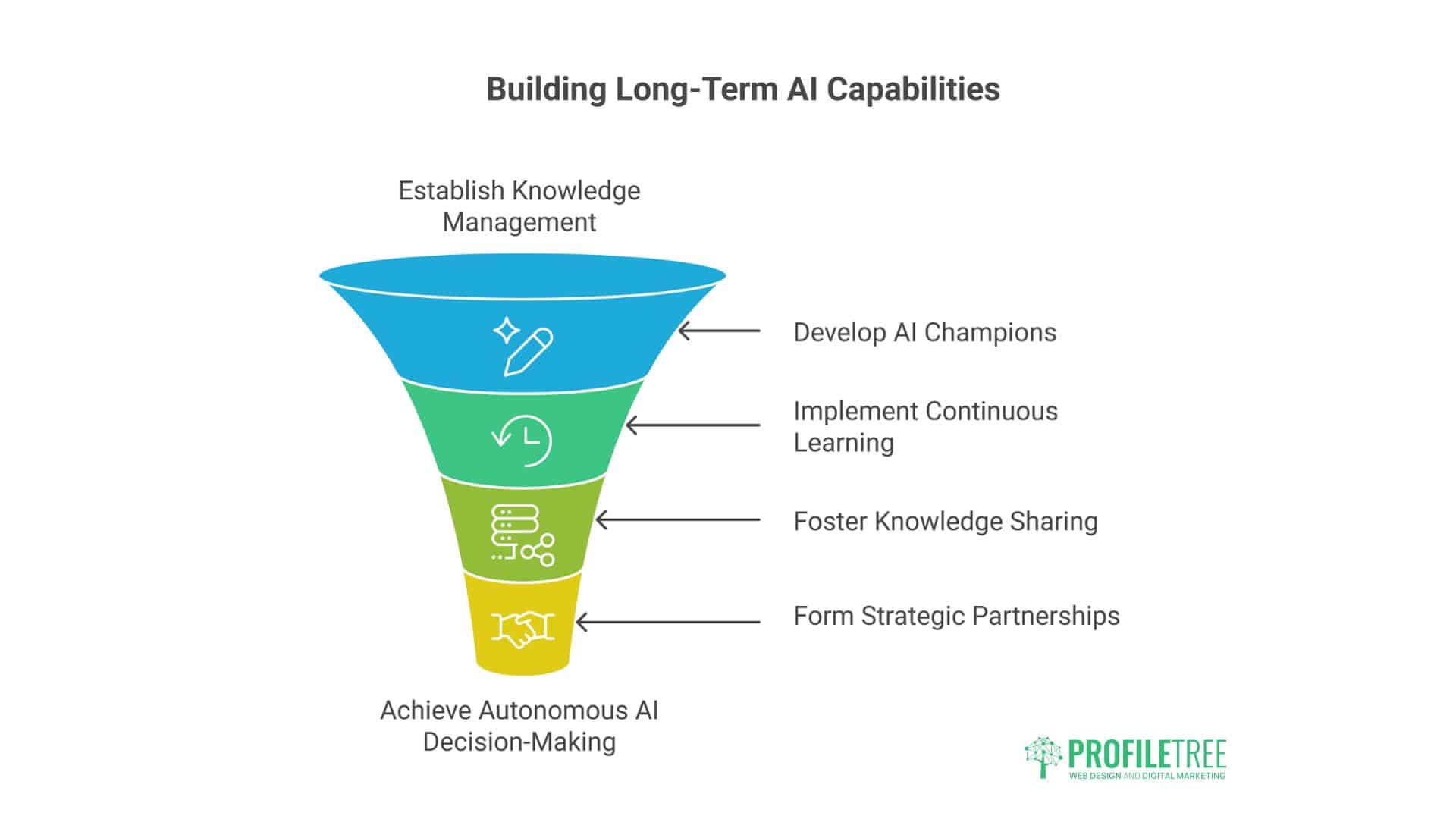
Building long-term AI capabilities requires establishing systematic knowledge management processes, internal AI champions who can train colleagues and identify new opportunities, and continuous learning frameworks that adapt to rapidly evolving AI technologies and business applications. Sustainable capability development involves creating documentation libraries, regular skill assessments, cross-departmental knowledge sharing initiatives, and strategic partnerships with AI providers that ensure your organization maintains competitive advantages while building internal expertise that reduces dependence on external consultants and supports autonomous AI decision-making and implementation.
Developing Internal AI Champions
Every successful SME AI transformation requires internal champions driving adoption and innovation. Identify employees combining technical aptitude, business acumen, and influence skills. These champions bridge the gap between AI potential and practical implementation.
Champion development requires structured investment. Provide advanced training beyond basic programmes—fund conference attendance and certification. Allocate time for experimentation and learning. Support community participation and knowledge sharing. Champions return 10-20 times the investment through successful implementations.
Create formal champion roles with clear responsibilities. Define expectations for knowledge sharing and mentoring. Establish metrics for adoption support and innovation. Provide resources and authority for implementation decisions. Recognition and rewards maintain champion engagement.
Build champion networks across the organisation. Multiple champions prevent single points of failure. Diverse perspectives improve solution development. Peer support sustains motivation during challenges. Network effects accelerate AI adoption.
Creating Innovation Frameworks
Sustainable AI advancement requires structured innovation processes. Establish regular AI opportunity identification sessions. Create evaluation frameworks for assessing ideas. Develop rapid prototyping capabilities. Build testing environments for safe experimentation. These frameworks ensure continuous improvement beyond initial implementations.
Innovation budgets separate from operational AI investments enable experimentation. Allocate 10-15% of the AI budget for exploratory projects. Accept 60-70% failure rates for true innovation. Learn from failures to improve future attempts. Protected innovation funding prevents stagnation.
Partnership strategies accelerate innovation without overwhelming internal resources. University collaborations have access to cutting-edge research. Vendor partnerships provide early access to new capabilities. Peer company exchanges share practical experiences. Strategic partnerships multiply innovation capacity.
Intellectual property strategies protect innovation investments—document novel AI applications for potential protection. Consider trade secrets for competitive advantages. Build data assets that improve AI performance. Create switching costs through customisation. IP strategy ensures innovation returns.
Maintaining Competitive Edge
Competitive advantages from AI erode without continuous advancement. Competitors copy successful applications. Vendors democratise advanced capabilities. Customer expectations escalate continuously. Maintaining leadership requires persistent innovation and improvement.
Technology monitoring identifies emerging opportunities and threats—track AI developments in your industry. Monitor competitor implementations through public information. Attend conferences and webinars showcasing innovations. Subscribe to relevant research publications. Early awareness enables proactive positioning.
Capability refresh prevents technical debt accumulation. Update AI models with new data regularly. Upgrade tools as better versions emerge. Refine processes based on operational experience. Retrain staff on advanced techniques. Regular refresh maintains performance advantages.
Strategic patience balances innovation with stability. Not every new AI capability deserves immediate adoption. Evaluate emerging technologies against business needs. Wait for proven applications rather than experimenting with everything. Strategic patience prevents costly distractions while maintaining advancement.
Your 2026 AI Investment Action Plan
The window for SME AI advantage remains open but is closing rapidly. Businesses investing in AI training and implementation during 2026 will establish competitive positions that become increasingly difficult for followers to challenge. Government support currently available may not continue indefinitely. Technology costs continue declining, but competitive advantages diminish as adoption spreads.
Start immediately with these specific actions:
Week 1: Assessment and Planning
- Complete digital readiness assessment
- Calculate the available investment budget
- Identify potential grant opportunities
- Map initial implementation opportunities
Week 2: Funding Applications
- Submit an Innovation Voucher application
- Begin R&D tax credit documentation
- Research sector-specific grants
- Contact Enterprise Ireland/Innovate UK
Week 3: Provider Selection
- Evaluate 3-5 training providers
- Request references from similar businesses
- Compare programme structures and costs
- Schedule a consultation with ProfileTree
Week 4: Programme Launch
- Finalise training provider selection
- Enrol key team members
- Communicate AI plans internally
- Begin baseline metric documentation
This 30-day sprint positions your business for successful AI adoption while competitors continue deliberating. Early action captures maximum grant funding, secures quality training spots, and establishes first-mover advantages in your market.
Conclusion: How SMEs Can Invest in AI Training
The mathematics of SME AI investment in 2026 are compelling: government grants covering the majority of costs, proven returns averaging 380% within 12 months, and competitive advantages that compound over time. Yet the window for maximum advantage closes as more businesses recognise these opportunities. Every month of delay represents lost efficiency, missed opportunities, and growing competitive gaps.
Successful AI adoption for SMEs requires neither massive budgets nor technical expertise. It demands commitment to structured learning, willingness to change established processes, and patience during implementation challenges. With proper training and support, any motivated SME can deploy AI successfully.
The businesses thriving in 2030 will trace their success to AI investments made in 2026. They’ll operate with efficiency levels competitors can’t match. They’ll deliver customer experiences that seem magical. They’ll make decisions based on insights others can’t access. Most importantly, they’ll continue advancing while laggards struggle to catch up.
ProfileTree is ready to guide your AI journey with training programmes for SME success. Our proven methodology, deep local knowledge, and comprehensive support ensure you achieve promised returns rather than expensive disappointments. We’ve helped hundreds of businesses across Ireland and the UK implement AI successfully—your business can be next.
Don’t let another quarter pass while competitors gain AI advantages. The government grants available today might disappear tomorrow, and the competitive advantages that are possible now will diminish as adoption spreads. The time for action is now, not next quarter or next year.
Contact ProfileTree today to begin your AI transformation journey. Visit ProfileTree’s AI training services to explore how we can accelerate your AI adoption. Schedule a consultation to discuss your needs and develop a customised implementation plan. Take the first step toward the competitive advantages that have defined your business success for years.
The future belongs to SMEs that embrace AI strategically and immediately. With proper training, available funding, and expert support, that future includes your business. Start your AI investment journey today—your competitors already have.
FAQs
What’s the minimum budget for SME AI training and implementation in 2026?
SMEs can begin meaningful AI adoption with £5,000-8,000 covering basic training for 2-3 key employees and initial tool subscriptions. Comprehensive programmes including thorough training, multiple implementations, and professional support typically require £20,000-30,000 over 12 months. Government grants and R&D credits reduce actual cash requirements by 40-70%, making adequate budgets £3,000-5,000 for basic programmes or £6,000-12,000 for comprehensive implementations.
How quickly can SMEs see returns from AI training investments?
Most SMEs implement their first AI solutions during training, seeing immediate returns within 2-4 weeks through time savings and efficiency gains. Typical payback periods run 3-6 months for well-planned implementations. Full ROI, including scaled implementations and optimisations, materialises within 9-12 months. Quick wins like email automation and document processing deliver value immediately, while complex applications like predictive analytics take longer but provide larger returns.
Which government grants are easiest for SMEs to obtain for AI training?
Local Enterprise Office Trading Online Vouchers in Ireland and Innovation Vouchers in the UK offer straightforward applications with 60-70% approval rates. These smaller grants (£5,000-10,000) suit initial AI investments perfectly. Enterprise Ireland’s Digitalisation Grant and Innovate UK’s Smart Grants provide larger funding but require more comprehensive applications. Start with smaller, easier grants to build experience and credibility for larger applications.
Can SMEs with no technical staff successfully implement AI?
Absolutely. Modern AI tools designed for business users require zero coding knowledge. Successful implementation depends more on understanding business processes and change management than on technical skills. 78% of successful SME AI implementations involve no technical specialists. Quality training programmes teach everything needed, from tool selection to implementation to optimisation. Technical support from vendors and consultants addresses any complex requirements.
What happens if AI implementation doesn’t deliver the expected ROI?
Properly planned implementations rarely fail completely, though results may vary from projections. Most “failures” are actually learning experiences informing better second attempts. Common issues include choosing the wrong initial applications, underestimating change management needs, or selecting inappropriate tools. Quality training significantly reduces failure risk by teaching best practices and common pitfalls. If challenges arise, pivot approaches rather than abandoning AI entirely—the second attempt typically succeeds using the first attempt learning.