
Ciaran Connolly on AI in Marketing: A ProfileTree Framework
Table of Contents
Ciaran Connolly, founder of Belfast-based digital agency ProfileTree, has spent fifteen years guiding businesses through every major shift in digital marketing. Social media, mobile-first design, video, voice search: he has watched each wave arrive, advised clients on how to respond, and built an agency that moved with each change. His view on AI is different. Not cautiously optimistic, not sceptical, not hedging. Direct. And it is a view that has shaped the approach of Ciaran Connolly on AI in marketing for the clients ProfileTree works with across the UK and Ireland.
“This is not another channel,” he says. “It is a change to how marketing actually works.”
Ciaran Connolly on AI in marketing is a subject he returns to across keynotes, client briefings, and the work ProfileTree does for SMEs across Northern Ireland, Ireland, and the UK. What follows draws on Ciaran Connolly on AI in marketing across client work, keynotes, and ProfileTree’s training programmes: what AI is doing to the discipline, how businesses should respond, and where the genuine risks lie. It is grounded in the agency’s day-to-day service delivery, not in speculative trends.
The “Human-Plus” Philosophy: Where AI Strategy Fails
Most of the AI commentary Ciaran Connolly on AI in marketing encounters falls into one of two camps: breathless enthusiasm that treats AI as a magic automation layer, or defensive dismissal from businesses hoping the trend will pass. Neither position serves SMEs well.
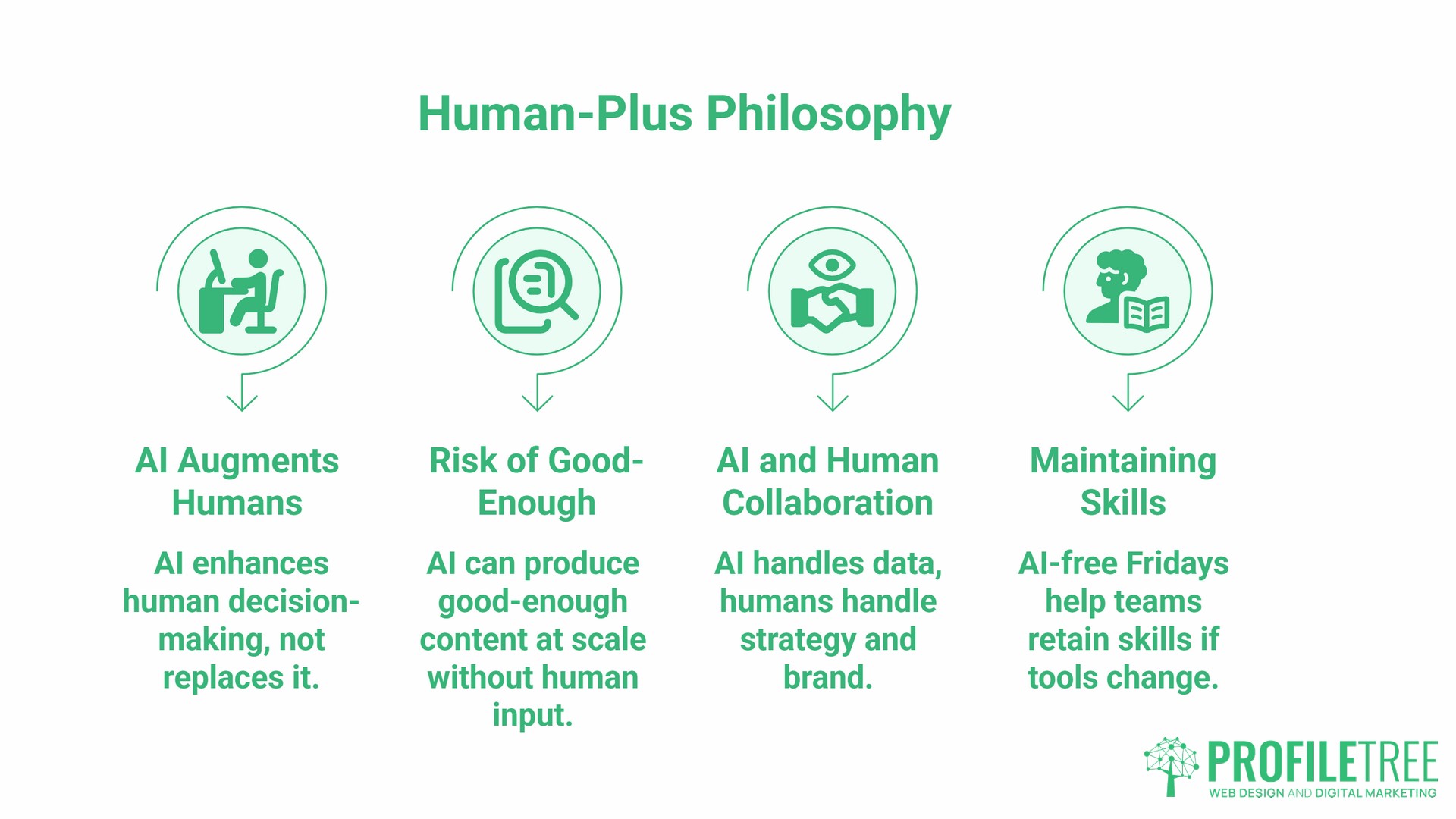
His starting point is what he calls the “Human-Plus” model: AI augments human decision-making; it does not replace it. Businesses that hand over brand voice, creative judgment, and strategic direction to an AI tool without oversight tend to produce content that is fast, plentiful, and indistinguishable from every competitor doing the same thing.
“The risk is not that AI produces bad content,” he says. “The risk is that it produces good-enough content at scale. Good-enough is the ceiling that AI sets without human input. The businesses pulling ahead are the ones using AI for the heavy lifting and keeping humans in the decisions that matter: what to say, who to say it to, and why it needs to sound like them.”
At ProfileTree, this philosophy shapes how the agency structures its digital marketing services for clients. AI tools handle data processing, content variation, and performance analysis. The agency’s team provides the strategic layer: campaign direction, editorial judgement, and brand consistency. The two work together. Neither works properly alone.
The “Human-Plus” stance also has a practical implication for teams implementing AI internally. Organisations that deprive their people of oversight tend to lose the skills those tools are replacing. ProfileTree runs what it calls “AI-free Fridays” monthly, where the team works without the tools they use daily. The goal is not nostalgia. It is making sure nobody forgets how to do the work if the tools change.
The SCALE Framework: Ciaran Connolly’s AI Implementation Methodology
When clients ask how to start with AI marketing, Ciaran Connolly on AI in marketing offers a consistent answer regardless of industry or budget: do not start with a tool. Start with a process audit.
The SCALE framework he has developed through ProfileTree’s AI training programmes provides a structured 90-day path from initial assessment to operational AI integration. It is designed for SMEs that have a functioning marketing function but have not yet introduced AI in a systematic way.
Start Small
The first 30 days focus entirely on identification, not implementation. Map every marketing task the team performs and categorise each as creative, analytical, administrative, or strategic. Identify the repetitive administrative and analytical tasks first. These are the entry points because they carry the lowest risk and the most obvious time return. For most marketing teams, a significant proportion of working time is spent on tasks that could be handled by AI tools without affecting the outputs that matter most to clients.
Once the audit is complete, select one tool that solves one identified problem. Content drafting, email subject line testing, social scheduling, performance reporting: pick the bottleneck that costs the most time and solve that first. Deploying multiple tools simultaneously before any single tool is embedded is the pattern that produces abandoned subscriptions and no behaviour change.
Consolidate Data
Weeks five to eight address the foundation that most AI tools require to function well: clean, connected data. Customer records, content libraries, campaign performance history, brand guidelines. The businesses that get the most from AI marketing tools are usually the ones that had already done the work of unifying their data sources. Those who have not will find that AI amplifies inconsistency as readily as it amplifies quality.
The practical step here is connecting the CRM, analytics platform, email tool, and social channels into a single data environment. Tools like Zapier or Make handle the integration layer for most SME tech stacks without requiring development work.
Automate and Expand
Weeks nine to thirteen cover process automation and the first performance review. Once data is consolidated and the first tool is embedded, the team has enough evidence to judge where AI investment is earning its return and where it is not. That evidence drives the expansion decisions in week thirteen, when the framework cycles back into a new audit for the next 90 days.
How does ProfileTree use AI for SEO? Within the SCALE framework, the agency applies AI to keyword clustering, content gap identification, and performance monitoring across client sites. The strategic decisions about which gaps to prioritise, which content formats to pursue, and how to position a client’s authority in a given topic area remain with the team. The AI accelerates the analysis; the agency makes the call.
Beyond ChatGPT: Building a Practical AI Tool Stack
The question most heard when discussing Ciaran Connolly on AI in marketing with SME owners is which tool to use. His answer is usually a question in return: “What problem are you trying to solve?”
The tool selection conversation matters because AI marketing tools now span dozens of credible options across different functions, and choosing by popularity rather than function produces the pattern described above: many subscriptions, minimal change.
A working AI tool stack for a UK or Irish SME marketing team in 2026 typically covers four functions:
| Function | Traditional Method | AI-Augmented Approach | Practical Benefit |
|---|---|---|---|
| Content drafting | The designer produces each variant | AI drafts from brief; editor refines | Faster first drafts; more time for editorial quality |
| Keyword research | Manual SERP analysis | AI-assisted clustering and gap analysis | Broader coverage in less time |
| Performance reporting | Manual data pulls | Automated dashboards with narrative summaries | Reports produced without analyst time |
| Image and creative variation | AI generates variations from the master concept | AI generates variations from master concept | More testing without proportional cost |
The tools that most reliably cover these functions within SME budgets include ChatGPT and Claude for content and analysis, Canva’s AI features for creative variation, and purpose-built SEO tools for keyword and content gap work. The specific tool matters less than the discipline of using one function well before adding the next.
What Ciaran recommends against is purchasing an enterprise AI suite before any of the above is in place. The licence cost is the smallest part of the problem. The real cost is organisational: introducing too many new workflows simultaneously produces rejection rather than adoption.
AI for Northern Ireland and Cross-Border Businesses
Ciaran Connolly on AI in marketing gives him a perspective on the Northern Ireland context that most general AI commentary misses entirely.
Businesses operating across the NI/ROI border face a marketing environment with two distinct regulatory frameworks. UK GDPR governs data processing for Northern Ireland-based operations. EU GDPR applies when those same businesses offer goods or services to customers in the Republic of Ireland, or monitor the behaviour of individuals there. A Belfast agency serving clients in Dublin, or an NI retailer with an all-island customer base, is subject to both frameworks simultaneously, even though the two regulations are nearly identical in structure and principle.
This is not a theoretical concern. AI personalisation tools that ingest customer data from both sides of the border need clear data residency policies, consent mechanisms that meet both regulatory standards, and vendor agreements that specify where data is processed and stored. Businesses that deploy AI tools without checking these requirements are taking on compliance risk that their marketing ROI figures will not show until an investigation occurs.
The cross-border dimension also affects campaign targeting. Google Ads and Meta campaigns targeting all-island audiences require audience definitions that work correctly across two currency environments, two regulatory contexts, and two distinct consumer cultures that marketing AI tools trained predominantly on US or UK data may not accurately reflect.
For NI businesses, ProfileTree’s AI implementation guidance addresses these specifics directly, connecting the technical deployment of AI tools to the regulatory environment in which businesses actually operate.
The IMPACT Model: How ProfileTree Guides Agency-Led AI Transformation
The IMPACT model, Ciaran Connolly on AI in marketing, articulated through ProfileTree’s client work, provides the structural framework for organisations ready to move beyond individual tool deployment.
The model emerged from ProfileTree’s experience working with clients who had attempted AI implementation without an organisational change strategy and stalled. The tools worked. The adoption did not.
- Initiate with leadership buy-in. An AI transformation that is delegated to a marketing team or IT department without active leadership involvement does not produce company-wide change. It produces a well-equipped marketing department and a sceptical organisation around it. The chief executive needs to use AI tools themselves, not just endorse their adoption. The signal that matters to teams is whether leadership is subject to the same learning curve they are being asked to work through.
- Map organisational readiness. Three dimensions need assessment before any deployment: technical readiness (infrastructure, data quality, existing system integrations), cultural readiness (openness to change, risk tolerance, existing attitudes to automation), and skill readiness (current capabilities, training requirements, hiring needs). Most organisations overestimate the technical barriers and underestimate the cultural ones. The technology is solvable. Changing how people think about their work takes considerably longer.
- Pilot strategic projects. Select three to five pilot projects across departments: AI-assisted content production in marketing, automated reporting in analytics, and process automation in operations. Each pilot needs clear success metrics established before launch, not after. Without predefined metrics, pilots either declare success based on enthusiasm or are abandoned when novelty fades.
- Accelerate successful initiatives. When a pilot produces measurable results, move quickly. The competitive advantage of AI adoption compounds over time, and organisations that spend six months evaluating a successful pilot lose six months of the lead their early adoption should have provided.
- Create a continuous learning culture. AI capabilities change faster than any fixed training programme can keep pace with. The organisations that sustain AI advantage are the ones that build continuous learning into how they work, not just into an annual training calendar. ProfileTree’s digital training services for SMEs are built around this principle: not a one-off workshop, but an ongoing relationship with the tools and their development.
- Transform business models. The final stage of the IMPACT model is also the most significant. Genuine AI transformation is not about doing existing tasks faster. It is about identifying what becomes possible that was not possible before: personalisation at a scale that was previously uneconomical, predictive analytics that inform decisions rather than just reporting outcomes, and content production cycles that allow testing at a pace that manual processes could not support.
This is where ProfileTree’s AI implementation work connects to its broader content marketing and strategy services. The tools are the beginning. What an organisation does with the time and capability they free up is the actual strategic question.
Common Pitfalls in AI Marketing
Ciaran Connolly on AI in marketing is not a straightforward promotional message. He is direct about where AI implementation goes wrong, and several of the failure patterns are consistent enough across the businesses that ProfileTree advises to be worth naming directly.
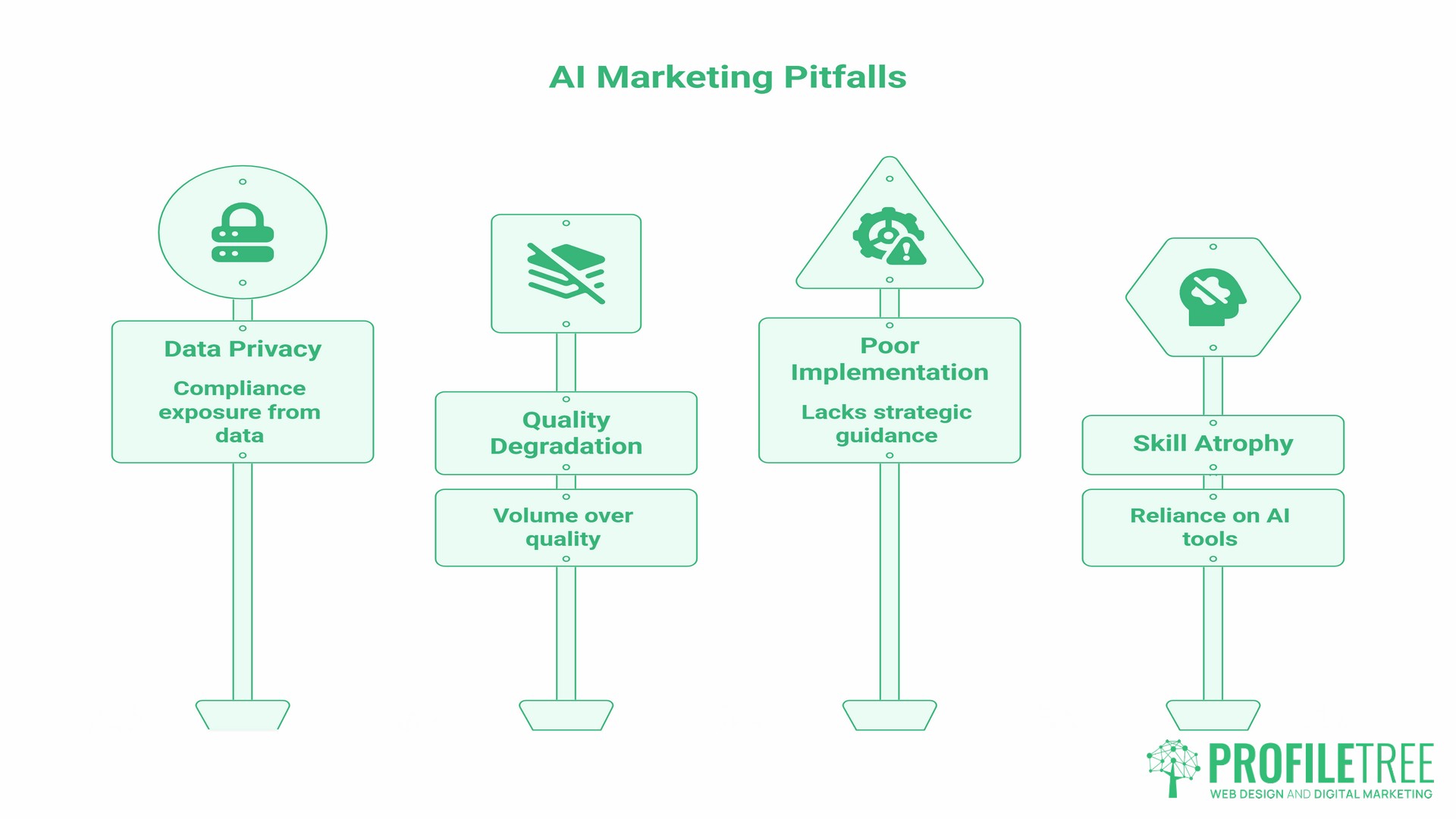
- Data privacy and GDPR compliance. AI tools require data. The more data they have access to, the more useful they become. But every additional data point processed by a third-party AI tool is a potential source of compliance exposure. UK GDPR violations from AI tools are not hypothetical: they arise from inadequate data processing agreements with AI vendors, from tools ingesting customer data without explicit consent for that use, and from businesses that have not reviewed their privacy policies since deploying AI capabilities. Before expanding AI tool adoption, review what data each tool accesses and on what legal basis.
- Quality degradation through volume. AI makes content production faster. Faster production makes it tempting to produce more. More content without a proportional increase in editorial quality tends to produce a content library that is large, undifferentiated, and unremarkable. ProfileTree’s position is that AI should be used to raise the quality ceiling of content production, not to lower the floor of the volume that gets published. Every AI-generated output should pass through human editorial review before publication. The standard should be higher with AI assistance, not lower.
- Poor implementation before the strategy. Deploying AI tools without a defined marketing strategy to guide them produces outputs that are technically competent and strategically incoherent. An AI tool asked to produce content without a clear audience definition, keyword strategy, or brand voice document will produce content that looks right and does nothing useful. The strategic groundwork has to come first. This is the consistent thread in Ciaran Connolly on AI in marketing: tools serve strategy; they do not replace it.
- Skill atrophy. The longer a team relies on AI tools for tasks it previously did manually, the harder those tasks become to perform without them. This is not inevitable, but it requires active management. Maintaining the ability to work without AI support is not anti-innovation: it is good operational risk management.
AI Marketing for SMEs: The Practical Case
The access argument for AI is straightforward. ChatGPT Plus costs approximately £19–20 per month for UK users, including VAT. Canva Pro costs £13 per month on a monthly plan. Claude’s Pro plan is in a comparable range. A functional AI marketing stack for an SME covering content drafting, basic image variation, and analytical support costs well under £200 per month.
Ciaran Connolly on AI in marketing has consistently argued that the access gap was closed long before most SME owners realised it. The price point means the tools that were cost-prohibitive for SMEs five years ago are now accessible at the scale of a single freelancer’s day rate. The question is no longer whether an SME can afford the tools. It is whether they have the strategic framework to use them well.
Ciaran Connolly’s argument, made consistently in briefings and through ProfileTree’s AI training offer, is that this is precisely where working with an agency that has already embedded AI into its own practice provides value. Not selling tools. Not running one-day workshops. Providing the strategic and operational context that turns accessible tools into an actual business advantage.
For SMEs in Northern Ireland, the combination of accessible AI tools and ProfileTree’s fifteen-year track record of working with local businesses presents a different proposition from the generic AI adoption narrative. The local regulatory context, the cross-border operational realities, and the specific industry mix of NI businesses: these specifics matter to implementation, and they are what Ciaran Connolly on AI in marketing has consistently addressed in his work with the agency’s clients.
FAQs
Who is Ciaran Connolly?
Ciaran Connolly is the founder of ProfileTree, a Belfast-based digital marketing and web design agency, which he established in 2010. He has worked with hundreds of SMEs across Northern Ireland, Ireland, and the UK on web design, SEO, content marketing, video production, and AI implementation. He is a regular speaker on digital transformation at events including Digital DNA and BelTech, and leads ProfileTree’s AI training programmes for business owners and marketing teams.
Does Ciaran Connolly offer AI consulting for small businesses?
ProfileTree provides AI strategy and implementation services for SMEs, including AI readiness audits, tool selection and integration guidance, team training, and ongoing strategic support. These services are designed for businesses that want structured guidance rather than a one-off tool recommendation. Details are available on ProfileTree’s AI and digital training pages.
What is the SCALE framework in marketing?
SCALE stands for Start small, Consolidate data, Automate repetitive tasks, Learn continuously, and Expand strategically. It is a 90-day implementation framework that sits at the centre of Ciaran Connolly on AI in marketing, developed through ProfileTree’s AI training work with SMEs. It is designed to take businesses from initial audit to embedded AI practice without the failed adoption patterns that come from deploying too many tools at once.
How should UK businesses handle GDPR when using AI marketing tools?
UK businesses using AI marketing tools that process personal data must have a valid legal basis for that processing, a data processing agreement with each tool provider, and a privacy notice that accurately describes the AI processing in use. Businesses operating across the NI/ROI border must also consider EU GDPR obligations: UK GDPR covers data processed in the UK context, but if a Northern Ireland business offers goods or services to customers in the Republic of Ireland, EU GDPR applies to those data subjects as well.
Under Article 27 of each regulation, a business based in one jurisdiction that processes data about individuals in the other may need to appoint a formal representative there. AI vendor agreements should specify data residency and storage locations. Legal review alongside technical implementation is advisable for any business with a cross-border customer base.
Is AI replacing human marketers at ProfileTree?
No. ProfileTree’s position is that AI augments human marketing work rather than replacing it. The agency uses AI for data processing, content drafting, performance reporting, and creative variation, while human team members retain responsibility for strategy, editorial judgement, brand voice, and client relationships. This is the “Human-Plus” model that Ciaran Connolly advocates for SME marketing teams.
What is the best starting point for an NI business adopting AI marketing tools?
A task audit comes before tool selection. Identify the specific marketing tasks that consume the most time and carry the lowest strategic risk if automated. Start with one tool that addresses the highest-priority task. Embed it, measure the result, and expand from there. ProfileTree’s digital training programmes provide structured guidance through this process for businesses that want support rather than self-directed experimentation.