
Digital Marketing for Solicitors in Northern Ireland
Table of Contents
Digital marketing for solicitors in Northern Ireland is not the same discipline as digital marketing for any other profession. The combination of Law Society of Northern Ireland advertising regulations, the sensitivity of client relationships, and the jurisdiction-specific nature of legal search intent means that strategies built for generic professional services will either underperform or, in the worst cases, trigger disciplinary proceedings.
This guide is written for partners and practice managers who want to build a compliant, effective digital presence. It covers the LSNI regulatory framework, the core services that deliver results for NI law firms, the cross-border considerations that most agencies ignore, and the questions to ask before appointing a digital partner. Whether a firm is starting from scratch or reviewing an existing approach, the principles of digital marketing for solicitors in a regulated jurisdiction are consistent: compliance first, then visibility, then conversion.
The NI Legal Landscape: Why Generic Advice Fails Here
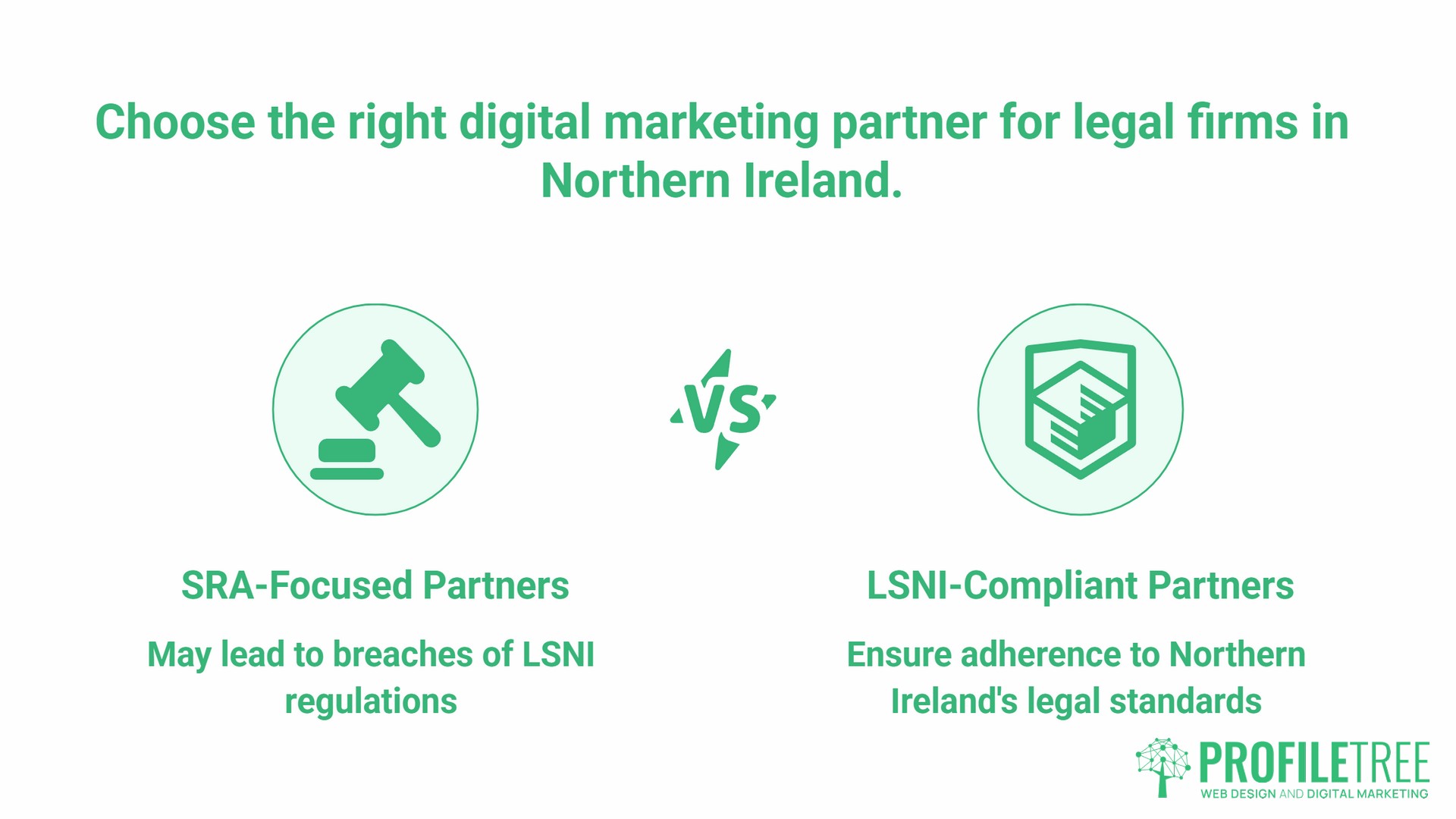
Northern Ireland operates under a separate legal jurisdiction from England and Wales. The Law Society of Northern Ireland (LSNI) enforces advertising standards through the Solicitors’ Practice Regulations and the Solicitors’ Publicity Code, which are distinct from the Solicitors Regulation Authority (SRA) rules that govern firms in England and Wales.
Most content about digital marketing for solicitors is written with the SRA in mind. If a firm is based in Belfast, Derry, Newry or anywhere else in the Province, that content does not accurately reflect its obligations. A single misstep in website copy, Google Ads, or social media could constitute a breach of the Solicitors’ Publicity Code and invite a formal complaint to the LSNI.
The stakes are higher here than in most industries. That means the choice of digital marketing partner matters considerably. For a deeper look at the ethics and legal considerations that underlie all digital marketing practice, the ProfileTree guide to the ethics and legalities of digital marketing provides useful grounding.
Marketing Within LSNI Guidelines: What NI Solicitors Need to Know
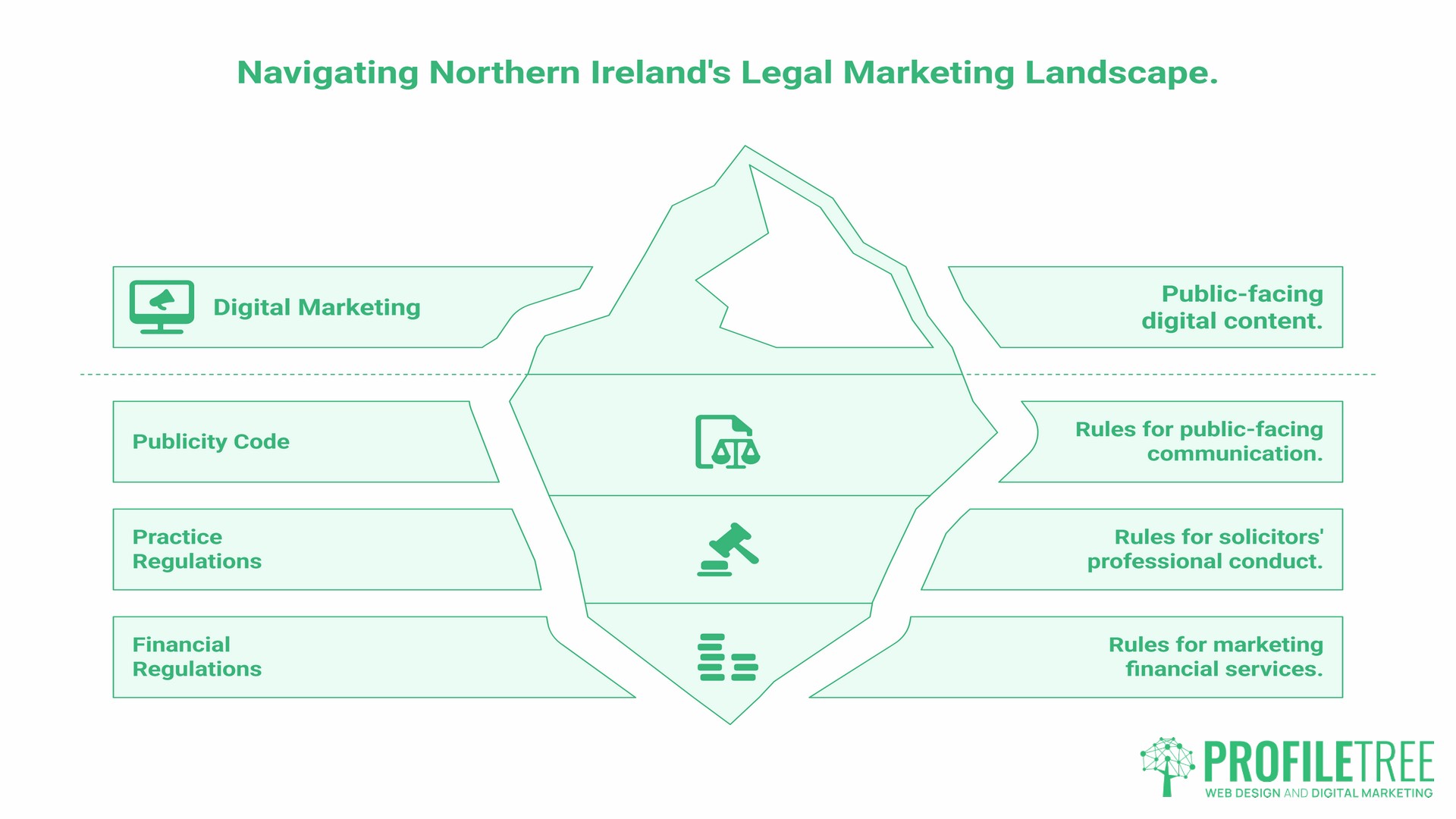
Two sets of rules govern what NI solicitors can say in public-facing digital content: the Solicitors’ Publicity Code and the Solicitors’ Practice Regulations. Together, they shape what a compliant digital marketing programme looks like for any firm in the Province.
Key Constraints of the Solicitors’ Publicity Code (NI)
The Solicitors’ Publicity Code sets out what NI firms can and cannot say in any public-facing communication, including websites, paid adverts, social media profiles, and email signatures.
Solicitors cannot make unsubstantiated claims about expertise or success rates. Stating that a firm is “Northern Ireland’s leading personal injury practice” requires verifiable evidence. The term “specialist” carries a specific meaning: a firm cannot claim specialisation without accreditation from a recognised body. This applies equally to Google Ads copy, LinkedIn headlines, and website service pages.
Comparative advertising is heavily restricted. Directly comparing services to named competitors or claiming to be “better” or “more experienced” than other firms is not permitted under the Publicity Code. This rules out a range of tactics that work elsewhere and requires a more consultative approach to positioning.
Client confidentiality extends to all digital marketing. A firm cannot share case outcomes, testimonials, or specific success stories without explicit written consent. Even anonymised scenarios require careful handling to prevent identification through contextual detail. Understanding the legal implications of misleading advertising is relevant background for any solicitor building a digital presence.
Fee Advertising and “No Win, No Fee” in Northern Ireland
Any mention of costs in digital marketing materials must be transparent, accurate, and include all relevant qualifications. This covers “no win no fee” arrangements, fixed-fee services, and hourly rate references. All fee advertising must disclose potential additional charges. Misleading fee advertising is treated as serious professional misconduct under the Solicitors’ Practice Regulations.
The Solicitors’ Financial Services Regulations add a further layer for firms marketing services connected to financial advice, pensions, or investment products.
| Advertising Area | LSNI Position |
|---|---|
| Claiming “specialist” status | Requires formal accreditation |
| Comparative advertising | Not permitted without substantiated evidence |
| Testimonials | Require explicit written client consent |
| Fee advertising | Must include all qualifications and potential charges |
| “No Win No Fee” language | Permitted with full disclosure of terms |
| Success rate claims | Require verifiable supporting evidence |
Strategic Pillars: Selecting the Right Services for an NI Law Firm
The four service areas below form the core of any effective digital marketing programme for NI solicitors. Each has specific applications in legal practice and carries compliance considerations that generic agencies tend to overlook.
Web Design: Building a Digital Practice Office
A solicitor’s website carries the same trust burden as a physical high street office. Prospective clients form impressions within seconds, and those impressions are difficult to reverse. A site that looks dated, loads slowly, or fails on mobile devices signals immediately that the firm has not kept pace.
For NI solicitors, website design needs to account for several specific requirements. WCAG 2.1 AA accessibility compliance is increasingly a legal expectation, not just a technical recommendation. Contact forms must include GDPR consent notices. Fee disclosure obligations mean that cost-related content requires careful drafting by someone who understands the regulatory context.
The practical design decisions that most affect conversion are: clear practice area navigation, separating consumer and commercial services; prominent contact options above the fold; and a Google review count with a star rating displayed where it is immediately visible. These are the elements that convert cautious, research-mode visitors into enquirers.
ProfileTree’s website development services are designed for regulated businesses where conversion performance and compliance cannot be treated as separate concerns. The ProfileTree guide on accessibility compliance in legal website design covers the technical requirements in detail.
Search Engine Optimisation: Dominating Local NI Practice Areas
SEO for solicitors in Northern Ireland is primarily a local search problem. The majority of consumer-facing legal searches are geographically qualified: “divorce solicitor Belfast,” “conveyancing Derry,” “personal injury Newry.” For commercial practices, the intent is more research-oriented but still local: “employment law firm Belfast,” “commercial property solicitor Northern Ireland.”
Most competing agencies treat NI as a single market. It is not. A high-street practice in Omagh relies on proximity to the community, reinforced by a strong Google Business Profile. A commercial firm in Belfast’s city centre needs to rank for sector-specific queries and build authority through thought leadership content that reaches decision-makers across the UK and Ireland. The digital marketing for solicitors approach that works in one context will not automatically transfer to the other.
Location-specific landing pages capture geographic searches, but only if the content is genuinely differentiated. Creating separate pages for Belfast, Derry, Newry, Lisburn, and Enniskillen with substantive local content is the right approach. Schema markup for LocalBusiness, including service areas and opening hours, helps a firm appear for relevant local queries. Google’s elevated scrutiny of legal and health content, which falls under its “Your Money or Your Life” evaluation framework, makes technical credibility signals particularly important.
ProfileTree’s SEO services include location page strategy and schema implementation for professional services firms across Northern Ireland, Ireland, and the UK.
Content Marketing and Video: Building Authority Within the Rules
Content marketing is the primary compliant vehicle available to NI solicitors. Because testimonials are restricted and comparative advertising is not permitted, a firm’s expertise has to be demonstrated rather than claimed. Educational content does this effectively: guides about the divorce process in Northern Ireland, explainers on commercial lease terms, and breakdowns of employment tribunal timelines.
Solicitors’ online marketing that relies solely on paid search leaves firms exposed to rising cost-per-click and provides no residual value. Content marketing for solicitors builds authority that compounds: a well-structured guide to personal injury claims in NI will continue to attract searches months after publication, while a paid ad stops the moment the budget does. This is one of the clearest distinctions in digital marketing for solicitors versus other professional services: the compliance constraints that limit promotional copy actually create a strong incentive to invest in educational content, which tends to perform better in search and AI citation anyway.
Video is particularly effective because it adds a human dimension that written content alone cannot provide. A partner explaining the firm’s process for handling conveyancing, or clarifying a frequently misunderstood point of employment law, builds credibility in a way that no copywriter can replicate. For regulated firms, production quality matters: a poorly produced partner introduction signals low investment to commercial clients. ProfileTree’s video marketing services cover planning, production, and platform distribution for legal sector audiences.
The ethics of digital marketing for law firms, including what types of content sit within the LSNI framework, are covered in ProfileTree’s dedicated guide to ethics in digital marketing.
Paid Search: High-Intent Lead Generation for Competitive Specialisms
Google Ads work for solicitors, but the economics are demanding in competitive practice areas. Personal injury and medical negligence are among the most competitive PPC categories in the UK. Long-tail keyword targeting based on specific injury types, claim time limits, and geographic qualifiers improves return by capturing users further into the decision process.
Ad copy must comply with the Solicitors’ Publicity Code. Factual copy describing what the firm offers, who it serves, and what the process involves is both more compliant and typically more effective at attracting qualified enquiries than promotional language.
Remarketing for legal services requires additional care. Someone who has visited family law pages may not want colleagues or family members to see retargeted ads for divorce solicitors. Frequency capping and careful audience exclusions are part of responsible paid search management for legal firms.
Cross-Border Marketing: Capturing the NI/ROI Client Base
Many Northern Ireland solicitors handle matters that cross the border into the Republic of Ireland. Dual-qualified practitioners, cross-border commercial transactions, and cross-border family matters create a client base that does not map neatly to either jurisdiction.
This is a gap in most competitor content. The majority of digital marketing for solicitors’ guidance addresses either NI or ROI in isolation. Firms that handle cross-border work need a digital strategy that reflects both.
The SEO implications are substantial. Cross-border keyword targets require content that explicitly addresses both jurisdictions: “conveyancing solicitor Northern Ireland and Republic of Ireland,” “cross-border employment law NI ROI.” These are low-competition phrases with genuine commercial intent from a specific audience that generic agency templates have not reached.
For firms operating under both the LSNI and the Law Society of Ireland frameworks, content compliance requires checking both sets of advertising rules. The table below sets out the key differences at the headline level.
| Advertising Rule | LSNI | Law Society of Ireland |
|---|---|---|
| Fee advertising | Permitted with full disclosure | Permitted with full disclosure |
| Testimonials | Permitted with written consent | Permitted with written consent |
| “No Win No Fee” language | Permitted with disclosure of terms | Permitted with conditions |
| Specialist claims | Require accreditation | Require accreditation |
| Comparative advertising | Not permitted | Not permitted |
Firms with cross-border ambitions benefit from jurisdiction-specific landing pages rather than attempting to serve both audiences from a single page.
Measuring What Matters: KPIs for Partners
Partners and practice managers need different metrics from marketing managers when evaluating digital marketing for solicitors. The numbers relevant to strategic decisions are not impressions or social follower counts.
Qualified lead volume by practice area shows which digital channels are generating viable enquiries, not just traffic. Cost per qualified lead gives a true picture of channel ROI when legal work carries high average case values. Organic search visibility for practice-area terms tracks whether SEO investment is moving the firm into positions where prospective clients can actually find it.
For local practices, Google Business Profile performance deserves particular attention. Search queries, direction requests, and call clicks are direct signals of local search presence. For commercial practices, LinkedIn engagement for senior partners and referral enquiry attribution tells a more useful story than reach metrics alone.
A practical starting point for any digital marketing for solicitors programme is a monthly review of: qualified enquiry volume by source, cost per enquiry by paid channel, top five search queries delivering impressions (from Google Search Console), and GBP call and direction request volume.
How to Choose a Digital Partner: A Checklist for NI Firms
Most digital agencies do not understand regulated professional services, and this matters particularly in digital marketing for solicitors. The questions below are designed to surface whether a prospective agency genuinely understands the NI legal market or is applying a generic template.
Ask a prospective agency to describe the difference between LSNI and SRA advertising regulations. If they cannot, they have not worked with NI solicitors before. Ask which specific LSNI regulations govern website content. Ask how they would handle a “no win no fee” claim in Google Ads copy. Ask for examples of legal sector content and whether it was reviewed for regulatory compliance.
The agency does not need to be staffed by former solicitors. It needs to demonstrate an understanding of the regulatory constraints that distinguish digital marketing for solicitors from other sectors. Firms that want to develop in-house capability alongside external support may find ProfileTree’s digital training services a useful starting point for building internal marketing skills within a regulated context.
The Future of Legal Marketing in Northern Ireland
AI-powered search is changing how prospective clients find legal services. Google’s AI Overviews now summarise answers to queries about legal processes and cite specific sources. Appearing in those citations requires structured, well-evidenced content that directly answers the questions people are asking.
The practices that will benefit most from this shift are those that have invested in genuine educational content: clear, factual guides to legal processes, jurisdiction-specific FAQs, and well-structured service pages. Digital marketing for solicitors is maturing in Northern Ireland, and the firms treating it as a serious professional discipline, with the same rigour applied to client work, are those building durable competitive advantages. The SEO strategies, content approaches, and channel choices that define effective digital marketing for solicitors in NI are now well-established enough to deliver predictable returns for firms that commit to them properly.
Ciaran Connolly, founder of ProfileTree, notes: “Solicitors often struggle with digital marketing because they apply traditional advertising mindsets to digital channels. Success comes from providing value first: answering questions, solving problems, and building trust. When you focus on helping potential clients understand their situations and options, compliant marketing that generates results follows naturally. The firms winning online are those brave enough to be genuinely helpful rather than purely promotional.”
Frequently Asked Questions
Can solicitors in Northern Ireland use “No Win, No Fee” in their marketing?
Yes. The LSNI does not prohibit “no win no fee” language, but full disclosure of the terms is required. This includes any circumstances in which the client might still incur costs, any success-fee arrangements, and the scope of work covered by the agreement. Vague or incomplete disclosure in digital marketing materials would constitute a breach of the Solicitors’ Publicity Code.
What are the Law Society of Northern Ireland’s rules on advertising fees?
Fee advertising is permitted but must be transparent, accurate, and include all relevant qualifications. Any mention of indicative costs must disclose potential additional charges. Fixed-fee services must specify clearly what the fee includes and what falls outside its scope. The Solicitors’ Publicity Code governs all fee-related communications, including website copy and paid adverts.
How long does SEO take for a law firm in Belfast?
For competitive consumer terms such as personal injury or conveyancing in Belfast, expect 6 to 12 months before significant ranking movement. Less competitive geographic targets (Derry, Newry, and smaller towns) and long-tail practice-area queries can show movement within 3 to 6 months. Local SEO, particularly Google Business Profile optimisation, often produces results faster than organic search. The timeline depends heavily on the domain’s starting authority and the quality of existing content.
Does a firm need a separate strategy for cross-border clients?
Yes. Firms that handle matters in both Northern Ireland and the Republic of Ireland need content that addresses each market’s legal context separately. Create jurisdiction-specific landing pages and check that any fee or service claims comply with both the LSNI Solicitors’ Publicity Code and Law Society of Ireland advertising rules. Cross-border keyword targeting is a genuinely underserved niche with real commercial intent from dual-jurisdiction practitioners and their clients.
Is social media marketing compliant for NI solicitors?
Social media posts are subject to the same Solicitors’ Publicity Code requirements as any other advertising. Claims must be substantiated, confidentiality must be protected, and tone must reflect professional standards. Staff social media policies are important: a fee earner’s personal LinkedIn post referencing a case outcome could constitute a breach even from a personal account. Educational content, firm news, and commentary on legal developments are the lowest-risk categories for regular social media activity.
What is the most cost-effective lead generation tool for NI law firms?
For most consumer-facing practices, Google Business Profile is the highest-return digital investment relative to cost. A well-optimised profile with accurate service categories, regular posts, and a consistent stream of genuine reviews will capture local searches at no direct cost per click. For commercial practices, organic search, backed by genuine thought leadership content, delivers the strongest long-term return, though the timeline is longer than with paid search.