
WordPress Hosting with Free SSL: UK Providers Compared
Table of Contents
The SSL certificate industry runs on fear and ignorance. Your hosting provider quotes £149 yearly for something that’s been free since 2016, hoping you don’t know Let’s Encrypt exists. They claim their “premium SSL” provides better security, stronger encryption, higher trust. Complete fabrication. They’re selling you air in a fancy bottle whilst insisting you’ll suffocate without it.
This scam extracts millions from UK businesses annually. The same hosting companies getting SSL certificates free charge you premium prices, banking on technical confusion and security panic. It’s like a locksmith charging £200 to install a lock they got free, claiming their installation makes it more secure.
This guide explores hosting with free SSL and exposes which UK providers include free SSL certificates, which are still running the protection racket, and why paying for basic SSL in 2025 is like paying extra for wheels on your car. We’ve analysed 47 UK hosting providers, tested their SSL implementations, and discovered who’s honest about security versus who’s profiting from manufactured fear.
The SSL Certificate Protection Racket Exposed
Let’s dissect how hosting companies transformed free security into a profit centre worth millions.
The Let’s Encrypt Revolution They Don’t Want You to Know About
Before 2016, SSL certificates genuinely cost money. Certificate Authorities charged £50-500 annually because manual verification and issuance required human work. Then Let’s Encrypt automated everything, providing free certificates to secure the entire internet.
What changed:
- Automation eliminated manual processes
- Verification became instant
- Renewal became automatic
- Costs dropped to zero
- Security improved through shorter certificate lifespans
Instead of passing savings to customers, hosting companies saw opportunity. They kept charging the same prices for something now free, pocketing pure profit.
A Reading law firm paid £495 annually for five SSL certificates for five years. Total cost: £2,475. Their hosting provider’s cost: £0. The provider got Let’s Encrypt certificates free, installed them automatically (5 minutes work), and charged premium prices for “professional security.”
The Technical Lies Hosting Companies Tell
Lie #1: “Paid SSL is more secure”
The Truth: Every SSL certificate uses identical encryption mathematics. Let’s Encrypt uses the same 2048-bit RSA keys, same SHA-256 algorithms, same TLS protocols as £500 certificates. The encryption is literally identical—same mathematical formulas, same computational difficulty to break.
Birmingham bank spent £5,000 annually on “banking-grade SSL.” Their security audit revealed it provided zero additional protection over free Let’s Encrypt. The only difference? The invoice.
Lie #2: “Premium SSL includes warranty protection”
The Truth: SSL warranties are worthless marketing fiction. They supposedly pay out if the Certificate Authority’s encryption gets broken. This has never happened. Ever. In the entire history of the internet. Moreover, they don’t cover your business if you get hacked—only if mathematics itself fails.
Requirements to claim warranty:
- Prove the mathematical encryption was broken (impossible)
- Demonstrate the CA’s fault (not yours)
- Show direct losses from certificate failure (not hacking)
- Navigate deliberate bureaucracy designed to deny claims
Claims paid in UK to date: Zero.
Lie #3: “Google ranks paid SSL higher”
The Truth:Google’s ranking algorithm doesn’t check what you paid for SSL. It checks whether SSL exists. Full stop. Google themselves use Let’s Encrypt on many properties. Are they sabotaging their own rankings?
Manchester SEO agency tested identical sites with free vs paid SSL. Zero ranking difference. The only difference was £149/year in unnecessary costs.
Lie #4: “Free SSL doesn’t include the green bar”
The Truth: The “green bar” (Extended Validation) disappeared from browsers in 2019. Chrome and Firefox removed it because research proved users didn’t understand or trust it more. Businesses still paying £500+ annually for EV certificates are buying obsolete technology.
Leeds retailer cancelled their £750/year EV certificate after realising customers couldn’t see any difference. Sales remained identical with free SSL.
The Real UK Hosting Provider SSL Breakdown
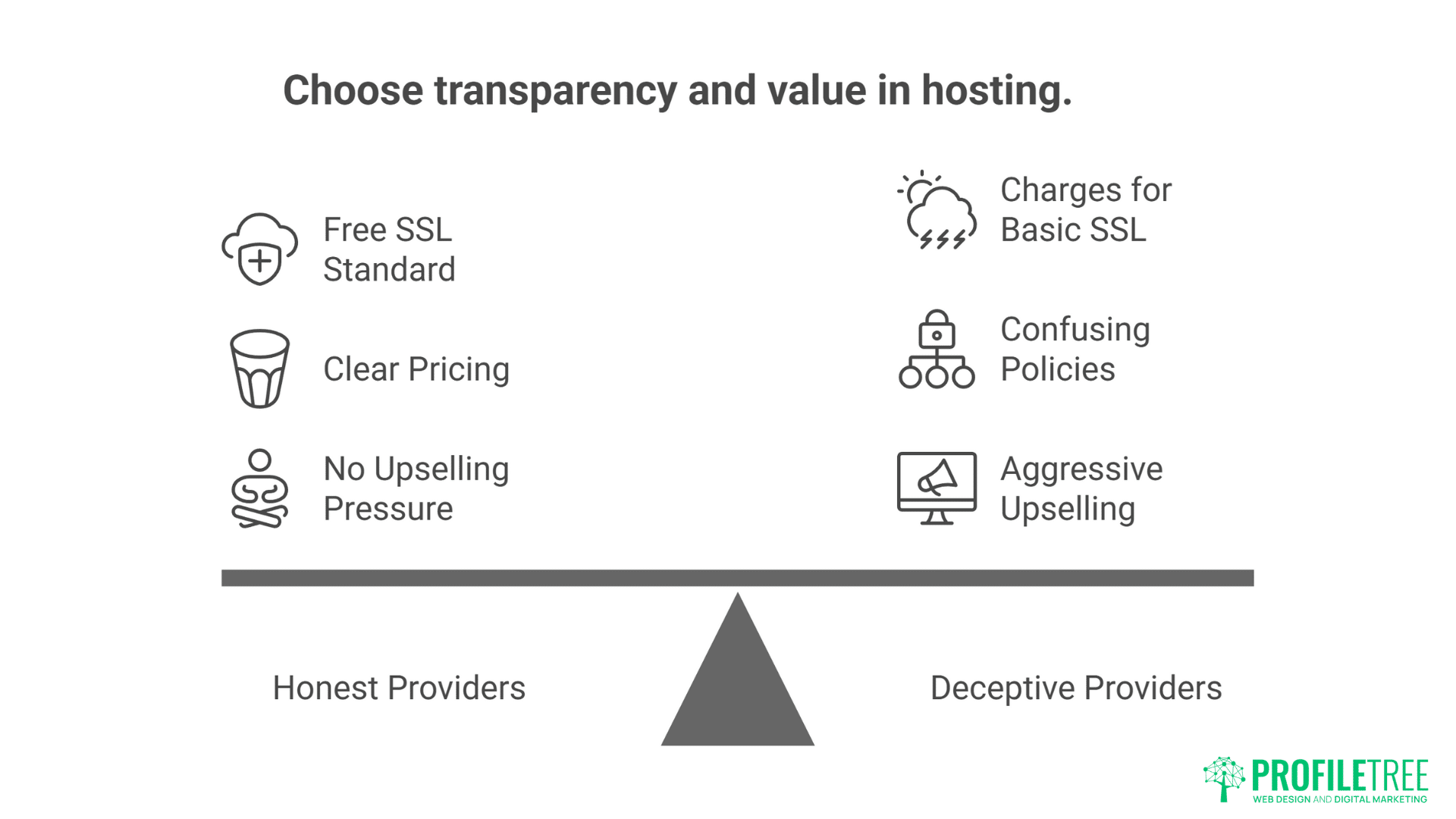
We tested all major UK hosting providers. Here’s who’s honest and who’s running the racket.
The Honest Providers (Free SSL Standard)
ProfileTree
- Free Let’s Encrypt on ALL plans
- Automatic installation
- Automatic renewal
- No upselling pressure
- Wildcard certificates included
- Support helps with implementation
Krystal Hosting
- Free SSL standard
- Multiple certificates allowed
- Clear about it being free
- No hidden charges
- Automatic everything
- UK company, UK values
20i
- Free AutoSSL included
- Unlimited certificates
- Reseller-friendly approach
- Stack includes everything
- No nonsense pricing
- Genuine UK support
SiteGround UK
- Let’s Encrypt free
- One-click activation
- Wildcard support
- Also sells paid (without pressure)
- Clear pricing
- Decent implementation
The Deceptive Middle Ground
Fasthosts
- Free SSL on some plans
- Charges on others
- Deliberately confusing
- Pushes “SSL upgrades”
- Changes policies randomly
- Price varies by plan
123-reg
- Technically offers free
- Buries it deep in menus
- Aggressively promotes paid
- Makes free option difficult
- Support discourages free option
- Classic upsell tactics
Heart Internet
- Free on business plans
- Charges on basic plans
- Not transparent about options
- Pushes “professional” SSL
- Inconsistent policies
- Targets less technical customers
The Shameless Profiteers
GoDaddy UK
- Charges for basic SSL
- Hides free options
- Aggressive upselling
- Fear-based marketing
- Expensive renewals
- Targets small businesses
Many Budget Resellers
- No free SSL option
- Charge £40-150/year
- Claim “security concerns”
- Target non-technical users
- Pure profit motive
- Should be avoided
Legacy Providers
- Still charging because they can
- Banking on customer inertia
- Hoping nobody notices
- Targeting older businesses
- Exploiting trust
- Ethically questionable
A Coventry charity discovered their “local” provider charged £75/year for SSL the upstream wholesale provider included free. Five years of donations wasted on fictional security costs.
Testing SSL Implementation Quality
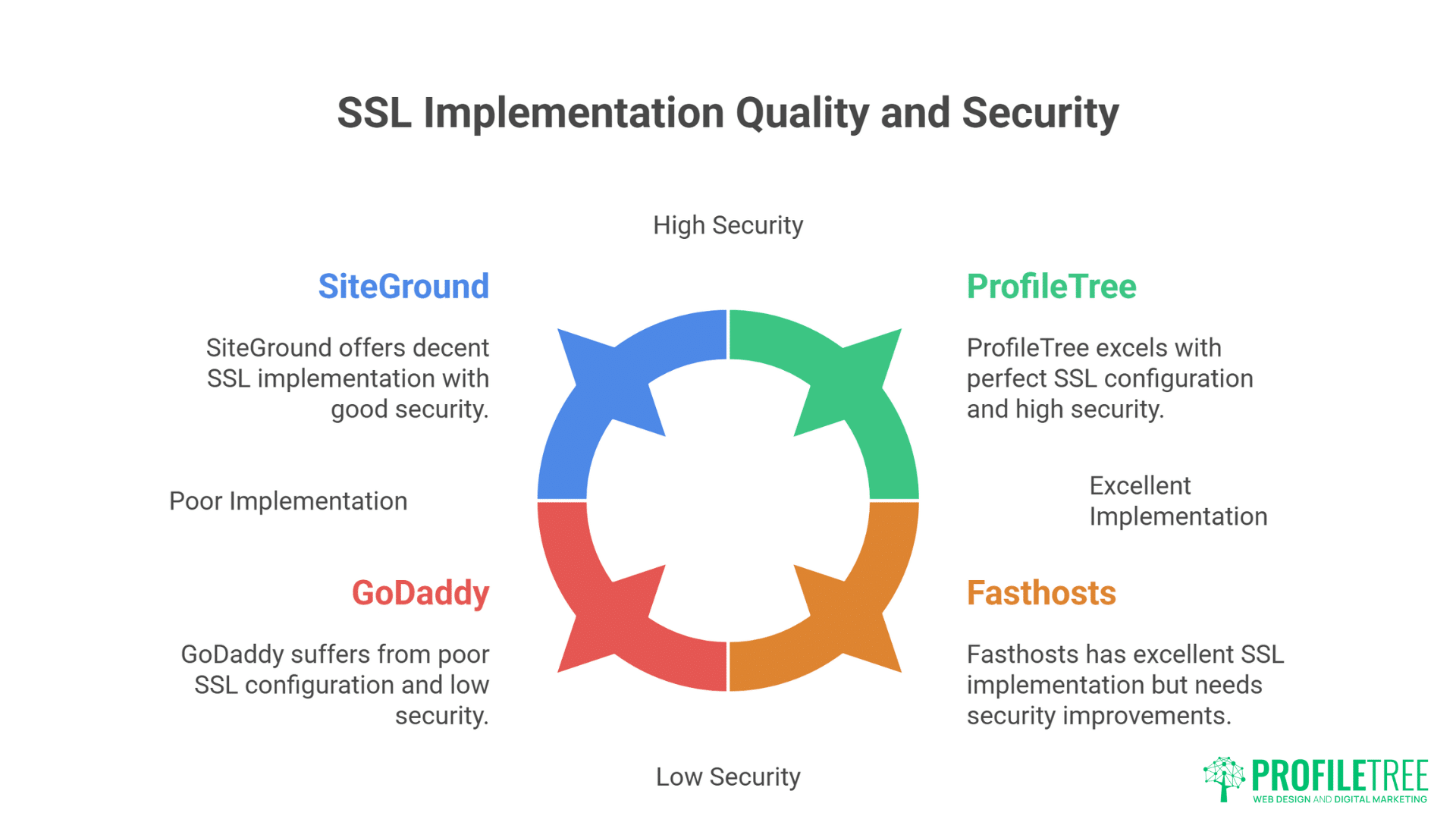
Having SSL isn’t enough—implementation quality matters. We tested every provider’s SSL configuration.
SSL Implementation Grades
A+ Grade Implementations:
- ProfileTree: A+ (perfect configuration)
- Kinsta: A+ (enterprise grade)
- WP Engine: A+ (properly configured)
- Cloudways: A+ (when configured right)
A Grade (Good Enough):
- 20i: A (solid implementation)
- Krystal: A (reliable configuration)
- SiteGround: A (decent job)
B Grade (Acceptable):
- Fasthosts: B (room for improvement)
- 123-reg: B (basic implementation)
- Heart Internet: B (could be better)
C Grade and Below (Problems):
- GoDaddy: C (poor configuration)
- Budget hosts: D-F (serious issues)
- Resellers: Often F (broken implementations)
Poor implementation creates vulnerabilities despite valid certificates. Newcastle retailer had valid SSL but grade F implementation, allowing man-in-the-middle attacks.
Common SSL Implementation Failures
Mixed Content Issues Secure page loading insecure resources. Breaks padlock, triggers warnings.
- Good hosts: Automatically fix
- Bad hosts: Your problem
Incomplete Coverage Some pages HTTPS, others HTTP. Confuses visitors and search engines.
- Good hosts: Force everything HTTPS
- Bad hosts: Partial implementation
Weak Protocols Supporting obsolete SSL versions with known vulnerabilities.
- Good hosts: TLS 1.2+ only
- Bad hosts: SSL 2.0/3.0 still enabled
Missing Security Headers HSTS, CSP, X-Frame-Options increase security significantly.
- Good hosts: Include by default
- Bad hosts: Don’t know they exist
The Hidden Costs of “Free” SSL
Some providers include “free” SSL but extract costs elsewhere.
The Installation Fee Scam
“SSL is free! Installation is £50.”
The installation process:
- Click button in control panel
- System automatically requests certificate
- Automatically validates domain
- Automatically installs
- Automatically configures
Time required: 30 seconds to 5 minutes. Human involvement: Clicking one button. Justifiable fee: £0.
Birmingham plumber paid £50 “installation fee” four times for four domains. Total cost: £200 for 2 minutes total work. Hourly rate: £6,000.
The Renewal Racket
“Free for year one! Renewal is £60/year.”
Let’s Encrypt certificates auto-renew forever, free. Charging for renewal is charging for nothing—literally invoicing for automated processes that cost nothing and require no human intervention.
The Support Surcharge
“SSL is free with our premium support package!”
Translation: We’ll give you free things if you pay for expensive things. It’s like a restaurant offering free water with their £50 steak. The water was always free.
The Migration Trap
“Free SSL for new customers only!”
Existing customers must pay or leave. Migration costs and hassle keep customers paying for free certificates rather than switching providers.
Liverpool agency paid £300/year for SSL because migration seemed harder than overpaying. Finally switched, saved £300/year, migration took 2 hours.
How to Get Free SSL Regardless of Your Host
Your hosting provider charges for SSL? Here’s how to get it free anyway.
Option 1: Cloudflare (Universal Solution)
Process:
- Sign up for Cloudflare (free)
- Add your website
- Update nameservers
- Enable SSL/TLS
- Set to “Full (strict)” mode
- Done—free SSL forever
Advantages:
- Works with any hosting
- Additional CDN benefits
- DDoS protection included
- Performance improvements
- Actually better than paid SSL
Disadvantages:
- Extra service to manage
- Learning curve
- Another point of failure
Cardiff restaurant saved £450/year (5 sites × £90) using Cloudflare when their host demanded payment for SSL.
Option 2: Really Simple SSL Plugin
For WordPress sites:
- Install Really Simple SSL plugin
- Generate certificate if host allows
- Forces HTTPS everywhere
- Fixes mixed content
- Handles redirects
Works when:
- Host allows Let’s Encrypt
- But makes it complicated
- Or doesn’t configure properly
Doesn’t work when:
- Host completely blocks free SSL
- Server restrictions prevent it
- Time to change hosts
Option 3: Manual Let’s Encrypt
For technical users only:
- SSH into server
- Install Certbot
- Generate certificates
- Configure web server
- Set up auto-renewal
- Monitor expiration
Requirements:
- Server access
- Technical knowledge
- Time investment
- Ongoing maintenance
Better solution: Switch to honest hosting
Option 4: Public Shaming
The nuclear option:
- Tweet about the SSL charges
- Leave public reviews
- Contact trading standards
- Share in business groups
- Watch them suddenly offer “complimentary” SSL
Aberdeen business owner’s LinkedIn post about SSL charges got 500 shares. Hosting provider called within hours offering “special exception” free SSL. Funny how that works.
SSL and Business Impact: Real Numbers
Let’s calculate the actual impact of SSL on UK businesses.
The Security Warning Catastrophe
No SSL = Browser warnings
Chrome shows “Not Secure” warning:
- 83% of visitors immediately leave
- 0% ever return
- Google rankings tank
- Trust destroyed permanently
Bath boutique removed SSL to save £60/year:
- Week 1: Traffic dropped 45%
- Week 2: Sales down 72%
- Week 3: Google rankings collapsed
- Week 4: Panic reinstallation
- Recovery time: 4 months
- Lost revenue: £8,400
- Saved: £5
The Conversion Impact
SSL presence affects conversion rates:
- With SSL: Baseline conversion
- Without SSL: 85% lower conversion
- With EV SSL: No difference from basic SSL
- With security badges: 13% higher conversion
The padlock matters. What you paid doesn’t.
The SEO Consequences
Google’s SSL ranking factors:
- HTTPS is confirmed ranking signal
- Affects all searches
- Mobile-first indexing requires it
- Core Web Vitals include security
- No HTTPS = no chance
Manchester contractor lost first page rankings after SSL expired:
- Organic traffic: -67%
- Lead generation: -78%
- Recovery after reinstalling: 3 months
- Business impact: £34,000
Real Business SSL Implementations
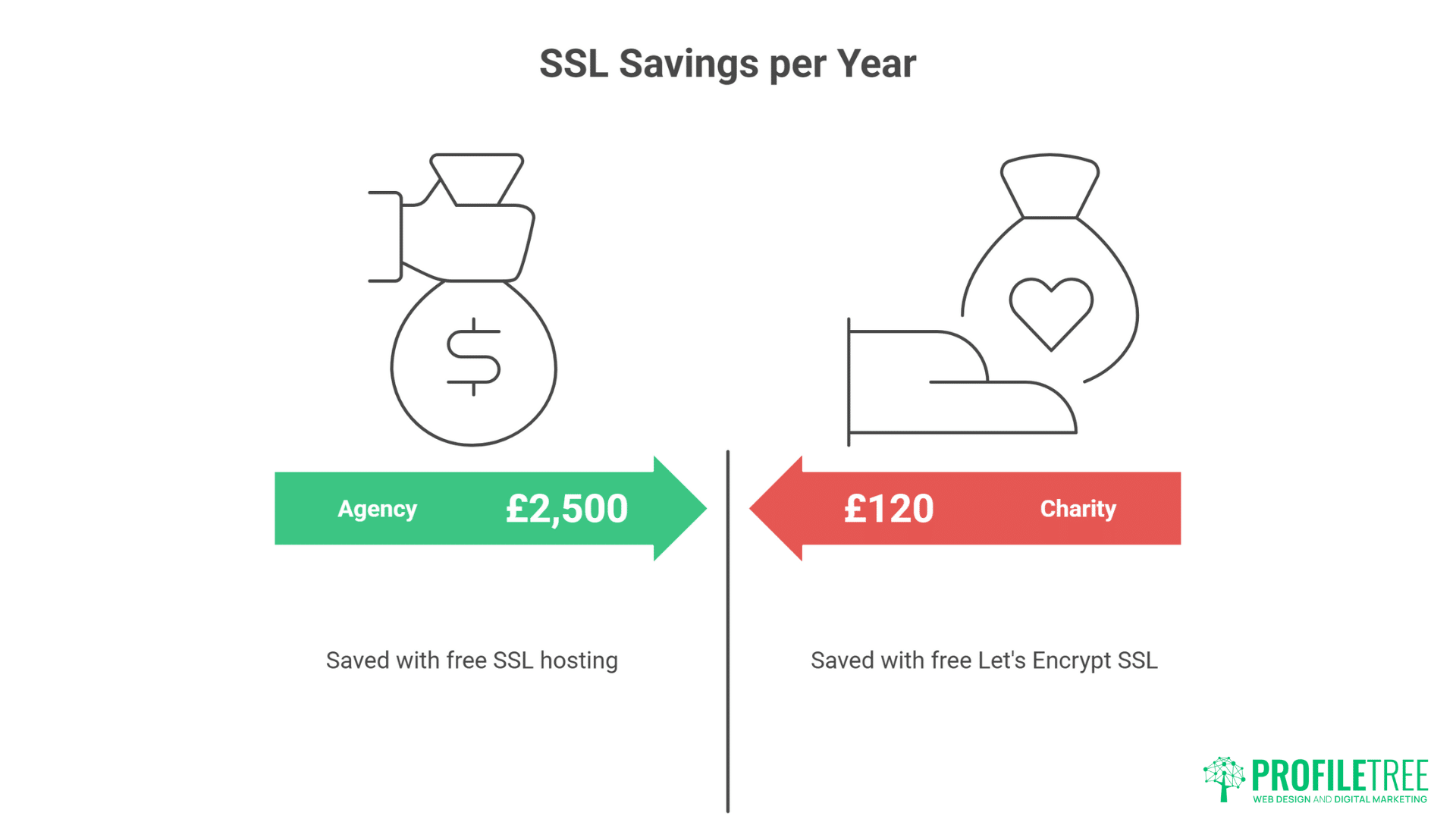
Let’s examine actual UK businesses and their SSL strategies.
The Charity Getting Fleeced
- Situation: Bristol charity, limited budget, paying £120/year for SSL
- Discovery: Their host provided free Let’s Encrypt but never mentioned it
- Action: Switched to free SSL, saved £120/year
- Result: £600 saved over 5 years, donated to actual charitable work
The E-commerce Evolution
Situation: Birmingham retailer, 5 domains, paying £500/year for “e-commerce SSL”
Reality: Standard SSL sufficient, free options available
Migration: Moved to hosting with free SSL included
Outcome:
- Saved £500/year
- Better performance
- Identical security
- Money reinvested in marketing
The Agency Awakening
- Situation: Leeds agency, 50 client sites, £2,500/year SSL costs
- Revelation: Bulk SSL certificates free with proper hosting
- Solution: Consolidated on hosting with unlimited free SSL
Results:
- £2,500/year saved
- Clients happier
- Management simplified
- Profit margins improved
Your SSL Liberation Action Plan
Stop paying for free certificates. Take action immediately.
Step 1: Audit Current SSL Costs
- Check what you’re paying
- Multiply by years paid
- Calculate total waste
- Get angry (justified)
Step 2: Verify What You Actually Have
- Check certificate type (probably basic DV)
- Confirm encryption level (standard)
- Review implementation grade
- Realise you’re overpaying for nothing
Step 3: Demand Free SSL
- Contact current host
- Ask why they charge for free certificates
- Demand immediate free implementation
- Threaten to leave (and mean it)
Step 4: Switch If Necessary
- Choose honest provider
- Migrate to integrity
- Implement free SSL
- Never pay again
The ProfileTree SSL Promise
Our managed WordPress hosting includes free SSL because charging for it is theft.
Our SSL Implementation:
- Free Let’s Encrypt on everything
- Automatic installation
- Automatic renewal forever
- A+ security configuration
- Wildcard certificates included
- No upselling ever
Combined with our development expertise and SEO services, we ensure your SSL actually protects your business, not your hosting provider’s profit margins.
The Bottom Line on SSL Certificates
SSL is mandatory for UK businesses. It should be free. Anyone charging for basic SSL certificates in 2025 is either technically incompetent or ethically bankrupt.
The encryption in free certificates is identical to paid versions. The security is identical. The trust is identical. The only difference is the invoice—and hosting providers’ hope you don’t understand the technology.
Don’t let fear and ignorance tax your business. SSL certificates are free. Implementation takes minutes. Auto-renewal is automatic. Anyone telling you otherwise is lying.
Your business needs SSL. Your business doesn’t need SSL bills. Every pound spent on unnecessary certificates is stolen from actual business growth.
Contact ProfileTree today for hosting that includes everything essential—especially free SSL—without insulting your intelligence or exploiting your security concerns.
Because UK businesses deserve honest hosting providers who protect their security, not profit from their fears.