
How to Use SEMrush for Backlink Analysis: A UK Strategy Guide
Table of Contents
Backlinks remain one of the most consequential signals in organic search. Google treats a well-earned link from a relevant, authoritative site as a vote of confidence, and that vote moves rankings. The challenge for most UK and Irish businesses is knowing which links to build, which to remove, and where competitors are quietly winning ground.
SEMrush brings together three distinct backlink tools under one interface: Backlink Analytics for discovery, Backlink Audit for health, and Backlink Gap for competitive intelligence. Used in sequence, they give you a clear picture of where your link profile stands and what needs to change.
This guide on using SEMrush for backlink analysis walks through each tool with a specific focus on the UK and Irish search landscape, covering how to filter for regional authority, when disavowing actually helps, how backlink quality connects to AI Overview citations, and how to report results in a format that stakeholders understand.
The SEMrush Backlink Ecosystem: Three Tools, One Strategy
SEMrush does not operate a single backlink report. It splits the work across three tools, each designed for a different stage of the process. Understanding what each one does before you open the dashboard saves considerable time and prevents the common mistake of running an audit when you should be running a gap analysis.
Backlink Analytics: Mapping Your Profile and Your Competitors’
Backlink Analytics is the discovery layer. Enter any domain, and the tool returns total backlinks, referring domains, Authority Score, anchor text distribution, and the breakdown of link types (text, image, form). You can run it on your own domain or on any competitor.
The most useful view for UK businesses is the referring domains report filtered by country. Sorting by UK-registered domains (.co.uk, .org.uk, .me.uk) gives you a far more meaningful picture of regional authority than raw totals dominated by global .com directories. A link from a regional news outlet, such as a Belfast or Manchester publication, carries considerably more weight for local search than an equivalent link from a generic international directory. For businesses investing in search engine optimisation, this regional filter is the starting point for any realistic audit.
Backlink Audit: Identifying and Acting on Toxic Links
The Backlink Audit tool scans your profile and assigns a Toxic Score to each link based on factors including trust scores, spam signals, and the character of the linking domain. It flags links that could be pulling your site down and gives you an in-tool workflow to either whitelist them or export them for disavowal.
Connect Google Search Console and Google Analytics before running the audit. With both integrated, SEMrush cross-references its toxicity data against actual traffic signals, which reduces false positives significantly. A link flagged as toxic in isolation may look very different when you can see that it has been sending qualified referral traffic for two years.
Backlink Gap: Finding What Competitors Have That You Do Not
Backlink Gap is the most underused of the three tools. Enter up to five domains and SEMrush maps overlapping and exclusive backlinks across all of them. The result is a prioritised list of domains that link to your competitors but not to you. These are warm prospects: the sites have already decided your topic is worth linking to. Your job is simply to give them a reason to include you.
For a UK SME competing against established agencies, the Gap report often surfaces local business directories, regional trade publications, and industry association pages that are straightforward to approach. Understanding competitor backlink strategies through this tool feeds directly into a digital strategy built on data rather than guesswork.
Conducting a Backlink Audit for UK and Irish Sites
A backlink audit is not a one-off exercise. For any site actively building links or operating in a competitive niche, a quarterly review is the minimum; monthly is better. The steps below cover a professional audit workflow, with attention to the nuances that matter specifically in the UK and Irish market.
Setting Up the Audit Correctly
Start by creating a project in SEMrush for your domain. Open the Backlink Audit tool within the project and initiate a new campaign. At this stage, connect Google Search Console so SEMrush can pull your verified link data alongside its own crawl. This combination catches links that SEMrush’s database may not have indexed yet.
Set your target domain category and primary market. If your audience is primarily UK-based, configure the tool to weight UK authority signals accordingly. The setup takes under ten minutes and significantly improves the relevance of the toxicity scoring that follows.
Evaluating Toxicity: What the Score Actually Means
SEMrush assigns each link a Toxic Score between 0 and 100. A score above 45 is worth reviewing; above 75 warrants action. The score draws on over 50 toxic markers, including low authority scores on the linking domain, a high ratio of outbound links relative to content, anchor text over-optimisation, and the presence of the linking domain on known spam networks.
The key principle is proportionality. A handful of toxic links on an otherwise strong profile is unlikely to cause ranking damage: Google’s algorithms have become considerably better at ignoring low-quality links rather than penalising for them.
Where toxicity becomes a genuine concern is when a significant percentage of referring domains carry high scores, particularly if those domains share IP subnets or were acquired in bulk. That pattern is harder for algorithms to dismiss. For a broader view of how site health affects rankings, the Google YMYL update guide provides useful context on how quality signals interact.
Filtering for UK and Irish Domain Authority
Standard backlink audits treat all referring domains equally, regardless of geography. For businesses targeting UK or Irish audiences, that approach misses an important signal. Use the advanced filters in Backlink Analytics to segment your referring domains by top-level domain (.co.uk, .ie, .org.uk, .gov.uk) and by the location of the linking site’s traffic.
A link from a UK regional newspaper, a Northern Ireland business association, or an Irish government-adjacent resource carries disproportionate authority for localised queries compared to an equivalent domain authority score on a generic international site.
Building a map of your UK and Irish referring domains separately from your global profile gives you a more honest read of your regional standing. Northern Ireland, in particular, has a growing cluster of high-trust local domains worth targeting, spanning everything from community organisations to regional trade bodies. The Connolly Cove guide to cities in Northern Ireland illustrates the depth of regional content that earns genuine local authority.
Interpreting Lost and Broken Backlinks
The Lost and New tabs in Backlink Analytics show links gained or dropped within a selected time window. A sudden loss of referring domains is worth investigating. Common causes include the linking page being deleted, the site restructuring its URLs without redirects, or the webmaster actively removing the link.
For lost links from high-authority domains, outreach to restore the link is almost always worth the effort. Draft a short, direct email to the webmaster referencing the original page, noting that the link appears to have been removed, and suggesting the most appropriate page on your site for reinstatement. Recovery rates are modest, but the ROI on a single restored link from a quality domain is significant.
When and How to Disavow Toxic Backlinks
Disavowal is one of the most misunderstood actions in SEO. Done correctly, it tells Google to ignore specified links when evaluating your site. Done incorrectly, it removes signals that were helping you. The guidance below reflects Google’s current position and the practical realities of running an audit in 2026.
When Disavowal Is Actually Warranted
Google’s spam-handling algorithms are significantly more capable than they were five years ago. For most sites, the automatic devaluation of low-quality links makes a disavow file unnecessary. Google’s John Mueller has stated on multiple occasions that for the vast majority of sites, disavowal has no measurable effect because the links in question are already being ignored.
Disavowal is genuinely warranted in three situations. First, if your site has received a manual action from Google explicitly citing unnatural inbound links, the Search Console manual actions report will make this clear. Second, if your profile shows large-scale, coordinated low-quality links, typically from a link scheme or a negative SEO attack, the volume and pattern are too structured for algorithmic devaluation to handle cleanly.
Third, if you are recovering from a previous link-building campaign that used paid links or exact-match anchor stuffing at scale, disavowal combined with a manual action reconsideration request is the appropriate path.
Building the Disavow File Correctly
SEMrush generates a disavow-ready export directly from the Backlink Audit tool. Work through your toxic links and mark those meeting the criteria above for disavowal. For links that SEMrush flagged but you have verified as legitimate (a low-traffic but genuinely relevant industry site, for example), use the Whitelist function to exclude them from the export.
The file format Google requires is straightforward: one entry per line, either a full URL (to disavow a specific page) or a domain-level entry using the format. domain:example.com (to disavow all links from a domain). Domain-level disavowal is almost always preferable to URL-level; it is cleaner, covers future links from the same source, and avoids the maintenance problem of tracking individual URLs that may change.
Submitting via Google Search Console and Monitoring the Outcome
Upload the completed file through the Disavow Links tool within Google Search Console. The process takes effect within Google’s next crawl cycle, which may be days or weeks, depending on your site’s crawl frequency. Do not expect an immediate ranking change: disavowal removes a negative signal rather than adding a positive one, and the effect on rankings is typically gradual and indirect.
After submission, set a reminder to review the disavow file quarterly. Sites that accumulate new toxic links over time need periodic updates to the file. Equally, if a domain you disavowed has since changed ownership and now operates as a legitimate resource, removing it from the file allows those links to be counted again. Ongoing monitoring through SEMrush’s audit tool, combined with attention to organic traffic drops, is the most reliable way to track whether the disavowal has had the intended effect.
Competitor Intelligence: Using the Backlink Gap for Local Growth
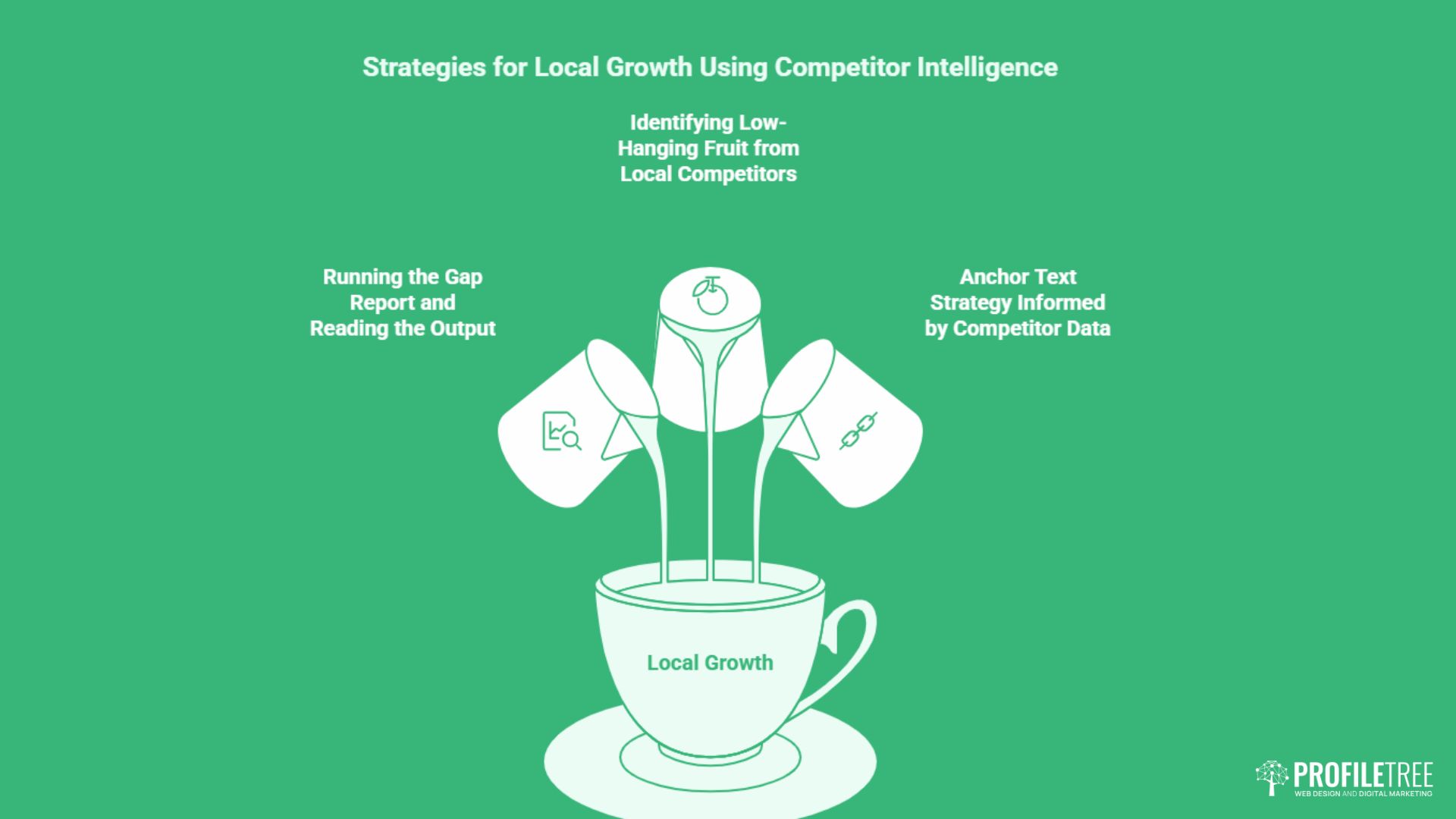
Knowing your own link profile is only half the picture. The Backlink Gap tool gives you a structured view of where competitors are earning links that you are not, which turns abstract competitive research into a concrete outreach list. For UK and Irish SMEs, this is often the fastest route to meaningful link growth.
Running the Gap Report and Reading the Output
Open Backlink Gap and enter your domain alongside two to four competitors. Choose domains that rank consistently for your target queries rather than aspirational giants with budgets you cannot match. The report shows three categories: domains that link to all sites,s including yours (Best), domains that link to competitors but not to you (Weak), and domains exclusive to a single competitor (Strong).
The Weak category is your primary target. These sites have already made an editorial decision to link to content in your niche. Sort by Authority Score to prioritise the highest-value prospects first, then filter by location to surface UK and Irish domains within that list.
Identifying Low-Hanging Fruit from Local Competitors
Regional competitors often earn links from sources that national players overlook: local chambers of commerce, regional business magazines, council economic development pages, and area-specific business directories. These domains tend to have modest global authority scores but carry genuine trust signals for localised queries.
Cross-reference the Gap output against domains you recognise from the regional landscape. A link from a Belfast business forum or a Northern Ireland trade association is straightforward to request if you have a legitimate reason to be listed. A short, direct pitch explaining your relevance to their audience, with a specific page on your site to link to, is typically all that is required. This kind of outreach is a practical application of the content marketing services ProfileTree delivers for clients across the region.
Anchor Text Strategy Informed by Competitor Data
The Gap report also surfaces how competitors’ links are anchored. Review the anchor text distribution for the domains linking to your competitors but not to you. If those links consistently use branded anchors, generic anchors, or topical descriptors, your outreach messaging should propose anchor text that fits the same natural pattern.
Over-optimised exact-match anchor text, particularly when concentrated in links from a short period, is one of the clearest signals of manipulative link building. A healthy profile mixes branded anchors, partial matches, generic phrases, and bare URLs. The Gap report, read through this lens, tells you what a natural anchor distribution looks like for your niche and market.
Backlinks, AI Overviews, and What It Means for UK Search
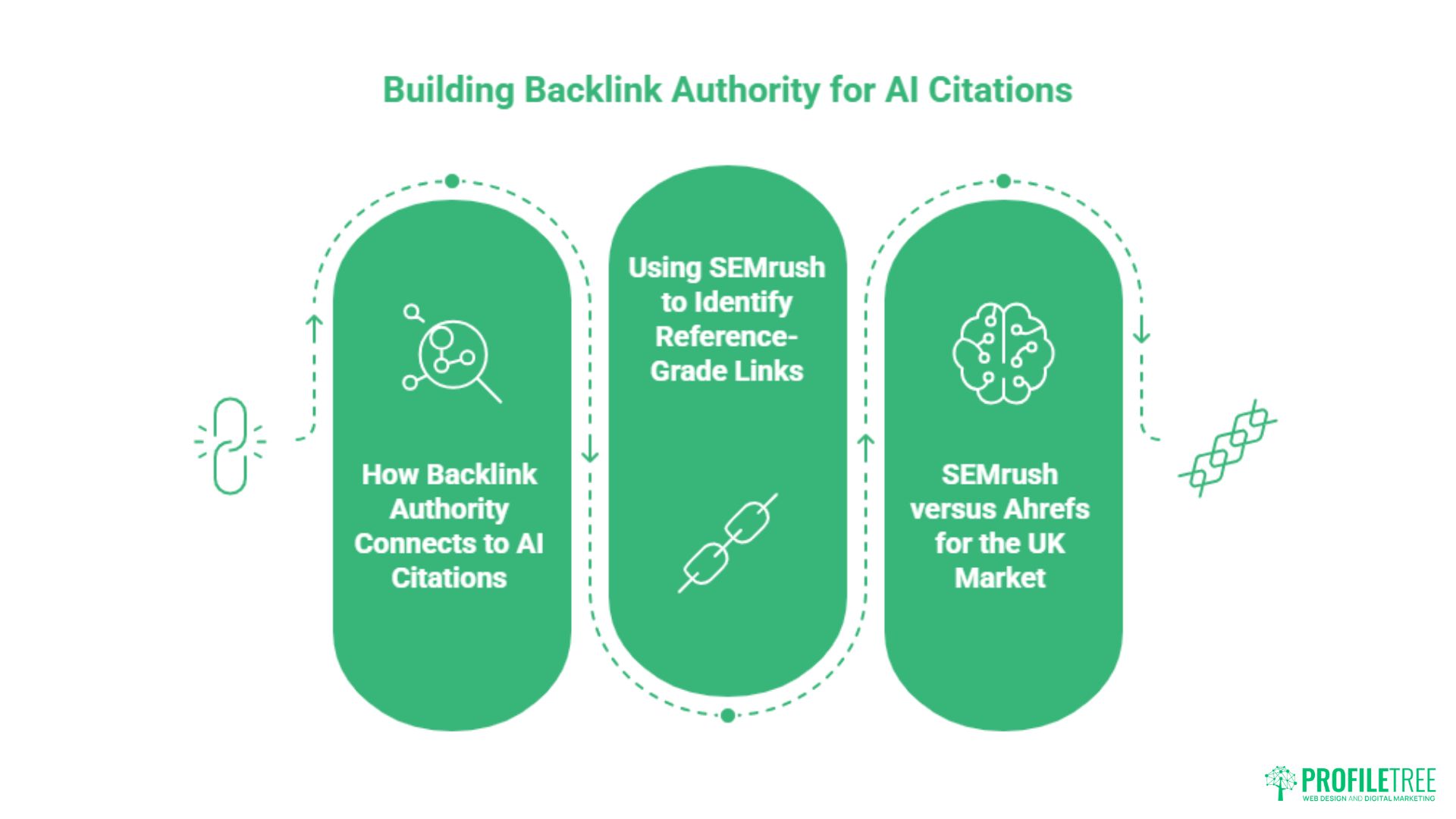
The role of backlinks has shifted in one important respect over the past 18 months. Google’s AI Overviews, Bing’s AI-generated answers, and ChatGPT’s browsing citations all draw on a common principle: they cite sources they consider authoritative and trustworthy. The link signals that help you rank in traditional search are the same signals that make you citeable in AI-generated responses, but the mechanism is different enough to warrant separate attention.
How Backlink Authority Connects to AI Citations
AI systems process web content to weigh pages that are already treated as authoritative by other high-quality sources. A page with a strong referring domain profile from relevant, trusted sites is more likely to be selected as a citation than a page with thin or low-quality link equity. In practical terms, this means the same link-building work that improves traditional rankings also improves your visibility in AI-generated answers.
The distinction lies in content structure. AI systems extract self-contained passages rather than ranking whole pages. A strong backlink profile gets your page into the candidate pool; structured, answer-first content determines whether a passage from that page gets pulled into an AI response. This is why combining backlink analysis with attention to on-page structure, as part of a broader digital marketing strategy, produces compounding results.
Ciaran Connolly, founder of ProfileTree, notes: “We see this playing out with client sites regularly. The pages earning AI citations are almost always the ones with both strong backlink profiles and clearly structured, factual content. Neither element works without the other.”
Using SEMrush to Identify Reference-Grade Links
Not all high-authority backlinks carry equal weight for AI citation purposes. Links from pages that are themselves cited frequently in AI responses carry a stronger association. SEMrush’s Authority Score is a reasonable proxy, but you can refine this further by looking at the traffic and topical relevance of linking pages alongside their domain authority.
Filter your referring domains report for domains with Authority Scores above 60 and traffic above 5,000 monthly visits. Within that set, prioritise domains whose content overlaps directly with your topic rather than general news aggregators or generic directories. These reference-grade links are harder to earn but significantly more valuable both for traditional rankings and for AI visibility. Reaching this level of authority often requires the kind of structured content approach covered in ProfileTree’s digital marketing services.
SEMrush versus Ahrefs for the UK Market
The practical question most UK agencies and SMEs face is whether SEMrush or Ahrefs gives a more accurate picture of the UK backlink landscape. Both tools index hundreds of billions of links, but their crawl priorities differ. Ahrefs is generally considered to have a larger raw database, while SEMrush offers stronger integration between backlink data and keyword research, site audit, and position tracking in a single interface.
For UK-specific filtering, both tools perform comparably. The decision typically comes down to workflow rather than data quality. If your team lives in a single platform and also needs keyword research and technical auditing alongside backlink analysis, SEMrush’s integrated project environment is the more efficient choice. If raw backlink database size and crawl frequency are the primary criteria, Ahrefs has the edge. Most established UK agencies maintain access to both, using SEMrush for client reporting and project management and Ahrefs for deep competitive research.
Reporting, ROI, and Building a Future-Proof Link Profile
Backlink analysis that stays inside the SEMrush interface has limited value. The work becomes useful when findings are translated into clear actions for internal teams, reported to stakeholders in language they understand, and connected to measurable outcomes. This section covers the reporting workflow and the principles behind a link profile designed to hold its value through algorithm updates.
Exporting Data and Creating Stakeholder Reports
SEMrush allows CSV and PDF exports from every major backlink report. For stakeholder reporting, the most useful exports are the referring domains summary (showing total domains, growth trend, and Authority Score distribution), the toxic link list with scores, and the Backlink Gap prospect list with prioritisation notes.
Structure stakeholder reports around outcomes rather than metrics. Rather than presenting a raw count of backlinks, frame the data as: “We currently have X referring domains in the UK, up from Y last quarter. Competitor A has Z UK domains; we do not. Closing that gap in three priority categories will require the following actions.” This framing connects the data to decisions, which is what makes reporting useful rather than decorative. Teams investing in digital training for internal staff find that this outcome-oriented reporting approach becomes part of their standard SEO practice.
Is SEMrush Worth the Cost for UK SMEs?
SEMrush Pro costs approximately £99 per month at current UK pricing. A manual backlink audit from a UK agency typically runs between £500 and £1,500 for a single project, depending on the size of the profile and the depth of analysis required. For a business running quarterly audits, the tool pays for itself against agency costs within the first two quarters, provided someone in-house has the skills to use it effectively.
The stronger case for the subscription is the ongoing monitoring capability. A one-off agency audit captures a point in time. SEMrush’s continuous crawl means you see new toxic links, lost referring domains, and competitor gains as they happen rather than discovering them retrospectively. All prices and figures in this guide are indicative UK examples and correct at the time of writing; use them as a benchmark rather than fixed quotations.
Building a Diverse and Durable Backlink Profile
A profile built for long-term stability mixes link types, anchor text variants, and source domains in proportions that reflect natural editorial behaviour. Overconcentration in any single category, whether exact-match anchors, links from a specific domain type, or links acquired within a short period, creates patterns that algorithm updates are increasingly good at identifying.
Practical diversity means pursuing editorial links from original content, directory listings on legitimate regional and industry directories, links earned through digital PR and media coverage, and links from partner and supplier sites where the relationship is genuine. This approach connects naturally to AI-enhanced marketing workflows that help identify the content angles most likely to earn organic links at scale. The reasons content fails to rank often trace back to link profile gaps as much as to on-page issues.
Embedding SEMrush into a Regular SEO Workflow
The most effective use of SEMrush for backlink analysis is not periodic: it is continuous. Set up automated email alerts within your project for new toxic links and significant referring domain losses. Run a Backlink Gap comparison against your top three competitors monthly. Review your anchor text distribution quarterly to catch drift toward over-optimisation before it becomes a problem.
This cadence keeps link analysis connected to the rest of your SEO activity rather than operating as a separate exercise. Combined with technical auditing, keyword tracking, and content performance monitoring, it gives you a full picture of why rankings move and what to do next. For businesses that want support building this kind of structured approach, ProfileTree’s SEO services cover both the analysis and the execution.
Conclusion
SEMrush for backlink analysis gives UK and Irish businesses a structured way to audit their link health, close competitor gaps, and build profiles that hold up through algorithm changes and AI-driven search evolution. The tools are only as useful as the process behind them: regular audits, disciplined disavowal, regional filtering, and stakeholder-ready reporting transform data into decisions.
If you want ProfileTree to handle the analysis and the execution, get in touch with our SEO team.
FAQs
Is SEMrush better than Ahrefs for UK backlinks?
Both tools index comparable volumes of UK backlinks. Ahrefs tends to have a larger raw database and faster crawl updates, while SEMrush offers stronger integration across keyword research, site audit, and backlink analysis in a single project interface. For UK agencies and SMEs that need an all-in-one platform with cleaner, consolidated reporting, SEMrush is typically the more practical choice.
How often should I run a backlink audit?
For sites actively building links or operating in competitive niches, monthly is ideal. For smaller sites with modest link acquisition activity, quarterly is sufficient. Set up automated SEMrush alerts for new toxic links so you don’t have to wait for a scheduled audit to catch a problem.
Can I remove toxic links for free without SEMrush?
Yes. Google Search Console includes a free Disavow Links tool. You can identify potentially harmful links manually or through a free-tier check, compile them into a text file in Google’s required format, and submit directly via Search Console. The limitation of the free approach is scale and ongoing monitoring: manual identification of toxic links across a large profile is time-consuming, and there is no automated alert when new ones appear.
Does SEMrush show NoFollow links?
Yes. SEMrush distinguishes between follow and nofollow links in its Backlink Analytics report. Nofollow links still matter for a natural-looking profile: a profile with zero nofollow links is itself an unusual pattern. They also drive referral traffic and brand visibility regardless of their effect on link equity.
Why did my Authority Score drop suddenly?
Authority Score in SEMrush is a relative metric recalculated against the wider web each time SEMrush updates its database. A drop does not always mean you lost links: it may mean that other sites in your category gained links faster than you did, shifting where you sit in the relative distribution. Check your referring domain count and backlink count alongside the score. I