
YouTube Premium Explained: Features, Pricing & Benefits for UK Users
Table of Contents
YouTube Premium revolutionises the way millions of people consume video content. As a paid membership service, it removes advertisements, adds offline viewing capabilities, and grants access to YouTube Music Premium. For businesses and content creators, understanding this platform is crucial because it influences how audiences engage with video content and presents opportunities to reach subscribers who actively pay for premium experiences.
The service costs £11.99 monthly in the UK after a one-month trial period. With over 2 billion logged-in monthly accounts and more than a billion hours watched daily, YouTube dominates the online video landscape. Premium subscribers represent a segment willing to invest in their viewing experience, making them valuable for brands creating video content strategies.
The Core Features That Define YouTube Premium
YouTube Premium was launched in 2015 as YouTube Red, before being rebranded in 2018. The service expanded from the US to include the UK, Canada, Australia, New Zealand, Mexico, South Korea, and several European countries. This growth reflects increasing demand for ad-free streaming experiences.
Ad-Free Viewing Across All Devices
The primary benefit is the removal of all advertisements from videos. No pre-roll ads, no mid-roll interruptions, no banner displays. This creates uninterrupted viewing sessions, particularly valuable for longer content like tutorials, documentaries, or music compilations.
For businesses producing video content, this matters. Premium subscribers watch content differently from free accounts. They engage more deeply because interruptions don’t break their focus. When creating content for YouTube, consider how Premium subscribers consume material without the natural breaks that ads provide.
Offline Downloads for Mobile Viewing
Downloads work similarly to Spotify’s offline feature. Users can save videos to their mobile devices for viewing without an internet connection. This proves helpful during commutes, flights, or areas with poor connectivity.
The download feature supports various video formats and quality levels. Business travellers and commuters form a significant portion of this audience, watching content during daily journeys where internet access may be unreliable.
Background Play Functionality
Background play allows audio to continue when switching apps or turning off the screen. This matters primarily for music content, podcasts, and audio-focused videos.
The feature is available across the YouTube, YouTube Music, and YouTube Kids mobile applications. For content creators producing podcast-style content or music videos, this expands how audiences can consume material beyond active viewing.
YouTube Music Premium Access
The subscription includes full access to YouTube Music Premium. This provides:
- Ad-free music streaming
- Offline downloads for songs and albums
- Music video viewing for most tracks
- Background playback on mobile devices
YouTube Music competes directly with Spotify and Apple Music. The integration provides Premium subscribers with a comprehensive audio and video streaming package. For businesses, this means YouTube serves both visual and audio content needs through a single subscription.
YouTube Originals Content
Premium subscribers have access to exclusive original series, films, and documentaries. Past offerings included shows like Cobra Kai, Step Up: High Water, and various reality series.
YouTube has evolved its Originals strategy over time, making some content freely available while retaining specific productions as Premium-exclusive. The library features a diverse range of content, including reality shows, docuseries, animated content, and scripted dramas.
“YouTube Premium represents more than ad-free viewing. It’s about creating an ecosystem where content consumption adapts to different contexts—whether that’s active viewing, background listening, or offline access during travel,” notes Ciaran Connolly, Director at ProfileTree.
Pricing Structure and Subscription Options
Understanding YouTube Premium’s cost structure helps businesses and individuals assess whether the investment aligns with their content consumption habits and budget.
Individual Plans
The standard individual subscription costs £11.99 monthly in the UK and $11.99 in the US. This followed price adjustments in 2024 that reflected increased content costs and platform development.
The pricing includes:
- Complete ad removal across YouTube
- Full YouTube Music Premium access
- Background play on all devices
- Offline download capabilities
- YouTube Originals access
Family Plans
Family subscriptions cost £17.99 monthly in the UK ($17.99 in the US). This allows up to six household members to share Premium benefits under one subscription. Each member maintains their own account, recommendations, and viewing history.
Family plans offer significant savings for households with multiple YouTube accounts. The per-person cost drops to approximately £3 per month when fully utilised.
Student Discounts
Students with verified enrolment status can access discounted subscriptions through YouTube’s student programme. Verification typically requires proof of current enrolment at an accredited institution.
This programme targets younger demographics who form a significant portion of YouTube’s active audience, making video content marketing to students more accessible.
Regional Pricing Variations
Subscription costs vary by country and region. YouTube adjusts pricing based on local economic conditions and competitive positioning against local streaming services.
UK businesses targeting international audiences should take note of these regional differences when developing their global content strategies. Premium subscriber behaviour may vary across markets due to pricing accessibility.
Content Preferences Among Premium Subscribers
Premium subscribers demonstrate distinct viewing patterns compared to free accounts. Understanding these patterns helps businesses create more effective video content.
Genre Performance Analysis
Premium subscribers favour entertainment-driven content with specific genre preferences:
Comedy Content: Sketch comedy, stand-up routines, and sitcom-style programming perform strongly. Subscribers seeking stress relief and entertainment tend to gravitate toward humorous content that offers quick engagement.
Action Programming: Thriller sequences and action-packed storytelling resonate with subscribers. This includes both fictional narratives and real-life adventure documentaries.
Drama Series: Emotionally engaging dramas exploring complex relationships attract sustained viewing. Premium subscribers invest time in serialised content without ad interruptions, which can break the narrative flow.
Reality Programming: Docu-series, talent competitions, and reality dramas maintain consistent viewership. The format’s authenticity appeals to subscribers across demographics.
Music Content: Music videos and live performances receive substantial engagement. YouTube Music integration makes the platform a primary destination for music consumption, both audio and video.
Video Length Preferences
Premium subscribers tend to prefer shorter formats, with higher engagement rates for content under 10 minutes. This suggests subscribers value concise, focused content that respects their time.
However, longer-form content performs well for specific genres:
- Documentaries: Extended formats work when providing deep topic exploration
- Drama Series: Episode lengths matching traditional television formats maintain engagement
- Reality Programming: Longer episodes succeed when narrative momentum sustains interest
Businesses creating video content should strike a balance between length and value. Shorter videos attract broader viewership, whilst longer content serves audiences seeking comprehensive information or entertainment.
How YouTube Premium Supports Content Creators
Premium subscriptions affect creator revenue differently from ad-supported viewing, creating implications for businesses producing video content.
Revenue Distribution Model
Creators receive payment based on watch time from Premium subscribers. The more Premium members watch a channel’s content, the larger share of subscription revenue that channel receives.
This differs from traditional advertising revenue, where:
- Ad-supported views generate income per advertisement shown
- Premium views generate income based on total viewing time
- Ad blockers eliminate revenue from free accounts
- Premium viewing guarantees creator compensation
For content creators, Premium subscribers represent a reliable source of revenue. These accounts can’t use ad blockers to watch content for free, while denying creators income.
Impact on Content Strategy
The Premium revenue model encourages specific content approaches:
Longer Watch Times: Content that keeps Premium subscribers engaged for extended periods generates more revenue than short clips that quickly lose attention.
Series Development: Multi-part series that builds loyal Premium viewership, creates consistent revenue streams as subscribers return for new episodes.
Quality Over Quantity: Premium subscribers often seek higher production value and substantive content, rewarding creators who invest in quality rather than chasing viral moments.
Businesses should consider how Premium subscribers consume content when developing video marketing strategies. Creating value-rich content that sustains engagement benefits both audience satisfaction and creator compensation.
Assessing YouTube Premium’s Value Proposition
Determining whether Premium justifies its cost requires examining usage patterns and alternative options.
Primary Benefits Analysis
- Ad Elimination: Removes 100% of advertisements across all video content. For frequent accounts, this saves substantial time that would otherwise be spent watching promotions.
- Offline Capability: Downloads enable viewing without internet dependency—valuable for travellers, commuters, and those with unreliable connectivity.
- Background Audio: Allows YouTube to function as a music player with the screen off, conserving battery life on mobile devices.
- Music Streaming: Full YouTube Music access provides a Spotify/Apple Music alternative with video capabilities.
When Premium Makes Sense
Premium proves valuable for:
- Frequent YouTube Accounts: Those watching multiple hours daily reclaim significant time otherwise lost to advertisements.
- Music Listeners: Subscribers who want both music streaming and video content get dual functionality from a single subscription.
- Mobile-Heavy Consumption: Accounts primarily using mobile devices benefit most from background play and offline downloads.
- Content Professionals: Marketers, video producers, and media professionals who study YouTube content professionally gain research efficiency without ad interruptions.
When Free Access Suffices
Standard YouTube access may be adequate for:
- Occasional Viewing: Light accounts watching a few videos weekly don’t lose much time to advertisements.
- Desktop-Only Consumption: Accounts primarily used for watching on computers with ad blockers may achieve similar ad-free experiences through alternative means.
- Budget-Conscious Households: Families prioritising other subscriptions may find free YouTube acceptable, given limited viewing time.
Comparing YouTube Premium Against Streaming Competitors
Understanding how Premium positions against alternatives helps businesses and consumers make informed subscription decisions.
YouTube Premium vs Spotify
| Feature | YouTube Premium | Spotify Premium |
| Monthly Cost (UK) | £11.99 | £10.99 (Individual) |
| Music Library | 100M+ tracks | 82M+ tracks |
| Video Content | Full YouTube library | Limited video podcasts |
| Ad-Free Experience | Complete | Music only |
| Offline Downloads | Music & videos | Music only |
| Background Play | Full functionality | Music only |
Key Differences: YouTube Premium includes full video platform access, whilst Spotify focuses exclusively on audio streaming. Premium serves accounts wanting both music and video content from one subscription.
YouTube Premium vs Amazon Prime Video
| Feature | YouTube Premium | Prime Video |
| Monthly Cost (UK) | £11.99 | £8.99 (standalone) |
| Content Type | User-generated + Originals | Professional productions |
| Content Volume | 100M+ videos | 24,000+ titles |
| Music Included | Yes (YouTube Music) | No (separate subscription) |
| Live Content | Abundant | Limited |
| Download Limits | No restrictions | Select titles only |
Key Differences: Prime Video emphasises professionally produced films and series, whilst YouTube Premium provides access to diverse creator content alongside original programming. The platforms serve different consumption patterns.
Selecting the Right Service
Choose YouTube Premium if:
- You watch substantial YouTube content daily
- Music videos form part of your listening habits
- Creator content and tutorials feature prominently in your consumption
- Mobile viewing and background play matter significantly
- You want a single subscription for music and video
Choose Spotify if:
- Audio-only streaming meets your needs
- Podcast consumption is the primary focus
- You rarely watch video content
- Curated playlists and music discovery tools are priorities
Choose Prime Video if:
- Film and television series form your primary viewing
- You already subscribe to Amazon Prime for shopping benefits
- Professional production quality matters most
- You consume less user-generated content
Integration with Digital Marketing Strategy
Businesses creating video content should consider Premium subscribers as a distinct audience segment with specific characteristics and behaviours.
Premium Subscribers as Target Audience
Premium accounts demonstrate:
- Higher Engagement: No ad breaks mean sustained attention throughout videos. Content that maintains quality throughout its length performs better with this audience.
- Financial Capability: Willingness to pay for an enhanced experience suggests disposable income and potential purchasing power.
- Platform Loyalty: An Active subscription indicates committed YouTube users who regularly consume video content.
- Content Quality Expectations: Paying subscribers expect professional production values and substantive content that justifies their investment.
Content Creation Considerations
Businesses producing video content for YouTube should:
- Optimise for Watch Time: Premium subscribers generate revenue based on viewing duration. Create content that sustains engagement throughout its length.
- Prioritise Value Delivery: Premium accounts expect content that justifies their subscription investment. Focus on educational value, entertainment quality, or practical utility.
- Consider Mobile Viewing: Premium benefits emphasise mobile consumption. Frame shots appropriately for smaller screens and consider viewing contexts such as commuting.
- Test Longer Formats: Premium subscribers show greater tolerance for extended content when it delivers sustained value. Consider tutorial series, detailed product demonstrations, or comprehensive guides.
Video SEO for Premium Visibility
YouTube functions as the world’s second-largest search engine. Premium subscribers still discover content through search and recommendations.
- Title Optimisation: Clear, keyword-rich titles help content appear in relevant searches—balance SEO with compelling copy that encourages clicks.
- Thumbnail Design: Eye-catching thumbnails compete for attention in crowded feeds. A/B test designs to identify what resonates with your target audience.
- Description Rich Content: Comprehensive descriptions containing relevant keywords improve discoverability whilst providing context that encourages viewing.
- Engagement Signals: Comments, likes, and shares influence recommendation algorithms. Create content that encourages audience interaction to boost visibility.
ProfileTree’s video production services incorporate these considerations from the planning stage. Understanding how Premium subscribers discover and consume content informs our production approach, helping clients maximise their YouTube investment.
Migration from YouTube Red to Premium
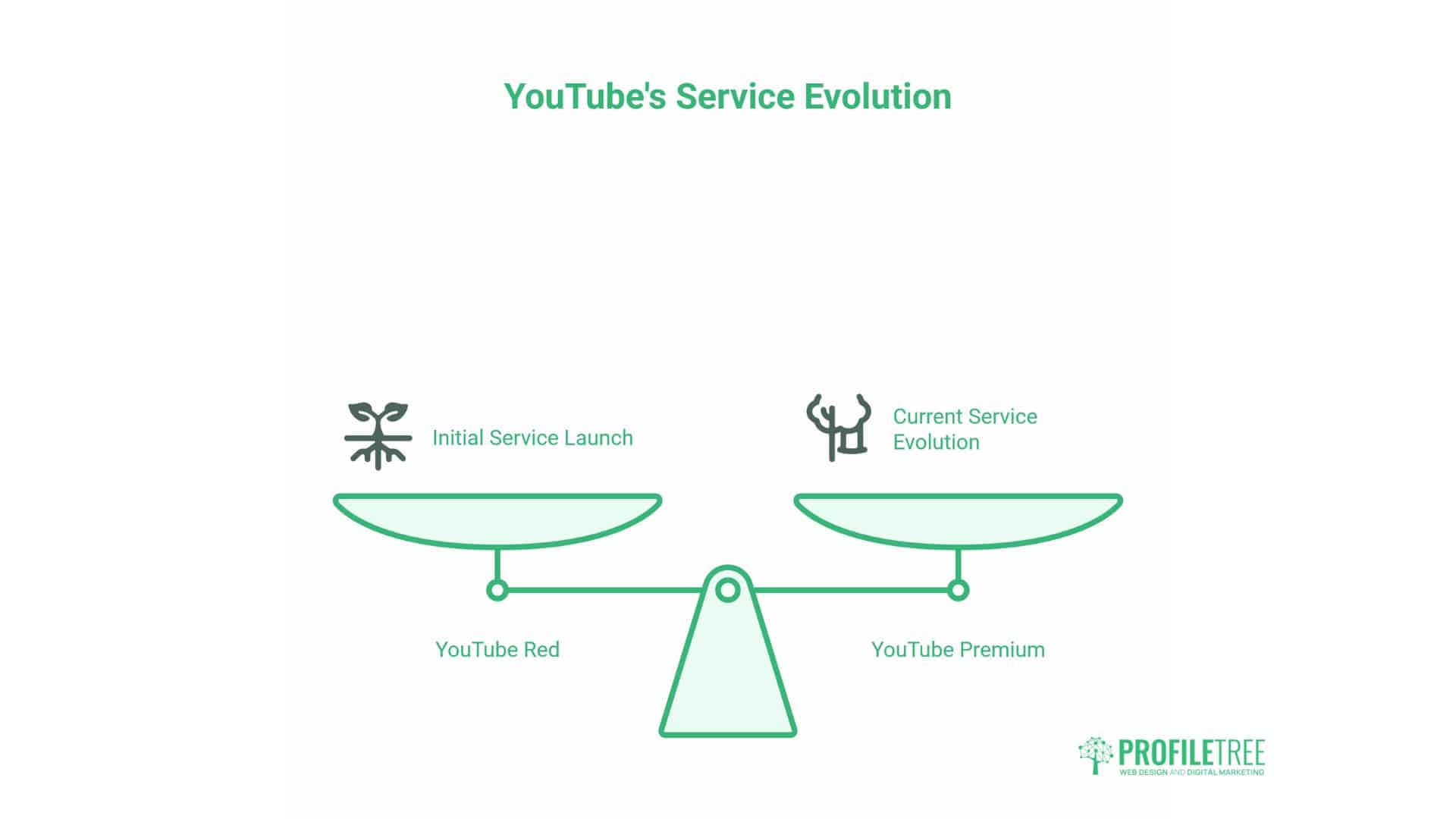
YouTube’s subscription service has undergone significant evolution since its 2015 launch, reflecting shifts in market conditions and competitive pressures.
Initial Launch as YouTube Red
YouTube Red launched in the US in 2015, offering ad-free viewing and exclusive content access. The service targeted users frustrated with the increasing frequency of ads, while creating new revenue streams for YouTube and its creators.
Initial expansion included:
- 2016: Australia and New Zealand access
- 2016: South Korea launches
- 2018: Canada and 11 European countries, including the UK
Rebranding to YouTube Premium
The 2018 rebrand to YouTube Premium simplified the service name, coinciding with the introduction of YouTube Music. This created more precise differentiation between video-focused Premium and music-focused Music Premium subscriptions.
The rebrand addressed confusion around YouTube Red’s positioning and better communicated the service’s premium nature. Marketing emphasised comprehensive benefits rather than singular features.
Current Service Evolution
YouTube Premium continues evolving with:
- Feature Additions: Regular updates add functionality based on user feedback and competitive analysis.
- Pricing Adjustments: Subscription costs are periodically adjusted to reflect changes in content licensing costs, platform development, and market positioning.
- Original Content Strategy: YouTube’s approach to Originals has shifted, with some content becoming freely available while maintaining Premium exclusives.
- Geographic Expansion: A gradual rollout to additional countries extends Premium’s global reach, although many regions still lack access.
Technical Requirements and Device Compatibility
Premium works across devices and platforms, although specific features vary depending on the context.
Supported Platforms
- Mobile Devices: Full functionality on iOS and Android through the YouTube and YouTube Music apps. Background play and offline downloads are exclusive to mobile devices.
- Web Browsers: Ad-free viewing available through desktop browsers on Windows, macOS, and Linux systems. Background play and downloads are unavailable in browser versions.
- Smart TVs: Ad-free viewing on smart TV YouTube applications, including Samsung, LG, Sony, and others. Downloads and background play don’t apply to TV contexts.
- Gaming Consoles: PlayStation, Xbox, and Nintendo Switch support Premium, ad-free viewing through their YouTube applications.
Streaming devices, including Roku, Apple TV, Chromecast, and Amazon Fire TV, offer ad-free Premium experiences.
Feature Limitations by Platform
| Feature | Mobile | Desktop | Smart TV | Streaming Devices |
| Ad-Free Viewing | ✓ | ✓ | ✓ | ✓ |
| Offline Downloads | ✓ | ✗ | ✗ | ✗ |
| Background Play | ✓ | ✗ | N/A | N/A |
| YouTube Music | ✓ | ✓ | Limited | Limited |
| 4K Quality | ✓ | ✓ | ✓ | ✓ |
Account Management
Premium subscriptions are linked to Google accounts, providing seamless access across all devices. Users sign in once per device, with Premium status automatically recognised.
Family plans require household members to link their accounts through Google Family Sharing. Each member accesses Premium independently, while billing consolidates under the primary subscription holder.
Alternatives to YouTube Premium for Ad-Free Viewing
Several methods allow for ad-free YouTube experiences without requiring a Premium subscription, although each comes with its own limitations or compromises.
Browser Extensions and Ad Blockers
Ad-blocking software removes advertisements from YouTube videos when browsing on desktop computers. Popular options include uBlock Origin, AdBlock Plus, and Ghostery.
Limitations:
- Only works on desktop browsers, not mobile devices
- Doesn’t provide offline downloads or background play
- Prevents revenue from reaching content creators
- Violates YouTube’s terms of service
- May break functionality on some websites
YouTube Premium Alternatives
- Spotify + Ad Blocker Combination: Spotify Premium for music (£10.99 monthly) plus a desktop ad blocker for video viewing. This approach is less expensive but offers reduced functionality.
- YouTube TV: A Different service focused on live television streaming rather than on-demand video platform. Doesn’t remove ads from standard YouTube viewing.
- Third-Party YouTube Apps: Various unofficial applications claim ad-free YouTube access. These violate the terms of service and risk account suspension or security vulnerabilities.
Free Account Limitations
Standard YouTube accounts include:
- Advertisements before, during, and alongside videos
- No offline download capability
- No background play functionality
- Limited YouTube Music features with ads
For businesses, encouraging staff to use Premium rather than ad blockers supports the creator economy whilst improving productivity through uninterrupted viewing.
FAQs
How much does YouTube Premium cost in the UK?
YouTube Premium costs £11.99 monthly for individual subscriptions in the UK. Family plans cost £17.99 monthly, accommodating up to six household members. Student discounts reduce pricing for verified students enrolled at accredited institutions.
What’s included with YouTube Premium?
Premium includes ad-free viewing across all YouTube content, offline video downloads on mobile devices, background play functionality, full YouTube Music Premium access, and exclusive YouTube Originals programming. All features work across multiple devices linked to your Google account.
Can I share YouTube Premium with family members?
Yes, through the Family plan. This subscription costs £17.99 monthly and supports up to six household members aged 13 or older. Each member maintains their own account, recommendations, and viewing history whilst sharing Premium benefits.
Does YouTube Premium work on all devices?
Premium provides ad-free viewing across all YouTube-compatible devices, including mobile phones, tablets, computers, smart TVs, and streaming devices. However, offline downloads and background play function exclusively on mobile devices through the YouTube and YouTube Music apps.
Is YouTube Premium worth the cost?
Value depends on usage patterns. Premium proves worthwhile for frequent users watching multiple hours daily, those seeking integrated music streaming, and individuals with mobile-heavy consumption patterns. Light account holders who occasionally watch may find free access adequate, given the limited viewing time saved.
How do I cancel YouTube Premium?
Cancel through your Google account subscription settings. Navigate to Payments & Subscriptions, select YouTube Premium, and choose “Cancel Subscription.” Access continues until the end of the current billing period, after which your account reverts to a free status with advertisements.
Making the Premium Decision
YouTube Premium removes advertisements while adding offline downloads and background play functionality. The subscription proves most valuable for frequent viewers who watch several hours of content daily, mobile-focused users, and those seeking integrated music streaming alongside video content.
Light users watching occasionally may find free access adequate. Desktop-primary viewers can achieve similar experiences through alternative methods, though these don’t support content creators financially.
For businesses creating video content, Premium subscribers represent an engaged audience segment with higher attention spans and purchasing power. Content that maintains quality throughout performs exceptionally well with this audience, who watch without ad interruptions.
Whether you’re subscribing or creating content for Premium users, assess how YouTube aligns with your consumption patterns or business strategy. The subscription’s value correlates directly with usage frequency and the importance of uninterrupted, mobile-friendly video access.
Ready to develop a comprehensive video content strategy for YouTube? ProfileTree’s video production and digital marketing services help businesses create compelling content that resonates with both free and Premium audiences, combining creative production with technical SEO expertise to maximise your YouTube presence.
Does youtube offer senior discount?