
What is Product Marketing? Strategy, Lifecycle and How It Works
Table of Contents
Product marketing is the discipline that connects a product to the people it was built for. It covers how a product is positioned, messaged, launched and sustained in the market and it sits at the junction of your marketing, sales and product teams.
Most businesses understand they need to market their products. Fewer understand that product marketing is a distinct function with its own strategy, process and metrics, separate from general marketing. That distinction matters because companies that treat product marketing as an afterthought tend to launch well-built products that nobody buys.
This guide explains what product marketing actually involves, how it differs from traditional marketing and product management, and what a practical product marketing strategy looks like for an SME.
What is Product Marketing?
Product marketing is the process of bringing a specific product to market, then sustaining and growing its position there. It encompasses market research, audience segmentation, positioning, messaging, pricing input, go-to-market planning, and post-launch performance tracking.
Where general marketing promotes your business as a whole, product marketing zooms in on one thing: making a particular product the obvious choice for a particular audience. That focus is what makes it different.
Think about two of the most studied product marketing campaigns of recent decades. Apple’s Mac vs. PC campaign did not advertise Apple as a company — it positioned a specific product (the Mac) against a specific alternative (the PC) for a specific audience (creative professionals who found Windows clunky). Volkswagen’s relaunch of the VW Bus used silence, literally, to position an electric vehicle for an audience that values minimalism and environmental intent. Both campaigns succeeded because someone had done the strategic work before the creative work: they knew who the product was for, what it meant to that person, and why this product and not a competitor’s.
That upstream thinking is product marketing.
A product marketer’s core outputs are:
- A defined target audience for the product (distinct from general brand personas)
- A positioning statement: how the product sits in the market relative to alternatives
- A messaging framework: the language used across all channels to describe the product
- A go-to-market plan: how, when and where the product reaches customers
- Post-launch KPIs and feedback loops that feed back into the product team
The last point is important. Product marketing is not a launch event. It is a continuous function that runs from pre-launch research through to mature product management and, eventually, product sunsetting or pivoting.
Product Marketing vs Traditional Marketing vs Product Management
These three disciplines overlap and are frequently confused. The table below separates them clearly.
| Product Marketing | Traditional Marketing | Product Management | |
|---|---|---|---|
| Primary focus | A specific product and its audience | The brand and all its offerings | The product itself: features, build, roadmap |
| Main output | Positioning, messaging, GTM plan | Campaigns, brand awareness, lead generation | Feature delivery, uptime, and usage data |
| Key metric | Product revenue, adoption, market share | Traffic, leads, brand recognition | Feature delivery, uptime, usage data |
| Works closest with | Sales, product, and marketing teams | Marketing and creative teams | Engineering and design teams |
| Time horizon | Product lifecycle (ongoing) | Campaign cycles | Sprint and roadmap cycles |
Product marketing vs traditional marketing: Traditional marketing promotes a business and its full range of products or services. Product marketing is narrower; it focuses on making a single product successful with a single audience. The seven Ps of marketing (product, price, place, promotion, people, process, and physical evidence) are a useful framework here: product marketing takes ownership of the “product” P and strongly influences pricing and positioning, while traditional marketing owns the promotional Ps.
Product marketing vs product management: Product management builds the product. Product marketing brings it to market and keeps it there. A product manager works inward with engineers, designers and data teams to define and ship features. A product marketer works outward with customers, sales teams and the market to define how the product is understood and adopted. They are complementary, not competing.
For an SME, these functions often sit with one or two people rather than dedicated teams. What matters is that both types of thinking happen: someone must be responsible for building the product, and someone must be responsible for connecting it to the right audience.
The Product Marketing Lifecycle
Most articles on this topic focus almost entirely on the go-to-market phase. That is a problem because product marketing that stops at launch is only doing half the job.
The product marketing lifecycle has five distinct stages.
Stage 1: Discovery and audience research. Before any messaging is written, a product marketer needs to understand who the product is for and what problem it solves better than the alternatives. This means customer interviews, surveys, search data analysis, and competitive research. In the UK context, this stage must also consider GDPR compliance: how you collect and use consumer data shapes what research methods are available to you.
A Belfast-based software company launching a B2B tool, for example, needs to understand not just its buyers’ job titles but also the specific pain points relevant to Northern Ireland’s SME landscape — smaller teams, tighter budgets, and a lower appetite for complex onboarding. That audience specificity is what separates effective product marketing from generic content.
Stage 2: Positioning and messaging. Positioning answers the question: why should this customer choose this product over every alternative, including doing nothing? It is a strategic statement, not a tagline. Messaging translates that positioning into the language used across your website, ads, sales materials and social content.
Effective positioning is specific and defensible. “We help marketing teams reduce reporting time” is a position. “We’re a powerful marketing platform” is not. The former tells the customer something concrete; the latter tells them nothing they cannot find on a hundred competitor sites.
As Ciaran Connolly, founder of Belfast digital agency ProfileTree, puts it: “The businesses we see struggle most with product marketing are the ones that can’t finish the sentence ‘this product is for people who…’ with anything specific. Vague positioning means vague results.”
Stage 3: Go-to-market planning. The go-to-market (GTM) plan defines how the product reaches its audience. It covers channel selection, launch timing, pricing strategy, sales enablement, and the content assets needed to support the launch. For an SME, this does not need to be elaborate — but it does need to exist as a written plan before the launch date, not assembled in the weeks after.
Key decisions in a GTM plan include which channels you will prioritise (search, social, email, PR, paid). What does the sales team need to convert leads? What content will help customers understand and trial the product? What is the pricing model, and how does it compare to alternatives in the market?
Stage 4: Launch and activation. This is the stage most resources focus on, and it is genuinely important. A well-executed launch creates momentum that is difficult to build from scratch afterwards. But a launch is a moment, not a strategy. The assets, channels and messaging created in stages 1–3 are what make a launch land well.
Video plays a significant role in modern product launches. A well-produced product demo or brand film can communicate positioning and emotion in two minutes that five pages of copy cannot.
Stage 5: Post-launch optimisation and lifecycle management. After launch, product marketing shifts to measuring, learning and adapting. Which customer segments are converting? Which messages are resonating? Where is churn happening and why? This feedback is shared directly with the product team and informs the next iteration.
Many products eventually reach maturity or decline. Product marketing in this phase involves deciding whether to reposition (new audience or new use case), refresh (updated features, new pricing), or sunset the product. Companies that treat product marketing as purely a launch function find themselves unprepared when a product plateaus.
How to Build a Product Marketing Strategy
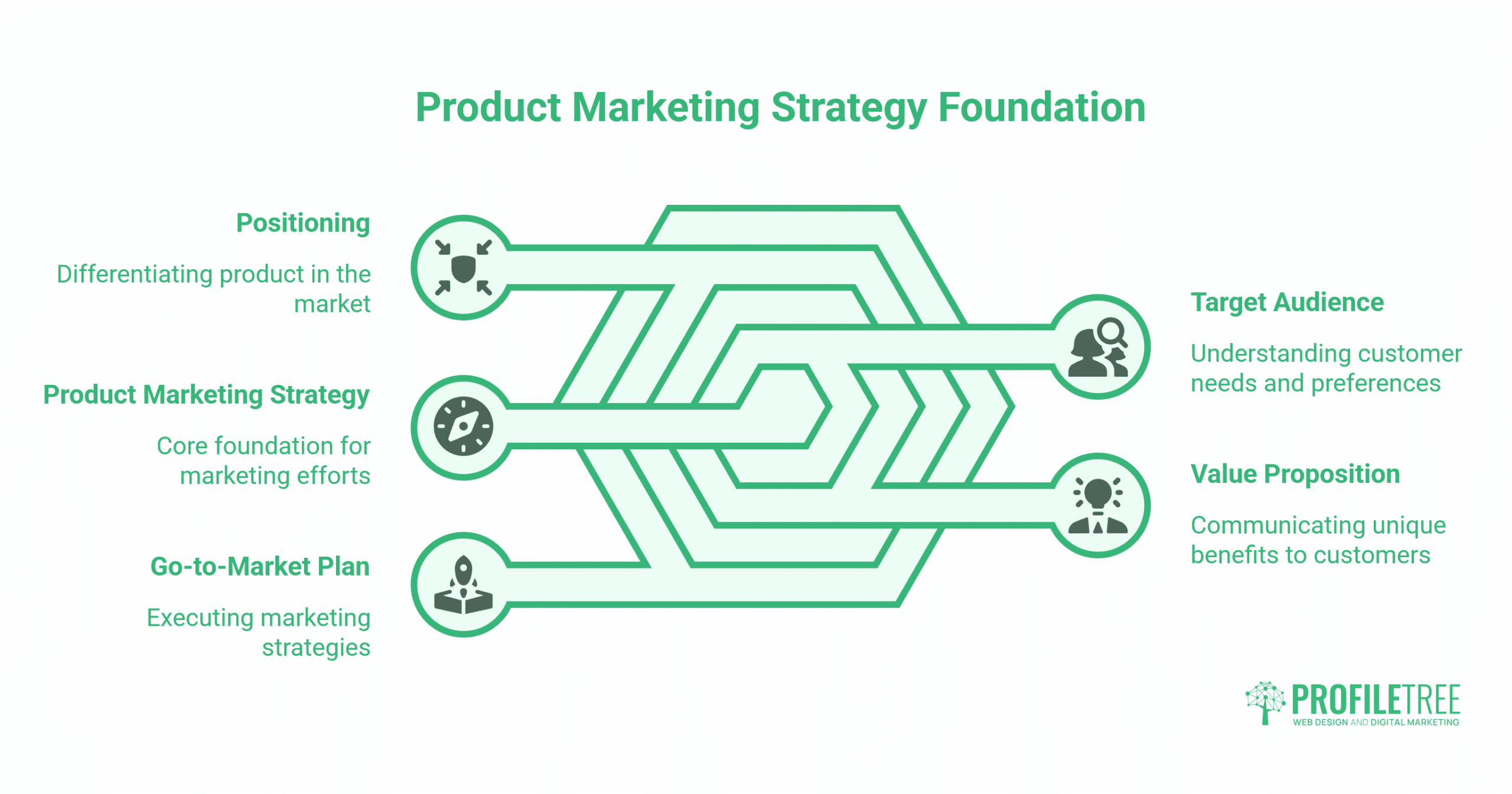
A product marketing strategy is not a campaign plan. It is the strategic foundation on which campaigns, content, and sales conversations are built. Here is what it needs to contain.
Define the product and the problem it solves. Start with a ruthlessly clear product definition. What does it do? What problem does it solve? What does the user need to be true for the product to work for them? Document this in one paragraph, not a list of features.
Segment and prioritise your audience. Not every potential customer is worth pursuing at the same time. Segment your market by firmographic (for B2B: company size, sector, location) or demographic criteria, then prioritise the segment most likely to buy quickly and generate revenue that supports growth. For UK businesses targeting SMEs, this often means narrowing by sector and geography initially — winning a tight vertical deeply before expanding broadly.
Develop your positioning and messaging. Using your audience research, define: (1) the primary benefit the product delivers to your priority segment, (2) the specific alternative it displaces (a competitor product, a manual process, or doing nothing), and (3) the proof points that make your claim credible. These three elements form the spine of your messaging framework.
Build your go-to-market plan. Choose the channels and tactics that are appropriate for your audience and budget. For most UK SMEs, this means: a well-optimised product landing page, content that answers pre-purchase questions through organic search, an email or outreach strategy to reach existing prospects, and potentially paid search to accelerate early visibility. ProfileTree’s digital marketing strategy services cover the planning and execution side of this for businesses that need external support.
Set metrics before launch. Define what success looks like before you launch, not after. Product-specific metrics to track include: sales volume and revenue, trial-to-paid conversion rate (for SaaS and subscription products), customer acquisition cost, and the product’s net promoter score. These should be tracked separately from general marketing metrics.
Create a feedback loop. Build in a structured review process monthly for the first six months post-launch, where sales data, customer feedback, and search performance data are reviewed together. The output of each review should be a short list of messaging or positioning adjustments to test in the next period.
How AI Is Changing Product Marketing
AI tools are now a practical part of the product marketing workflow rather than an experimental add-on. For SMEs in the UK, the most useful applications are:
Audience and persona research: Tools like ChatGPT and Claude can be used to synthesise customer interview notes, identify recurring pain points, and draft audience profiles faster than manual analysis. The output still requires human judgement, but the time to first draft is dramatically reduced.
Competitive intelligence: AI tools can process large volumes of competitor content, review data and search results to identify gaps in competitor positioning. This is particularly useful at the discovery stage of a new product launch.
Messaging testing: Before committing to a messaging framework, AI tools can generate multiple positioning variants for the same product, which can then be tested in ads, emails or landing page A/B tests.
Content production at scale: Product marketing generates significant content needs, including landing pages, email sequences, sales decks, FAQ sections, and social posts. AI-assisted drafting reduces the time cost of this content production, though human editing remains essential to remove generic phrasing and ensure brand voice consistency.
The risk is over-reliance. Product marketing depends on genuine customer understanding, which cannot be generated by an AI working solely on public data. The insight comes from real customer conversations, real sales calls and real market data. AI accelerates the process of working with that insight, but it does not replace the need to gather it.
Product Marketing for SMEs: What Good Looks Like
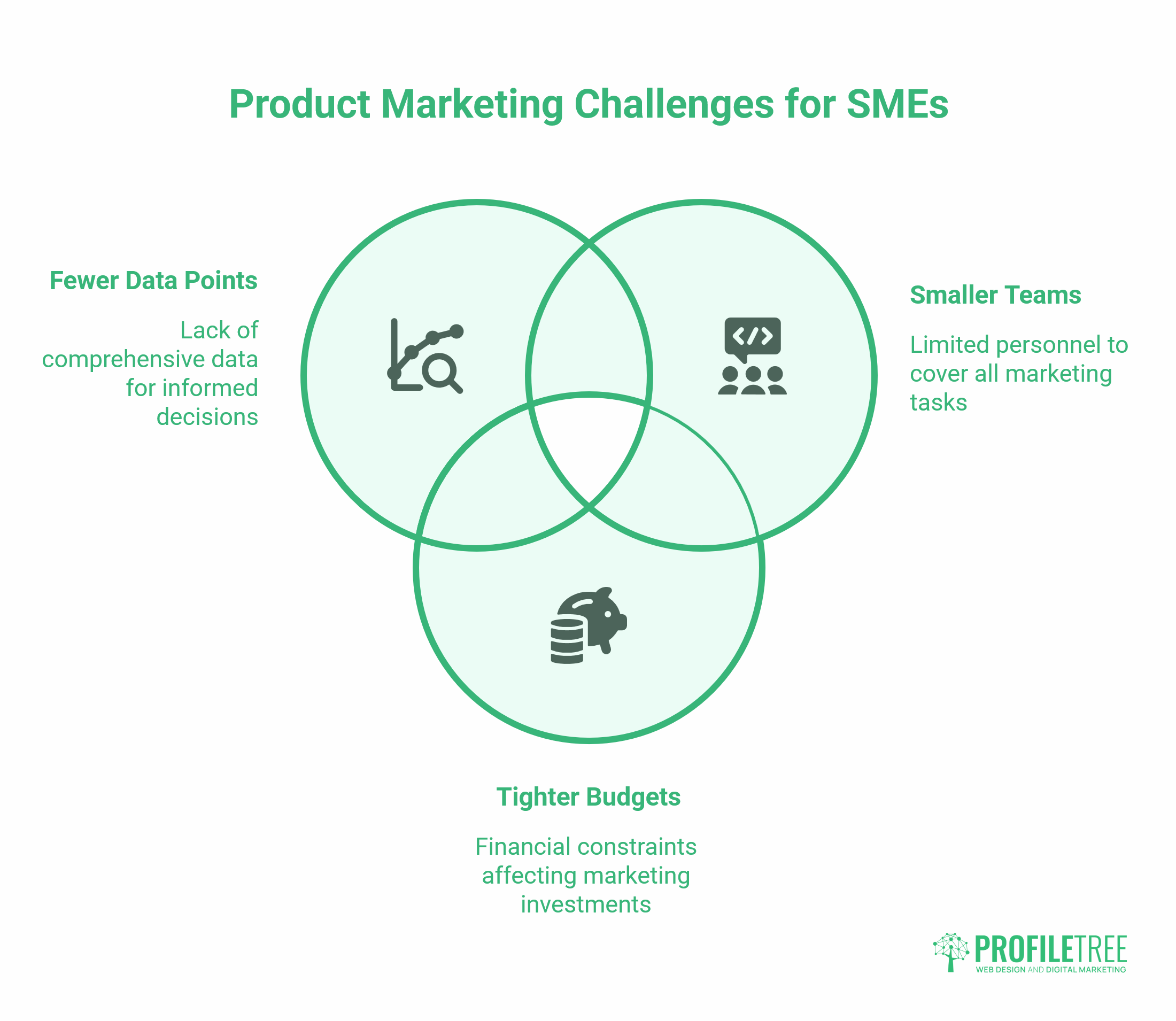
Large technology companies have dedicated product marketing teams with specialists for every stage of the lifecycle. SMEs face different constraints: smaller teams, tighter budgets, and fewer data points.
Good product marketing for an SME does not need to replicate enterprise practice. It needs to:
- Identify one specific audience segment rather than targeting everyone
- Produce one clear positioning statement before any campaign begins
- Build a product landing page that reflects the messaging framework not just a page that lists features
- Create a short but genuine GTM plan that commits to specific channels and a launch date
- Review performance monthly against pre-set product metrics
This is achievable with two or three people working in a structured way, or with external support from a digital agency that understands both strategy and execution.
ProfileTree works with SMEs across Northern Ireland, Ireland and the UK to build product marketing foundations alongside web, SEO and content delivery. For businesses launching a new product or repositioning an existing one, the new product development process is a useful starting point for understanding where product marketing sits in the broader commercial process.
Product Marketing Examples: What the Strategy Looks Like in Practice
Monzo: When Monzo launched in the UK, its product marketing strategy was built on a specific positioning: banking for people who find traditional banks frustrating. It did not compete on interest rates or branch numbers; it competed on experience. Every piece of content, every product update and every community touchpoint reinforced that positioning. The result was rapid adoption in a market traditionally resistant to switching.
Octopus Energy: Octopus entered a commoditised market (energy) and used product marketing to make transparency and technology its differentiators. Its messaging consistently focused on what made the product functionally different, real-time pricing, smart tariffs, rather than generic claims about “better service.” That specificity translated directly into customer acquisition.
Skyscanner: Skyscanner’s product marketing positioned the tool as a neutral comparison engine rather than a booking platform that favoured certain partners. That positioning built the trust that made it the default starting point for UK flight searches. The product itself is the marketing; the product marketing team’s job was to communicate what made it trustworthy.
None of these examples required a large budget at the outset. They required clear thinking about audience, positioning and messaging before any campaign spend.
Building a Product Marketing Capability
Product marketing is not a one-off project. The businesses that do it well treat it as an ongoing discipline: continuously researching their audience, testing their messaging, and refining their positioning as the market changes.
For SMEs without the in-house resources to run this function at full depth, the practical approach is to start with the foundations: clear positioning, a well-built product page, and a structured GTM plan—and build from there. ProfileTree’s digital marketing campaigns and content creation services are built to support exactly that kind of systematic development for businesses that are ready to take product marketing seriously. Get in touch to discuss what that looks like for your product.
FAQs
What is the difference between marketing and product marketing?
Marketing promotes your business and brand across all its products and services. Product marketing focuses on a single product, defining its audience, positioning it against alternatives, and driving its commercial performance.
What does a product marketer actually do?
A product marketer conducts customer and competitor research, develops positioning and messaging, builds go-to-market plans, produces launch content and sales materials, and tracks post-launch performance against product-specific metrics.
What are the main stages of product marketing?
Discovery and audience research, positioning and messaging, go-to-market planning, launch and activation, and post-launch lifecycle management. The last stage is the one most businesses underinvest in.
What is the difference between product marketing and product management?
Product management builds the product, working with engineers and designers on features and roadmap. Product marketing brings the product to market, working with sales and customers on positioning, messaging and adoption.