
Digital Training for Change Management: The Practical Enterprise Guide
Table of Contents
Most digital change projects do not fail because the software is poor. They fail because the people expected to use it never get the support they need to switch from the old way of working to the new one. New systems get bought, configured and switched on, and then sit half-used while staff quietly carry on with the spreadsheets and habits they trust. Digital training for change management is what closes that gap: a structured way of preparing a workforce to adopt new tools, not just be told about them.
This guide sets out how to design, deliver and measure that training for a real organisation. It covers the difference between old-style classroom rollouts and digital-first adoption, the tools that support learning inside the software itself, how to tailor training for different teams, and the UK and Ireland funding routes that can offset the cost. Throughout, the focus is practical: what an SME or mid-sized organisation across Northern Ireland, Ireland and the UK can actually put in place.
The intersection of digital change and workplace learning
Digital change management is the people side of a technology project. The technology team installs and configures the system; change management makes sure the workforce is ready, willing and able to use it well. Training is the part of that work that builds skill and confidence, so the link between “we have a new CRM” and “everyone uses the new CRM properly” actually holds.
Industry research has consistently pointed to user adoption, rather than the technology itself, as the most common reason transformation projects underdeliver. Bodies such as McKinsey and Gartner have published widely cited work on transformation failure rates tied to the human side of change. The exact figures move around between studies, so treat them as directional: a large share of projects miss their goals because people were not brought along, not because the code did not work.
Training sits inside a wider organisational change management (OCM) effort that also includes communication, sponsorship and reinforcement. Get the training element right and you remove the single biggest practical barrier to adoption, which is staff who do not feel confident performing their job in the new system.
Traditional versus digital-first change management: what has changed
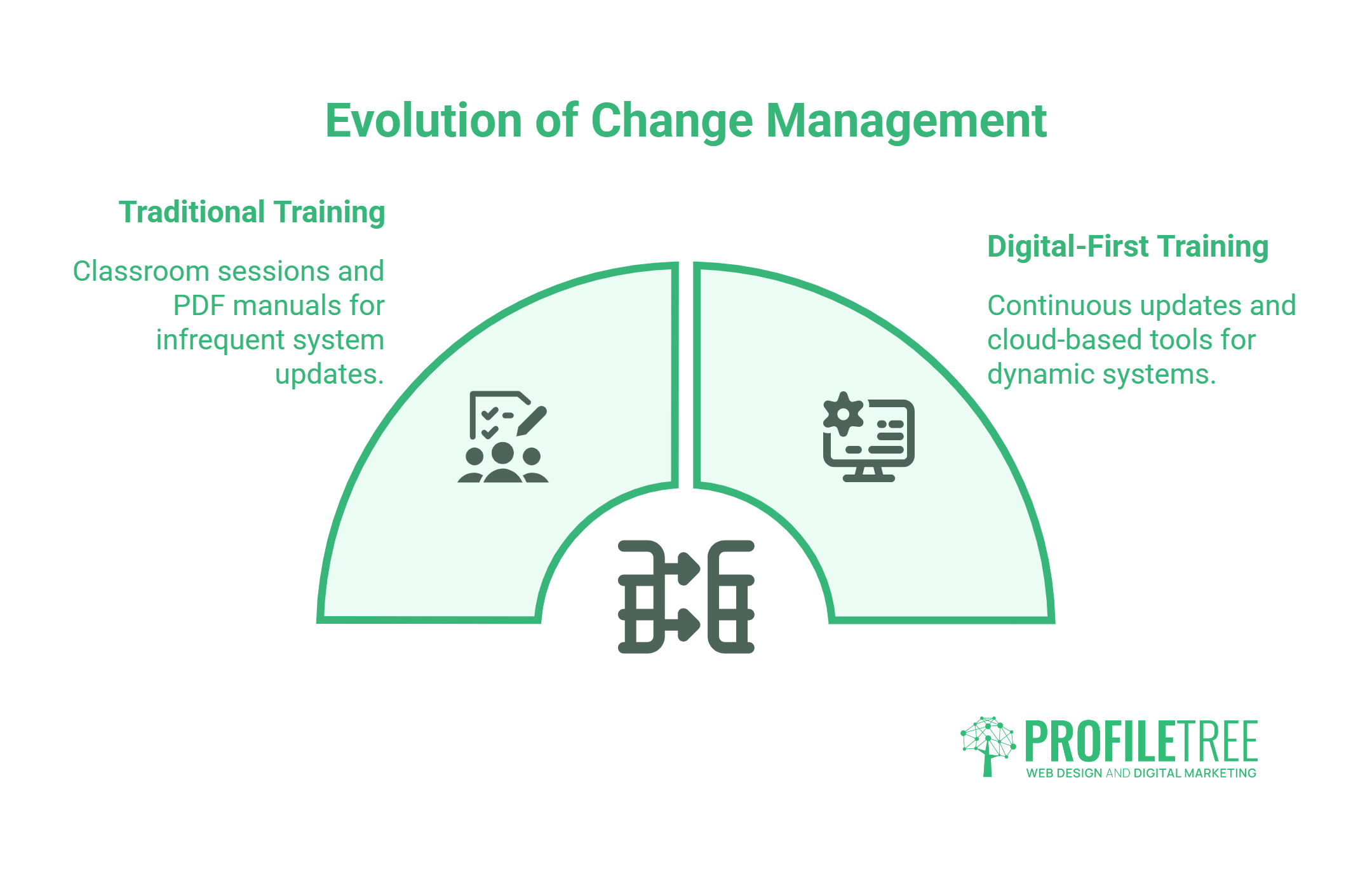
The old model of change training assumed a system that changed rarely. You ran a few classroom sessions or handed out a PDF manual, and people learned the new process once, and that knowledge was expected to last for years. Modern cloud tools break that assumption. Software like a CRM, an ERP or an AI assistant updates continuously, so a one-off training event is out of date within months.
Digital-first change management treats learning as ongoing rather than a single milestone. Instead of one big push at go-live, support is delivered in smaller pieces, closer to the moment people actually need it, and refreshed as the tool evolves. The table below sets out the practical contrast.
| Category | Traditional OCM training | Digital-first change training |
|---|---|---|
| Delivery method | Classroom sessions, static PDF manuals | Microlearning, in-app guidance, mobile modules |
| Timing | One-off event at go-live | Continuous, just-in-time at point of need |
| Update frequency | Rarely revised after rollout | Refreshed with each software change |
| User support | Helpdesk ticket after the fact | Real-time prompts inside the software |
| Time to competency | Slow, with a steep early drop-off | Faster, with reinforcement built in |
For organisations rebuilding their wider digital setup at the same time, training rarely sits on its own. A change programme often runs alongside a new website or internal platform, which is where joined-up website development and a clear digital strategy keep the technology and the people side moving together rather than in separate silos.
Designing an effective digital change training strategy: a step-by-step framework
A workable strategy follows a clear sequence: understand where people are now, design training around their actual roles, deliver it in digestible pieces, then measure and adjust. The four steps below give you a structure you can apply to most rollouts, whether that is a new finance system or a move to AI tools across the team.
Step 1: Conduct a digital readiness and skills gap assessment
Before designing anything, find out what your workforce can already do and where the gaps are. A short readiness survey works well here. Ask questions such as: how confident are staff using similar tools today, which tasks do they currently find slow or frustrating, and what devices do they actually work on. Pair that with performance data and a quick conversation with team leaders.
The point is to stop guessing. A team that already lives in cloud software needs a very different programme from one moving off paper for the first time. Mapping that early lets you spend the training budget where it changes behaviour.
Step 2: Design role-based, cohort-specific curricula
One curriculum for the whole company wastes people’s time and loses their attention. Leaders need a short session on sponsorship and reporting. Change champions need deeper, hands-on training so they can support peers. End users need only the parts of the system they will touch daily. Build distinct learning paths for each cohort rather than a single generic course.
Step 3: Execute agile, bite-sized learning paths
Deliver training in short modules spaced over time, not in one exhausting day. Bite-sized learning, often five to ten minutes per module, fits around real workloads and improves retention. Mix formats: a short explainer video for the concept, a guided walkthrough for the task, a quick check to confirm understanding. Short video is particularly effective here, and producing a reusable internal library through professional video production and video marketing means staff can revisit a task whenever they hit it, rather than waiting for the next live session. https://www.youtube.com/embed/3XftEp4vB70 Reusable training video shortens the time it takes staff to reach competency.
Step 4: Measure adoption and provide continuous feedback
Set up feedback loops from the start: completion data, short pulse surveys, and usage stats from the system itself. Watch for where people get stuck, then revise those modules. This is the agile part. Treat the first version of your training as a draft you improve with evidence, not a finished product you ship once.
Digital training pre-flight checklist:
- Current user access and devices audited
- Readiness and skills gap survey completed
- Cohorts defined (leaders, champions, end users)
- Success metrics agreed before go-live
- Change champions identified and briefed
- Feedback channel set up and owned by a named person
Advanced tool integration: moving beyond the LMS to digital adoption platforms
A learning management system (LMS) is a destination. Staff log in, take a course, and log out. That works for background knowledge, but it does not help someone who is stuck mid-task in live software. This is where a one-off course alone falls short for complex rollouts: people forget a large share of what they learned within a day or two if nothing supports them at the moment they actually use the tool.
Digital adoption platforms (DAPs) close that gap. A DAP sits as an overlay on top of software such as Salesforce, SAP or Workday, and guides users step by step through tasks as they perform them. Instead of remembering a course from last month, the user follows an on-screen prompt in real time. The practical model that works best combines the two: an LMS for structured background learning, a DAP for in-the-moment support.
According to Ciaran Connolly, founder of ProfileTree, “the businesses that get adoption right treat training as something that lives inside the daily workflow, not a one-off event before go-live. Support has to be there at the exact moment someone is trying to do the task, or the knowledge simply leaks away.”
For SMEs, full enterprise DAP licences are not always proportionate. The same principle, support at the point of need, can be delivered more simply through short embedded videos, internal help pages and well-structured content that staff can reach in two clicks. Where a project also depends on a clean, fast internal platform for that material to live on, reliable website hosting and management keeps those resources available when people need them.
Tailoring training pathways: strategies for frontline versus office cohorts
Desk-based staff and frontline or field-based staff do not learn the same way, and training them as if they do is a common reason adoption stalls in one part of a business. An office worker can sit at a screen and complete an e-learning module between tasks. A field engineer, a care worker or a shop-floor operator often cannot.
For office cohorts, longer interactive sessions, webinars and advanced modules work well, because they have the screen time and the quiet to use them. For frontline cohorts, the answer is mobile-first microlearning: short lessons on a phone, context-aware tips inside a mobile app, and content that works offline where the signal is patchy. The same change project may need two parallel training tracks running at once.
AI adoption is its own special case here. Rolling out a generative AI assistant is a different psychological and practical challenge from a mandatory ERP system, because staff often need reassurance about what the tool will and will not do to their role before they will use it openly. Structured digital training and dedicated AI training built around real tasks tend to move teams faster than generic awareness sessions. ProfileTree has covered the wider organisational side of this in detail in its guide to change management during AI adoption.
Funding and support: UK and Ireland regional digitalisation initiatives
One advantage UK and Irish organisations have, which most global guides ignore, is access to government-backed funding for digital upskilling. These schemes can cover a meaningful share of training and change costs, so it is worth checking eligibility before assuming the full bill falls on the business.
In the UK, Made Smarter supports manufacturers with digital technology adoption and the leadership and workforce upskilling that goes with it, delivered through regional programmes. Across Northern Ireland and the broader UK and Ireland market, schemes change and open in waves, so the practical step is to contact your local Growth Hub, council economic development team, or Invest NI to confirm what is currently available.
In the Republic of Ireland, Enterprise Ireland and the Local Enterprise Offices run digitalisation supports, including voucher-style schemes aimed at smaller businesses, and InterTradeIreland runs cross-border digital support initiatives. Public sector healthcare rollouts in the UK also work within NHS Digital Academy guidance, which is worth knowing if you operate in that space. Funding rules and amounts shift regularly, so verify current terms directly with the relevant body before building them into a budget.
Proving the business case: measuring training ROI in change initiatives
Course completion rates and “people enjoyed it” surveys do not prove value to a finance director. To make the business case, connect the training activity to hard operational metrics that someone already tracks. The aim is to show that better adoption produced a measurable change in how the business runs.
| Training indicator | How to measure it | Expected business impact |
|---|---|---|
| Support ticket volume | Helpdesk tickets per user, before vs after | Lower IT support overhead |
| Task completion speed | Time to complete a key process in the system | Faster cycle times, more throughput |
| User error rate | Rejected entries or correction rates on key tasks | Cleaner data, less rework |
| Feature usage | Login frequency and feature adoption stats | Higher return on the software spend |
Set the baseline before training starts. Without a “before” figure, you cannot show improvement, and the project loses the evidence it needs to justify the next phase of investment.
Sustaining adoption after go-live
The riskiest period is not launch week. It is the months afterwards, when the project team moves on and the forgetting curve sets in. Without reinforcement, people drift back to old habits, and the system slowly hollows out. A sustainment plan keeps adoption alive: short refreshers tied to new features, a living help library, and a small group of change champions who answer day-to-day questions in each team.
Treat the help resources as a product you maintain, not a folder you forget. When the software updates, update the guidance the same week. This is where keeping training material on a well-run internal platform pays off, and where ongoing internal communication and engagement work keeps staff aware that support still exists. For teams adopting AI specifically, tools such as AI chatbots can answer routine “how do I” questions instantly, taking pressure off champions.
Frequently asked questions
What is the role of change management in digital training?
Change management makes sure employees are ready and willing to adopt new tools, so training is acted on rather than ignored. Without it, even well-built training fails because people resist the change it supports.
How do you train employees who are resistant to new technology?
Start with early, honest communication about what the change means for their day-to-day role, not just the technical mechanics. Identify respected, non-technical colleagues as change champions who can reassure peers, and frame the training around what the tool does for each person rather than what it does for the business. Resistance usually drops once people feel competent and can see a personal benefit.
What is the difference between an LMS and a DAP?
A learning management system (LMS) is a place users go to take structured, off-the-job courses, like an internal library of lessons. A digital adoption platform (DAP) is an overlay that sits on top of live software and guides users step by step through tasks as they do them. Most effective programmes use both: the LMS for background knowledge, the DAP for support at the point of need.
Is there UK government funding available for digital change training?
Yes. Regional schemes such as Made Smarter for manufacturers, along with local enterprise growth grants, frequently cover part of digital upskilling costs. Contact your local Growth Hub, Invest NI, or Enterprise Ireland in the Republic to confirm current eligibility, as terms change regularly.
What metrics prove that a digital training programme has worked?
Look beyond completion rates to operational data: a fall in post-launch IT support tickets, faster process cycle times, lower user error rates on key tasks, and steady feature usage pulled from the system itself. Capture a baseline before training begins so you can show the change clearly.
Where to start
Digital training for change management is not a single event you tick off before go-live. It is an ongoing discipline: assess where people are, design for their actual roles, deliver in small pieces at the point of need, measure against real business metrics, and keep supporting adoption long after launch. Organisations across Northern Ireland, Ireland and the UK that treat it this way get far more from their software spend than those that switch a system on and hope.
If your business is planning a system change, a move to AI tools, or a wider digital transformation, ProfileTree’s digital training programmes and AI implementation support are built for exactly this stage. The next step is a scoping conversation about what your teams actually need to adopt the new way of working.