
SEO for Landscapers and Garden Services: Win More Projects
Table of Contents
When homeowners decide to transform their garden, whether a complete landscape redesign, new patio, or regular maintenance, they search online. “Landscapers near me,” “garden design Belfast,” “patio installers”, these searches represent projects worth hundreds to tens of thousands of pounds, and the landscapers appearing in results win the work.
Landscaping SEO has a distinct advantage: your work is inherently visual. Beautiful garden transformations, stunning patios, and thriving planting schemes photograph beautifully and tell compelling stories. This visual nature makes landscaping businesses ideally suited to building powerful online presence.
The landscaping industry spans diverse services: full landscape design and construction, hardscaping, planting, and regular garden maintenance. Each attracts different customers with different budgets and search behaviours. Understanding your target market and optimising accordingly captures the right enquiries for your business.
ProfileTree works with trade and service businesses across Northern Ireland, Ireland, and the UK to build search visibility that generates quality enquiries. For landscapers, that means appearing when homeowners search, showcasing beautiful work, and making it easy to start a conversation about their garden project.
SEO for Landscapers: Why Search Visibility Matters
The landscaping industry has evolved with customer behaviour. Understanding how clients find and choose landscapers shapes effective marketing.
The Visual Research Process
Garden and landscaping decisions are visually driven. Customers spend significant time:
- Browsing inspiration images
- Researching design ideas
- Looking at landscaper portfolios
- Comparing before and after transformations
- Reading reviews from previous clients
This visual research process means your online presence, particularly your portfolio imagery, directly influences whether customers contact you. Beautiful work photography isn’t just nice to have; it’s essential for winning projects.
Different Services, Different Searches
Landscaping searches vary significantly by service type:
- Full landscaping: “Landscapers near me,” “garden design [location],” “landscape gardeners”
- Hardscaping: “Patio installers [location],” “driveway contractors,” “garden walls,” “decking installers”
- Soft landscaping:“Garden planting,” “lawn specialists,” “tree surgeons
- Maintenance: “Garden maintenance [location],” “gardeners near me,” “lawn care service”
- Specialist services: “Artificial grass installers,” “water feature specialists,” “garden lighting”
Each service type has different competition levels and customer intent. Targeting your specific services captures relevant enquiries.
Seasonal Considerations
Landscaping has pronounced seasonality:
- Spring: Peak enquiry period. Customers planning summer projects, garden renovations, and planting.
- Summer: Project execution season. Some ongoing enquiries but often booked up.
- Autumn: Garden preparation, clearance, and planning for next year.
- Winter: Quieter period. Some hardscaping continues, planning for spring.
Understanding this cycle affects both when you generate enquiries and what content to create at different times.
Google Business Profile for Landscapers
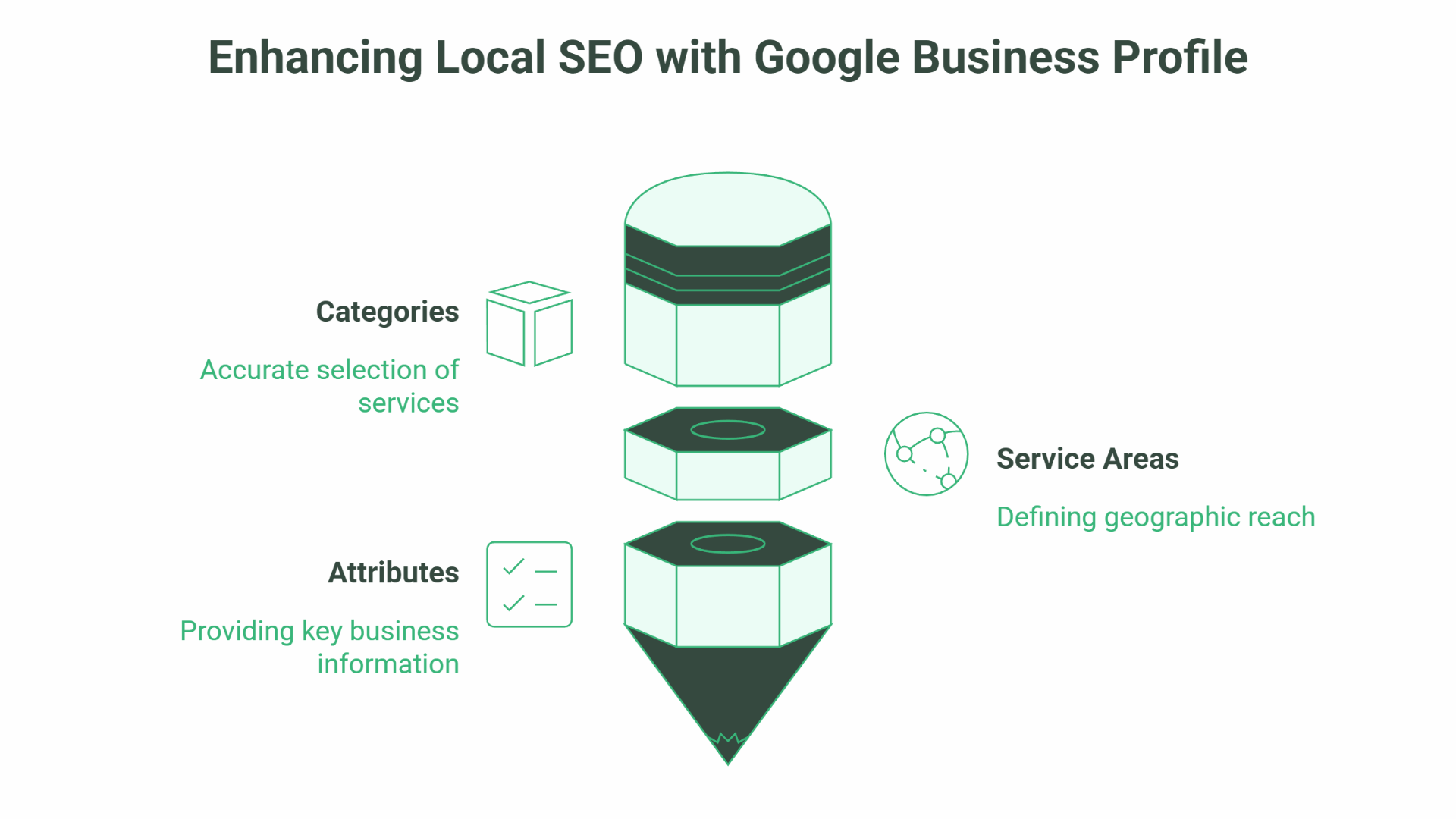
Your Google Business Profile is foundational for landscaper local SEO. It appears in local search results and showcases your work directly to searchers.
Essential Profile Setup
Categories: Select accurate categories:
- Landscaper (broad, primary for most)
- Landscape Designer
- Garden Service
- Lawn Care Service
- Tree Service
- Paving Contractor
- Fencing Contractor
Choose your primary category based on main service focus. Add secondary categories for additional services. A landscaper doing design, construction, and maintenance should include relevant categories for each.
Service Areas: Define where you work. Landscaping service areas are typically moderate, customers want local providers but accept some travel for quality work, especially for larger projects.
Consider:
- Your primary working area
- How far you’ll travel for different project sizes
- Areas where you have portfolio work to show
Attributes: Complete relevant attributes:
- Online quotes available
- Appointments required
- Payment methods accepted
- Business ownership attributes
Portfolio Photography: Your Most Important Asset
For landscapers, photos are everything. Potential customers need to see your work quality:
- Completed projects: Professional photos of finished landscapes. Wide shots showing full designs, detail shots highlighting quality.
- Before and after: Transformation shots are powerful for landscaping. Show the starting point and the finished result.
- Different project types: Show variety, patios, planting, water features, lawns, different garden sizes.
- Seasonal shots: Gardens at different times of year where possible. Planting schemes developing over time.
- In-progress work: Construction shots showing professionalism and process.
- Team and equipment: Your team working professionally, quality equipment.
Invest in professional photography for your best work. Quality images of quality landscaping generate quality enquiries.
Reviews: Building Confidence
Reviews significantly influence landscaper selection. Customers making significant garden investments want assurance:
Encouraging reviews:
- Ask at project completion when customers are delighted with results
- Follow up after planting has established (few weeks/months later)
- Send follow-up emails with review links
- Include review requests in project completion documentation
- Never offer incentives
What to encourage customers to mention:
- Quality of design and finished result
- Workmanship and attention to detail
- Communication throughout project
- Reliability and timekeeping
- Tidiness during work
- How well plants have established
Responding to reviews:
- Respond to every review professionally
- Thank customers for detailed feedback
- Address concerns constructively
- Show passion for your work
Landscapers have a natural advantage in visual marketing, beautiful garden transformations speak for themselves. But that imagery needs to be visible when customers search. Strong Google Business Profile with professional project photos captures the customers actively looking for someone to transform their garden.” — Ciaran Connolly, ProfileTree
Website Strategy for Landscapers
Your website showcases your capability in detail and converts interest into enquiries.
Essential Website Elements
Portfolio: This is your most important content. Showcase projects with:
- Multiple professional photos per project
- Project descriptions (brief, style, challenges)
- Design rationale where relevant
- Client testimonials where available
- Project type and approximate scope
Services: Clear explanation of what you offer:
- Garden design
- Landscape construction
- Patios and paving
- Decking
- Fencing and boundaries
- Planting schemes
- Water features
- Artificial grass
- Garden maintenance
- Specialist services
Service areas: Where you work. List towns and areas covered.
- About: Your story, experience, design philosophy, qualifications. Customers choosing landscapers often want to know about the people behind the work.
- Process: How you work, from initial consultation through design, construction, and aftercare. Customers appreciate understanding what to expect.
- Contact: Multiple contact options. Form, phone, email. Make starting a conversation easy.
Portfolio Best Practices
Your portfolio wins or loses projects:
- Quality photography: Invest in professional photography. Gardens photograph beautifully with proper equipment and timing.
- Best light conditions: Early morning or late afternoon light often works best for garden photography.
- Seasonal photography: Capture gardens at their best moments. Return to photograph established planting.
- Variety demonstration: Show different styles, scales, and project types.
Detailed case studies: Don’t just show photos. Explain:
- What the client wanted
- The design approach
- Challenges overcome
- Materials used
- How the garden has developed
Organisation: Organise portfolio logically, by project type, style, or size, so visitors can find relevant examples.
Service Pages
Create dedicated pages for each service type:
- /garden-design/:Design services and approach
- /patios-paving/: Hardscaping services
- /planting/: Soft landscaping services
- /garden-maintenance/: Ongoing care services
- /artificial-grass/: If offered, dedicated page for this growing service
Each service page should include:
- Detailed service description
- Relevant portfolio examples
- Materials and options available
- Process explanation
- Clear call to action
Location Pages
Create pages for significant service areas:
- /landscapers-belfast/: Services in Belfast
- /landscapers-lisburn/: Services in Lisburn
Each location page should include:
- Services available in that area
- Portfolio projects from that area
- Local testimonials where available
- Area-relevant information
- Clear call to action
Avoid thin pages with just location names changed. Each needs genuinely useful content.
Technical Foundations
Basic technical SEO supports visibility:
- Speed: Large image portfolios require optimisation. Compress images without losing quality.
- HTTPS: Security matters for credibility.
- Schema markup: Implement LocalBusiness schema with services and areas.
Image optimisation: Alt text describing each image, appropriate file sizes, proper formats.
Our guide at profiletree.com/seo-basics/ covers technical fundamentals.
Local SEO Strategy for Landscapers
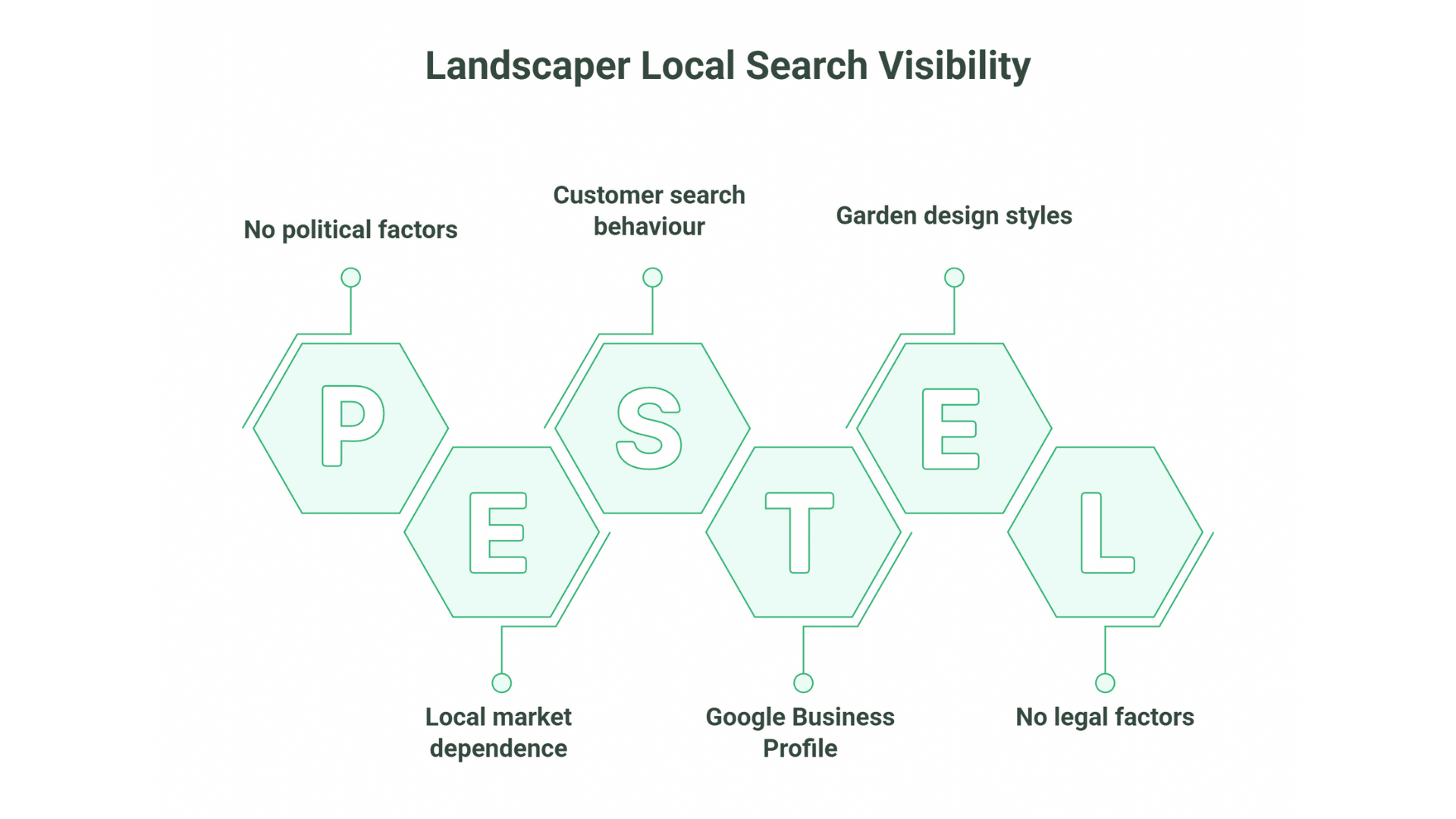
Landscapers depend on local search visibility. Everything else supports this priority.
Local Keyword Targeting
Understand how customers search:
- Generic + location: “Landscapers Belfast,” “garden services near me,” “landscape gardeners Derry”
- Service + location: “Patio installers Lisburn,” “garden design Belfast,” “decking contractors Bangor
- Style + location: “Contemporary garden design,” “cottage garden planting,” “low maintenance gardens”
- Problem + location: “Garden makeover,” “overgrown garden clearance,” “sloping garden solutions”
Your Google Business Profile categories help you appear for these searches. Website content targets longer, more specific queries.
Building Local Citations
Directory listings reinforce local presence:
Trade directories:
- Checkatrade
- MyBuilder
- Rated People
- Bark
- Houzz (particularly relevant for design)
- TrustATrader
Industry bodies:
- Association of Professional Landscapers (APL)
- British Association of Landscape Industries (BALI)
- Society of Garden Designers (SGD)
General directories:
- Yell.com
- Thomson Local
- Yelp
Local directories:
- Local council listings
- Community directories
- Garden centre partnerships
Ensure consistent Name, Address, and Phone across all listings.
Local Link Building
Local links strengthen geographic visibility:
- Partner with garden centres for referrals
- Connect with architects and builders
- Build relationships with interior designers
- Participate in local garden shows or events
- Join local business networks
- Seek coverage in local publications for notable projects
These relationships generate links while building referral networks.
Our guide at profiletree.com/check-backlinks/ explains link building strategy.
Content Strategy for Landscapers
Content marketing captures customers at different stages of their garden planning journey.
Inspiration Content
Content for customers gathering ideas:
- Style guides: “Contemporary garden design ideas,” “Cottage garden inspiration,” “Japanese garden elements”
- Project galleries: Collections of project photos by theme or style
- Trend content: “Garden design trends [year],” “Popular garden features”
- Seasonal inspiration: “Spring garden ideas,” “Winter garden interest”
This content captures customers early in their planning who may become clients.
Planning Content
Content for customers preparing projects:
- Planning guides: “How to plan a garden redesign,” “What to consider before landscaping”
- Budget content: “Garden landscaping costs guide,” “How much does a patio cost”
- Process explanations: “What to expect from a landscape project,” “How garden design works”
- Timing content: “Best time for landscaping work,” “When to plant”
Educational Content
Helpful content demonstrating expertise:
- Plant guides: “Best plants for shade,” “Low maintenance planting,” “Year-round interest plants”
- Maintenance advice: “Garden care calendar,” “Lawn maintenance guide,” “Pruning basics”
- Problem solving: “Dealing with difficult soil,” “Drainage solutions,” “Sloping garden ideas”
- Material guides: “Choosing patio materials,” “Types of garden fencing,” “Decking options”
Local Content
Connect services to local context:
- Local conditions: “Gardening in [area],” local climate and soil considerations
- Local materials: Locally sourced materials, stone options for your region
- Local projects: Case studies highlighting local work with area context
Video content works exceptionally well for landscaping, garden tours, project time-lapses, planting guides. Our guide at profiletree.com/video-storytelling/ covers video strategy.
Seasonal SEO Strategy
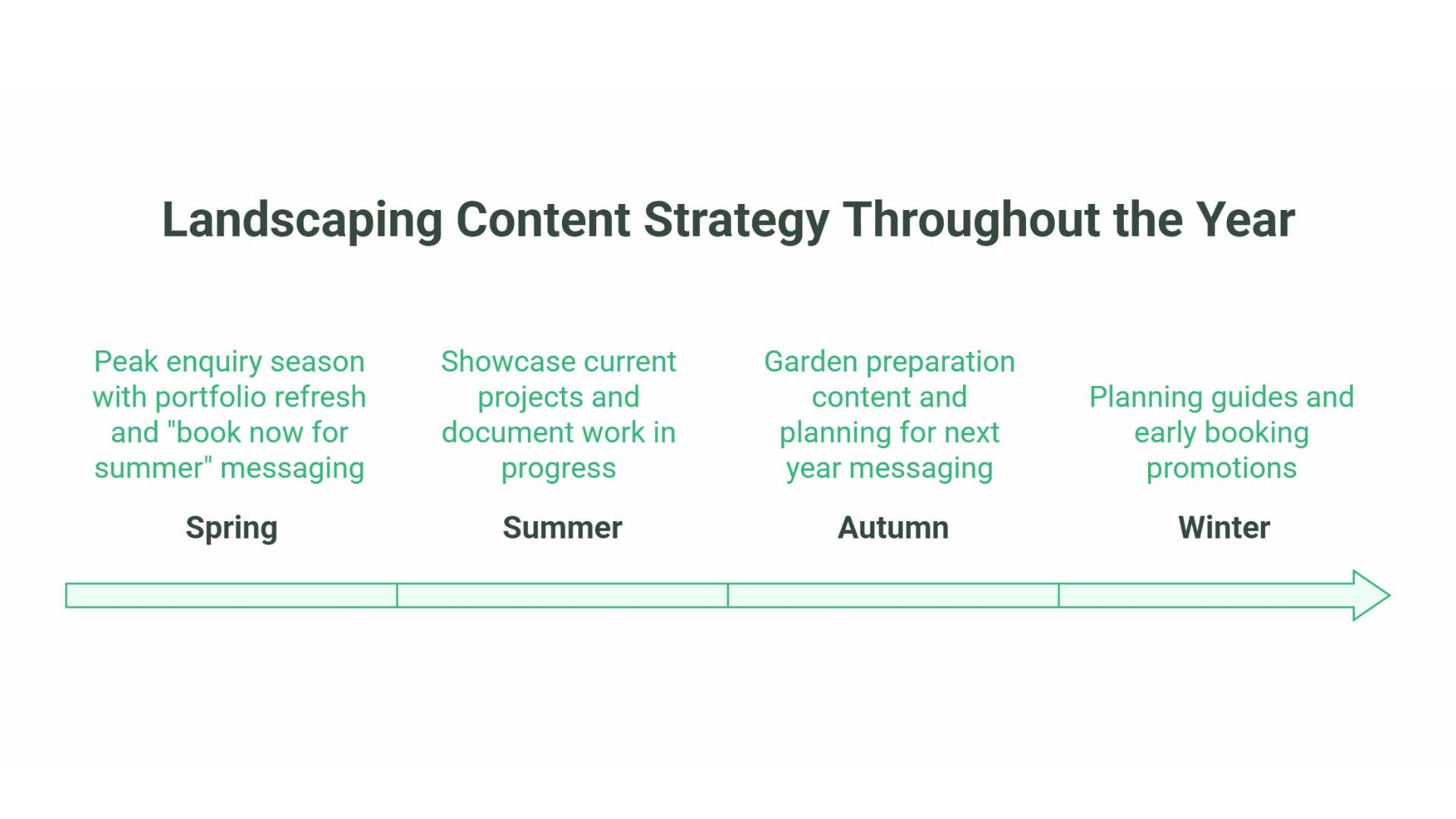
Landscaping’s seasonality requires strategic content timing.
Spring Focus (Peak Enquiry Season)
Content priorities:
- Refresh portfolio with new images
- Publish inspiration content
- Update pricing information
- Create “book now for summer” messaging
SEO focus:
- Ensure Google Business Profile is optimised before peak season
- Check all contact methods work
- Respond to reviews promptly
- Monitor and respond to enquiries quickly
Summer Strategy
Content priorities:
- Showcase current projects (with permission)
- Document work in progress
- Capture photos of established gardens
- Plan autumn content
SEO focus:
- Maintain visibility even when busy
- Continue review requests
- Keep portfolio updated
- Plan for quieter period content creation
Autumn Approach
Content priorities:
- Garden preparation content
- Planning for next year messaging
- Off-season services promotion
- Maintenance service marketing
SEO focus:
- Capture remaining seasonal searches
- Build content for next year
- Update portfolio with summer completions
- Review and improve technical SEO
Winter Planning
Content priorities:
- Planning guides for next year
- Garden design inspiration
- Winter garden interest content
- Early booking promotions
SEO focus:
- Major website improvements
- Content creation for spring
- Technical SEO audit and fixes
- Competitor analysis and strategy refinement
Design vs. Maintenance SEO
Different business models require different approaches.
Design and Construction Focus
For landscapers primarily doing design and build projects:
- Keyword focus: “Garden design,” “landscaping,” “landscape architects,” project-specific terms
- Content emphasis: Portfolio showcasing, design process explanation, inspiration content
- Trust signals: Design qualifications, awards, industry memberships
- Conversion path: Consultation booking, design enquiry forms
Maintenance Focus
For businesses focused on regular garden maintenance:
- Keyword focus: “Garden maintenance,” “gardeners,” “lawn care,” “regular garden service”
- Content emphasis: Service descriptions, pricing transparency, reliability demonstration
- Trust signals: Consistent scheduling, team reliability, long-term client relationships
- Conversion path: Quote requests, service booking, regular contract enquiries
Combined Services
Many landscapers offer both. Structure your SEO to serve both audiences:
- Separate service pages for design/construction and maintenance
- Different content targeting each customer type
- Clear navigation between service types
- Testimonials relevant to each service area
Measuring Landscaper SEO Success
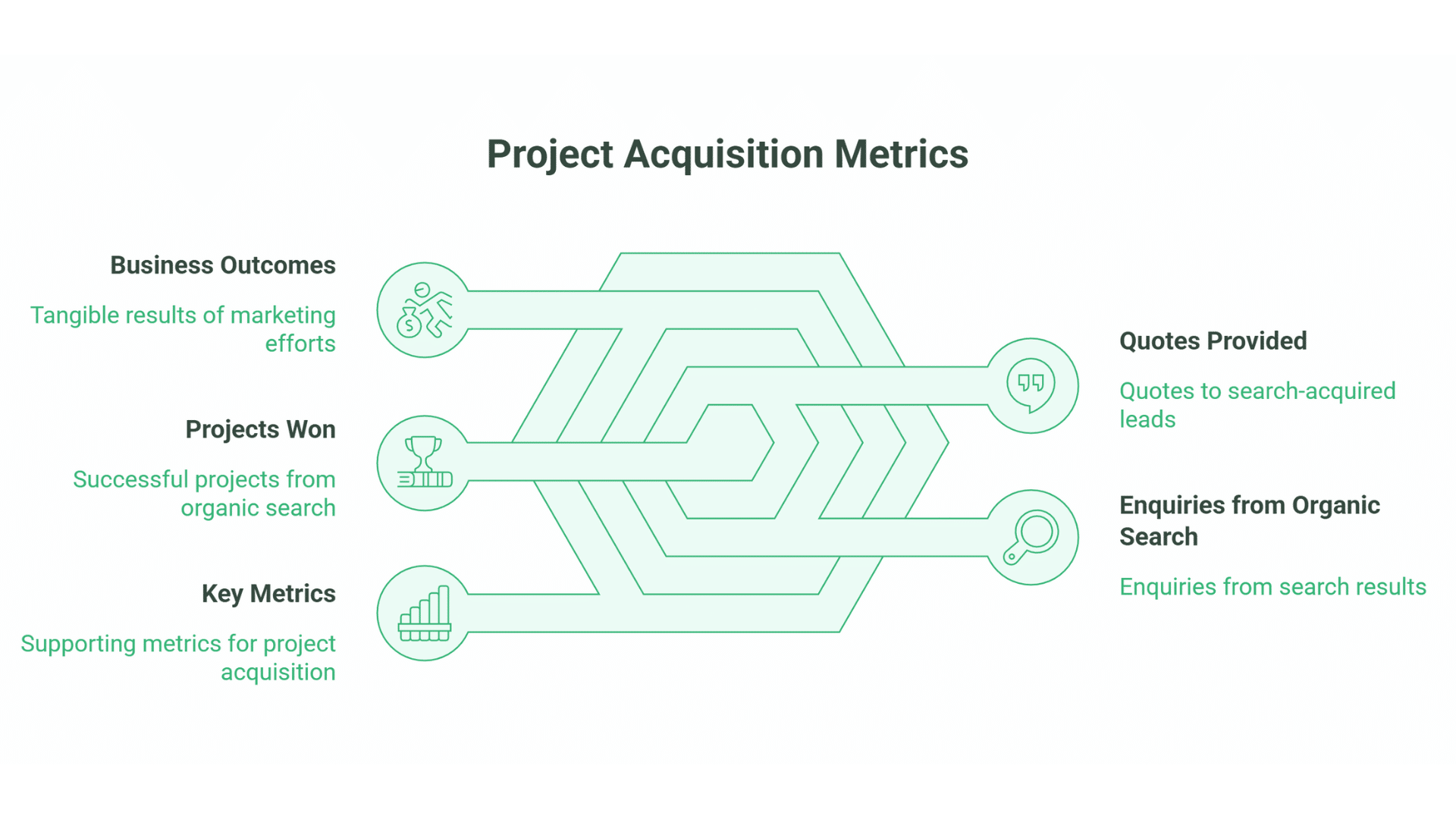
Track metrics connecting to actual project acquisition.
Key Metrics
Visibility:
- Google Business Profile views
- Website organic traffic
- Local keyword rankings
- Portfolio page views
Engagement:
- Time on site
- Portfolio engagement
- Contact page visits
- Form submissions and calls
Business outcomes:
- Enquiries from organic search
- Site visits resulting from search
- Quotes provided to search-acquired leads
- Projects won from organic search
Seasonal Tracking
Account for seasonality when measuring:
- Compare to same period previous year
- Track enquiry quality, not just quantity
- Measure project value from different sources
- Monitor conversion rates through seasonal changes
Lead Quality Assessment
For landscapers, lead quality varies significantly:
- Track enquiry quality: What proportion become viable projects?
- Measure project value: What’s the average value of search-acquired projects?
- Assess fit: Do search enquiries match your target project type and budget?
Common Mistakes Landscapers Make
Avoid these frequent errors:
- Poor photography: Low-quality images of beautiful work. This is the biggest missed opportunity in landscaping SEO. Invest in professional photography.
- Incomplete portfolio: Too few projects shown, or projects without context. Build comprehensive portfolio with detailed case studies.
- No before and after: Missing transformation shots that demonstrate capability.
- Seasonal neglect: Stopping SEO effort during busy season, then struggling when quiet.
- Generic content: Content that could describe any landscaper. Show your distinctive style and approach.
- Ignoring reviews: Not actively requesting reviews or responding to feedback.
- Hidden pricing: Complete opacity about costs when customers want ballpark guidance.
- Poor mobile experience: Portfolios that don’t display well on phones.
- No service differentiation: Not clearly distinguishing between different service types.
Getting Started with Landscaper SEO
If you’re beginning SEO or reviewing existing efforts:
Immediate priorities:
- Claim and complete Google Business Profile
- Add best project photos, minimum 20 images
- Ensure contact information is accurate
- List all services offered
First month:
- Respond to all existing reviews
- Create or improve portfolio section
- Verify consistent NAP across directories
- Implement review request process
First three months:
- Create dedicated service pages
- Build location pages for key areas
- Develop helpful garden content
- Invest in professional portfolio photography
Ongoing:
- Add new projects regularly
- Seasonal content aligned with garden calendar
- Prompt review requests
- Monitor and improve based on results
FAQs
How quickly can SEO generate landscaping enquiries?
Google Business Profile improvements often show results within weeks. Website content and broader visibility typically takes three to six months. The seasonal nature of landscaping means timing matters, optimise before spring for peak impact.
How important is professional photography for landscapers?
Extremely important. Beautiful work poorly photographed loses to average work beautifully photographed. Professional photography is one of the highest-ROI investments landscapers can make.
Should we show pricing on our website?
Some guidance helps, “Patios from £X per square metre” or “Garden designs from £X.” Complete pricing for bespoke projects isn’t expected, but ballpark figures build trust and qualify enquiries.
How do we handle seasonal fluctuations in SEO?
Maintain consistent effort year-round but adjust focus. Use quieter periods for content creation, website improvements, and portfolio building. Ensure you’re fully optimised before spring peak season.
What content works best for landscapers?
Portfolio content and project case studies are most important. Inspiration content captures early-stage researchers. Practical guides like “choosing patio materials” attract customers preparing for projects.
How do we compete with larger landscaping companies?
Focus on your distinctive style, personal service, and local expertise. Large companies often have generic presence. Strong portfolio showcasing your specific aesthetic wins customers who want that style.
Should landscapers be on Instagram?
Instagram is particularly valuable for landscapers given the visual nature of the work. Beautiful garden photography performs well on the platform. Consider it part of overall marketing alongside SEO.
How do we target both design clients and maintenance customers?
Separate content and service pages for each audience. Different keywords, different messaging, different trust signals. Both can coexist but need distinct approaches.
Can smaller landscaping businesses compete?
Absolutely. Quality portfolio, genuine reviews, and distinctive style often outperform larger operations with generic presence. Personal service and specific aesthetic are competitive advantages.
How do we get more photos of past projects?
Contact past clients for permission to photograph. Return to photograph established gardens. Offer incentives like complimentary garden visit in exchange for photography access. Build photography into project completion process.
Building Long-Term Landscaping Business Growth
Landscaper SEO rewards visual excellence and consistent effort. The fundamentals are clear: stunning portfolio photography, complete Google Business Profile, genuine customer reviews, and helpful content demonstrating expertise.
Landscapers executing these basics capture quality enquiries from competitors who don’t. The opportunity isn’t sophisticated tactics. It’s letting beautiful work speak through professional presentation when customers search.
The landscapers winning quality projects consistently aren’t necessarily the biggest. They’re the ones visible when customers search, impressive when customers browse portfolios, and trustworthy when customers read reviews. Make sure your business is one of them.
If you’re ready to improve your landscaping business’s search visibility and attract more quality project enquiries, ProfileTree’s team works with trade and service businesses across Northern Ireland, Ireland, and the UK. We understand both the technical requirements of effective SEO and the visual marketing opportunities unique to landscaping. Get in touch at profiletree.com/contact-us/ to discuss how we can help your business grow through search.