
Education SEO: Rank Schools, Colleges and Universities
Table of Contents
Education SEO helps institutions be found by students, parents, and career changers already searching for what they offer, at the exact stage of the decision when a search result can still change the outcome. ProfileTree builds that visibility for schools, colleges and universities across Northern Ireland, Ireland and the UK, from a single-campus grammar school to a multi-faculty university managing thousands of course pages.
The search itself rarely happens once. A parent researching grammar schools starts months before the transfer test. A sixth-former looking at engineering degrees in October might not apply until January. Education SEO has to maintain an institution’s visibility across that whole stretch, through UCAS deadlines, Clearing, open days, and every quiet month in between, so the shortlist is already decided by the time an application form is filled in.
What Makes Education SEO Different
Four things separate education SEO from a standard commercial campaign.
The decision cycle runs long. A plumber or a solicitor converts a searcher within days; a degree or a school choice can take a year or two to settle, so a course page has to work just as hard for the visitor who applies eight months later as for the one who enquires that afternoon.
More than one person is doing the searching. A prospective student, a parent who often holds the final say, an employer weighing up an apprenticeship, and an international applicant checking visa rules can all be looking at the same page for different reasons.
Demand moves with the calendar, sharply. UCAS deadlines cluster in January, Clearing dominates August, and open days peak in October and June. A page that starts ranking in September has already missed the January applicant.
And trust weighs more heavily here than almost anywhere else. Education falls under Google’s Your Money or Your Life (YMYL) category, as covered in ProfileTree’s YMYL content guidelines, because choosing where to study is expensive and life-shaping. Since the March 2026 core update sharpened expertise and trust checks for this kind of content, named author credentials now appear on roughly 72% of pages ranking at the top. Real staff, verified accreditation, honest inspection results and genuine student voices are what the ranking depends on.
Mapping the Student Search Journey
Matching content to where a searcher is in their decision-making is the highest-leverage move on an education website, because the same person types completely different queries depending on how close they are to applying.
| Search stage | Example query | What the page should be |
| Exploration | “careers in psychology” | Career or subject guide |
| Research | “accountancy degree Belfast” | Course or subject page |
| Comparison | “[course] entry requirements” | Entry criteria and outcomes page |
| Decision | “[institution] open day” | Event page with schema markup |
Exploration searches are broad and career-shaped, and nobody at this stage is ready to apply, so subject guides and career content earn a place in their consideration set early. By the research stage, the language sharpens, “accountancy degree Belfast” already carries a subject and a location, and a course page that answers it directly wins the click. Comparison-stage searches weigh options against each other, so honest outcomes data and real student voices matter most. At the decision stage, everything becomes practical: open days, deadlines, and accommodation, with a clear event page that converts months of interest into a booking.
Most institutions build for research and decision, and skip exploration entirely, handing away the cheapest visibility on the whole map. It’s also where school SEO and university SEO pull apart: a school’s exploration content focuses on subject choice and taster days, while a university needs a discipline-level guide above dozens of individual programmes.
Student Recruitment SEO: Winning Course Discovery Searches
Course discovery is where education SEO earns its keep commercially, and specificity is what wins it. A term like “plumbing course Northern Ireland” carries far less competition than “college”, because it already tells you the subject and the place.
A course page that converts follows a predictable pattern: an H1 naming the course, an opening hundred words saying plainly what it is and who it’s for, then the details students actually search for, modules, entry requirements, career outcomes, fees, funding, and a real student’s account of the course. Course schema markup gives search engines and AI tools a structured version of this rather than leaving them to guess.
Common Failures: PDFs and Duplication
The prospectus trapped inside a PDF is the first recurring mistake: PDFs rank badly and extract poorly into AI answers, so a web-first course page with the PDF as a supplementary download works better. The second is duplication, dozens of near-identical courses on the same template with only the name swapped, which Google reads as thin content. Each page needs its own substance to justify its existence.
This is frequently a platform problem before it’s a content one. ProfileTree’s WordPress web design and development work builds course architecture that lets a marketing team publish and update programmes without a developer standing over their shoulder, whether that’s a single further education college or university SEO across several faculties.
Open Day and Event Page SEO
Open day pages convert better than almost anything else on an education site, yet they’re routinely the most neglected. Many institutions bury this content in a news post that gets deleted once the date passes, throwing away a year’s worth of ranking equity.
The better model is a single, permanent open-day page at a URL that never changes, refreshed each cycle rather than replaced. Event schema helps it surface in Google’s event features, and clear dates, a straightforward booking flow, and honest details about what a visitor will see, all lift ranking and conversion together.
A short campus tour answers the question every prospective student and parent is really asking: what the place feels like day-to-day. ProfileTree’s video production work generates footage that also works on YouTube, backed by organic social channels that circulate it ahead of the date.
Further Education and Vocational Course Architecture
Further education colleges offer an enormous range of courses across academic, vocational and apprenticeship routes, serving everyone from a school leaver to an adult retraining mid-career to an employer weighing up apprenticeship levy spend. Carrying that without collapsing into thin, templated pages takes real architecture.
Each route needs its own treatment. Apprenticeship searches often have dual intent, since both the applicant and the employer funding them are searching. T-Level and BTEC pages need to explain the qualifications in plain terms, and adult provision needs content focused on flexibility and career outcomes rather than a copy of the school-leaver page. The same logic reaches upward: a business school running an executive MBA alongside a full-time cohort needs entirely separate content tracks.
The structure that works gives every qualification its own page, groups them logically by subject, and links them so a searcher can move from “how do I become an electrician” straight through to the course that gets them there.
Local SEO for Schools and Colleges
For a school or a single-campus college, local search often matters more than anything else, since the audience is geographically bound and the searches make that clear.
Google Business Profile Optimisation
Category selection matters more than most institutions give it credit for. “University” and “College” both work as primary categories, and secondary categories like “Language School” help a profile surface for narrower searches. Multi-site institutions need a separate, verified profile for each campus that describes the programmes actually taught there, not a copy-pasted description with the town name changed. ProfileTree’s guide to Google Business Profile metrics covers what’s worth tracking.
Reviews and Reputation Management
Reviews shape click-through and credibility before a family has even opened the website. Encouraging honest reviews from students, parents and alumni is one of the better returns an admissions team can make. Respond to critical reviews professionally and never argue with a family’s experience in public; acknowledge it and move the detail to a private channel.
Local citations reinforce this, and trust content sits alongside it: inspection outcomes, safeguarding information, and the practical things a parent is trying to find out.
Inspection and Accreditation Content Strategy
Inspection results and accreditation are valuable assets most schools leave on the table. Terms tied to the Education and Training Inspectorate in Northern Ireland, Ofsted in England, and bodies like the ISI carry genuine weight and high intent, since a parent searching for your inspection outcome is already deep into the decision-making process.
The approach is simple: a clear, current page covering the latest inspection outcome, accreditations and quality indicators, written for the parent doing the checking. Higher and further education face the same logic through accreditation and awarding-body relationships, and these are increasingly the facts that AI systems pull when summarising an institution.
Independent Schools and Prospectus Page SEO
Reputation runs the independent schools market. Fee-paying schools compete on academic results, values, facilities and a sense of place, almost entirely in front of parents. The recurring problem is the same one that dogs universities: a prospectus trapped in a PDF.
The fix is to move that content onto the web properly, admissions, fees, ethos, results, pastoral care, each as its own findable page. Real photography instead of stock, and genuine parent and pupil voices, build the trust this market runs on.
SEO for the NI and Irish Education Sector
Working out of Belfast is a genuine advantage here because so much of this work depends on regional knowledge that a national or US-based agency doesn’t have. Most generic “higher ed” guides are written for an American audience, built around “colleges,” FAFSA and US News-style rankings that mean nothing to a UK or Irish applicant.
Queen’s University Belfast and Ulster University anchor higher education here. Further education runs through the regional colleges, including Belfast Metropolitan College and South Eastern Regional College. Across the border, institutions like Dundalk Institute of Technology operate under a different system entirely: Leaving Cert instead of A-levels, CAO instead of UCAS. Content built for the Irish market using UK terminology reads as foreign, and ranks like it too.
The independent schools sector and the grammar school transfer test shape parental search behaviour in ways no English or American guide accounts for, which is a large part of what backs ProfileTree’s wider SEO work across Belfast and Northern Ireland.
Faculty and Staff as Content Authors
Academic institutions possess genuine expertise by definition, yet most fail to translate it into web content that search engines recognise, which is why institutions with decades of credibility get outranked by generic agency guides on their own sector.
Closing that gap starts with treating academic staff as content assets rather than an occasional press-release quote. Every lecturer or researcher is a potential author entity, and a subject guide published under a named lecturer’s byline, backed by a verified profile, carries more weight than the same words published anonymously. Building author pages with credentials, research interests and publications is content marketing in its fullest sense, and it’s how institutions win the E-E-A-T argument in both organic and AI search.
Original research adds a further route to authority. A research summary published as an accessible web page, with a clear executive summary, referenced data and standalone statistics that a journalist or another site can cite directly, can earn links from news publishers and peer institutions without any outreach effort, something that stays locked away when the same findings sit only in a paywalled journal.
Education SEO in the Age of AI Search
Education content now needs to earn visibility in two places at once: traditional Google rankings and AI-generated answers. Students increasingly put open questions to ChatGPT, Gemini and Perplexity and act directly on the summary they get back. The reassuring part is that the groundwork overlaps: pages ranking in the top 20 organically get cited in AI Overviews around 97% of the time.
What AI surfaces reward beyond that is structure. Roughly 44% of AI citations pull from the first 30% of a page, so the answer needs to come first. Clear question-and-answer formatting, self-contained sections, FAQ markup and named, credentialed authors all help content get picked up and cited.
Technical SEO for University Sprawl: Sub-directories vs Sub-domains
Large institutions run into a technical problem smaller schools rarely face: sprawl. A university might run its main site, a library on one sub-domain, a business school on another. Google treats each subdomain as a largely separate entity for authority, so trust built on the main domain doesn’t automatically carry over to a business school’s course pages at its own address.
Sub-directories beat sub-domains for nearly every faculty and department. A structure like university.ac.uk/business-school/ consolidates authority under a single root domain, whereas businessschool.university.ac.uk fragments it. The genuine exception is a separate technical platform, an online learning environment with its own login.
Sub-directory versus Sub-domain Comparison
| Factor | Sub-Directory | Sub-Domain |
| SEO authority | Consolidates under one domain | Often treated separately by Google |
| Ease of implementation | Straightforward on most modern CMS platforms | Requires separate hosting or DNS setup |
| Branding | Consistent with the main institution | Can read as a distinct, disconnected brand |
| Tracking and reporting | A single analytics property | Often needs a cross-domain tracking configuration |
Consolidating Zombie Sub-domains
Consolidating “zombie” subdomains spun up years ago for a department that has since merged or been restructured is often the single biggest structural win available to a university’s SEO. It’s unglamorous work, migrations, redirects, stakeholder sign-off, but it tends to move the needle further than another year of blog content.
Technical Foundations for Large and Multi-campus Sites
Institutional websites accumulate content faster than most organisations, spanning course listings, staff profiles, research outputs, event archives, and news releases built up over years. Left unmanaged, that volume becomes a liability: crawl budget is spent on thin pages, and topical authority ends up spread thin across an ungoverned site.
Legacy Content and Crawl Budget
Course pages for discontinued programmes, event pages from years past, staff profiles for people who have left, and news articles with no incoming links all drain crawl budget and dilute topical authority. Pages with no organic visits in the last 12 months and no strategic reason to keep should be consolidated, redirected to a current page, or removed with a proper 301 redirect in place. An annual content audit is the fix, and it’s how a well-run site holds onto its authority as it keeps growing.
Accessibility and WCAG 2.1
Accessibility sits closer to SEO than most marketing teams assume. It’s a legal requirement for UK public sector bodies under the Public Sector Bodies Accessibility Regulations, and the technical work that satisfies it, alt text, a logical heading structure, ARIA labels, and clear form labelling, is largely the same work that makes a page easier for a search engine to crawl. Sites that meet WCAG 2.1 also tend to load faster, as reflected in Core Web Vitals.
Structured Data and Schema Markup
Course schema for programme pages, Event schema for open days, FAQPage schema for question sections, and Person schema for staff author pages all help search engines and AI systems read content beyond plain text. Course schema, in particular, can produce a rich result showing the course name, description, and provider alongside the organic listing, which widens the visual footprint of that result and can lift click-through even without any change in ranking position. The same markup increasingly feeds voice search too, since smart speakers and AI assistants draw on schema to answer spoken questions about courses and open days.
ProfileTree’s technical SEO audits catch legacy content, subdomain fragmentation, and accessibility gaps in one pass.
From Training to Education: A Natural Fit
ProfileTree’s own background in digital training makes education a natural fit. Through its digital and AI training programmes, delivered in part via ProfileTree Academy, the team spends its working life turning dense subjects into something a nervous applicant or busy parent can follow.
That same capability extends to building in-house skills rather than outsourcing every task, an extension of the same digital marketing training ProfileTree delivers for SME clients, and a natural complement to a longer-term digital strategy for education rather than a single project.
As Ciaran Connolly, founder of ProfileTree, puts it:
“Student recruitment SEO requires things that commercial SEO never has to consider. You are advertising to under-18s, which imposes a duty of care and regulatory scrutiny that most sectors never face. You are writing for the parent and the student at once, and they search in completely different ways: one worried about safeguarding and outcomes, the other about student life and the course itself.
And you are working across a decision cycle that can run for 18 months, from the first curious search to a firm application. Our advantage is that we sit a few miles from Queen’s, Ulster, Belfast Met, and the independent schools; we know how families here actually search, and we came into this from training, so explaining a complicated course to an anxious sixteen-year-old is the thing we already do best.”
Measuring What Matters
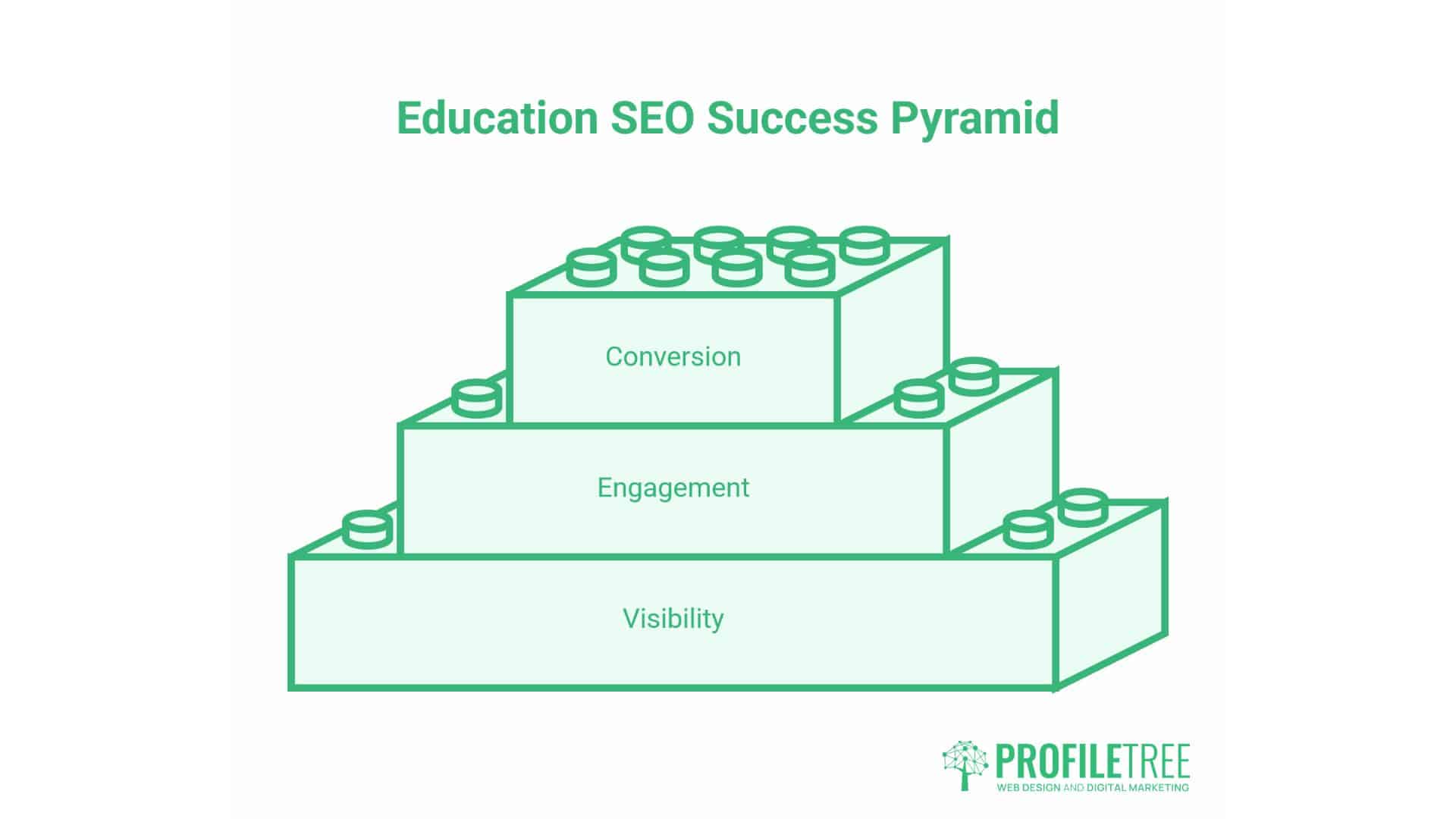
Rankings and raw traffic only tell the first part of the story. Visibility metrics show whether you’re being found. Engagement metrics show whether the right people are finding you. Conversion metrics show whether any of it is working.
Attribution Across a Long Decision Cycle
Standard last-click attribution was not built for a cycle this long, and it consistently undercounts organic search for the groundwork it does early on. That gap matters beyond the analytics: when organic’s contribution to enrolment is hard to prove, budget tends to drift towards paid search instead, even in cases where paid is not delivering more, simply because it is easier to track. Conversion events need to reflect the whole funnel rather than the final application alone.
Prospectus downloads, open day registrations, virtual tour completions, and enquiry form submissions are all worth tracking as their own conversion events; they show organic search doing its job long before an application form is submitted. Switching Google Analytics 4 to a data-driven attribution model rather than last-click gives organic search proper weight for the awareness stages it’s actually doing the work in.
Cost per Enrolment: Organic versus Paid
| Channel | Early cost | Cost over time | Trend |
| Paid search | High, immediate spend | Continues at broadly the same rate | Flat or rising as competition increases |
| Organic search (SEO) | Medium, build phase | Falls per enrolment as authority compounds | Declining as rankings consolidate |
Paid search still has its place, particularly around Clearing, but organic visibility keeps paying down its build cost long after a paid campaign’s budget has run out. Every figure also needs seasonal context, read against the application cycle year-on-year rather than month-on-month.
Why Institutions Choose ProfileTree
ProfileTree brings education-sector understanding, real content capability, and a full range of digital services under one roof, backed by a 5-star rating from more than 450 Google reviews. Because web design, video production, content marketing and digital training all sit under one roof, an institution can fix the platform, build the content and train its own staff without juggling four separate suppliers.
Local knowledge is the real differentiator: working a short distance from Queen’s, Ulster University, Belfast Met and Northern Ireland’s independent schools, and across the border into the Irish system, means the strategy is built on how students and parents here actually search.
FAQs About Education SEO
How long does education SEO take to work?
Typically, three to six months for the first movement, with stronger gains between six and twelve. Work needs to start at least two full cycles ahead of the intake you’re targeting.
How much does education SEO cost?
Usually £1,500 to £5,000 or more a month, depending on the institution’s size and how competitive its market is.
How do I get started with SEO for a small school or college?
Start local: a correctly categorised Google Business Profile, a handful of properly built course pages, and a tight set of long-tail keywords will outperform a broad, unfocused campaign.
What is the difference between SEO for schools and SEO for universities?
School SEO is mostly local and parent-facing. University SEO is course-led and larger in scale, built around programme pages and subject authority.
Does an Ofsted rating affect SEO?
Indirectly. A strong rating generates brand mentions across news sites and directories that build backlink authority and positive sentiment. A weak rating can suppress branded search click-through rates, which is itself a signal Google tracks, so the inspection page needs to present the current outcome honestly rather than avoid it.
Should every school department or faculty have its own SEO strategy?
No. Departments and faculties should sit as sub-folders of one unified domain strategy rather than run as separate sites or sub-domains. Splitting authority across multiple addresses fragments link equity and makes it harder to build the domain-level authority that competitive terms need.