
The Post-Cookie Era: 5 First-Party Data Strategies for Marketers
Table of Contents
First-party data strategies have become critical for marketers as the digital advertising landscape undergoes its most significant transformation in decades. Third-party cookies, which have tracked user behaviour across the internet for over twenty years, are being phased out. Google’s decision to deprecate third-party cookies in Chrome, combined with privacy regulations like GDPR and growing consumer demand for data protection, has forced businesses to rethink their entire approach to customer intelligence.
This transition isn’t just another technical adjustment—it’s a complete reimagining of how businesses understand and reach their audiences. For companies across Northern Ireland, Ireland, and the UK, the challenge is real: how do you maintain personalised marketing, measure campaign performance, and understand customer behaviour without relying on third-party tracking?
First-party data strategies provide the answer. By collecting information directly from customers through your own channels, you gain advantages that third-party cookies never deliver: direct customer relationships, higher data quality, better privacy compliance, and genuine insight into what your actual customers want and do.
What First-Party Data Actually Means
First-party data is information you collect directly from people who interact with your business. This includes website visits, email subscriptions, purchases, customer service conversations, social media engagement, survey responses, and any other touchpoint you own and control.
Unlike third-party data purchased from external providers or aggregated from across the web, first-party data comes from people who have actively chosen to engage with your company. When someone fills out a contact form on your website, downloads your guide, subscribes to your newsletter, or makes a purchase, they’re providing first-party data.
The advantages are substantial. First-party data reflects actual behaviour rather than inferred interests. It’s collected with explicit or implicit consent, making it compliant with GDPR and other privacy regulations. You own it completely, giving you full control over how it’s stored, analysed, and used. Most importantly, it’s accurate—based on real interactions rather than probabilistic tracking across anonymous users.
A Belfast-based retailer tracking which products customers view and purchase on their own website gains far more actionable intelligence than any third-party cookie could provide. They know exactly what their customers want because those customers have shown them directly.
“The post-cookie landscape requires businesses to own their customer relationships,” says Ciaran Connolly, Director of ProfileTree. “First-party data isn’t just a compliance solution—it’s the foundation for building meaningful connections that drive long-term growth.”
Website Optimisation for Data Collection
Your website represents your primary channel for first-party data collection. However, effective data gathering requires more than just adding forms and pop-ups. Strategic website design balances user experience with data acquisition, creating valuable exchanges rather than intrusive demands.
Progressive Profiling and Smart Forms
Progressive profiling collects customer information gradually across multiple interactions rather than demanding everything up front. Instead of confronting visitors with lengthy registration forms that ask for fifteen fields of information, you gather basic details initially—perhaps just an email address and name—then collect additional information during subsequent visits.
This approach dramatically reduces form abandonment. Research consistently shows that each additional form field decreases completion rates. By spreading data collection across multiple touchpoints, you build comprehensive customer profiles without creating friction that drives people away.
A practical example: an e-commerce site collects basic contact information during account creation, gathers shipping details during the first purchase, adds birthday information when offering a loyalty programme benefit, and requests communication preferences when someone subscribes to specific content updates. Each step feels natural and contextually relevant rather than intrusive.
Smart forms take this further by using conditional logic to display relevant fields based on previous responses. If someone selects “business customer” from a dropdown, the form shows company-related fields like organisation name and employee count. Individual customers see different options entirely. This personalisation makes data collection feel relevant and purposeful.
Creating Genuine Value Exchanges
People willingly share data when they receive clear, immediate value in return. The most effective data collection strategies offer something worth the information being requested—not a trivial newsletter signup that promises vague “updates,” but concrete resources that solve real problems.
Valuable exchange mechanisms include detailed industry reports, comprehensive how-to guides, free tools or calculators, exclusive discounts, personalised assessments, early product access, and membership in exclusive communities. The key is matching the perceived value to the data being requested.
A digital strategy consultancy might offer a free website performance audit in exchange for contact information and basic business details. The prospect receives immediate, actionable intelligence about their current digital presence. The consultancy gains qualified lead data plus detailed information about the prospect’s challenges and priorities. Both parties benefit meaningfully from the exchange.
For smaller data requests, smaller value offerings work fine. A basic email signup might warrant industry tips or curated news. Detailed company information, budget ranges, and timeline details require more substantial value—comprehensive guides, proprietary research, or personalised consultations.
Tracking Behaviour Without Cookies
Modern website development enables sophisticated behaviour tracking without relying on third-party cookies. First-party cookies, server-side tracking, and privacy-compliant analytics platforms capture valuable behavioural intelligence whilst respecting user privacy and complying with regulations.
Track which pages visitors view, how long they spend on specific content, where they enter and exit your site, which calls-to-action generate responses, what internal search terms they use, and which content they download or share. This behavioural data reveals customer interests, pain points, and purchase intent without identifying individuals across other websites.
Google Analytics 4, for example, uses event-based tracking and first-party cookies to provide detailed insights about user journeys on your website. You can see that someone visited your services page three times, downloaded two resources, and spent significant time reading about specific solutions—all without third-party tracking.
Cookie consent mechanisms must be clear and transparent. Explain what data you collect and why in plain English, not legal jargon. Visitors who understand how their data improves their experience are more likely to accept tracking. This transparency also positions your business favourably as privacy regulations continue tightening across the UK and European markets.
Email Marketing and CRM Integration
Email represents one of the most powerful channels for first-party data collection and customer engagement. Your email list comprises people who have explicitly chosen to hear from your business, making it an invaluable asset in the post-cookie era.
Building Quality Email Lists
Quality trumps quantity in modern email marketing. A list of 1,000 engaged subscribers who regularly open your emails and click through to your content delivers far better results than 10,000 contacts who ignore everything you send. Focus on building permission-based lists through website forms, content downloads, event registrations, webinar signups, and checkout processes.
Make your value proposition explicit and specific. Rather than generic “Subscribe to our newsletter” calls to action, tell people exactly what they’ll receive: “Get weekly SEO tips delivered every Tuesday”, or “Receive exclusive offers on website services first.” Specificity attracts the right audience and sets accurate expectations for future communications.
Double opt-in processes add an extra confirmation step but dramatically improve list quality. They confirm subscriber intent, reduce spam complaints, and provide clear evidence of consent—important for GDPR compliance. Yes, some people won’t complete the second step, but those who do are far more likely to engage with your content long-term.
Regular list maintenance matters. Remove inactive subscribers who haven’t opened emails in six months or more. Delete bounced addresses immediately. This cleaning improves deliverability rates, maintains accurate engagement metrics, and focuses your efforts on people who actually want to hear from you.
Segmentation That Drives Results
Generic mass emails no longer work. Modern email marketing requires intelligent segmentation—dividing your list into groups based on shared characteristics, behaviours, or preferences. Effective segments might include purchase history (what they’ve bought), engagement level (how often they open and click), demographic information (location, company size, role), content interests (which topics they care about), or customer journey stage (awareness, consideration, decision).
A content marketing agency might segment its list into small business owners, marketing managers at larger companies, and agency partners. Each group receives tailored content addressing their specific needs, challenges, and priorities. Small business owners get practical DIY tips and affordable service options. Marketing managers receive strategic insights and case studies demonstrating ROI. Agency partners see collaboration opportunities and referral programmes.
Dynamic content takes personalisation further by showing different elements within the same email based on recipient data. Product recommendations change based on browsing history. Messaging adjusts according to previous purchases. Offers customised based on location or loyalty tier. CRM systems track these data points and automate personalisation at scale.
Preference Centres and Customer Control
Preference centres give subscribers control over their email experience rather than forcing a binary subscribe or unsubscribe choice. Customers select which types of content interest them, choose email frequency (daily, weekly, monthly), update their interests as they evolve, manage which topics they want to hear about, and control communication channels (email, SMS, phone).
This approach significantly reduces unsubscribes. Someone overwhelmed by daily emails might prefer weekly digests rather than opting out completely. A customer interested in your SEO services but not your video production offerings can receive only relevant content. This selectivity keeps people engaged longer and generates better results when you do contact them.
Preference centres also collect valuable intelligence about customer interests without requiring surveys or additional research. The preferences people select tell you exactly what matters to them, enabling more targeted communications and product development informed by actual customer priorities.
Social Media and Direct Engagement
Social media platforms provide opportunities for first-party data collection through direct audience interactions. However, since you don’t own these platforms, combining social media tactics with owned community spaces creates the most robust approach.
Platform-Based Data Collection
Lead generation forms within platforms like Facebook and LinkedIn capture contact information without requiring users to leave the platform. These forms often auto-populate with profile information users have already provided, reducing friction significantly. Someone interested in your social media marketing services can share their details with two clicks rather than navigating to an external form.
Drive social traffic to your website for conversions when you want richer data collection and more control over the experience. A promotional post might offer a detailed resource or discount code available only by signing up on your website. This approach combines social media’s reach with first-party data collection in your owned environment.
Social listening tools track mentions of your brand, industry keywords, and competitor activities across platforms. This behavioural intelligence informs content strategy, product development, and customer service improvements. Comments, direct messages, and engagement patterns reveal customer sentiment, common questions, and emerging trends before they show up in formal feedback channels.
Building Owned Communities
Creating communities on your own properties—forums, membership sites, branded apps, or private networks—gives you complete control over data collection and the customer experience. Members willingly share detailed information to access community benefits, participate in discussions, and connect with peers.
An industry-specific forum positions your business as a knowledge hub whilst collecting rich data about member expertise, challenges, priorities, and interests. Discussion topics reveal common customer pain points. Profile information enables detailed audience segmentation. Engagement patterns identify your most active and influential community members.
Membership sites with gated content require registration to access valuable resources. This registration process captures first-party data whilst the content you provide demonstrates expertise and builds trust. Track which content members access most frequently to understand their priorities and information gaps.
User-Generated Content as Intelligence
User-generated content—reviews, testimonials, social media posts, forum discussions, questions, and comments—contains valuable first-party data about customer experiences, preferences, and challenges. Analysing this content reveals patterns that inform product development, marketing messaging, and service improvements.
Encourage content creation through review requests, social media campaigns, photo contests, community challenges, and customer story features. A video marketing agency might ask clients to share brief success story videos, collecting both promotional content and intelligence about customer outcomes and what drove their satisfaction.
Text analysis tools extract insights from unstructured user-generated content at scale. They identify common themes, sentiment patterns, frequently mentioned topics, and emerging concerns within your community. This qualitative intelligence complements quantitative metrics, explaining why customers behave as they do rather than just what they do.
Customer Data Platforms and Integration
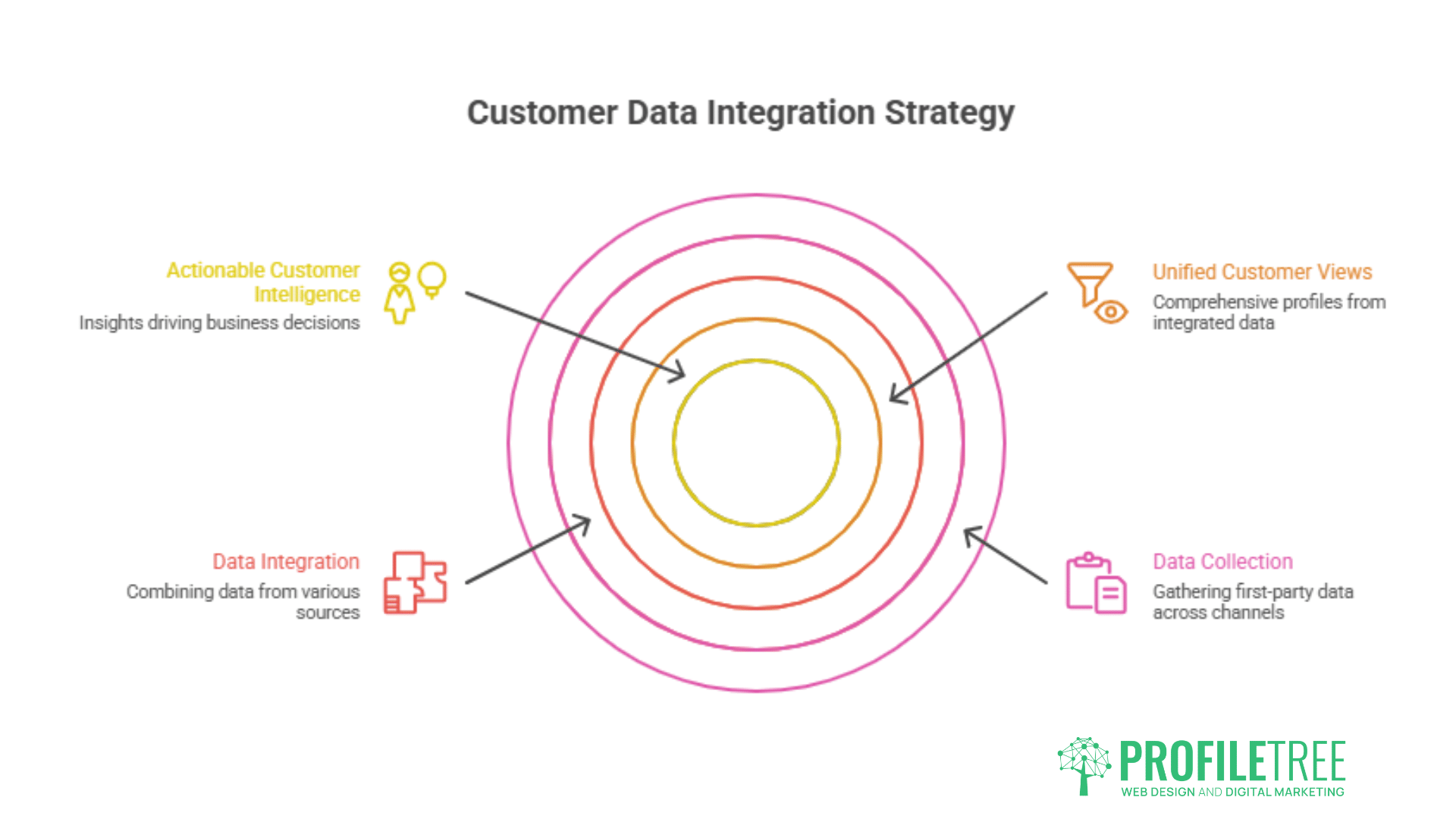
Collecting first-party data across multiple channels is valuable. Integrating that data into unified customer views is transformative. Customer Data Platforms (CDPs) and strategic integration turn scattered data points into actionable customer intelligence.
Understanding Customer Data Platforms
CDPs collect first-party data from all customer touchpoints—website, email, social media, offline interactions, customer service, purchases—and create unified profiles for each customer. Unlike CRM systems that focus primarily on sales-related information, CDPs incorporate all customer data to build comprehensive views of behaviour, preferences, and history.
These platforms resolve identity across devices and channels, recognising that the person who visits your website on a mobile phone, opens emails on a tablet, and makes purchases on a desktop is the same customer. This unified view enables consistent, personalised experiences regardless of how customers interact with your business.
Modern CDPs range from enterprise solutions costing tens of thousands of pounds to accessible platforms suitable for SMEs. Many offer scalable pricing that grows with your business. Start by integrating your most important data sources—website analytics, email marketing platform, and CRM—then expand to additional channels as your data strategy matures and demonstrates ROI.
Integration Best Practices
Effective integration requires planning. Begin by auditing existing data sources to understand what information you collect, where it lives, how it’s currently used, and what’s missing. Map data flows between systems. Identify integration points and potential obstacles.
Establish data governance policies defining data quality standards, ownership responsibilities, collection protocols, usage guidelines, and privacy compliance requirements. Consistent data formats and naming conventions across systems prevent integration headaches. Regular data cleaning removes duplicates, corrects errors, and maintains accuracy.
API connections between systems enable real-time data synchronisation. When someone updates their email address in your CRM, that change should automatically reflect in your email platform, support system, and any other tools using contact information. This automation reduces manual work whilst maintaining data consistency across all systems.
Creating Unified Customer Views
A unified customer view consolidates all data about an individual into one comprehensive profile accessible across your organisation. This profile might include basic contact information, complete purchase history, website browsing behaviour, email engagement patterns, customer service interactions, social media activity, content preferences, and explicitly stated interests.
This unified view transforms how your business operates. Customer service representatives see the complete purchase and support history before answering calls. Marketing automation triggers campaigns based on comprehensive behavioural data rather than isolated actions. Sales teams access full interaction history before conversations, enabling more relevant discussions. Everyone works from the same information, creating consistent customer experiences.
Single customer views also reveal patterns invisible when data lives in silos. You might discover that customers who engage with certain content are significantly more likely to purchase specific services. Or that particular support issues predict increased churn risk. These insights inform strategy across departments, from product development to marketing to customer success.
Loyalty Programmes and Engagement Incentives
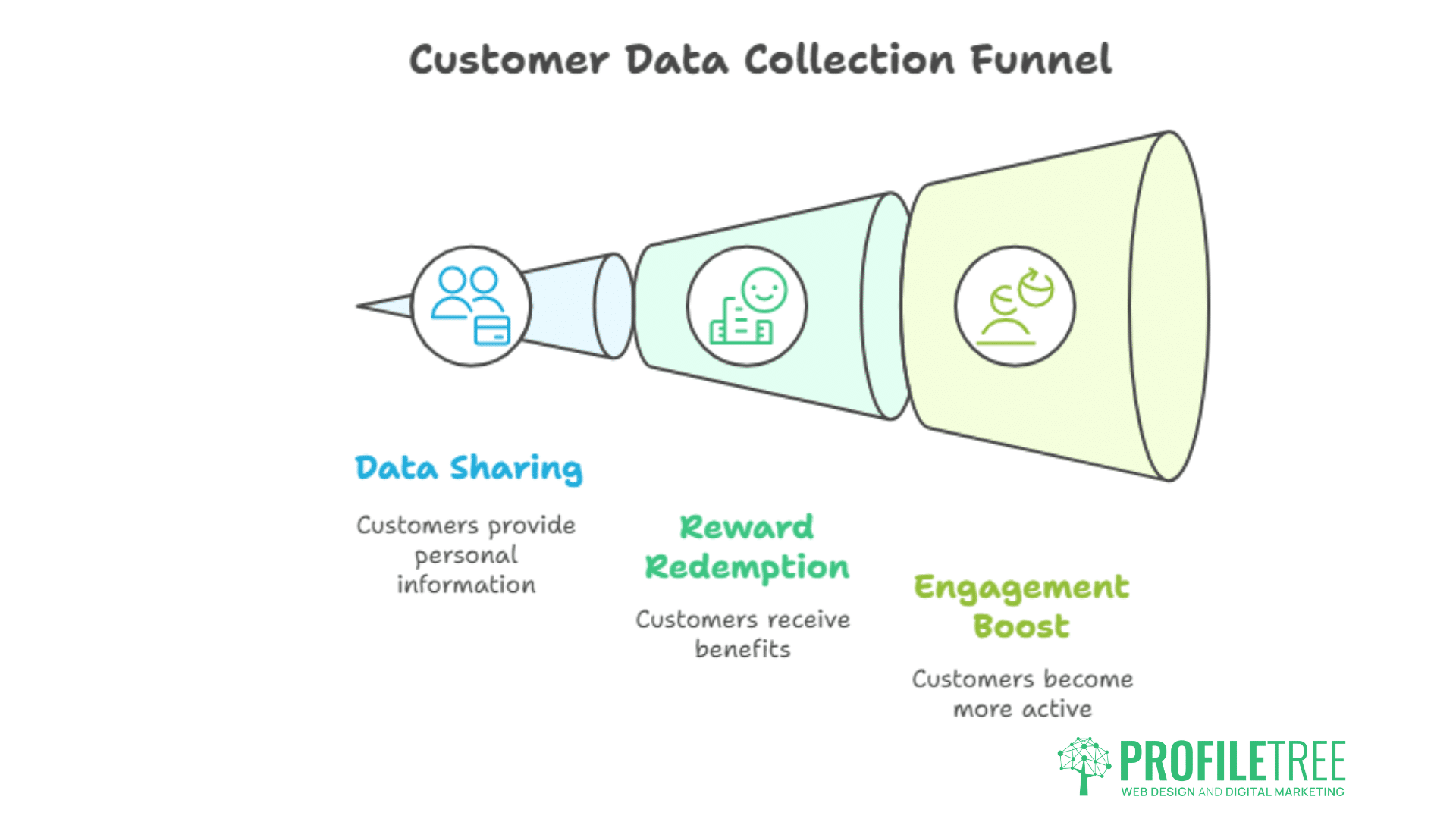
Loyalty programmes represent highly effective first-party data collection strategies. Customers willingly share detailed information in exchange for rewards, creating mutually beneficial relationships rich in data and value.
Designing Programmes That Work
Effective loyalty programmes balance simplicity with meaningful rewards. Overly complex point systems confuse participants and reduce engagement. Irrelevant rewards fail to motivate desired behaviours. The best programmes offer clear value propositions with rewards customers genuinely want.
Consider what matters to your specific audience. A digital agency might offer discounts on future services, complimentary digital training sessions, priority booking for consultations, or early access to new service offerings. A retailer could provide exclusive products, special shopping events, free shipping, or personalised recommendations. Match rewards to demonstrated customer values and behaviours.
Tiered programmes encourage increased engagement by offering progressively better benefits at higher participation levels. Bronze members might receive 5% discounts, whilst gold members get 15% discounts, priority support, and exclusive content. Platinum members access everything plus personalised consultations and invitation-only events. This structure motivates customers to share more data and increase engagement to reach better tiers.
Collecting Transactional Intelligence
Every transaction generates valuable first-party data. Purchase history reveals product preferences, buying patterns, price sensitivity, purchase frequency, basket composition, and customer lifecycle stage. Analysing this intelligence identifies cross-sell opportunities, predicts future purchases, and enables genuinely personalised recommendations.
Encourage account creation before checkout to link purchases with customer profiles. Guest checkout is convenient, but it sacrifices valuable data collection opportunities. Offer clear incentives for account creation: faster checkout on future purchases, easy order tracking, streamlined returns process, automatic warranty registration, and loyalty programme participation.
Stored payment information (collected and stored securely) enables frictionless repeat purchases. Saved payment methods reduce checkout abandonment whilst encouraging additional transactions. Combined with purchase history, this convenience significantly increases customer lifetime value whilst providing data about spending patterns and preferences.
Rewarding Engagement Beyond Purchases
Consider engagement-based loyalty programmes that reward behaviours aligned with your business goals beyond transactions. Award points for reviewing products, referring friends, sharing content on social media, completing detailed profile information, participating in surveys, attending events, or contributing to your community.
This approach creates participation opportunities for customers who aren’t frequent purchasers but remain highly engaged with your brand. Someone might rarely buy but regularly read your blog, attend your webinars, and share your content. Recognising this engagement builds relationships with future high-value customers whilst collecting data about their interests and influence.
Gamification elements—achievement badges, experience levels, challenges, leaderboards—make engagement-based programmes more compelling. These mechanics tap into human psychology around achievement and status whilst encouraging the consistent interactions that generate ongoing first-party data about customer behaviour and preferences.
Measuring Success and Optimising Strategy
Implementing first-party data strategies requires investment in technology, processes, and organisational change. Measuring return on this investment justifies resources, demonstrates value, and identifies optimisation opportunities.
Critical Performance Indicators
Track metrics directly related to first-party data quality and effectiveness. Data collection rate measures the percentage of website visitors who provide information through forms, signups, or accounts. Data completeness shows average fields populated in customer profiles—higher completeness enables better personalisation. Data accuracy tracks the percentage of records with valid, current information. Engagement rate measures the percentage of contacts who actively interact with your communications.
Business impact metrics connect data collection to tangible outcomes. Compare conversion rates between customer segments with different profile completeness levels. Measure customer lifetime value for customers in your database versus anonymous visitors. Track how personalisation based on first-party data affects email open rates, click-through rates, website engagement, and purchase behaviour.
Search engine optimisation benefits from first-party data through improved personalisation and user experience signals. Monitor how data-driven website improvements affect organic traffic, bounce rates, time on site, pages per session, and conversion rates. These metrics demonstrate SEO value beyond traditional ranking measurements.
Attribution and Customer Journey Analysis
First-party data enables sophisticated attribution modelling that tracks complete customer journeys across all touchpoints. Understanding which interactions contribute to conversions helps optimise marketing spend and strategy based on actual performance rather than assumptions.
Multi-touch attribution models use first-party data to assign value to each customer interaction throughout their journey. Someone might discover your business through organic search, return via social media, subscribe to your email list, attend a webinar, and eventually convert after receiving a targeted email campaign. First-party data connects these touchpoints, revealing the complete path to purchase.
Analyse cohort behaviour to understand how different customer groups respond to strategies over time. Compare customers acquired through different channels, who purchased different products, or who engaged with specific content. These comparisons reveal what approaches work best for different audience segments, enabling more effective resource allocation.
Continuous Testing and Refinement
First-party data strategies require ongoing optimisation. A/B test data collection methods to determine which form designs, field combinations, and value propositions generate the highest completion rates with the best data quality. Test email personalisation approaches to identify which variables drive the strongest engagement and conversion improvements. Experiment with loyalty programme structures to find optimal reward levels and tier thresholds.
Regular data audits identify quality issues, integration gaps, and compliance concerns before they become serious problems. Review what data you’re collecting, whether you’re using it effectively, if it still serves your business goals, how current and accurate it is, and whether collection processes remain compliant with evolving regulations.
Stay informed about emerging best practices and technologies. The first-party data landscape continues to develop rapidly as more businesses adapt to the post-cookie reality. New tools and approaches might offer significantly better results than your current methods. Professional development, industry publications, and peer networks keep your strategy current and competitive.
ProfileTree: Your Digital Marketing Partner
ProfileTree helps businesses across Northern Ireland, Ireland, and the UK adapt to post-cookie marketing through comprehensive digital services. Our Belfast-based team at the McSweeney Centre works with SMEs and organisations to develop effective first-party data strategies that drive measurable growth whilst maintaining full privacy compliance.
We provide website design and development optimised for data collection and user experience, digital strategy consulting to align data initiatives with business goals, content marketing that attracts and engages target audiences, and SEO services that improve visibility and organic traffic. Our digital training programmes build your team’s capabilities in data-driven marketing, AI implementation services help you extract maximum value from customer data through intelligent automation, and our AI training develops practical skills for using data effectively.
Whether you’re building your first data collection strategy or optimising existing approaches, ProfileTree provides the expertise and support needed to succeed in the post-cookie era. Contact our team to discuss how first-party data strategies can transform your marketing performance.