
Cost per Impression (CPM): A Guide for UK Marketers
Table of Contents
Cost per impression, commonly abbreviated to CPM (cost per mille), measures what you pay for every one thousand times your advertisement is displayed. It is one of the oldest pricing models in media buying, and it remains the standard for brand awareness campaigns across display, social, and video advertising.
This guide breaks down the CPM formula using GBP examples, compares CPM with CPC and CPA so you can choose the right model, and covers UK-specific benchmarks by platform and sector. It also addresses viewable CPM (vCPM), the metric that is gradually replacing standard CPM as the industry default.
All prices and figures in this guide are indicative UK examples and correct at the time of writing; use them as a benchmark rather than fixed quotations.
What is Cost per Impression and How Does CPM Work?
Before running any paid campaign, you need to understand what you are actually buying. CPM defines the cost of visibility, making it the foundation of media planning across channels.
Defining an Impression
An impression is recorded each time an advertisement is loaded and displayed on a screen, regardless of whether the person who sees it clicks, scrolls past, or takes any action. One user who sees the same ad five times on the same day contributes five impressions, not one. This distinction matters when you are trying to control frequency, which refers to how many times a single person encounters your ad before the campaign ends.
Impressions are not the same as reach. Reach counts unique individuals, whereas impressions count total ad displays. A campaign with a reach of 10,000 and an average frequency of 3 will record 30,000 impressions. Both figures are reported in most ad platforms, and understanding the difference prevents misreading your results.
The CPM Formula
The formula for calculating cost per impression is straightforward:
CPM = (Total Campaign Cost ÷ Total Impressions) × 1,000
As a practical example: a campaign that costs £400 and generates 80,000 impressions produces a CPM of £5, which means you are paying £5 for every thousand times your ad appears. To reverse the calculation and find out how many impressions a given budget will buy, divide the budget by the CPM and multiply by 1,000. A £1,000 budget at a CPM of £8 delivers 125,000 impressions.
The “mille” in CPM is Latin for one thousand, which is why the metric is sometimes written as cost per thousand or CPT. All three terms describe the same calculation.
Why CPM Is Used for Brand Awareness
CPM suits campaigns where the primary goal is visibility rather than immediate response. When a business launches a new product, enters a new market, or wants to keep its brand name in front of a defined audience over time, paying per impression is logical. You are buying exposure, and CPM gives you a predictable cost for a known volume of that exposure.
This is why CPM dominates upper-funnel activity. Display advertising, YouTube pre-roll, LinkedIn awareness campaigns, and programmatic banner placements all routinely operate on a CPM basis. When ProfileTree builds digital marketing campaigns for Northern Ireland and UK businesses, the choice of buying model is one of the first strategic decisions on the table, because it determines how performance is tracked and what success looks like.
Interactive CPM Calculator
Use the calculator below to work out your CPM or estimate how far your budget will stretch.
CPM Calculator: Total campaign cost (£), Total impressions. Calculate CPM
UK CPM Benchmarks: What Should You Expect to Pay?
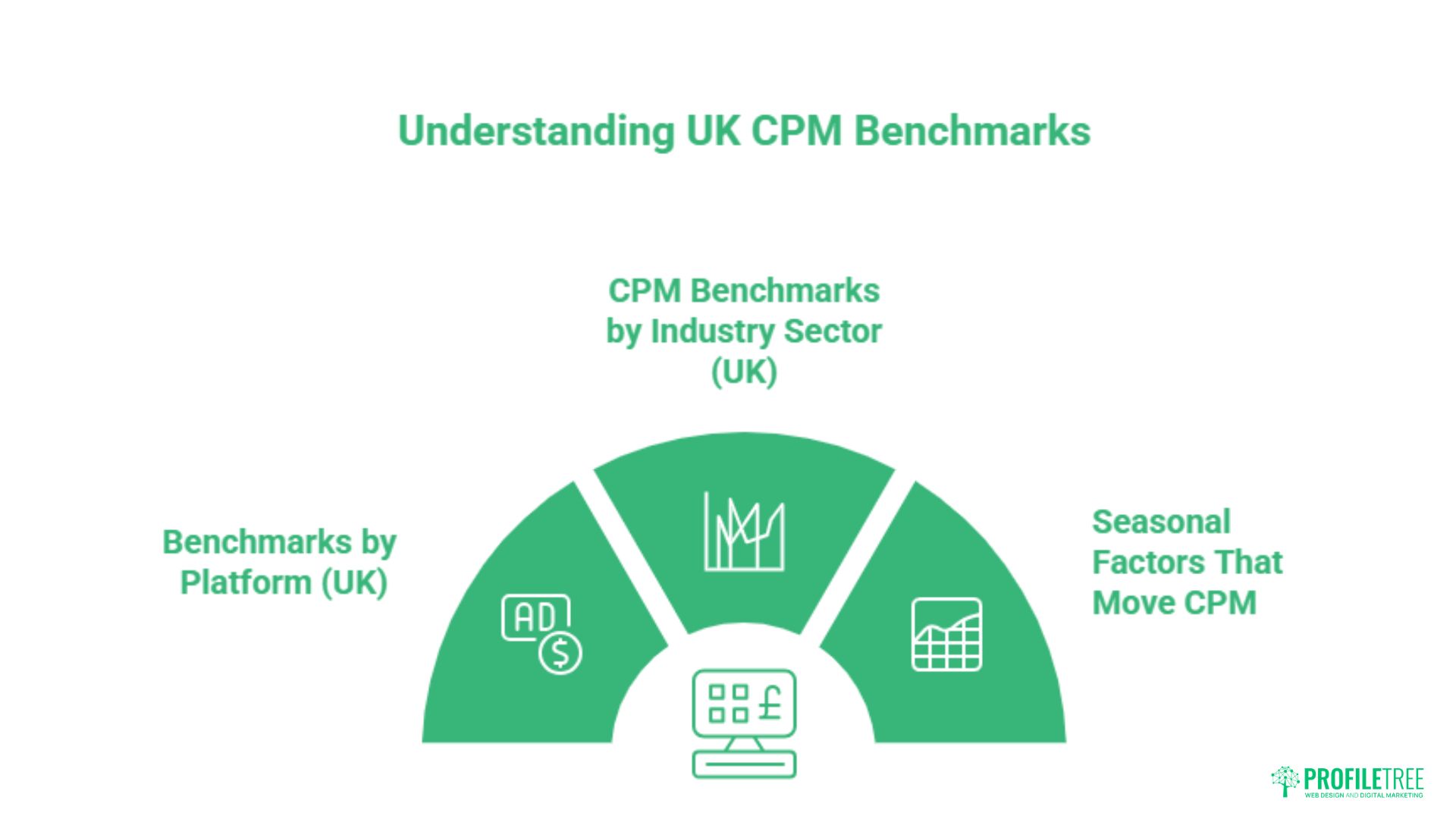
One of the most common complaints about CPM content is that it relies on US dollar figures that bear little relation to UK media costs. The benchmarks below are expressed in GBP and reflect typical ranges for UK-based campaigns, though actual rates vary by targeting precision, ad format, creative quality, and seasonal demand.
CPM Benchmarks by Platform (UK)
Platform choice has a large effect on CPM. Consumer platforms generally offer cheaper reach than professional or intent-rich environments, but format matters as much as audience. Video inventory commands a premium wherever it sits, which is why YouTube pre-roll runs closer to LinkedIn than to TikTok despite reaching a similar consumer audience.
| Platform | Typical UK CPM Range (£) | Primary Use Case |
|---|---|---|
| Meta (Facebook/Instagram) | £6 – £14 | Consumer brand awareness, retargeting |
| £28 – £70 | B2B awareness, decision-maker targeting | |
| Google Display Network | £1.50 – £6 | Broad reach, programmatic retargeting |
| YouTube (pre-roll) | £8 – £23 | Video brand awareness |
| TikTok | £3 – £8 | Consumer awareness, under-35 audiences |
| X (formerly Twitter) | £4 – £10 | Real-time event awareness, news adjacent |
| Sky AdSmart / ITVX | £20 – £55 | Connected TV, regional audience targeting |
The spread across platforms is wider than most advertisers expect. TikTok delivers the cheapest reach of the major social platforms in the UK, typically undercutting Meta by a third or more, while YouTube pre-roll runs at the top end of social because video audiences are more attentive and inventory is tighter.
LinkedIn sits in a category of its own. A £50 CPM looks expensive next to a £6 TikTok CPM, but if your target audience is finance directors in Belfast and Glasgow, LinkedIn impressions carry far more weight. Cost per impression only means something alongside audience quality.
CPM Benchmarks by Industry Sector (UK)
Beyond the platform, the sector you are advertising in affects CPM through audience competition. Highly commercial sectors with multiple advertisers bidding for the same audience segments push rates up.
| Sector | Estimated UK CPM Range (£) |
|---|---|
| Retail and e-commerce | £5 – £14 |
| Financial services | £12 – £30 |
| B2B technology | £20 – £60 |
| Travel and hospitality | £6 – £18 |
| Healthcare and pharmaceuticals | £10 – £25 |
| FMCG (food, drink, household) | £4 – £10 |
| Recruitment and HR | £15 – £40 |
Seasonal Factors That Move CPM
CPM is not static. Rates rise sharply during high-competition periods when more advertisers are competing for the same impressions. Q4 is consistently the most expensive quarter in the UK, driven by Black Friday, the pre-Christmas shopping period, and Boxing Day sales. January is usually cheaper, making it a good time for awareness campaigns with limited budgets.
Northern Ireland and Ireland campaigns can see additional variation around bank holidays, local sporting events, and the distinct retail calendar differences between the Republic and Northern Ireland. If you are running cross-border campaigns targeting both markets, budget for CPM variance between the two regions. ProfileTree’s Brexit impact on digital marketing analysis covers some of these audience and targeting considerations in more detail.
CPM vs CPC vs CPA: Choosing the Right Buying Model
CPM is one of the three main pricing models in digital advertising. Understanding when each is appropriate stops you from paying for the wrong type of performance at the wrong stage of the customer journey.
The Three Models Compared
Each model is suited to a different campaign objective. Choosing the wrong one does not just waste money; it produces misleading performance data that can lead to poor future decisions.
| Model | Full Name | You Pay For | Best For | Risk |
|---|---|---|---|---|
| CPM | Cost per Mille | 1,000 impressions | Brand awareness, reach | Impressions with no engagement |
| CPC | Cost per Click | Each click | Traffic, lead generation | Clicks with no conversion |
| CPA | Cost per Acquisition | Completed action (purchase, form) | Direct response, e-commerce | Higher unit cost, volume limits |
When to Choose CPM
CPM makes sense when you want to put your brand in front of a defined audience as many times as possible within a budget, and when you are not expecting an immediate click or purchase. New product launches, local market entries, and content amplification campaigns all benefit from a CPM approach because they are building recognition, not harvesting intent.
A Belfast-based professional services firm launching a new division, for example, might run a LinkedIn CPM campaign targeting finance managers in Northern Ireland for four weeks before switching to CPC ads that drive traffic to a consultation landing page. The CPM phase primes the audience; the CPC phase converts them. This two-stage approach consistently outperforms going straight to CPC in low-awareness markets.
When CPC or CPA Is the Better Choice
If your campaign goal is measurable website traffic or completed transactions, CPC and CPA models align payment with performance more directly. CPC charges you only when someone clicks, which means you are at least buying intent signals. CPA goes further, tying spend to actual outcomes such as a form submission or sale.
The trade-off is cost and volume. CPA rates are invariably higher per unit than CPM because the platform absorbs more targeting work to deliver qualifying users. For B2B campaigns in smaller markets like Northern Ireland, CPA volume can also be limited, making CPM a more practical tool for building the audience pool needed to make CPC and CPA campaigns viable later. Understanding how different campaign models interact with your overall digital marketing ROI is something the ProfileTree team works through with every client before a campaign brief is finalised.
CPM and Click-Through Rate Together
CPM alone tells you what you spent to get seen. It tells you nothing about whether people responded. That is why CPM campaigns should always be evaluated alongside click-through rate (CTR), which measures the percentage of impressions that generated a click. A campaign with a low CPM and a strong CTR is performing well on both cost and engagement dimensions.
The combination also lets you calculate effective CPC from a CPM campaign. If your CPM is £8 and your CTR is 1%, you are receiving 10 clicks per thousand impressions, which means your effective CPC is £0.80. Framed this way, a CPM campaign that achieves even a moderate CTR can deliver very competitive cost-per-click rates compared with CPC bidding in a competitive auction.
Factors That Affect Your CPM and How to Optimise It
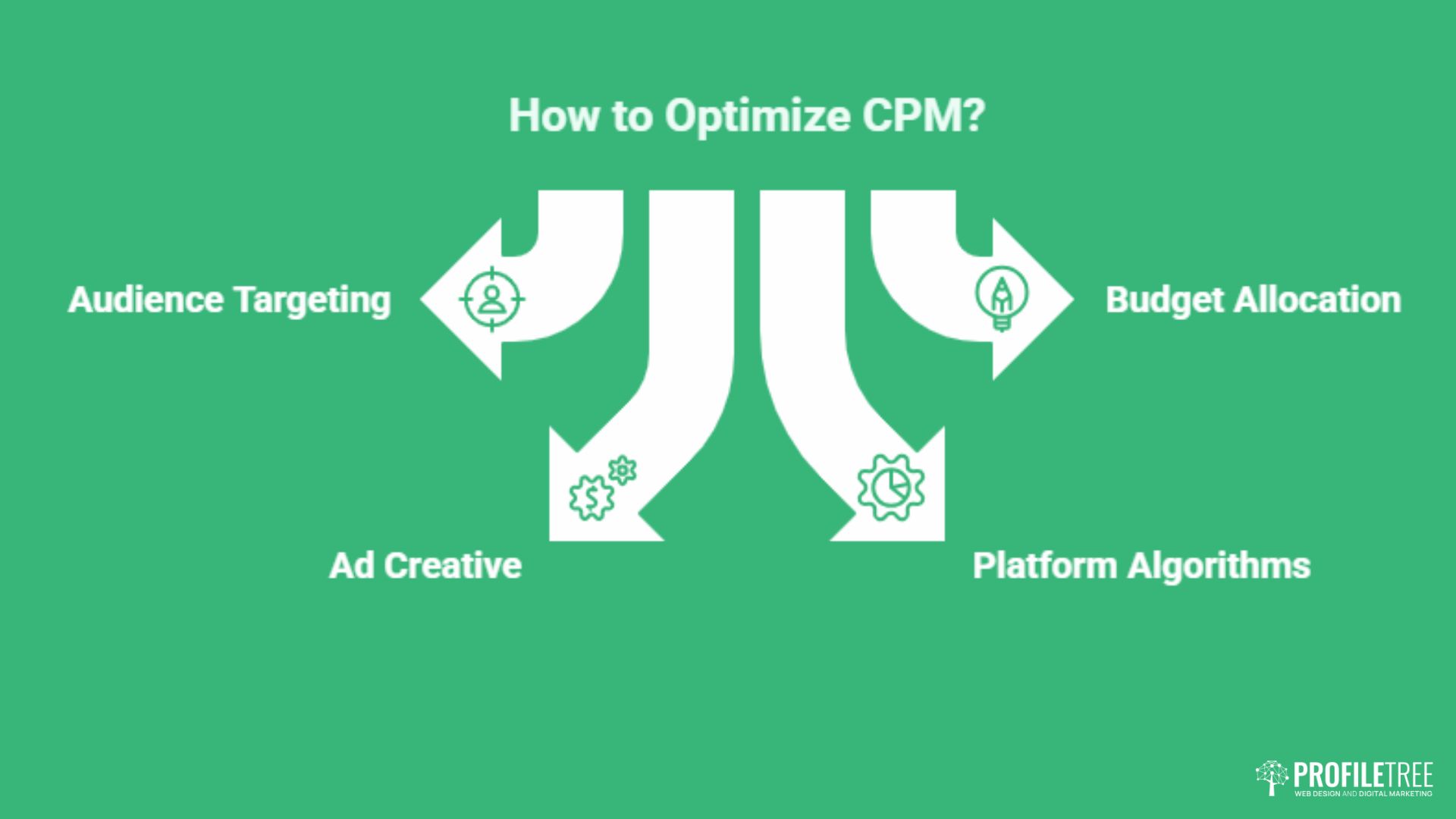
Knowing your CPM figure is only useful if you understand what is driving it up or down. Several variables are within your control, and addressing them directly can produce meaningful cost reductions without sacrificing audience quality.
Audience Targeting Precision
Narrow, highly specified audiences typically carry higher CPMs because you are competing with more advertisers for the same small pool of users. A LinkedIn campaign targeting CFOs at UK manufacturing companies with 50 to 200 employees will cost far more per thousand impressions than one targeting a broad interest in “business and finance.” The question is not which CPM is lower, but which audience is more likely to convert.
Lookalike audiences and interest-based targeting tend to offer lower CPMs while maintaining reasonable relevance, making them useful for awareness phases. Retargeting campaigns, which show ads to people who have already visited your website, often carry higher CPMs but produce much stronger engagement rates, making the cost per meaningful interaction lower overall.
Smart audience segmentation is central to the social media strategies ProfileTree builds for SMEs across Northern Ireland and the wider UK. ProfileTree’s analysis of digital marketing ethics and regulatory considerations also covers how targeting restrictions, particularly under GDPR and the UK’s Privacy and Electronic Communications Regulations, are reshaping what audience data is available for CPM-based buying.
Ad Creative Quality and Format
Ad platforms reward higher-quality creative with lower CPMs through relevance and quality scores. Meta assigns a relevance score to each ad; ads with stronger scores are shown more frequently at a lower cost per impression. Google’s Display Network applies a similar quality signal. An ad that generates above-average engagement relative to its audience reduces your CPM over the life of the campaign.
Format also plays a role. Video ads consistently command higher CPMs than static display, but they also produce stronger brand recall. Connected TV placements through Sky AdSmart or ITVX sit at the premium end of the UK CPM spectrum, reflecting both production investment and audience attentiveness. Carousel and story formats on Meta tend to deliver competitive CPMs with strong engagement metrics for e-commerce brands.
Platform Algorithms and How Auction Pricing Works
Most digital ad placements are sold through real-time auctions. Your CPM is not a fixed rate; it is the price your bid wins at in competition with every other advertiser targeting the same audience at the same time. When demand is high, CPMs rise. When advertiser competition for your target audience is low, CPMs fall.
This is why campaign timing matters. Running awareness campaigns in January and February rather than October and November can deliver 20 to 40 per cent lower CPMs for equivalent audiences, purely because fewer advertisers are competing. For brands with flexible campaign windows, scheduling around low-demand periods is one of the simplest CPM optimisation strategies available. ProfileTree’s analysis of failed marketing campaigns includes examples of brands that spent peak-period CPM budgets on underprepared creative, compounding the cost problem.
Budget Allocation and Frequency Caps
Running a campaign without a frequency cap means some users will see your ad dozens of times. Beyond a certain threshold, additional impressions from the same user add cost without adding value. Research consistently shows that brand lift from repeated impressions plateaus after three to five exposures in most categories. Setting frequency caps at three to seven impressions per user per week tends to preserve CPM efficiency while maintaining adequate reach.
Budget pacing also matters. Platforms that exhaust a daily budget early in the day can end up buying less competitive remaining inventory, potentially at worse CPMs than a campaign that paces spend evenly. Most major platforms offer budget pacing controls; using them is a basic step that many smaller advertisers overlook.
Viewable CPM (vCPM), Ad Fraud, and the Cookieless Future
Standard CPM has a fundamental weakness: it counts an impression as soon as an ad is served, regardless of whether it was actually seen by a human being. The industry has spent the last decade developing standards and technologies to address this, with real implications for how UK advertisers buy and measure awareness campaigns.
What is Viewable CPM?
Viewable CPM charges only for impressions meeting the IAB and Media Rating Council standard: at least 50 per cent of a display ad’s pixels visible for at least one continuous second, or two seconds for video. Large-format display ads over 242,500 pixels need only 30 per cent in view for one second. An impression that loads below the fold and is never scrolled to does not count as viewable and is not charged under a vCPM model.
This distinction is more significant than it might seem. Industry viewability rates typically run between 50 and 60 per cent, which means close to half of all served impressions are never seen. Ads load in non-visible page positions, in inactive browser tabs, or the user scrolls past before the ad renders. On a standard CPM buy, you pay for every one of them. vCPM buying shifts the risk of wasted impressions from the advertiser to the publisher or ad network.
For UK brand advertisers, moving to vCPM wherever available is worth the typically higher unit cost. A vCPM of £12 on a premium publisher site is often more cost-effective than a standard CPM of £4 across a broad display network if half of those £4 impressions were never actually in view.
“Understanding true viewability is where CPM strategy gets serious,” says Ciaran Connolly, founder of ProfileTree. “For SMEs with tight awareness budgets, paying for served impressions rather than seen impressions is a hidden cost that adds up quickly across a campaign.”
Viewability is now the floor rather than the ceiling. The MRC and IAB finalised Attention Measurement Guidelines in November 2025, which use viewability as the baseline before assessing deeper signals such as dwell time and screen share. Expect attention metrics to appear in platform reporting over the next two years, and expect them to make some currently acceptable placements look considerably worse.
Ad Fraud and Non-Human Traffic
A second challenge for CPM buyers is invalid traffic, which includes bot activity, domain spoofing, and ad stacking, where multiple ads are layered on top of each other so only the top one is visible. Invalid traffic accounts for a persistent share of programmatic display spend, and the proportion rises sharply on open exchanges compared with direct publisher deals.
UK advertisers can mitigate this through several measures: purchasing through whitelisted publisher lists rather than open exchanges, requiring ads.txt compliance from all placements, using a third-party verification tool such as Integral Ad Science or DoubleVerify, and avoiding very low CPM deals that seem implausibly cheap, as these often indicate low-quality or fraudulent inventory.
GDPR, Cookie Deprecation, and Impression Tracking
UK and EU advertisers face an additional complication that most US-centric CPM content ignores: the impact of GDPR and inconsistent third-party cookie support across browsers on impression tracking accuracy. When a user does not consent to cookies on a publisher’s site, their impressions may be counted differently across platforms, leading to discrepancies between what your ad server reports and what the publisher reports.
The picture here changed and most guidance has not caught up. Google abandoned its plan to deprecate third-party cookies in Chrome in July 2024, and confirmed in April 2025 that Chrome will keep them with no standalone user prompt. Safari and Firefox still block them by default, which covers roughly a third of UK traffic. Cross-site frequency capping and audience deduplication therefore still work for most users, but not all, and the gap is invisible in standard reporting.
The practical response is to move more CPM activity to first-party data environments, such as platforms where users are logged in (Meta, LinkedIn, Google), and to invest in contextual targeting approaches that do not depend on individual-level tracking.
Note which regulator applies to what. The Information Commissioner’s Office enforces cookie consent under the Privacy and Electronic Communications Regulations, and its guidance is the one to read if your tracking setup is in question. The Advertising Standards Authority governs the content of your ads rather than how impressions are measured. Confusing the two is common, and it leads businesses to check the wrong rulebook.
CPM in the Context of a Full Campaign Strategy
CPM does not operate in isolation. It sits at the top of a campaign structure that should move audiences through awareness, consideration, and action. Understanding where CPM fits within that structure stops it from being misused as a catch-all metric.
Attribution and CPM
One of the persistent challenges with CPM campaigns is attribution. Because CPM buys exposure rather than clicks, it rarely gets credit in last-click attribution models for conversions that happen later in the customer journey. A user who sees a LinkedIn awareness ad on Monday, searches on Google and clicks a CPC ad on Thursday and then completes a contact form on Friday will typically be attributed entirely to the CPC click in a last-click model, making the CPM campaign look ineffective.
Moving to multi-touch attribution, where credit is shared across the touchpoints that contributed to a conversion, gives CPM campaigns a more accurate performance picture. View-through conversion windows, which attribute a conversion to a CPM impression if the user converts within a defined period after seeing the ad, are another way to capture CPM’s contribution to business outcomes. Most major ad platforms offer these settings, though they require careful configuration to avoid overcounting.
Integrating CPM with Organic and Content Channels
Paid CPM campaigns work best when the organic environment supports them. A brand running LinkedIn awareness ads will see stronger results if the company’s LinkedIn page is active, the team members are posting regularly, and the website content the ads lead to is genuinely useful. CPM buys attention; the content and site experience then determine whether that attention converts to a relationship.
This is particularly relevant for Northern Ireland and Irish SMEs, where budgets are smaller, and every paid impression needs to do more work. ProfileTree’s approach combines a compliant digital marketing strategy with content that supports paid activity, so awareness campaigns land in an environment set up to convert interest into enquiries. A fragmented approach, where CPM ads point to thin or poorly optimised landing pages, wastes the majority of the spend.
Budgeting for CPM Campaigns
Setting a CPM budget requires working backwards from your reach goal. If you want to reach 50,000 unique users at an average frequency of four impressions each, you need 200,000 impressions. At a CPM of £7, that is a total campaign cost of £1,400. Adding vCPM uplift (typically 20 to 40 per cent above standard CPM) and platform fees brings the realistic budget closer to £1,700 to £2,000 for that reach objective.
Most professional media planners build in a 10 to 15 per cent test budget to run creative variants before committing the full spend. Running two or three ad versions in the first week, then shifting budget to the best performer, regularly produces 20 to 35 per cent improvements in CPM efficiency for the remainder of the campaign.
It is one of the simplest improvements available and one that smaller advertisers consistently skip because they treat their first ad as final. ProfileTree’s campaign ROI guidance walks through how to structure this kind of test-and-learn approach regardless of budget size.
Reporting on CPM Campaigns
A CPM campaign report should include more than just the CPM figure and total impressions. Effective reporting covers: total reach and average frequency, viewability rate (for display and video), CTR and effective CPC, view-through conversions where available, and CPM broken down by placement or audience segment to identify where spend is most efficient.
Comparing CPM across placements often reveals that one channel delivers twice the viewable impressions per pound as another, which is an easy optimisation most platforms make available via a simple filter.
Getting CPM Right
Cost per impression remains the standard model for brand awareness buying across digital and traditional channels, but the sophistication required to use it well has grown considerably. UK advertisers now need to account for viewability standards, GDPR-driven tracking changes, and the attribution gap between awareness spend and downstream conversions. Getting this right means lower wasted spend and more efficient campaigns over time.
If you want support planning or managing CPM campaigns for your business in Northern Ireland, Ireland, or across the UK, speak to the ProfileTree team.
Frequently Asked Questions
What is a good CPM for UK digital advertising?
A good CPM depends heavily on the platform and sector. For consumer display advertising in the UK, a CPM of £3 to £8 is broadly competitive, with TikTok typically at the lower end and Meta at the upper. LinkedIn B2B campaigns routinely run at £30 to £70 and can still represent good value if the audience quality is high. Compare your CPM against the benchmarks in this guide for your specific platform and sector rather than applying a single universal standard.
What is the difference between CPM and vCPM?
Standard CPM charges for every ad impression that is served, whether or not it was actually visible on screen. Viewable CPM (vCPM) only counts impressions where at least 50 per cent of the ad was visible for at least one second. vCPM rates are typically higher per thousand impressions, but you are paying for confirmed exposure rather than technical delivery, making it a more meaningful metric for brand awareness.
How does CPM compare to CPC for a small business with a limited budget?
For a small business with a limited budget, CPC is often the safer choice if the goal is website traffic or enquiries, because you only pay when someone shows enough interest to click. CPM makes more sense when brand recognition is the primary objective and immediate response is not expected.
Does VAT apply to CPM advertising costs in the UK?
Yes. UK VAT-registered businesses purchasing advertising from platforms such as Meta and Google will typically find VAT applied to their invoices if they are registered in the UK. The CPM rate you see during campaign setup is usually the net rate; the total invoice will include VAT at the standard rate. You can reclaim the VAT through your normal VAT return if the advertising is for a business purpose.
What is the difference between an impression and reach in advertising?
Reach measures the number of unique individuals who see your ad at least once. Impressions measure the total number of times your ad is displayed, including multiple views by the same person. A reach of 10,000 with a frequency of three means 30,000 impressions. Both metrics appear in most ad platform dashboards and serve different analytical purposes.