
What Is a Customer Data Platform and Do You Need One?
Table of Contents
Most businesses collect more customer data than they know what to do with. Website sessions in one tool, purchase history in another, email engagement sitting in a third. A customer data platform (CDP) is the technology that pulls all of that together into a single, actionable view of every customer.
This guide covers how CDPs work, how they differ from your existing tools, and what UK businesses need to think about before choosing one.
How a Customer Data Platform Works
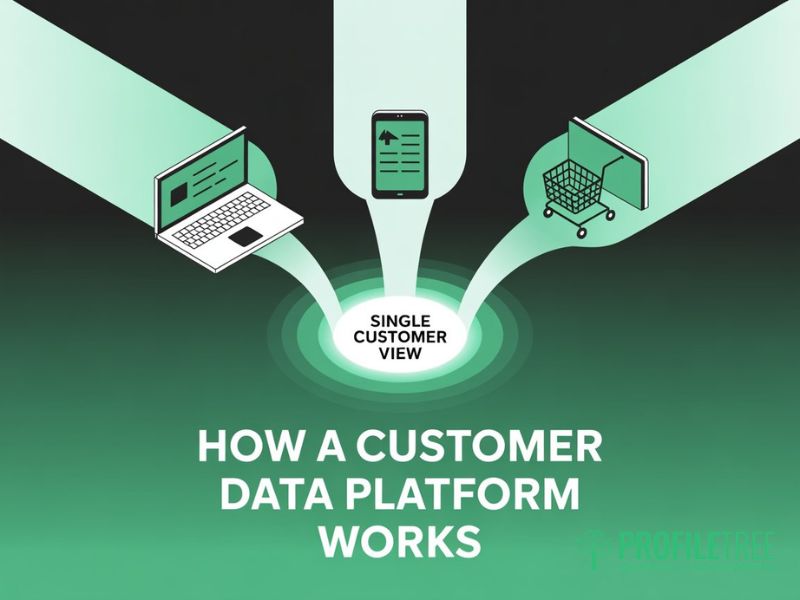
Understanding the mechanics of a CDP is important before evaluating whether you need one. The platform operates across three core functions: taking in data, making sense of it, and making it available to your marketing tools.
Data ingestion and the single customer view
A CDP collects first-party data generated directly by your customers’ interactions with your business from every touchpoint. That includes your website, mobile app, email platform, CRM, point-of-sale system, and customer service tools. The platform ingests all of this, standardises it, and resolves multiple identifiers (email address, cookie ID, loyalty number) into a single persistent profile.
This is the “single customer view” that marketers have been chasing for decades. It’s a complete, continuously updated record of every customer: who they are, what they’ve bought, which content they’ve engaged with, and what they’re likely to do next.
For businesses where customer data accuracy sits at the heart of strategy and protecting user data through secure storage is increasingly a board-level concern, a CDP provides both the consolidation layer and the audit trail regulators expect.
Real-time identity resolution vs batch processing
Not all CDPs handle data at the same speed. Real-time CDPs resolve identities and update profiles as events happen, allowing marketers to trigger personalised messages within seconds of a customer action. Batch-processing CDPs update profiles at intervals, hourly or daily, which works for email campaigns but not for live website personalisation or abandoned-basket recovery.
For most UK SMEs, real-time processing is a premium feature that adds cost without proportional benefit. Unless your marketing strategy depends on sub-minute trigger windows, a batch-processing customer data platform is sufficient for segmentation, lifecycle campaigns, and reporting.
CDP vs CRM vs Data Warehouse: Which Do You Actually Need?
One of the most common questions from business owners is whether they already have the functionality they need. CDPs, CRMs, and data warehouses do different jobs, and understanding the distinction saves a great deal of time and budget.
Why your CRM is not a CDP
A CRM (customer relationship management system) manages direct interactions: sales pipeline stages, support tickets, and account notes. Data enters a CRM primarily through manual input by sales and service teams. It’s structured around accounts and deals.
A CDP, by contrast, ingests behavioural data automatically every page view, email open, and purchase event and builds profiles without human intervention. A CRM tells your sales team what a prospect said in a call last week. A CDP tells your marketing platform what that same prospect browsed on your website at 11 pm last night, and adjusts the next email they receive accordingly.
The two tools complement each other rather than compete. Many businesses find that a structured digital marketing strategy is what determines whether either system delivers value; technology alone is rarely the answer.
Is GA4 a CDP? The “diet CDP” question
Google Analytics 4 collects behavioural data and offers some audience segmentation through Google Ads. For many UK SMEs using GA4 with BigQuery, the question is reasonable: do you need a dedicated customer data platform on top of this?
The gap lies in two areas. First, GA4 profiles are anonymous and session-based by default; it can’t build persistent, individually identified customer records across devices and channels. Second, GA4 reports on what happened. A CDP is an activation tool; it uses that data to trigger personalised marketing actions in real time.
If you currently rely on Google Analytics for content marketing decisions and want to move toward personalisation at scale, a CDP fills the gap that GA4 cannot.
Table 1: CDP vs CRM vs Data Warehouse at a glance
| CDP | CRM | Data Warehouse | |
|---|---|---|---|
| Primary function | Unified customer profiles for marketing activation | Managing sales pipelines and service interactions | Long-term analytical storage across the business |
| Data type | First-party behavioural, transactional, and identity data | Manually entered sales, support, and account records | Structured historical data from multiple systems |
| Real-time capability | Yes built for real-time segmentation and activation | Yes, built for real-time segmentation and activation | No batch processing only |
| Best use case | Personalised, cross-channel marketing campaigns | Sales forecasting and customer service management | Business intelligence and long-range reporting |
| GDPR compliance tools | Consent management, right-to-erasure workflows | Limited is typically updated by sales teams | Varies by provider and configuration |
UK and Ireland Compliance: GDPR, Data Residency, and First-Party Data
UK businesses operate in a more complex regulatory environment than most CDP marketing materials acknowledge. The ethics and legalities of digital marketing matter a great deal when first-party customer data is being consolidated, profiled, and activated for commercial purposes.
UK-GDPR After Brexit: What Changed and What It Means
Since leaving the EU, the UK operates under UK-GDPR, a retained version of EU GDPR with some divergence points, particularly around international data transfers. The UK has issued adequacy decisions for the EEA, meaning data can flow between the UK and the EU without additional safeguards. However, transfers to the US still require assessment under Transfer Risk Assessments (TRAs) following the Schrems II ruling.
In practice, this means that before selecting a customer data platform, UK businesses must establish: where the vendor processes and stores data, whether data leaves the UK or EEA, what the vendor’s sub-processor list looks like, and whether the standard contractual clauses are current.
Irish businesses face EU GDPR in full, with the Data Protection Commission (DPC) as the supervisory authority. For businesses operating across both jurisdictions, a customer data platform that can partition data by geography and provide granular consent records is not optional; it’s a compliance necessity.
Data residency: where does your customer data actually live?
Composable CDPs, which use your existing cloud data warehouse as the data store, give you complete control over where data resides. Your data stays in your AWS, Azure, or Google Cloud environment, in whatever region you specify. This is a meaningful advantage for businesses with data residency requirements.
Enterprise SaaS CDPs typically offer regional data centres, but the specifics vary by vendor and contract tier. Always confirm data residency in writing before signing, and verify the sub-processor list; the CDPs they use are often hosted on infrastructure with their own transfer agreements.
Consent management and right-to-erasure workflows
A customer data platform is not required for GDPR compliance, but it makes compliance much easier in practice. Having all customer data in one place means that a Subject Access Request (SAR) or right-to-erasure request can be fulfilled without manually contacting six different platforms.
The same applies to consent management. When a customer withdraws consent, a CDP can propagate that change across every connected platform, email, paid media, and personalisation tools in a single action. Without a CDP, it’s a manual process with a meaningful risk of error. Designing GDPR-compliant data collection processes is the necessary foundation before a CDP can function compliantly.
Why CDP Implementations Fail (and How to Avoid the Common Pitfalls)
A CDP implementation is not a technology project. It’s a data strategy project that happens to involve technology. The majority of failed implementations share the same root causes, and most of them have nothing to do with which platform was chosen.
The data hygiene trap
A CDP aggregates and activates your existing data. If that data is incomplete, inconsistently structured, or full of duplicates, the CDP will reproduce the problem at scale. Businesses that skip a data audit before implementation typically spend the first six months cleaning data they should have cleaned before signing.
Before selecting a CDP, audit your primary data sources: your CRM, your email platform, and your website analytics. Identify how customer identity is captured across each one. If you can’t match 60–70% of records across two systems, you’re not ready for a CDP.
Organisational silos and the missing data owner
Technical silos of data sitting in separate platforms are fixable. Organisational silos are harder. CDP implementations consistently fail when marketing, IT, and data teams can’t agree on who owns the platform, who controls the taxonomy, or who defines what a “customer” means for segmentation purposes.
Successful implementations appoint a named data steward before the project begins: someone responsible for defining data standards, approving integrations, and maintaining the governance framework. Without that role filled, most CDPs become expensive data repositories that nobody activates.
Total cost of ownership beyond the licence fee
CDP vendors quote licence fees. The total cost of ownership is typically two to four times higher once implementation costs, internal resourcing, ongoing data engineering, and platform training are included. Mid-market businesses in the UK should budget as follows:
- Composable CDP (e.g. Hightouch, Census): £20k–£80k per year in licence fees, plus data warehouse costs and implementation (typically £15k–£40k for an agency or consultancy)
- Enterprise SaaS CDP (e.g. Adobe, Salesforce): £80k–£300k+ per year, with implementation projects often running six to nine months and costing an equivalent amount in professional services
- Mid-market SaaS CDP: £20k–£100k per year; implementation typically three to five months
Selecting the Right Customer Data Platform: A 10-Point Evaluation Framework
Choosing the right customer data platform requires moving beyond vendor marketing and assessing each option against your specific data architecture, team capability, and compliance requirements. The following framework gives you a structured basis for comparison when choosing a customer data platform that fits your business.
Composable vs all-in-one: the architectural choice
The most important decision in CDP selection is architectural. A composable CDP (sometimes called a reverse ETL tool) sits on top of your existing data warehouse and uses your own data infrastructure. An all-in-one CDP manages data ingestion, storage, processing, and activation within its own platform.
Composable CDPs give you more control over data residency, lower vendor lock-in, and often lower total cost for businesses that already have a data warehouse. All-in-one platforms are faster to implement from scratch and better suited to businesses without existing data infrastructure. Neither is universally correct; the right choice depends on what you’ve already got.
Integration fits with UK tech stacks
UK businesses often run different martech stacks than their US counterparts. Before evaluating a CDP, list your current tools and confirm that each one has a native integration or a well-documented API connection with the CDPs you are considering. Pay particular attention to:
- Your email service provider (ESP) is typically the highest-volume activation channel
- Your e-commerce platform, if applicable (Shopify, WooCommerce, Magento)
- Your paid media platforms (Google Ads, Meta Ads, LinkedIn Campaign Manager)
- Your analytics tools, including GA4 and any BI platform
- Your customer service platform (Zendesk, Freshdesk, Intercom)
Native integrations are always preferable to custom API builds; each custom build incurs maintenance costs and is a potential point of failure.
The 10-point CDP readiness and selection checklist
- Have you completed a data audit across your primary customer data sources?
- Can you match customer identities across at least two of your main platforms?
- Is there a named data steward or data owner in your organisation?
- Do you have a documented data governance policy?
- Have you mapped all personal data flows to assess GDPR exposure?
- Do you have a data warehouse, or will the CDP need to manage its own storage?
- Have you listed every tool the CDP must integrate with?
- Have you requested data residency and sub-processor documentation from vendors?
- Have you modelled the total cost of ownership, including implementation and resourcing?
- Have you defined what success looks like in the first 12 months?
Table 2: Composable vs Enterprise CDP: A Practical Comparison
| Factor | Composable CDP | Enterprise Suite | Best for |
|---|---|---|---|
| Examples | Hightouch, Census | Adobe, Salesforce | — |
| Setup complexity | Moderate requires a data warehouse | Long implementation cycles | — |
| Typical cost (annual) | £20k–£80k | £80k–£300k+ | — |
| Data residency control | High you own the warehouse | Varies by contract | — |
| Ideal company size | Mid-market SMEs with existing data infrastructure | Large enterprise with dedicated data teams | — |
Does Your Business Actually Need a Customer Data Platform?
CDPs are often marketed to businesses that would be better served by improving their existing tools. A CDP is the right investment when you have customer data in at least three separate platforms, your team can’t answer basic questions about customer behaviour across channels, and your marketing is limited by an inability to personalise beyond basic segmentation.
If you’re a UK SME with a straightforward e-commerce operation and a single primary channel, you may not need a CDP yet. Improving your GA4 configuration, cleaning your CRM data, and setting up email segmentation could deliver equivalent value at a fraction of the cost.
ProfileTree works with SMEs across Northern Ireland, Ireland, and the UK on digital marketing strategy and data-driven marketing programmes. If you’re unsure whether your business is at the stage where a CDP investment makes sense, the practical first step is a data audit rather than a vendor demo.
The Practical Next Steps
A customer data platform is a meaningful infrastructure investment, not a quick fix. The businesses that get sustained value from a CDP are those that arrive with clean data, a clear activation strategy, and a named owner for the platform. The ones that struggled bought the technology and then tried to work backwards to develop a strategy.
If you’re at the stage of seriously evaluating a CDP, the immediate priority is a data audit. Map where your customer data currently lives, how it’s structured, and how much of it can be matched across systems. That exercise will tell you more about CDP readiness than any vendor demo.
ProfileTree, a Belfast-based digital agency, works with SMEs across Northern Ireland, Ireland, and the UK on data strategy, digital marketing, and AI-assisted marketing implementation. Since 2011, the team has completed over 1,000 projects for businesses across the region. If you’re building a data-driven marketing infrastructure, that’s a conversation worth having.
FAQs
1. What is the main difference between a CDP and a CRM?
A CRM manages manually entered records of sales and service interactions. A CDP automatically ingests behavioural and transactional data from every digital touchpoint to build persistent, individually identified customer profiles. CRMs are built for sales and service teams; CDPs are built for marketing activation. Most businesses benefit from having both, with the CDP enriching the CRM with behavioural data rather than replacing it.
2. Is Google Analytics 4 a customer data platform?
No. GA4 is an analytics tool designed to report on aggregate website and app behaviour. It doesn’t build persistent individual customer profiles, and it can’t activate data across external marketing platforms. The GA4 and BigQuery combination gets closer to CDP functionality for data analysis, but still lacks the cross-channel identity resolution and real-time activation that define a true CDP.
3. Is a CDP required for GDPR compliance?
A CDP is not legally required, but it makes compliance materially easier. With all customer data centralised, Subject Access Requests and right-to-erasure requests can be fulfilled in one action rather than manually across six platforms. Consent changes propagate automatically to every connected tool. For businesses handling significant volumes of personal data across multiple channels, a CDP substantially reduces compliance risk and administrative overhead.
4. How long does a CDP implementation take?
Typically three to nine months, depending on the number of data sources, the quality of existing data, and the internal resources available. Composable CDP implementations on top of an existing data warehouse can be faster. Enterprise SaaS implementations with multiple custom integrations take longer. Businesses that complete a data audit and governance review before the project begins consistently report shorter implementation timelines.
5. What are the four types of customer data platforms?
The four broad categories are: data CDPs, which focus on data collection and integration; analytics CDPs, which add predictive modelling and insight generation; engagement CDPs, which are primarily built around marketing automation and campaign execution; and smart CDPs, which combine all three with AI-driven personalisation. Most enterprise vendors offer some combination, while mid-market platforms tend to specialise in one or two areas.