
Nike Marketing Strategy: What Every Business Can Learn From the Swoosh
Table of Contents
Sport’s most recognised brand did not get there by making good shoes. Nike built global dominance by understanding something most businesses miss: people do not buy products, they buy what those products say about them. From the Swoosh to “Just Do It,” every element of the Nike marketing strategy is designed to sell a feeling of aspiration, determination, and belonging rather than a piece of footwear.
This guide breaks down how Nike’s strategy actually works, from the 4Ps framework and audience segmentation through to its digital operation and UK market approach, and draws out the practical lessons SMEs in Northern Ireland, Ireland, and the UK can apply to their own brand building. The same principles sit behind ProfileTree’s digital marketing strategy services, scaled to an SME budget rather than a global one.
Nike’s Origins: From Running Shoes to Global Icon
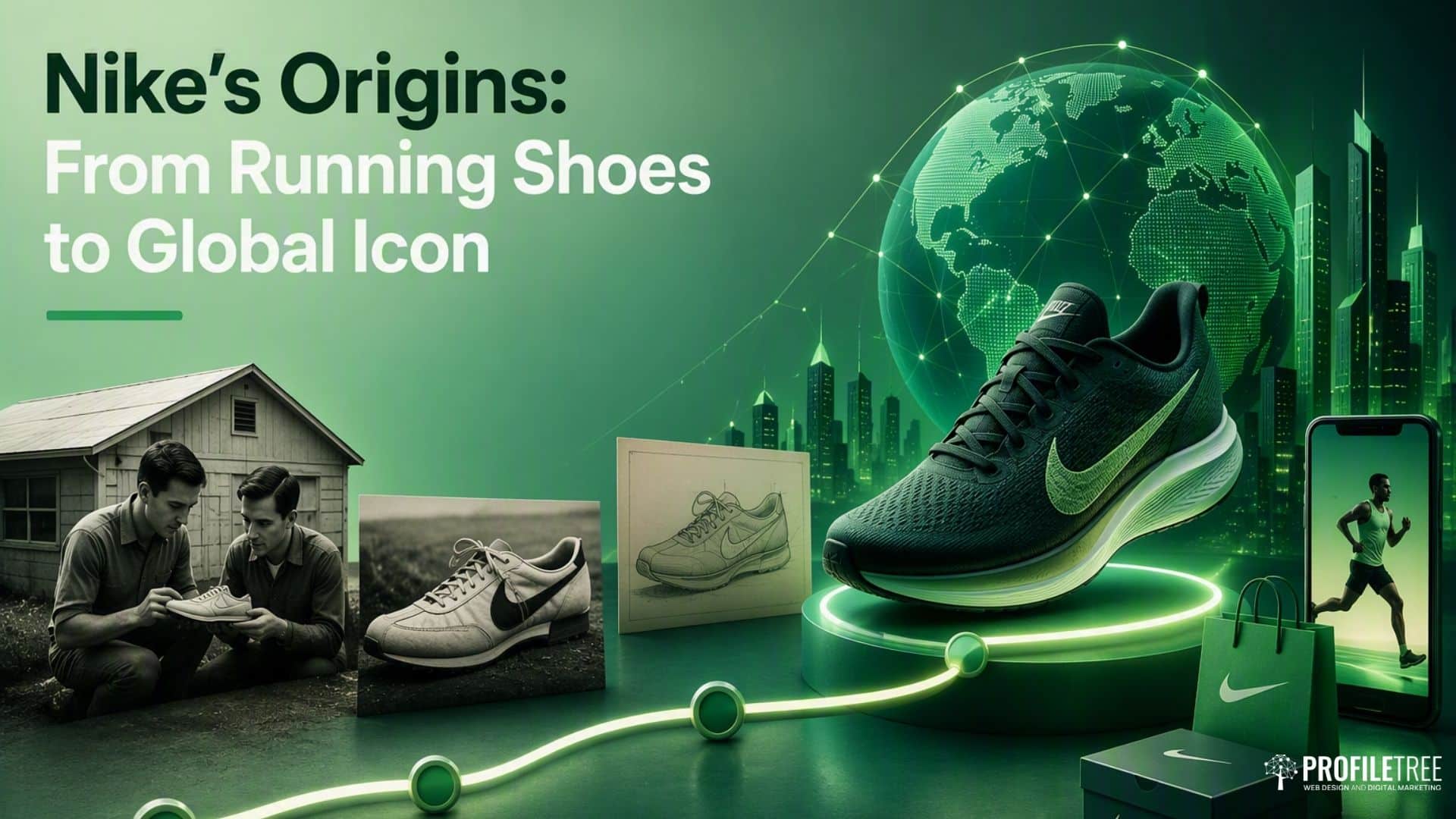
Bill Bowerman, a track-and-field coach at the University of Oregon, and Phil Knight, a middle-distance runner and Stanford MBA graduate, founded Blue Ribbon Sports in 1964. Their original model was simple: import high-quality Japanese running shoes and sell them to American athletes at a lower price than domestic alternatives.
What set Bowerman apart was his obsession with making shoes lighter. He was the kind of coach who poured rubber into a waffle iron to test a new sole design. That relentless focus on product improvement became the company’s founding culture, and it has never left.
| Year | Milestone |
|---|---|
| 1964 | Blue Ribbon Sports founded by Bowerman and Knight |
| 1971 | Nike brand name was introduced; Carolyn Davidson designed the Swoosh for $35 |
| 1972 | Nike shoes debut at the US Olympic Trials in Eugene, Oregon |
| 1978 | Company formally renamed Nike, Inc. |
| 1984 | Air Jordan line launches with Michael Jordan; transforms sports endorsement |
| 1988 | “Just Do It” campaign launches, written by Dan Wieden of Wieden+Kennedy |
By the late 1970s, the running boom had turned a niche product into a mainstream one. Nike did not just ride that wave; it helped create it through targeted athlete partnerships, grassroots event sponsorships, and a marketing approach that treated runners as a community rather than a consumer segment.
The Swoosh logo has remained largely unchanged since 1971. That consistency is a deliberate brand decision, not inertia. When a symbol is distinctive enough, and the values behind it are well maintained, stability becomes an asset. Most SMEs change their visual identity far too often, undermining the brand recognition they are trying to build.
Nike’s Core Brand Identity and Positioning
Nike built its brand on one durable idea: sport belongs to everyone willing to try. The sections below examine how that positioning translates into a consistent visual identity, a globally recognised slogan, and athlete partnerships that turn individual performers into cultural symbols.
The Swoosh as a Symbol of Aspiration
Carolyn Davidson designed the Swoosh in 1971 for $35. It was meant to suggest motion and speed, inspired by the wing of the Greek goddess Nike, whose name the brand later adopted. Phil Knight famously said he did not love it at first but felt it would grow on him. It did, and on several billion other people.
The logo works because it is abstract enough to mean different things in different contexts while remaining instantly recognisable. On a basketball shoe, it signals performance. A running vest signals endurance. On a lifestyle trainer, it signals aspiration. That flexibility is the product of brand discipline, not accident.
The “Just Do It” Philosophy
“Just Do It” was created in 1988 by copywriter Dan Wieden, inspired by the last words of convicted murderer Gary Gilmore. That origin is deliberately not part of Nike’s marketing, but it illustrates an important point: great brand lines come from honest human emotion, not focus groups.
The slogan works because it is not about shoes. It is about the internal resistance every person feels before doing something difficult. Nike positioned itself as the answer to that resistance. That is a far more powerful place to occupy than “we make well-designed trainers.”
For SMEs, the lesson is not to copy the slogan, but to identify the emotional territory your brand can credibly own. A local gym does not compete with Nike on product. It can compete on community, personal transformation, and accountability. The brand question is: what feeling does your business represent at its best?
Celebrity and Athlete Partnerships
Nike’s endorsement model changed when it signed Michael Jordan in 1984. Previous sports sponsorships put a logo on a jersey. The Air Jordan deal built an entire sub-brand around one person’s story. The shoe became a cultural object rather than equipment.
Since then, Nike has consistently chosen athletes who represent something beyond their sport. Serena Williams. LeBron James. Colin Kaepernick. The pattern is the same: the athlete stands for a set of values, and Nike aligns its brand with those values by association. The commercial risk of the Kaepernick campaign was significant, given the political polarisation around his stance against racial injustice, but Nike accepted it because it understood its core audience. Brand courage, when it is genuine, creates loyalty that no discount can buy.
UK and Irish audiences have their own version of this. Marcus Rashford’s campaign against child food poverty gave Nike a natural connection to social purpose in the British context. The campaign was credible precisely because Rashford’s background made the issue personal rather than performative.
Nike’s Marketing Mix: The 4Ps in Practice
The 4Ps are a standard business theory. What makes Nike’s version worth studying is how deliberately each element reinforces the others. Premium pricing only holds if the product justifies it, and a DTC model only works if the brand pulls customers directly. Here is how Nike executes each pillar.
Product: Innovation as a Competitive Moat
Nike’s product development strategy is built around marginal gains, the idea that continuous small improvements compound into significant competitive advantages. The Flyknit technology, introduced in 2012, replaced traditional stitched uppers with a single-piece woven structure, reducing weight and material waste simultaneously. The self-lacing Nike Adapt, launched in 2019, applied smart technology to footwear in a way that was functional rather than gimmicky.
The Air Jordan line remains one of the clearest examples of product-as-brand-asset. A trainer designed in 1985 still sells not because it is the best-performing basketball shoe available today, but because it carries decades of cultural meaning. That kind of product equity takes time to build, but it starts with making something genuinely good and consistently marketing it.
For businesses considering their own product development strategy, Nike’s model suggests two things: invest in genuine quality at the point of development, and then protect the product’s identity with disciplined, consistent marketing.
Price: The Psychology of Premium Positioning
Nike does not compete on price. It competes on perceived value. A pair of Nike trainers costs more than most unbranded equivalents because the brand has built a narrative around performance, aspiration, and cultural belonging that makes customers willing to pay the premium.
This pricing strategy carries risk in periods of economic pressure. The cost-of-living challenges in the UK since 2022 have tested premium sports brands, prompting consumers to trade down in some categories. Nike’s initial response was to lean further into its DTC (direct-to-consumer) model, where it could control pricing and presentation more tightly than through wholesale partners. That bet did not hold, and the correction since 2024 has been substantial.
For SMEs, the takeaway is not to charge more for less; rather, price is a signal. Consistent underpricing can undermine the perceived quality of a service just as effectively as poor delivery. Knowing what your positioning is and pricing to reflect it is a strategic choice rather than an afterthought.
Place: The DTC Experiment and the Wholesale Correction
Nike’s distribution strategy has been through a full cycle since 2017. The “Consumer Direct Acceleration” plan under the chief executive John Donahoe deliberately cut back wholesale accounts, including major UK retailers, to push sales through Nike’s own apps, website, and flagship stores.
The logic was sound on paper. Owning the customer relationship means owning the data. When Nike sells through the Nike app or through SNKRS for limited releases, it captures every interaction, preference, and purchase decision, and that data feeds product development and personalisation in a way wholesale cannot.
What the plan underestimated was shelf space. Pulling back from multi-brand retail handed visibility to faster-moving competitors and trained shoppers to wait for discounts on Nike.com. Elliott Hill, who returned as chief executive in October 2024, has spent the period since rebuilding those retail relationships under a turnaround plan called “Win Now”. The fiscal 2026 results show the correction working through: full-year revenue was flat at $46.4bn, but NIKE Direct fell 6% to $17.7bn with brand digital down 12%, while fourth-quarter wholesale rose 4%.
In the UK, the JD Sports relationship remains significant, and it is one of the partnerships Nike has been actively repairing. JD holds exclusive rights to certain Nike product lines, giving Nike a high-street presence alongside its direct channels rather than in competition with them.
For SMEs, the round trip is the lesson rather than either endpoint. A business selling mainly through a third-party marketplace is building someone else’s customer database, so owned channels are worth investing in: a well-structured website, an email list, and a booking system. But walking away from the places customers already look, purely to force them into your own channel, costs more reach than the data is usually worth. Owned channels only generate demand if people can find them, which is where search engine optimisation does the work that Nike’s brand recognition does for free.
Promotion: Storytelling at Scale
Nike’s promotional strategy is built on one consistent principle: tell stories that the audience wants to share. The “Find Your Greatness” campaign, launched during the 2012 London Olympics, featured ordinary athletes rather than elite performers. It landed because it democratised the idea of greatness, making it accessible to anyone who tried.
The promotional mix includes broadcast advertising, social media, athlete-led content, community events, and the brand’s own digital channels. What ties it together is a consistent emotional tone rather than a consistent message. The specific campaigns change; the feeling they create does not.
Wieden+Kennedy, Nike’s creative agency since 1982, has been central to maintaining that consistency across decades. The longevity of that relationship is itself a strategic signal: Nike understands that great creative work requires deep brand knowledge, and that deep brand knowledge takes time to develop.
Nike’s Market Segmentation Strategy
Nike’s segmentation approach works across demographic, psychographic, and behavioural dimensions simultaneously, which is what allows a single brand to feel relevant to a 16-year-old buying Air Jordans and a 45-year-old buying running shoes.
| Segment | Primary Characteristics | How Nike Addresses This |
|---|---|---|
| Performance athletes | High-performance requirements, data-driven | Specialised product lines, athlete endorsements, Nike Training Club app |
| Lifestyle and fashion | Trend-driven, culturally engaged | Collaborations, limited drops via SNKRS, streetwear positioning |
| Fitness enthusiasts | Health-conscious, motivated by progress | Nike Run Club, Training Club content, community events |
| Youth | Aspiration-driven, socially influenced | Youth-facing campaigns, creator partnerships, social media content |
The buyer persona work behind this segmentation is detailed. Nike does not market “running shoes”; it markets to “the person who runs five kilometres three times a week and wants to feel like a real runner.” The persona’s specificity shapes everything from product design to the language used in campaigns.
ProfileTree applies the same audience definition work at the start of a strategy engagement, before any channel decisions get made. Everything downstream depends on knowing precisely who you are talking to.
Nike’s Digital Marketing and Social Media Strategy
Nike’s digital strategy is not social media bolted onto traditional marketing. It is an integrated system where owned apps, content, and community tools deepen the customer relationship with every interaction. Here is how it works in practice.
The Direct-to-Consumer Digital Operation
Nike’s digital strategy centres on three interconnected owned channels: the Nike app, the SNKRS app for limited footwear releases, and Nike Training Club for workout content. Together, these create a closed loop: customers discover products through content, purchase through the app, track their performance through training features, and return for new releases driven by personalised recommendations.
This is what a data-driven digital marketing strategy looks like at scale. The apps are not just sales channels; they are behavioural data collection tools that make every subsequent interaction more relevant. Nike knows whether you run or play basketball, what you have bought before, what you looked at but did not buy, and what time of day you are most active. That data shapes what you see and when.
For SMEs, the infrastructure differs, but the principle remains the same. Email marketing built on genuine segmentation, a website designed to capture behavioural signals, and content that rewards return visits are the building blocks of an owned digital presence. The scale differs; the logic does not.
Content Marketing and Brand Storytelling
Nike produces content that earns attention rather than buying it. The “Dream Crazier” campaign, narrated by Serena Williams and focused on women in sport, generated significant earned media and social sharing because it was emotionally resonant and culturally timely. That kind of content return is not primarily a function of budget; it is a function of insight and execution.
The brand’s YouTube channel is a content marketing operation in its own right, with campaign films, athlete documentaries, and product launches designed to generate viewing time rather than just impressions. This is video content treated as a strategic asset rather than a broadcast medium.
For businesses developing their own content strategy, Nike’s approach illustrates the gap between content that performs and content that merely exists. The brand storytelling principles that drive Nike’s campaigns are applicable at any budget level. The craft of identifying a genuine human tension and building a narrative around it costs more in thinking than in production.
Social Media: Community Over Broadcasting
Nike’s social media strategy prioritises community engagement over broadcasting. The brand’s accounts do not simply post product images; they participate in conversations, share athlete stories, and respond to cultural moments in real time. This is social media used as much as a listening tool as a publishing platform.
The influencer marketing approach has shifted from pure celebrity endorsement to what Nike calls the “athlete as creator” model. Athletes produce their own content within brand guidelines, giving the output an authenticity that advertising cannot replicate.
SMEs rarely have the budget for macro-influencer partnerships, but the micro-influencer model, working with local creators who have genuine credibility within a specific community, can deliver proportionally stronger results. A running shop in Belfast, partnering with local running clubs and their most enthusiastic members, is operating on the same principle, at the right scale.
Regional Spotlight: Nike in the UK and Ireland
Most published analyses of Nike’s marketing are written from a US perspective. That leaves a gap, because Nike’s approach in the UK and Ireland has features worth examining on their own terms.
The JD Sports Relationship
In the UK, Nike’s most important retail partnership is with JD Sports. JD holds exclusivity on specific Nike product lines and colourways, an arrangement that gives Nike high-street presence without flooding general retail. The strategy keeps certain products scarce in mainstream channels, maintaining their perceived value while still making them physically accessible.
This kind of tiered distribution, controlling which products appear where, and in what quantities, is a sophisticated form of brand management that most businesses do not think about until they have a genuine scarcity problem. For SMEs that produce physical goods or face capacity constraints, the tiered-access model (premium clients, general clients, waitlists) is worth considering.
Purpose-Led Marketing and Local Cultural Resonance
Marcus Rashford’s campaign against child food poverty, which ran from 2020 onwards, created a genuine connection between Nike’s brand values and a specific UK social issue. Rashford’s personal story growing up in Manchester and experiencing food poverty gave the campaign credibility that no paid partnership brief could manufacture.
Nike did not create that story. It supported it and aligned its brand with it. The lesson for UK and Irish businesses is that purpose-led marketing only works when there is genuine alignment between what the brand stands for and what the cause represents. Manufactured purpose is immediately identifiable and creates more reputational damage than staying silent.
The UK High Street: Withdrawal and Return
Nike’s withdrawal from some UK wholesale accounts created real tension with retailers. Sports Direct, a major stockist, saw its Nike allocation cut sharply in the early 2020s. That was a deliberate signal at the time, and it has since been reversed: rebuilding multi-brand retail distribution, including with UK partners, is a central pillar of the current turnaround.
The UK market is also where Nike’s digital-physical integration is most visible. The Nike flagship store on Oxford Street in London incorporates scan-to-buy technology, personalisation stations, and community spaces, making the physical store an extension of the digital experience rather than a separate channel.
Nike’s SWOT Analysis
| Strengths | Weaknesses | |
|---|---|---|
| Internal | Brand recognition, athlete relationships, first-party customer data, running category momentum | Premium pricing exposure in downturns; retail shelf space lost during the DTC years; Greater China underperformance |
| External | Opportunities | Threats |
| Rebuilt wholesale distribution; continued expansion of women’s sport; World Cup and Olympic marketing cycles | Competitor gains in running performance, tariff cost pressure, and counterfeit market |
The SWOT analysis reveals something important about Nike’s strategic position: its strengths are deeply structural (the brand is not easily replicated), while its vulnerabilities are primarily cyclical (premium pricing is sensitive to economic conditions) or relational (the DTC pivot cost it distribution relationships that have taken years to rebuild).
Lessons for SMEs: Applying the Nike Blueprint
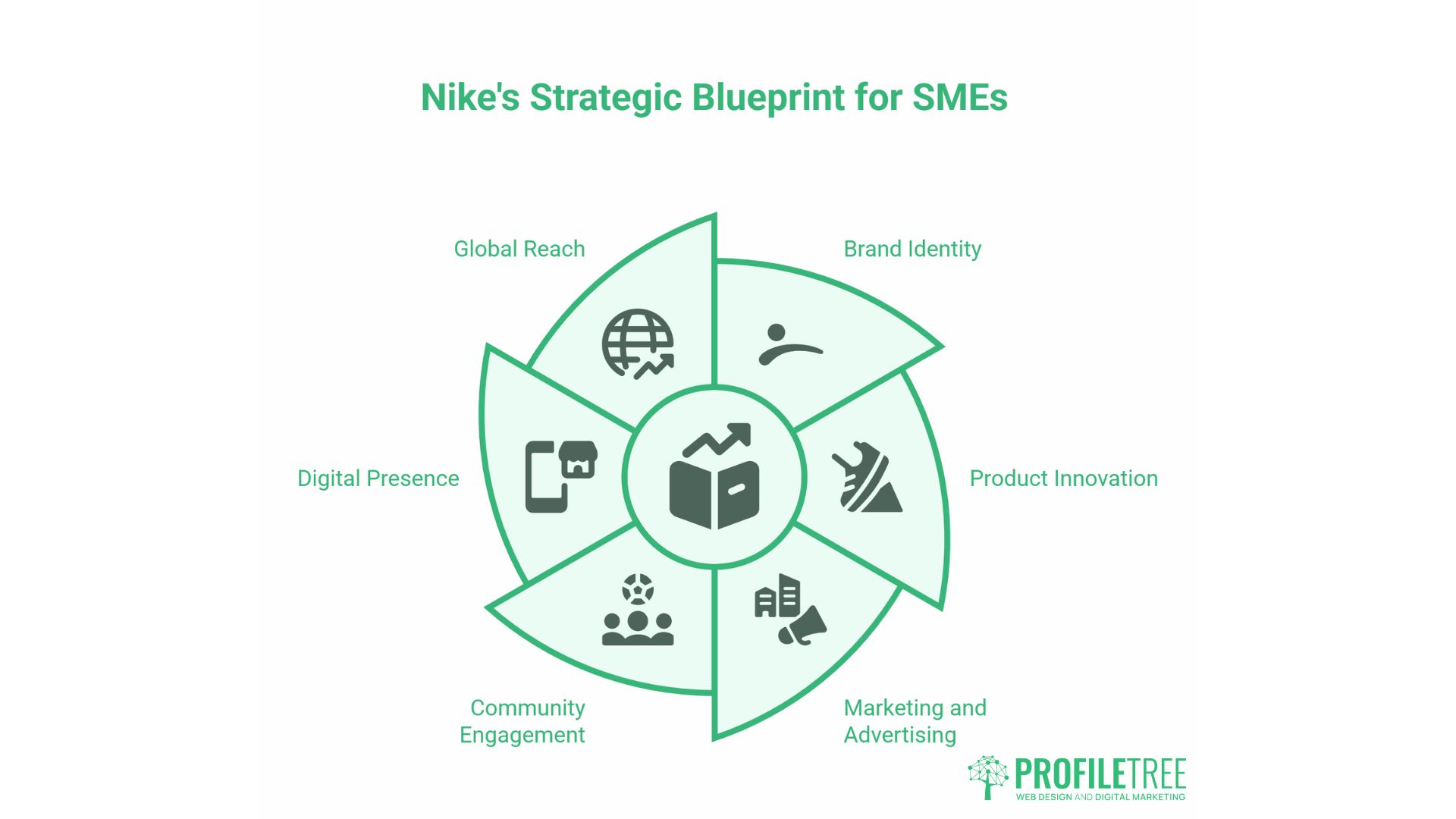
The gap between Nike’s scale and an SME’s budget is enormous. The gap between their strategic principles and what any business can apply is much smaller.
Define the emotional territory you own. Nike does not sell shoes. It sells the experience of overcoming your own resistance. What does your business sell, beyond the functional product or service? A web design agency does not sell websites; it sells the confidence of knowing your business looks credible online. A digital training provider does not sell courses; it sells the ability to make decisions without depending on external experts. Clarity on this question shapes everything else.
Build buyer personas before writing a word of content. Nike’s segmentation of professional athletes, lifestyle buyers, fitness enthusiasts, and youth shapes everything from product specification to social media tone. An SME running generic “digital marketing tips” content is speaking to no one in particular. A content strategy built around a clearly defined persona (say, a manufacturing business owner in Northern Ireland with 20 staff, no internal marketing resource, and a website that has not been updated since 2019) has a genuine chance of being useful to someone.
Consistency beats volume. Nike has used the same logo since 1971 and the same core brand message since 1988. Most SMEs change their visual identity, tone of voice, and messaging priorities every time they hire a new person or attend a new networking event. Consistency in brand positioning is not a passive activity; it requires active decisions to stay the course when something new looks attractive.
Own your customer relationship. Nike’s DTC pivot was an attempt to take back control of the customer relationship from wholesale distribution, and its partial reversal shows how costly it is to get the balance wrong in either direction. Any business that relies primarily on third-party platforms, whether that is a marketplace, a social media algorithm, or a referral network, is building on borrowed ground. A digital marketing strategy built around owned channels (a website that ranks, an email list that engages, a community that returns) creates an asset rather than a dependency.
Video is not optional. Nike’s brand has been built on visual storytelling for more than fifty years. For SMEs, video has become the most effective format for building trust at scale, particularly on social media where algorithm reach increasingly favours video over static posts. The connection between social media activity and actual sales is strongest where the content gives people a reason to watch rather than scroll past.
As Ciaran Connolly, founder of ProfileTree, puts it: “Most SMEs have a genuinely good story to tell. The challenge is rarely the story itself; it is building the discipline to tell it consistently, in the right format, to the right people. That is what a digital strategy is for.”
Why Nike’s Strategy Still Holds Up
Nike’s marketing strategy endures because it is built on principles that do not date: know your audience precisely, own your customer relationship, and make your brand stand for something beyond the product itself. The last five years also show what happens when one of those principles is pushed too far, which is arguably the more useful half of the lesson. The scale is Nike’s; the logic belongs to any business willing to apply it consistently. If you are ready to build a digital marketing strategy with that kind of clarity behind it, ProfileTree’s digital marketing team is ready to help.
FAQs
What is the core of Nike’s marketing strategy?
Emotional storytelling, precise audience segmentation, and product innovation that gives the marketing something genuine to say. Consistency across decades means each new campaign builds on accumulated brand equity rather than starting from scratch.
Why is Nike’s marketing so successful?
Nike understands that its audience is not buying shoes; it is buying the experience of overcoming resistance. Selecting athlete partners who stand for values rather than performance alone gives the brand cultural credibility beyond any single product.
What is Nike’s target market strategy?
A multi-segment approach covering performance athletes, lifestyle buyers, fitness enthusiasts, and younger aspiration-driven consumers. Emotional positioning stays constant across all segments; product lines, price points, and channels vary by audience.
How much does Nike spend on marketing?
Nike reports marketing spend as “Demand Creation”, covering brand marketing and sports marketing. In fiscal year 2026, which ended on 31 May 2026, this was $4.8 billion USD against full-year revenue of $46.4 billion, or roughly 10% of turnover. That is up from $4.7 billion in fiscal 2025 and reflects heavier investment in sports marketing and major event cycles.
Has Nike moved away from its direct-to-consumer strategy?
Partly, yes. The Consumer Direct Acceleration plan, launched in 2017, cut back wholesale distribution in favour of Nike’s own apps and stores. Since Elliott Hill returned as chief executive in October 2024, Nike has been rebuilding those retail partnerships under a plan called “Win Now”. In fiscal 2026, NIKE Direct revenue fell 6% to $17.7 billion while wholesale grew, reversing the trend of the previous five years. The direct channels remain, but they now sit alongside multi-brand retail rather than replacing it.