
Using Fintech to Enhance Digital Marketing Strategies
Table of Contents
Fintech in digital marketing refers to the use of financial technology tools and data to shape how businesses promote their services online. Key strategies include content marketing that builds trust, mobile-first SEO, data-driven personalisation, and regulatory compliance as a competitive advantage. For SMEs in the UK and Ireland, that means navigating FCA guidelines, GDPR obligations, and a consumer base that demands transparency from every brand it engages with.
The overlap between financial technology and marketing strategy is no longer niche. Businesses across sectors are using fintech tools to track spending behaviour, personalise campaigns, and prove their credibility to audiences who are increasingly cautious about who they trust with their data. Understanding how fintech and digital marketing intersect is now a practical priority for any SME that markets financial services or operates in a regulated environment.
“Effective collaboration between marketing and technology teams is what allows businesses to move fast without cutting corners on compliance,” says Ciaran Connolly, founder of ProfileTree. “When fintech tools are integrated thoughtfully into a digital strategy, they give businesses a measurable edge, particularly in sectors where trust is the deciding factor.”
What Fintech Means for Digital Marketers
Financial technology, broadly defined, covers any software or system that automates, improves, or replaces traditional financial processes. For digital marketers, the relevant applications include payment processing tools, CRM platforms that track financial behaviour, AI-driven personalisation engines, and analytics systems that connect campaign spend to revenue outcomes.
The shift matters because fintech tools give marketers access to a layer of behavioural data that was previously unavailable. Knowing not just that a customer visited a product page but that they completed a micro-transaction, used a buy-now-pay-later option, or abandoned a checkout at the payment stage changes how you build campaigns and measure their success.
For businesses in sectors like investment, insurance, payments, and lending, this data also carries compliance obligations. Any marketing activity that touches financial promotions in the UK falls under FCA oversight, which means the way you collect, use, and refer to customer financial behaviour in campaigns must meet specific regulatory standards.
Why Trust Is the Core Challenge in Fintech Marketing
Consumer trust in financial brands does not come automatically. Research consistently shows that people apply far more scrutiny to financial service providers than to most other categories, particularly for newer or digital-first brands that lack the familiarity of established high-street institutions.
For fintech companies and any business that markets financial products, this creates a specific strategic problem: standard digital marketing tactics that work well for e-commerce or hospitality often fall flat because they prioritise engagement over credibility. A promotional tone, exaggerated claims, or unclear fee structures will cost you more than they gain.
The businesses that market fintech services most effectively tend to treat compliance and transparency not as constraints but as content. Explaining how customer data is protected, what regulatory body oversees the service, and how fees are calculated becomes a form of marketing in itself because it answers exactly the questions a sceptical audience is asking before they commit.
ProfileTree’s approach to content marketing for financial and professional services businesses focuses on this principle: the most persuasive thing a regulated business can publish is content that makes its processes clear and its obligations explicit. For more on how this applies to content strategy, see our content marketing services.
Core Fintech in Digital Marketing Strategies for Businesses
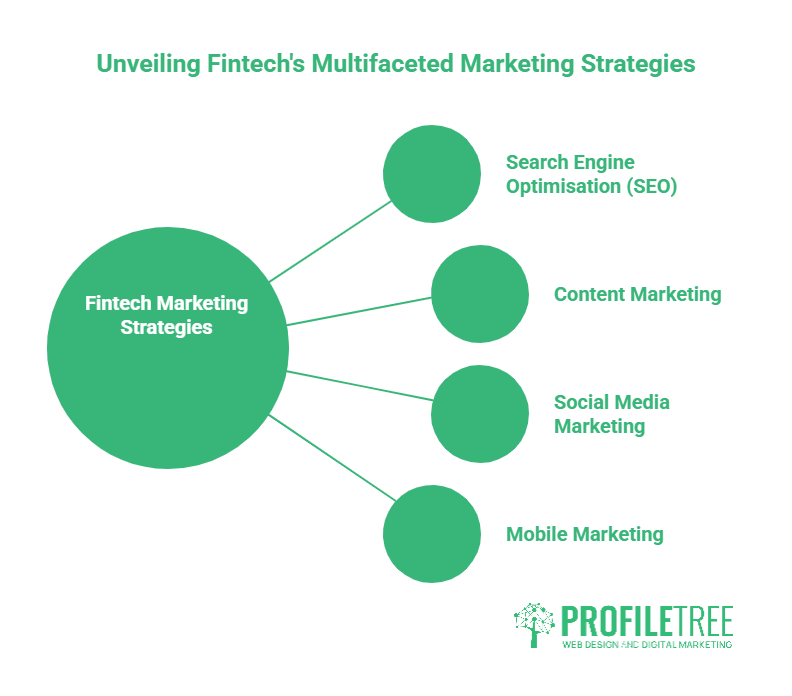
No single channel dominates fintech marketing. The businesses that perform consistently well tend to run coordinated strategies across search, content, social, and mobile, each reinforcing the others rather than operating in isolation. What follows covers the channels that deliver the most reliable results for UK and Irish SMEs, along with the specific considerations that make each one different in a regulated context.
SEO for Financial and Regulated Content
Search engine optimisation for fintech content operates under stricter standards than most other sectors. Google classifies financial content as YMYL (Your Money Your Life), which means pages covering investment, lending, insurance, and payments are evaluated with a higher bar for expertise, authoritativeness, and trustworthiness.
Practically, this means that ranking for fintech-related queries requires demonstrable credentials: named authors with verifiable expertise, citations from authoritative sources, accurate and up-to-date information, and a clear organisational identity that users can verify. Thin content or generic overviews will not compete.
For SMEs, this is actually an opportunity rather than a barrier. Most competitor content in the fintech space is written generically for a broad audience. A business that targets specific search intents with genuine depth, such as a guide to FCA-compliant social media advertising for UK lending businesses, will consistently outperform a broader piece with no specific angle.
ProfileTree’s SEO services include content strategies built around YMYL requirements and authority signals, particularly for clients in professional services and regulated sectors.
Content Marketing That Educates First
The most effective fintech content marketing does not lead with what a product or service costs. It leads with what the audience needs to understand before they can make a good decision.
This means building content around the questions your audience is actually asking: how does open banking work, what protections apply to my data, what should I look for in a payment processing provider, how do I know if a fintech tool is FCA authorised? Content that answers these questions directly, with specific and accurate information, earns the trust that moves a reader toward an enquiry.
Long-form guides, comparison frameworks, and explainer articles consistently outperform promotional content in fintech because the decision cycle is longer and the audience is more research-intensive. Short promotional pieces do not survive in this category.
Social Media for Fintech Brands
Social platforms are useful for fintech marketing primarily as trust-building and community tools rather than as direct acquisition channels. LinkedIn works well for B2B fintech targeting decision-makers in financial services, payments, or professional services. YouTube is effective for product explainers and thought leadership content, particularly for complex propositions that benefit from a visual walkthrough.
The FCA’s guidance on financial promotions applies to social media in the UK, which means any post that promotes a financial product or service must be fair, clear, and not misleading. This creates a practical constraint on the kind of content you can publish, but it also provides a framework: the best social content for fintech is educational and specific, not aspirational and vague.
Mobile Optimisation and UX
A significant proportion of fintech interactions happen on mobile. Applications, payment flows, account management, and increasingly marketing content are all consumed on smartphones. A website that performs poorly on mobile will lose fintech conversions at a higher rate than almost any other sector, because the moment a user encounters friction in a financial interaction, they stop.
Mobile optimisation for fintech marketing means fast load times, clear navigation, minimal form fields, and a checkout or contact process that does not ask for more information than is necessary at each stage. These are baseline requirements, not differentiators. The differentiation comes from what happens within a well-optimised experience: the quality of the content, the clarity of the value proposition, and the credibility signals that appear before the call to action.
Data, Personalisation, and Analytics
Fintech tools enable a level of campaign personalisation that was not available through traditional marketing channels. CRM platforms that track financial behaviour, AI-driven segmentation, and revenue attribution systems all allow marketers to connect campaign activity to commercial outcomes with much greater precision.
For SMEs, the practical starting point is not the most sophisticated tool but the most integrated one. A CRM that links your marketing activity to enquiry and conversion data gives you better insight than a complex analytics suite that sits in isolation. The goal is to understand which channels and content types produce clients, not just traffic.
ProfileTree’s digital marketing services include data integration and campaign tracking approaches designed for SMEs that need clear ROI visibility without enterprise-level overhead.
Regulatory Considerations for UK and Irish Fintech Marketers
Marketing financial products in the UK requires compliance with FCA financial promotions rules. Any communication that promotes a regulated financial product or service must be approved by an FCA-authorised person before it is published, unless an exemption applies. This includes social media posts, website content, email campaigns, and paid advertising.
The UK Consumer Duty, introduced in 2023 and now fully in force for ongoing products, adds a further layer: businesses must be able to demonstrate that their communications genuinely support consumer understanding and do not exploit behavioural biases or obscure material information. For marketers, this means content that uses deliberately unclear language about fees, risks, or terms is not just bad practice — it carries regulatory risk.
For businesses that operate across the UK and the Republic of Ireland, there is an additional layer of complexity. The Republic of Ireland falls under the EU financial services regulatory framework, including DORA (the Digital Operational Resilience Act) for financial entities and their suppliers. Marketing content and data practices need to account for both regulatory environments if you are targeting customers across the border.
The Belfast and Northern Ireland fintech community sits at the intersection of these frameworks, which creates both a challenge and a genuine differentiator. Businesses that clearly articulate their compliance position in their marketing are the exception rather than the rule, and that transparency carries significant credibility value with a risk-aware audience.
The UK-Ireland Fintech Corridor: A Regional Perspective
London dominates most UK fintech coverage, but the Belfast-Dublin corridor represents a distinct and underserved regional cluster with its own characteristics. Belfast has a growing fintech sector supported by investment from the financial services industry and proximity to both UK and EU regulatory frameworks. Dublin is a major European fintech hub with significant international firm presence following post-Brexit relocations.
For SMEs in Northern Ireland, this geography creates practical opportunities. Businesses that understand both UK and Irish regulatory contexts, can operate in both markets, and can speak to local industry bodies and funding schemes are positioned to serve clients that London-centric agencies often cannot reach effectively.
From a digital marketing perspective, this regional specificity is also an SEO opportunity. Content that addresses the Northern Ireland or Belfast fintech context specifically will rank more easily and attract more relevant traffic than content competing for generic UK-wide terms.
ProfileTree works with SMEs across Northern Ireland, Ireland, and the UK. Our digital strategy services include regional market positioning for businesses that operate across multiple jurisdictions.
Measuring Fintech Marketing Performance
Standard marketing metrics (clicks, impressions, social engagement) are insufficient on their own for fintech contexts where the decision cycle is long and the compliance environment limits some conversion-tracking methods.
The most useful metrics for fintech marketing performance are:
- Customer acquisition cost (CAC): The total spend required to acquire one customer, across all channels. For regulated services, this typically needs to account for longer nurture cycles than consumer e-commerce.
- Lifetime value (LTV): For financial products with recurring relationships (accounts, insurance, lending), LTV provides a more accurate measure of marketing ROI than first-transaction revenue.
- Content attribution: Which specific content pieces are touched by users who go on to convert? This requires careful tracking but produces far more actionable data than channel-level attribution alone.
- Compliance cost per campaign: Not a standard metric but a practical one. If a campaign requires significant legal review time before it can be published, that cost should be factored into the ROI calculation.
For businesses operating under Consumer Duty obligations, demonstrating that your marketing genuinely supports consumer understanding — not just that it generated clicks — may also become a reporting requirement over time.
How AI Is Changing Fintech in Digital Marketing
AI tools are now embedded in most fintech marketing stacks, whether through CRM automation, content personalisation, predictive analytics, or chatbot-based customer engagement. For marketers, the key question is not whether to use AI but how to use it in a way that meets compliance obligations and maintains the quality signals that search engines and AI citation systems reward.
In the UK, the FCA has published guidance on the use of AI in financial services that is relevant to marketers as well as product teams. Using AI to generate promotional content that is then published without authorised person review creates a compliance risk regardless of how the content was produced. The standard that applies is the content itself, not the method of production.
For ProfileTree’s clients, AI implementation in marketing contexts focuses on efficiency gains in research, reporting, and content planning, while keeping human review and editorial judgement in the loop for published financial promotions. Our AI transformation services include marketing workflow applications appropriate for regulated sector clients.
Frequently Asked Questions
What is fintech digital marketing?
Fintech digital marketing is the application of financial technology tools and data to how businesses promote their services online. It covers personalisation, analytics, compliance-aligned content strategy, and the use of platforms that connect marketing activity to financial outcomes.
How does the FCA affect fintech marketing in the UK?
The FCA requires that financial promotions are fair, clear, and not misleading. Any communication that promotes a regulated financial product must be approved by an FCA-authorised person before publication. This applies to website content, social media, email, and paid advertising.
Is fintech marketing different from traditional financial services marketing?
The compliance obligations are largely the same, but fintech marketing typically involves faster product cycles, digital-native audiences, and more sophisticated data tools. The trust challenge is often greater for newer fintech brands because they lack the familiarity of established institutions.
Which digital marketing channels work best for fintech?
SEO and content marketing tend to deliver the strongest long-term results because fintech audiences are research-intensive before making decisions. LinkedIn works well for B2B propositions. Paid social requires careful compliance review but can be effective for specific acquisition campaigns.
Conclusion
Fintech has moved the goalposts for digital marketing in financial services, not by replacing the fundamentals but by raising the bar on data quality, compliance rigour, and audience trust. The businesses that perform well in this space do not treat regulation as a hurdle to route around. They treat it as a content opportunity, because an audience that is worried about data security, unclear fees, and misleading claims will respond strongly to a brand that addresses those concerns head on.
For SMEs in Northern Ireland, Ireland, and the UK, the regional dimension matters too. The Belfast-Dublin-London corridor is underserved by most fintech marketing content, and that gap is a genuine opportunity for businesses that can speak to both the UK and Irish regulatory contexts with authority.
If you are working on a digital marketing strategy for a fintech product or a regulated financial service, talk to the ProfileTree team about how a compliance-first content strategy can support your commercial goals.