
Small Business Owner Statistics: UK and Ireland Facts
Table of Contents
Small businesses power the UK and Irish economies. They account for the overwhelming majority of all registered companies, employ millions of people, and drive a significant share of net new job creation each year. Yet many of the people running them operate without the digital tools, marketing strategies or business systems that give larger competitors a structural advantage.
This article brings together key statistics on small business ownership, survival, employment and online presence, with a specific focus on the UK and Ireland. Whether you are starting out, scaling up, or looking to understand where your business stands relative to wider trends, the data here provides a practical reference point.
What Is a Business Owner?
A business owner is any individual who holds legal ownership of a commercial enterprise, regardless of its structure or size. In the UK and Ireland, the most common ownership structures are sole trader, limited company and partnership. Each carries different obligations around tax, liability and reporting.
A sole trader owns and operates the business personally, with no legal separation between personal and business finances. A limited company is a separate legal entity, meaning the owner’s personal assets are protected from business debts. Partnerships split ownership between two or more individuals, with varying degrees of shared liability depending on whether the arrangement is a standard or limited liability partnership.
The distinction between a business owner and an entrepreneur is worth clarifying. An entrepreneur typically starts a business to grow and often exits it. A business owner may run an established enterprise with no intention of selling. In practice, many small business owners are both.
Small Business Statistics: UK and Ireland Context
Most headline figures on small businesses are drawn from US data. The patterns are broadly similar in the UK and Ireland, though the specifics differ by sector, region and regulatory environment.
In the UK, the Department for Business and Trade reports that small and medium-sized enterprises (SMEs) account for 99.9% of the business population. They employ around 61% of the private sector workforce and generate approximately 53% of private sector turnover. In the Republic of Ireland, SMEs make up over 99% of all active enterprises and employ more than 68% of the private sector workforce, according to the Central Statistics Office.
Northern Ireland sits within this picture as a region with a particularly high proportion of micro-businesses: enterprises with fewer than ten employees. The Northern Ireland Statistics and Research Agency (NISRA) consistently records more than 80% of local businesses in this micro category. These are often owner-operated, with limited administrative resources and a significant dependency on the owner’s personal time and expertise.
| Business size | UK definition (employees) | Share of UK business population |
|---|---|---|
| Micro | 0–9 | ~96% |
| Small | 10–49 | ~3.5% |
| Medium | 50–249 | ~0.6% |
| Large | 250+ | ~0.1% |
Source: Department for Business and Trade, Business Population Estimates.
Small Business Employment and Job Creation
Small businesses are the primary engine of employment across the UK and Ireland. In the UK, SMEs collectively employ approximately 16.7 million people in the private sector. Micro-businesses alone account for roughly 5.5 million of those jobs.
Job creation among small businesses is closely tied to economic conditions. During periods of growth, small firms typically outpace larger employers in net new job creation. During downturns, they are also more exposed to rapid employment contraction because they carry less financial buffer.
Sector matters significantly. Professional services, construction, retail and hospitality are among the sectors with the highest concentrations of SME employment in Northern Ireland and Ireland. Technology and digital services have steadily increased their share of SME job creation, particularly since 2020.
For business owners managing a small team, this creates a particular challenge: they are often simultaneously the strategist, salesperson, customer service function, and marketer. Understanding which of those roles to delegate, automate or professionalise is one of the more consequential decisions a growing owner will face.
Small Business Survival Rates: What the Data Shows
Survival statistics for small businesses are sobering and consistent across markets. UK data from the Office for National Statistics shows that approximately 20% of businesses do not survive beyond their first year. By year five, roughly half of all new businesses have closed.
The reasons for failure are well-documented. Poor cash flow management is the most commonly cited factor, followed by insufficient demand for the product or service, ineffective marketing, and an absence of clear planning. A recurring pattern in early-stage closures is the gap between a strong product and the ability to communicate its value to the right audience at the right time.
“Most of the SMEs we work with have a genuinely good service,” says Ciaran Connolly, founder of ProfileTree. “The problem is usually that nobody outside their immediate network knows about it. Building a consistent digital presence changes that, and it compounds over time in a way that word-of-mouth alone cannot match.
Digital adoption is now directly correlated with SME resilience. Research from the Federation of Small Businesses (FSB) has found that digitally active small businesses grow faster, are more likely to export, and are more stable during economic shocks than those operating without digital tools.
Digital Presence Statistics: Where SMEs Stand
The gap between SME ambition and digital reality remains significant. A consistent finding across UK and Irish surveys is that a substantial proportion of small businesses either have no website, or have one that is outdated, slow or not optimised for search.
Ofcom’s Connected Nations report and multiple FSB surveys indicate that while website ownership among UK SMEs has grown, a material share still rely primarily on social media profiles or directory listings rather than a dedicated website. For businesses in Northern Ireland and rural Ireland, this gap is wider still.
The commercial consequences are direct. A business without a functioning, searchable website is effectively invisible to customers who do not already know it exists. For sole traders and micro-businesses that depend on local custom, this narrows the growth ceiling considerably.
There is also the question of what a website actually does once it exists. Owning a website and having a website that generates enquiries are different things. The latter requires search engine optimisation, clear calls to action, appropriate page structure, and regular content that signals authority to both visitors and search engines.
ProfileTree’s web design services for SMEs are built around this distinction: not just building a site, but building one that ranks, converts and supports the business’s commercial goals.
For business owners looking at data in business decision-making, the picture is consistent: digital investment delivers measurable returns at a relatively modest cost for small firms, particularly compared with traditional advertising.
Business Owner Demographics: Who Runs UK and Irish SMEs?
Understanding who owns small businesses matters for marketing, policy and support services alike.
In the UK, the British Business Bank’s Small Business Finance Markets report shows that business ownership is skewed towards older age groups, with the 35–54 age group accounting for the largest share of active SME owners. Millennial ownership is growing but still lags behind older cohorts, partly due to access to capital.
Gender distribution has shifted materially over the past decade. Women-owned businesses now represent a growing share of new starts in both the UK and Ireland, with Enterprise Ireland and Invest Northern Ireland both reporting increased female entrepreneurship in recent years. Women-owned firms are disproportionately concentrated in services, retail and the creative industries.
Ethnic minority business ownership in the UK remains under-represented relative to population share, though the British Business Bank has documented growth in applications for funding from minority ethnic founders, suggesting the pipeline is expanding.
For business owners in Northern Ireland, the demographic picture is shaped by a relatively young population, strong cross-border economic ties with the Republic of Ireland, and a business culture that tends toward caution. This last trait has both strengths and costs: it creates stability, but it also means slower uptake of new tools and technologies, including digital marketing and AI.
AI and Digital Tools: The Growing Divide Among Business Owners
One of the more significant emerging patterns in small business data is the divergence between owners who have adopted AI tools and those who have not. This is not primarily a technology story; it is a capacity story.
Business owners who have integrated AI tools into their workflows, whether for content creation, customer communications, data analysis, or scheduling, consistently report time savings that allow them to redirect effort toward higher-value activities. Those who have not adopted these tools are increasingly at a competitive disadvantage in sectors where speed and content output matter.
The challenge for most SME owners is not awareness of AI; it is knowing which tools are genuinely useful for their specific situation, and how to set them up without a technical background. This is the gap that structured digital training for business owners addresses directly.
ProfileTree’s AI implementation work with SMEs across Northern Ireland and Ireland focuses on practical adoption rather than theoretical possibility. The question is not whether a business owner should use AI, but which specific tasks it should handle first to generate the most immediate return on the time invested.
Online Sales and E-Commerce: The Current Landscape
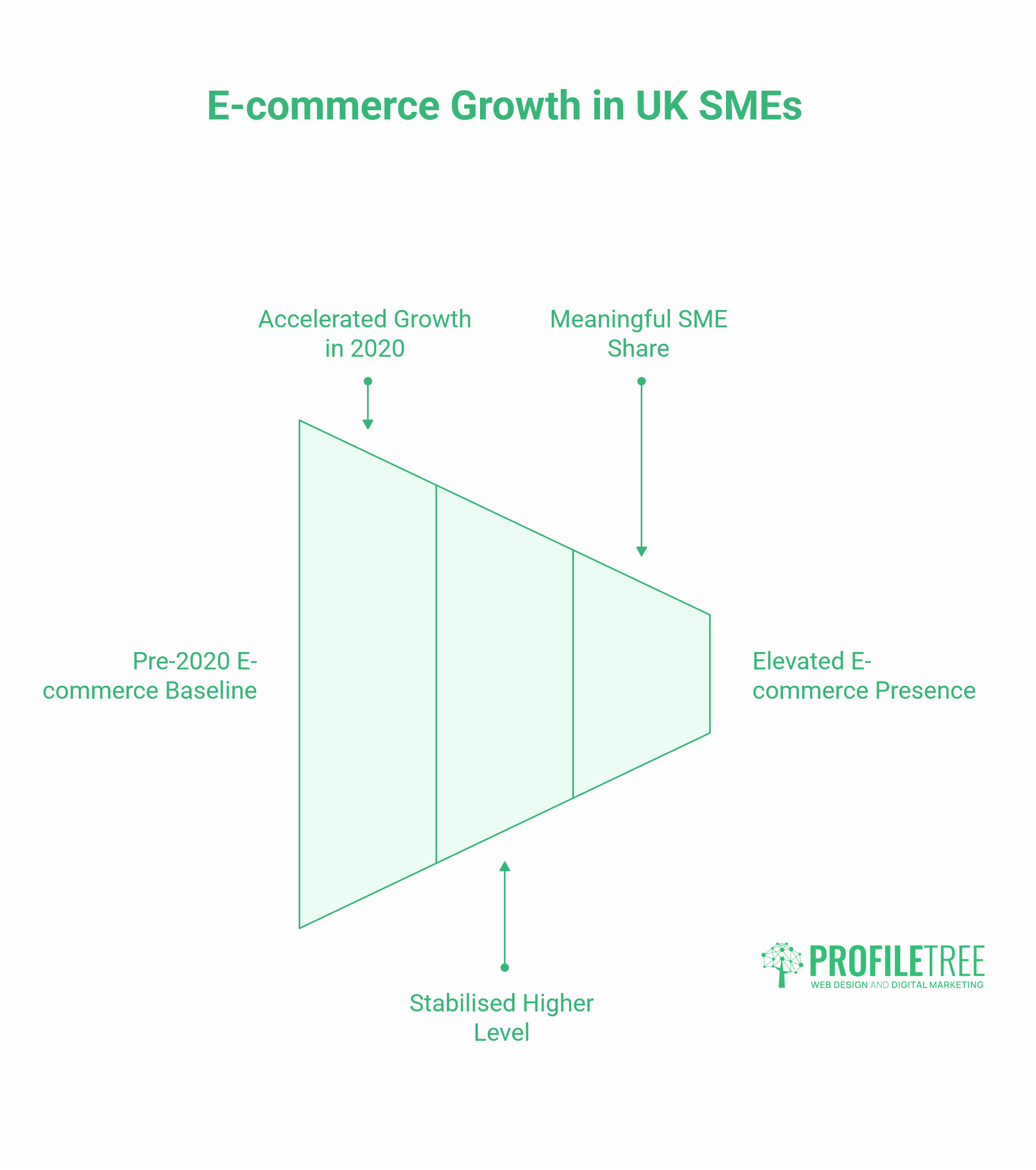
E-commerce growth among UK SMEs accelerated sharply during 2020 and has remained elevated. The Office for National Statistics reports that online sales as a share of total retail have stabilised at a higher level than pre-2020 baselines, with small businesses accounting for a meaningful share of that volume through platforms such as Shopify, WooCommerce and Etsy.
For service businesses, the equivalent shift is in online lead generation: the move from referral-dependent pipelines to search-driven enquiries. A business that appears on page one of Google for its core service in its local area generates a fundamentally different volume of inbound interest than one that does not.
The businesses that have made this transition most successfully tend to share a few characteristics. They have a clear service offering, a website that explains it plainly, a content strategy that builds authority over time, and a basic understanding of how SEO works. None of these requires a large budget. They do require consistency.
Social media marketing plays a supporting role here, particularly for building awareness and retaining existing customers. But for most SMEs seeking new customers, organic search remains the highest-return channel over the medium term.
What Business Owners Can Do: A Practical Digital Checklist
Based on the patterns in SME performance data, these are the five digital foundations that make the most difference to small business growth:
A functional, optimised website. Not just a presence, but a site that loads quickly, ranks for relevant terms, and gives visitors a clear reason to get in touch.
Local SEO. For any business serving a geographic area, appearing in Google’s local results is often the single most valuable digital action. This means a verified Google Business Profile, consistent contact information, and location-relevant content.
A content strategy. Publishing useful, search-optimised content regularly builds topical authority over time. It also creates the raw material for social media, email marketing and AI training data.
Basic analytics. Understanding where website visitors come from, what they look at, and where they leave is the minimum required to make informed decisions about digital investment.
A plan for AI. Not a comprehensive transformation, but a considered decision about which repetitive tasks AI tools can handle, starting with the ones that consume the most time relative to their strategic value.
The Northern Ireland Business Owner: Specific Challenges and Opportunities
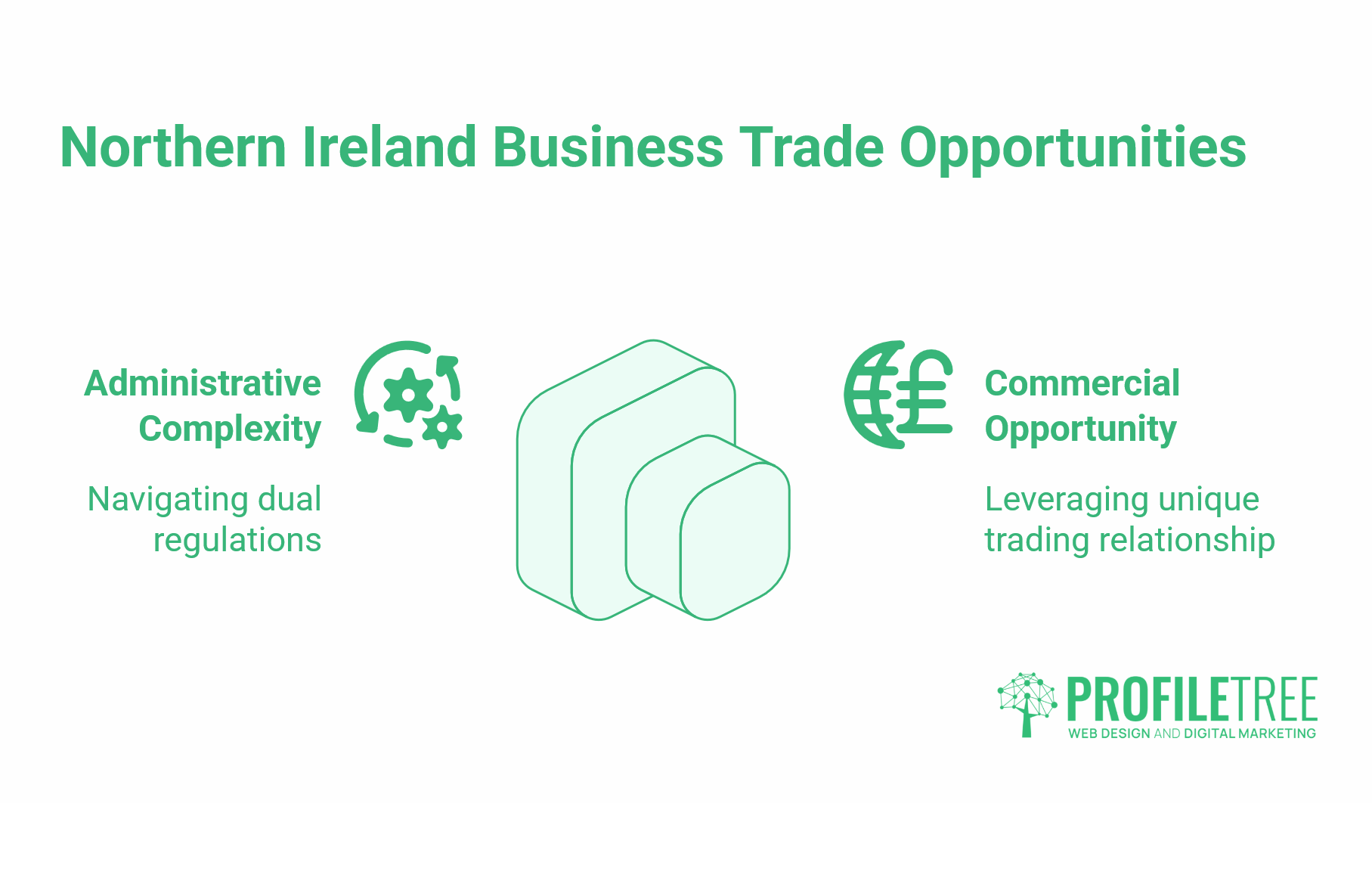
Northern Ireland occupies an unusual position in the UK business landscape. Its SMEs have dual market access that no other region can claim: full participation in the UK internal market alongside a unique trading relationship with the Republic of Ireland and the wider EU under the Windsor Framework. For business owners who trade goods across the Irish border, this creates both administrative complexity and genuine commercial opportunity.
The practical reality for most Northern Ireland SMEs is that cross-border trade remains underutilised. Many owner-operators, particularly in services, hospitality and retail, are focused almost entirely on the local Northern Ireland market. The FSB Northern Ireland has consistently noted that awareness of cross-border and export opportunities among micro-businesses is low, and that the administrative burden of navigating dual regulatory environments puts many owners off pursuing them.
Invest Northern Ireland and Enterprise Ireland both offer funding, mentoring and market development support for businesses looking to grow beyond their immediate geography. The overlap between the two agencies creates an opportunity that relatively few Northern Ireland-based businesses actively pursue: accessing support from both simultaneously, particularly for businesses with operations or ambitions on both sides of the border.
The digital dimension of this is significant. A Northern Ireland business that ranks well in organic search is visible to customers in Dublin, Cork and Galway as readily as it is to customers in Belfast or Derry. The same website, the same content strategy, and the same SEO investment that builds local authority can extend commercial reach across the island without the overhead of a physical presence. ProfileTree’s work with SMEs across Northern Ireland includes businesses that have grown their Republic of Ireland client base solely through search-driven enquiries, without a sales team or a second office.
The challenge, as Ciaran Connolly, founder of ProfileTree, puts it: “Most NI business owners are sitting on a geographic advantage they haven’t activated yet. The dual-market position is genuinely rare. But you can only benefit from it if customers in both markets can find you, and that starts with your digital presence.”
For owner-operators in Northern Ireland navigating this landscape, the definition of entrepreneurship and what it means to grow a business beyond a single market is worth revisiting. The structural opportunity is real. The question is whether the digital foundations are in place to support it.
Conclusion
The data on small business ownership in the UK and Ireland points in one direction: digital capability is no longer optional for SMEs that want to grow past the early years. A functional website, a local SEO presence, and a basic content strategy are now table stakes, not advantages. The good news is that none of these requires a large budget — they require clarity and consistency. ProfileTree works with SME owners across Northern Ireland, Ireland and the UK to build exactly that through our web design, SEO and digital marketing services.
FAQs
What is the difference between a business owner and an entrepreneur?
A business owner holds legal ownership of a commercial enterprise and may run it indefinitely. An entrepreneur typically builds with a growth and exit objective in mind. In practice, the two roles overlap considerably at the SME level.
What are the main types of business ownership in the UK?
The three most common structures are sole trader, limited company and partnership. Sole traders carry full personal liability. Limited companies protect the owner’s personal assets as a separate legal entity. Partnerships share ownership between two or more individuals.
How do I register as a business owner in Northern Ireland?
Sole traders register with HMRC for Self Assessment. Limited companies register with Companies House, which covers the whole of the UK. NI Business Info (nibusinessinfo.co.uk) is the official regional resource for registration guidance.
What percentage of small businesses fail in the UK?
Office for National Statistics data shows approximately 20% of new businesses do not survive their first year, with around half closing within five years. The most common causes are cash flow problems, insufficient demand, and weak marketing.