
Web Design Fundamentals: A Plain-English Guide for UK Businesses
Table of Contents
Web design fundamentals come down to three things: a site that tells visitors exactly what you do, makes the next step obvious, and loads fast enough that they stay to find out. Get those three things right, and the rest of web design falls into place. Get them wrong, and no amount of clever design will fix the problem.
This guide walks through the core fundamentals of web design in the order a project actually happens, from the brief and discovery phase through to launch and post-launch SEO. It is written for business owners and marketing managers commissioning a site, not developers writing code. If you are working with an agency, reading this first means you will ask better questions, make faster decisions, and end up with a site that earns its keep.
Phase 1: Discovery, Goal Setting and Research
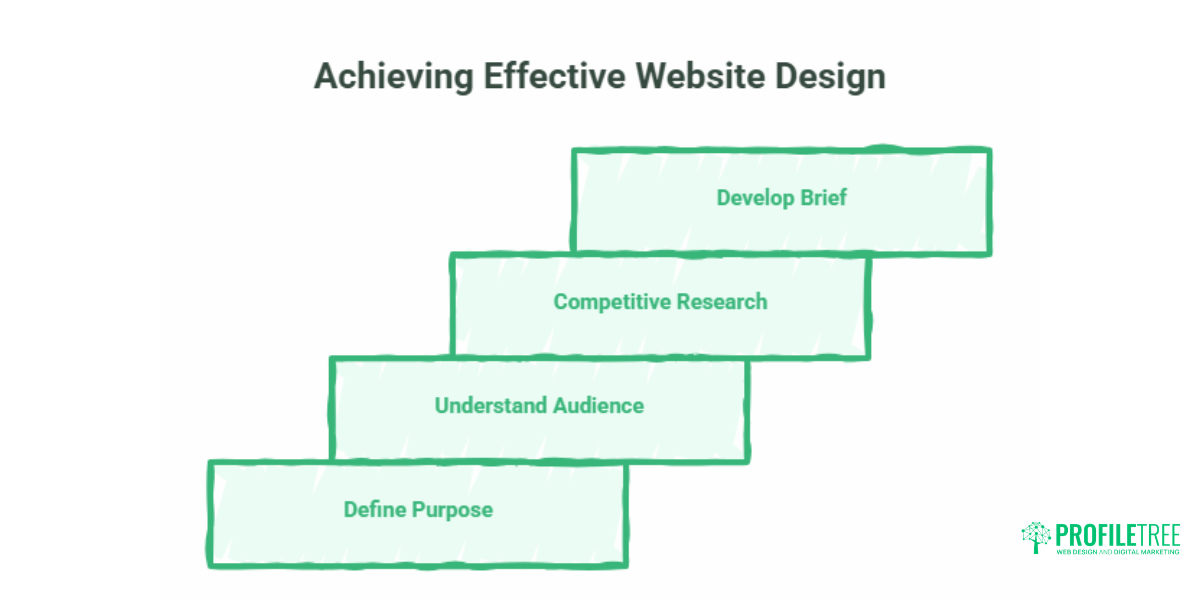
Every site that underperforms was built without a clear brief. Discovery is the phase where that brief gets written, and skipping it is the single most common reason SME websites need rebuilding within two years.
Discovery has three outputs: a statement of purpose, a target audience profile, and a list of measurable success criteria. Those three things answer the questions every subsequent design decision will need to refer back to.
Defining what the site needs to do
A website can do many things: generate enquiries, sell products, support existing customers, or build brand credibility. It should not try to do all of them equally. Decide which one is the primary objective, then make every other goal secondary to it.
For most SMEs in Northern Ireland and across the UK, the primary goal is lead generation: getting qualified prospects to make contact. That single focus changes dozens of design decisions, from where the phone number sits on mobile to how many form fields you ask visitors to fill in.
ProfileTree’s digital strategy service starts with this kind of structured discovery work before any design begins. Agreeing on objectives at the outset prevents the costly mid-project scope changes that push timelines and budgets out.
Understanding your target audience
Target audience work is not about demographics on a spreadsheet. It is about understanding what a visitor knows, fears, and needs to believe before they will pick up the phone or fill in a contact form.
For a Belfast-based accountancy firm, that might mean a visitor who is comparing three local providers and wants to see a clear list of services, transparent pricing, and visible client testimonials before they commit to a call. For a retail brand selling across the UK, it might mean a mobile-first shopper who will abandon within three seconds if the product images do not load.
The audience profile shapes the site structure, the content tone, the call-to-action wording, and the visual hierarchy. It is not a nice-to-have; it is the foundation the rest of the design sits on.
Competitive research
Look at five direct competitors before writing a single word of a brief. Note what they do well, what they ignore, and where their sites fall down. The goal is not to copy them; it is to find the gap they have left open that your site can fill.
Pay particular attention to how competitors handle mobile, how quickly their pages load, and whether their navigation makes sense within thirty seconds. These are the areas where well-resourced competitors often fall short, and where a focused SME site can outperform them.
The video below gives a practical overview of how ProfileTree approaches the web design process for SME clients.
Phase 2: Structure, Wireframes and Visual Design
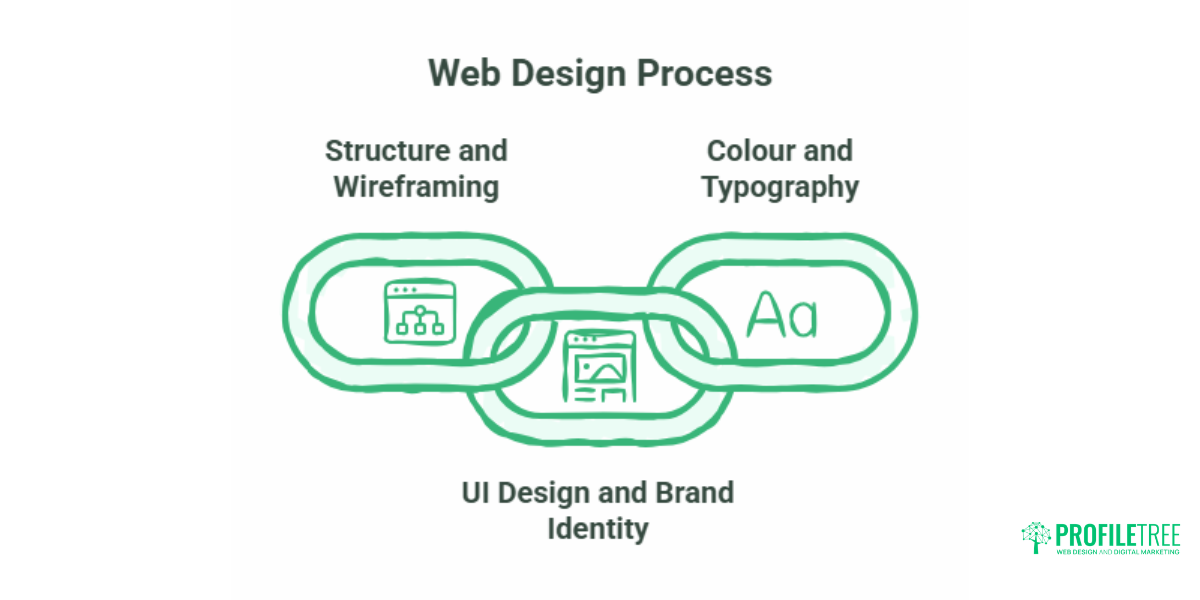
Once the brief is agreed, the next phase builds the skeleton of the site before any visual design begins. This sequence matters. Designing pages before the structure is confirmed is one of the main reasons projects run over budget. A beautiful homepage mockup becomes redundant if the navigation changes three weeks later.
Information architecture and sitemapping
Information architecture is the term for how a site’s pages are organised and connected. A sitemap is the simplest representation of that structure: a hierarchical list of every page and how they relate to each other.
For most SME sites, the rule of thumb is to keep the primary navigation to no more than 7 items. Beyond that, visitors start to hesitate. The goal is to make the path from landing page to desired action as short as possible, ideally two to three clicks for the most important journeys.
The sitemap also informs the internal linking structure, which has a direct bearing on SEO. Pages higher in the hierarchy receive more internal link equity, so the site’s structure should reflect the commercial priorities established in discovery.
Wireframing and responsive layouts
A wireframe is a low-fidelity layout that shows where content, navigation, images, and calls to action will sit on a page, without any colour, typography, or visual styling applied. It is a planning tool, not a design deliverable.
Good wireframes are built mobile-first. Google indexes the mobile version of your site for ranking purposes, so the mobile layout is not an afterthought; it is the primary design context. The desktop version expands from there.
Wireframes also expose problems early. If a page layout cannot communicate its purpose in a wireframe, adding colour and images will not fix it. The structural problem needs to be solved at this stage, when changes cost an hour rather than a day.
UI design, brand identity and the design-to-development handoff
User interface design is where the wireframes gain visual identity: colour, typography, spacing, imagery, and component styling. For established businesses, the design must work within existing brand guidelines. For new ventures, this phase often includes brand identity work running in parallel.
The output of UI design is a set of high-fidelity mockups, typically built in a tool like Figma, that show exactly how every key page will look across desktop and mobile. These mockups also function as the specification document that the development team works from.
The quality of this handoff between design and development directly affects how closely the built site matches the approved mockups. A well-documented Figma file with defined design tokens — colour variables, spacing scales, typography styles — means developers can build to spec rather than interpret. Poorly documented design files are one of the most consistent sources of launch delays on agency projects.
Colour, typography and accessibility
Colour and typography choices are not purely aesthetic decisions. They have measurable effects on readability, conversion rate, and legal compliance.
Under the Web Content Accessibility Guidelines (WCAG 2.2), text must meet minimum contrast ratios against its background: 4.5:1 for normal text, 3:1 for large text. These are not optional for UK businesses. The Equality Act 2010 requires organisations to make reasonable adjustments to ensure their digital services are accessible, and public sector bodies in Northern Ireland, England, Scotland, and Wales must comply with WCAG 2.2 AA standards under the Public Sector Bodies Accessibility Regulations 2018.
Typography choices affect reading speed and perceived authority. A body font that is too small, too light, or too condensed increases cognitive load and pushes visitors away before they have read enough to convert. The generally accepted minimum for body copy on screen is 16px, with generous line spacing and short paragraph lengths.
Getting the design fundamentals right feeds directly into stronger digital marketing results. The video below covers how brand and design decisions connect to wider digital strategy.
Phase 3: Development, Content and Built-In SEO
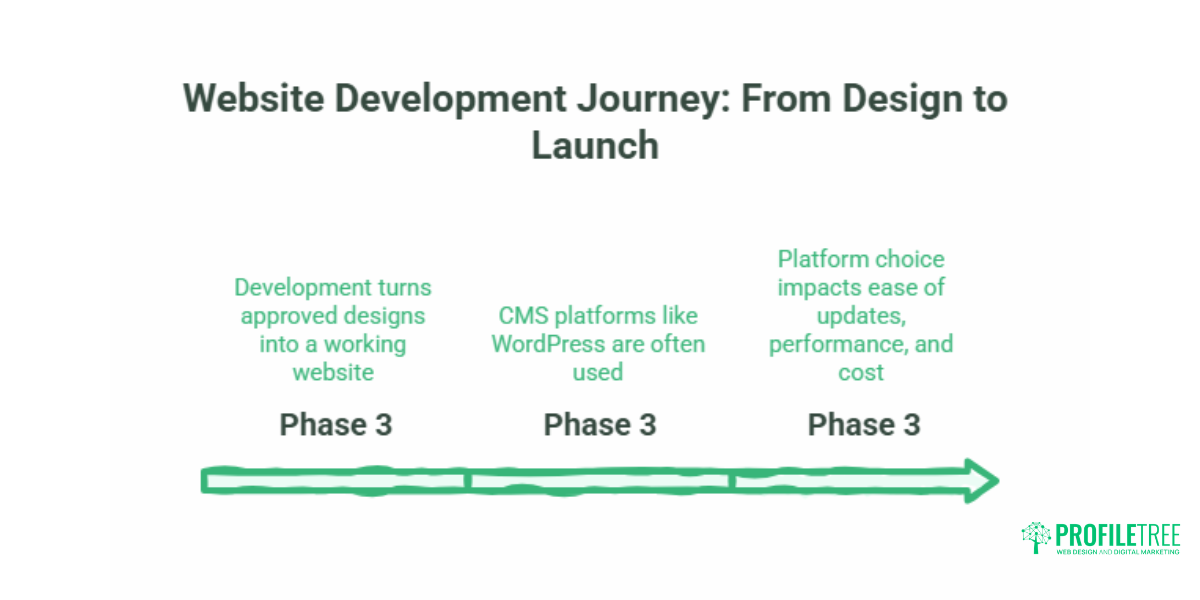
Development turns the approved designs into a working website. For the majority of SME projects in the UK and Ireland, this means a content management system (CMS), most often WordPress, rather than a fully custom-coded build. The choice of platform has lasting consequences for how easy the site is to update, how well it performs technically, and what it costs to maintain.
CMS platforms: WordPress, Webflow and custom builds
WordPress powers over 40% of all websites globally and remains the most practical choice for most SMEs. It has a large ecosystem of developers, extensive plugin support, and a straightforward content editing interface that business owners can use without technical training. ProfileTree’s web development team builds the majority of client sites on WordPress for exactly these reasons.
Webflow is a strong alternative for design-led projects where the visual editor matters. It produces clean code and good Core Web Vitals scores out of the box, but the ecosystem is smaller and ongoing editing requires some familiarity with the platform.
Fully custom builds using frameworks like React or Next.js are appropriate for web applications, complex e-commerce platforms, and sites with non-standard functionality requirements. They are more expensive to build and maintain, and are rarely justified for a standard SME brochure or lead-generation site.
UK legal compliance: GDPR, PECR and cookie consent
UK web projects have a compliance layer that many development guides ignore. Getting this wrong after launch is considerably more expensive than building it in from the start.
Under the Privacy and Electronic Communications Regulations (PECR) and UK GDPR, any website placing non-essential cookies, including Google Analytics and most advertising pixels, on a visitor’s device must obtain explicit, affirmative consent before doing so. A pre-ticked box does not count. A banner that buries the decline option does not count. The Information Commissioner’s Office (ICO) has issued guidance making this clear, and enforcement has increased since 2023.
In practical terms, this means building a compliant cookie consent mechanism into the site during development, not adding a free plugin after launch. The consent tool must be configured to block tracking scripts until consent is given, which has implications for how analytics and tag management are set up.
Domain registration for UK businesses typically uses a .co.uk or .uk domain, both managed through Nominet-accredited registrars. There are no special compliance requirements attached to .co.uk registration, but the registrant details must be accurate and kept up to date.
Content and SEO are built into development.
Content and SEO cannot be retrofitted to a site after launch. The decisions made during development — URL structure, heading hierarchy, page speed, image optimisation, structured data — directly determine how well the site performs in organic search.
URL structure should be logical, keyword-relevant, and permanent. A service page for web design in Belfast should sit at something like /web-design-belfast/, not /page?id=47. Once a URL is indexed and has accumulated any link equity, changing it requires 301 redirects and carries some ranking risk.
Page speed is a ranking factor and a conversion factor. Google’s Core Web Vitals measure three things: how fast the largest visible element loads (LCP), how quickly the page responds to the first user interaction (FID/INP), and how stable the layout is as it loads (CLS). A site that fails Core Web Vitals is penalised in rankings and pushes visitors away before they engage.
ProfileTree’s SEO team works alongside development on every site build to ensure technical SEO requirements are met at launch rather than added retrospectively. The difference in organic performance between a site built with SEO in mind from day one and a site that has SEO bolted on afterwards is significant and measurable.
The video below covers how SEO and content strategy work together to drive organic performance from a new or rebuilt site.
Visual content: images, video and the case for original assets
Stock photography is the fastest way to make a professional design feel generic. Visitors recognise stock images instantly, particularly the posed handshake and woman-on-laptop varieties, and they undermine trust at exactly the moment you need to build it.
Original photography and video tell a visitor something no stock library can: that there are real people behind the business. For SMEs in Belfast, Derry, Dublin or anywhere else in the UK and Ireland, this is a meaningful competitive advantage over larger competitors who rely on branded photography that shows nothing local or specific.
Short explainer videos embedded on service pages consistently reduce bounce rate and increase time on page. ProfileTree’s video production service produces these for SME clients across Northern Ireland and Ireland, working to briefs that align the video content with the page’s SEO and conversion goals.
This video covers how businesses use video content to improve website performance and conversion rates.
Phase 4: Testing, Launch and Post-Launch Support
A launch is not the end of a web project. For SEO purposes, it is closer to the beginning. A new site needs time to be crawled, indexed, and assessed by Google before rankings stabilise. The decisions made in the first few weeks after launch, particularly around technical SEO setup and content, have an outsized effect on how quickly that process happens.
Pre-launch testing
Pre-launch testing covers six areas. Each needs to be signed off on before the site goes live.
- Cross-browser and device testing: The site must render correctly in Chrome, Firefox, Safari, and Edge, and on iOS and Android devices of varying screen sizes. Layout breaks that look fine on a MacBook can be invisible until someone opens the site on an older Samsung phone.
- Form testing: Every contact form, enquiry form, and checkout flow should be tested end-to-end, including confirmation emails and CRM integrations. Broken forms are one of the most common and costly post-launch discoveries.
- Link checking: All internal links, navigation links, and any external links should be verified as working. Broken links damage user experience and send negative signals to search engines.
- Page speed: Run Lighthouse and PageSpeed Insights before launch. Address any Core Web Vitals failures before the site is indexed, not after.
- Accessibility check: Run an automated accessibility audit (tools such as WAVE or axe are standard) and address critical failures before launch.
- Content review: Check spelling, factual accuracy, and that no placeholder text or test content has been left in any page.
Technical SEO at launch
The launch day technical SEO checklist includes: submitting the XML sitemap to Google Search Console, verifying the site in Bing Webmaster Tools, confirming canonical tags are set correctly, checking that development-mode noindex directives have been removed, setting up 301 redirects for any URLs from the previous site, and connecting Google Analytics 4 (with a verified cookie consent integration).
If the site is replacing an existing one, the redirect mapping is the highest-priority task. Any old URL with backlinks pointing to it should redirect to the closest equivalent new page. Losing that link equity by allowing old URLs to return 404 errors is one of the most damaging and avoidable post-migration problems.
Post-launch: maintenance, content and ongoing SEO
A website without ongoing maintenance becomes a liability within eighteen months. Software updates, security patches, plugin compatibility, and hosting performance all require regular attention. ProfileTree’s website hosting and management service handles this for clients who want to focus on running their business rather than managing a server.
Content updates are the most reliable driver of organic growth after launch. Google rewards sites that add new, useful content consistently. A site that was built and left untouched tells the algorithm it may be outdated; a site with regular new articles, updated service pages, and fresh case studies signals that it is actively maintained. ProfileTree’s content marketing team works with clients on the ongoing content programmes that turn new sites into long-term organic assets.
Social media amplifies the content investment. New articles and updated pages shared through LinkedIn, Instagram, and Facebook bring direct referral traffic while building the brand signals that support organic rankings. ProfileTree’s social media marketing service handles this alongside the broader content strategy for clients who want an integrated approach.
Web Design Costs and Timelines: What UK Businesses Should Expect
Pricing transparency is one of the most consistent gaps in web design content. Most agency sites avoid it; most business owners want it. The table below gives realistic ranges for the UK market in 2026, broken down by project type.
| Project Type | Typical Budget Range | Timeline | Best For |
|---|---|---|---|
| Template-based build (WordPress) | £1,500 – £5,000 | 3 – 6 weeks | Early-stage businesses, simple brochure sites |
| Custom design, CMS build | £5,000 – £20,000 | 8 – 14 weeks | Established SMEs, lead-generation focus |
| E-commerce (WooCommerce/Shopify) | £8,000 – £30,000 | 10 – 20 weeks | Product-based businesses, online retail |
| Enterprise / custom web application | £30,000+ | 4 – 9 months | Complex integrations, bespoke functionality |
These ranges reflect boutique agency pricing. Freelance rates run lower, typically 30 – 50% less across each tier, with corresponding differences in process rigour, project management, and post-launch support. Enterprise agency rates run higher, often 50 – 100% above the figures above, particularly in London and larger English cities.
The timeline is as important as the cost. A project that runs long is not just inconvenient; every week without the new site is a week the old one is sending the wrong message to potential customers. The most common causes of timeline overrun are delayed client feedback, incomplete content at handover, and scope changes made after development has started. All three are avoidable with a clear brief and an agreed project schedule.
Where AI Fits Into the Web Design Process
AI tools have entered the web design workflow at several points: copywriting assistance, image generation, automated accessibility auditing, and chatbot integration. They are useful at each of these points, and none of them replaces the strategic decisions that determine whether a site actually works.
The most practical current application for SMEs is AI-powered chatbots on service pages and contact pages. A well-configured chatbot can qualify enquiries, answer common questions outside business hours, and route serious prospects to the right contact point. ProfileTree’s AI chatbot service implements these for clients as part of both new builds and post-launch improvements to existing sites.
AI-enhanced marketing using machine learning to personalise content, optimise ad spend, and predict the best time to contact prospects is increasingly accessible to SMEs who would not have been able to afford enterprise-level marketing technology three years ago. ProfileTree’s AI-enhanced marketing service helps businesses integrate these tools without the overhead of a specialist data science team.
For business owners who want to build their own AI literacy to commission better projects, evaluate agency proposals more critically, and spot the opportunities AI creates for their sector, ProfileTree’s AI training programme covers the practical foundations at a level that makes sense for non-technical decision-makers.
Frequently Asked Questions
What is the average cost of website design in the UK?
A template-based WordPress site from a boutique agency typically runs from £1,500 to £5,000. A custom-designed site with bespoke development falls between £5,000 and £20,000 for most SME projects. E-commerce platforms and sites with complex integrations start from around £8,000 and can reach £30,000 or above. Enterprise builds are priced separately based on scope.
How long does the web design process take?
A straightforward informational site takes six to ten weeks from signed brief to launch. A custom e-commerce build typically runs twelve to twenty weeks. The single biggest variable is how quickly the client can provide feedback and approved content. Projects where content is delivered late almost always run over the timeline.
What is the difference between web design and web development?
Web design covers the visual and user-experience layer: what pages look like, how they are structured, and how users interact with them. Web development is the process of writing the code that makes those designs functional in a browser. On most agency projects, both disciplines work in sequence, with design completed and approved before development begins.
Do UK websites need to be accessible?
Yes. Under the Equality Act 2010, organisations must make reasonable adjustments to ensure digital services are accessible to disabled users. Public sector bodies in Northern Ireland, England, Scotland, and Wales must comply with WCAG 2.2 AA standards under the Public Sector Bodies Accessibility Regulations 2018. For commercial businesses, accessibility is both a legal risk mitigation and a practical improvement to usability for all visitors.
Is a cookie consent banner legally required in the UK?
Yes. Under PECR and UK GDPR, websites must obtain explicit, affirmative consent before placing non-essential cookies on a visitor’s device. Pre-ticked boxes and consent-by-scrolling do not meet the standard. The Information Commissioner’s Office has published clear guidance on compliant consent mechanisms, and enforcement has increased since 2023.
Can a small business build its own website?
DIY builders such as Wix and Squarespace are suitable for very early-stage businesses that need an online presence quickly and cheaply. Once a business has commercial objectives that depend on organic search performance, lead generation, or e-commerce, the limitations of template builders become constraints. A custom-built site gives full control over technical SEO, page speed, and content structure, all of which have a direct effect on how the site performs commercially.
Taking the Next Step
The fundamentals of web design have not changed: a clear purpose, a well-structured build, technically sound development, and ongoing content investment. What has changed is the standard a site needs to meet to compete, and the range of services from AI chatbots to video production that a well-built site can now support. ProfileTree is a Belfast-based web design and digital marketing agency that has delivered over 1,000 projects for businesses across Northern Ireland, Ireland, and the UK. To talk through your site requirements, visit the web design service page or get in touch directly.