
How to Hire a Media Buyer: A Practical Guide for UK and Irish SMEs
Table of Contents
The question most guides skip is not how to post a job description. It is about deciding whether hiring a media buyer is the right move at all, and, if so, which route makes sense: a freelancer, an in-house hire, or a specialist agency. Each works under different conditions, and the wrong choice costs more than the fee.
This guide covers the full decision: what a media buyer actually does in 2026, how the role has shifted as platforms like Meta and Google have become increasingly algorithm-driven, how to compare your options honestly, what to look for when vetting candidates, how pricing models work, and what managing a media buyer well looks like once they have started. It is written for business owners and marketing managers in the UK and Ireland who want to get this right the first time.
What Does a Media Buyer Actually Do?
The term “media buyer” covers a wide range of activities. At its most basic, a media buyer plans, negotiates, and purchases advertising space, whether that is digital display, paid social, paid search, connected television, radio, or print. In a digital context, that means managing campaigns on platforms such as Meta Ads, Google Ads, TikTok Ads, and YouTube.
From technical setup to creative strategy
The role has changed substantially. When Meta and Google still rewarded granular manual targeting, a skilled media buyer could outperform a mediocre one through technical precision: tighter audience segmentation, more deliberate bid strategies, better negative keyword management. That gap has narrowed. Advantage+ on Meta and Performance Max on Google now handle much of the targeting and bidding automatically, using machine learning to find converting audiences within the parameters you set.
This means a buyer who excels purely at the technical setup side is less differentiated than they were. What matters more now is their ability to develop a creative strategy, interpret algorithmic signals, manage the feedback loop between ad performance data and creative output, and decide where budget should sit across platforms and funnel stages. The role has moved closer to that of a growth strategist than a button-pusher.
Understanding how social media marketing drives sales is part of the broader context a good media buyer needs, because paid social does not operate in isolation from organic presence, content strategy, and brand consistency.
What a media buyer is not
A media buyer is not a content creator, a copywriter, or a web designer, though the best ones understand enough about all three to give useful direction. Their job is to make paid media work. That means they need quality creative assets to run, strong landing pages to send traffic to, and a clear commercial goal to optimise towards. If those inputs are not in place, a skilled media buyer cannot compensate.
This matters practically. Before hiring a media buyer, audit what you are giving them to work with. Weak landing pages, stock creative, and unclear conversion goals will limit results regardless of who is running the campaigns. ProfileTree’s video marketing service and web design team regularly work alongside paid media activity for exactly this reason: the quality of the creative and the destination page are as important as the campaign itself.
Media buyer vs media planner
These two roles are often confused. A media planner decides where advertising should run: which platforms, formats, and audiences, and in what proportions. A media buyer executes that plan, negotiating rates, booking placements, and managing live campaigns. In smaller operations, one person does both. In larger organisations, they are separate roles. When hiring for an SME, you will generally want someone who can handle both, which is worth clarifying in your brief upfront.
Agency, Freelancer, or In-House: How to Choose
This is the decision most hiring guides gloss over, but it is the most consequential one you will make. Getting it wrong costs money in two directions: either you are paying for capacity you do not use, or you are under-resourcing something that directly affects revenue.
When a freelance media buyer makes sense
Freelancers suit businesses with a defined scope of work, an established creative library, and an internal team member who can manage the relationship and interpret performance data. They typically work across multiple clients simultaneously, so they may not be embedded in your business the way a full-timer would. Day rates for experienced freelance media buyers in the UK vary broadly: a mid-level buyer with solid Meta and Google experience might charge between £250 and £450 per day. More senior practitioners with a track record on high-spend accounts can command considerably more.
One important consideration for UK businesses is IR35. If you are engaging a freelance media buyer through their limited company, you have a legal obligation to assess whether the engagement falls inside or outside IR35 rules. Working arrangements that look like disguised employment, where the buyer works exclusively for you, follows your direction on hours, and uses your equipment, are likely to fall inside IR35, making you responsible for PAYE deductions and National Insurance contributions. This catches many SMEs off guard. HMRC’s CEST tool is the standard starting point for assessment, and taking professional advice before the contract is signed is worth the cost.
When a media buying agency makes sense
An agency makes the most sense when you want accountability without management overhead, or when your campaigns span multiple platforms, and you need people with deep specialism in each. A good agency brings platform certifications, established relationships with ad representatives, access to beta features, and the ability to scale resources up or down without a hiring process. The trade-off is cost: agency fees typically include a management charge on top of your ad spend, and a degree of distance from your business that requires good briefing to overcome.
For SMEs in Northern Ireland and Ireland, working with a Belfast-based agency means the team understands the local market, the specific characteristics of the UK and Irish consumer, and the regulatory environment on both sides of the border. A digital marketing strategy built for a US audience rarely translates directly, and the nuances of GDPR as applied through the ICO in the UK versus the DPC in Ireland add a compliance dimension that matters for data-driven advertising.
When in-house hiring makes sense
Bringing a media buyer in-house makes sense when paid advertising is genuinely central to your revenue model, not a channel you are experimenting with, but a primary driver of new business. At that point, the cost of a full-time salary is justified by the depth of knowledge and institutional embedding you gain in return. In-house buyers develop real expertise in your specific customer base, your creativity, and your competitive environment. The downside is platform breadth: most in-house buyers specialise in one or two platforms, and if your needs span Meta, Google, TikTok, and connected TV, you will either need more than one person or accept uneven results.
| Hiring route | Speed to start | Cost | Scalability | Management overhead | Best for |
|---|---|---|---|---|---|
| Freelancer | Fast (days) | Medium (day rate) | Limited | Medium | Defined projects, existing creative |
| Agency | Fast (1-2 weeks) | Higher (fee + spend) | High | Low | Multi-platform, growth focus |
| In-house | Slow (weeks-months) | Highest (salary + NI) | Low | High | Paid media as primary revenue driver |
Pricing Models: What You Are Actually Paying For
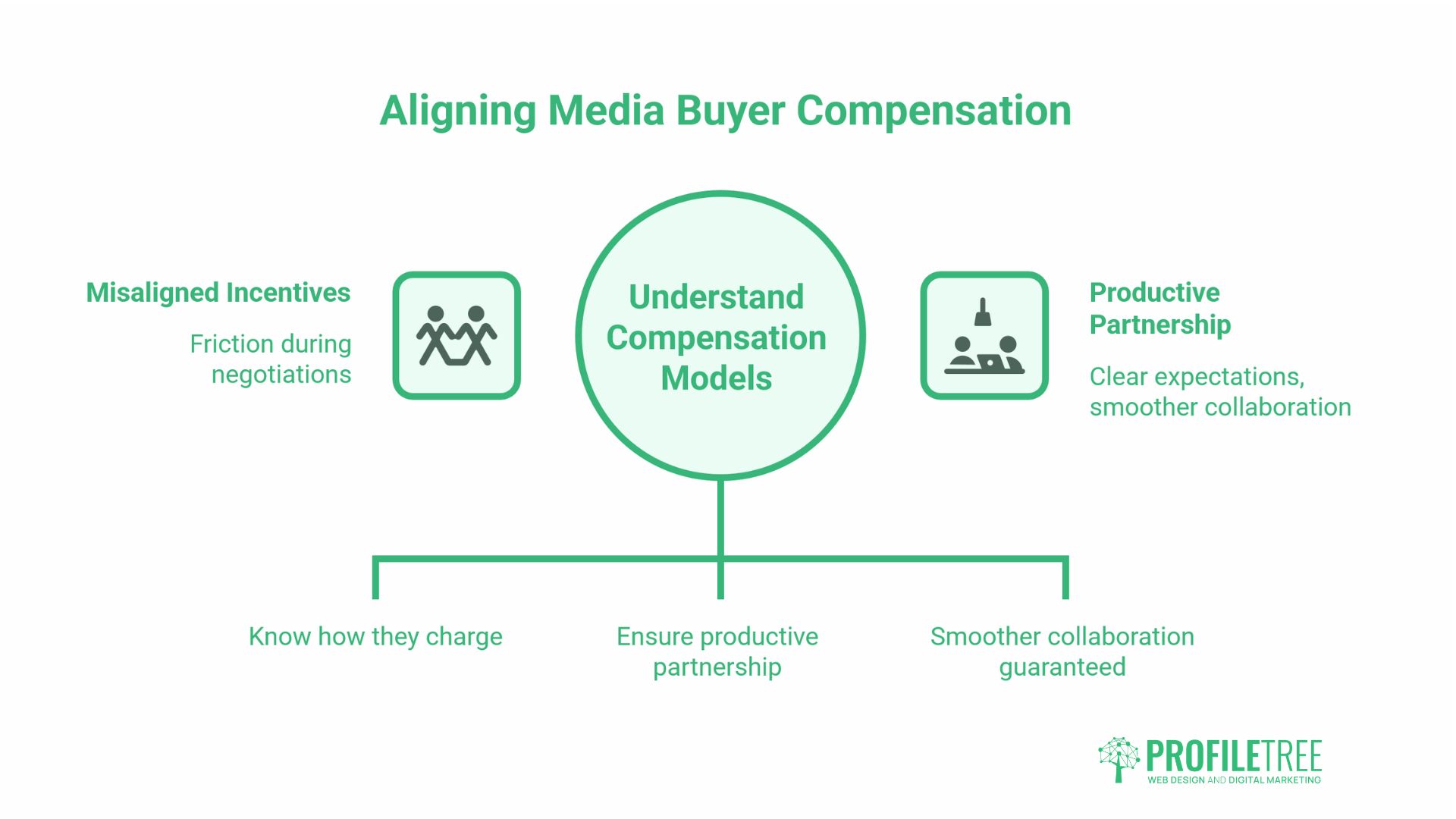
Media buyer compensation varies considerably, and how they charge affects their incentives. Understanding the main models before you negotiate saves friction later.
Percentage of ad spend
The traditional agency model. You pay a percentage of your total ad spend, typically 10 to 20%, as the management fee. This aligns the buyer’s compensation with the scale of the work, but it also creates an incentive misalignment: a buyer paid on a percentage of spend benefits from you spending more, whether or not more spend is the right strategy. Ask specifically how they handle recommendations to reduce the budget if performance data suggests it.
Flat monthly retainer
A fixed fee regardless of ad spend. This is increasingly common at the mid-market level and removes the incentive misalignment of the percentage model. It works well when the scope of work is consistent month to month. The risk is scope creep: if your campaigns expand significantly, the retainer may not reflect the actual work required, leading to friction.
Performance-based (hybrid)
A base retainer plus a performance bonus tied to agreed metrics, typically cost per acquisition, return on ad spend, or revenue generated. This model aligns incentives well but requires careful upfront definition of success metrics. ROAS alone is not sufficient: a buyer who optimises for ROAS can hit impressive numbers by cutting low-ROAS but profitable audience segments. Agree on metrics that connect to actual business outcomes.
Hourly rate
More common for consultants and freelancers to do defined tasks. Useful for audits, account setup, and training, but unwieldy for ongoing campaign management where the hours are difficult to predict.
| Model | Pros | Cons | Best for | Typical cost (GBP) |
|---|---|---|---|---|
| % of ad spend | Scales with scope | Spend incentive misalignment | High-spend accounts | 10-20% of spend |
| Flat retainer | Predictable cost | Scope creep risk | Consistent monthly activity | £1,500-£5,000/month |
| Performance hybrid | Aligned incentives | Metric definition complexity | Growth-focused accounts | Base + 5-15% of improvement |
| Hourly | Flexibility | Unpredictable total cost | Audits, one-off projects | £75-£200/hour |
Regardless of the model, the costs of poorly paid media management extend well beyond the fee itself. Marketing campaigns that went wrong consistently trace back to misaligned incentives, unclear briefs, or buyers who were not held to measurable outcomes from the start.
How to Vet a Media Buyer: What to Look for and What to Question
The gap between a capable media buyer and an average one is wide, and it is not always visible in a portfolio at first glance. Here is how to assess candidates with more rigour.
Five red flags in a portfolio
ROAS presented without context. A 6x ROAS on a £500 monthly budget means something very different from a 6x ROAS on £50,000. Always ask for the absolute spend figures alongside the ratios.
Results from a single platform. A buyer who can only point to Meta results, with no meaningful experience in Google Search, YouTube, or TikTok, is not a full-funnel media buyer. That may be fine if your brief is Meta-only, but understand what you are getting.
No mention of creative. If a candidate’s portfolio focuses solely on targeting and bidding, ask them directly how they approach creative strategy. A buyer who says “the creative team handles that” but cannot articulate what briefs they gave or how they used performance data to iterate on creative is operating below where the role now needs to sit. Creative feedback loops matter: the rise of short-form video has changed what paid social creatives need to look like, and a buyer who hasn’t adapted to that is already behind.
Vanity metrics front and centre. Click-through rate and impressions look impressive in a PDF. Cost per acquisition, revenue attributed, and marketing efficiency ratio connect to business outcomes. Prioritise the latter.
Case studies with no bad news. Every media buyer has campaigns that underperformed. If a portfolio contains only wins, either the candidate is cherry-picking or they have not been running campaigns at a sufficient scale to encounter meaningful failure. Ask specifically: “Tell me about a campaign that did not perform as expected. What happened, and what did you do about it?”
Technical questions worth asking
Ask them to walk you through how they would set up conversion tracking from scratch on a new account, including what they would check to verify the data is clean before launching spend. A buyer who does not understand attribution and pixel health will make optimisation decisions based on bad data. For context on why clean analytics matter, this guide to social media analytics tools covers the fundamentals of what good measurement looks like.
Ask how they approach Advantage+ campaigns on Meta. Their answer will tell you whether they understand how the algorithm works today or whether they are still thinking in terms of 2020-era manual audience stacking.
Ask what metrics they would use to assess campaign health in the first 30 days of a new account, and at what point they would escalate concerns rather than continuing to optimise. This tests both their analytical judgement and their communication instincts.
The paid trial
For a senior hire or a significant agency engagement, a short paid audit or trial period is worth building into the process. A capable media buyer should be able to audit an existing account and identify at least three to five specific, actionable issues within a few hours. The quality of that audit tells you more than any interview.
“The difference between a media buyer who delivers and one who does not often comes down to how they handle the first 60 days,” says Ciaran Connolly, founder of ProfileTree. “If they are still getting to know the account after two months without producing a structured performance report, that is a warning sign. The account should be talking to them from day one.”
Managing Your Media Buyer After They Start
Most hiring guides focus entirely on finding and selecting a media buyer. The post-hire period is where SMEs most commonly make mistakes, either by being too hands-off or by micromanaging in ways that undermine the buyer’s ability to do their job.
Setting KPIs that connect to business outcomes
Agree on KPIs before the first campaign launches. ROAS is a useful signal but a poor primary metric for most SMEs: it is influenced by product margin, customer lifetime value, and seasonality, making meaningful benchmarking difficult. Better primary metrics include cost per qualified lead, cost per acquisition, and marketing efficiency ratio (total revenue divided by total marketing spend). These connect more directly to whether paid media is contributing to the business.
Set a realistic learning period. Most platforms need meaningful data volume before algorithmic optimisation kicks in properly. Expecting consistent performance from week two of a new account is unrealistic. A typical learning phase on Meta runs three to four weeks at sufficient spend; making major changes during this period resets the clock.
Understanding how to maximise ROI from digital marketing campaigns means knowing which inputs drive outcomes and which are simply noise. That reading is useful both for evaluating a media buyer’s work and for briefing them effectively.
The reporting cadence
Weekly updates should be standard on active accounts. A useful weekly update covers spend versus budget, key performance metrics against target, any significant changes made and the rationale, and the planned focus for the following week. If a media buyer is sending you vanity metric screenshots without commentary, ask for more structured reporting.
Monthly reviews should step back from the weekly data and assess trajectory: are the core metrics trending in the right direction over the past four to six weeks? What creative is performing? What needs testing next? This is also where budget allocation decisions for the following month should be made, not in reactive mid-week adjustments.
Building internal literacy around paid media means you can manage the relationship more effectively, regardless of who you hire. ProfileTree’s digital training programmes are designed specifically for business owners and marketing managers who want to understand performance marketing well enough to ask the right questions, evaluate reports critically, and hold their media buyer accountable.
Working with your media buyer on creative
One of the most common points of failure in paid media is the gap between what a business can produce creatively and what the platforms actually reward. A media buyer can optimise distribution, but they cannot fix weak creative after the fact.
Short-form video content consistently outperforms static images in paid social, particularly on Meta, TikTok, and YouTube. Before running significant paid spend, building a basic library of 15 to 30-second direct-response video assets gives your media buyer something meaningful to test. ProfileTree’s video production team works with SMEs across Northern Ireland, Ireland, and the UK to produce paid social creatives built for performance, not just aesthetics.
The UK and Ireland Context: What Most Guides Miss
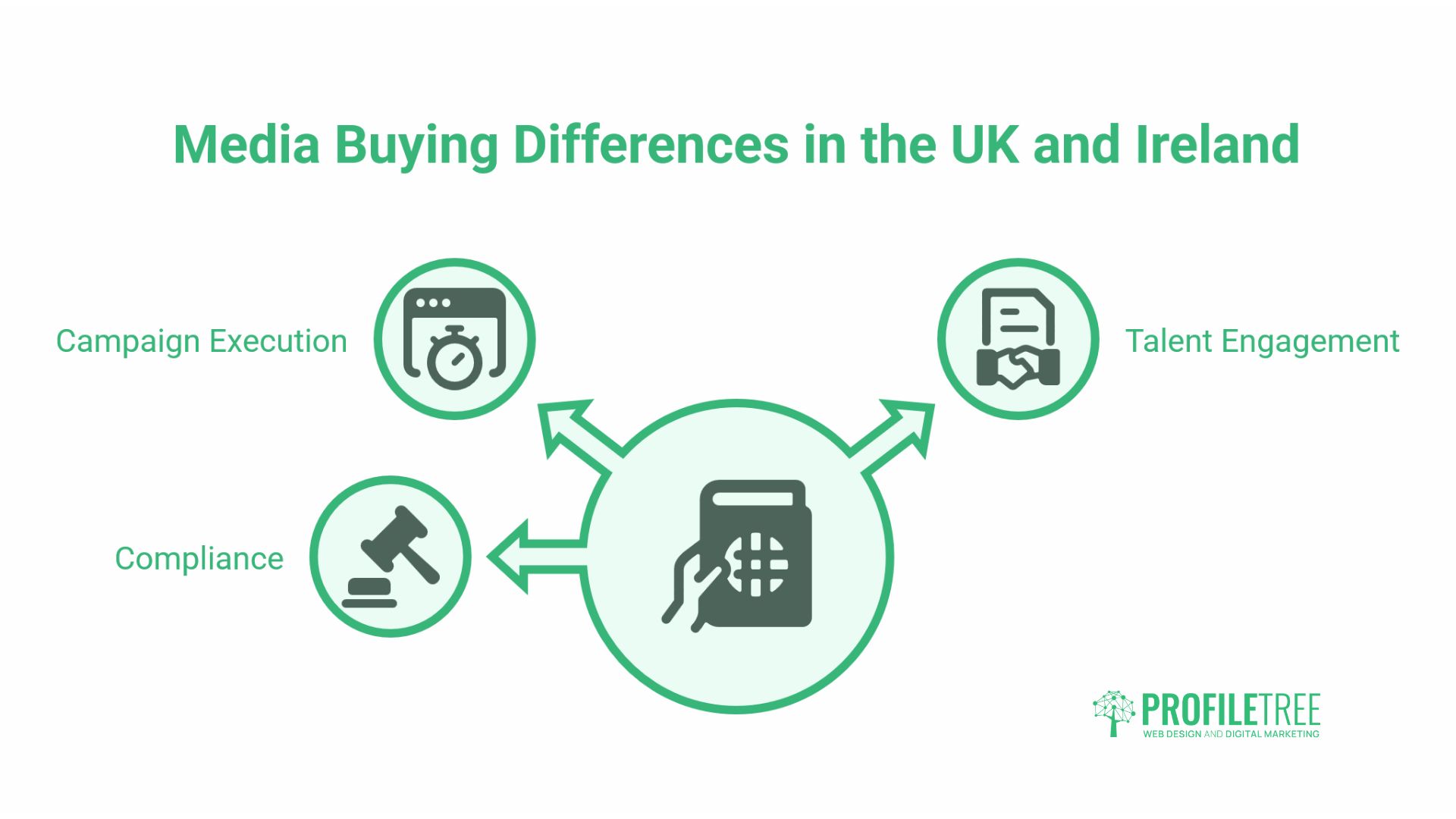
The majority of media buying guides are written for US audiences. The UK and Irish markets have significant differences that affect how campaigns are run, how talent is engaged, and how compliance is handled.
GDPR and ICO compliance
Any paid media buyer working with UK-based audiences needs to understand the data compliance implications of using pixel data, custom audiences, and retargeting. In the UK, the relevant authority is the Information Commissioner’s Office. In Ireland, it is the Data Protection Commission. Both operate under GDPR frameworks but with distinct enforcement approaches. Consent-based audience building, first-party data strategies, and cookie compliance are not peripheral concerns: they are central to operating legally. The ethics and legalities of digital marketing cover these obligations in more detail, and any buyer you hire should be fluent in them.
If a candidate cannot speak to data compliance, establishing how they handle it during onboarding is essential. It is not an optional extra for UK and Irish businesses.
UK-specific media channels
Beyond Meta and Google, the UK market has distinct paid media opportunities that a buyer experienced only in the US market may not be aware of. Sky AdSmart allows highly targeted television advertising at relatively accessible cost floors for SMEs, reaching specific postcode areas, demographic groups, or Sky subscriber segments. ITVX and Channel 4’s streaming platforms offer similar connected TV inventory. These channels are not yet saturated in the way paid social can be, and for businesses in categories such as professional services, home improvement, or financial services, they can deliver strong results at a lower cost per impression than equivalent digital display.
The evolution of digital media versus print media is a useful context for understanding where different media channels sit today and how audiences are shifting across them.
Regional market knowledge
For businesses in Northern Ireland, Ireland, and the wider UK, a media buyer based in or familiar with those markets adds practical value. Understanding the competitive dynamics of a local market, which categories are oversaturated with paid advertising, where share of voice is still available, and how consumer behaviour differs from London-centric benchmarks, is the kind of contextual knowledge that does not come from platform dashboards.
TikTok statistics for the UK illustrate this clearly: TikTok’s penetration and engagement patterns in Northern Ireland and regional UK differ from national averages in ways that matter for campaign planning. A buyer who only thinks in aggregate UK figures will miss those variations.
Before You Hire: What Needs to Be in Place
Hiring a media buyer before your foundations are solid is one of the most common and expensive mistakes SMEs make with paid advertising. A media buyer needs inputs to work with. Without them, the budget gets spent on learning things that should already be known.
Landing pages that convert
The page your ads send traffic to needs to be built for conversion, not just for information. This means a clear value proposition above the fold, a single primary call to action, mobile optimisation, and fast load times. Sending paid traffic to your homepage or a generic services page wastes spend. If your landing pages are not in good shape before you hire, address that first.
The impact of AI on e-commerce conversion rates is worth reading if your paid campaigns are driving traffic to an e-commerce store, as conversion optimisation and ad strategy are increasingly intertwined.
A clear offer and customer definition
A media buyer cannot manufacture demand for an unclear offer or for a product that has not been validated. They can find audiences and serve them ads efficiently, but if the messaging is vague or the offer is not strong, no amount of targeting precision will fix it. Before briefing a media buyer, be able to articulate in one sentence what you offer, who it is for, and why someone should choose you over the available alternatives.
Brand storytelling examples can help sharpen how you frame your offer for paid advertising purposes. The same narrative principles that make brand content perform well apply directly to ad creative.
A content and creative library
Short-form video consistently outperforms static images in paid social advertising. A media buyer who has only static images to work with will be constrained. A video creative of 15 to 30 seconds, structured around a specific problem and solution, is the format that performs most consistently across Meta, TikTok, and YouTube advertising. Building a basic creative library before running significant paid spend is one of the highest-value preparations an SME can make.
The essential skills for web designers piece is also relevant here if you are evaluating whether your digital assets are ready for paid traffic: a media buyer can only work with what exists on the destination side.
Analytics and tracking that works
Before any paid campaign goes live, verify that your conversion tracking is accurately capturing the actions you care about. Pixel health, GA4 configuration, and the connection between ad platform data and your CRM matter more than ever, as third-party cookie deprecation has reduced the reliability of platform-side attribution.
AI content detection and the broader shift towards AI-driven analytics have changed how businesses should think about measurement. A media buyer operating on clean, verified data will always outperform one working from incomplete or broken tracking, regardless of their skill level.
Training your team to work alongside paid media
If your business has a marketing or sales team, their ability to follow up on paid leads quickly and consistently directly affects your campaign ROI. Training your team to work with AI and digital tools means the gains your media buyer makes at the top of the funnel do not evaporate at handover. This is an underappreciated part of making paid media work well.
Conclusion
Hiring a media buyer is a strategic decision, not just a recruitment exercise. The right route, freelancer, agency, or in-house, depends on your budget, your internal capacity, and how central paid advertising is to your revenue. Get the foundations right first: landing pages, creative, tracking, and a clear offer. ProfileTree’s digital marketing team works with SMEs across the UK and Ireland to do exactly that. Talk to the team about where to start.
FAQs
Do media buyers take a percentage of ad spend?
Some do, typically 10 to 20%, but flat retainers and hybrid models are increasingly common. The percentage model suits high-spend accounts where workload scales with budget; on smaller accounts, it often produces a fee too low to cover the work properly. Ask any prospective buyer how their fee changes if you scale spend up or down.
What is the difference between a media planner and a media buyer?
A media planner decides where advertising should run: which platforms, audiences, and formats. A media buyer executes that plan, managing placements, bids, and live campaign optimisation. For most SMEs, one person handles both. The distinction matters mainly in larger organisations where misalignment between planning and execution wastes budget.
How much does a freelance media buyer cost in the UK?
Day rates range from £150 to £250 for junior or single-platform buyers, £250 to £450 for mid-level practitioners with solid Meta and Google experience, and £500-plus for senior multi-platform specialists. Monthly retainers for ongoing management typically run £1,500 to £4,500. London rates sit at the upper end of each range.
Is IR35 applicable when hiring a freelance media buyer?
Potentially, yes. Since the 2021 reforms, medium- and large-sized UK businesses must assess whether an off-payroll engagement falls within or outside IR35. If the buyer works exclusively for you and follows your direction on how the work is done, IR35 likely applies, making you responsible for PAYE and National Insurance. Small businesses below these thresholds (turnover £10.2m, balance sheet £5.1m, 50 employees) are currently exempt. Take employment law advice before signing any contract.