
Generative Engine Optimisation: A Practical Guide for Business Websites
Table of Contents
Generative engine optimisation, usually shortened to GEO, is the practice of making a business easy for AI systems such as ChatGPT, Google’s AI Overviews, Perplexity, and Gemini to understand, trust, and quote. It sits next to traditional SEO rather than replacing it, and together the two make up most of what AI SEO covers.
ProfileTree, a Belfast-based digital marketing agency, has spent the last year folding GEO checks into its regular SEO process, including its AI SEO work across Ireland. This guide explains what GEO is, how it overlaps with SEO, where it differs, and what changes for businesses selling on both sides of the border.
What Is Generative Engine Optimisation?
Generative engine optimisation is the work of structuring a website, and the wider picture of a business online, so that AI tools can describe that business accurately and cite it in the answers they write. Where SEO earns a position on a results page, GEO earns a mention inside an AI-generated answer.
The distinction matters because of how people now search. A buyer who once scrolled through ten blue links increasingly reads a written answer first, and that answer names a small number of businesses or sources before moving on. There’s no second page to scroll. A business either appears in the answer or it doesn’t, and the work of GEO is making sure the AI system has enough clear, consistent, and trustworthy information to include it.
The term itself comes from a 2023 research paper by academics at Princeton and partner institutions, which tested how different changes to content affected visibility in AI-generated answers. It has since been adopted across the industry as the name for this kind of work, sometimes alongside related labels such as answer engine optimisation.
How AI Systems Choose What to Cite
Understanding the mechanics makes GEO far less mysterious. When someone asks an AI assistant a question, the system typically does three things in quick succession.
It retrieves pages. Many AI tools fetch content at the moment the question arrives, working to a time limit, so a page that loads slowly or hides its text behind heavy scripts may never be read at all.
It verifies the source. Before citing a business, the system needs reasonable confidence that it exists, operates where it says it does, and does what it claims. Consistent details across the web and mentions on sites the business doesn’t control supply that confidence.
It extracts a passage. AI systems rarely quote a whole page. They lift a short passage, often somewhere between 40 and 100 words, that answers the question on its own, then build a reply around it. The full detail of each stage is covered in how AI search engines cite websites.
What GEO Shares With SEO
Most of the foundation is identical, which is the first useful thing to say to anyone worried that GEO is a whole new discipline requiring a whole new budget. AI answer engines still need to find a page, read it, and trust it.
Crawlability. If search and AI crawlers can’t reach a page, nothing else matters. Clean sitemaps, sensible robots.txt rules, working internal links, and fast load times remain the entry ticket. A site with crawl errors gains nothing from better structured data.
Authority. AI systems weigh credibility in broadly similar ways to search engines. Backlinks and mentions from relevant, credible sites still count. A site with no external validation gives a model no independent reason to trust it.
Structured data. Schema markup that labels an organisation, its services, its reviews, and its FAQs helps both traditional search results and AI extraction. It’s one of the clearest overlaps between SEO and GEO, and a good reason for the same team to run both disciplines. A schema markup guide covers the properties worth prioritising.
Content depth and clarity. Thin, vague pages perform badly in both worlds. A page that fully answers a question, with specific facts and a clear structure, tends to do well whether the destination is a blue link or a generated paragraph. That is why GEO usually starts from existing SEO services; the crawl, index, and authority fundamentals are identical.
How Is GEO Different From SEO?
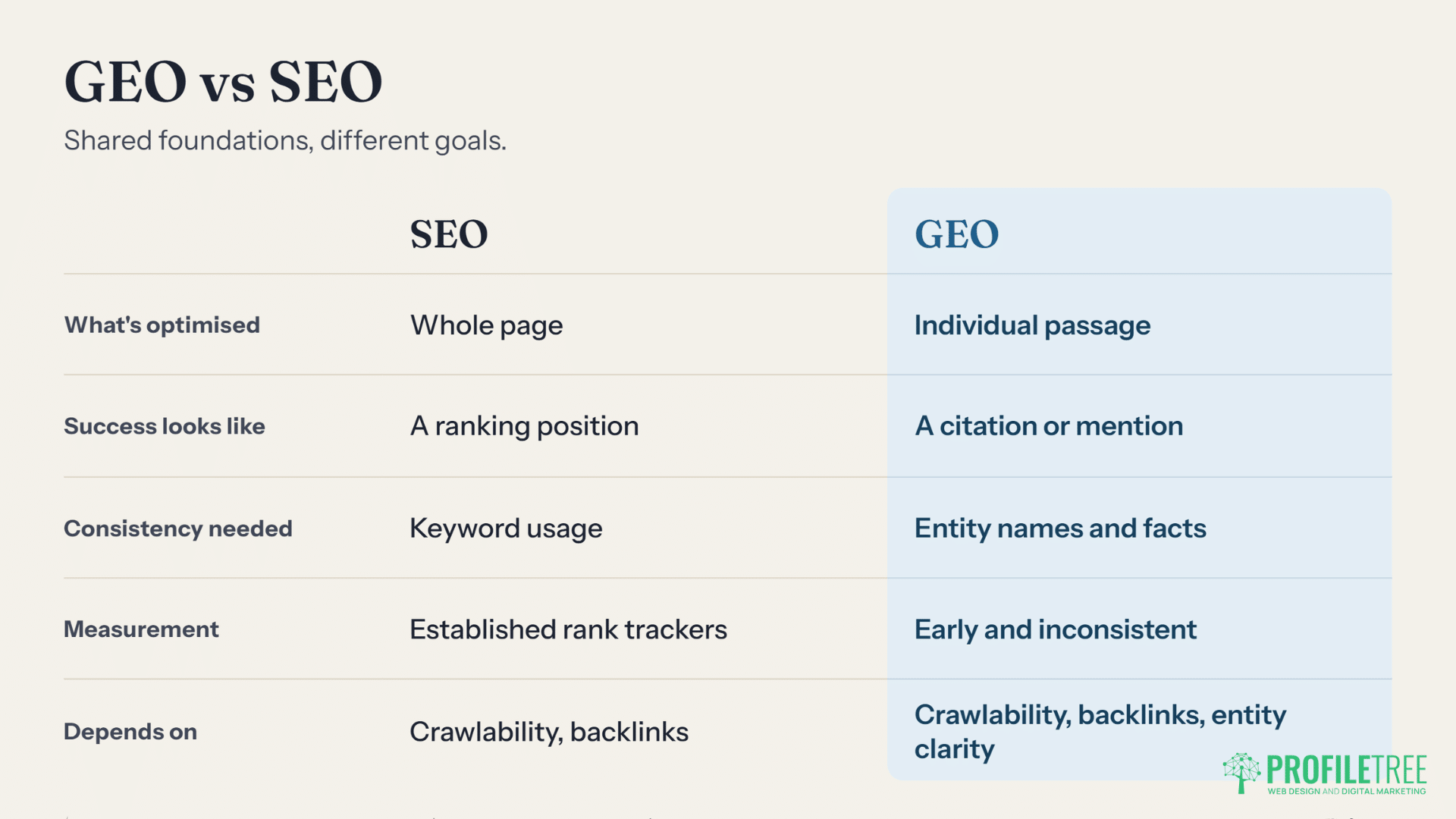
Three things separate GEO from conventional SEO, and each one changes how a business should write and measure its content.
Passages, not pages. Search engines rank whole pages against a query. Generative engines pull specific passages, sometimes a single sentence, and combine them with passages from other sites. A page can rank on page one and still contribute nothing to an AI answer if none of its paragraphs stands up on its own. Writing for GEO means every section opens with a clear claim, follows it with the supporting detail, and doesn’t rely on context from three paragraphs earlier.
Entity consistency, not keyword matching. Traditional SEO rewards a page that uses a keyword phrase in the right places. GEO rewards a business whose name, location, services, and people are described the same way across every page and every third-party mention. If one page says “ProfileTree” and another says “Profile Tree Digital,” the models have a harder time confirming they’re the same business, and confirmation is what leads to a citation.
Citations, not rankings. There’s no fixed results page in an AI answer and no stable position to track. What can be tracked is whether a business is mentioned for a given question, in which tools, and how that changes over time. It’s a younger and less precise measurement problem than rank tracking, and anyone promising exact “AI ranking” numbers is overselling.
| Traditional SEO | Generative Engine Optimisation | |
|---|---|---|
| Unit optimised | Whole page | Individual passage |
| Success signal | Keyword rank position | AI citation or mention |
| Consistency needed | Keyword usage | Entity naming and facts |
| Measurement maturity | Established (rank trackers) | Early and inconsistent |
| Core dependency | Crawlability, backlinks | Crawlability, backlinks, entity clarity |
Google’s own documentation on AI features and your website confirms that the same fundamentals apply: there’s no special markup for AI features, and pages need to be indexable and eligible to appear in ordinary search first.
Generative Engine Optimisation in Ireland
GEO works the same way in Ireland as anywhere else, but the island has a feature most markets don’t: two jurisdictions, two currencies, and two sets of official records, with many businesses trading across both. That creates specific problems for an AI system trying to build a clear picture of a business, and specific opportunities for the businesses that get it right.
Selling Into Two Jurisdictions
A large share of Northern Ireland businesses serve customers in the Republic, and plenty of southern businesses sell north. An AI assistant answering a question from Dundalk has to decide whether a Newry firm genuinely serves that area, and it can only do that if the business says so clearly. A site that names only Belfast, prices only in sterling and lists only UK contact details gives the model every reason to leave it out of an answer for a southern buyer.
“Most Northern Ireland businesses sell into the Republic, but their websites, listings, and reviews only tell half that story. An AI assistant answering a question from Dundalk or Dublin needs the same clear, consistent picture as one answering from Belfast, and very few firms have given it one.” Ciaran Connolly, founder of ProfileTree
The Records AI Systems Check
Official registers act as anchor points for AI knowledge graphs. For a Northern Ireland company, that means Companies House. For a company in the Republic, it means the Companies Registration Office. A business trading across the border should make sure its trading name, registered name, and address appear consistently wherever they’re recorded, alongside Irish and UK industry bodies and regional directories. One accurate business listing on a well-used Irish source often does more for a southern query than several on UK-only sites.
Naming Places, Prices, and Terms Clearly
Models tie a business to a place only when the place is written down. Name the towns and counties served on both sides of the border in ordinary sentences, set the Google Business Profile service area to the real footprint, and state prices in euros where the business genuinely sells into the Republic. Some services are also searched for under different words north and south, so check the terms southern buyers actually use before assuming one page serves both. The same principles, applied to getting a business recommended, are covered in how to rank in ChatGPT in Ireland.
How Does ProfileTree Approach GEO?

At ProfileTree, GEO is part of the standard SEO services engagement rather than a bolt-on product. The same technical audit now checks schema completeness as well as crawl errors, the same content review checks whether each passage can stand alone, and the same reporting includes a directional view of AI mentions alongside rankings and traffic.
Because entity consistency touches everything from how a site is built to the content marketing that fills it, the work connects directly into wider digital strategy. ProfileTree’s AI training for businesses also covers GEO, for teams that want to understand how AI tools describe their company and manage it in-house.
Where a Business Should Start With GEO
For most businesses, GEO isn’t a new project so much as a set of checks added to work already underway. The work usually starts with consistent business details, then structure and schema, then external mentions. The full order, a checklist for small businesses, and what GEO services include are covered in generative engine optimisation strategies for small businesses.
FAQs
What is generative engine optimisation?
It’s the practice of making a business easy for AI tools such as ChatGPT and Google’s AI Overviews to understand, trust and cite in the answers they write.
How is GEO different from SEO?
SEO earns a ranking for a whole page, while GEO earns a citation for a single passage. GEO also puts far more weight on describing the business consistently everywhere it appears.
Does GEO replace traditional SEO?
No. The two overlap substantially in the technical foundations, and a business that abandons rank tracking or keyword strategy in favour of pure GEO tactics is likely to lose ground on both fronts. GEO is additional work layered onto a working SEO programme, not a replacement for it.
Is GEO different for businesses in Ireland?
The principles are the same, but businesses trading across the border need consistent details in both Companies House and the CRO, clear place names on both sides, and pricing that reflects each market.
Should schema markup be added to every page on a site?
Not necessarily everywhere at once. Prioritise the organisation-level schema, service pages, FAQ sections and review data first, since these carry the facts most likely to be extracted. Blog content benefits from Article schema, but it’s a lower priority than the commercial and trust pages.
Is it worth paying for an “AI visibility audit” as a standalone product?
Only if it’s genuinely tied to actionable fixes, entity inconsistencies, missing schema, unclear content structure, rather than a dashboard reporting a score with no clear path to improving it. A useful audit should read like a task list, not a scorecard.
How does a local business show up in AI search?
By being easy to verify in the places AI systems check for local results. A complete Google Business Profile, a stable set of reviews shown as text, matching details across directories, and pages that name the town and the areas served all tell a model where a business operates and that it is real. Get those aligned and the business becomes one of the options an assistant can safely put forward for a “near me” or “in [town]” question. Domain authority helps, but for local prompts the verifiable ground-level signals tend to matter more.