
How to Get Your Business Recommended by ChatGPT
Table of Contents
Someone asking “who’s a good web designer in Belfast” used to scroll through ten blue links. Now they ask an assistant, and the assistant answers with a short list of named businesses. No scrolling, often no alternatives shown, and the buyer treats the reply the way they’d treat a tip from a well-informed colleague. Getting your business recommended by ChatGPT is now its own job, separate from ranking in search, and it sits at the centre of what AI SEO sets out to do.
That list isn’t random, and it isn’t paid placement. ChatGPT, Gemini and Perplexity build their answers from checkable signals: how consistently a business names itself online, how complete its Google Business Profile is, how recent its reviews are, whether it shows up in the directories these systems draw on, and whether its own pages contain sentences an assistant can quote with confidence.
ProfileTree, a Belfast digital agency working with businesses across Northern Ireland, Ireland and the UK, has run this exact process on its own listings and service pages over the past year, and it’s the same process behind its AI SEO work for businesses in Ireland. What follows is the practitioner version: the criteria assistants use, six steps in the order that actually moves the needle, and a ten-minute test you can run tonight.
Three Things to Take Away
- Assistants recommend the business whose facts are easiest to verify, not the biggest brand.
- Entity consistency comes first. Every other signal gets discounted if an assistant can’t confirm you’re one real, active business.
- You can measure where you stand in about ten minutes by asking three assistants the same buyer question.
Why AI Recommendations Became Their Own Channel
For years, the aim of local marketing was simple: rank in Google, appear in the map pack, get the click. That still matters. It’s no longer the whole picture. Through 2025 and into 2026, the search press tracked a steady rise in “assistant-first” queries, where the first stop in a buying decision is a conversation with an AI tool rather than a search box.
The shift lands hardest on service businesses selling to other businesses, because B2B buyers already ask around before they buy. A recommendation that once came from a phone call or a LinkedIn message now comes from typing a question into ChatGPT. If the assistant has good information about you, it will happily put you forward. If the information is thin, inconsistent or out of date, it recommends a competitor with cleaner signals, or hedges so heavily that the mention is worthless.
There’s a structural difference worth sitting with. A search results page shows ten options and lets the buyer choose. An assistant names two or three, then moves on. Businesses left off that shortlist stay invisible, because buyers rarely ask which names the assistant left out, and there’s no second page to scroll.
Businesses that already invest in local SEO have a head start, because the groundwork overlaps. Consistent entity data, structured content and genuine authority signals feed both ranking and recommendation.
Ciaran Connolly, founder of ProfileTree, puts it plainly: “The businesses getting recommended by ChatGPT right now aren’t necessarily the biggest names in their sector. They’re the ones whose information is clean, consistent and easy for a machine to verify in seconds. That’s a fixable problem, not a budget problem.”
The Criteria ChatGPT Uses to Decide Who to Recommend
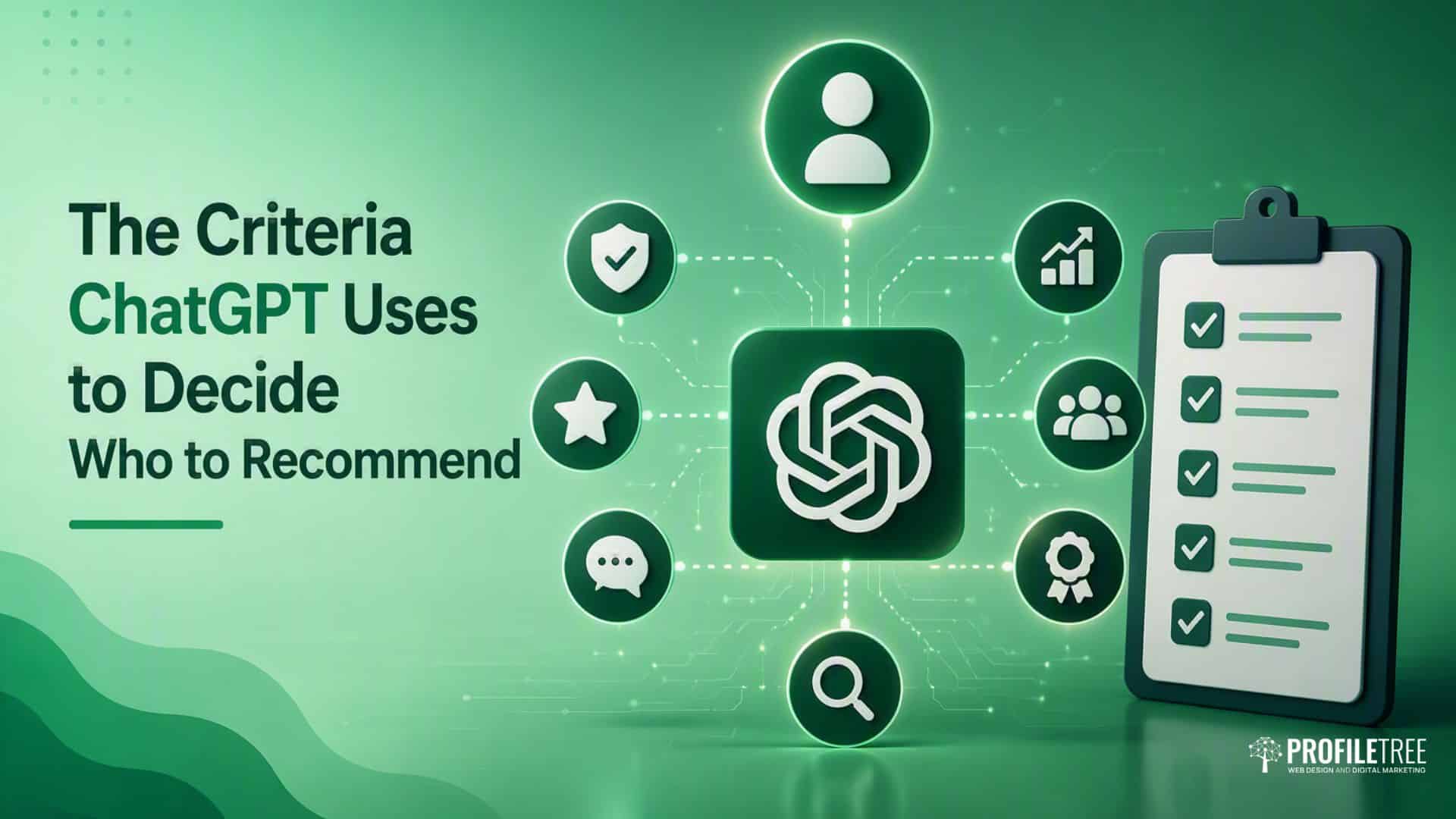
It helps to understand the mechanics before changing anything, because guessing at this stage wastes effort on the wrong fixes. A large language model doesn’t know your business the way a person does. It builds a picture from training data, from live web retrieval where the tool supports it, and from structured sources such as knowledge graphs, directories and review platforms. When someone asks for a recommendation, the assistant runs a fast, informal version of due diligence: does this business exist, is it real, is it active, is it liked, and does it do the specific thing being asked about? Five criteria carry most of the weight.
Entity Consistency
The same trading name, the same descriptor and the same address, repeated identically across the web. Inconsistency reads as risk to a system trying to confirm a business is real and singular. This is the criterion most businesses fail without realising it.
Review Signals
Volume, average rating and recency. A profile with a steady trickle of new reviews looks active and trustworthy. A profile whose most recent review is two years old looks dormant, even when the older reviews are glowing. Replying to reviews counts too, good and bad, since it signals to both people and machines that the business is active and paying attention.
Directory and Citation Presence
Showing up correctly across the directories and data aggregators that feed AI knowledge graphs, not just Google Business Profile. Each independent source that confirms the same facts raises the confidence an assistant can act on. Reference sources such as Wikidata and official registers carry particular weight, because knowledge graphs treat them as anchor points, and one wrong entry on a widely cited source can spread further than a correct entry on an obscure one.
Structured Data and Quotable Content
Schema markup states, in a format machines parse reliably, what the business is, what it does and where it operates. Alongside it, the words on your own pages need to answer the exact question a buyer might ask, written clearly enough to lift and attribute. None of these criteria works alone: excellent reviews with an inconsistent name still confuse the verification step, and immaculate markup with no reviews still looks unproven.
Six Steps That Move the Needle
The order matters as much as the list. Fixing entity consistency after the fact means redoing later work twice, so the steps below run from foundation upward. Most businesses can make real progress on the first three without a developer.
Step 1: Lock Down One Name and Descriptor Everywhere
Pick one exact business name, one descriptor phrase and one address format, then audit every place the business appears: Google Business Profile, Companies House, LinkedIn, Facebook, industry directories and the footer of the site itself. Look for “Ltd” in one place and no “Ltd” in another, or an address written three ways across three platforms. The fix is unglamorous: a spreadsheet listing each location, the current wording and the corrected wording. It’s slow, and it’s the base everything else sits on.
Step 2: Build Out a Complete Google Business Profile
Google Business Profile data feeds Google’s own AI features and, through data partnerships and public APIs, other assistants too. A complete profile means accurate primary and secondary categories, a plain-language description, current hours, a working website link, service-area detail where relevant, and fresh photos. A business serving all of Northern Ireland but signalling only “Belfast” is quietly limiting itself. Posts act as a freshness signal more than a click driver: a profile last posted 14 months ago suggests nobody is watching it.
Step 3: Treat Reviews as an Ongoing Signal
Volume and rating still count, but recency has caught up with them for recommendation specifically. Between two similar businesses, an assistant leans towards the one with reviews from the past few weeks. Build a review request into the natural end of a project rather than running an occasional push. Reviews that mention a specific service or place (“redesigned our WordPress site ahead of a Derry product launch”) give an assistant more to work with, and you can prompt for that detail simply by asking “What did we help you with?” rather than “Leave us a review.”
| Signal | Weak version | Strong version |
|---|---|---|
| Review volume | Under 20 reviews | 100+ reviews |
| Review recency | Last review 12+ months ago | New reviews in the past 30 days |
| Review content | Star rating only | Star rating plus the specific service named |
| Profile completeness | Category and address only | Full description, hours, photos, service area |
| Update frequency | No posts in a year | Posts or edits every few weeks |
Step 4: Check the Directories Assistants Actually Draw On
Beyond Google Business Profile, a handful of directories and aggregators feed the knowledge graphs assistants consult. If a business’s information exists only on its own site, it’s asking a machine to take its word with no independent confirmation. Worth checking: general business directories, industry-specific listings, Companies House, the LinkedIn company page and any accreditation bodies you belong to. A few accurate listings beat dozens of low-quality ones, and stale listings you no longer control can actively hurt consistency.
Step 5: Add Organisation and Service Schema
Schema is the most technical step here, and one of the most effective. Organisation schema states who the business is: legal name, logo, address, contact details, social profiles. Service schema does the same for each offering. Google’s own documentation on AI features is clear that there’s no special AI-only markup to add, so the point isn’t to game an assistant. It’s that structured data helps any crawler read your entities cleanly, and the markup must match what the page visibly says. This is developer work, so flag it clearly in any brief rather than assuming it gets picked up. Every service page should carry Service schema, and the site should carry Organisation schema site-wide.
Step 6: Write Pages an Assistant Can Quote
Even with clean entities, strong reviews and correct schema, an assistant still needs sentences on your site that answer the question directly. This is where bottom-line-up-front earns its place. A page that opens with three paragraphs of scene-setting gives an assistant nothing quotable in the section it extracts from first.
“We help businesses grow online” says nothing concrete. “ProfileTree provides WordPress web design for small and medium businesses across Northern Ireland, with most projects delivered in four to eight weeks” hands the assistant a fact it can repeat. The same logic runs across every service line, from content marketing to video production to animation: state plainly and early what the service covers, who it suits and what a buyer can expect.
A dedicated “why choose us” page deserves particular care, since assistants lean on it heavily to assemble a recommendation.
How to Rank in ChatGPT in Ireland and Northern Ireland
The criteria don’t change by country, but the corroborating sources do, and that’s where a local business wins or loses. An assistant answering “recommend a web designer in Dublin” or “in Belfast” is trying to tie a business to a place, so the location signals need to agree everywhere they appear.
Make the Location Signal Agree Everywhere
Set the service area in Google Business Profile to reflect the real footprint, not just the head-office city. Use the same town and county wording on the site, in listings and in review prompts. A business that delivers across Ireland but only ever says “Belfast” gives an assistant a reason to hedge on any query outside that city. For a firm serving Derry, Lisburn or Newry, naming those towns specifically, rather than only the county or the capital, is what lets an assistant tie you to a genuinely local search.
Lean on Irish and UK Sources
Corroboration from Companies House or the CRO, Irish and UK industry bodies, and region-specific directories carries weight for local queries. These are the sources an assistant can check against a place, so getting them consistent does more for Irish visibility than any single on-site change. The same care that supports web design enquiries locally supports AI recommendation for them.
The Test to Run Tonight, and Where to Start
Before spending on any of this, find out where you stand. It takes about ten minutes and costs nothing.
Run the Three-Assistant Check
Open ChatGPT, Perplexity and Gemini in three tabs. Ask each the same question, phrased as a customer would: “Can you recommend a [service type] in [town]?” Note who each names, in what order, and what it says about them. Then ask a follow-up: “Why did you recommend them?” If a business doesn’t appear at all, that’s an entity or visibility gap. If it appears but the facts are wrong, that’s a consistency problem to fix first. If it appears but sits behind competitors, look at reviews and schema next.
Repeat It, Then Act in Order
Run the test every few weeks rather than once. AI answers shift as the underlying data changes, sometimes faster than search rankings, so a business missing this month may appear next month once the review count climbs and the schema goes live. When you act, start with entity consistency, because every other signal gets discounted without it. Reviews and schema tend to move fastest after that, since both sit within your direct control. None of this replaces solid SEO; it sits alongside it, and a business working with an agency should ask for evidence of what changed and why, not just a promise of improvement.
Working through this takes time, and the entity and directory audit is the least glamorous part of it. If you’d rather have it handled, ProfileTree runs the same audit as the first step of local SEO support for businesses across Northern Ireland and Ireland. Get in touch to find out where your business stands in AI answers today.
FAQs
How Do I Get Recommended by ChatGPT?
Make your business easy for a machine to verify. Use one consistent name and address everywhere, keep Google Business Profile complete and current, collect recent reviews, appear in reputable directories, add Organisation and Service schema, and write service pages that state plainly what you do and who for. Start with name and address consistency, since the rest is discounted without it.
What Are ChatGPT’s Business Mention Criteria?
Five criteria carry most of the weight: entity consistency (one name, descriptor and address across the web), review signals (volume, rating and recency), directory and citation presence, structured data, and quotable content on your own pages. They work together. Strong reviews with an inconsistent name still fail the verification step.
How Do I Rank in ChatGPT in Ireland?
The criteria are the same, but the local sources decide it. Set your Google Business Profile service area to your real footprint, use identical town and county wording across your site and listings, and get consistent entries in Irish and UK registers, industry bodies and regional directories. Assistants match businesses to places, so agreement across local sources matters most.
How Do I Make ChatGPT Recognise My Business as a Trusted Option?
Give it independent confirmation. One business, one set of facts, repeated across your profile, directories and registers, backed by recent reviews and a clear “why choose us” page. The more sources that agree, the more confidently an assistant can name you rather than hedge.
Is This Just SEO with a New Name?
There’s overlap, but no, they’re not the same. SEO optimises for ranking in a list a person chooses from. AI recommendation optimises for being one of a few names an assistant states with confidence, often with no visible alternatives. A business can rank well in search and still be missed or misdescribed in AI answers.