
The Future of E-Commerce: Digital Marketing’s Strategic Influence
Table of Contents
The future of e-commerce is being shaped by decisions that UK and Irish SMEs are making right now: which platforms to sell through, how to structure product data for AI-powered search, and whether their websites can actually convert the traffic they are working hard to attract.
Consumer habits have shifted, search technology has changed, and the channels that drive product discovery look different to how they did three years ago. This guide cuts through the global trend reports to focus on what matters for small and medium-sized businesses in the UK, Ireland, and Northern Ireland: the changes that require action now and those you can afford to wait on. Each section connects a broader development to the specific decision it creates.
The UK and Ireland E-Commerce Landscape
The UK is one of the most mature e-commerce markets in the world, with online retail accounting for roughly 38% of total retail sales. Ireland sits closer to 20%, but that gap is an opportunity rather than a lag. With internet penetration in Ireland above 98% and digital payment adoption rising steadily, the conditions for rapid e-commerce growth among Irish businesses are strong. The CSO’s Retail Sales data shows consistent year-on-year growth in online channels across both consumer and B2B categories.
Northern Ireland occupies a distinct position. The Windsor Framework gives NI businesses access to both the UK domestic market and the EU single market without the customs complexity that affects GB-to-EU trade. For e-commerce businesses shipping physical goods, dual-market access is a genuine commercial advantage. Most global trend reports ignore it entirely. If you are building or scaling an online store in Northern Ireland, it should be part of your fulfilment and marketing planning from the outset. There is a broader context of e-commerce opportunities and challenges in Ireland that applies across the island.
For SMEs across the UK and Ireland, the defining challenge of the current period is not getting online — that is straightforward, but building the digital infrastructure that actually generates revenue. Website architecture, search visibility, content depth, and discovery channels all require deliberate investment. A Shopify subscription and a product catalogue are a starting point, not a strategy.
Mobile Commerce
The majority of online shopping journeys in the UK now begin on a mobile device. That has practical consequences beyond making your site display on a phone screen. Page speed, checkout simplicity, tap target sizing, and mobile payment options (Apple Pay, Google Pay, PayPal One Touch) directly affect whether a customer completes a purchase or abandons it. A site that loads slowly on mobile loses sales before it has a chance to persuade anyone. This is one of the most consistently overlooked factors in e-commerce underperformance.
Cross-Border Complexity
Post-Brexit trading arrangements continue to affect UK businesses selling into the EU and Irish businesses selling into the UK. VAT rules, customs documentation, and returns logistics all require attention for any SME moving beyond its domestic market. The impact of Brexit on digital marketing in the UK has been substantial for businesses that relied on EU-based advertising networks or customer databases. Getting UK digital compliance for e-commerce websites right from the start costs significantly less than correcting it after a regulatory complaint.
Trust as a Differentiator
The e-commerce market is more crowded than ever. Amazon, Temu, and other large marketplace platforms compete for the same consumer attention as independent brands, and they compete on price and speed in ways most SMEs cannot match. The differentiator for smaller businesses is trust: clear product information, genuine reviews, transparent return policies, and a brand identity that makes a customer feel confident about buying from someone they have not heard of before. That trust is built through content, design, and consistency across every customer touchpoint. It cannot be bought through advertising alone.
AI and Agentic Commerce: When Discovery Changes
The way people find products online is changing, affecting every e-commerce business. AI-powered search tools, such as Google AI Overviews, ChatGPT Shopping, and Perplexity, are increasingly answering product discovery queries directly rather than presenting a list of links to browse. In some cases, AI systems are beginning to act as purchasing agents: a user sets preferences, the AI searches, evaluates, and buys on their behalf. This is early-stage in 2026, but the technical preparation required starts now.
Structured Data and Product Schema
For an AI system to recommend or purchase a product, it needs to read that product’s attributes clearly and unambiguously. Structured data markup, including the Schema.org Product schema, with GTINs, pricing, availability, and verified review data, is the layer that makes product information legible to both search engines and AI systems. Most SME online stores are missing substantial portions of this markup, which limits their visibility in the next generation of product discovery tools. A web developer with e-commerce SEO experience can audit and implement this relatively quickly. The delay in doing so is incurring increasing costs.
This same technical investment improves visibility in standard Google results in the meantime, so it pays off on two fronts. The impact of AI training and implementation on e-commerce conversion rates is already measurable for businesses that have invested in structured, AI-readable content.
Generative Engine Optimisation
Traditional SEO optimises pages to rank higher in search results. Generative Engine Optimisation (GEO) optimises content for AI systems that synthesise answers rather than display links. The principles overlap significantly: clear, factual, well-structured content that answers specific questions tends to perform well in both contexts. What GEO adds is a sharper requirement for entity clarity, making it unambiguous who you are, what you sell, and where you operate and a preference for direct answer formats rather than introductory preamble. Sections that open with a direct answer and then provide supporting detail are more likely to be extracted by AI systems than sections built around a narrative arc.
AI Tools for SME E-Commerce: Practical Starting Points
Agentic commerce is the emerging frontier, but AI is already practical for smaller businesses without enterprise budgets. Automated email flows triggered by browsing and purchase behaviour, AI-generated product descriptions at scale, chatbot customer service for common pre-purchase queries, and analytics tools that identify underperforming pages are all accessible today. The question is not whether to use AI tools but which ones to integrate without creating more complexity than they solve. A structured cost-benefit analysis of AI implementation for SMEs is a useful starting point, and there are real examples of SMEs successfully implementing AI solutions that illustrate what realistic adoption looks like. Understanding how to measure the impact of AI on your business before you begin also prevents the common mistake of investing in tools with no clear success criteria.
“The real triumph in digital commerce lies in an e-commerce site’s ability to echo the personal touch of in-store engagement through bespoke online recommendations,” says Ciaran Connolly, founder of ProfileTree.
Social Commerce and the New Discovery Journey
Social commerce, the ability to discover and buy products directly within social platforms, has moved from experiment to mainstream channel. TikTok Shop launched in the UK in 2023 and continues to grow. Instagram and Facebook Shops allow customers to complete purchases without leaving the platform. Pinterest connects shoppable product catalogues directly to retailer inventory. For UK and Irish SMEs, the practical question is which platform their customers actually use and whether transaction data from social channels integrates cleanly with their existing inventory management systems.
Short-Form Video and Product Discovery
Short-form video has become the primary discovery format for consumer products on social platforms. A product demonstrated in a 30-second TikTok or Instagram Reel reaches audiences who would never have found that product through a Google search. This changes the customer acquisition model: instead of optimising purely for search intent, product-based businesses need to optimise for attention and impulse as well. The two approaches are not mutually exclusive, but they require different content, different production disciplines, and different performance metrics.
The rise of short-form video as a format is well documented, and the connection between social media activity and increased sales is particularly strong for product-based businesses with visually demonstrable products. The social media shopping statistics from recent consumer research make clear that the purchase journey increasingly begins on social platforms, even when the final transaction happens elsewhere.
Live-Stream Shopping
Live-stream shopping is an established format in East Asian markets and is growing steadily in the UK. Brands or creators broadcast live product demonstrations, with viewers purchasing in real time. The format works because it combines the immediacy of broadcast media with the social proof of watching an audience respond to a product in the moment. For SMEs with physical products that benefit from demonstration food, beauty, homeware, craft goods, fitness equipment, live streaming is a lower-cost entry into video commerce than full broadcast production. The barrier is primarily confidence and consistency, not equipment.
Instagram Live has become one of the most accessible formats for small businesses entering this space, with no additional platform or software required beyond an existing account.
Measuring Social Commerce Performance
Attribution remains the persistent challenge with social commerce. When a customer sees a product on TikTok, searches for it on Google, reads a review, and then buys from the brand’s website, most analytics setups credit the conversion to the last click. That systematically undercounts the contribution of social discovery. Multi-touch attribution models, available through most mid-range analytics platforms, give a more honest picture of where to invest. Understanding how channels interact rather than evaluating each in isolation is a meaningful competitive advantage for SMEs willing to invest the time in proper measurement.
SEO, Content and Visibility for Online Stores
Search engine optimisation remains the highest long-term return channel for most e-commerce businesses. Paid advertising stops generating traffic the moment the budget runs out. Organic search traffic, built through sound SEO and content, compounds over time. The challenge for SMEs is that e-commerce SEO has become considerably more technical and competitive than it was five years ago.
There is a useful external reference point here: the Office for National Statistics tracks monthly online retail sales in the UK. Their data consistently shows that e-commerce growth is concentrated in categories where product discovery happens through search, clothing, electronics, home goods, and beauty, which makes SEO investment in those categories particularly well-justified. The ONS Retail Sales Index provides the most authoritative view of UK e-commerce trends for businesses making budget decisions.
Category and Product Page SEO
The most valuable SEO work for an e-commerce site typically happens on category pages, not the homepage. A category page targeting “handmade candles Northern Ireland” or “women’s running shoes Belfast” captures the specific intent of a buyer who knows what they want and is close to a purchase decision. These pages need unique, substantive content, clean URL structures, breadcrumb navigation, product schema markup, and internal links from related editorial content. The majority of SME online stores have category pages that are either thin (a heading and a product grid with no text) or duplicated across similar categories, both of which suppress rankings. The choice of programming language and platform for your e-commerce website affects how much flexibility you have to implement these technical improvements.
Content Marketing as an SEO Asset
Buying guides, comparison articles, how-to content, and FAQ pages serve two functions for e-commerce businesses. They capture early-stage searchers who are researching rather than ready to buy, and they create the internal link structure that passes authority to product and category pages. A furniture retailer that publishes a well-researched guide to choosing a sofa for a small living room captures traffic that competitors without that content miss entirely. The guide links to relevant product categories, closing the path from research to purchase. Transparency in content marketing, being honest about trade-offs, limitations, and alternatives, is particularly effective for e-commerce because it builds the kind of trust that converts first-time visitors into buyers.
First-Party Data and Search Strategy
As third-party cookies become less reliable across browsers and data privacy regulations tighten, first-party data becomes more valuable. For an e-commerce business, first-party data means the behavioural information collected directly from your own site: what products people view, what they add to baskets, what they search for within your store, and what they ultimately purchase. This data informs both the SEO strategy, which topics to write about, which categories to prioritise, and paid advertising targeting. Navigating data privacy laws in e-commerce is now a baseline competency rather than a compliance exercise, and businesses that have structured their data collection correctly are better positioned than those still reliant on third-party signals.
Web Design, UX and Conversion
The most common reason e-commerce businesses with reasonable traffic perform poorly is a poorly converting website. Traffic acquisition costs time and money; losing potential customers at checkout, on the product page, or at the category level wastes both. Web design and user experience are not aesthetic considerations. They are commercial ones, and the returns from improving them are often faster than those from any additional marketing spend.
Page Speed and Core Web Vitals
Google uses page experience signals, including Core Web Vitals, which cover loading speed, visual stability, and interactivity as ranking factors. For e-commerce sites, these metrics are often weaker than for editorial sites because product images, third-party scripts (payment processors, review platforms, live chat, retargeting pixels), and complex page layouts all add load time. A site that scores poorly on Core Web Vitals is being penalised twice: in search rankings and in conversion rate, because slow pages lose impatient customers before they have read anything.
Checkout Optimisation
Cart abandonment rates in UK e-commerce typically range from 70% to 80%. A significant proportion of that abandonment occurs during checkout, at friction points largely avoidable: too many form fields, no guest checkout option, payment methods the customer does not recognise or trust, unexpected delivery costs revealed late in the process, and poor mobile checkout layouts. Reducing checkout friction is one of the highest-return investments available to an e-commerce business, and most of the changes sit in the website build rather than in ongoing marketing spend. Maximising ROI from digital marketing campaigns consistently shows checkout optimisation as one of the levers with the fastest payback.
Trust Signals and Product Pages
A customer arriving at your product page through organic search or a social post has invested attention but has no existing relationship with your brand. The page needs to do considerable persuasive work quickly: multiple product images including scale references, descriptions that answer the questions a buyer actually has rather than describing the product from the brand’s perspective, verified reviews, clear stock and delivery information, and a returns policy that removes risk from the purchase decision. Many SME product pages fail on two or three of these, and that failure shows up directly in conversion data.
Video Marketing for E-Commerce
Video has become a primary conversion tool for product-based businesses, not a supplementary channel for brand awareness. Consumer research consistently shows higher time-on-page, lower return rates, and improved conversion rates for product pages that include video compared to those that do not. For e-commerce businesses, the question is no longer whether to invest in video but where to start.
Product Demonstration Video
The most practical form of video for an SME e-commerce business is product demonstration: showing the item in use, in context, at a realistic scale, and with honest detail. This does not require broadcast-quality production. A well-lit, stably filmed demonstration on a modern smartphone with clear audio is sufficient for most product categories. Professional video production adds consistency, brand alignment, and the kind of visual quality that signals to a first-time buyer that this is a credible business. Text-to-video AI tools are also beginning to make it feasible for businesses with limited production budgets to create supplementary video content at scale, though human-made demonstration videos remain more persuasive for most product categories.
YouTube as a Search Channel
YouTube is the second-largest search engine in the world. For e-commerce businesses selling products that benefit from demonstration tools, cooking equipment, beauty products, home furnishings, fitness equipment, craft materials, YouTube is a discovery channel as much as it is a social platform. Buyers search “how to use X” or “X honest review” and find product videos. Those videos link to the product page in the description, creating a discovery-to-purchase path that operates independently of Google search. ProfileTree’s video marketing services cover both content strategy and channel optimisation, which ensures consistent results. Video email marketing statistics also make the case for using video across the full customer journey, not just at the discovery stage.
Video in Social Channels
Video content consistently achieves higher organic reach than static posts on most social platforms. For an SME with a limited content production budget, prioritising video over static content generally delivers better returns across the channels that matter for product discovery. The production discipline required is different from what most businesses are used to, but it is learnable, and the returns compound as an audience builds.
Data, Personalisation and Privacy
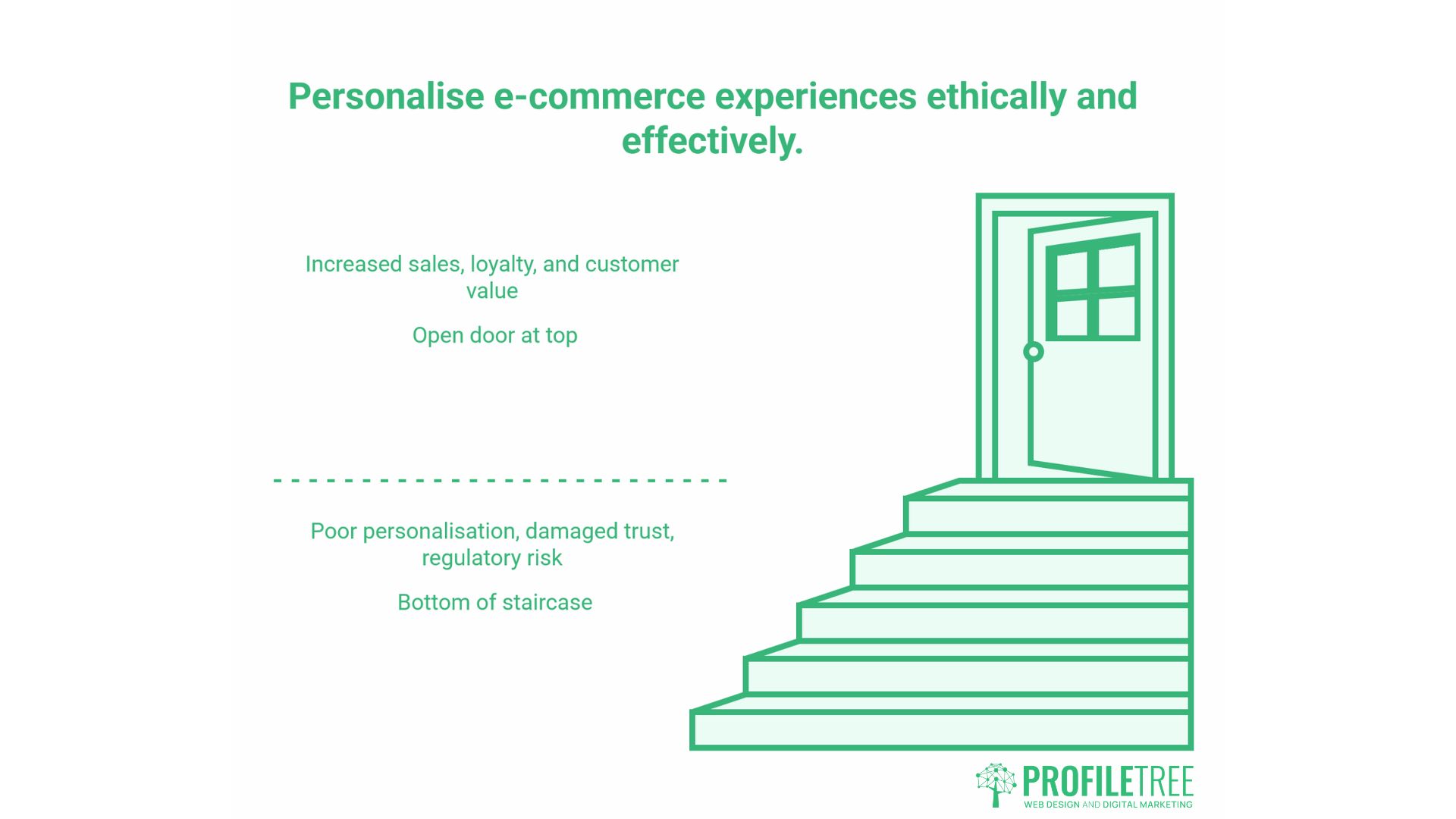
Personalisation in e-commerce means showing the right product to the right person at the right moment. Done well, it increases average order value, repeat purchase rate, and customer lifetime value. Done poorly, or done in ways that violate data privacy expectations, it damages trust and creates regulatory exposure.
Personalised Recommendations
Product recommendation engines are available through most major e-commerce platforms and through third-party apps. The quality of recommendations depends on the volume of behavioural data available, which means smaller stores with lower traffic see more modest benefits than larger ones. For SMEs, the more practical personalisation applications are email segmentation, sending different product recommendations to customers based on purchase and browsing history and on-site search personalisation. Customer feedback as a content strategy input also directly informs personalisation: knowing what questions customers actually ask before buying helps you decide what to include on your product pages and in your email flows.
GDPR and Data Privacy Compliance
Collecting and using customer data for personalisation requires a lawful basis under UK GDPR and, for businesses operating in Ireland, EU GDPR as enforced by the Irish Data Protection Commission. Consent, legitimate interest, and contractual necessity are the most relevant bases for e-commerce. The practical implications are that your cookie consent mechanism must function correctly without pre-checked consent boxes, your email marketing must be permission-based with clean opt-in records, and your data retention policies must be documented and actually followed. Businesses that treat compliance as a tick-box exercise face enforcement risk. Getting data privacy compliance in e-commerce structured correctly from the outset costs substantially less than fixing it after a complaint or audit.
Zero-Party Data Strategy
Zero-party data is information customers share proactively, such as style preferences, size details, interests, and intentions, provided through quizzes, account setup questions, or preference centres. For e-commerce businesses, collecting zero-party data enables personalisation without relying on inferred behavioural signals. A skin care brand that asks customers about their skin type and concerns during account registration can personalise product recommendations and email content without any third-party tracking. This approach is also more resilient to future changes in privacy regulation, since it is based on freely given information. Digital marketing strategy built around first- and zero-party data is increasingly where the more durable competitive advantages in e-commerce are being built.
What the Next Three Years Require: Future of E-Commerce
The businesses that grow in UK and Irish e-commerce over the next three years will not necessarily be the ones that adopt every new technology first. They will be the ones that build strong foundations, a fast, well-designed website, solid SEO, genuine content, and a disciplined approach to data and then layer in new channels and tools once those foundations are in place. A well-executed TikTok Shop strategy built on a slow, confusing website with thin product pages will underperform every time. The sequence matters.
If you want to talk through where to start or what to prioritise for your specific business, get in touch with the ProfileTree team.
FAQs
What is the single biggest e-commerce trend for UK SMEs right now?
AI-driven product discovery. AI systems are increasingly answering product queries directly rather than presenting a list of links, so businesses that invest in structured data and content that answers specific product questions will be better positioned, and the same work improves traditional SEO rankings in the meantime.
Is e-commerce growing or declining in the UK?
Growing. Online retail accounts for around 38% of total UK retail sales, and that share is expected to continue rising, though the competitive environment is more intense than it was three to five years ago.
What is agentic commerce?
AI systems that search for, evaluate, and purchase products on behalf of a user based on preferences set in advance. The technical infrastructure required structured product data, schema markup, and real-time availability signals, which also improve visibility in current AI search tools, so building it now has immediate value.
Will AI replace traditional e-commerce SEO?
No, but it is changing what good SEO looks like. AI systems respond better to direct answers and factual density than to keyword density alone, so the shift rewards the same clear, well-organised content that ranks well in traditional search.