
Facebook Marketing Strategy for UK SMEs: A Practical Growth Guide
Table of Contents
Most of the top-ranking guides on Facebook marketing strategy are published by social media software companies whose primary goal is to sell subscriptions. The advice is accurate but context-free. It does not account for the fact that a sole trader in Derry and a product brand in London face fundamentally different challenges on the same platform.
For UK and Irish SMEs, the issues that actually determine success are rarely covered: how to target a local service area effectively without wasting spend on irrelevant postcodes, how to handle UK-GDPR compliance when using Meta’s tracking tools, and how to build a content approach when one person is handling the social media alongside three other jobs.
A Facebook marketing strategy for this context needs to be built around commercial outcomes, limited resources, and the specific behaviour of audiences in the UK and Ireland.
Step 1: Define What Commercial Success Looks Like
The most common mistake SMEs make with Facebook is treating engagement metrics as business results. Likes, shares, and follower counts are not revenue. Before touching Meta Business Suite, get clear on what you actually want Facebook to do for your business.
SMART Goals vs Vanity Metrics
A useful goal for a service business might be: “Generate 15 qualified enquiries per month from Facebook within 90 days, at a cost per lead under £40.” That is specific, measurable, and tied to revenue.
A vanity goal looks like: “Grow our Facebook page to 2,000 followers.” Followers who never buy are not an asset.
For most Northern Ireland and UK service businesses, the two objectives that justify Facebook investment are local brand awareness (getting in front of people in your service area before they need you) and direct lead generation (getting in front of people who need you now). These require different content, different ad formats, and different measurement approaches. Trying to do both with the same campaign dilutes both.
B2B vs B2C on Facebook
Facebook is often dismissed by B2B businesses as a consumer platform, and for many categories that is broadly true. But professional services, construction, recruitment, and training businesses in the UK and Ireland have found Facebook effective for reaching decision-makers in a non-work context, particularly in regional markets where LinkedIn reach is thin.
If you are targeting businesses rather than consumers, your Facebook marketing strategy should focus on thought leadership content, case studies, and lead generation ads that offer something of genuine value (a consultation, an audit, a guide) rather than a hard sell. The conversion journey is longer, but a well-structured Facebook marketing strategy can still generate pipeline if the approach is right.
“For most SMEs we work with, Facebook isn’t a channel they can afford to ignore, but it also isn’t one they should approach without a plan. The businesses that get results are the ones that connect their Facebook activity back to a specific commercial outcome from day one,” says Ciaran Connolly, founder of ProfileTree.
Step 2: Know the UK Facebook Audience
Any effective Facebook marketing strategy starts with an accurate picture of who is actually on the platform. Facebook is not the most-used platform in the UK, but it remains one of the largest by reach, and the addressable audience is substantial for most SMEs. Reported figures vary depending on whether the denominator is UK adults or UK internet users, so treat any single percentage with caution.
Demographics and Behavioural Patterns in the UK and Ireland
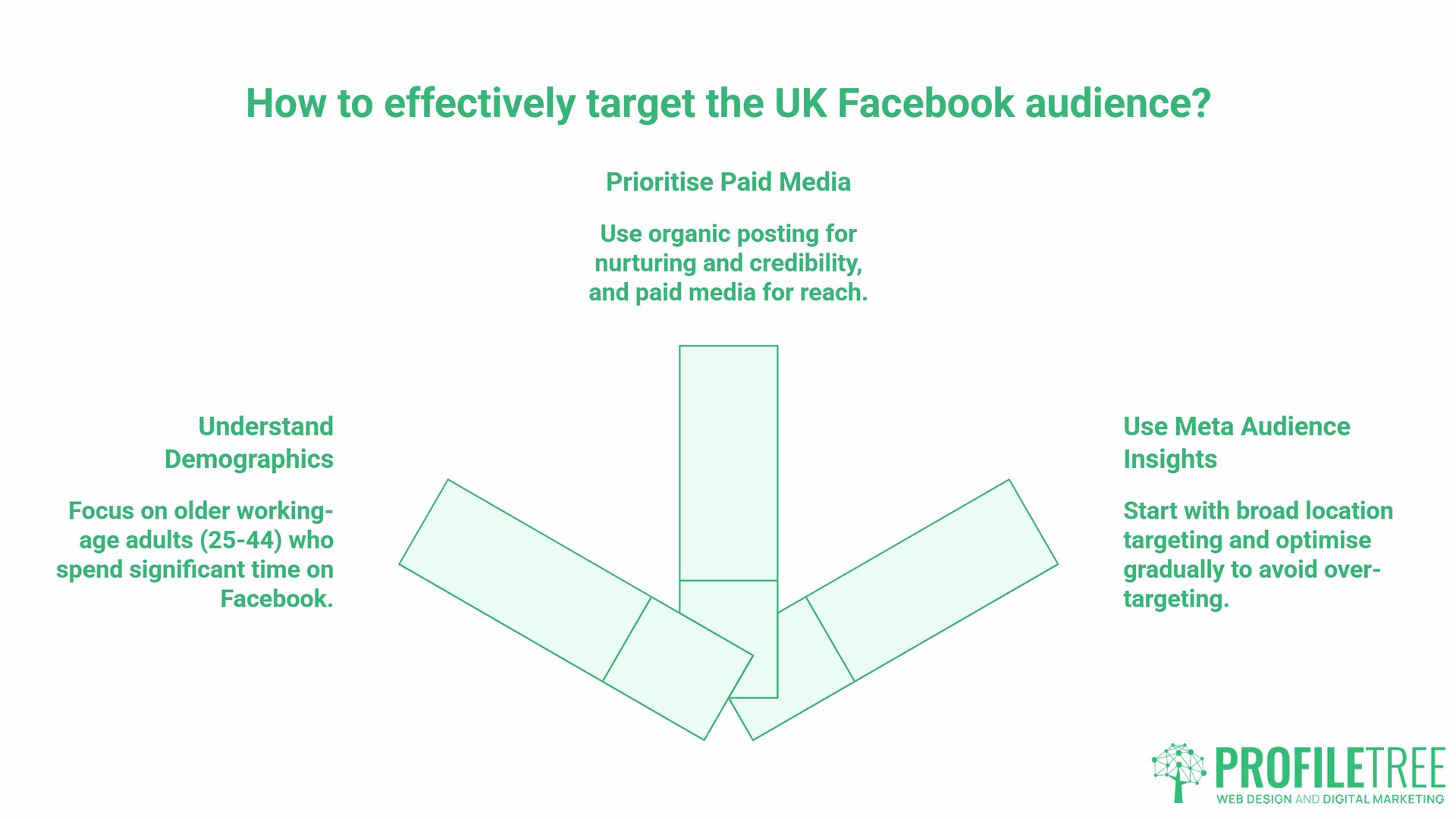
The UK Facebook audience concentrates in the 25-to-44 range, with those two brackets making up the largest share of users. Time spent skews slightly older again, which is what matters commercially: the platform suits businesses targeting homeowners, established professionals and mid-career decision-makers rather than teenagers.
Where Facebook has weakened is in organic content distribution. Average organic reach for business pages now sits well below 2% of followers, with anything above that counting as strong performance. This is not a reason to abandon the platform; it is a reason to stop treating organic posting as a growth strategy and start treating it as a nurturing and credibility tool, with paid media handling reach.
Using Meta Audience Insights for Local Targeting
Meta Audience Insights (accessed through Meta Business Suite) allows you to build a picture of who is engaging with your page and your category more broadly. For Northern Ireland businesses in particular, this tool is worth using carefully: the addressable audience in a specific service area can be small, and over-targeting a narrow audience can inflate your cost per result quickly.
A practical approach is to start with broad location targeting (your county or region) and let Meta’s algorithm optimise delivery before layering in interest or behaviour filters. Over-constraining your audience at the start of a campaign is one of the most common causes of poor performance for local SMEs.
Step 3: Build a Content Mix That Works Without a Full-Time Team
Organic content on Facebook won’t replace paid reach for most businesses. But it does serve a purpose within your wider Facebook marketing strategy: it gives paid audiences something to land on when they check your page before enquiring, and it signals that the business is active and credible.
The 70/20/10 Content Rule for Small Businesses
A workable split for an SME posting two to four times a week:
- 70% value content: Practical tips, answers to common questions, industry updates, behind-the-scenes content, process explainers. Content that earns attention because it is genuinely useful, not because it promotes the business.
- 20% social proof: Customer testimonials, project results, before-and-after work, case studies. Content that builds trust without being a sales pitch.
- 10% direct promotion: Service announcements, offers, direct calls to action. Keep this proportion low; the moment a page tips into mostly promotional content, engagement drops and so does organic visibility.
The goal of organic content is not growth. It is credibility maintenance for the audience that paid campaigns will drive to your page.
Facebook Stories and Reels for Organic Reach
Reels remain the format Facebook’s algorithm actively distributes beyond your existing page audience. A short video (30 to 90 seconds) addressing a question your customers regularly ask, or showing a piece of your work process, has a better chance of organic discovery than a static post or link share.
Stories work differently: they are seen only by people who already follow your page, but they sit at the top of the feed and have high visibility for that existing audience. Use Stories for time-sensitive updates, quick check-ins, and anything that benefits from a raw, unpolished feel.
ProfileTree’s video production and animation services are designed with short-form social content in mind. For businesses that want professional-quality Reels without the time investment of in-house production, commissioning a batch of short videos every quarter is a more efficient approach than producing ad-hoc content week to week.
User-Generated Content and Community Building
Encouraging customers to share their experience with your brand on Facebook is one of the few organic tactics that still gets genuine distribution. A branded hashtag, a specific prompt (“show us your results”), or a simple request to leave a review all provide authentic content that performs better than brand-produced posts because people trust other people.
Facebook Groups offer a different angle again. A well-managed group around a topic related to your business (not a promotional group for your brand) can build a genuinely engaged community. For businesses in the home improvement, fitness, parenting, or professional development sectors, this approach has worked consistently well in UK and Irish markets.
Step 4: Paid Facebook Advertising for UK SMEs
Organic reach alone will not grow a business on Facebook. Paid advertising is the mechanism for reaching new audiences, and for most SMEs, it represents the part of a Facebook marketing strategy that needs the most careful planning.
Moving from Boost Post to Meta Ads Manager
The “Boost Post” button is designed to be simple. It is also the least efficient way to spend Facebook ad budget. Boosted posts go through a simplified version of Meta’s ad system with fewer targeting options, no split testing capability, and no conversion tracking.
Meta Ads Manager gives you access to the full range of campaign objectives (awareness, traffic, leads, conversions), proper audience controls, A/B testing, and detailed reporting. If you are spending more than £200 a month on Facebook advertising, it is worth learning Ads Manager or working with an agency that uses it properly.
Realistic Ad Budgets for UK and Northern Ireland Businesses
The question most guides avoid is what Facebook advertising actually costs in the UK market. Costs vary widely by industry, audience size, and competition, but some general benchmarks apply:
| Campaign Objective | Typical UK Cost Range | Best Suited For |
|---|---|---|
| Local awareness (CPM) | £4 to £12 per 1,000 impressions | Brand building, event promotion |
| Traffic to website (CPC) | £0.40 to £1.80 per click | Content promotion, landing pages |
| Lead generation (CPL) | £8 to £45 per lead | Service enquiries, consultations |
| Conversions (CPA) | £12 to £80+ per conversion | E-commerce, high-ticket services |
For a service business in Northern Ireland or the wider UK starting Facebook advertising for the first time, a testing budget of £300 to £500 per month over 60 to 90 days is enough to gather meaningful data on which audiences and formats are working before scaling spend.
Targeting and Retargeting for Local Service Businesses
Location targeting in Meta Ads Manager can be set by country, region, city, or postcode radius. For businesses serving a specific area, a radius around your base location (or multiple locations if you cover a wider area) is the most efficient starting point.
Retargeting (showing ads to people who have already visited your website or engaged with your page) consistently outperforms cold audience targeting for conversion objectives. A visitor who has already looked at your services page is much more likely to enquire than someone seeing your brand for the first time. Setting up a retargeting audience requires the Meta Pixel or Conversions API on your website, which is covered in the compliance section below.
Ad Formats by Objective
Different formats suit different stages of the customer journey:
| Format | Best For | Notes |
|---|---|---|
| Reels / Video | Awareness, engagement | Highest organic + paid reach in current algorithm |
| Carousel | Showcasing multiple products or services | Works well for before/after, step-by-step |
| Static image | Offers, announcements | Simple to produce; lower engagement than video |
| Lead form | Direct enquiries | Keeps user on Facebook; reduces friction |
| Click-to-website | Traffic to landing pages | Requires a well-optimised landing page to convert |
Step 5: UK-GDPR Compliance and Tracking
This is the section every US-written guide skips, yet it directly affects how legally and effectively you can run your Facebook marketing strategy in the UK and Ireland. UK and Irish businesses operating Facebook advertising face specific legal obligations under the UK GDPR (in Great Britain), the GDPR (in the Republic of Ireland), and the Privacy and Electronic Communications Regulations (PECR), which govern cookie consent.
The Meta Pixel, Consent Mode, and Your Obligations
The Meta Pixel is a piece of tracking code that records what visitors do on your website and sends that data back to Meta for ad targeting and measurement. Under UK-GDPR, you cannot load the Pixel or collect any personal data without valid consent from the user.
This means your website must have a compliant consent banner that gives users a genuine choice, and the Pixel must only fire for users who have actively accepted tracking cookies. A cookie banner that is pre-ticked or that makes it harder to decline than to accept does not meet the standard.
ProfileTree builds consent-compliant websites for SMEs across Northern Ireland, Ireland, and the UK. Getting this right is not just a legal obligation; it also affects the quality of the data your Facebook campaigns can use.
Moving Beyond the Pixel: Conversions API
The Conversions API (CAPI) is Meta’s server-side tracking solution. Instead of relying solely on browser-based Pixel tracking (which is increasingly blocked by iOS privacy settings and browser restrictions), CAPI sends conversion data directly from your server to Meta.
Meta reports meaningfully better attribution and lower cost per result for advertisers running CAPI alongside the Pixel, because server-side events capture conversions the browser misses. Setting it up requires technical access to your website backend or a third-party integration. It is not something to set up without understanding the data flows involved.
What to Do If You Operate in Both Northern Ireland and the Republic of Ireland
Businesses operating across the border need to be aware that, as part of the UK post-Brexit, Northern Ireland follows the UK GDPR. The Republic of Ireland remains under EU GDPR, enforced by the Data Protection Commission. The practical difference for Facebook advertising is minimal, but if your website serves users in both jurisdictions, your consent mechanism needs to be strong enough to satisfy both frameworks.
Step 6: Using AI to Scale Your Facebook Marketing Strategy
Most SMEs do not have the time to produce daily content or run continuous ad testing. AI tools have changed what is achievable with a small team, and integrating them into your Facebook marketing strategy is one of the more practical changes available to businesses in the UK and Ireland right now.
AI for Content Creation and Testing
Generative AI tools can produce draft copy for Facebook posts, ad headlines, and ad descriptions in minutes. The output requires editing and brand voice calibration, but the time saving on first drafts is real. A process that works well for small teams is to produce a month’s worth of post drafts in one session, then spend a separate session editing and scheduling.
For ad copy in particular, AI-generated variations can speed up A/B testing considerably. Instead of running one headline and one description, generate five of each and let Meta’s system optimise toward whichever combination performs best.
ProfileTree’s digital training programme covers AI implementation for marketing teams, including how to build content workflows that use AI tools without losing your brand voice or producing generic copy.
Meta’s Advantage+ Campaigns
Meta has integrated AI at the campaign level through its Advantage+ suite. Advantage+ Shopping campaigns automate audience targeting, creative selection, and budget allocation within parameters you set. For e-commerce businesses in the UK and Ireland, this represents a genuine shift in how campaigns are managed; the algorithm handles optimisation decisions that previously required daily manual intervention.
For service businesses, Advantage+ Audiences (which expands your defined target audience when Meta’s system identifies higher-converting users outside your parameters) is worth testing once you have a baseline of conversion data.
Step 7: In-House vs Agency Management
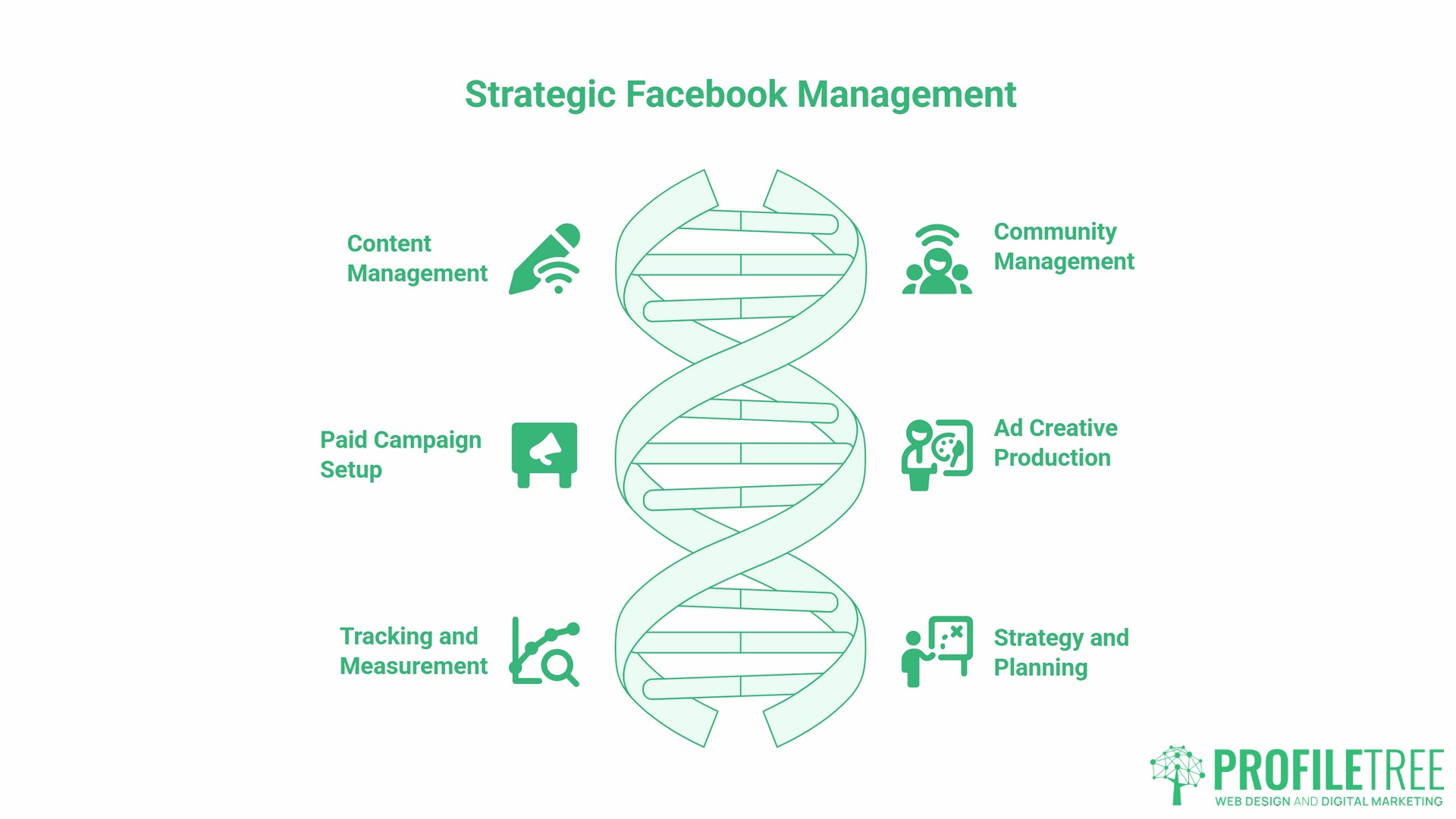
A realistic assessment of what managing a Facebook marketing strategy actually requires helps SMEs decide what to handle internally and what to bring in external support for.
| Task | In-House Viable? | Agency Adds Value? |
|---|---|---|
| Page content and posting | Yes, with a basic process | Only if content quality is a genuine problem |
| Community management | Yes | Rarely needed for most SMEs |
| Paid campaign setup | Possible with training | Yes, especially at higher spend levels |
| Ad creative production | Depends on skills | Yes, for video and high-quality static |
| Tracking and measurement | Difficult without technical knowledge | Yes, particularly for CAPI setup |
| Strategy and planning | Possible, but time-intensive | Yes, especially for businesses without a marketing function |
For businesses spending under £500 per month on ads, managing campaigns in-house after proper training is often the most cost-effective route. ProfileTree’s digital training courses cover Meta Ads Manager specifically for SME owners and marketing managers who want to run their own campaigns competently.
For businesses at higher spend levels, or those without the internal capacity to manage campaigns consistently, working with ProfileTree’s digital marketing strategy team means campaigns are set up correctly from the start, tracked properly, and optimised regularly without the business owner needing to spend time on platform management.
Measuring What Actually Matters
The metrics that matter in a Facebook marketing strategy depend entirely on your objective. Many SMEs track the wrong things because the Facebook interface makes engagement metrics easy to see and conversion metrics harder to access.
Metrics by Objective
- For brand awareness campaigns: Reach, frequency, and cost per 1,000 impressions (CPM). Track whether branded search volume or direct website traffic increases over the campaign period as a secondary indicator.
- For traffic campaigns: Click-through rate (CTR) and cost per click (CPC). Also track on-site behaviour from Facebook traffic using Google Analytics or equivalent: bounce rate and session duration tell you whether the people clicking are the right people.
- For lead generation campaigns: Cost per lead (CPL) and lead quality. Facebook lead form submissions are easy to track in Ads Manager. Conversion to actual sales calls or proposals is harder but more important: a low-cost lead that never converts is worse than a higher-cost lead from a better-qualified audience.
- For conversion campaigns: Cost per acquisition (CPA) and return on ad spend (ROAS). These require proper Pixel or CAPI tracking to measure accurately.
The most important discipline is checking these metrics weekly and being willing to turn off what is not working within the first 7 to 14 days. Many SMEs leave underperforming campaigns running because they assume results take longer to materialise. For most campaign types, if the trajectory is not positive after two weeks and £150 to £200 in spend, the creative or audience needs to change.
Integrating Facebook Data with Your Wider Analytics
Facebook’s analytics exist in a silo unless you connect them to your broader data. UTM parameters on all links (available in Meta Ads Manager under URL parameters) allow Google Analytics or equivalent to attribute website sessions, goals, and revenue back to specific Facebook campaigns and ad sets.
For businesses working on a full digital marketing strategy, ProfileTree’s approach integrates Facebook data with Google Analytics, Search Console, and any CRM the business uses, giving a single view of which channels and campaigns are driving actual revenue rather than platform-specific vanity metrics.
Your 30-Day Facebook Marketing Strategy Implementation Plan
A simple starting point for an SME that wants to move from no structured approach to a working one:
- Week 1: Audit your current page. Update the About section, cover image, and CTA button. Install or verify the Meta Pixel (with a compliant consent mechanism in place). Define your primary commercial objective and the single metric you will use to measure it.
- Week 2: Build your content calendar for the next 30 days. Draft post copy for two to three pieces of value content and one piece of social proof. Set up Meta Business Suite scheduling. Identify which existing content on your website is best suited to drive Facebook traffic.
- Week 3: Set up your first paid campaign in Meta Ads Manager. Start with a lead generation or traffic objective, depending on your goal. Set a daily budget of £10 to £15. Define your location targeting and one audience. Use three to four creative variations to test what resonates.
- Week 4: Review performance. What is your cost per click or cost per lead? Which creative is performing best? What does the traffic from Facebook do on your website? Use this data to decide whether to continue, adjust, or pause the campaign. Refine your organic content approach based on which posts got genuine engagement.
Frequently Asked Questions
Is Facebook marketing still worth it for UK small businesses?
Yes, but the approach has changed. Organic reach from business pages is low, so a Facebook marketing strategy that relies on free posting to grow an audience will not deliver meaningful results. The platform works well for SMEs that combine a small amount of consistent organic content with targeted paid advertising, even on a modest budget of £300 to £500 per month. The reach and targeting capability are still strong; the question is whether your approach is built around that reality.
How much should a small business spend on Facebook ads per month?
For a UK or Northern Ireland business new to Facebook advertising, £300 to £500 per month is a reasonable testing budget. This provides enough data to identify what is working before committing to higher spend. Most SMEs who see consistent results are spending between £500 and £2,000 per month on ads, depending on their sector and the competitiveness of their audience. Spending below £200 per month makes it difficult for Meta’s algorithm to optimise effectively.
What is the difference between a Facebook Page and Meta Business Suite?
Your Facebook Page is the public-facing profile where you post content and interact with followers. Meta Business Suite is the administrative platform where you manage your page, run ads, review analytics, and set up business assets like the Pixel and product catalogue. All paid advertising is managed through Business Suite (specifically Meta Ads Manager within it). You need a Business Suite account to run any paid activity, access detailed analytics, or set up tracking.
How do I comply with UK-GDPR when using the Meta Pixel?
You must obtain valid, active consent from website visitors before loading the Meta Pixel. This requires a compliant consent management platform (CMP) or cookie consent tool that genuinely allows users to decline tracking. The Pixel should only fire for users who have actively accepted tracking cookies. Pre-ticked boxes and misleading consent flows do not meet the legal standard. For businesses in the Republic of Ireland, the same applies under EU GDPR, enforced by the Data Protection Commission.
What is the best time to post on Facebook for a UK audience?
The honest answer is that optimal posting times matter less than content quality. Meta’s algorithm distributes content based on engagement signals, not the time of posting, so a strong piece of content published at noon on a Tuesday will outperform a weak piece published at the algorithm’s supposed “peak time.” That said, reviewing your page’s own Insights data (under Meta Business Suite) will show you when your specific audience is most active, which is a better guide than generic industry averages.
Can I run a Facebook marketing strategy without an existing following?
Yes. Paid advertising on Facebook does not require an existing audience; you can reach people who have never encountered your brand before through targeted campaigns. A business page with no followers can run effective lead generation campaigns from day one. Building an organic following takes time, but it should not be a prerequisite for starting paid activity if you have a clear offer and a defined target audience.