
Conversational Marketing Statistics: A UK SME Guide
Table of Contents
Most articles on conversational marketing statistics recycle the same vendor figures, dress them up with superlatives, and stop well short of explaining what any of it means in practice. This guide takes a different approach. It works through the key data by business outcome, flags where the numbers come from and their limitations, and sets out a realistic framework for SMEs in the UK and Ireland who want to move from reading about this to actually doing it.
The statistics are real. The compliance risks are real. And the gap between a chatbot that generates leads and one that frustrates visitors comes down to decisions most guides never address.
What Is Conversational Marketing?
Conversational marketing sits at the intersection of technology, content, and customer experience. Before working through the statistics, it is worth being precise about what the term actually covers, because vendors use it loosely, which creates unrealistic expectations.
The definition behind the data
Conversational marketing is a strategy that uses real-time, two-way communication to move customers through the buying process faster than traditional lead generation methods allow. Instead of asking a website visitor to complete a form and wait for a callback, a conversational approach engages them immediately, qualifies their interest, and routes them to the right information or the right person.
The tools vary: AI-powered chatbots, live chat staffed by a human team, WhatsApp Business integrations, and in-app messaging. The strategy does not depend on any single tool. It depends on matching the right communication channel to the customer journey stage.
Why statistics-based articles on this topic often mislead
Most conversational marketing statistics circulate from vendor research, where Drift, HubSpot, and Intercom publish findings based on their own platforms and customer bases. This creates survivorship bias: the businesses surveyed are already committed adopters, so the data reflects outcomes for that group rather than for average SMEs implementing these tools for the first time.
That does not make the data useless. It means you need to read it in context. The sections below flag the source behind each key figure so you can judge its relevance to your own situation.
Customer Engagement Statistics
Engagement figures are the most cited in conversational marketing content, and they are also the most context-dependent. The headline numbers tell part of the story; the channel preferences and industry variations underneath them tell the rest.
What the numbers say about how people want to communicate
A 2023 Zendesk Customer Experience Trends Report found that 54% of customers prefer contacting a business via messaging apps rather than by phone or email. A Twilio State of Customer Engagement Report found that nearly 9 in 10 consumers expect to reach businesses through messaging platforms.
These figures appear consistently across conversational marketing content and are worth taking seriously, though the important qualifier is that customer preferences vary significantly by industry, age group, and purchase type. A Belfast solicitor’s firm will see different channel preferences from its clients than a Dublin e-commerce retailer.
What the data does confirm is a directional shift. Asynchronous communication, the model where a customer emails or fills in a form and waits for a reply, is losing ground to synchronous or near-synchronous interaction. For businesses whose websites currently offer nothing more than a contact form, that gap represents a measurable loss of leads to competitors who are more responsive.
“The businesses we work with in Northern Ireland consistently tell us that the biggest barrier to digital enquiries isn’t traffic; it’s the gap between someone arriving on a website and getting a response,” says Ciaran Connolly, founder of ProfileTree. “Conversational tools close that gap, but only if the website is built to support them.”
What this means for SMEs
A business that adds live chat or a chatbot without reviewing its page structure, load speed, or conversation design is unlikely to achieve the engagement rates cited in vendor reports. The website must be ready to handle user interaction. ProfileTree’s work in web design for SMEs across Northern Ireland and Ireland consistently shows that the technical foundation matters as much as the tool choice.
Lead Generation Statistics
Of all the business outcomes linked to conversational marketing, lead generation is where the data is most actionable. The core finding is not about which tool to use; it is about response speed, and most SMEs are losing leads at exactly this point.
Response time is where most SMEs lose enquiries
Research from HubSpot found that 90% of customers rate an immediate response as important or very important when they have a sales or marketing question. Separate research from the Harvard Business Review found that responding to a lead within an hour of their initial enquiry makes a business 7 times more likely to have a meaningful conversation with that lead than waiting 2 hours or more.
A Drift study found that over 50% of businesses using conversational marketing tools reported increased sales productivity, attributing the improvement largely to lead pre-qualification: chatbots filtering out low-intent enquiries before they reach the sales team.
For most SMEs, the bottleneck is not traffic or even interest. It is response time. A small business without a 24/7 team cannot personally answer every chat message as soon as it arrives. This is where automation handles the first layer of qualification, asking a few targeted questions to separate a serious enquiry from a casual browse, and either routing the lead immediately or creating a clear brief for the human follow-up.
Chatbot adoption and lead qualification
The practical value for an SME is not the chatbot itself, but the conversation design behind it. A chatbot that asks the right three questions can qualify leads, segment them by service type, and deliver a more useful enquiry to the sales team than a generic contact form ever will.
ProfileTree’s AI implementation work with SMEs regularly involves this kind of conversation design: mapping the questions a good salesperson would ask in the first two minutes of a call, then building that logic into an automated first-touch workflow that operates around the clock.
Conversational Marketing and GDPR: What UK Businesses Need to Know
This is the section that most conversational marketing guides skip entirely. US-based vendors writing for a global audience have no particular reason to address UK and Irish compliance requirements, which means businesses here often deploy these tools without understanding the legal obligations that come with them.
The compliance layer that most guides ignore
The UK GDPR and the Privacy and Electronic Communications Regulations (PECR) both have direct implications for how chatbots collect and process personal data. There are three areas that matter most.
Cookie consent for tracking bots is the first. Many chatbot platforms use cookies to track returning visitors and personalise conversations. Under PECR, non-essential cookies require prior consent. If your chatbot drops a tracking cookie before the visitor has accepted your cookie banner, you are in breach. The ICO has issued guidance specifically on this point.
Data processing transparency is the second. If a chatbot collects a visitor’s name, email address, or phone number during a conversation, your privacy notice must disclose this, explain the lawful basis for processing, and state how long the data is retained. Most chatbot conversation transcripts are stored on the vendor’s servers, often outside the UK, so your data processing agreement with the vendor needs to cover international transfers.
WhatsApp Business and GDPR are the third. Sending marketing messages via WhatsApp requires explicit opt-in consent. Using it solely for service conversations, responding to an enquiry a customer initiated, sits on considerably firmer legal ground.
Building compliance from the start
None of this makes conversational marketing off-limits for UK or Irish businesses. It means the compliance layer has to be designed in from the start, not retrofitted after the chatbot is already live. The ethics and legalities of digital marketing cover a wider set of considerations that are increasingly relevant to SMEs as ICO enforcement activity increases.
Why Traditional Lead Generation Is Losing Ground
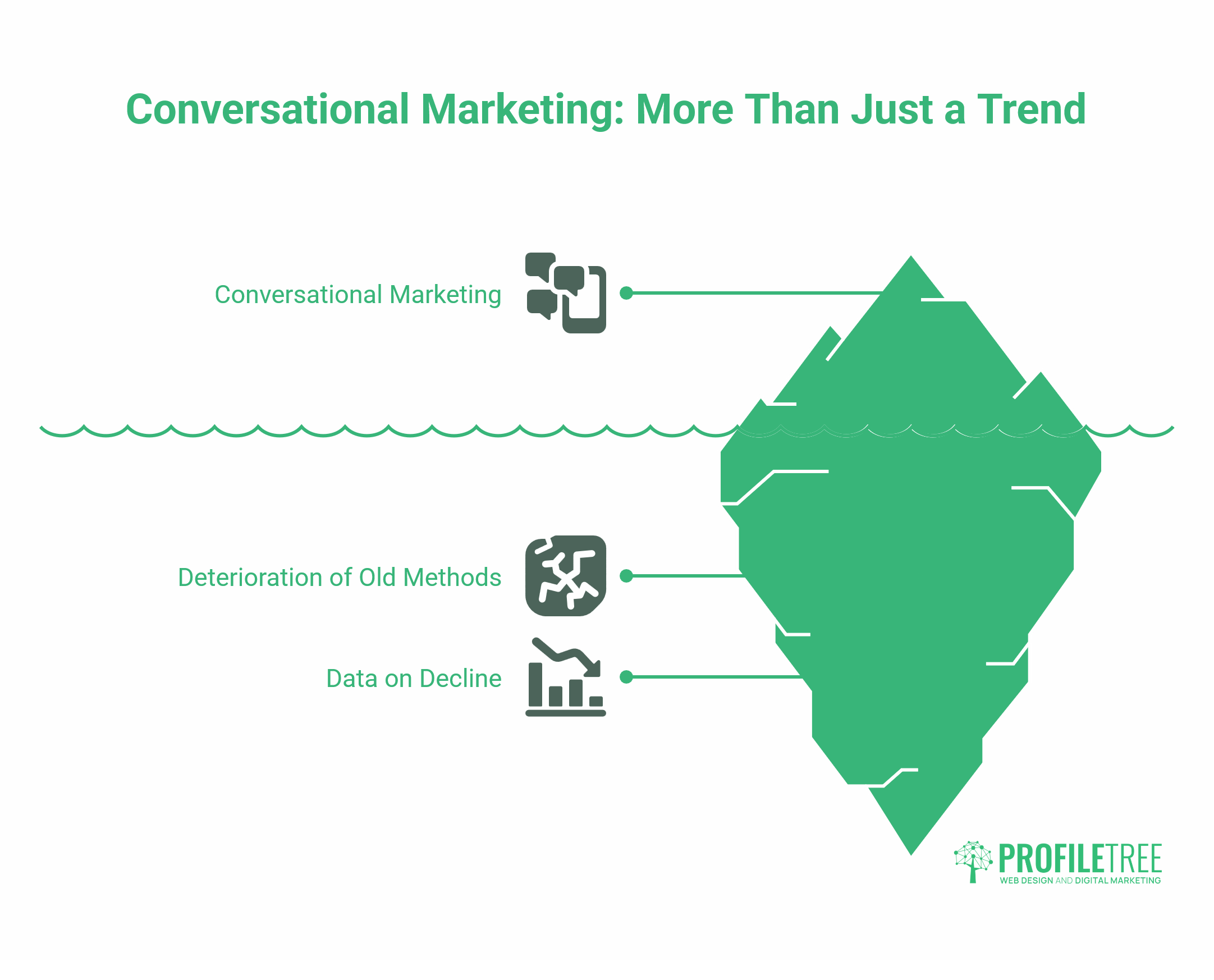
The shift toward conversational marketing is not happening in isolation. It is a response to a genuine deterioration in the performance of older lead generation methods, and the data on that decline is worth understanding before investing in any new tool.
The problem with forms and delayed follow-up
Traditional lead generation relies on a friction-heavy process: a visitor finds your website, locates the contact form, fills it in, submits it, and then waits. The average response time for a web lead in the UK is measured in hours, sometimes days. By the time a sales team picks up the enquiry, the visitor has often already contacted three other businesses.
The Harvard Business Review response time research cited above quantifies this precisely. The seven-times conversion advantage for businesses that respond within the first hour is not a marginal improvement; it fundamentally changes the commercial outcome of the same traffic volume.
What conversational marketing replaces and what it does not
Conversational marketing does not replace all of your lead generation. It adds a faster, lower-friction channel that captures intent while it is active. A contact form still has value for complex enquiries that require detail. Email marketing still has value for nurturing leads over the long term. The digital marketing strategy framework that works best treats conversational tools as one layer in a broader system, not as a wholesale replacement for everything that came before.
The Hybrid Model: When AI Hands Off to a Human
The most consistently high-converting conversational marketing setups are not fully automated. This is the finding that vendor guides tend to gloss over, because it complicates their pitch for full automation. The data and practical experience both point in the same direction: automation handles volume, but humans close deals.
What the research shows about human intervention
Independent research across conversational marketing implementations consistently finds that the handoff point, where a chatbot passes an active conversation to a human agent, produces the highest conversion rates in the entire process. The chatbot’s role is qualification and context-gathering. The human’s role is judgment, relationship, and closeness.
This matters particularly for high-value B2B scenarios. A Belfast accountancy firm, a Derry solicitor’s practice, a Dublin financial adviser: these are businesses where the value of a single client relationship justifies personal attention, and where a poorly handled handoff can destroy a lead that the chatbot worked to qualify. The handoff moment is not a technical problem; it is a content and training problem.
Designing the handoff effectively
Effective hybrid models require three things to work. First, the chatbot needs to gather enough context that the human agent can step in without asking the customer to repeat themselves. Second, the human needs to receive that context in a format they can act on immediately. Third, the transition has to feel seamless to the customer, which means consistent tone and no gap in response time.
ProfileTree’s digital training programmes for Northern Ireland SMEs address exactly this kind of implementation challenge: the technical setup is relatively straightforward, but training staff to manage live chat handoffs, maintain brand voice under pressure, and use conversation data to improve content is where most businesses underinvest.
Conversational Marketing vs Traditional Inbound Marketing
These two approaches are often positioned as competing philosophies, but the more useful frame is complementary layers. Understanding where one outperforms the other helps you allocate resources accurately rather than treating every conversation as a reason to abandon your existing content strategy.
A direct comparison
| Factor | Traditional Inbound | Conversational Marketing |
|---|---|---|
| Response speed | Hours to days | Seconds to minutes |
| Lead qualification | Form data only | Dynamic, question-based |
| Personalisation | Segment-level | Individual conversation |
| Staffing requirement | Low | Medium (hybrid model) |
| GDPR complexity | Low to medium | Medium to high |
| Best for | Long sales cycles, research-phase buyers | High-intent, time-sensitive enquiries |
| Content dependency | High | Medium |
Where each approach earns its place
Inbound marketing, built on content that answers the questions your customers are searching for, remains the most scalable way to generate awareness and top-of-funnel traffic. Conversational marketing converts that traffic more effectively once it arrives. The content marketing work that ProfileTree delivers for clients across Northern Ireland and the UK is designed with this relationship in mind: content builds the audience, conversation converts it.
Conversion and ROI Statistics
ROI figures for conversational marketing are the most frequently cited yet misrepresented. The headline numbers come almost entirely from vendor research and from businesses that have already invested significantly in implementation. Read them as directional indicators, not as guarantees.
What the data says about commercial outcomes
Drift’s State of Conversational Marketing report found that companies using conversational marketing reported a 10% average revenue increase over a 12-month period. Intercom research found that live chat produces a 48% increase in revenue per chat hour compared to phone-based sales conversations, primarily because agents can handle multiple simultaneous conversations. A separate Aberdeen Group study found that businesses using live chat experienced a 44% average increase in web conversions.
All of these figures aggregate across very different business types, traffic volumes, and implementation quality. A poorly designed chatbot on a slow website will not approach these outcomes. The data reflects the ceiling for well-implemented setups, not the average for first-time adopters.
Where the real ROI sits
The most reliable ROI case for conversational marketing is not revenue uplift but cost reduction: fewer phone calls for routine queries, faster lead qualification, and shorter sales cycles for chat-originated leads compared to form-originated ones. For a small business, those operational savings can justify the investment before any measurable revenue improvement.
ProfileTree’s cost-benefit analysis framework for AI implementation in SMEs applies the same logic: start with what you can measure operationally, then build toward revenue impact as the data matures.
Conversational Marketing and SEO
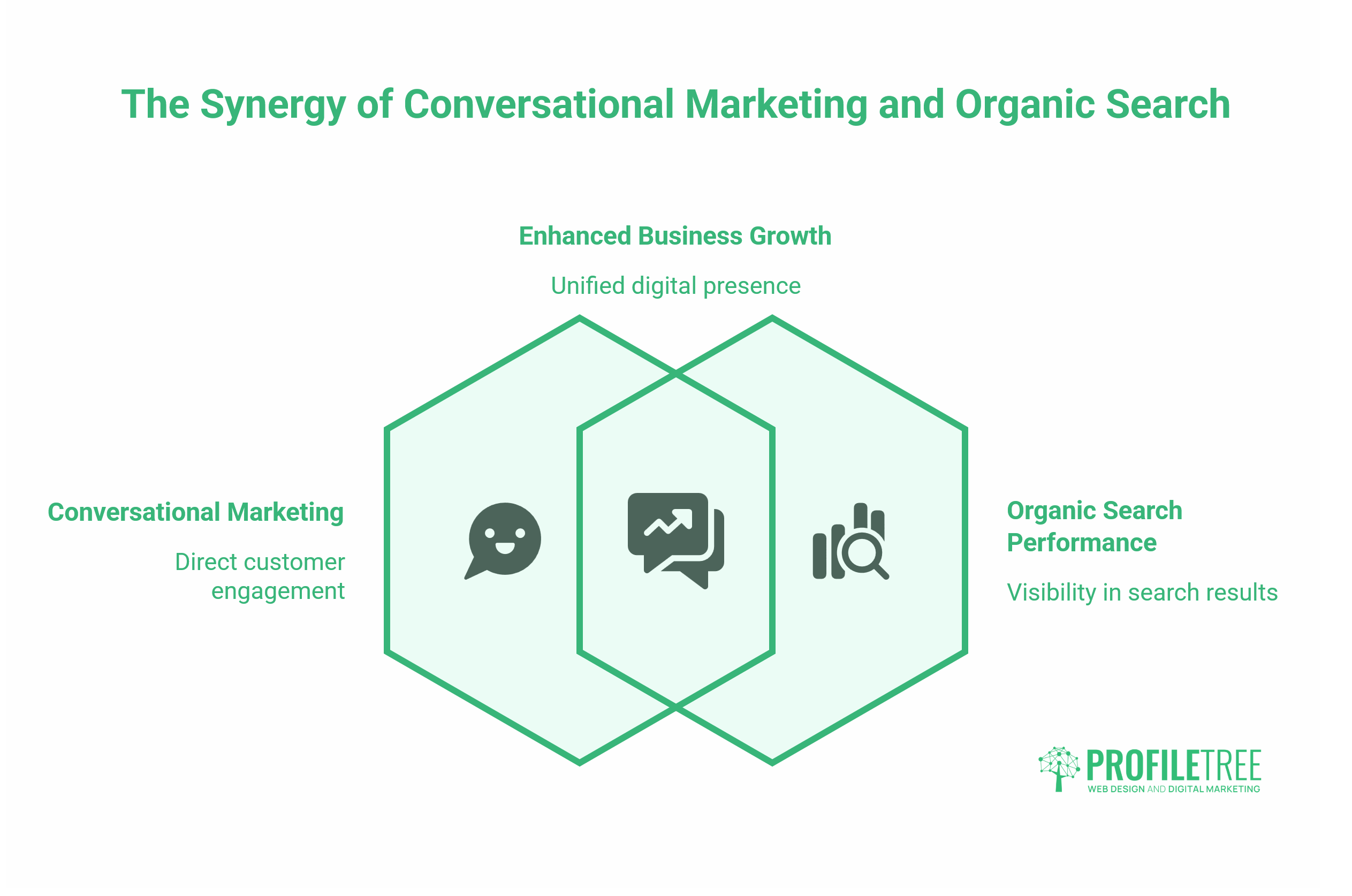
The relationship between conversational marketing and organic search performance is one of the least-discussed aspects of the topic, yet it has direct implications for any business that cares about both. There are two connections that matter.
How chat data improves your content
Chat transcripts are a source of genuine search intent, phrased in the customer’s own language. The questions visitors ask via live chat or chatbot conversations are often the same ones they type into Google. Businesses that review their chat transcripts regularly and turn recurring questions into FAQ content, service page additions, or standalone blog posts are building content that matches real search behaviour rather than guessing at it.
This is a practical advantage that requires no additional tools beyond what you already have if you are running any conversational marketing tool. The data is there in the transcript log.
How chatbots can damage your rankings
Most chatbot widgets load as third-party JavaScript, which adds to page weight and can delay time-to-interactive. A chatbot script that adds half a second to page load is not just a user experience problem; it is a Core Web Vitals problem that affects your Google rankings. The fix, asynchronous loading where the chatbot script loads after the main page content, reduces the performance impact significantly but requires a developer to implement correctly.
Check your Core Web Vitals in Google Search Console before and after installing any chat tool. If your scores decline, the chatbot loading method is the first place to investigate. ProfileTree’s web development team routinely addresses this during website builds and audits for clients across Northern Ireland and Ireland.
Key Conversational Marketing Statistics: Summary
For quick reference, the table below consolidates the key figures referenced throughout this guide, along with their sources.
| Outcome | Statistic | Source |
|---|---|---|
| Customer preference for messaging | 54% prefer messaging apps over phone/email | Zendesk, 2023 |
| Expectation of messaging access | ~90% of consumers expect messaging options | Twilio |
| Importance of instant response | 90% rate immediate response as important | HubSpot/Salesforce |
| Lead response speed advantage | 7x more likely to convert within the first hour | Harvard Business Review |
| Revenue increase (adopters) | 10% average revenue increase over 12 months | Drift |
| Conversion rate increase | 44% average increase in web conversions | Aberdeen Group |
| Sales productivity increase | 50%+ of businesses using tools report gains | Drift |
Building a Conversational Marketing Strategy: A Framework for SMEs
A strategy framework is only useful if it accounts for the constraints SMEs actually face: limited staff, variable opening hours, tight budgets, and compliance obligations that enterprise-focused vendor guides ignore. The steps below are ordered to reflect how implementation actually works rather than how it looks in a vendor deck.
Step one: Audit your current customer journey
Before selecting any tool, map the current customer journey on your website. Where are visitors dropping off? Where are they spending time without converting? What questions does your sales team get asked most often in the first call? This audit determines whether you need a chatbot, live chat, WhatsApp, or some combination, and where on the site it should sit.
Step two: Design the conversation flows first
Write out the first five to ten exchanges a chatbot needs to handle before you touch any platform settings. What should it ask? What answers trigger which responses? What falls outside its scope and requires a human? This is content work before it is technical work, and the quality of the conversation design determines whether the tool generates leads or frustrates visitors.
Step three: Address compliance before launch
Update your privacy notice to include the chatbot as a data collection mechanism. Review your cookie consent configuration to confirm the chatbot does not fire before consent is given. Confirm your data processing agreement with the vendor covers UK GDPR requirements, including data storage location and retention periods.
Step four: Integrate with your CRM
A conversational marketing tool that captures contact details but does not push them into your CRM creates manual work and risks missed leads. The integration between the chat platform and CRM is the operational backbone of the whole setup. ProfileTree’s AI implementation guidance for SMEs covers this kind of systems integration in practical terms, including the common failure points.
Step five: Train the team handling handoffs
Staff managing live chat handoffs need to understand the context that the chatbot has already gathered. They need to know what the bot has asked, what the visitor has said, and what they are stepping into. Without this briefing, the handoff creates the exact friction that conversational marketing is supposed to remove.
Step six: Measure what matters
The metrics worth tracking are conversation start rate (the percentage of visitors who engage with the tool), qualification rate (the percentage of conversations that produce a usable lead), and sales cycle length for chat-originated leads compared to form-originated leads. Review chat transcripts monthly and use them to refine both the conversation flows and the website content.
Conclusion
Conversational marketing statistics confirm what most SMEs already suspect: faster responses on the right channels convert more of the traffic you already have. The tools are accessible, but the compliance obligations are real, and the quality of your conversation design matters more than the platform you choose.
ProfileTree works with businesses across Northern Ireland, Ireland, and the UK on web foundations, content, and AI implementation that enable conversational marketing to perform in practice. Speak with our team to discuss a realistic setup for your business.
FAQs
What is the difference between a chatbot and conversational marketing?
A chatbot is a single tool; conversational marketing is the broader strategy. You can run conversational marketing through live chat or WhatsApp alone, and you can deploy a chatbot with no coherent strategy behind it at all. The tool is only as effective as the thinking that shapes it.
Does conversational marketing comply with GDPR in the UK?
Yes, if it is designed correctly from the start. Chatbots must not fire tracking cookies before visitor consent is given, personal data collected in conversation must be disclosed in your privacy notice, and your data processing agreement with the vendor must cover UK GDPR requirements, including data storage location.
What are the 4 Cs of conversational marketing?
Connection, Context, Care, and Convenience. Reach customers on their preferred channels, use prior interaction data to personalise the exchange, prioritise their question over your sales agenda, and remove friction from the enquiry process.