
TV and Online Advert Production in Northern Ireland
Table of Contents
Producing a TV or online advert for a Northern Ireland business follows four stages: an approved script, a planned shoot, an edit cut to each format’s length and, for television, clearance by Clearcast before a UK commercial channel will broadcast it. ProfileTree plans, films and delivers the finished advert, and you or your media buyer book the airtime.
This page deals with adverts specifically, meaning the short spots that run between programmes, before YouTube videos or in a social feed. Company films, interviews and event coverage are covered on our video production Belfast page, and the planning that decides where video earns its place in your marketing sits with our video marketing strategy service.
TV, video on demand and online adverts are built to different rules
The format shapes the script before anyone picks up a camera. A television advert has a fixed length agreed with the broadcaster and is written to work with the sound on, while an advert in a social feed may be watched silently on a phone and has to make sense within the first second or two. YouTube sits between the two. On a skippable in-stream advert the viewer can skip after five seconds, and a bumper advert runs for six seconds at most with no option to skip, according to Google’s own guide to YouTube video ad formats, so on YouTube the brand and the main idea belong at the very start.
Viewers in Northern Ireland see national and regional commercial television, including UTV, which is ITV’s service here, alongside the broadcasters’ streaming apps. Adverts on those apps, known as broadcaster video on demand, are checked in the same way as linear television, which means a television advert and its streaming version can usually be produced and cleared together. The table below compares the main formats a Northern Ireland business is likely to commission.
| Format | Where it runs | Length and shape | Checks before it runs | Recommendation |
|---|---|---|---|---|
| Linear TV | UTV, Channel 4, Sky and other commercial channels | Length agreed with the broadcaster’s sales team; 16:9 widescreen, with sound | Clearcast script and final clearance against the BCAP Code | Choose it for broad regional reach when the schedule allows time for clearance |
| Broadcaster video on demand | The broadcasters’ streaming apps | Usually the TV master or a shorter cut | Clearcast approval, which the broadcasters require | Produce it alongside the TV version from the same shoot |
| YouTube in-stream | Before, during or after YouTube videos | Skippable after five seconds; bumpers of six seconds or less | Google’s advertising policies and the CAP Code | Put the brand and the main message inside the first five seconds |
| Social feed | Instagram, Facebook, TikTok and LinkedIn | Vertical or square, subtitled for silent viewing | Each platform’s advertising policies and the CAP Code | Cut it from the main shoot rather than filming separately |
Every TV advert is cleared by Clearcast before it airs
Clearcast checks adverts for the channels owned by ITV, Channel 4 and Sky and for their video on demand apps, testing each one against the UK Code of Broadcast Advertising, known as the BCAP Code. The Clearcast clearance process runs in three stages, starting with the written script and moving on to the filmed advert, its technical settings and the evidence behind any claim it makes. Standard clearance carries no charge when the advert will air on one of Clearcast’s shareholder channels.
The script stage is where most delays are avoided. A price, a saving or a comparison with another product needs evidence Clearcast can check, and a script approved before the shoot is far less likely to lead to a reshoot or a costly re-edit later. Clearcast’s help pages suggest allowing two to three weeks for clearance and say that the longer you allow, the better, so we build that window into the schedule from the first meeting. Clearcast can also attach scheduling restrictions, for example keeping an advert away from children’s programmes, and the broadcaster then decides how to apply them.
Online adverts are not pre-cleared in the same way, although the rules still apply. Non-broadcast advertising in the UK falls under the CAP Code, which the Advertising Standards Authority enforces, and each platform runs its own review before it approves an advert. Writing the online versions from the same approved script keeps the claims consistent between television and the web, and it saves a second round of legal checks on wording that has already been tested.
An advert moves through four stages from brief to delivery
Each stage has its own decisions, and most of the cost and most of the risk are settled in the first two. The sequence below is the one we follow on advert work.
- We agree the single message, the audience and where the advert will run, then write a script and shot list for each length; for television, the script goes to Clearcast at this point.
- Pre-production confirms casting, locations, permissions, crew and the shooting schedule, along with usage terms for everyone who appears on screen and for any music.
- On the shoot day we capture the widescreen master, close product detail and vertical framing together, so the social versions do not need a second day of filming.
- Post-production covers the edit, colour grade, sound mix, graphics and subtitles, followed by the final Clearcast submission for television and export to each platform’s technical specification.
Ciaran Connolly, founder of ProfileTree, puts it this way: “The money you save on a video is almost always saved in pre-production, not on the shoot day. A clear brief and a tight plan are what keep costs predictable.” Our guide to how a video production runs from script to screen covers each stage in more depth for readers planning their first project.
Filming an advert on location in Northern Ireland takes early planning
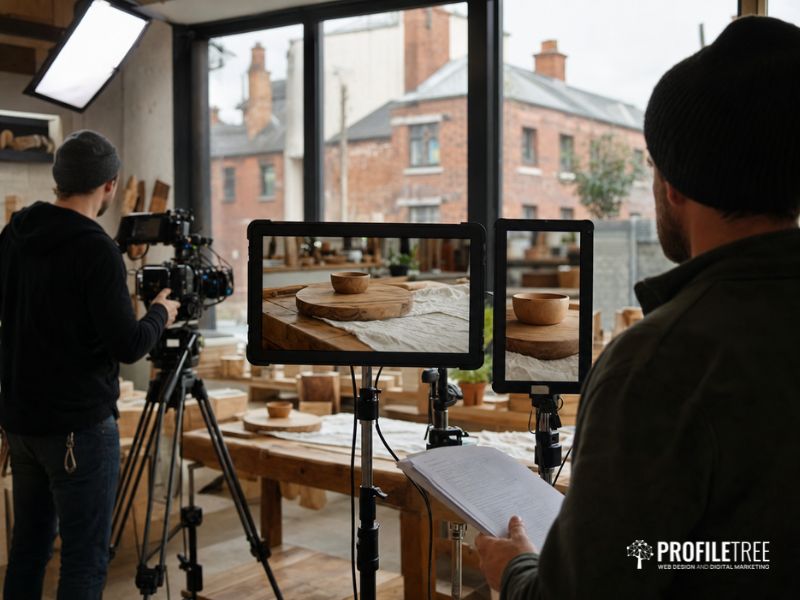
Location permissions are the most common reason a shoot date moves, and the process varies across Northern Ireland. Northern Ireland Screen publishes a code of practice for filming agreed with all eleven district councils, and it covers commercial filming as well as film and television drama. A shoot that needs a road closed or traffic held is applied for through the relevant authority, which for most public roads is the district council, and the code asks for at least twelve weeks’ notice with a full traffic management plan.
Some places have their own owners and their own rules. Roads around Belfast Harbour and the Titanic Quarter are not public roads, so filming requests there go to Belfast Harbour Police rather than to the council, and sites such as universities and airports run separate permission processes with their own notice periods and insurance requirements. Aerial shots need a drone pilot who holds the Civil Aviation Authority qualification the location and flight require, and our guide to drone filming for business explains what that involves in practice.
Northern Ireland’s weather changes quickly, and an advert has less room for compromise than a company film because every frame is paid for on air. We recommend holding a weather day in the schedule for any outdoor shoot and agreeing an indoor alternative wherever the script allows one.
Versions and usage rights drive most of an advert’s cost
There is no fixed price for an advert, because two briefs with the same running time can need very different crews, casts and licences. We quote against your script once the formats and the planned run are known, and the factors below explain most of the difference between one quote and another.
The number of versions is the first factor. Each extra length or aspect ratio adds edit and grading time, although capturing all of them in one planned shoot costs far less than returning for a second day. Usage rights come next and are the factor buyers most often overlook. Actors and presenters are paid for the media, territory and period in which the advert runs, so a year of UK television costs more in fees than a short organic social run, and music licences follow the same logic. Clearcast reports the music used in TV adverts to PRS so that writers are paid, which is one more reason the licence has to match how the advert will actually be used.
Locations, crew size and the number of filming days make up the rest of most quotes. Motion graphics add design time, and some briefs suit animated adverts better than live action, particularly where the product is a service or a process that cannot be filmed easily. Our guide to budgeting for a video project sets out how to plan these costs before you ask for a quote.
One shoot should supply every version of the advert
A well-planned shoot can supply a broadcast master, shorter TV cut-downs, YouTube versions with the brand inside the first five seconds and vertical edits for social feeds. Planning the framing on the day, rather than cropping later, keeps faces and products in shot when a widescreen frame becomes a vertical one.
Subtitles belong in every online version, because social platforms commonly start video playing without sound, and Clearcast offers subtitling and audio description for broadcast versions. The same footage also has a life beyond paid placement. A longer version on your website and YouTube channel, properly titled, described and transcribed, can keep earning organic views after the campaign ends, and our guide to video SEO explains how. If your own team will publish the social cuts, our digital training can show them how to caption, schedule and measure them.
ProfileTree produces the advert and your media buyer places it
Our role covers the creative work from brief to final files: the script, the shoot, the edit, preparation for Clearcast clearance and delivery in every format the campaign needs. We do not buy airtime, manage advertising budgets or run paid social campaigns, so the media plan sits with you, the broadcaster’s sales team or a media agency, and we supply the finished files to the specification they give us.
Many businesses commission the advert and then use the same footage in organic channels, such as a YouTube channel, website video and regular social content that needs no paid placement. Our page on corporate films for Belfast companies sets out the other kinds of film we make, from brand films to recruitment and training videos.
FAQs
How long does it take to produce a TV advert?
Clearance and locations set most of the timeline, while the shoot itself is often a single day. Clearcast’s help pages suggest allowing two to three weeks for clearance, and a shoot that needs a road closure requires at least twelve weeks’ notice under Northern Ireland Screen’s code of practice, while online-only adverts usually move faster because there is no broadcast pre-clearance.
Do online adverts need Clearcast clearance?
No, unless the advert also runs on a broadcaster’s TV channel or video on demand app. Online adverts must still follow the CAP Code, which the Advertising Standards Authority enforces, and each platform reviews an advert before it runs.
Can one shoot produce both the TV advert and the social versions?
Yes, if the shoot is planned for every format from the start. Each shot is framed to work in widescreen and vertical, and short moments are captured for the six second and fifteen second cuts, which costs far less than a second day of filming.
Who owns the advert and the footage once it is finished?
The production agreement sets ownership, but actors and music are usually licensed for a set media, territory and period. Using the advert beyond that may need a further payment, so state where and for how long it will run when you ask for a quote, and check unusual terms with your own adviser.
Can you film an advert outside Belfast?
We film on location across Northern Ireland from our base at the McSweeney Centre in Belfast. Locations outside the city need permission from the landowner or the district council, and rural or coastal shoots need extra allowance for travel time and weather cover.
How do we start an advert project with ProfileTree?
Send us the air date, the single message the advert has to carry and where you expect it to run. To arrange a call with the production team, phone 028 9568 0364 or email agency@profiletree.com, and we will agree the formats before preparing a quote and a schedule.