
Instagram Stories for Business: A UK Marketing Guide
Table of Contents
Most businesses post to their Instagram feed, watch the likes trickle in, and wonder why the enquiries never follow. The answer is usually one tap up in the app, in Stories. The full-screen photos and clips that vanish after 24 hours are where your existing followers actually pay attention day to day, and where casual interest turns into a real conversation.
The problem is that most Instagram Stories best practices you find online are written for US influencers chasing follower counts, not for a small business trying to win local customers. This guide takes a different angle on Instagram Stories best practices. ProfileTree, a Belfast-based digital agency, sees the same pattern across clients in Northern Ireland, Ireland and the UK: strong feed content, a quiet inbox, and a Stories tab left half-used. What follows covers the specs, the ranking signals, the ideas and examples worth copying, a daily and weekly routine you can run without a social team, the UK rules most guides skip, and how to tell whether any of it is working.
What Instagram Stories Are, and Where They Fit
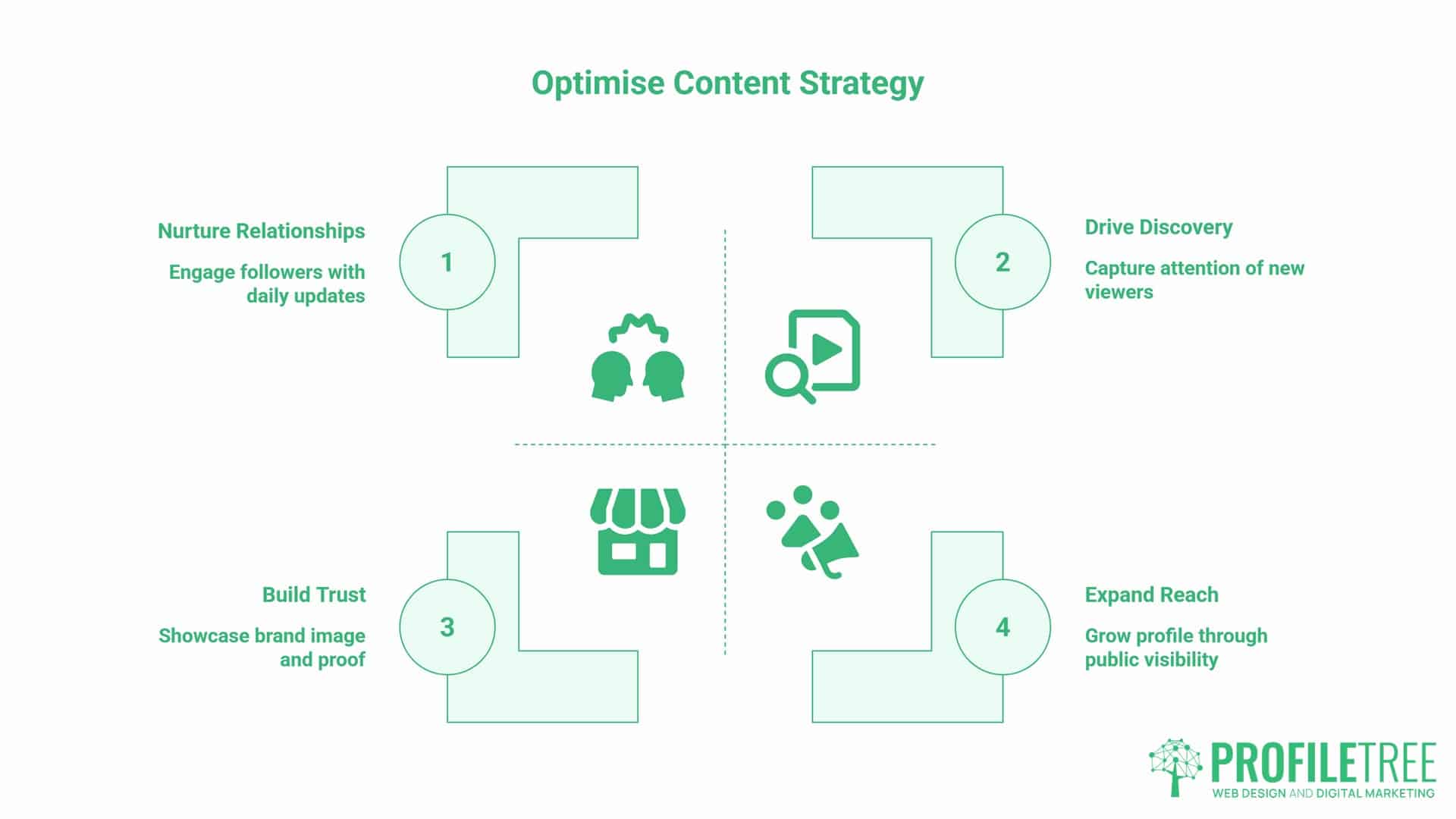
Instagram Stories are full-screen photos and short videos that stack together and disappear after 24 hours, unless you save them to a Highlight. They appear in a row at the top of the app, above the main feed, which is prime real estate. Instagram’s own reporting puts daily Stories users at around 500 million, and roughly seven in ten Instagram users check Stories every day, so for many people the Stories tray is the first thing they tap when they open the app.
That daily habit is the point. Feed posts are your shop window. Stories are the conversation happening inside the shop. One shows finished work, the other shows the people and process behind it.
Stories vs Reels: Which Should You Use?
The two get confused constantly, so here is the plain version. Stories are for your existing audience: people who already follow you and check in regularly. Reels are for reach, the format Instagram pushes to people who do not yet follow you. If your goal is to nurture warm relationships and drive repeat website visits, lean on Stories. If your goal is discovery and growth, invest in Reels alongside them. Most SMEs need both. For the full side-by-side, see our Reels comparison.
| Feature | Stories | Feed post | Reels |
|---|---|---|---|
| Shelf life | 24 hours (or saved to Highlights) | Permanent | Permanent |
| Aspect ratio | 9:16 vertical | 4:5 or 1:1 | 9:16 vertical |
| Primary goal | Retention and relationships | Brand image and proof | Reach and discovery |
| Best for | Existing followers | New profile visitors | People who don’t follow you yet |
Technical Specs: Getting the Basics Right
Stories display at 1080 by 1920 pixels in a 9:16 vertical ratio. Video clips are capped at 60 seconds before the app splits them into segments. Get the ratio wrong and Instagram crops or letterboxes your content, which looks amateur next to competitors who size things correctly.
The detail most businesses miss is the safe zone. Instagram’s own interface, the profile icon at the top and the reply bar and stickers at the bottom, covers roughly the top and bottom 250 pixels of the frame. Keep all text, logos and tappable elements inside the middle 60% so nothing important gets hidden behind the interface. When you build graphics in Canva or similar tools, set guides 250 pixels in from the top and bottom edges before you start.
| Spec | Value |
|---|---|
| Dimensions | 1080 x 1920 pixels |
| Aspect ratio | 9:16 |
| Max video length per segment | 60 seconds |
| Expiry | 24 hours (unless saved to a Highlight) |
| Safe zone | Keep content in the central 60% of the frame |
This is one area where professional support pays off quickly. A brand that shoots and edits Stories properly looks noticeably more credible, which is why platform-native vertical video sits at the heart of our video marketing work rather than being treated as an afterthought. The process for a 15-second Story differs from a horizontal YouTube edit, and knowing that difference is half the battle.
How Stories Reach and Engage Your Audience
Two features make Stories punch above feed posts: urgency and interaction.
The 24-hour expiry creates a natural reason to look now. People tap through Stories before they vanish, which tends to boost engagement above that of standard feed posts. That urgency works especially well for time-sensitive content: a limited offer, an event reminder, a same-day announcement.
Interaction is the other half. Stories carry a set of tappable tools built for two-way conversation. Polls gather quick opinions. Question stickers invite replies. Quizzes test knowledge in a playful way. Emoji sliders read the room. Countdown stickers build anticipation before a launch. For a service business, the question sticker is quietly one of the most useful tools on the platform. Asking “What is your biggest headache with your website right now?” surfaces the exact prospects whose problems you solve, and every reply lands in your inbox as a warm conversation.
Getting Your Stories Seen
Reach starts with placement: because Stories sit above the feed, even followers who rarely scroll will often glance at the Stories bar. Two habits push that reach further. Post when your audience is actually online, as shown by Instagram’s built-in analytics. And lean on descriptive keywords rather than a wall of hashtags.
Instagram now reads the words in your Story, so a clear on-screen phrase people search for, like “small business tips” or “Belfast coffee”, does more than five tags hidden behind a sticker. Add a location tag if you serve a local area (there is more on local tagging further down), keep one or two topical keywords in the text, and stop there. Our piece on the visual content that drives social engagement covers why interactive formats beat passive ones.
Decoding the Instagram Story Algorithm
Most guides gloss over the part everyone actually wonders about: why does the same handful of people always sit at the front of your Stories tray, and why do some of your Stories barely get seen?
Instagram orders Stories in the tray by predicted interest, not by the time they were posted. The accounts a user interacts with most, through replies, profile visits, DMs and repeat viewing, get pushed to the front of that user’s tray. This is why the viewer list on your own Stories tends to show the same names near the top: those are the accounts most engaged with you, not simply the first to watch.
The practical takeaway is straightforward. Stories that earn taps, replies and shares in the first hour signal to Instagram that the content is worth surfacing, which lifts placement for the rest of the sequence. The interactions that matter most:
- Replies and DMs. A reply is the strongest signal you can get, which is why question and poll stickers exist partly to prompt them.
- Taps back. When a viewer taps back to rewatch a frame, Instagram flags it as worth rewatching. Forward taps that skip ahead suggest the opposite.
- Shares. A Story sent to a friend or reshared carries real weight and extends reach beyond your followers.
- Profile visits. A Story that sends people to your profile signals to the app that your content is driving genuine interest.
Structuring a sequence with this in mind changes how you plan. Open with a hook that earns a tap, place an interactive sticker in the second or third frame while attention is close, and give people a clear reason to reply. AI tools can help too, from drafting caption variations to spotting which Story types your audience responds to, an area we cover in our work on AI in social marketing.
Features and Stickers That Drive Engagement
Here is a correction worth flagging, as the old rule led to many missed opportunities. Link stickers used to be gated behind a 10,000-follower threshold or verification. That is no longer the case. The link sticker is now available to every account, which means any business, however small, can send Story viewers straight to a webpage.
That change matters more than it sounds. A five-frame Story that teases the key points of a guide on your website, ending with a link sticker to the full article, turns a disappearing post into measurable website traffic. The destination has to be worth the tap, so send people to a page that loads quickly and reads well, the sort of thing our web design work is built around. Publish a piece on local SEO, tease three quick wins in Stories, link to the full read. It is one of the cleanest content-to-conversion loops on the platform.
The ask works best once you have earned it. A follower who has watched several of your Stories and answered a poll is far more likely to tap a link than a first-time viewer, so place the direct nudge after you have given something useful, not before.
| Sticker | What it does | Best use for SMEs |
|---|---|---|
| Link | Sends viewers to any URL | Driving traffic to guides, service pages, bookings |
| Poll | Two-option vote | Quick market research, product decisions |
| Question | Open text replies | Lead generation, gathering FAQs |
| Countdown | Timer to an event | Launches, webinars, sale start times |
| Quiz | Multiple-choice with answers | Educational content, showing expertise |
A quick note on restraint. Adding stickers to video Stories tends to help engagement, but photo Stories need a lighter touch, where two stickers can start to clutter the frame. Whatever you add, keep it inside the safe zone so the interface does not obscure it.
Story Ideas That Earn Engagement
The strongest Story content for a smaller business does three things: it invites a tap or a reply, it shows the human side of the operation, and it gives a reason to come back tomorrow. You do not need a studio for any of that. A phone, decent natural light and a consistent habit will outperform an occasional polished production almost every time. Treat these ideas as one strand of a wider content marketing plan rather than a standalone task.
Interactive stickers are the quickest lift because they give viewers something to do rather than something to watch. Polls work for light market research as well as for fun: a Belfast bakery might poll which seasonal flavour to bring back, while a B2B consultancy might ask which of two common problems clients struggle with most. Question stickers suit professional services particularly well, letting an accountant field tax queries or a solicitor answer a common one on a “Q&A Friday” slot. Quiz stickers reward a correct answer, and the slider gives a low-effort way for people to react.
Stories also let you build a narrative across several frames, which suits customer education. A step-by-step tutorial broken across four or five frames keeps people tapping through, and each tap is a small engagement signal. A trades business might show a before-and-after; a retailer might walk through how a product is made or sourced. One reliable structure is to open a loop and close it: name the problem you hit this week in the first frame, then resolve it a few frames later.
That unfinished thread is what keeps people tapping through rather than tapping past. Add text overlays and captions so your Stories still land for the large share of people who watch with the sound off. Captions are not an optional extra: they widen your reach to viewers who are deaf or hard of hearing and to anyone scrolling on a quiet commute.
Stories That Work for UK and Ireland SMEs
Large global brands make for tidy case studies, but their tactics rarely translate to smaller businesses. The patterns below reflect the kinds of approaches that work for UK and Ireland SMEs, drawn from common sector behaviour rather than borrowed from billion-pound advertising budgets.
- A local café or restaurant can run a daily “today’s specials” Story with a poll asking which dish to feature next week, turning a routine update into a two-way conversation and a genuine demand signal for the kitchen.
- A solicitor or accountant can use the question sticker for a weekly FAQ slot. Answering one real client question a week, in plain language, positions the firm as approachable long before a prospect picks up the phone.
- A retailer or independent shop can use the countdown sticker for a stock drop, then follow with behind-the-scenes frames of the products arriving.
- A tradesperson or manufacturer can post short before-and-after sequences of completed work, which prove quality far more convincingly than any claim.
- A fitness studio or wellness business can run a quiz sticker on a common myth in their field, then correct it in the next frame, combining education with interaction.
The thread running through all of these is the same: low production cost, high relevance, and a clear reason for the viewer to engage.
Showcasing Services on Stories
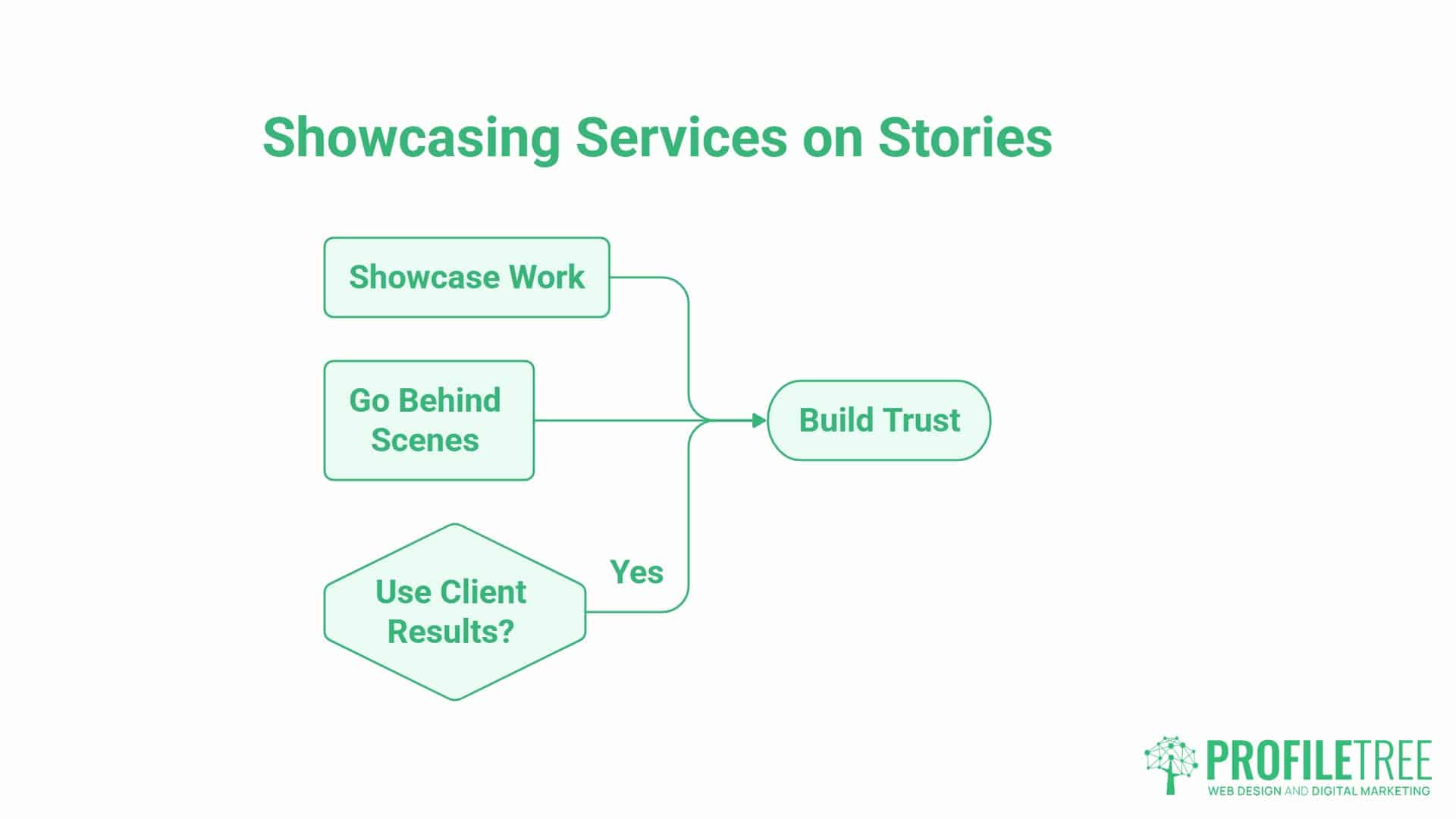
Physical products are easy to show on Stories. Services are harder because there is no box to photograph. For agencies, trades, professional firms and training providers, the job is to make intangible work visible.
Show the work, not the pitch. Share a short clip of a website you have just launched, with permission. Walk through a before-and-after. Film a 20-second explanation of a concept your clients always ask about. This demonstrates capability through evidence rather than claims, which is far more persuasive than telling people you are good.
Go behind the scenes. A quick office tour, a snippet of a team planning session, a look at how a video edit comes together. This kind of content humanises the business and builds trust, and it performs because it feels real rather than staged. Film genuine moments; audiences can tell the difference between authentic footage and manufactured content.
Use client results carefully. Social proof works, but only with real numbers you can stand behind and permission to share them. Never invent a figure to fill a frame. A genuine, modest result beats an impressive fabricated one every time, and honesty protects both your reputation and your client’s. If you want the broader framework, our guide to SME social media marketing sets the strategy that Stories fit inside.
Instagram Stories for B2B, Not Just B2C
Most Stories advice assumes you sell coffee or clothes. Professional services, from law and accountancy to finance and agencies, can use Stories just as well, and few competitors do, which is exactly the opening.
For B2B, the goal shifts from impulse buys to authority and leads. A short “day in the life” sequence, an explainer answering a common client question, or a teaser for a webinar or guide with the link sticker all build credibility without a hard sell. The tone stays professional. The format just makes you human.
A financial firm in Belfast, for example, could run a weekly Story answering one client’s question. Over a quarter, that becomes a body of helpful content that positions the team as approachable experts. The same pattern works for solicitors, accountants and consultants: pick the three questions clients always ask, answer one a week, and let the archive build.
For lead generation specifically, the link sticker is your quiet workhorse. Point it at a booking page, a short guide or a webinar sign-up, then use a question box a day earlier to warm people up (“what is your biggest payroll headache right now?”). You get free market research and a natural reason to send the follow-up Story with the link. If your team wants structured help planning this, ProfileTree’s digital training covers social content from scratch.
Story Highlights: Your Extended Portfolio
Highlights let you save Stories to permanent, categorised collections that sit under your bio. They are the exception to the 24-hour rule, and for a business, they function as a curated portfolio the moment someone lands on your profile.
Organise them the way a new visitor would want to browse. Useful categories for a service business include Portfolio, Client Results, Services, Team, Testimonials and Tips. Each becomes a tappable folder that answers a question a prospect is already asking.
Design the covers to match your brand. Consistent colours drawn from your logo and website, plus simple bold icons, read clearly at thumbnail size. A camera icon for video work, a graph for results, a lightbulb for strategy: clarity beats decoration at that scale.
Instagram Story Ads
Story ads slide between the Stories your audience already watches, in the same full-screen vertical format. Because they appear inside content people have chosen to view, they tend to feel less intrusive than a banner dropped into a crowded feed.
The targeting is the real draw. You can define audiences by location, interests, behaviour and lookalike modelling, which lets a Belfast firm show ads only to people in its service area. In terms of cost, Story ads remain competitive with other placements for well-targeted campaigns. Rather than fixating on a headline rate, watch the cost per result during the first 24 to 48 hours and let the data guide you.
Four habits separate Story ads that work from ones that burn budget:
- Hook in the first second. Viewers decide almost instantly whether to skip, so open with a bold visual, a surprising figure or a sharp question.
- Keep copy short. People consume Stories fast; if your service needs explaining, send them to a landing page rather than cramming it into the frame.
- Use motion. Movement, whether animated text or a product in use, reduces skip rates against static images.
- Give one clear action. “Book a consultation” or “Read the guide” tells viewers exactly what to do next.
If you run paid or gifted Story content, the ad labelling rules set by the ASA and CMA apply to every relevant frame. We cover how to label paid content correctly in our Instagram Reels guide.
Building a Story Routine: Daily and Weekly
Most Instagram stories’ best practices come down to rhythm rather than volume. The two routines below give you a daily minimum and a weekly shape, so you show up consistently without it taking over your day.
The 15-Minute Daily Workflow
The biggest barrier owners report is time. This three-part routine keeps Stories consistent in about a quarter of an hour.
- Morning (5 minutes). Capture one piece of real-time content before 10am: the team arriving, a product being prepared, a delivery unpacked, or a quick thought on something relevant in your industry. Film it on your phone, add a short caption, post. No editing. Behind-the-scenes content performs because it feels unscripted.
- Midday (5 minutes). Add one interactive element: a poll between two options, a question sticker inviting feedback, or a quiz. Keep the question simple. “Which colour do you prefer?” beats an open-ended prompt that takes effort to answer, and every reply signals to the algorithm that your content is worth distributing.
- Evening (5 minutes). End with a link sticker or a product feature. This does not need to be a hard sell. A finished project, a customer result or a service you offer, with a link sticker pointing to the relevant page, is enough. The link sticker is available to all accounts, so there is no follower threshold to clear before you use it.
A Weekly Rhythm
Consistency beats intensity. You do not need 20 Stories a day; you need a regular mix that serves your audience. A workable week for a small team:
- Monday: an industry insight or a trend your clients should know about.
- Tuesday: a client result or short testimonial, with permission.
- Wednesday: behind the scenes on a live project.
- Thursday: a question sticker asking about your audience’s current challenges.
- Friday: team culture, a win from the week, or something human.
- Weekend: a quick, useful tip tied to your expertise.
Recurring segments help people build a habit. A “Tip Tuesday” or “FAQ Friday” gives followers a reason to check back. Respond to every reply and sticker answer promptly, because those replies are where client conversations often begin. Planning a week in one sitting, with a scheduling tool, keeps the flow steady even in a busy week and stops the gaps that lose you regular viewers. For teams that would rather build the capability in-house, our digital training covers this hands-on; for businesses that want it managed end to end, our social media marketing service handles strategy, content and reporting.
“Instagram Stories represent the most authentic touchpoint between brands and their audience. Businesses that treat Stories as conversation starters rather than broadcast channels consistently outperform competitors focusing solely on polished feed content.”Ciaran Connolly, founder of ProfileTree
Localised Story Strategy Across the UK and Ireland
Most Story guides are written for a global or US audience. They mention location stickers in passing without explaining how to use them for local impact. For businesses operating in specific towns, cities or regions, this is where ground can be gained.
Geo-Tags for UK High Streets and Business Districts
When you add a location sticker to a Story, tagging Belfast city centre, the Cathedral Quarter, Derry’s walled city or a specific retail park, your Story becomes discoverable to Instagram users browsing that location. This is separate from your follower count. People who have never encountered your brand can find your content because they searched for or visited that place. Tag as specifically as possible. “Belfast” is broad. “Castle Court Belfast” or “Botanic Avenue Belfast” surfaces your content to people with genuine local intent.
The B2B Community Loop
Tag local suppliers, partner businesses and industry contacts where it makes genuine sense. When you tag another account, they receive a notification and can reshare your Story to their own audience. For small businesses with modest follower counts, this is one of the most practical ways to reach new people without paid advertising.
A café tagging the local bakery that supplies its pastries, a web agency tagging a client after a project launch, a retailer tagging the designer behind a new product: these are natural, editorial tags that carry real reach value. A well-chosen collaboration or piece of influencer marketing works the same way, putting your brand in front of an audience that already trusts the person featuring you, as long as the partner is relevant to your sector.
Music and Consent Rules for UK Business Stories
This is an area almost absent from US-led Story guides, and it poses a real risk to UK and Irish businesses that follow that advice without question.
Resharing Customer Content Under UK GDPR
If a customer posts a Story that mentions or tags your business, you cannot automatically reshare it. Under UK GDPR, you need explicit permission before reposting content that features an identifiable individual. A simple approach is to reply to the tag with a direct message asking, “We would love to reshare this, are you happy for us to do so?” Screenshot the confirmation and keep it on file. Do not rely on the original tag as implied consent.
Music Licensing on Business Accounts
Accounts registered as Business accounts on Instagram have restricted access to the music library because of commercial licensing agreements. Many tracks available on personal accounts are unavailable or will be muted on business posts. If music matters to your content, use Instagram’s royalty-free sound library, source music through a licensed provider such as Epidemic Sound, or switch to a Creator account, which retains access to music and still provides most business analytics features.
Measuring Success
Data is what turns guesswork into a plan. Instagram provides analytics for business and creator accounts, and a handful of metrics tell you most of what you need.
- Reach and impressions. Reach is the number of unique accounts that saw your Story; impressions count total views, including repeats. A big gap tells you people are rewatching.
- Completion rate. The share of viewers who watch from the first frame to the last. A sharp drop-off points to a frame that needs fixing.
- Exits. When someone swipes away entirely. A spike on a particular frame flags content that is losing people.
- Sticker interactions and link taps. Poll votes, question replies and link taps are the clearest sign your interactive content is working. Tracking these interactions week to week shows which formats actually earn a response.
- Navigation taps. Forward taps suggest a frame is too slow. Backward taps mean something was interesting enough to rewatch.
Review these monthly, spot the patterns, and adjust. A Story seen by 400 people with 30 replies generates more commercial value than one seen by 2,000 with none. Understanding who your audience actually is helps too, which is why our audience demographics research is worth a look when you plan content. As you collect audience data through polls and questions, handle it responsibly; our guide to data privacy in social media marketing covers the obligations.
Where to Go From Here: Instagram Stories Best Practices
The Instagram Stories best practices in this guide all point in one direction: treat Stories as a conversation rather than a broadcast. The format favours consistency, genuine interaction, and content that shows the people behind the work, all of which are within reach of a small team with a clear plan. Start with the 15-minute daily workflow and the weekly rhythm above, use the link sticker to send viewers somewhere useful, tag your locations and partners, label any paid content properly, and read your analytics each month to sharpen what you do next. The businesses that stick with a simple strategy, week after week, are the ones that turn a disappearing post into a lasting relationship.
FAQs
What are the most important Instagram Stories best practices for business?
Post consistently rather than in bursts, hook viewers in the first frame, and add one interactive sticker to earn replies. Send warm viewers to a useful page with the link sticker, and read your analytics each month so you can do more of what earns taps and replies. Consistency and genuine interaction matter more than volume or production polish.
How do Instagram Stories work?
Stories are full-screen photos and short videos that appear in a row at the top of the app and disappear after 24 hours, unless you save them to a Highlight. They sit above the main feed, so followers often see them first, and they carry interactive stickers like polls, questions and links that let viewers tap, vote or reply.
How can I tell who viewed my Instagram Story?
Open your Story while it is live, then swipe up or tap the viewer icon in the bottom-left corner to see the list of accounts that watched. That list is tied to the live Story and is reliably available for the 24 hours it is up. Once it expires, the names go with it. There is a short grace period in your archive, but do not count on it, so screenshot the list before the 24-hour window closes if you need a record.
Why is the same person always at the top of my Story views?
The viewer list is ordered by Instagram’s interest signals, not by who watched first. The accounts that interact with you most, through profile visits, replies, DMs and repeat viewing, tend to appear near the top. It reflects engagement, not viewing order, so it is not a reliable sign of who is watching you in any deliberate sense.
Can I schedule an Instagram Story in advance?
Yes. Third-party scheduling tools let you line up a week of Stories in one sitting, which keeps the flow steady through a busy week and stops the gaps that lose regular viewers. Plan ahead of a launch or event so the sequence is ready to go.
Why is music restricted on my business Instagram account?
Business accounts have restricted access to the music library because of commercial licensing agreements, so many tracks are unavailable or get muted. Use Instagram’s royalty-free sound library, a licensed provider, or switch to a Creator account, which keeps music access and most business analytics.
Can I use Instagram Stories for influencer marketing?
Yes. A collaboration or takeover with a relevant local creator puts your brand in front of an audience that already trusts them. Keep the partner relevant to your sector, and if money, gifts or editorial control are involved, label the content as advertising.
Do Instagram Stories really last only 24 hours?
Yes. A Story disappears from your profile and the Stories tray 24 hours after posting. The exception is Highlights: save a Story to a Highlight and it stays on your profile permanently until you remove it.
What are the best dimensions for Instagram Stories?
1080 by 1920 pixels, a 9:16 vertical ratio. Keep your important text and elements within the central 60% of the frame so Instagram’s interface does not cover them.