
Guide to Facebook Marketing for UK Businesses
Table of Contents
Facebook has more than 44 million active users in the UK. For businesses across Northern Ireland, Ireland, and Great Britain, that reach represents a genuine commercial opportunity, but only when the platform is treated strategically rather than as a free posting tool.
Organic reach has declined sharply over the past five years. The businesses getting results from Facebook in 2026 are those combining consistent content, a clear paid media strategy, and a working understanding of how Meta’s algorithm rewards engagement. UK GDPR compliance adds a layer of complexity that generic American guides rarely address.
This guide covers the Facebook marketing fundamentals: the algorithm, page setup, content strategy, Meta Ads, analytics, and community management, with a specific focus on UK and Irish market conditions, GBP budgeting benchmarks, and the compliance requirements that apply here.
Understanding Facebook’s Algorithm in 2026
The algorithm has changed substantially since Facebook’s early chronological feed. Today, Meta’s system scores every piece of content against predicted engagement, personal relevance, and post type, then decides how many users will see it, and when. Understanding those scoring factors is the starting point for any effective Facebook marketing guide.
For UK businesses, Facebook audience data shows the platform still commands the largest social media user base in the country across the 25–54 age bracket, the core purchasing demographic for most SMEs. That audience is real; reaching it consistently is the challenge.
How the Ranking System Works
Meta applies four primary signals to determine content distribution: meaningful interaction (comments and shares outrank passive likes), content type (video and Reels receive preferential treatment in 2026), relationship strength (pages users have messaged or interacted with recently rank higher), and dwell time (how long someone pauses on a post before scrolling).
The practical implication is that reach is no longer proportional to follower count. A page with 2,000 highly engaged followers will consistently outperform a page with 20,000 passive ones. Building the right audience, then giving them content worth engaging with, matters more than accumulating numbers.
Facebook Algorithm Updates: Engagement Patterns in 2026
The most significant 2026 update has been Meta’s increased weighting of Reels in the News Feed, mirroring the model it deployed on Instagram. Short video content now receives approximately 30–40% wider distribution than static image posts at equivalent engagement rates. This shift does not mean abandoning static content (mixed formats remain important), but businesses ignoring video are operating at a structural disadvantage.
Facebook’s algorithm also places growing weight on content that keeps users within the platform rather than directing them away. Posts that drive comments, save rates, and share activity rank higher than those leading immediately to an external link. One effective approach is to post engaging content that builds curiosity, then include the link in the first comment rather than the post itself.
Why Organic Reach Requires Realistic Expectations
Average organic reach for a business page post in 2026 sits at roughly 2–5% of the total page audience. A page with 5,000 followers can expect 100–250 people to see any given organic post without paid amplification. This is not a bug in the system; it reflects Meta’s core business model. Accepting this reality early is the difference between a Facebook strategy that works and one that breeds frustration.
Compared to UK social media stats across TikTok and Instagram, Facebook’s organic reach is lower, but its targeting precision through paid ads and its depth of audience data give it a distinct commercial advantage that newer platforms have not yet replicated at the same scale.
Adapting Content to Algorithm Preferences
The most consistent way to maintain reach without relying solely on ad spend is to optimise for the signals the algorithm rewards. Post consistently (three to five times per week is the recommended baseline for most SMEs). Prioritise short-form video and Reels. Ask direct, specific questions in post copy to prompt comments. Respond to every comment in the first hour after posting, and early engagement signals send a strong positive ranking indicator to the algorithm.
Timing matters too. For UK audiences, the highest engagement windows are typically Tuesday through Thursday between 9 am–11 am and 7 pm–9 pm GMT. Facebook’s own Insights data will show the specific peak times for a given page’s audience, and those figures should always take precedence over general benchmarks.
Building Your Facebook Foundation
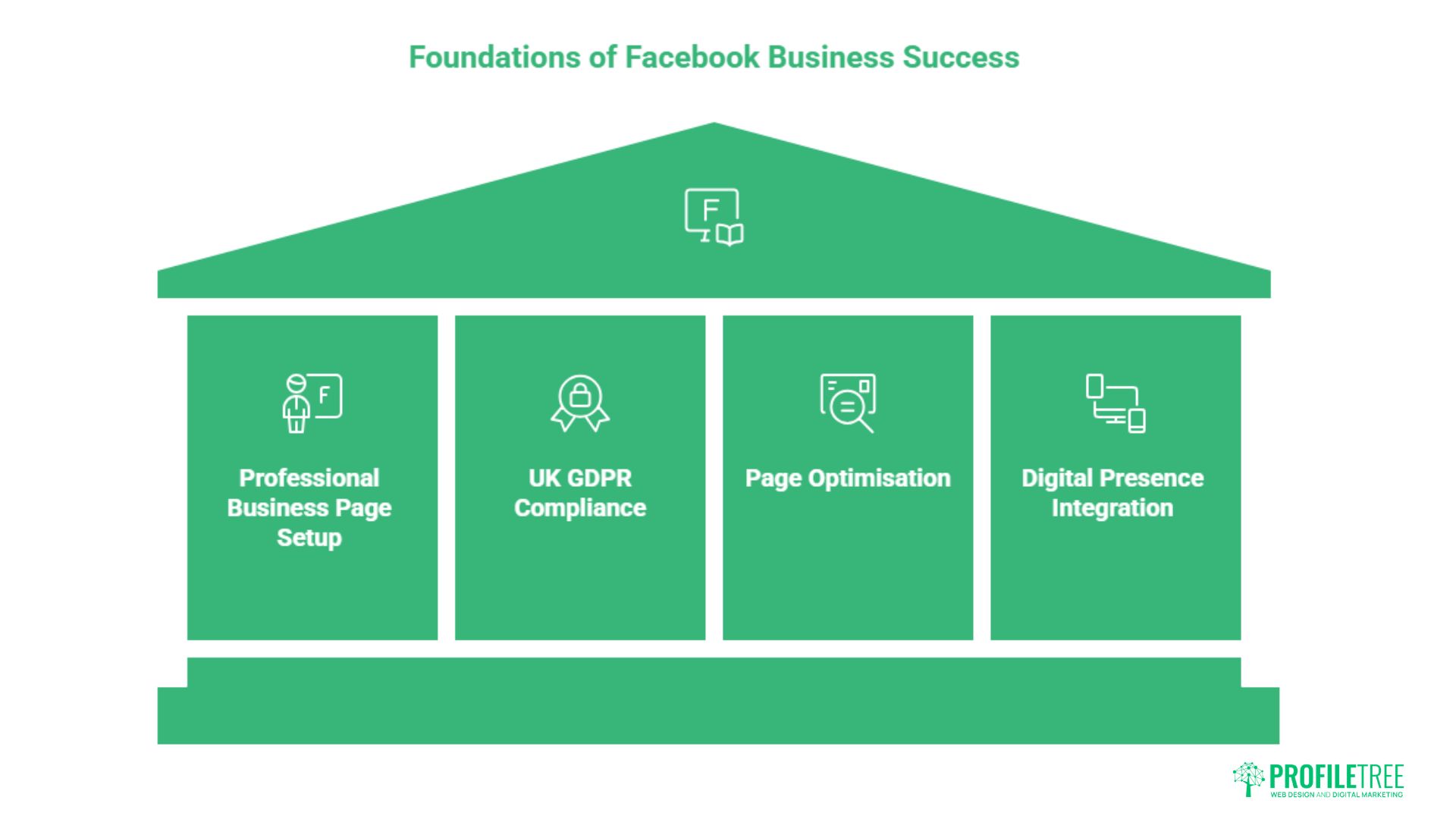
The structural setup of a Facebook business page has a direct effect on discoverability, first impressions, and long-term marketing performance. Many businesses rush past the configuration stage, and the gaps (incomplete information, poor imagery, misconfigured settings) quietly undermine every piece of content published afterwards.
For UK businesses, Facebook’s algorithm shifts over the past few years have placed increasing weight on page completeness as a trust signal. A fully completed, regularly updated page ranks higher in Facebook search and performs better in ad delivery.
Setting Up a Professional Business Page
Start with the page name: use the business’s legal or trading name as it appears elsewhere online. Consistency across Google Business Profile, the company website, and Facebook strengthens entity recognition for both search engines and Meta’s own ad targeting systems. Choose a category that accurately reflects the primary service, as this affects how the page surfaces in local searches.
The profile picture should be the business logo, cropped to display cleanly within Facebook’s circular format (180×180 pixels at minimum). The cover image is prime visual real estate: use it to communicate the service, a current campaign, or a clear value statement rather than a generic stock photograph. Update the cover image seasonally or when running specific campaigns to signal an active, maintained presence.
UK GDPR Compliance and Meta Business Suite Setup
This is the area where most UK-facing Facebook marketing guides fall short. The Meta Pixel, the tracking code that allows businesses to measure ad conversions and build Custom Audiences from website visitors, must be deployed in compliance with the UK’s Privacy and Electronic Communications Regulations (PECR) as well as UK GDPR.
In practical terms, this means the Meta Pixel cannot fire until a website visitor has given explicit consent via a Cookie Consent Management Platform (CMP). Deploying the Pixel unconditionally, as many businesses still do, is a breach of ICO guidance and exposes the business to enforcement action. The solution is to integrate the Pixel with a compliant CMP such as Cookiebot or OneTrust, and to use Meta’s Conversions API alongside (or instead of) the browser Pixel to maintain measurement accuracy even when cookies are rejected.
Meta’s Business Suite also requires a Data Processing Agreement (DPA) between the business and Meta for ad targeting activity involving UK resident data. This is accepted within the Business Settings section and should be completed before any paid campaigns go live. Social media marketing that bypasses these compliance steps creates real legal exposure: the ICO issued its first Meta Pixel-related enforcement notice to a UK business in 2023, and scrutiny has intensified since.
Page Optimisation for Discoverability
The About section is indexed by both Facebook search and Google. Include a clear, keyword-relevant description of what the business does and who it serves, written in plain language. Add the full business address for local pages (this enables Facebook’s local discovery features), the website URL, phone number, and trading hours. These fields collectively signal a legitimate, active business rather than a dormant or low-quality page.
Add a call-to-action button appropriate to the business objective: “Book Now,” “Get Quote,” “Contact Us,” or “Shop Now.” These buttons receive meaningful click volume from users who arrive at the page through search or ad referrals, and they provide a direct conversion path without requiring the user to go further.
Integrating Facebook with Your Wider Digital Presence
Facebook does not operate in isolation. Connecting the page to Instagram through Meta Business Suite enables cross-posting, shared ad creative, and unified analytics. Linking the Pixel to the website (with compliant consent management) ties ad spend to on-site behaviour. For businesses running a digital marketing services strategy across multiple channels, the Meta Business Suite dashboard provides a single point of management for all connected assets, ad accounts, and data sources.
Content Strategy Beyond the News Feed
A Facebook content strategy for 2026 requires more than a posting schedule. It requires a clear understanding of which content formats earn reach, how to build content pillars that serve different stages of the buyer journey, and where AI tools can legitimately save production time without producing generic output that fails to engage.
Content Pillars for UK and Irish Businesses
A manageable content pillar structure for most SMEs divides content into three broad categories: educational (60%), social proof and behind-the-scenes (30%), and promotional (10%). This ratio keeps the page useful to its audience rather than functioning as a broadcast channel. The 10% promotional cap is not a hard rule, but pages that exceed it consistently tend to see engagement rates fall, which then suppresses reach for all content, including non-promotional posts.
Educational content for UK businesses could include industry regulation updates relevant to the sector, cost comparison guides (always in GBP), how-to content relevant to the local audience, and data-led posts drawing on UK-specific research. For businesses in Northern Ireland, content touching on cross-border trading, the Windsor Framework, or specific NI business support programmes provides genuine regional relevance that no generic social media tool can replicate.
Mastering Reels and Stories for Organic Reach
Reels are currently Facebook’s highest-reach organic format. A 15–60 second Reel consistently outperforms static posts by a factor of three to five in terms of impressions for a comparable engagement rate. The content does not need to be polished to broadcast standard: authenticity and clear value, such as a quick tip, a process walkthrough, or a before-and-after, generate better performance than high-production videos that feel like television advertising.
Stories, by contrast, are best used to maintain daily presence and deepen relationships with the existing audience rather than reach new users. Story polls, question stickers, and countdown timers generate interactions that feed positive engagement signals back to the algorithm. A consistent Story posting cadence of one to three Stories per day is achievable for most businesses and produces meaningful engagement data that can inform future content decisions.
Using Generative AI to Scale Facebook Content
AI tools have become a genuine production accelerant for Facebook content teams. The practical workflow that works for most businesses involves using a large language model to generate multiple ad copy or post copy variants from a single brief, then editing the output for brand voice, accuracy, and local relevance before publishing. What AI cannot provide is proprietary insight, local knowledge, or professional opinion. Facebook audiences respond to exactly those qualities.
The risk with AI-generated social content is uniformity. If the tool produces five post variants that all sound identical, the audience notices, engagement declines, and the algorithm deprioritises the page. The solution is to treat AI output as a first draft that requires genuine editorial investment, not a finished product. AI marketing tools are most valuable when they handle the repetitive elements (caption length variations, hashtag research, A/B copy testing), freeing human time for the content decisions that actually drive performance.
For image content, Meta’s own AI image generation tools (available within Ads Manager) now allow rapid production of ad creative variants. These are useful for testing visual formats at low cost before committing to professional photography or illustration. The same compliance point applies: AI-generated imagery used in UK ads falls under the ASA/CAP Code requirements for advertising transparency.
Creating Effective Facebook Posts for Engagement
Writing effective Facebook posts comes down to a handful of consistent principles. Lead with the most interesting or useful element, because the algorithm measures whether users pause on a post before scrolling, and the opening line determines that pause. Keep body copy under 125 characters where possible (text is truncated at this length on mobile without the user tapping “See more”). Use plain, direct language rather than marketing jargon. End with a single, specific call to action rather than a vague invitation to “check this out.”
The Meta Ads Blueprint: From Awareness to Conversion
Facebook’s paid advertising platform, managed through Meta Ads Manager, remains one of the most capable audience targeting tools available to businesses of any size. The ability to build Custom Audiences from first-party data, create Lookalike Audiences from existing customer lists, and layer demographic, interest, and behavioural targeting gives even a small business genuine precision at modest budgets.
Ciaran Connolly, founder of Belfast digital agency ProfileTree, puts it directly: “For most SMEs in Northern Ireland, Facebook remains the single best platform for reaching a local audience at scale, but only if you treat it as a paid channel from day one and stop expecting organic reach to carry the load.”
All prices and figures in this section are indicative UK examples and correct at the time of writing; use them as a benchmark rather than fixed quotations.
Facebook Ad Types and When to Use Each
Meta Ads Manager offers six primary ad formats, each suited to different campaign objectives. Photo ads, consisting of a single image with headline and primary text, are the simplest to produce and perform well for direct response campaigns where the offer is clear. Video ads outperform static in most awareness-stage campaigns, with the first three seconds critical for capturing attention before the user scrolls past.
Carousel ads allow businesses to showcase multiple products, services, or case study outcomes within a single ad unit, with each card linking to a different URL. This format consistently delivers lower cost-per-click than single-image ads in e-commerce and service-sector campaigns. Lead Generation ads (which open a pre-filled Meta form rather than sending the user to an external landing page) produce higher conversion rates for contact-form-style offers because they remove the friction of navigating to a separate website.
UK Budgeting Benchmarks and Campaign Structure
UK average cost-per-click (CPC) across Facebook ad campaigns in 2025–26 ranges from £0.40 to £1.20 for awareness-stage campaigns, rising to £1.50–£4.00 for conversion-optimised campaigns in competitive sectors such as professional services, property, and financial products. Cost-per-thousand-impressions (CPM) typically sits between £6 and £15 for UK audiences, with Northern Ireland and regional Irish audiences sometimes delivering lower CPMs due to reduced advertiser competition.
A minimum viable test budget for a new campaign is £5–£10 per day over a 14-day learning period. Meta’s delivery system requires approximately 50 conversions per ad set per week to exit the learning phase and begin optimised delivery. Below this threshold, results will be inconsistent regardless of creative quality. Most SMEs should plan for a minimum monthly ad spend of £300–£500 to generate usable learning data, with scale increasing once a winning creative and audience combination is identified.
Custom Audiences, Lookalikes, and Advantage+ Campaigns
Custom Audiences built from first-party data (email lists, website visitors, video viewers, past purchasers) are the highest-performing targeting option available in Meta Ads. A retargeting campaign targeting website visitors from the past 30 days will almost always deliver a lower cost-per-result than a cold audience campaign, because the audience has an established relationship with the brand.
Lookalike Audiences extend this logic to cold prospecting: Meta analyses the characteristics of an existing Custom Audience and finds users who share similar attributes. A 1% Lookalike based on a clean customer email list is typically the most effective cold audience starting point for UK campaigns. Advantage+ Audiences, Meta’s AI-driven targeting option introduced in 2023 and expanded in 2025, automates the audience selection process and can outperform manual targeting for accounts with sufficient conversion history.
Pixel Setup, Conversions API, and UK GDPR
The Meta Pixel tracks on-site actions (page views, add-to-carts, purchases, form completions) and sends this data back to Meta to enable conversion optimisation and audience building. As noted in the foundation section, Pixel deployment in the UK requires explicit user consent under PECR. Businesses that deployed the Pixel before consent-first infrastructure was in place should audit their current setup against ICO guidance before running conversion-optimised campaigns, as the targeting data underpinning those campaigns may be non-compliant.
The Conversions API (CAPI) provides a server-side alternative that is less dependent on browser cookies and less affected by iOS privacy changes. Running CAPI alongside the browser Pixel, a “redundant” setup, maximises signal quality while maintaining compliance. Meta provides direct CAPI integration documentation for most major e-commerce and CMS platforms, including Shopify, WooCommerce, and BigCommerce.
Analytics, Community Management, and Proving ROI
Measuring Facebook performance accurately requires looking beyond vanity metrics. Page likes, impressions, and reach tell you how visible the content is; they do not tell you whether it is driving business outcomes. A professional Facebook marketing guide needs to address both layers of measurement.
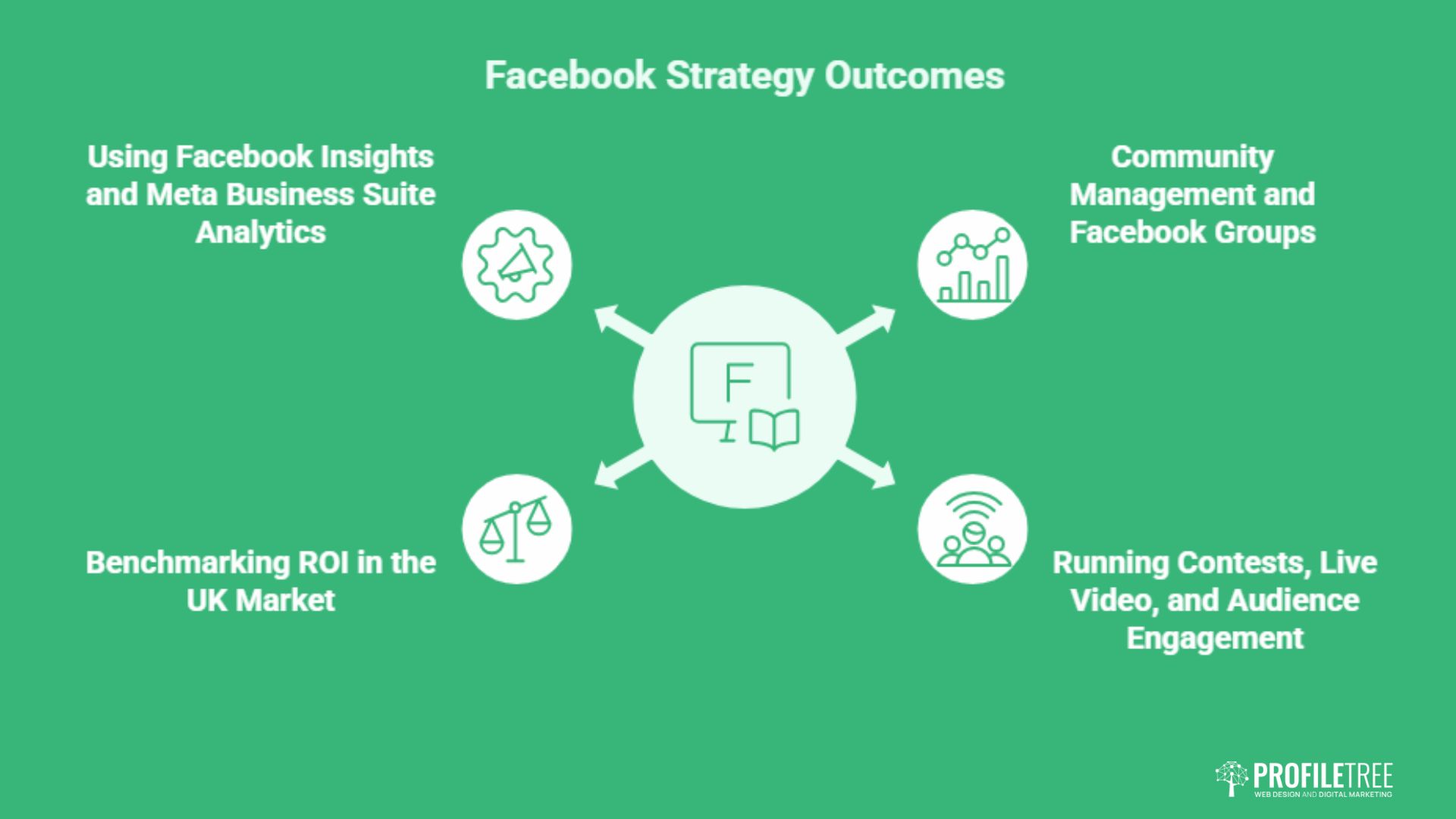
Using Facebook Insights and Meta Business Suite Analytics
Facebook Insights provides page-level data on reach, engagement, follower demographics, and post performance. The most commercially useful metrics for SMEs are: engagement rate per post (target 1–3% for organic content), link click rate (measures how often post content drives off-platform action), and audience growth rate (net new followers as a percentage of total, monthly). Page views and reach figures provide context but should not be the primary performance indicators for a business-focused page.
For paid campaigns, the relevant metrics depend on the campaign objective. Awareness campaigns should be judged on CPM and video view rate. Traffic campaigns on CPC and landing page view rate. Conversion campaigns on cost-per-result and return on ad spend (ROAS). Mixing metrics across different campaign types leads to misleading conclusions: a £0.50 CPC is excellent for a traffic campaign and largely irrelevant for a purchase-optimised campaign.
Benchmarking ROI in the UK Market
UK Facebook ad benchmarks by sector vary considerably. Retail and e-commerce campaigns targeting UK audiences typically see ROAS of 2–4x on cold audiences and 5–8x on retargeting. Professional services campaigns (accountancy, legal, financial advice) typically generate £8–£25 cost-per-lead, with higher-value services tolerating higher lead costs. For local service businesses in Belfast and Northern Ireland, the reduced audience competition relative to London and South East England can produce cost-per-lead figures 20–40% lower than UK national benchmarks.
Northern Ireland businesses also benefit from the region’s position relative to both UK and Irish audiences. With the right targeting setup, a campaign can reach Republic of Ireland users through the Irish-connected Facebook audience overlap, useful for businesses serving both markets, and an advantage not available to competitors operating purely within Great Britain. Exploring top cities to visit in Northern Ireland illustrates how strongly NI consumer culture maps across both jurisdictions, a dual-market characteristic that Facebook’s geographic targeting can exploit effectively for tourism, hospitality, and consumer brands.
Community Management and Facebook Groups
A Facebook Group attached to a business page creates a community space with higher organic visibility than page posts. Groups receive preferential News Feed placement under Meta’s current algorithm because they generate the comment-led, back-and-forth interaction that Meta’s engagement model rewards. For businesses with a clear customer community (training providers, niche retailers, professional networks), a managed Group can deliver consistent organic reach at zero ad cost.
Effective community management requires daily attention: answering questions, seeding discussion topics, acknowledging contributions, and moderating off-topic content. The commitment is real, and businesses that create Groups without resourcing the moderation typically see them become inactive within 60–90 days. If consistent management is not feasible, a well-run page with proactive comment responses will outperform a neglected Group.
Running Contests, Live Video, and Audience Engagement
Facebook Live remains one of the most accessible routes to sustained organic reach available on the platform. Live video receives six times more engagement on average than pre-recorded video, and the notifications sent to followers when a page goes live provide a reach mechanism independent of the standard News Feed algorithm. For businesses without video production budgets, a 15–20 minute weekly Live covering an industry topic, client FAQ session, or product walkthrough can produce meaningful audience engagement at minimal cost.
Contests and giveaways, run within Meta’s promotion policies, generate short-term spikes in engagement and follower growth. They are most effective when entry mechanics are simple (comment with a response, tag a friend) and the prize is relevant to the specific audience rather than a generic consumer product. A digital marketing agency running a free website audit giveaway will attract genuinely qualified leads; the same agency running an iPad giveaway will attract entrants with no interest in the core service.
Conclusion
Facebook marketing in 2026 rewards clarity over volume. Businesses that define a clear audience, commit to a realistic content cadence, build compliant paid media infrastructure, and measure outcomes against genuine commercial goals consistently outperform those chasing follower counts and boosting posts without strategy. The platform has more UK users than any competitor. The opportunity is real, and the businesses investing in it deliberately are seeing returns that justify the effort.
ProfileTree’s team works with SMEs across Northern Ireland, Ireland, and the UK on digital training and full-service social media strategy. If you want to build a Facebook marketing approach that fits your business and budget, get in touch to discuss where to start.
FAQs
How do I start Facebook marketing as a beginner?
Begin by setting up a fully completed Meta Business Page, including business category, contact details, and an About section, written in plain language. Connect Meta Business Suite, install a compliant cookie consent management platform on your website before adding the Meta Pixel, and establish a simple content calendar covering three to five posts per week. Start with organic content to build baseline engagement data before investing in paid ads
Is Facebook marketing free?
Creating and managing a Facebook business page is free. Organic posting costs nothing beyond the time to produce content. In practice, however, organic reach for most business pages averages 2–5% of the total follower count per post, meaning a page with 2,000 followers might reach 40–100 people organically. Most UK businesses treating Facebook as a genuine marketing channel commit a baseline paid media budget alongside their organic activity.
How does UK GDPR affect my Facebook ads?
The Meta Pixel, which tracks website visitor behaviour and feeds data back to Meta for ad targeting, cannot fire without explicit user consent under the UK’s Privacy and Electronic Communications Regulations (PECR). Businesses must integrate the Pixel with a compliant Cookie Consent Management Platform and accept Meta’s Data Processing Agreement within Business Settings before running targeted campaigns.
What is a good CPC for Facebook ads in the UK?
UK Facebook ad cost-per-click benchmarks range from £0.40–£1.20 for awareness-stage campaigns and £1.50–£4.00 for conversion-optimised campaigns in competitive sectors. Northern Ireland and regional Irish audiences often deliver lower CPCs than the national UK average due to lower advertiser competition. These figures should be treated as starting benchmarks; actual CPCs vary significantly by industry, audience temperature, ad creative quality, and campaign objective.
Should I use Boost Post or Meta Ads Manager?
Meta Ads Manager provides substantially better control, targeting precision, and reporting than the Boost Post button. The Boost function is a simplified interface that limits audience targeting options and does not allow objective-based campaign configuration. For most business campaigns beyond basic awareness, Ads Manager is the correct tool.