
AI Marketing in 2026: Statistics Driving UK Business Performance
Table of Contents
The artificial intelligence sector within UK marketing has moved beyond experimental phases. Business owners and marketing directors now face practical questions about deployment, measurement, and return on investment rather than theoretical possibilities. The statistics emerging from 2026 paint a picture of rapid adoption tempered by real-world implementation challenges. This analysis examines the current state of AI marketing through verifiable data, focusing on metrics that matter to SMEs and mid-market organisations across Northern Ireland, Ireland, and the broader UK market.
The Current State of AI Marketing Adoption
AI marketing technology reached a valuation exceeding £40 billion globally in 2024, with the UK market representing a substantial portion of this growth. The sector continues expanding as organisations move from pilot programmes to full-scale implementations across their marketing operations.
The adoption pattern reveals distinct phases. Early experimentation between 2022-2023 gave way to structured testing in 2024. By 2026, businesses will be making permanent changes to their marketing workflows, integrating AI into core operations rather than treating it as a supplementary tool.
British businesses face specific considerations that shape their AI adoption patterns. Regulatory requirements, data protection standards, and established legacy systems create a unique implementation landscape. The path to successful AI integration differs markedly from approaches taken in other markets, requiring frameworks that account for UK-specific operational realities.
Key Statistics Shaping UK AI Marketing
The data reveals several trends affecting how organisations approach AI marketing investments:
- 70% of UK businesses have tested generative AI tools within their marketing departments
- Only 18% have progressed beyond testing to full operational deployment
- Customer satisfaction metrics show a potential 25% improvement when AI systems are properly configured
- Conversion rates increase by up to 30% in implementations where AI handles personalisation at scale
- 75% of marketing technology solutions now incorporate AI capabilities in some form
These figures tell a story of widespread interest meeting implementation friction. The gap between experimentation and execution remains the defining challenge for UK marketing teams in 2026.
“The statistics around AI adoption are impressive, but the real measure of success lies in practical implementation that respects compliance requirements whilst delivering measurable business outcomes. At ProfileTree, we focus on helping businesses navigate this complexity with solutions that fit their existing infrastructure,” notes Ciaran Connolly, Director.
How AI Marketing Differs from Traditional Approaches
Traditional marketing relied on historical data analysis, manual segmentation, and periodic campaign adjustments. AI marketing operates on real-time data processing, automated personalisation, and continuous optimisation cycles.
The shift affects three core areas. First, decision-making speed increases dramatically. Where manual analysis might take days, AI systems process information in seconds. Second, personalisation scales beyond previous limitations. AI can create thousands of content variations tailored to individual preferences. Third, prediction accuracy improves through machine learning models that identify patterns humans might miss.
For UK businesses, this transformation brings both opportunities and obligations. The same systems that enable better targeting also require careful governance to meet ICO standards and maintain consumer trust.
The Role of Machine Learning in Marketing Operations
Machine learning algorithms form the foundation of modern AI marketing systems. These algorithms analyse customer behaviour, predict future actions, and optimise campaign performance without constant human intervention.
Email marketing provides a clear example. Machine learning examines open rates, click patterns, and conversion data across thousands of campaigns. It identifies the optimal send times, subject line structures, and content formats for different audience segments. This analysis happens continuously, adjusting recommendations as patterns change.
The application extends across marketing channels. Paid advertising benefits from bid optimisation and audience targeting refinement. Content marketing utilises predictive analytics to identify topics that are likely to resonate with specific audiences. Social media management employs sentiment analysis to gauge brand perception and respond to emerging trends.
UK businesses face specific challenges when transitioning AI marketing from concept to operational reality. These challenges affect timelines, budgets, and ultimate success rates. Understanding them helps organisations prepare adequate resources and set realistic expectations for their AI transformation projects.
10 Implementation Challenges Facing UK Marketers
Implementation difficulties stem from technical, organisational, and regulatory factors. Each presents distinct solutions, but all require dedicated attention during the planning phase.
Data Quality and System Integration
Most UK mid-market firms operate multiple disconnected systems. Customer data resides on one platform, sales information on another, and marketing analytics in a third. AI requires unified access to data to function effectively.
The problem compounds when data quality varies across systems. Inconsistent formatting, duplicate records, and incomplete information reduce AI accuracy. Businesses must invest in data cleansing and integration before AI implementations can deliver value.
Solutions involve creating a central data repository that pulls information from all relevant sources. This data warehouse serves as the foundation for AI operations, ensuring that algorithms have access to complete and accurate information when making decisions or generating insights.
Privacy Compliance and Data Protection
UK data protection law imposes strict requirements on how businesses collect, process, and store personal information. AI systems often need access to customer data to personalise marketing, creating potential compliance risks.
The ICO requires organisations to demonstrate legitimate interests for data processing activities. Automated decision-making through AI is subject to special scrutiny, particularly when it affects individuals in significant ways. Businesses must document their AI processes, maintain audit trails, and provide explanations for automated decisions when requested.
Practical compliance means implementing technical and organisational measures. Data minimisation reduces risk by limiting what information AI systems can access. Purpose limitation ensures AI only uses data for specified, legitimate marketing purposes. Regular audits verify compliance as AI systems evolve.
Skills Gap and Talent Acquisition
Technical expertise remains scarce in the UK AI marketing sector. Businesses need professionals who understand both marketing strategy and AI implementation, a combination in short supply.
The challenge extends beyond hiring. Training existing marketing teams to work effectively with AI tools requires investment in professional development. Many marketers lack confidence in their technical abilities, which creates resistance to AI adoption within their departments.
Organisations address this through phased training programmes. Initial education encompasses basic concepts and the use of tools. Advanced training develops strategic thinking around AI deployment. Partnerships with agencies like ProfileTree provide expert guidance during transition periods, bridging knowledge gaps whilst internal capabilities develop.
System Integration Complexity
Connecting AI tools to existing marketing technology stacks involves technical complexity. APIs must communicate between systems, data formats need standardisation, and security protocols require coordination across platforms.
Legacy systems present particular difficulties. Older CRM platforms or databases may lack modern API capabilities, making integration expensive or impossible without significant upgrades. Businesses must evaluate their existing infrastructure before committing to specific AI solutions.
Success requires careful technical planning. System architecture reviews identify integration points and potential obstacles to ensure seamless integration. Proof-of-concept projects test connections before full deployment. Phased implementations allow technical teams to address issues incrementally rather than managing large-scale cutover events.
Cost Management and ROI Demonstration
AI marketing implementations require upfront investment in technology, training, and process redesign. Finance directors want clear ROI projections before approving budgets, but predicting returns on emerging technology proves difficult.
Initial costs extend beyond software licenses. Data preparation, system integration, training programmes, and change management all require resources. Ongoing expenses include platform fees, technical support, and continuous optimisation work.
Businesses approach this challenge by focusing on measurable outcomes from the start. Clear KPIs linked to business objectives provide evidence of value. Pilot projects targeting specific, high-impact use cases demonstrate ROI before requesting budgets for broader deployments.
Team Adoption and Change Management
Marketing teams may resist AI adoption due to concerns about job security, increased workload during transition periods, or a simple preference for familiar workflows. This human element often determines whether implementations succeed or fail.
Effective change management addresses these concerns directly. Communication about how AI augments rather than replaces human expertise reduces anxiety. Involving team members in tool selection and process design builds ownership. Celebrating early wins demonstrates value and builds momentum.
Organisations that treat AI implementation as a change management project rather than just a technology upgrade achieve higher adoption rates. This means allocating resources to training, communication, and ongoing support throughout the transition.
Security and Data Vulnerability
AI systems have become attractive targets for cyberattacks. They often access valuable customer data and connect to multiple business systems, creating potential entry points for malicious actors.
Security considerations include protecting data in transit between systems, securing AI model parameters from manipulation, and preventing unauthorised access to AI-generated insights. Each integration point requires a security evaluation and the implementation of appropriate protection measures.
Best practices include encryption for data storage and transmission, access controls that limit who can modify AI systems, regular security audits to identify vulnerabilities, and incident response plans to address potential breaches. These measures protect both the organisation and its customers from security incidents.
Transparency and Explainability Requirements
UK regulations increasingly require organisations to explain how their AI systems make decisions. This proves challenging when using complex machine learning models that operate as “black boxes” with limited visibility into their decision-making processes.
Marketing applications face particular scrutiny when AI determines customer treatment. Why did one customer receive a discount while another didn’t? How does the system calculate lead scores? These questions require clear, documented answers.
Solutions involve selecting AI systems with explainability features built in. Decision trees, rule-based systems, and certain neural network architectures allow tracing how inputs lead to outputs. Documentation protocols record the logic behind AI-driven marketing decisions, providing transparency for internal reviews and regulatory enquiries.
Managing Expectations and Hype
AI marketing often suffers from inflated expectations. Vendors promise revolutionary results, creating pressure for immediate transformation. Reality involves gradual improvement through iterative refinement.
This gap between expectation and reality causes project failures when organisations lose patience with incremental progress. Leadership may withdraw support if dramatic results don’t materialise quickly, even when the implementation proceeds normally.
Addressing this requires honest communication about timelines and realistic goal-setting. AI implementations typically show measurable improvements within 3-6 months but reach full potential over 12-18 months as systems learn and optimise. Framing projects with this timeline prevents premature judgments about success or failure.
Measuring and Attributing Success
Traditional marketing measurement struggles to keep pace with the complexity of AI. AI systems often influence multiple touchpoints in the customer path, making attribution difficult. Which marketing activity deserves credit for a conversion when AI personalised content, optimised ad placement, and timed email delivery?
This measurement challenge affects budget allocation and strategic decisions. Without clear attribution, organisations struggle to identify which AI investments deliver the best returns.
Solutions involve implementing comprehensive tracking across all AI-influenced touchpoints. Multi-touch attribution models allocate credit proportionally across multiple activities. A/B testing isolates the impact of AI by comparing results against control groups. These measurement approaches provide clearer pictures of AI’s contribution to business outcomes.
UK businesses operate within a regulatory framework that significantly shapes how they can implement AI marketing technology. These requirements differ from other markets, creating specific considerations for organisations based in Northern Ireland, Ireland, and throughout the UK. Compliance isn’t optional overhead—it’s fundamental to sustainable AI marketing operations.
The UK Regulatory Landscape for AI Marketing
The regulatory environment combines established data protection law with emerging AI-specific guidance. The Data Protection Act 2018 and UK GDPR form the foundation, whilst the Information Commissioner’s Office provides evolving interpretations specific to AI applications.
Recent guidance from the ICO emphasises accountability in AI systems. Organisations must demonstrate they’ve considered risks, implemented appropriate safeguards, and maintain ongoing monitoring of AI performance. This represents a shift from tick-box compliance to genuine governance.
The UK AI Regulation White Paper, published in 2023, established principles for AI governance across sectors. Whilst not yet statutory legislation, these principles signal regulatory direction and shape best practices. Marketing applications fall under this evolving framework, particularly when they involve automated decision-making processes that affect individuals.
GDPR Compliance in AI Marketing Applications
UK GDPR requirements apply directly to AI marketing systems. The regulation affects how businesses collect data, what they can do with it, and how they must protect it throughout AI processing activities.
Key requirements include:
Lawful basis for processing – Organisations need valid legal grounds for using personal data in AI systems. Legitimate interests often apply to marketing, but they must be balanced against individual rights and documented.
Purpose limitation – Data collected for one purpose cannot automatically feed into AI systems serving different purposes. Marketing data gathered with customer consent for email campaigns cannot be used freely to power AI prediction models without an additional legal basis.
Data minimisation – AI systems should only access information necessary for their specific function. Feeding entire customer databases into AI tools when they only need demographic information violates this principle.
Accuracy obligations – Businesses must take reasonable steps to ensure that data is accurate and up-to-date. AI systems trained on outdated information may produce inaccurate predictions, resulting in both compliance and performance issues.
Storage limitation – Personal data cannot remain in AI systems indefinitely. Retention policies must specify how long data is stored in systems and trigger automatic deletion when the retention periods expire.
The ICO has published specific guidance on AI and data protection, which is available on its website. This guidance clarifies how established principles apply to newer technologies, helping organisations navigate the intersection of AI capabilities and legal requirements.
Data Protection Impact Assessments for AI
Data Protection Impact Assessments (DPIAs) become mandatory when AI processing is likely to result in a high risk to individuals. Most AI marketing applications meet this threshold due to the use of automated decision-making, profiling, or large-scale processing of personal data.
A proper DPIA involves several steps:
- Describing the AI system and its purpose within marketing operations
- Assessing the necessity and proportionality of the data processing
- Identifying risks to individuals from the AI implementation
- Documenting measures to address those risks
- Recording approval from relevant stakeholders, including the DPO
The DPIA isn’t a one-time exercise. Organisations must review and update assessments as AI systems evolve, new features launch, or processing activities change. This creates ongoing compliance obligations throughout the AI system lifecycle.
ProfileTree incorporates DPIA requirements into implementation planning from project inception. This approach embeds compliance into technical architecture rather than treating it as an afterthought, reducing both risk and future remediation costs.
The Human-in-the-Loop Requirement
UK data protection law gives individuals rights around automated decision-making. When AI systems make decisions that significantly affect people, organisations must provide meaningful human intervention in the process.
For marketing applications, this means AI cannot operate entirely autonomously in certain contexts. Lead scoring systems can suggest priorities, but humans make final decisions about customer treatment. Pricing algorithms can recommend discounts, but human review validates the outputs before implementation.
This requirement shapes system design. AI operates as a decision-support tool rather than final arbiter. Marketing teams receive AI insights, recommendations, and predictions, then apply judgment before execution. This approach satisfies regulatory requirements whilst capturing AI’s analytical benefits.
Documenting human oversight proves compliance. Audit trails show where humans reviewed AI outputs, what decisions they made, and the reasoning behind those decisions. This documentation becomes valuable evidence of regulatory compliance during ICO investigations or audits.
Data Residency and Processing Location
Where AI systems physically process data matters for UK organisations, particularly those in regulated sectors. Financial services, healthcare, and legal firms often require data to remain within UK borders to comply with industry-specific regulations beyond general data protection law.
Cloud-based AI platforms may process data across multiple jurisdictions. A marketing automation tool might store data in UK servers but route AI processing through US or EU data centres. This creates potential compliance complications depending on the data type and business sector.
Solutions involve:
- Selecting AI vendors with UK-based processing capabilities
- Implementing private cloud instances within UK data centres
- Using on-premises AI deployments for sensitive data
- Conducting transfer impact assessments when cross-border processing occurs
AWS UK regions (London) and Microsoft Azure UK South offer infrastructure options for businesses that require UK data residency. These platforms offer AI capabilities whilst maintaining data within the UK jurisdiction.
Rights of Individuals in AI Systems
UK GDPR grants individuals specific rights over their personal data. These rights extend to information processed through AI marketing systems, creating operational requirements for businesses.
The right to access means individuals can request information about how AI systems use their data. Organisations must clearly explain what data the AI processes, how it makes decisions, and what outputs it generates.
The right to rectification allows individuals to correct inaccurate information. When AI systems base predictions or decisions on incorrect data, businesses must update the information and reprocess any decisions that were affected.
The right to erasure (the “right to be forgotten”) requires deleting personal data under certain circumstances. AI systems must include capabilities to remove individual data and retrain models without that information.
The right to object gives individuals the power to opt out of processing for direct marketing purposes. AI systems need mechanisms to immediately cease processing an individual’s data when they exercise this right.
Implementing Compliant AI Marketing Solutions
Compliance shapes AI system architecture from the design phase. Waiting until implementation to address regulatory requirements typically requires expensive retrofitting or system replacement.
Best practice involves:
Privacy by design – Building data protection into AI systems from initial planning through entire lifecycles. This means considering privacy at every decision point rather than adding it later.
Regular compliance audits – Scheduling periodic reviews of AI systems against current regulations. Laws evolve, and systems must adapt to maintain compliance.
Documentation protocols – Maintaining comprehensive records of AI decision logic, data sources, processing activities, and risk assessments. Documentation proves compliance when regulators ask questions.
Staff training – Equipping marketing teams with knowledge about their compliance obligations when using AI tools. Understanding prevents accidental violations through ignorance.
Vendor due diligence – Evaluating AI platform providers for their own compliance measures. Third-party systems introduce risks that businesses remain accountable for under UK law.
ProfileTree helps businesses navigate these requirements through implementation services that prioritise compliance from project inception. Our approach treats regulatory requirements as design constraints rather than obstacles, creating AI marketing solutions that deliver performance whilst maintaining legal obligations.
Financial justification drives AI marketing adoption decisions. Business owners and finance directors require evidence that technology investments deliver measurable returns. The statistics emerging from successful implementations provide this evidence, though returns vary based on implementation quality and organisational readiness.
Measuring ROI from AI Marketing Investments
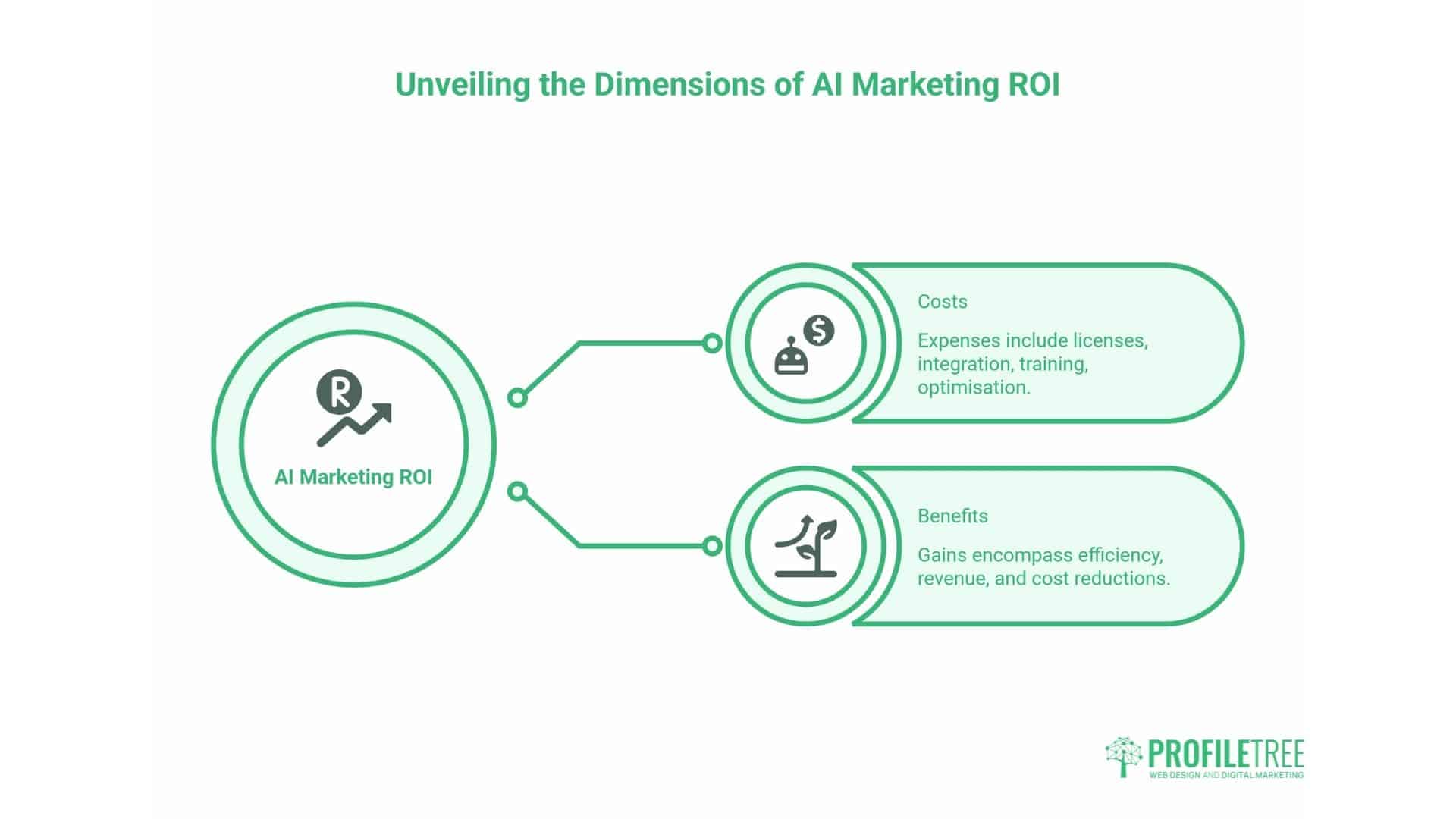
Return on investment calculations for AI marketing involve comparing implementation costs against business benefits. Costs include technology licenses, integration work, training, and ongoing optimisation. Benefits span efficiency gains, revenue increases, and cost reductions across marketing operations.
The time horizon for ROI assessment matters significantly. Initial investments often yield limited returns as teams learn and systems and algorithms are optimised. Substantial benefits typically emerge 6-12 months into implementation as AI systems accumulate data and marketing teams develop proficiency.
Quantifiable Benefits from AI Marketing
Performance data from UK implementations reveals specific improvement areas:
Email marketing performance – Machine learning optimisation increases open rates by 15-20% through better send-time prediction and subject line testing. Click-through rates improve by 25% through content personalisation. Conversion rates from email campaigns increase by 20-30% when AI tailors offers to individual preferences.
Customer service efficiency – AI chatbots handle 85% of initial customer enquiries without human intervention. Resolution times decrease by 40% for complex issues as AI provides support agents with contextual information and suggested responses. This reduces customer service costs whilst improving satisfaction scores.
Content marketing effectiveness – Predictive analytics helps content teams identify high-performing topics before they are created. This foresight improves content ROI by 35% through better resource allocation. AI-powered personalisation engines increase average time on site by 45% and reduce bounce rates by 30%.
Advertising performance – Automated bid management and audience targeting reduce cost per acquisition by 25-40% in paid search and social campaigns. AI systems identify profitable micro-segments that human analysis misses, expanding the addressable audience while maintaining conversion efficiency.
Lead quality improvement – Machine learning lead scoring increases qualified lead volumes by 30% whilst reducing time wasted on poor-fit prospects. Sales teams report 40% higher conversion rates on AI-scored leads compared to traditional qualification methods.
These figures represent averages across multiple implementations. Individual results vary based on starting performance, implementation quality, and market conditions. However, the consistent pattern shows AI marketing delivers measurable improvements when properly deployed.
Cost Considerations in AI Implementation
Understanding the true cost of AI marketing helps organisations budget appropriately and set realistic expectations. Expenses fall into several categories that affect total investment requirements.
Technology costs include platform licenses, API access fees, and infrastructure expenses. Enterprise marketing automation platforms with AI capabilities typically cost between £2,000 and £10,000 per month, depending on the features and contact volumes. Specialist AI tools for specific functions (chatbots, prediction engines, content generation) add £500-£3,000 monthly each.
Integration expenses cover the cost of connecting AI systems to existing marketing technology stacks. Simple integrations between modern platforms with robust APIs cost £5,000-£15,000. Complex integrations involving legacy systems or custom development run between £25,000 and £75,000, depending on the scope.
Data preparation work involves cleansing, structuring, and consolidating information before AI systems can use it effectively. This often represents the highest hidden cost in implementations. Organisations typically spend £15,000 to £50,000 preparing data environments for AI.
Training and change management costs include formal education programmes, ongoing coaching, and time spent learning new workflows. Budget £3,000-£8,000 per team member for comprehensive AI marketing training programmes.
Ongoing optimisation requires continuous monitoring, adjustment, and improvement of AI systems. Plan for 10-15 hours of weekly support from skilled personnel or an equivalent agency to maintain performance.
Total first-year costs for comprehensive AI marketing implementations typically range £75,000-£200,000 for mid-market UK businesses. Subsequent years cost 40-60% less as major integration and training expenses don’t recur.
Calculating Your Potential Return
The specific ROI depends on your starting position and the scope of implementation. Organisations should calculate potential returns based on their current performance metrics.
Identify baseline performance – Document current conversion rates, customer acquisition costs, marketing efficiency ratios, and revenue per customer. These baselines allow measuring AI impact.
Project improvement ranges: Apply conservative estimates based on proven implementation data. Use the lower end of published improvement ranges when projecting your returns.
Factor in ramp-up time – Avoid assuming full benefits immediately. Model gradual improvement reaching peak performance 12-18 months post-implementation.
Include all costs – Account for hidden expenses, such as staff time spent learning systems, temporary productivity dips during the transition, and the opportunity costs of resources allocated to implementation.
Measure continuously – Track actual performance against projections on a monthly basis. This data informs optimisation priorities and validates (or challenges) initial ROI assumptions.
A mid-market retailer serves as an example of this approach. Starting position: £2M annual marketing spend generating £15M revenue (7.5x return). Conservative AI improvement projection: 20% efficiency gain and 15% revenue increase. Expected outcome: £1.8M marketing spend generating £17.25M revenue (9.6x return). Net improvement: £2.05M additional profit. Implementation cost: £120,000 in the first year, £60,000 in subsequent years. Payback period: approximately 7 months.
Beyond Financial Returns
AI marketing delivers benefits beyond immediate financial metrics. These secondary benefits contribute to competitive positioning and long-term sustainability.
Speed to market improves as AI systems accelerate content creation, campaign planning, and performance analysis. Marketing teams execute more initiatives with existing resources, increasing innovation capacity.
Competitive intelligence strengthens through AI-powered market analysis. Systems monitor competitor activities, identify emerging trends, and highlight market gaps faster than manual analysis.
Customer experience consistency increases when AI systems maintain brand voice and personalisation standards across all touchpoints. This consistency builds trust and strengthens brand perception.
Team satisfaction often improves as AI handles repetitive tasks, allowing marketing professionals to focus on strategy and creativity. This can reduce turnover and improve recruitment appeal.
Scalability increases dramatically. AI systems handle volume increases without proportional cost increases. Businesses can enter new markets or launch additional products without scaling marketing headcount linearly.
These qualitative benefits are difficult to measure precisely but contribute significantly to business success. Include them in ROI discussions whilst maintaining focus on quantifiable financial returns.
ProfileTree’s Approach to ROI-Focused Implementation
Our implementation methodology prioritises measurable outcomes from project inception. This starts with identifying specific, high-impact use cases rather than attempting comprehensive transformation immediately.
We begin implementations with targeted pilot projects addressing clear business problems. A common starting point involves email marketing optimisation—a contained use case with clear measurement and significant improvement potential. Success here builds confidence and funding for broader deployments.
Each implementation includes defined KPIs tied to business objectives. We establish baseline measurements before deployment, track performance throughout, and provide regular reporting showing progress against targets. This data-driven approach keeps projects focused on outcomes rather than technical complexity.
Our services include ongoing optimisation work after initial deployment. AI systems require continuous refinement to maintain peak performance. This includes monitoring algorithm accuracy, adjusting targeting parameters, testing new features, and expanding successful applications to additional use cases.
We also provide training that emphasises practical application over theoretical knowledge. Marketing teams learn to interpret AI insights, make data-informed decisions, and identify opportunities for AI application in their specific contexts. This builds internal capability for long-term success beyond initial implementation support.
The AI marketing landscape continues evolving rapidly. Understanding emerging trends enables businesses to plan investments and prepare their teams for the upcoming changes. Several developments will significantly affect UK marketing operations over the next 2-3 years.
Emerging Technologies Shaping AI Marketing
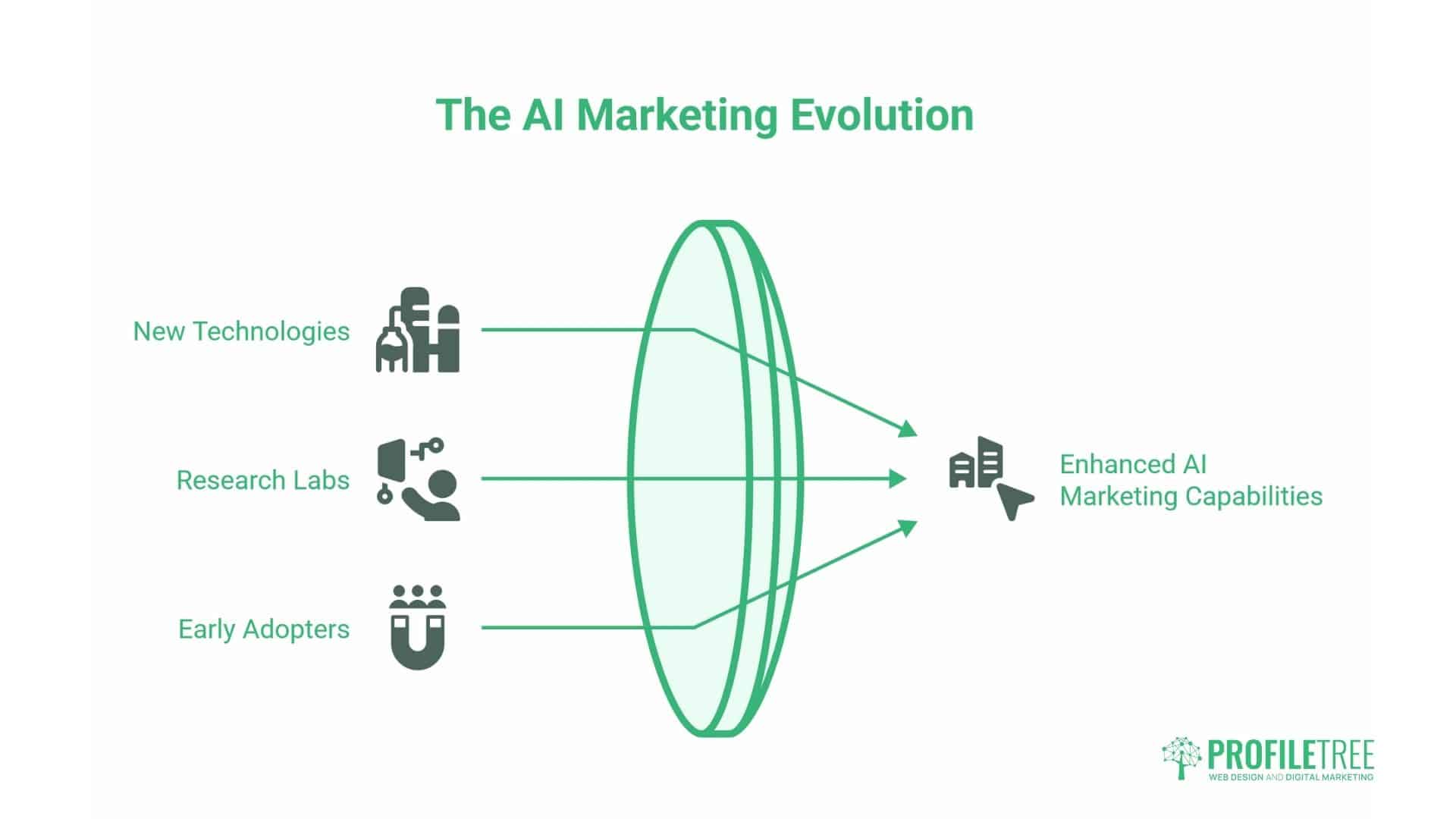
New capabilities enter the market regularly, expanding the capabilities of AI marketing systems. These technologies move from research labs to practical applications, creating opportunities for early adopters.
Agentic AI Systems
Traditional AI marketing tools respond to human inputs—marketers ask questions, and systems provide answers. Agentic AI operates more autonomously, taking independent actions to achieve specified goals.
An agentic system might manage an entire campaign with minimal human oversight. Given the objectives (to generate 500 qualified leads under £50 each), it would create content variations, select channels, allocate the budget, adjust targeting, and continuously optimise performance without constant direction.
This represents a shift from AI as a tool to AI as a team member. The technology remains early but shows promise for increasing marketing productivity dramatically. UK businesses should monitor developments whilst maintaining appropriate human oversight aligned with regulatory requirements.
Advanced Personalisation Engines
Current personalisation operates at the segment level—groups of similar customers receive similar content. Next-generation systems deliver true individual personalisation, creating unique experiences for each person.
These engines analyse thousands of behavioural signals, predict individual preferences, and generate customised content in real-time. A single product page might exist in millions of variations, each optimised for the specific person viewing it.
The technology challenges current content creation workflows. Rather than producing fixed assets, marketing teams will create content components that AI assembles into personalised experiences. This requires different creative approaches and production processes.
Predictive Analytics Evolution
Early predictive models focused on narrow use cases—predicting churn or scoring lead quality. Advanced systems provide holistic customer intelligence, including lifetime value forecasting, product affinity, optimal engagement timing, and propensity to respond to specific offers.
This intelligence enables proactive rather than reactive marketing. Instead of responding to customer actions, businesses can anticipate needs and engage before problems or opportunities arise.
UK retailers implementing advanced predictive analytics report 40-50% improvements in cross-sell success rates and 30% reductions in customer churn. These systems are particularly beneficial for businesses with complex product catalogues or long customer lifecycles.
Voice and Conversational Interfaces
Voice assistants and conversational AI move beyond simple question-answering to genuine dialogue. These systems conduct natural conversations, understanding context and intent rather than just matching keywords.
Marketing applications include sophisticated customer service experiences, voice-activated shopping assistance, and interactive content consumption. The technology is particularly suited to mobile contexts where typing proves inconvenient.
British consumers are increasingly comfortable with voice interactions. Businesses investing in natural conversational interfaces now position themselves advantageously as adoption accelerates.
Preparing Your Organisation for AI Evolution
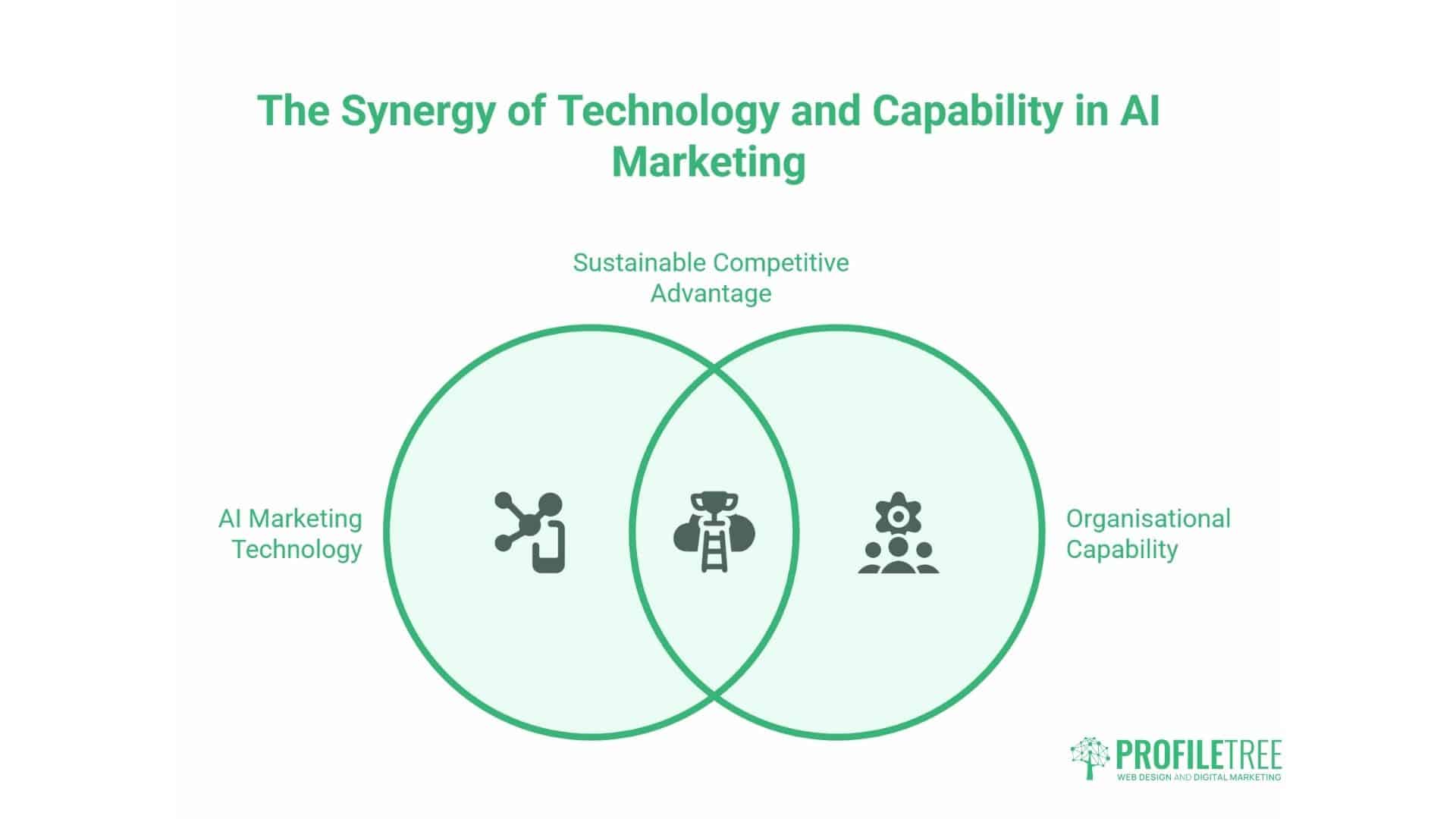
Staying current with AI marketing requires deliberate organisational development. Technology alone doesn’t create competitive advantage—capability does. Businesses must build internal capacity to adopt new tools as they emerge.
Building Technical Foundations
Future AI capabilities require solid technical infrastructure today. This means investing in data quality, system integration, and cloud architecture now rather than waiting for specific AI applications.
Organisations should focus on:
Data infrastructure – Creating centralised, clean, accessible data repositories. AI systems are only as good as their data sources. Poor data infrastructure limits future AI capabilities, regardless of the sophistication of the algorithm.
API-first architecture – Selecting marketing technology with robust APIs facilitating easy integration with current and future AI tools. Avoid systems that lock data in proprietary formats without export capabilities.
Cloud readiness – Migrating infrastructure to cloud platforms supporting modern AI services. On-premises systems limit access to rapidly evolving AI capabilities available through cloud providers.
Security frameworks – Implementing comprehensive security measures to protect data and systems. AI expands attack surfaces, requiring proactive security rather than reactive responses to incidents.
These foundation investments pay dividends across multiple AI applications rather than benefiting only specific use cases.
Developing Team Capabilities
Marketing teams need evolving skill sets to work effectively with AI systems. This doesn’t mean that every marketer needs programming skills, but everyone needs a basic understanding of AI literacy.
Priority training areas include:
Understanding AI capabilities and limitations – Knowing what AI does well, where it struggles, and how to identify appropriate applications. This prevents both over-reliance and under-utilisation.
Data interpretation – Reading AI outputs, understanding confidence levels, questioning unusual results, and making informed decisions based on algorithmic recommendations.
Prompt engineering – Crafting effective inputs to generative AI systems to produce desired outputs. This skill becomes increasingly valuable as more marketing tasks involve the use of AI for content generation.
Ethical AI use – Recognising bias, maintaining privacy standards, and applying judgment to AI recommendations. Human wisdom remains necessary despite AI’s analytical power.
ProfileTree provides structured training programmes to build these capabilities. Our approach combines theoretical understanding with practical application, enabling teams to develop confidence in using AI tools within their specific marketing contexts.
Strategic Planning for AI Integration
Successful AI adoption follows strategic plans rather than opportunistic tool acquisition. This means developing clear visions for how AI fits within broader marketing strategies.
Effective planning involves:
Auditing current capabilities – Assessing what AI already exists in current marketing technology and identifying gaps between the current state and desired capabilities.
Prioritising use cases – Selecting specific applications based on business impact, implementation feasibility, and alignment with strategic objectives. Avoid trying to implement everything simultaneously.
Phasing implementations – Creating realistic timelines accounting for learning curves, integration complexity, and resource constraints. Successful AI adoption typically spans 18 to 24 months, from the initial pilot to full deployment.
Building vendor relationships – Developing partnerships with AI platform providers and implementation specialists like ProfileTree who understand UK market requirements and provide ongoing support.
Establishing governance – Creating clear policies about AI use, data handling, and decision authority. Governance prevents problems rather than reacting to them.
This strategic approach enables the development of sustainable AI capabilities, rather than disconnected point solutions that fail to deliver cumulative value.
The Competitive Landscape in 2026 and Beyond
AI marketing adoption creates competitive separation between organisations. Early movers gain advantages that compound over time as AI systems accumulate data and optimise performance.
Businesses delaying AI investment face growing disadvantages. Competitors using AI achieve better targeting, higher efficiency, and superior customer experiences. This gap widens as AI capabilities advance and early adopters refine their implementations.
However, rushing into AI without proper planning often proves worse than measured delays. Failed implementations waste resources, damage team confidence, and create technical debt. The optimal approach strikes a balance between urgency and thoughtfulness.
UK businesses benefit from the regulatory clarity emerging around AI use. Whilst compliance requirements create obligations, they also establish stable operating parameters. Businesses investing in compliant AI architectures now avoid costly remediation as regulations solidify.
The market increasingly values authentic implementation experience over theoretical AI knowledge. Businesses that have worked through actual deployments, solved real integration challenges, and delivered measurable results possess valuable practical wisdom. This experiential advantage becomes difficult for competitors to replicate quickly.
Taking Action on AI Marketing
The evidence is clear: AI marketing delivers measurable business benefits when implemented properly. Success requires strategic planning, team development, and ongoing optimisation rather than simply purchasing software.
UK businesses must address specific compliance and integration considerations, but these don’t prevent successful deployment. Numerous organisations now operate AI marketing systems that deliver strong returns while maintaining regulatory standards.
Competitive pressure increases as adoption spreads. Businesses must either commit to implementation or accept growing disadvantages against competitors who do.
ProfileTree helps UK businesses navigate this transition through strategy development, technical implementation, team training, and ongoing optimisation. Our services span web design, development, content marketing, video production, and digital strategy—understanding how AI fits within broader marketing operations.
The path forward starts with assessment: understanding current capabilities, identifying opportunities, and developing realistic plans. Systematic execution then brings AI capabilities online, delivering the efficiency gains and competitive advantages the statistics demonstrate.
FAQs
What is AI marketing, and how does it differ from traditional digital marketing?
AI marketing uses machine learning algorithms to analyse data, predict customer behaviour, and personalise activities at scale. Unlike traditional marketing with manual analysis and rule-based automation, AI systems learn from patterns and continuously optimise without constant human input, processing vast information in real-time.
How much should UK businesses budget for AI marketing implementation?
Mid-market businesses typically invest £75,000 to £200,000 in year one, including technology licenses, integration, data preparation, and training. Subsequent years cost 40-60% less. Smaller implementations focusing on specific use cases, such as email optimisation, start at £15,000-£30,000.
What ROI can businesses expect from AI marketing investments?
Well-implemented systems typically show 20-30% improvements in conversion rates, 25-40% reductions in acquisition costs, and 15-25% increases in email engagement. Businesses commonly achieve payback within 6-12 months, with companies spending £2M annually on marketing, potentially seeing £2M+ additional profit within 18 months.
How does UK data protection law affect AI marketing?
UK GDPR requires lawful bases for data processing, Data Protection Impact Assessments for high-risk applications, human oversight for significant automated decisions, clear audit trails, and respect for individual rights. The ICO provides specific AI guidance. Compliance is mandatory; failure to comply risks substantial fines.